Emil Bisttram first came to the American Southwest in 1930 with an adventurous sense of experimentation. At first, he found it overwhelming to illustrate the Southwest’s expansive landscapes. Through his sense of artistic expression, and the modernist ideal that visual elements were more important than realistic artistic expression, his art continuously evolved. By the time he moved to Taos, New Mexico, in 1931, he was more prepared to depict life in the Southwest in his unique way. Bisttram’s modernist ideals furthered his own works and revolutionized the art community in Taos.
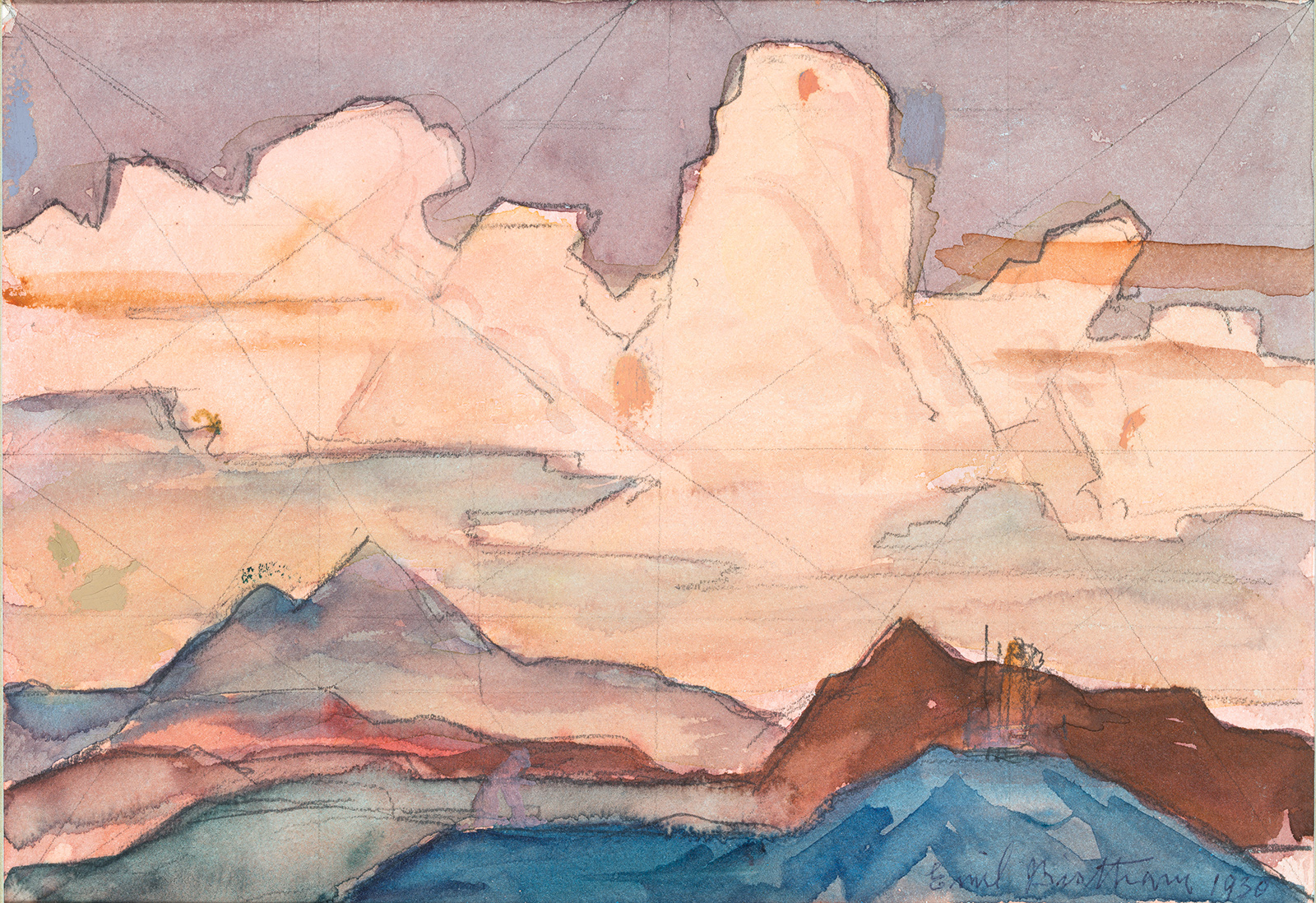 Emil Bisttram (1895-1976), Great Western Sky (Study) (B-033), 1930. Watercolor on paper. Courtesy of American Museum of Western Art – The Anschutz Collection.
Bisttram was born in Hungary in 1895 and immigrated with his family to the United States in 1906. They settled in New York City where he began his art training in 1913 at the National Academy of Design. He also took classes at the New York School of Applied Art (now Parsons School of Design) and the Cooper Union. Through these classes he built a basis in traditional European and American art and was introduced to more modern approaches and styles.
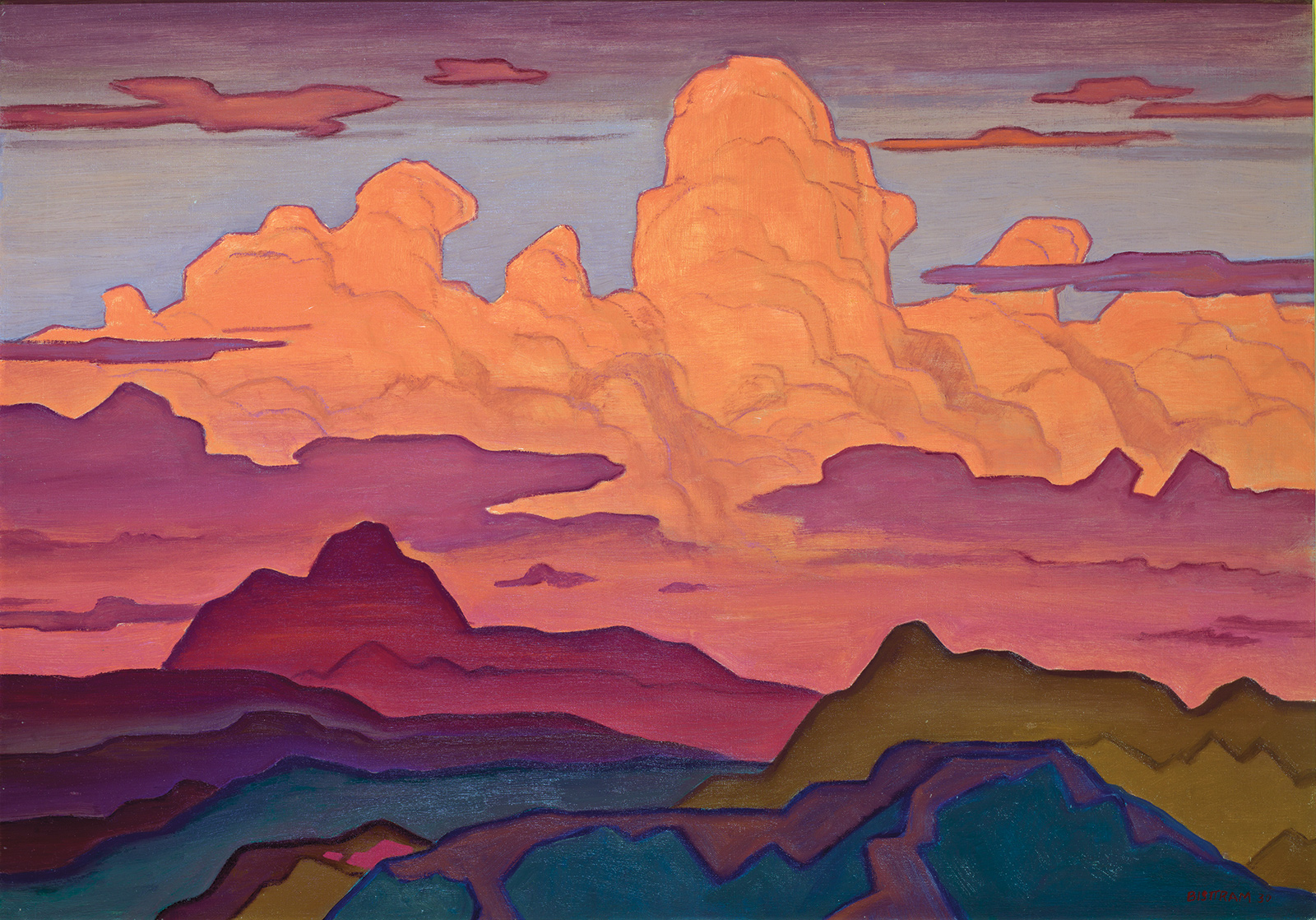 Emil Bisttram (1895-1976), Great Western Sky, 1930. Oil on canvas. Courtesy of American Museum of Western Art – The Anschutz Collection.
Howard Giles introduced Bisttram to the composition theory of dynamic symmetry at the New York School. The theory of dynamic symmetry was “rediscovered” by artist Jay Hambidge in the early 1900s after studying ancient Greek and Egyptian art and architecture. This theory structured an artwork’s composition on the shape of objects in the work and their relationship to one another using a framework of diagonals, rights angles and geometric forms. Bisttram found the theory helped create balanced and pleasing compositions whether they were representative, completely non-objective or somewhere in between. These guiding diagonal lines are visible in the study for one of Bisttram’s few paintings from his 1930 trip to New Mexico, Great Western Sky (Study). In the finished oil painting, the guiding lines are not visible, but the sense of compositional cohesion those lines help create is.
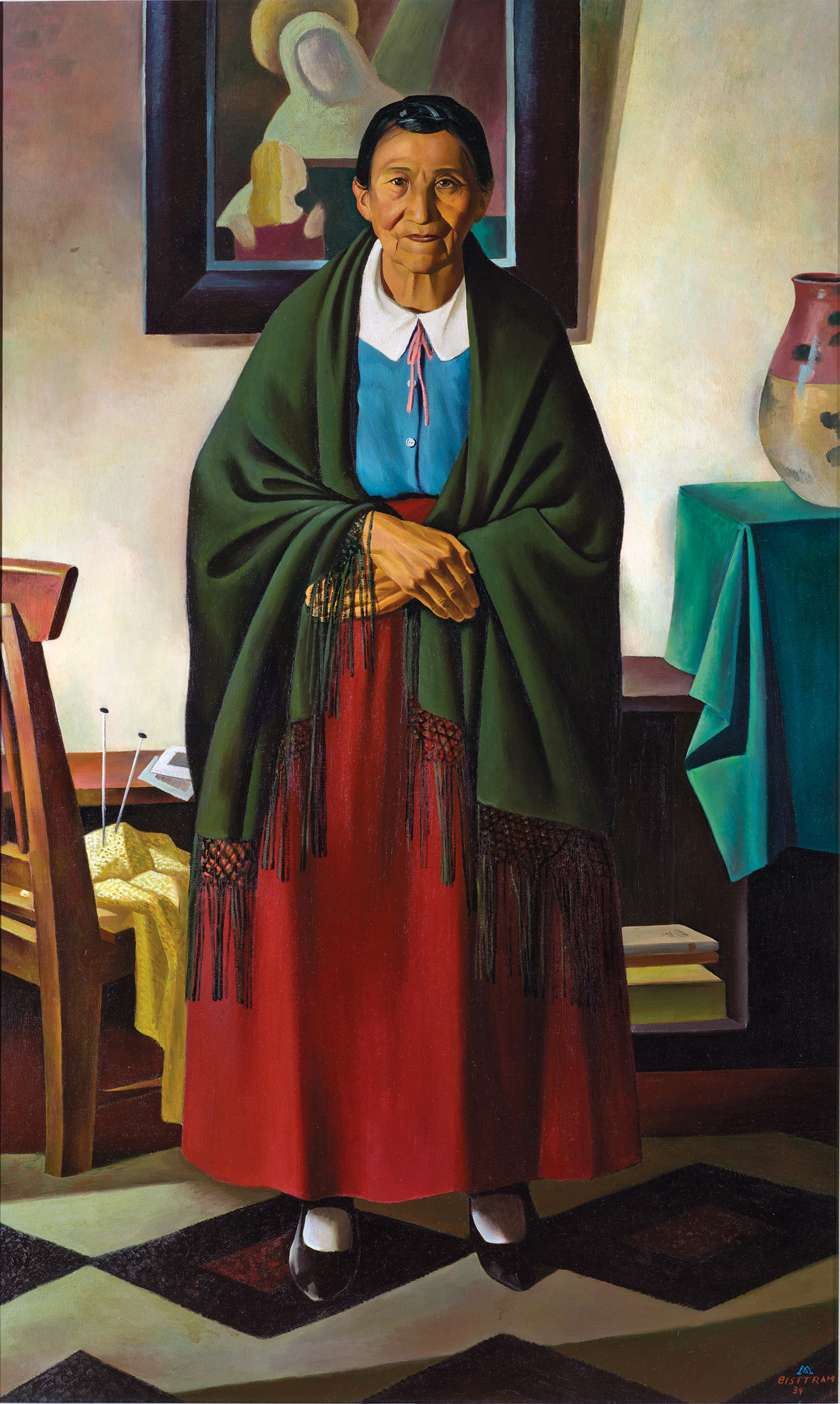 Emil Bisttram (1895-1976), Comadre Rafaelita, 1934. Oil on canvas. Courtesy of American Museum of Western Art – The Anschutz Collection.
Nicholas Konstantin Roerich was another significant artistic influence on Bisttram in New York. Roerich founded the Master Institute of United Arts where Bisttram taught from 1923 to 1931. Russian born and trained, Roerich brought with him to New York an approach to visual art heavily influenced by other artistic mediums such as dance and music. The Master Institute featured classes in multiple art forms and encouraged students to study multiple artistic and intellectual fields. Through lectures and performances at the Master Institute, Bisttram experienced modernism in dance and music as well as visual arts. This approach of pulling from various art mediums is one Bisttram used throughout his life even though he focused on creating visual two-dimensional works.
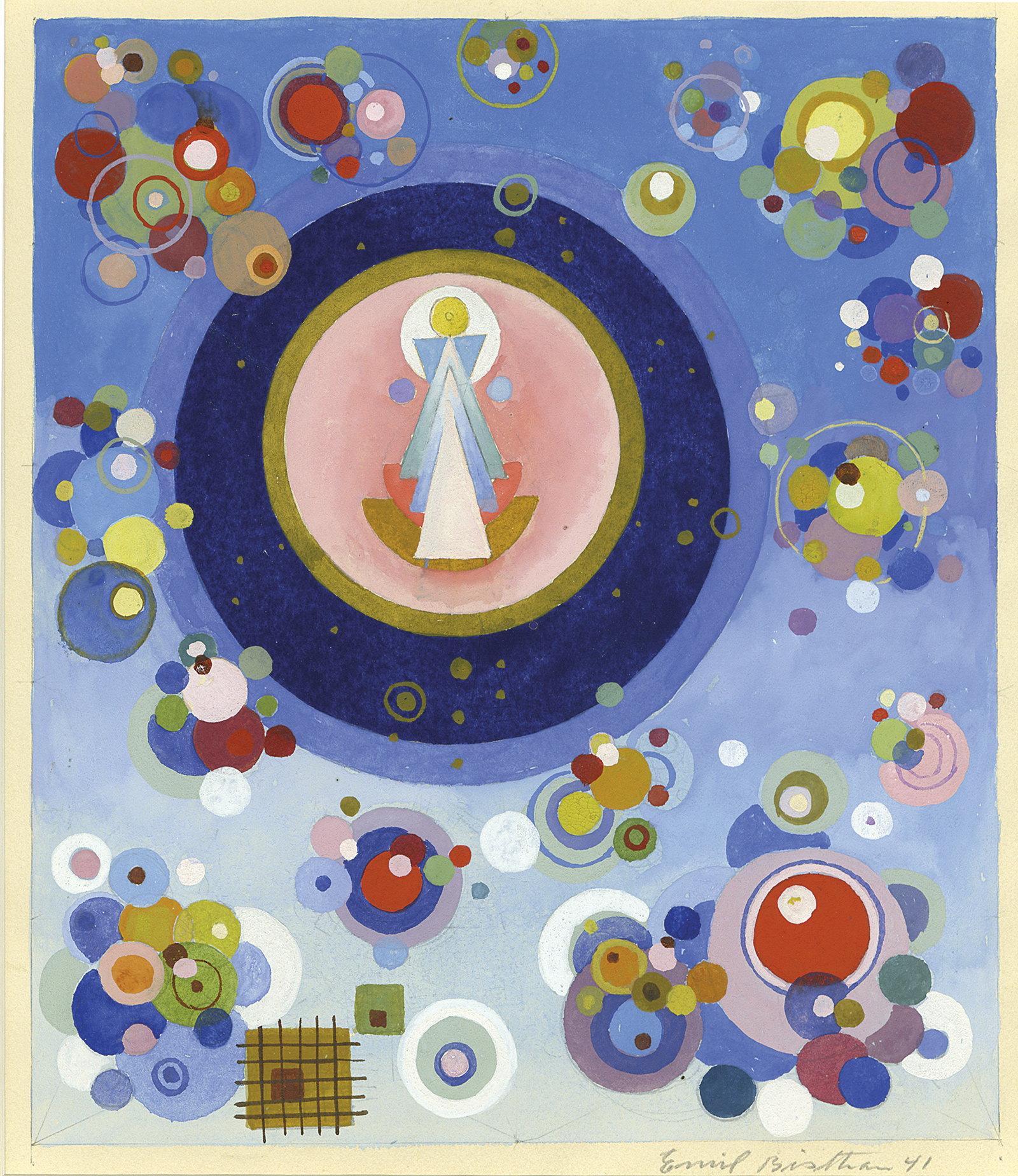 Emil Bisttram (1895-1976), Ascension of the Virgins, 1941. Gouache on paper. Courtesy of American Museum of Western Art – The Anschutz Collection.
Roerich was influential to Bisttram in other ways as well. He is credited with suggesting Bisttram travel to Taos, New Mexico. In the summer of 1930, Bisttram traveled around Taos trying to paint, but became “frustrated by the grandeur of the scenery and limitless space, but above all there was that strange, almost mythic quality of light.”1 It was not until he returned to Taos in 1931 that he began what became a lifelong endeavor to capture the quality of light and land of the Southwest.
Bisttram received a Guggenheim Fellowship in 1931 and studied fresco mural painting in Mexico City, Mexico with Diego Rivera. While he was in Mexico, his wife Mayrion, and her mother, moved to Taos, and Emil joined them after his fellowship.
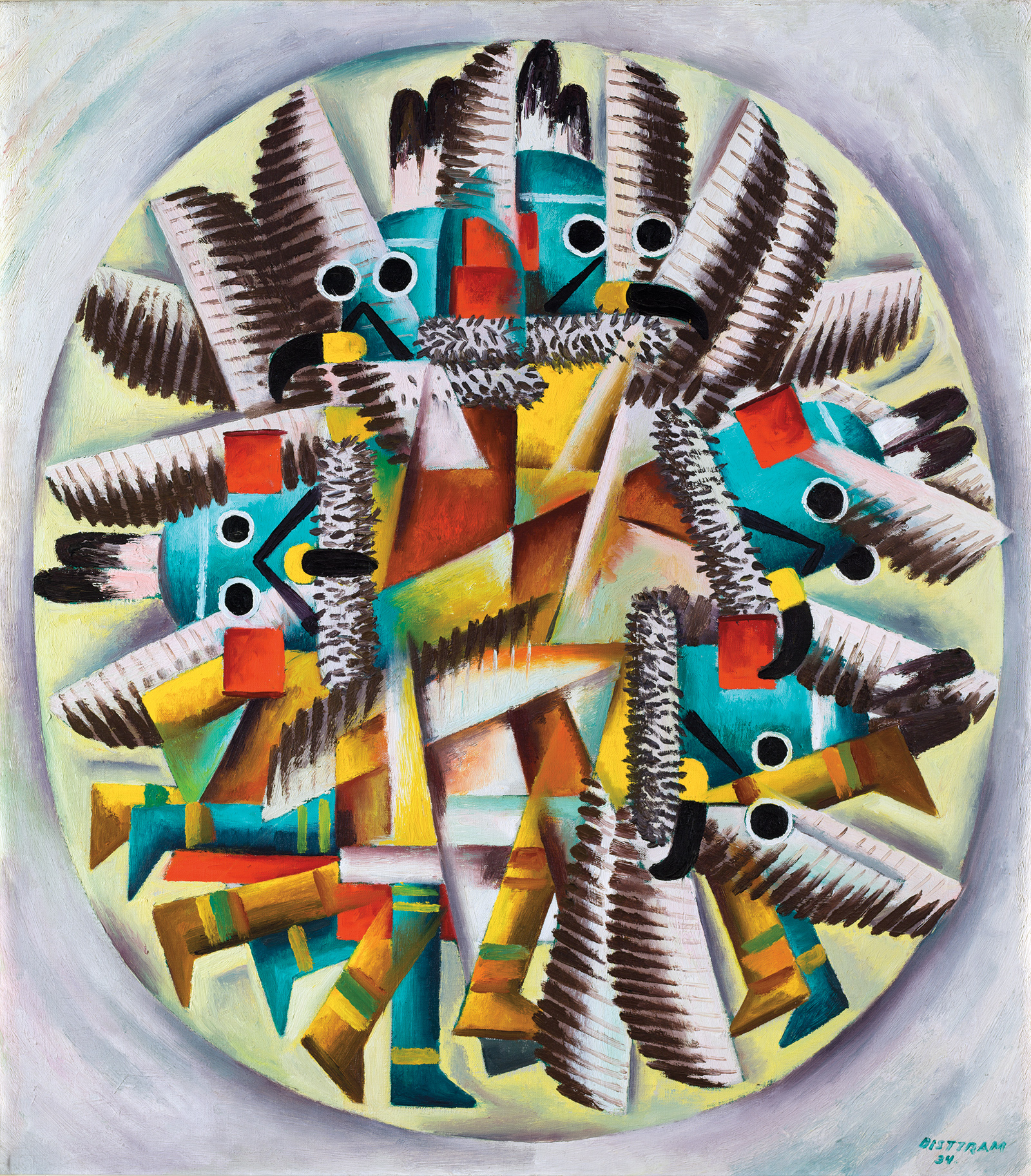 Emil Bisttram (1895-1976), Eagle Dance, 1934. Oil on canvas. Courtesy of American Museum of Western Art – The Anschutz Collection.
While in Taos, Bisttram transitioned between styles and mediums, experimenting with how to best capture intellectual concepts as well as the world around him. In paintings like Comadre Rafaelita, he paints the sitter, his neighbor Rafaelita, in a representative detailed style with attention to line and composition evident in the background. He also went non-objective and quite esoteric with pieces like Ascension of the Virgins, with an emphasis on color and form to portray ascending to a higher state of being through meditation. Though most often Bisttram was somewhere in-between with his abstract styles, as seen in the painting Eagle Dance, using strong diagonal lines and repetition to portray the movement in an Eagle Dance he witnessed at one of the Pueblos near the town of Taos.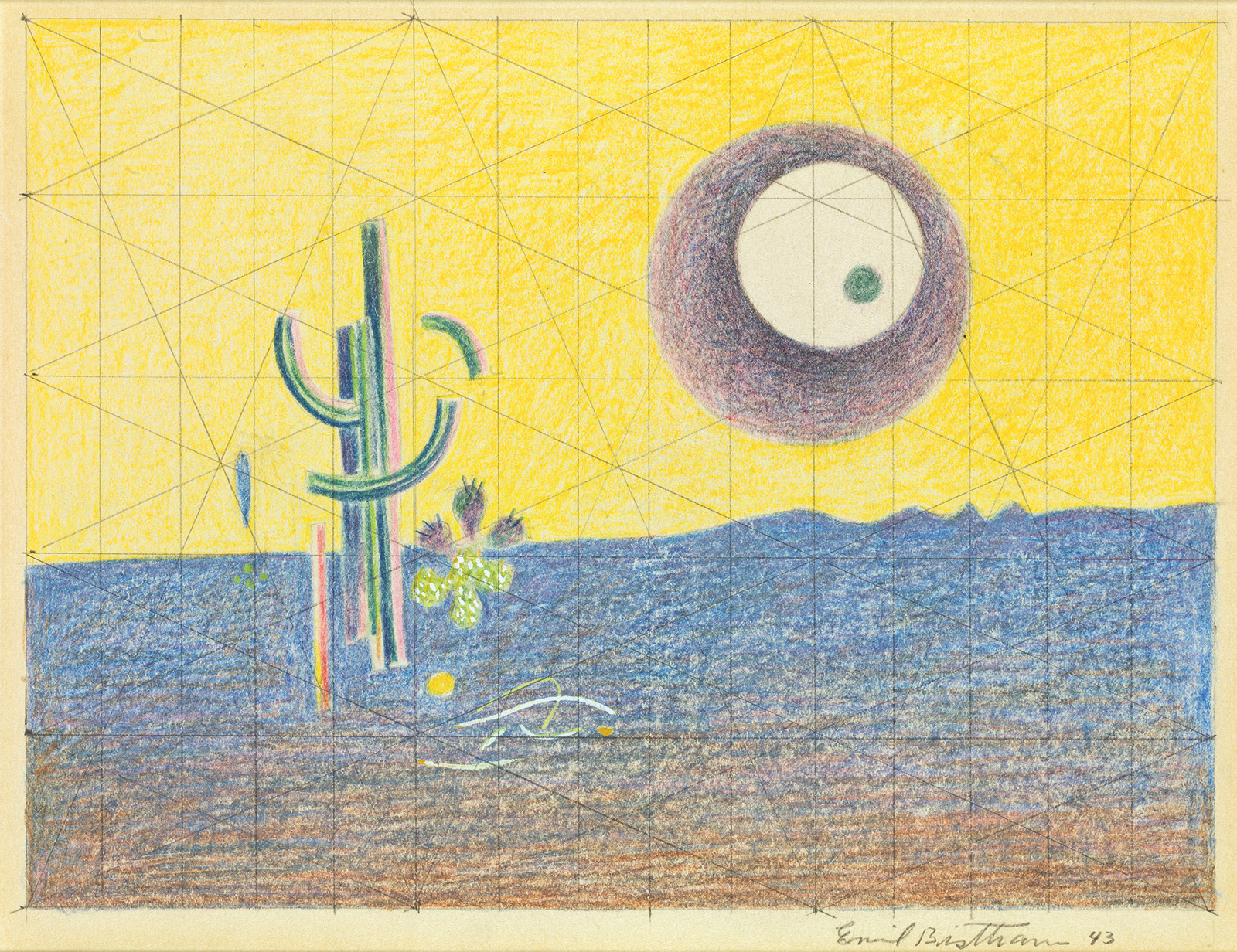 Emil Bisttram (1895-1976), Arizona Landscape, 1943. Graphite and crayon on paper. Courtesy of American Museum of Western Art – The Anschutz Collection.
Bisttram was active in the Taos art community and helped form artist groups like the Transcendental Painting Group and the Taos Artists Association. The Transcendental Painting Group was only active from 1938 to 1941, but succeeded in its goal of creating “paintings beyond the appearance of the physical world, through new concepts of space, color, light and design, to imaginative realms that are idealistic and spiritual.”2 As a group, these artists could more effectively organize and publicize shows of their art (and the virtues they saw in their particular aesthetics), and potentially sell more of their works. Though the group was small, with only 10 painters, it helped foster more abstract and non-objective visuals in the small and conservative art community of Taos. Transcendental Painting Group members also attempted to depict non-visual concepts and ideas through paint. Many of these concepts were informed by philosophical and spiritual beliefs, leading to an emphasis on using visual elements like line, color and form to convey a non-tangible idea instead of focusing on recreating a recognizable image of the real world.
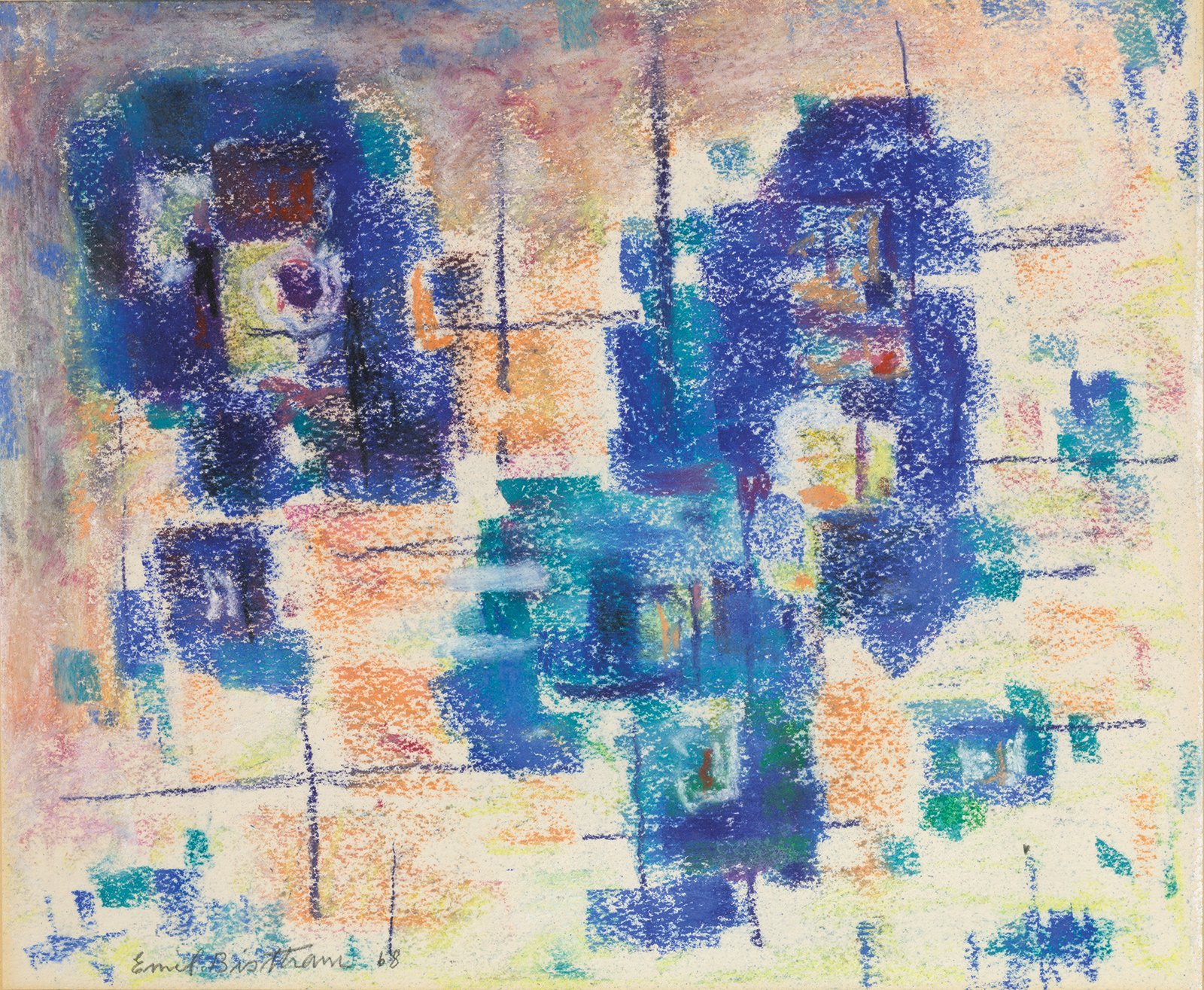 Emil Bisttram (1895-1976), Symphony in Blue, 1968. Pastel on paper. Courtesy of American Museum of Western Art – The Anschutz Collection.
Bisttram was one of the original members of the Taos Artists Association, founded in 1952, with the goals of fostering a better relationship between artists and Toas residents. The Taos Artists Association also founded Stables Gallery, an art cooperative for artists living in Taos. This gallery focused on displaying more modern art opposed to the traditional art generally on display in other Taos galleries at the time.
Bisttram’s adventurous approach to art, and dedication to community-building, helped him foster and expand modern styles in the Southwest.
Claire Mosier is the Registrar at the American Museum of Western Art – The Anschutz Collection. Born and raised in Colorado, she is interested in how the power of place influences artists and their artwork.
Powered by Froala Editor