A bout the ongoing exhibition Andrew Dasburg (1887-1979); Symphonic Drawings, gallery owner and director Victoria Addison Rowe says, “At first glance, one might say drawings are just drawings. The works in this exhibition, however, tell a completely different story.” The exhibition of 15 works, highlights the variety, skill and complexity of Dasburg’s drawings, covering his early period in the 1910s to a transitioned style in the 1950s, and finally, the late “accomplished,” minimalist period between the 1960s and 70s.
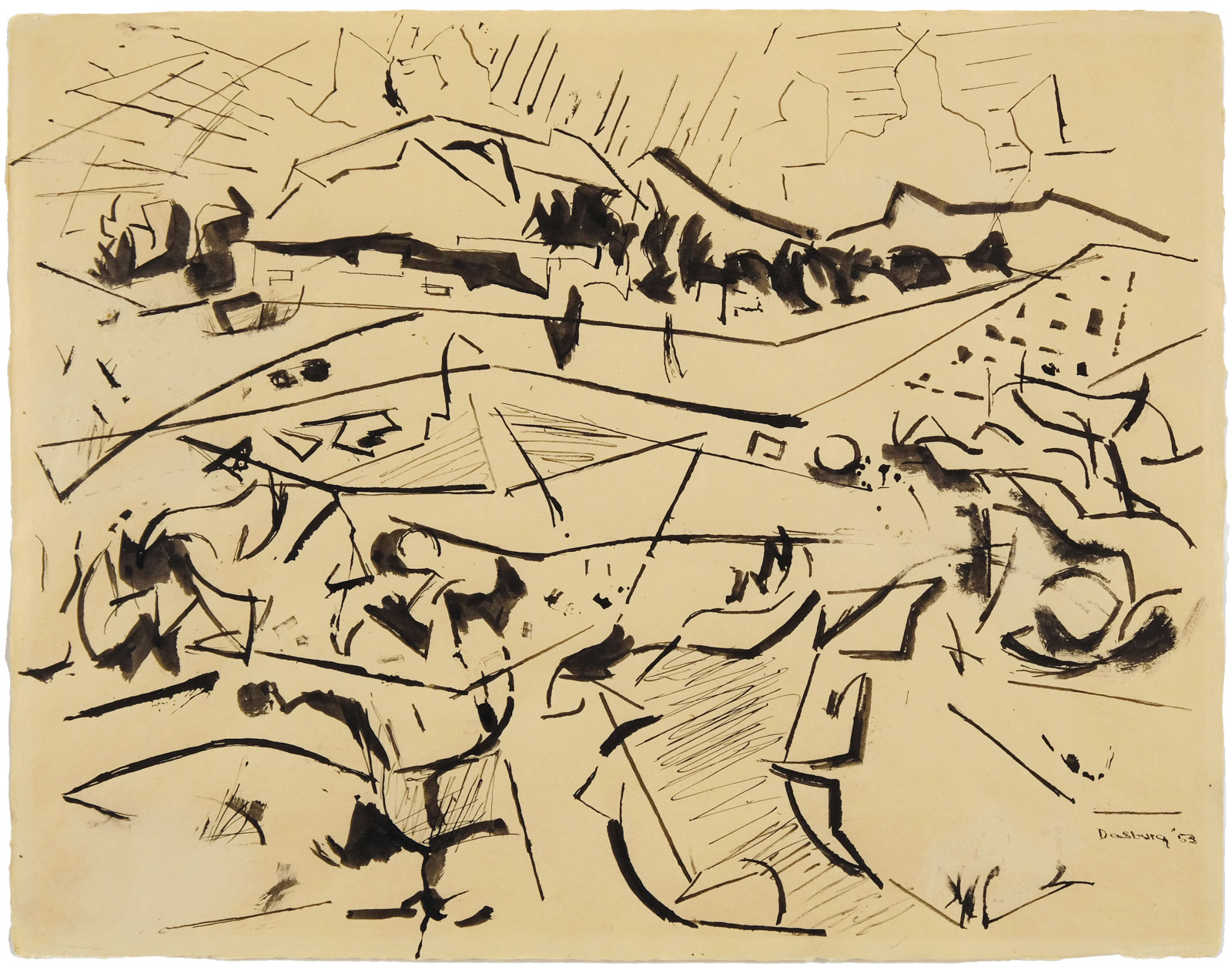 Andrew Dasburg (1887-1979), New Mexico Landscape, 1953. Ink on paper, 17½ x 22½ in., signed and dated lower right.
Often thought of as “ahead of his time,” Dasburg is known for his contributions to the modernism movement of the early 20th century. “He saw the work of Cezanne in Paris and visited the studio of Matisse,” explains Rowe. “These artists affected his artistic style and Dasburg was one of the few artists to add cubistic elements to his work prior to the [groundbreaking] Armory Show of 1913. By 1923, Dasburg was one of the leading proponents of cubism.”
At the request of his friend Mabel Dodge who was living in Taos, the artist visited in 1918, fell in love with the landscape and moved permanently to New Mexico in 1930. “His ideas were initially a shock wave for New Mexico artists,” says Rowe. “Dasburg believed that the ‘objects and occurrences of natural phenomena are not art... but causations. The underlying geometric mechanism is the guiding principle on which [the artist] builds.’ [His] ideas would influence his peers and even some of the older Taos group.”
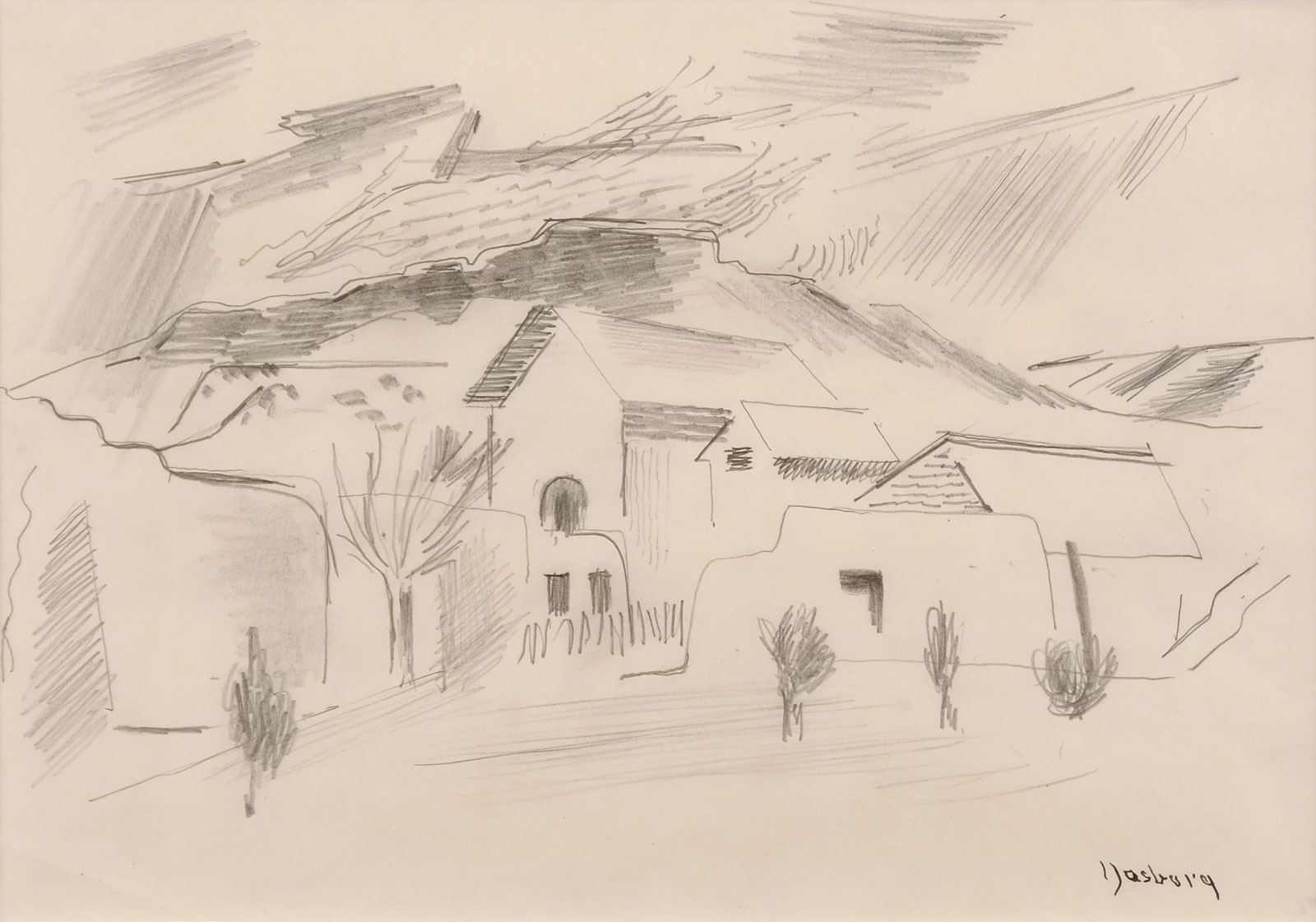 Andrew Dasburg (1887-1979), Houses and Walls, 1930. Graphite on paper, 9¾ x 14 in., signed and dated lower left.
It’s noted that Dasburg often used large angular shapes to create dramatic landscapes; in others, he used soft curved lines that show a quality of serenity and peaceful openness to the vistas. His drawings capture the space of the New Mexico landscape, and the vibrancy of the rugged environment by suggesting shapes of buildings, houses, churches and mountain vistas.
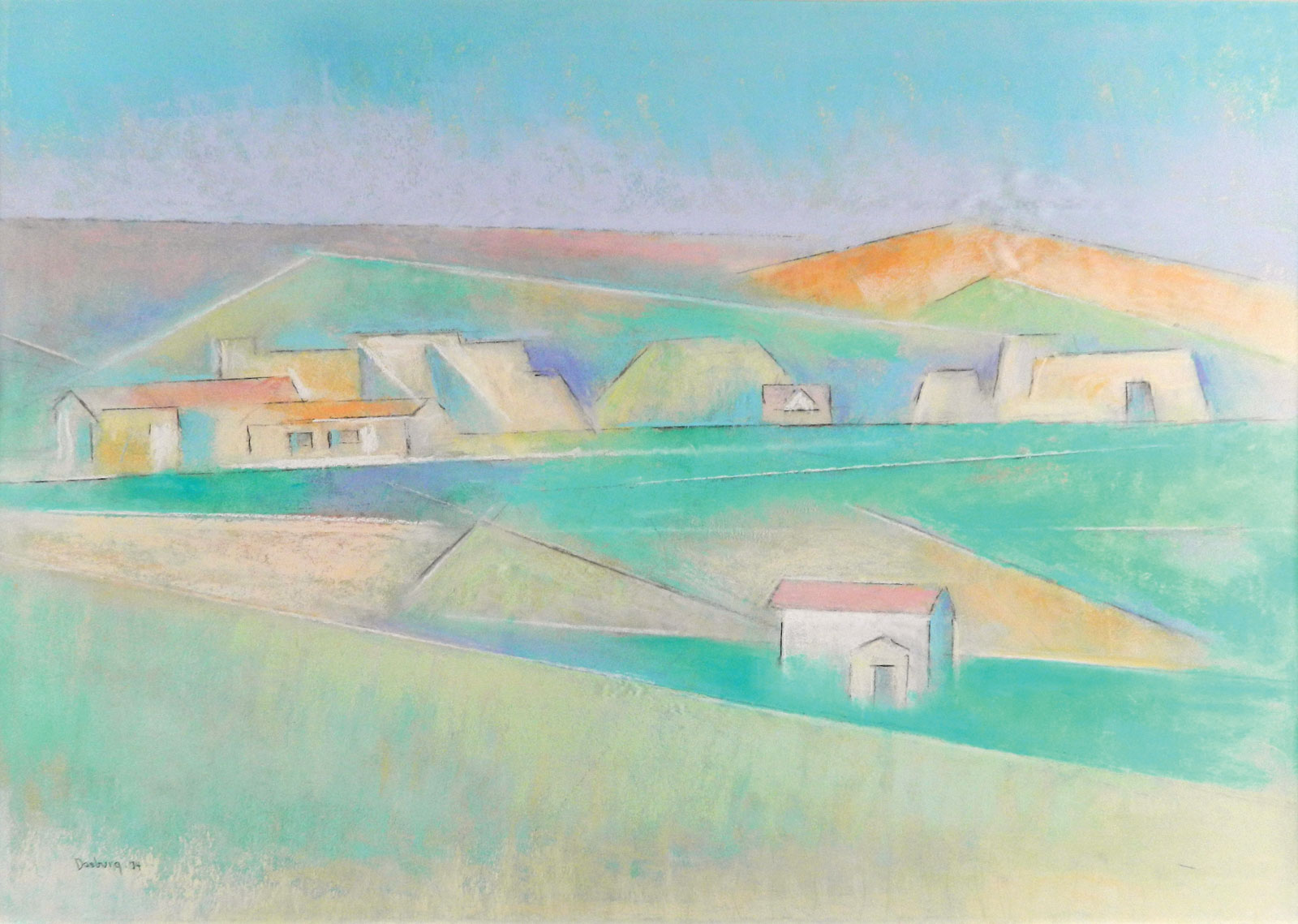 Andrew Dasburg (1887-1979), Ranchos Looking North, 1974. Pastel on paper, 16 x 23 in., signed and dated lower left.“He also creates texture with his pen giving the effect of scribbled lines that look like spiderwebs that bounce around the paper,” says Rowe. “These works challenge the viewers’ interpretation of the landscape environment as it creates a sense of constant motion. These symphonic drawings give the viewer a chance to reflect on the concepts of positive and negative space; the infinite landscape as seen through a blend of lines and shapes and create movement in a stagnant image.”
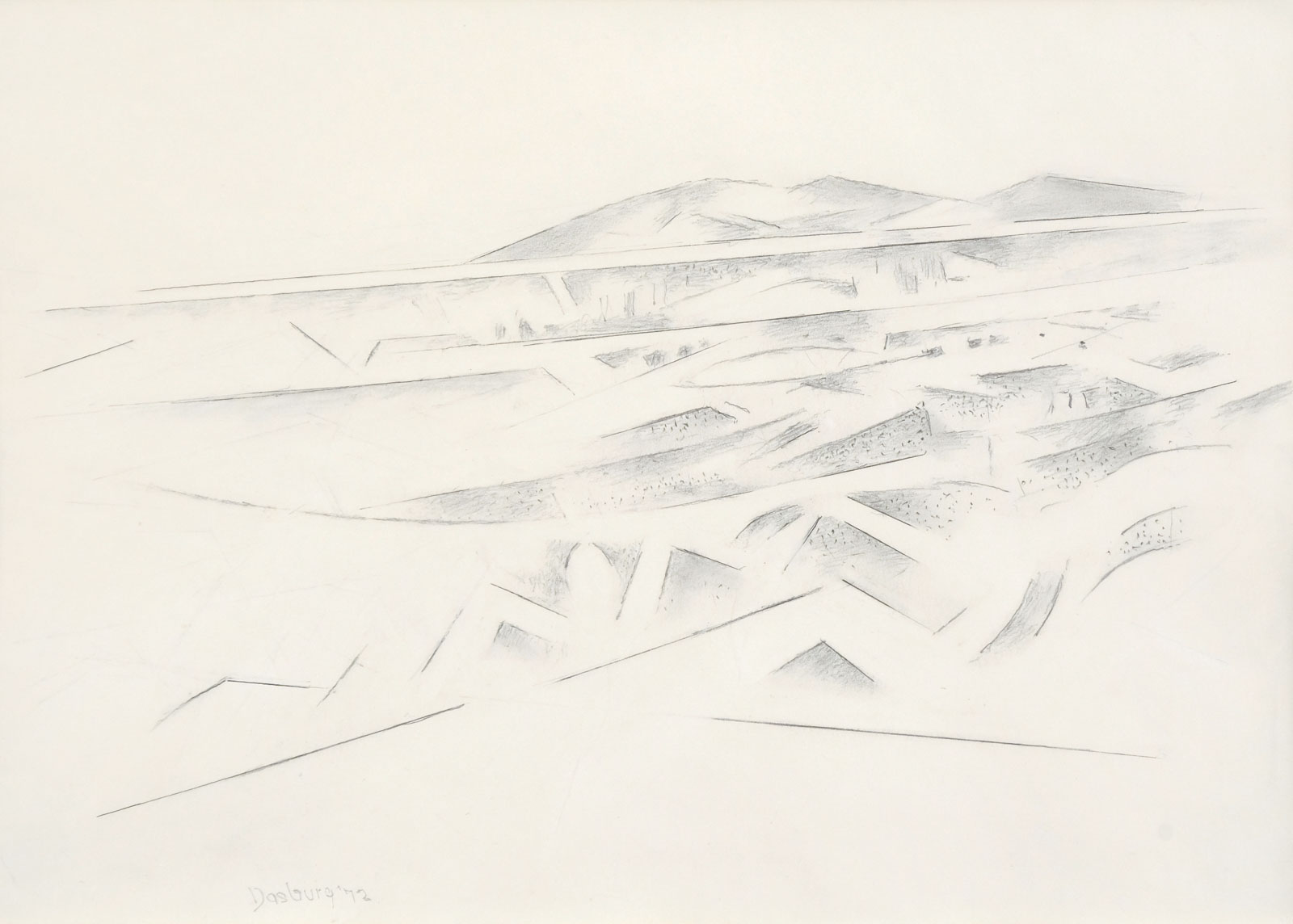 Andrew Dasburg (1887-1979), Arroyo Hondo Valley, 1972. Graphite on paper, 14¼ x 20 in.
In one of Dasburg’s earlier graphite pieces, Houses and Walls, 1930, we see what looks like a study for a modernist landscape painting. “Dasburg leaves very little to the imagination in this work,” Rowe notes. “The image has a distinct central focus, and the composition is contained within the image and the open spaces are outside the compositional elements. It is a true modernist composition from the 1930s.”
Illustrating his transitional period in the 1950s, is the piece New Mexico Landscape, 1953. “It is bold and powerful, and the use of the black brush makes the lines wider, bigger and stronger,” explains Rowe. “It is very active with less open space between the shapes, forms and lines representing the landscape and its buildings. There is a kind of chaos and disarray in the way the brush is used to create the landscape…There are few straight edge lines, mostly bold and busy. He is not using the assistance of a hard edge to create his straight lines at this period.”
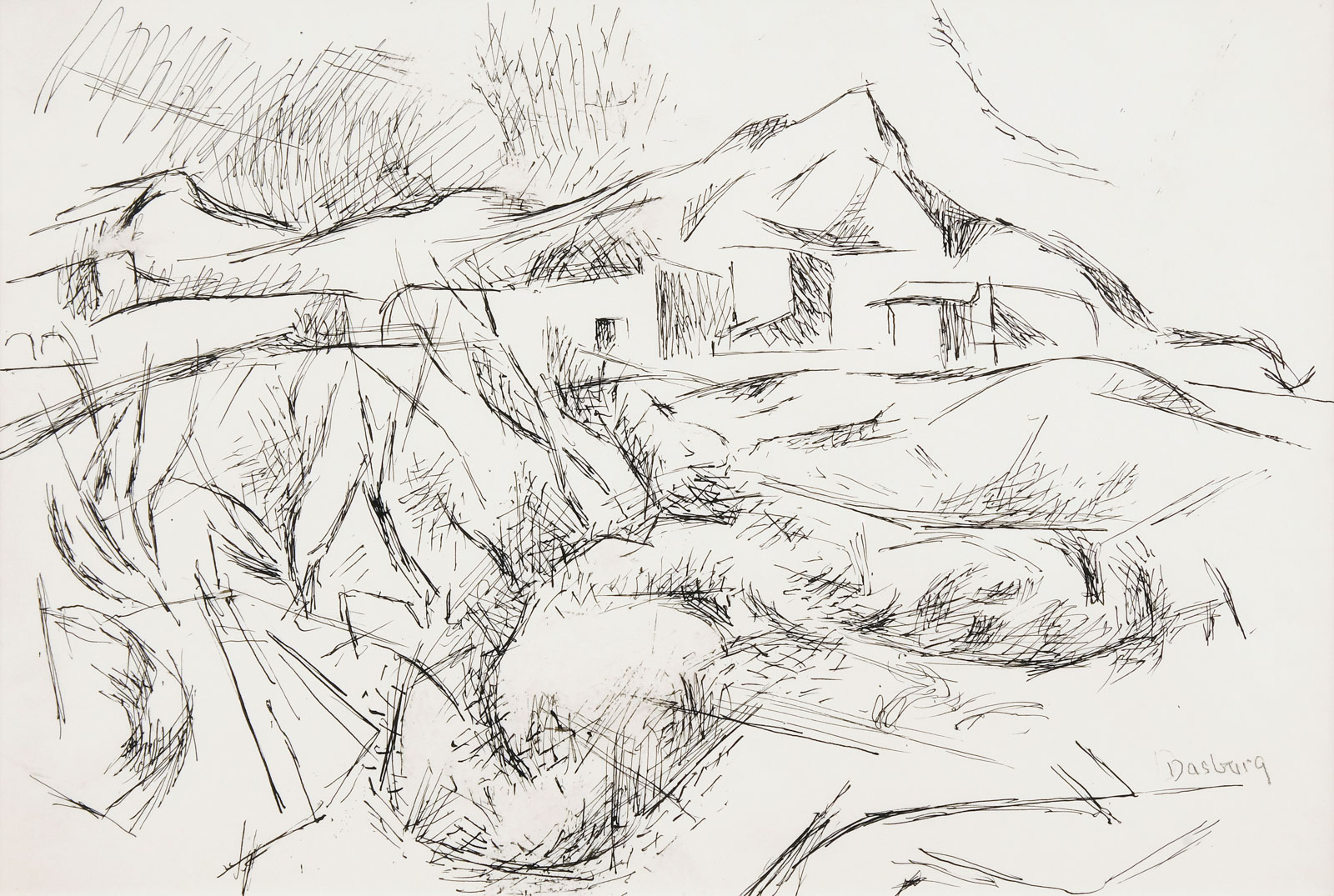 Andrew Dasburg (1887-1979), Houses and Mountains, circa 1950s. Pen and ink on paper, 137⁄8 x 20¾ in., signed lower right.
In an effort to bring context and dimension to the collection of drawings, the exhibition will also include some of Dasburg’s pastel paintings, like his 1974 Ranchos Looking North—a piece that Rowe considers the strongest, most colorful in the exhibition, and top in the artist’s oeuvre. “It employs all of Dasburg’s strengths as an artist; strong angles, simplicity of composition, open spaces and distant mountain elements,” Rowe says. “There is also a complexity to the work with a brilliant mix of strong pastel colors, especially in the sky for the sun effect, and the modeling of the house elements and landscape. The mix of color is extremely dramatic.”
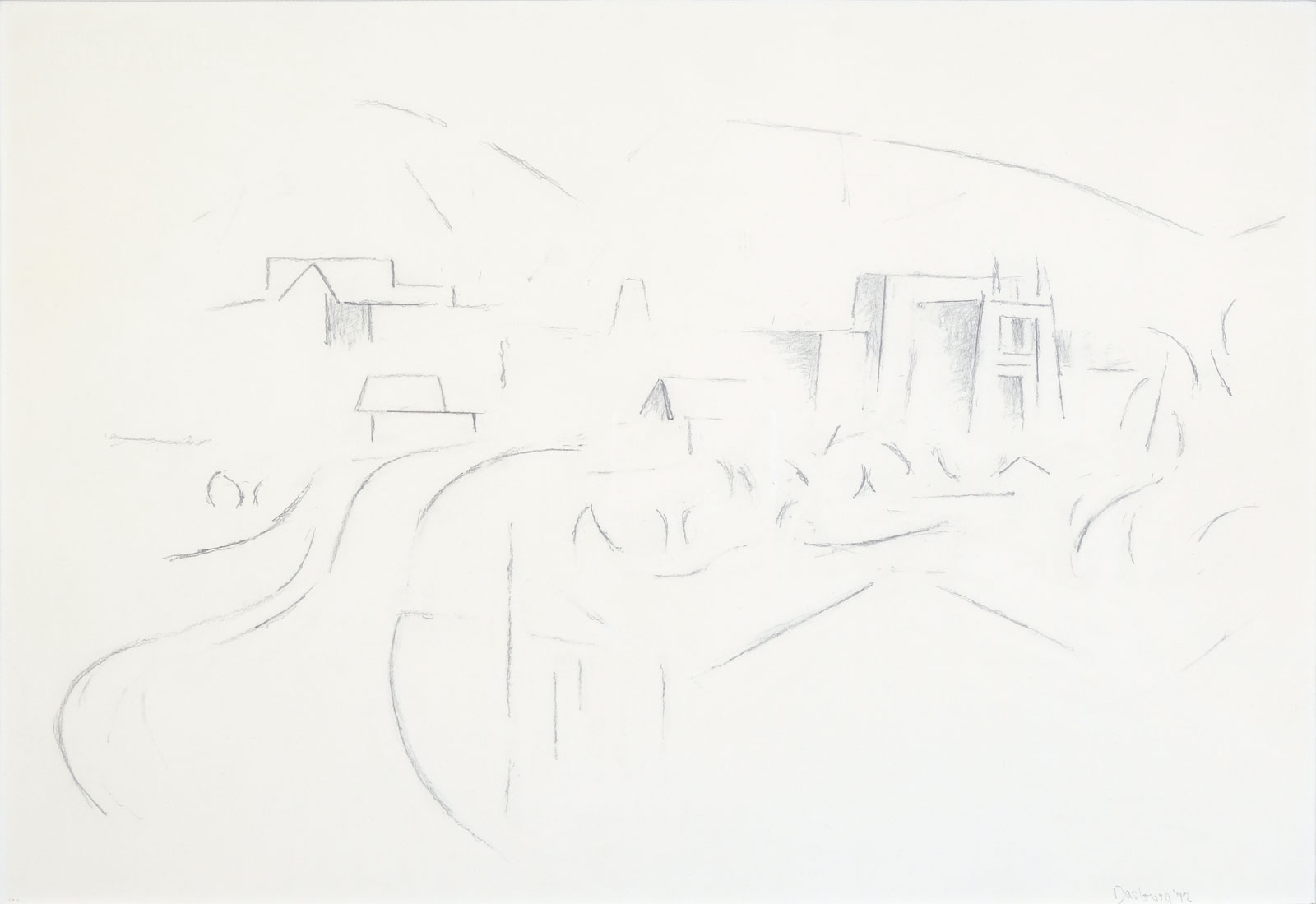 Andrew Dasburg (1887-1979), Untitled, NM Landscape, 1972. Graphite on paper, 14 x 20 in., signed and dated lower right.
The exhibition, hosted at Addison Rowe Gallery in Santa Fe, New Mexico, through April 30, gives attention “to the importance of drawings and the role they play for an artist and his artistic development,” says Rowe in closing. “I also hope there’s a renewed interest in the unique style of modernism in the 20th century, and how important Dasburg was to this happening.”
Powered by Froala Editor