
Gordon’s responsibilities include researching the collection and overseeing its care, engaging donors and the public, proposing acquisitions and organizing exhibitions. He also teaches an undergraduate seminar on American silver for Yale’s History of Art department.
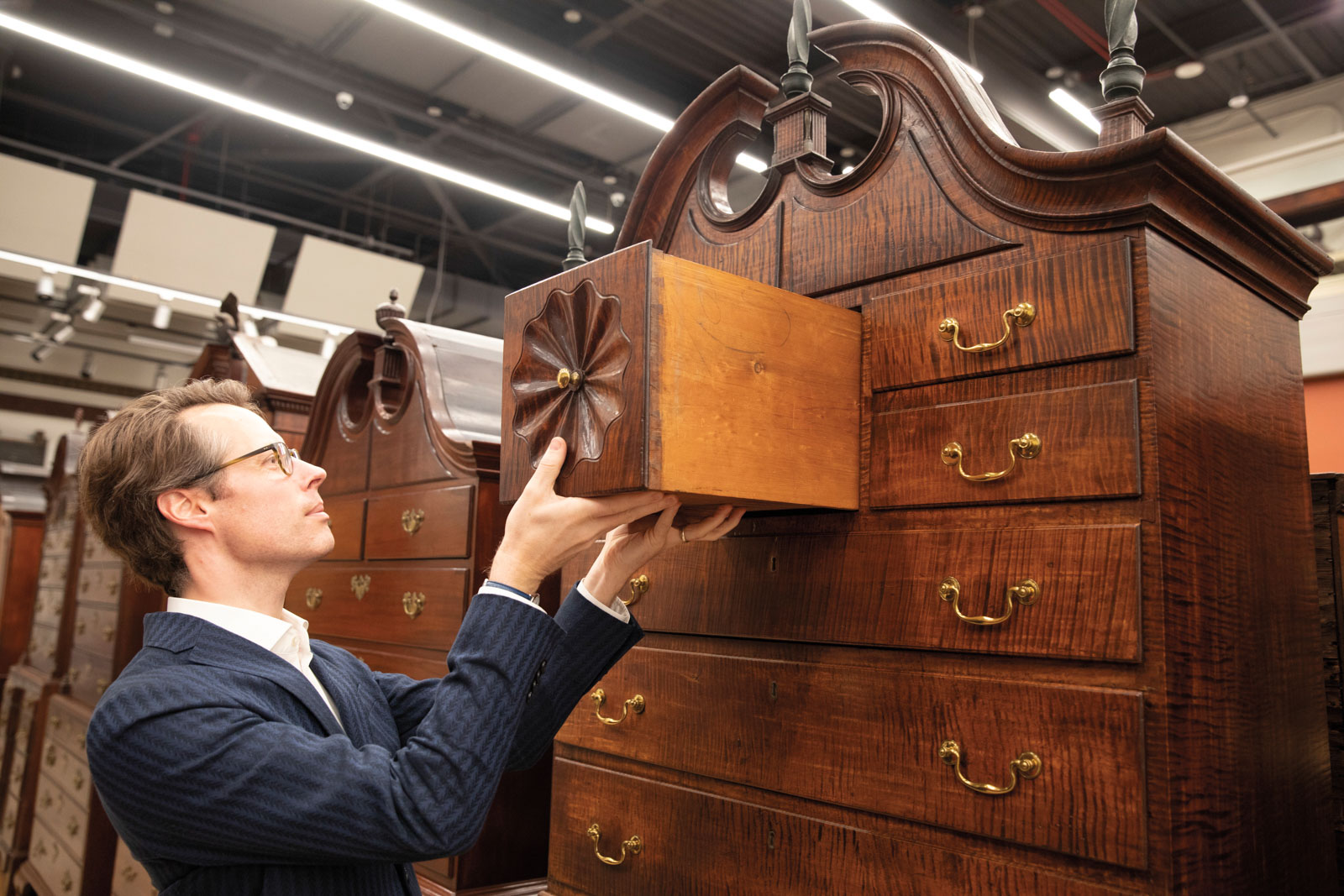 John Stuart Gordon in the Leslie P. and George H. Hume American Furniture Study Center. Photo credit: Jessie Smolinski
In addition to the Leslie P. and George H. Hume American Furniture Study, a working library of over 1,300 examples of furniture, clocks and wooden objects dating from 1650 to the present, the core of Yale University’s holdings of American decorative arts is the 10,000-piece Mabel Brady Garvan Collection. The strengths of the 1930 gift are early colonial furniture, glass, prints, pewter and some of the finest American silver in existence.
“Working with such a sizable collection is exciting—there are always overlooked areas to explore and objects waiting to be reinterpreted,” says Gordon, adding that one of Yale’s best-known pieces of furniture is a magisterial mahogany desk and bookcase originally owned by the Rhode Island merchant John Brown. The piece was originally thought to have been made by the Townsend-Goddard shops in Newport. “My colleague, Patricia E. Kane, has been studying Rhode Island furniture for over a decade and she now believes the desk was made in Providence by Daniel Spencer, a nephew of the cabinetmaker John Goddard who struck out on his own and captured an impressive clientele. This shows that even for objects we thought we understood, there are still new things to learn.”
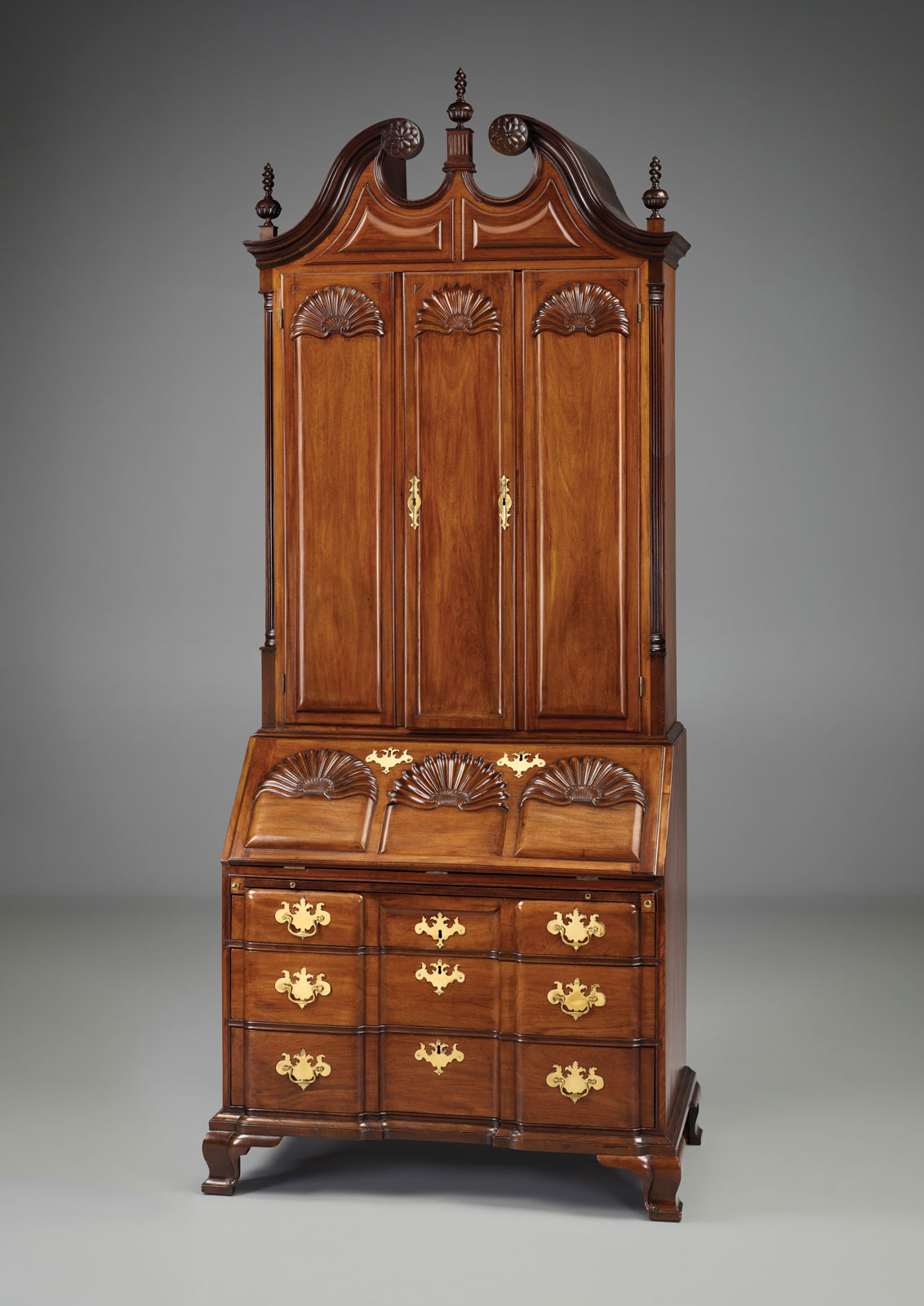 Attributed to Daniel Spencer (1741-1796), Desk and Bookcase. Mahogany, American black cherry, chestnut and eastern white pine, Providence, RI, ca. 1772–90. Yale University Art Gallery, Mabel Brady Garvan Collection.
A recent addition to the collection is one of Tiffany and Company’s storied “Goelet Cups” awarded by the New York Yacht Club between 1882 and 1897. “A beautifully sculpted mermaid is intertwined with a dolphin and rests her arms on a large shell dripping with seaweed,” says Gordon. “It epitomizes the exuberance and wealth of America’s Gilded Age.”
Objects are reflective of the times in which they were made. They are material manifestations of technological advances, new materials as well as indicators of the social and cultural climate of the day. “Take, for example, lacy pressed glass. For many modern viewers, this material might seem fussy or old fashioned, yet it was hugely innovative,” shares Gordon. “For years, glasshouses looked for more economical alternatives to hand-cut glass. In the 1820s, the Boston and Sandwich Glass Works perfected using a hydraulic press to squeeze molten glass into a mold. The earliest pieces mimicked cut glass but quickly glassmakers adapted the technology to create patterns that were more intricate than what could be done with cutting. Companies also responded to a growing taste for bright colors. A particularly vibrant yellow, called ‘canary’ at the time, was made by adding uranium to the glass. In many ways, pressed glass was quite daring.”
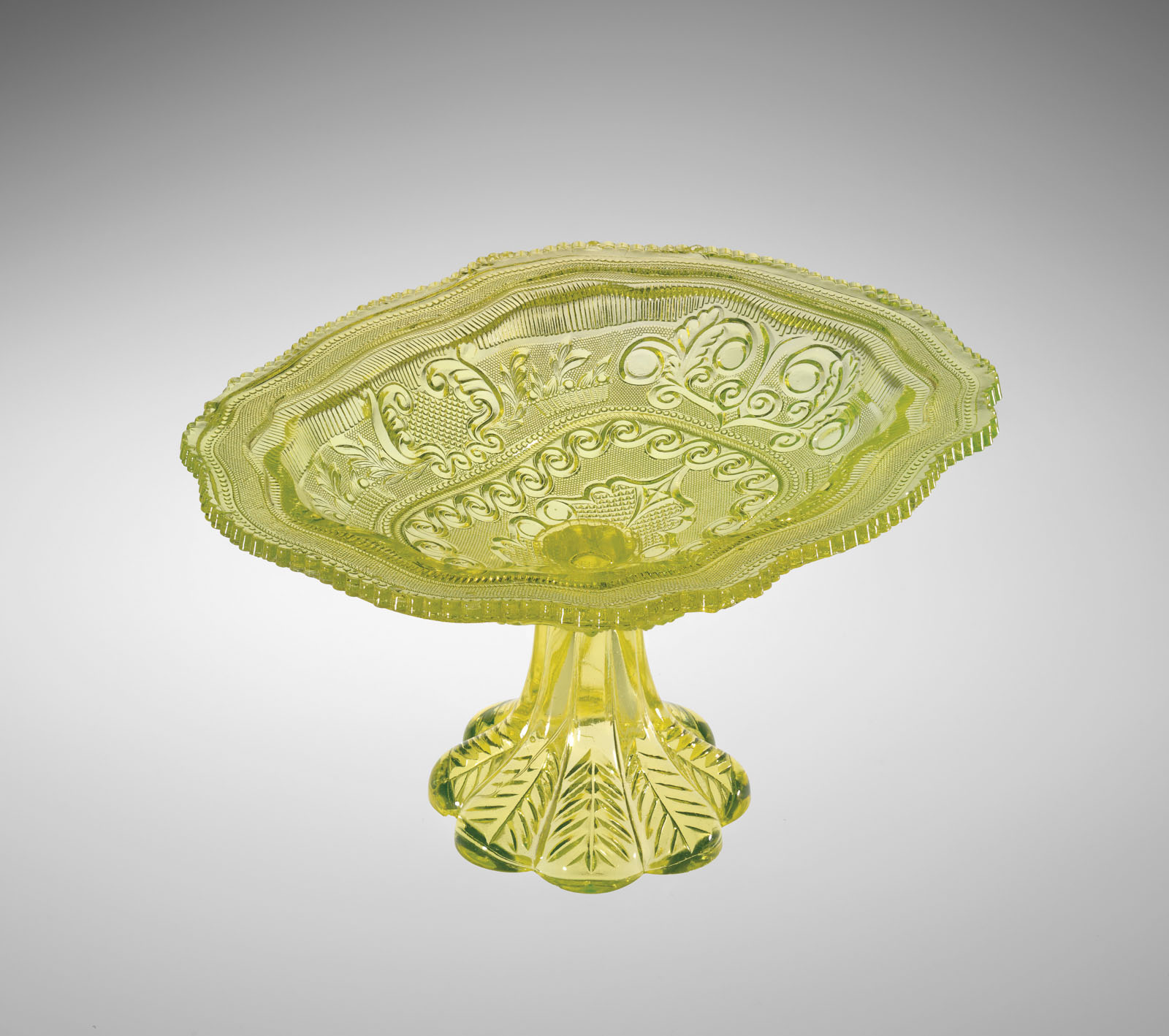 Attributed to Boston and Sandwich Glass Works (1826-88), compote, ca. 1845-55. Pressed lead glass. Sandwich, MA. Yale University Art Gallery, Mabel Brady Garvan Collection.
A cocktail set made a century later during Prohibition (1920-1933) also speaks to its era. Once Franklin D. Roosevelt’s efforts to end prohibition prevailed, companies began to add drink wares to their lines. The 1935 catalogue for Revere Copper and Brass offered the “Manhattan” cocktail ensemble, created by the famed industrial designer Norman Bel Geddes. “Drinking, it seemed to say, was as chic as modern architecture and urban living,” says Gordon. “Even the material bespoke newness…In these two very different examples, the objects are captivating on their own, but they also speak to artistic, social, political, technological and material issues.
 Norman Bel Geddes (1893-1958) for Revere Copper and Brass, Rome, NY, “Manhattan” Cocktail Service, designed 1934, introduced 1935. Chromium-plated brass. Yale University Art Gallery, Stephen Carlton Clark, B.A. 1903, Fund, 1982.31A-J.
“Humans have always lived in a world of objects, making them vivid repositories of history. They are also remarkably adaptive to shifts in scholarship,” says Gordon. “One generation may have been interested in an object’s tie to a famous figure, while another generation might be interested in how the raw materials associated with the object were sourced and transported. To me, neither approach is wrong. It fascinates me how the same works of art can live multiple intellectual lives. The word ‘curate’ means to care for, and I see a pastoral element to our profession. We are here to safeguard objects for the future and for future approaches to thinking about culture.”
Powered by Froala Editor