During a time when the Great Depression left millions of people unemployed, the Works Progress Administration launched its Federal Art Project, offering job opportunities for artists across the country. An exhibition currently on view at the Baltimore Museum of Art titled Art/Work: Women Printmakers of the WPA is a comprehensive exploration of artwork created by women artists in the 1930s and 1940s—a selection of approximately 50 works from the BMA’s extensive holdings of nearly 1,000 prints made by WPA artists.
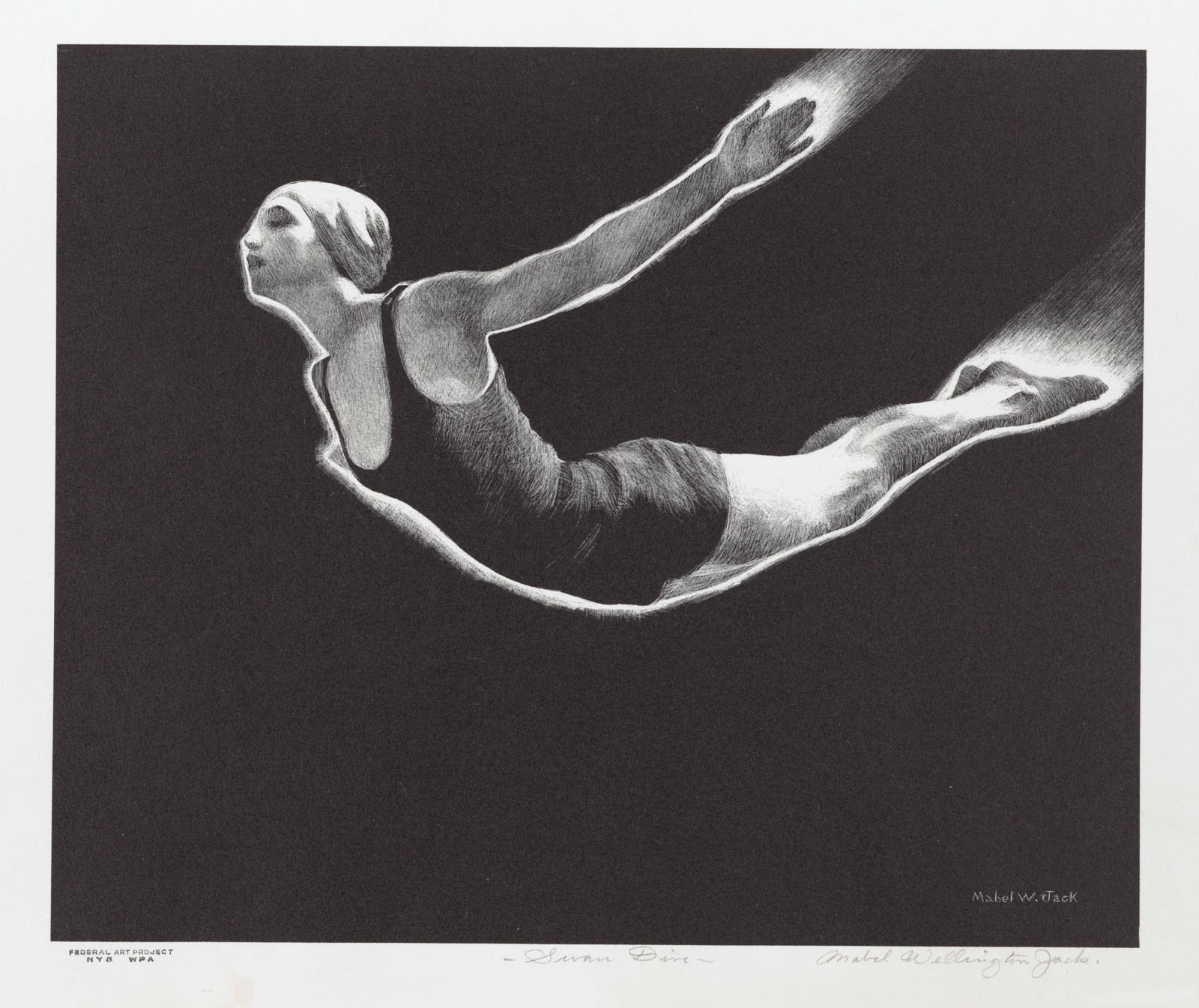 Mabel Wellington Jack (1899-1975), Swan Dive, ca. 1935-39. The United States General Services Administration, formerly Federal Works Agency, Works Progress Administration, on extended loan to the Baltimore Museum of Art. Courtesy of the Fine Arts Collection, U.S. General Services Administration, WPA, Federal Art Project, 1935-1943.
“Art/Work brings to light an incredible array of prints by often little-known women printmakers, expanding the canon of recognized artists of the 1930s and ’40s,” says Virginia Anderson, BMA Curator of American Art and Department Head of American Painting & Sculpture and Decorative Arts. The exhibition sheds light on important printmakers like Elizabeth Olds, Blanche Grambs, Florence Kent, Miné Okubo, Ida Abelman, Mabel Dwight, M. Lois Murphy and many more. “Importantly, in their prints they portrayed the social issues of their time—which are still so relevant to our own—drawing attention to subjects like worker’s rights, race and gender-based inequities, ecological devastation, the unseen labor of working mothers, the dangerous rise of fascism and the need for artists to have community and support,” Anderson adds.
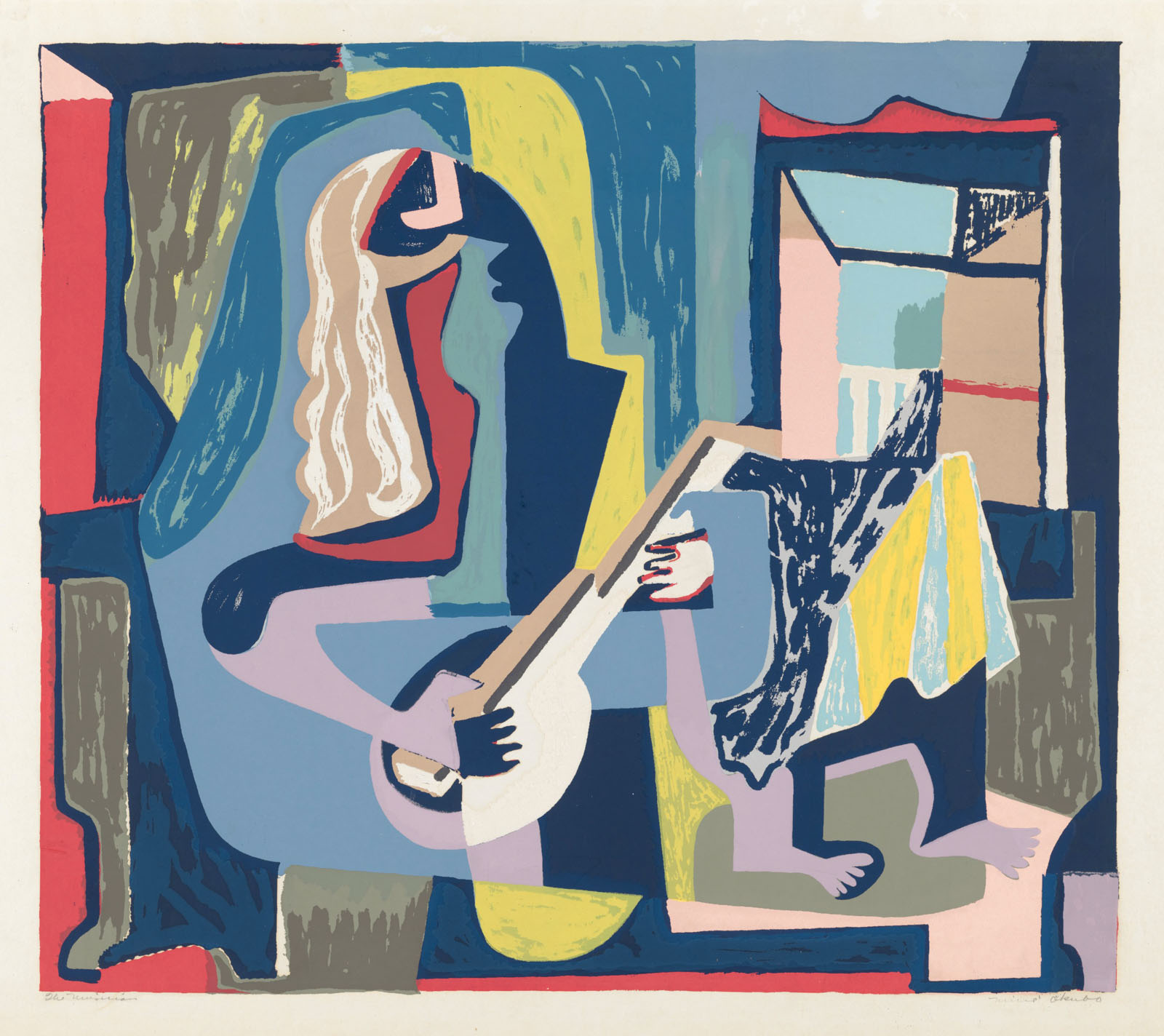 Miné Okubo (1912-2001), The Musician, ca. 1938-1941. The United States General Services Administration, formerly Federal Works Agency, Works Progress Administration, on extended loan to the Baltimore Museum of Art. Courtesy of the Fine Arts Collection, U.S. General Services Administration, WPA, Federal Art Project, 1935-1943.They worked in a sweeping range of styles as well, from surrealism to social realism to abstraction, across a variety of printing techniques including woodcuts, etchings, lithography and color silkscreen printing, a new technology for the time.
Anderson points out several major highlights within the exhibition. Among these Mabel Wellington Jack’s 1939 Swan Dive, a crayon and brush and tusche lithograph with scraping. “[This piece] beautifully captures a diver falling through space, her gracefully athletic form set against a black background. Rather than depicting the female form as idealized, Jack focuses on her subject’s strength and agility as a modern woman of the era,” Anderson comments. “It’s possible she was inspired by Marjorie Gestring, an American who won gold in women’s springboard diving in the 1936 Berlin Olympics.”
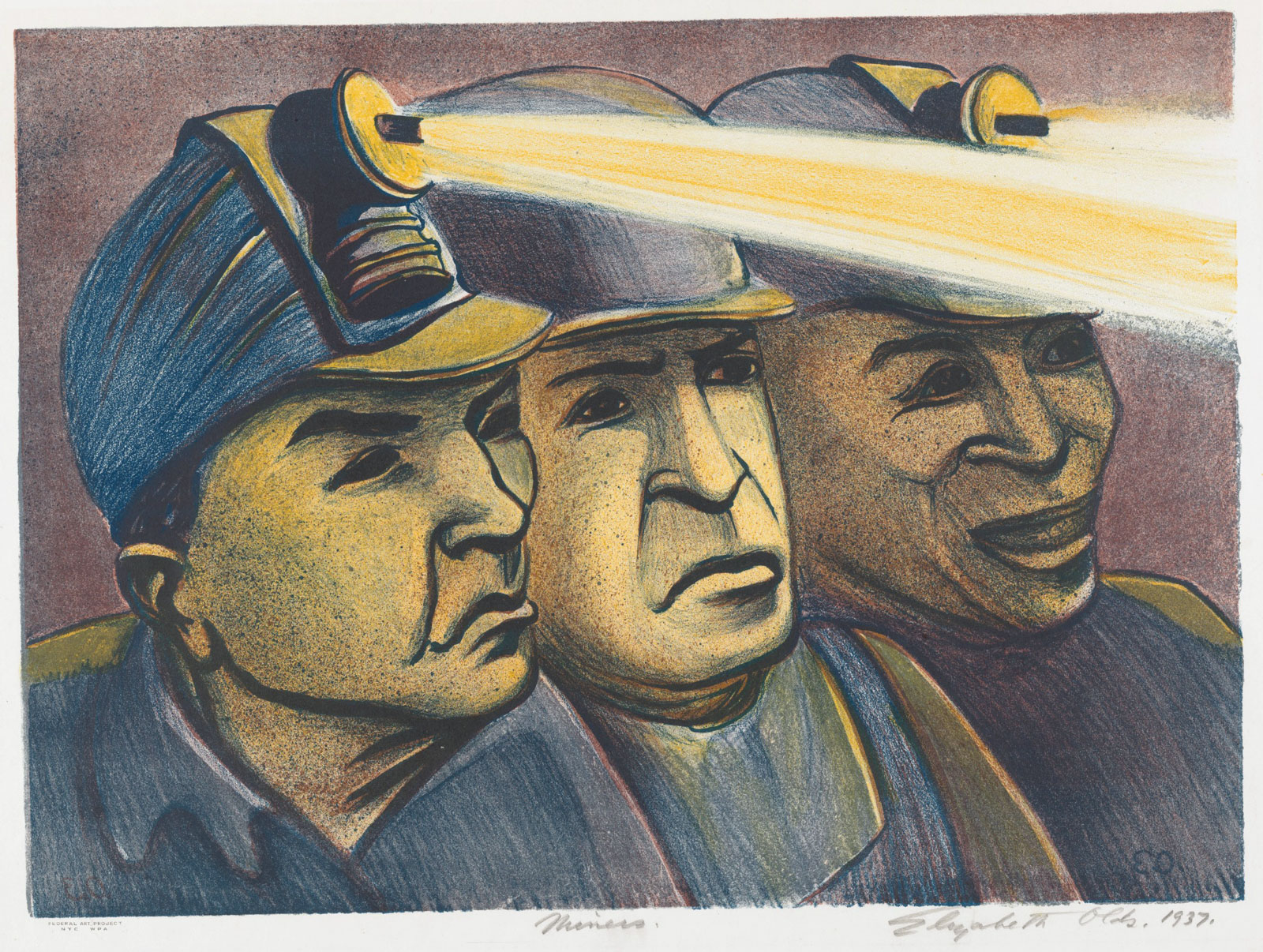 Elizabeth Olds (1896-1991), Miners, 1937. The United States General Services Administration, formerly Federal Works Agency, Works Progress Administration, on extended loan to the Baltimore Museum of Art. Courtesy of the Fine Arts Collection, U.S. General Services Administration, WPA, Federal Art Project, 1935-1943.
In the color screenprint The Musician, from around 1938 to 1941, artist Miné Okubo blends different styles and influences. “[Okubo] experiments with cubist abstraction inspired by European artists and combines it with the new artistic technique of color screenprinting, in which ink is dragged across a stenciled screen using a squeegee,” explains Anderson. “The colorful forms of this work come together to suggest a female form playing a musical instrument, set against an open window. In 1942, Okubo and her family were imprisoned in internment camps when the U.S. government forcibly relocated Japanese Americans following the 1941 bombing of Pearl Harbor by Imperial Japan. She later published a well-known graphic novel based on her experiences, Citizen 13660.”
Art/Work: Women Printmakers of the WPA will be on display at the Baltimore Museum of Art through June 30.
Powered by Froala Editor