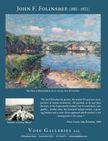

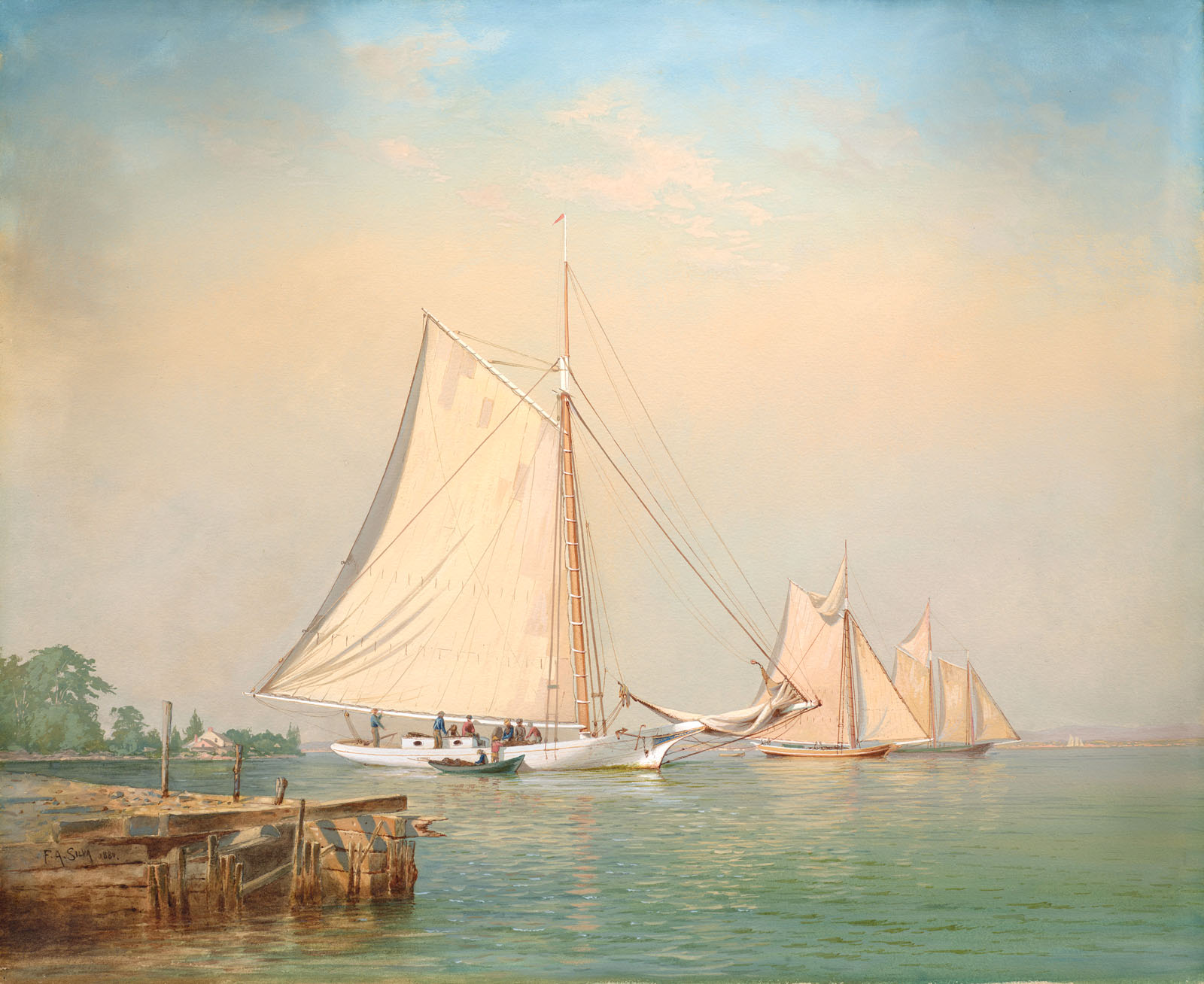
 Francis Augustus Silva (1835-1886), Morning on the Shrewsbury River, 1880. Watercolor and gouache on paper laid down on canvas, 195⁄8 x 235⁄8 in.
Francis Augustus Silva (1835-1886)
Morning on the Shrewsbury River
Francis Augustus Silva is best known for his luminist paintings of New York Harbor and the Hudson River. In 1880, he moved from New York City to Long Branch, New Jersey, and the surrounding area became his new source of inspiration. Morning on the Shrewsbury River depicts the short stream and estuary that borders the northern edge of the town. The clarity of light, bright palette and crisp, linear composition are exemplary of the artist’s work in both watercolor and oil during this period. The scale of the watercolor and its probable inclusion in 14th annual exhibition of the American Watercolor Society in 1881 make it an exciting rediscovery, as the work has descended through the collection of a Southern family.
Debra Force Fine Art
13 E. 69th Street, Suite 4F • New York, NY 10021 • (212) 734-3636 • info@debraforce.com www.debraforce.com
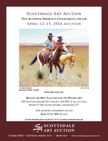
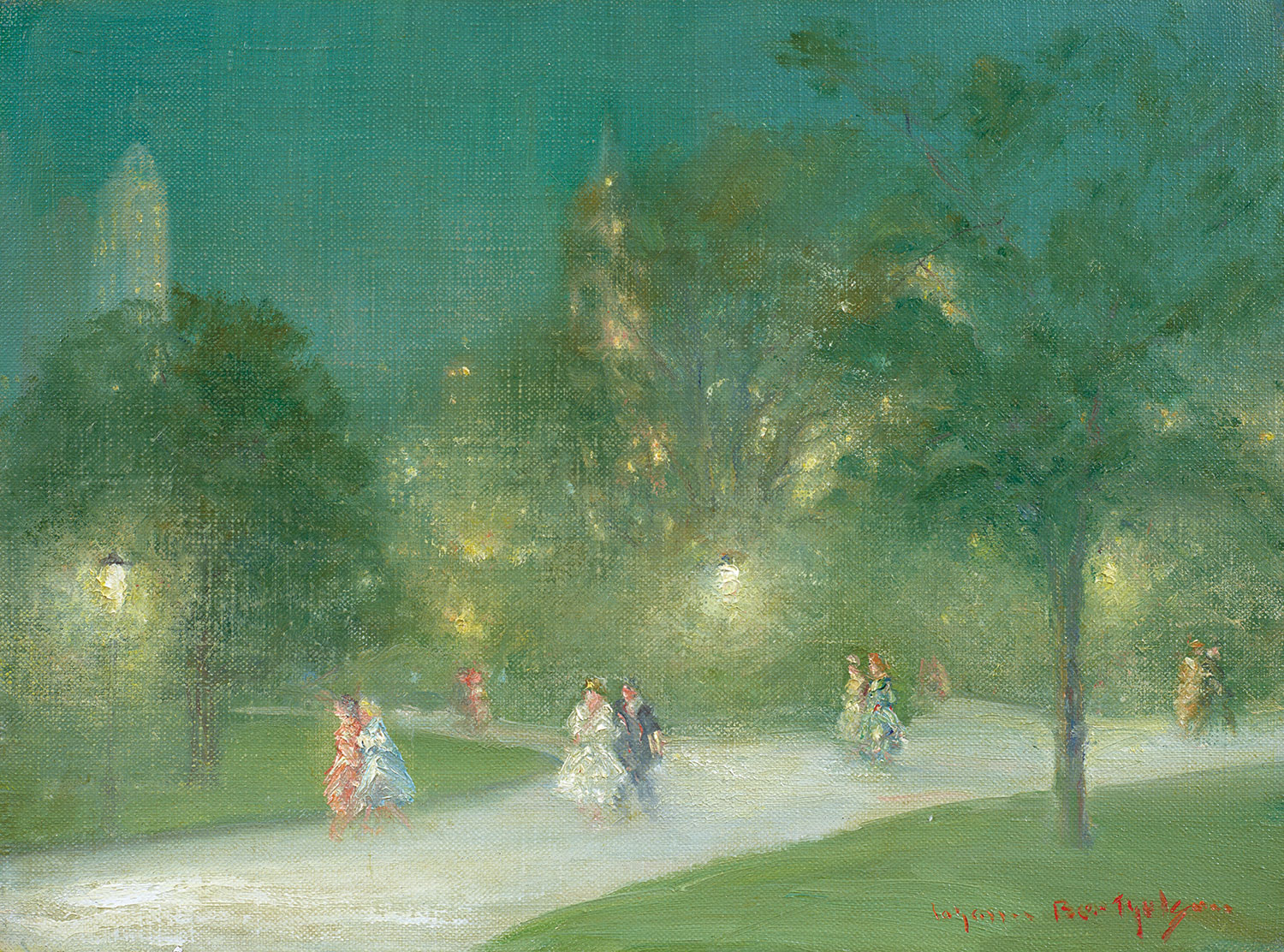 Johann Berthelsen (1883-1972), An Evening Walk, Central Park. Oil on canvas, 9 x 12 in., signed; also signed on the reverse.
Johann Berthelsen (1883-1972)
An Evening Walk, Central Park
Johann Berthelsen was an American impressionist best known for his poetic paintings of New York City, of which An Evening Walk, Central Park, is a prime example. Born in Copenhagen, Denmark, Berthelsen emigrated to the U.S. as a boy with his mother and siblings, settling in Wisconsin near family. Interestingly enough, Berthelsen’s main pursuit for much of his life was singing and theater. He graduated in 1905 from the Music Conservatory of Chicago College of Performing Arts, after which he toured the United States and Canada as lead baritone for the Chicago Grand Opera Company, eventually becoming a voice instructor, first in Indianapolis and then in New York when he moved there in 1920. Berthelsen also painted throughout his life, though mostly for his own pleasure. In the 1920s, however, his work began to receive critical recognition and popular acclaim, and in 1932 he decided to paint full time, which he did rest of his life.
Rehs Galleries
20 W. 55th Street, 5th Floor • New York, NY 10019 • (212) 355-5710 • info@rehscgi.com • www.rehs.com
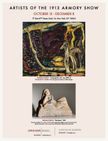
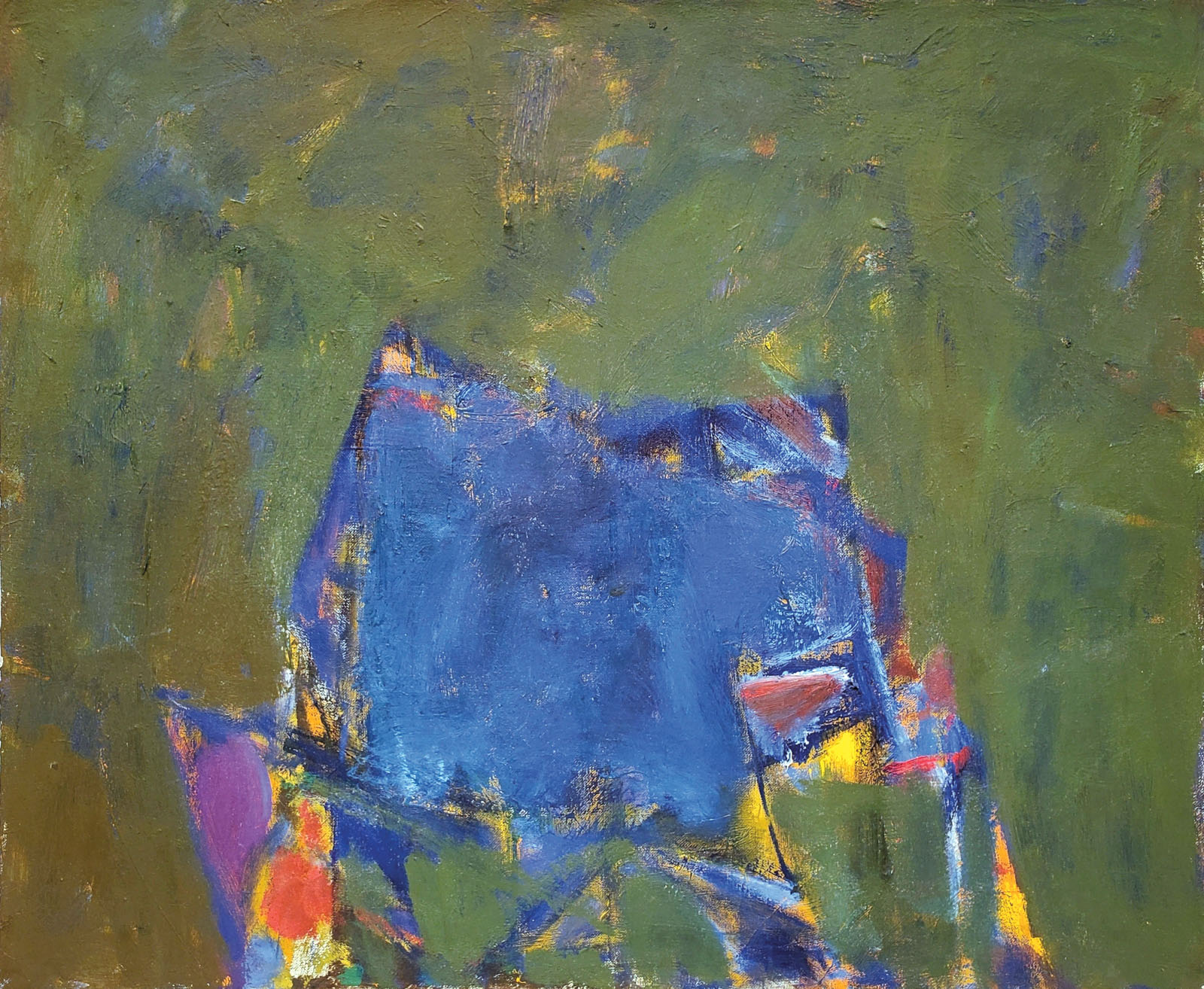 Seymour Boardman (1921-2005), Untitled, 1958. Oil on canvas, 24 x 28 in.
Seymour Boardman (1921-2005)
Untitled
Seymour Boardman was a New York abstract expressionist painter. After a long hospitalization following an injury while in the United States Air Force, in 1946, he left for Paris to continue his art education at the École des Beaux-Arts, Académie de la Grande Chaumière and Atelier Fernand Léger. Boardman’s work became more abstract but still figure- and landscape-based. He returned to New York in 1949 and went to the Art Students League, where Boardman continued to paint dark, moody paintings using a limited palette of black, white, gray and an occasional splash of color. After his first solo exhibition in Paris in 1951, Boardman developed a personal vision and style of his own, following his own path of abstraction. In 1955, he had his first one-man show in New York at the Martha Jackson Gallery, which was met with positive reviews. He began to acquire recognition in the 1950s with his paintings of griddled facets seen as if through a frosted glass. Throughout the 1960s, Boardman exhibited frequently in both galleries and museums. His work is in the collections of the Whitney Museum of American Art and the Guggenheim Museum.
J. Kenneth Fine Art
668 N. Palm Canyon Drive • Palm Springs, CA 92262 (802) 540-0267 • jkennethfineart@gmail.com • www.jkennethfineart.com
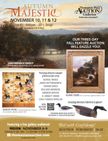
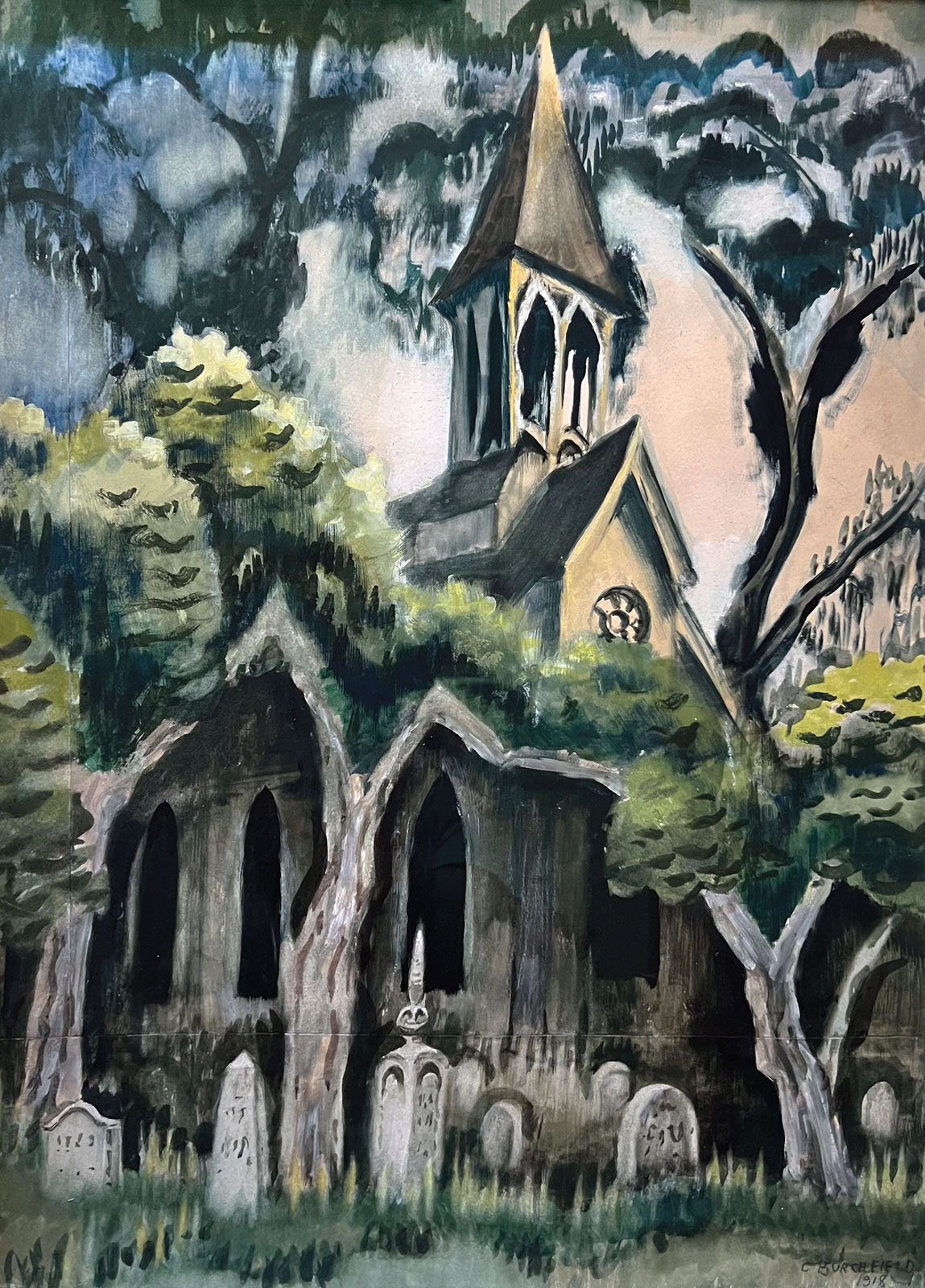 Charles Ephraim Burchfield (American 1893-1967), Country Church in June, 1918. Watercolor and gouache on joined paper, 277⁄16 x 201⁄8 in., signed and dated ‘C Burchfield/1918’ bottom right; titled, dated and inscribed with dimensions verso.
Charles Ephraim Burchfield (American 1893-1967)
Country Church In June
Artist Charles Ephraim Burchfield is perhaps best known for his fantastical watercolor landscapes, but some of the artist’s most intriguing works are the “house pictures” he created earlier in his career. The natural world still weaves itself through these eerie paintings, often through the presence of ominous clouds and spindly trees that threaten to strangle the central character—the structure itself.
Burchfield painted Country Church in June in 1918 work during his “Gothic” year of depression. It functions like a landscape version of Edvard Munch’s The Scream. Everything, including the skeleton-like church steeple, the eye-socket windows, electric clouds and sentinel grave stones contribute to the sense of foreboding.
Thomas Colville Fine Art
111 Old Quarry Road • Guilford, CT 06437 • (203) 453-2449 • tlc@thomascolville.com • www.thomascolville.com
Powered by Froala Editor