In 2010, the Philbrook Museum of Art in Tulsa, Oklahoma, received a bequest of 15 paintings by three generations of one of the country’s most important creative families. Marylouise Cowan (1921-2009) was born in Tulsa and went on to be the publisher of two newspapers on the Maine coast. She collected the paintings of three members of the Wyeth family: N. C. Wyeth (1882-1945), his son Andrew (1917-2009), and grandson Jamie (b. 1946).
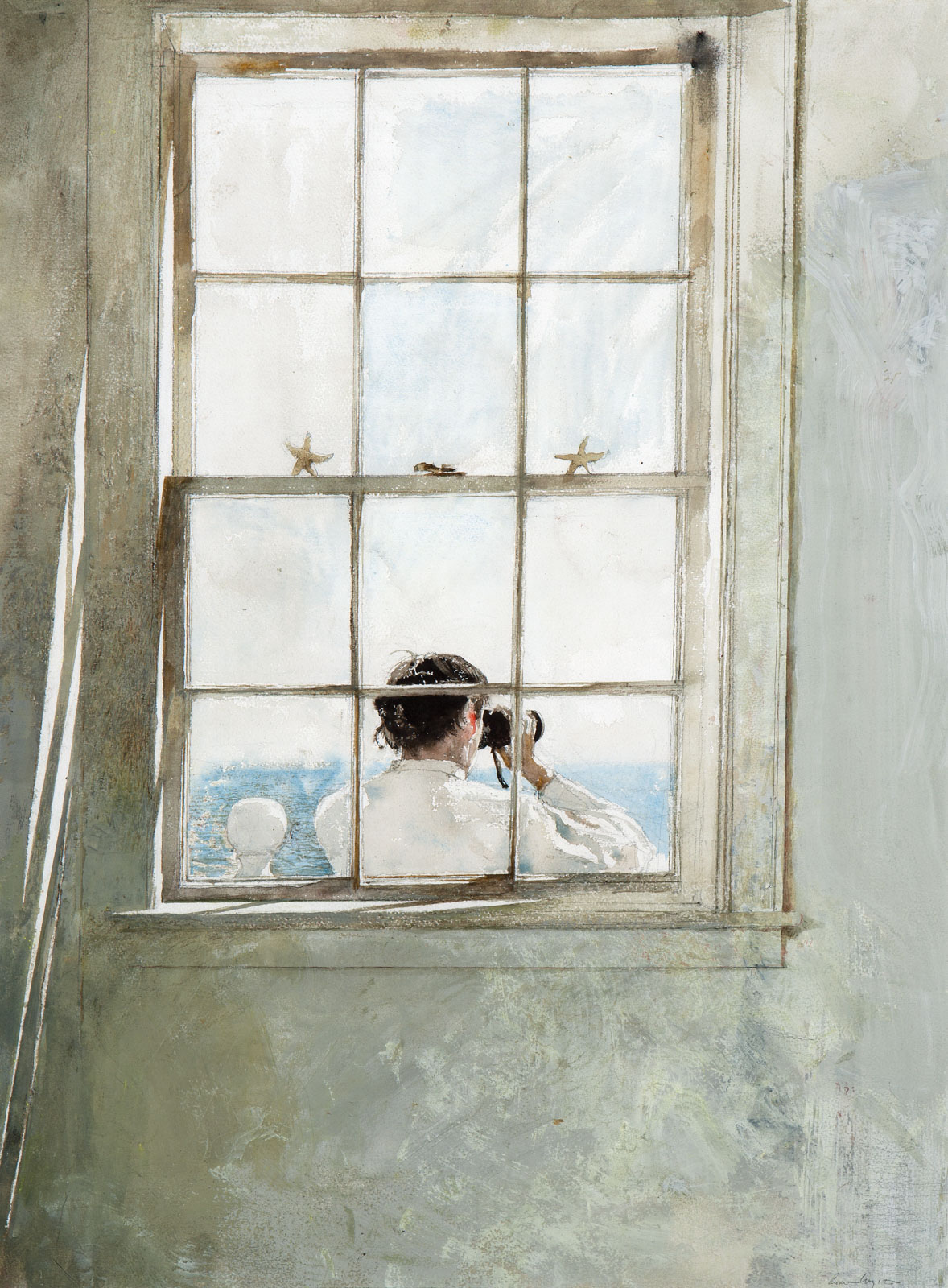 Andrew Wyeth (1917–2009), Star Fish, 1986. Watercolor on paper, 285/8 x 21¼ in. Philbrook Museum of Art, Tulsa, Oklahoma. Bequest of Marylouise Cowan, 2010.9.14. © 2023 Wyeth Foundation for American Art / Artists Rights Society (ARS), New York.
The second floor of the Wyeth Center at the Farnsworth Museum in Rockland, Maine, is named in her honor and shows primarily the work of Jamie Wyeth. Her bequest to the Philbrook added to its already significant collection of American art.
Its exhibition, Wyeths: Textures of Nature, running through June 09, 2024, explores how the family “closely observed the world around them to produce artworks that reflect their richly textured visions of nature,” notes the museum.
“N.C. painted quiet moments in the countryside, and Andrew created scenes that convey a sense of solitude. Jamie, who is still working today, depicts enticing details others may overlook. Although all three artists explore elements of nature within their paintings, they each build texture in different ways in order to convey specific ideas or moods. The resulting compositions are linked, yet offer distinctly personal views of rural New England.”
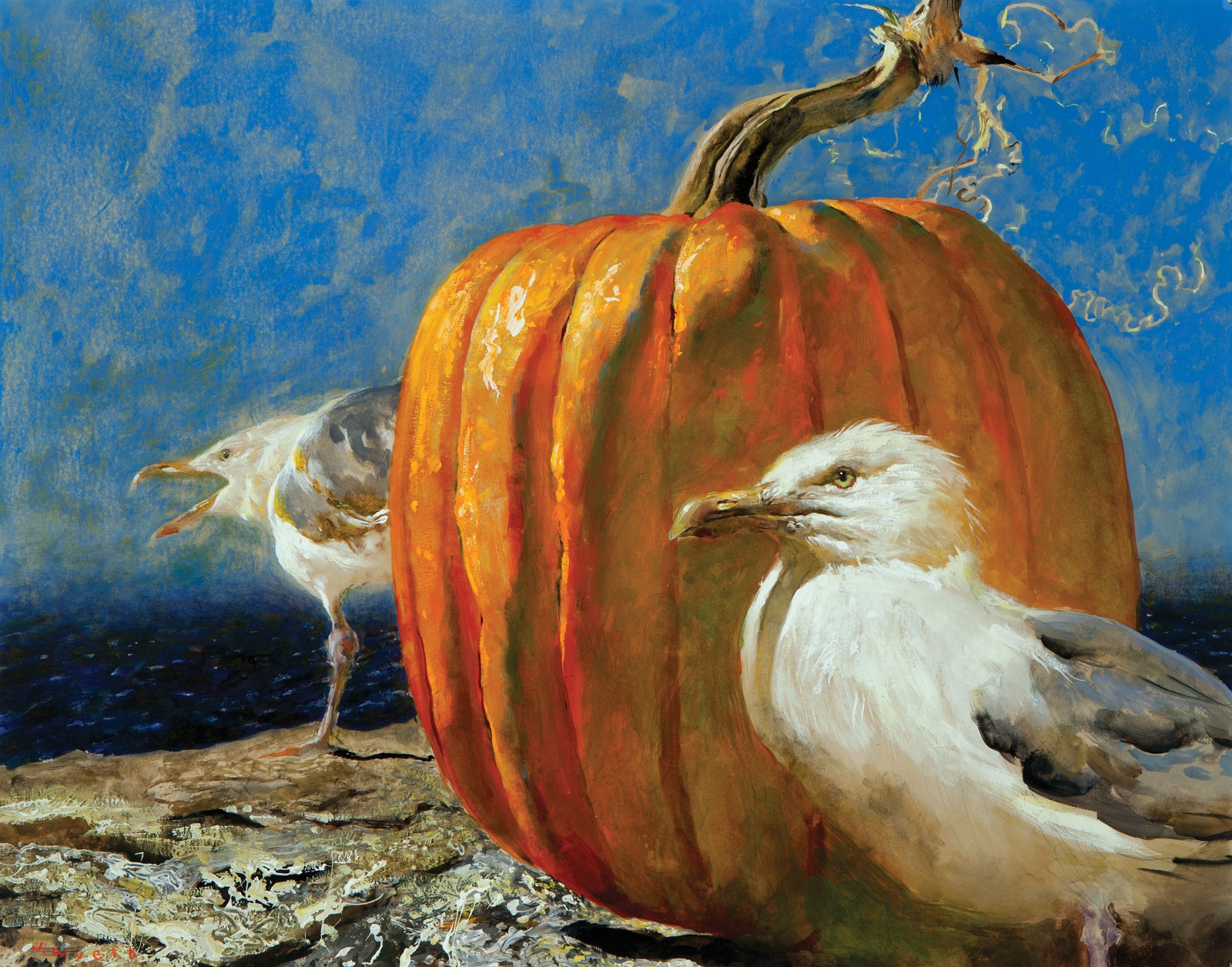 Jamie Wyeth (b. 1946). Gulls and Pumpkins #3, 1992. Mixed media on paper, 22 x 28 in. Philbrook Museum of Art, Tulsa, Oklahoma. Bequest of Marylouise Cowan, 2010.9.20. © 2023 Jamie Wyeth / Artists Rights Society (ARS), New York.
In N.C. Wyeth: A Biography, David Michaelis writes, “Two events took place in 1911 to pattern the rest of his life. In February, Charles Scribner’s Sons asked Wyeth if he would undertake an ‘elaborate edition’ of Robert Louis Stevenson’s Treasure Island. His fee would be $2,500. On the strength of the offer, Wyeth bought a piece of land. Putting down $1,000, he took out a $2,000 mortgage on 18 acres of Rocky Hill, a wooded, northern-facing slope about two-fifths of a mile from the center of Chadds Ford. He called the lot the ‘most glorious site in this township for a home.’”
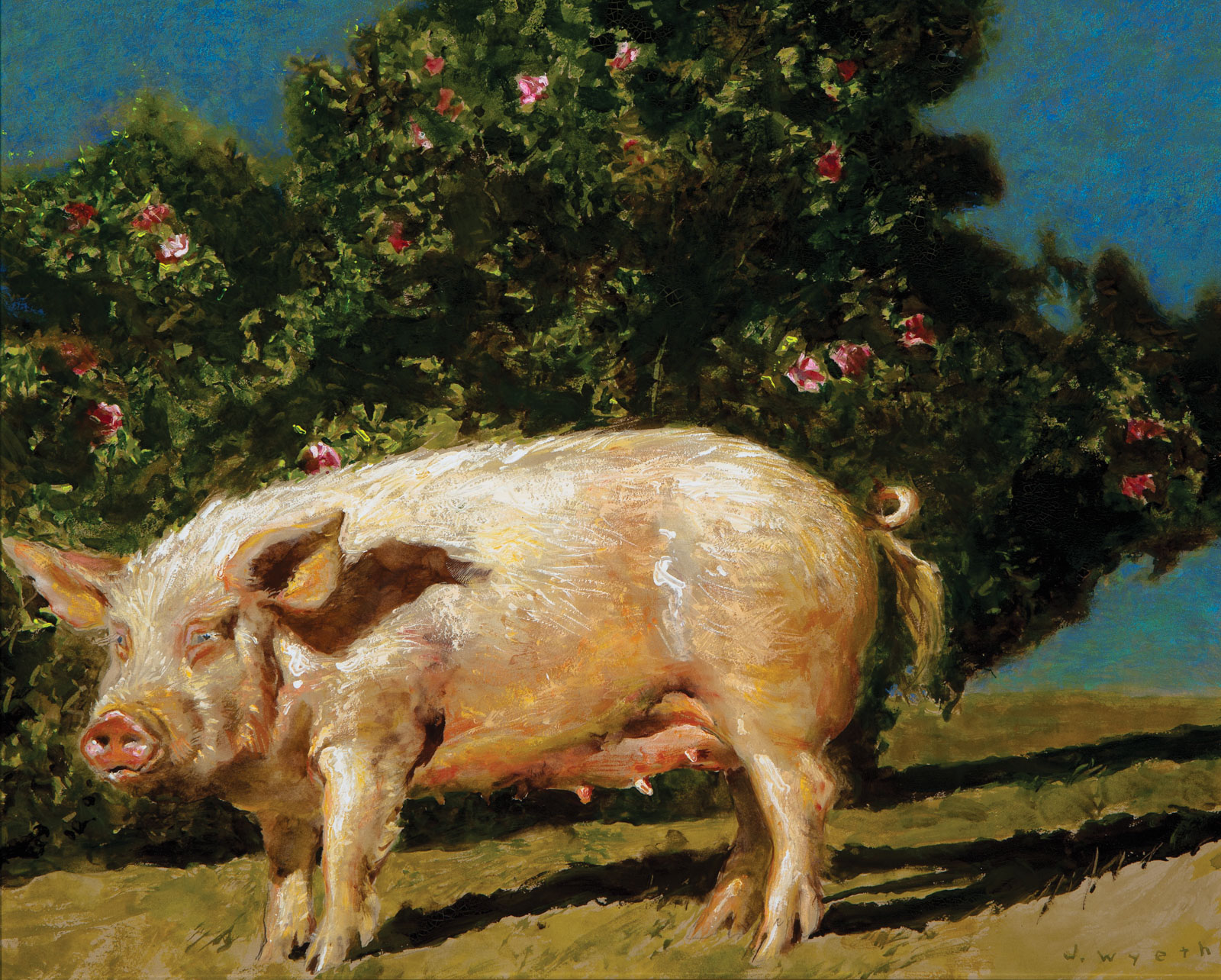 Jamie Wyeth (b. 1946), Pig and Roses, ca. 1990. Oil on panel, 16 x 20 in. Philbrook Museum of Art, Tulsa, Oklahoma. Bequest of Marylouise Cowan, 2010.9.21. © 2023 Jamie Wyeth / Artists Rights Society (ARS), New York.
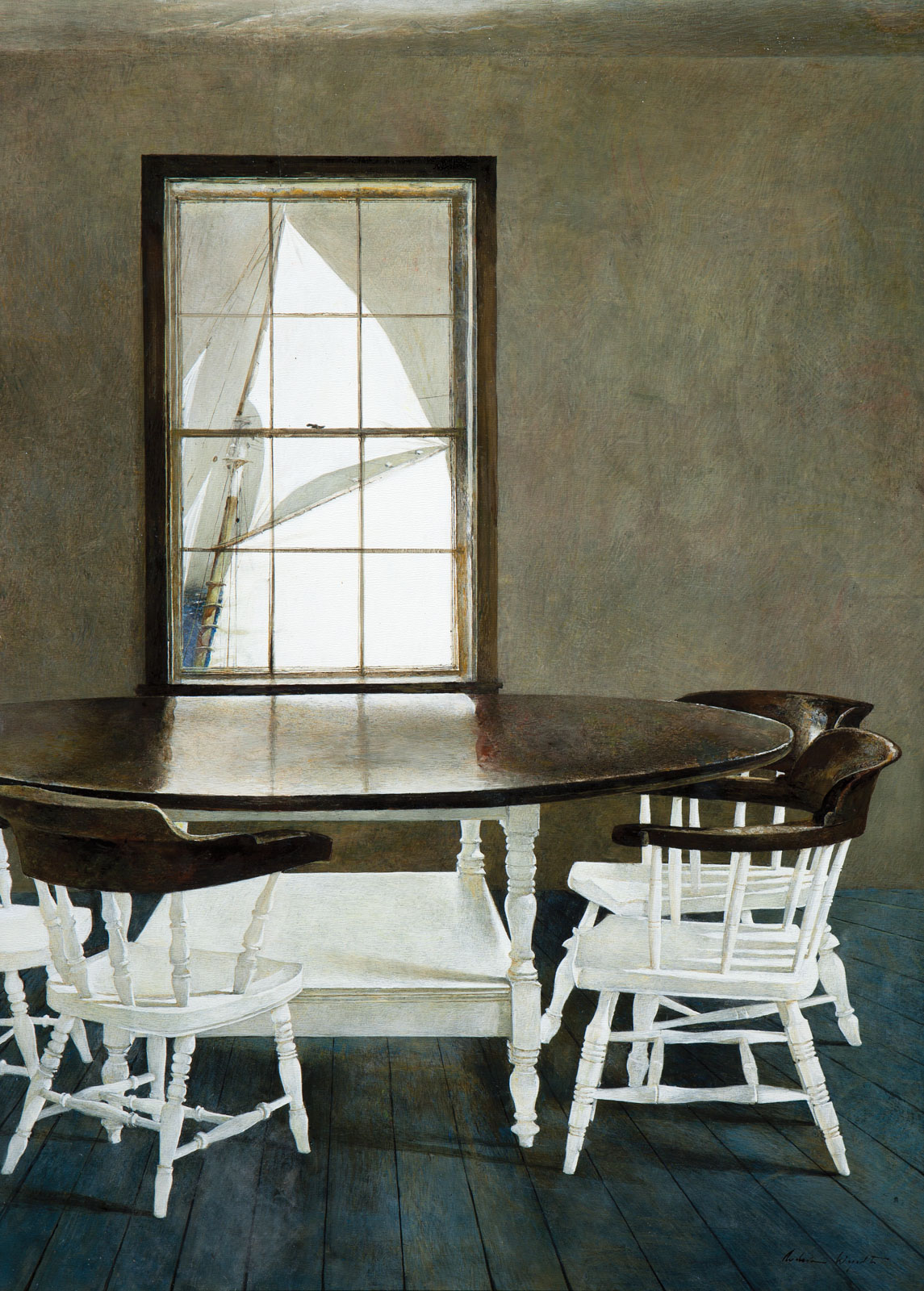 Andrew Wyeth (1917–2009). Boarding Party, 1984. Tempera on panel, 27¾ x 20 in. Philbrook Museum of Art, Tulsa, Oklahoma. Bequest of Marylouise Cowan, 2010.9.11. © 2023 Wyeth Foundation for American Art / Artists Rights Society (ARS), New York.
Between Chadds Ford and their homes in Maine, the Wyeths were immersed in some of nature’s most beautiful manifestations.
Andrew, unlike his father who painted swashbuckling heroes for his book illustrations in addition to more bucolic subjects, painted the common things of his surroundings. He said, “Most artists look for something fresh to paint; frankly I find that quite boring. For me it is much more exciting to find fresh meaning in something familiar.” The bowls for Barn Cats in a well-used barn and a woman bent over pushing a wheelbarrow attest to his observational skill, his knowledge of farm life and his love for the people who live it. Straw on the dirt floor, peeling paint and the reflection of water in the bowls and to the sense of being there.
Jamie Wyeth marches to the beat of his own drummer, his work as distinct from his father’s as Andrew’s work was from his father’s. In an earlier conversation with this magazine he commented that Andrew’s work could sometimes be dark. When asked about his own, he laughed.
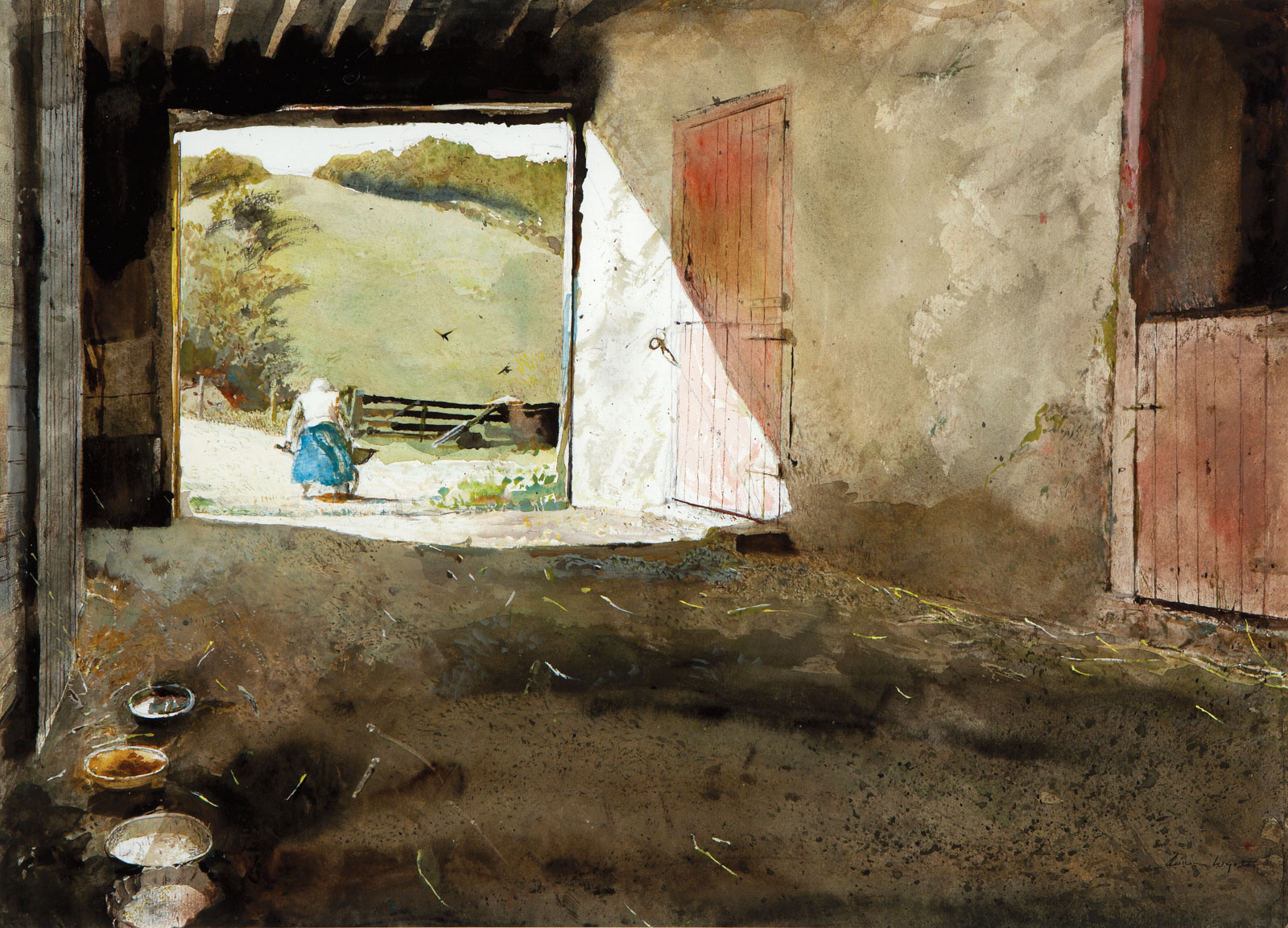 Andrew Wyeth (1917–2009). Barn Cats, 1993. Dry brush and watercolor on paper, 19 11/16 x 27 3/16”. Philbrook Museum of Art, Tulsa, Oklahoma. Bequest of Marylouise Cowan, 2010.9.10. © 2023 Wyeth Foundation for American Art / Artists Rights Society (ARS), New York.
In his series, Seven Deadly Sins, he uses seagulls to personify their characteristics. They are some of the most terrifying representations of the vices. In Gulls and Pumpkins #3, the gulls are definitely not creatures to be messed with. The hard, glaring eyes gazing out from the soft surround of feathers makes them even more menacing.
Pig and Roses recalls an anecdote he related. “I had a pig eat some of my paint once. She chose mostly ochres and oranges and a little later there were colorful droppings around the yard. The farmer asked ‘What have you done to my pig?’ We thought she was going to die but I took her home and she survived.”
Powered by Froala Editor