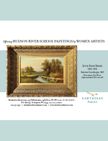
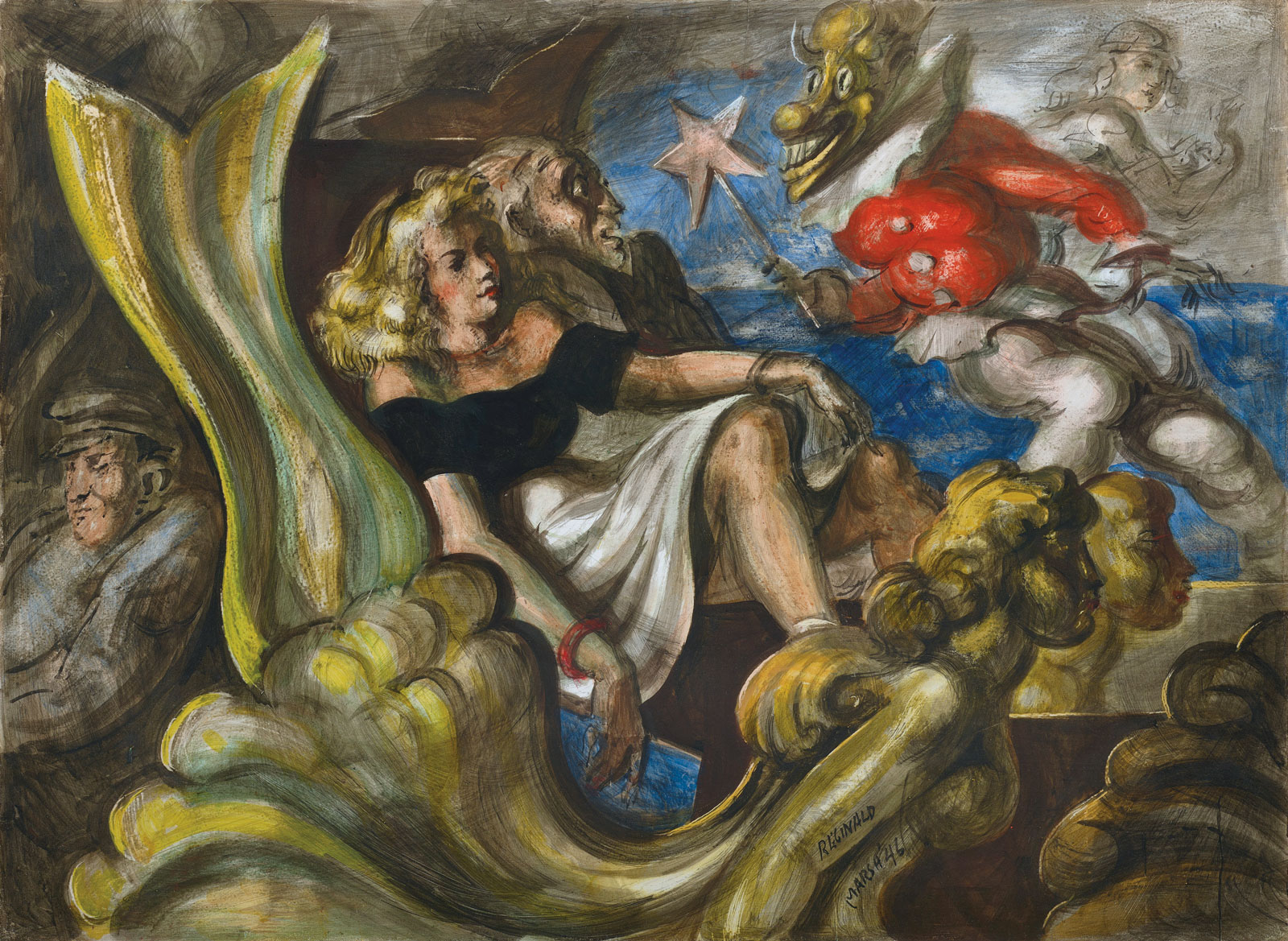
 Reginald Marsh (1898-1954), Eldorado: The Sorrow and Futility of Man Before the Beauty of Woman, 1946. Mixed media on paper, 22 x 295⁄8 in. Courtesy Debra Force Fine Art.
Reginald Marsh (1898-1954)
Eldorado: The Sorrow and Futility of Man Before the Beauty of Woman
Known for his depictions of New York City life, Reginald Marsh often turned to scenes of the city that existed outside the realm of popular culture. Eldorado: The Sorrow and Futility of Man Before the Beauty of Woman was inspired by one of the artist’s many trips to Coney Island. Here, the artist captures a couple passing through the Tunnel of Love amusement park ride, Eldorado. In a letter from the artist to Senator William Benton, the original owner of the work, Marsh describes the painting as, “It is Coney Island, but not a merry-go-round. It shows the futility and sorrow of man before the beauty of woman in a tunnel.” According to Benton, he bought the painting based on this line alone. Benton and Marsh attended Yale together and the two kept up a life-long friendship and correspondence, with Benton collecting numerous works by Marsh.
Debra Force Fine Art
13 E. 69th Street, #4F • New York, NY 10021 • (212) 734-3636 • www.debraforce.com
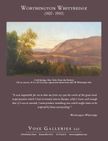
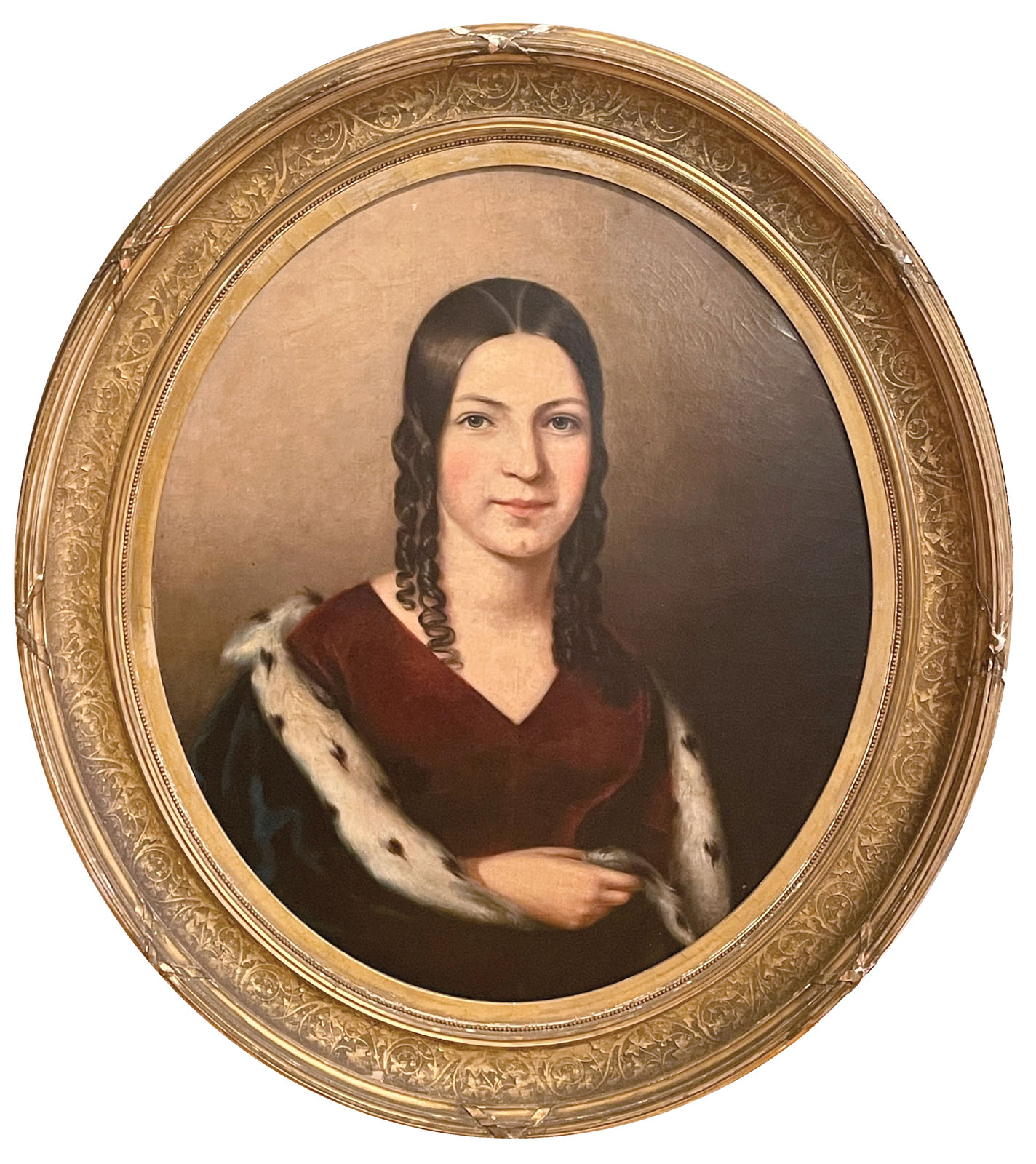 Sarah Miriam Peale (1800-1885), Portrait of Mary Catherine Dail, ca. 1840-1845. Oil on canvas, 29½ x 24½ in. Courtesy Lincoln Glenn Art Gallery.
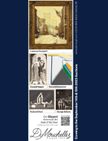
Guy C. Wiggins (1883-1962)
Wall Street, Winter
The New York City snow scenes of American impressionist Guy C. Wiggins (1883-1962) are nearly as iconic as the landmarks they depict. In Wall Street, Winter, Wiggins captures the historic Federal Hall building with its distinctive Doric colonnade and bronze statue of George Washington blanketed in snow. Trinity Church appears as a silhouette in the background framed between the marble facades of two buildings decked in American flags.
A Brooklyn native, Wiggins received his formal artistic training at the National Academy of Design under William Merritt Chase and later studied under Robert Henri. At the age of 20, Wiggins became the youngest artist to have his work accepted into the permanent collection of the Metropolitan Museum of Art. His work can be found in the collections of many prominent institutions including the White House.
Hawthorne Fine Art
New York, NY • By appointment only • (212) 731-0550 • www.hawthornefineart.com
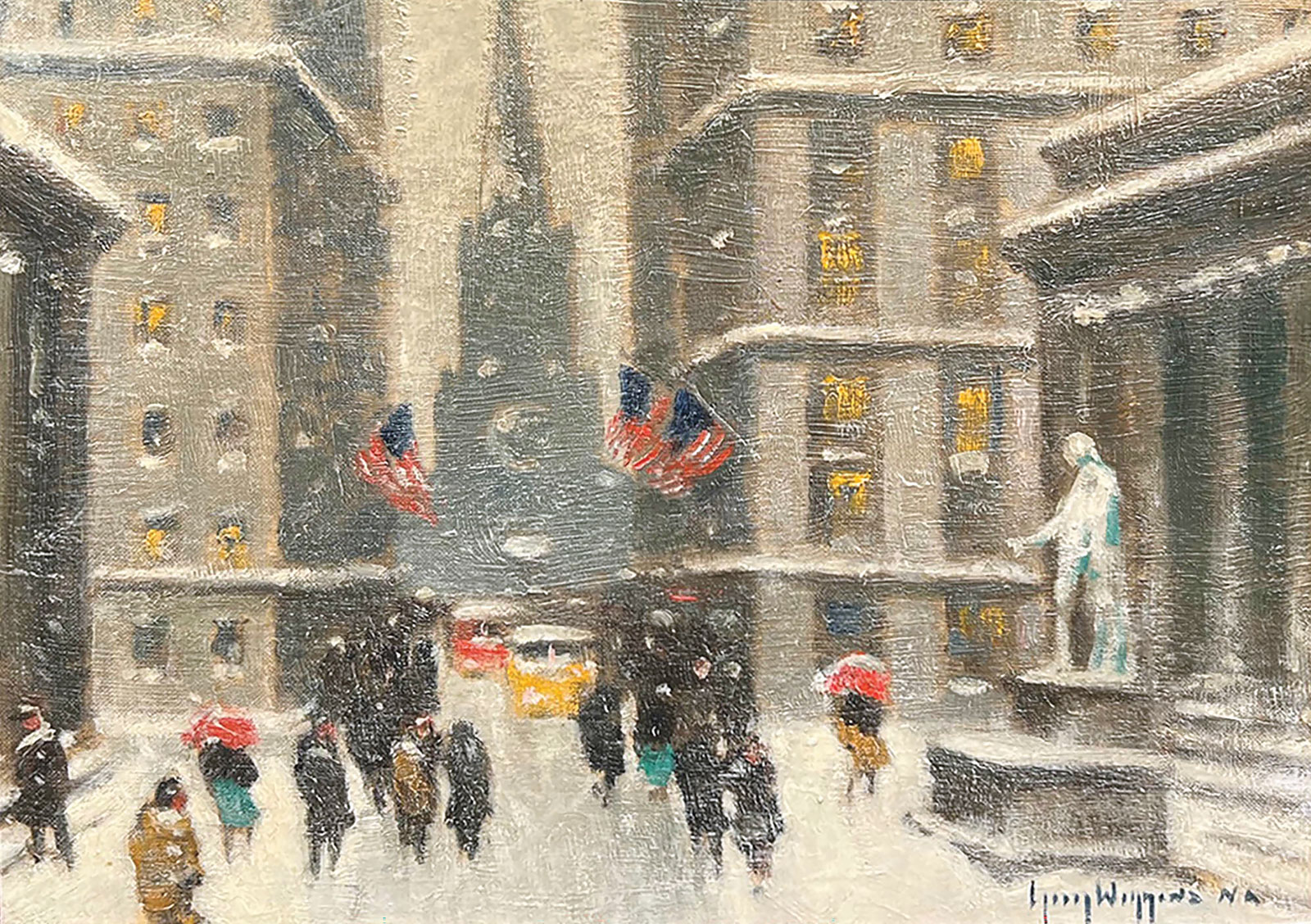 Guy C. Wiggins (1883-1962), Wall Street, Winter. Oil on canvas, 12 x 16 in., signed lower right; signed and inscribed with title on verso. Courtesy Hawthorne Fine Art.
Sarah Miriam Peale (1800-1885)
Portrait of Mary Catherine Dail
Sarah Miriam Peale was the first professional female artist in America and a member of the well-known Peale artist family. Her career spanned nearly 60 years, and she supported herself financially and successfully competed with male painters of that time including John Wesley Jarvis, Thomas Sully and Jacob Eichholtz. The painting’s provenance dates back to the sitter’s father. Mary Catherine Dail (1826-1904) was born in Cambridge, Maryland, and was the daughter of Daniel Dail (1791-1863), a Baltimore architect and builder. In the portrait, one of five commissioned works by Peale of members of the Dail Family, the sitter is dressed in fashionable ermine. According to John Mahey, after moving from Philadelphia, Peale painted more than 100 portraits during her Baltimore years before relocating to St. Louis, of which only 75 were identified by 1967, including the present work.
Lincoln Glenn
17 E. 67th Street, Suite 1A • New York, New York 10065
126 Larchmont Avenue • Larchmont, NY 10538 (914) 315-6475 • www.lincolnglenn.com
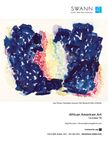
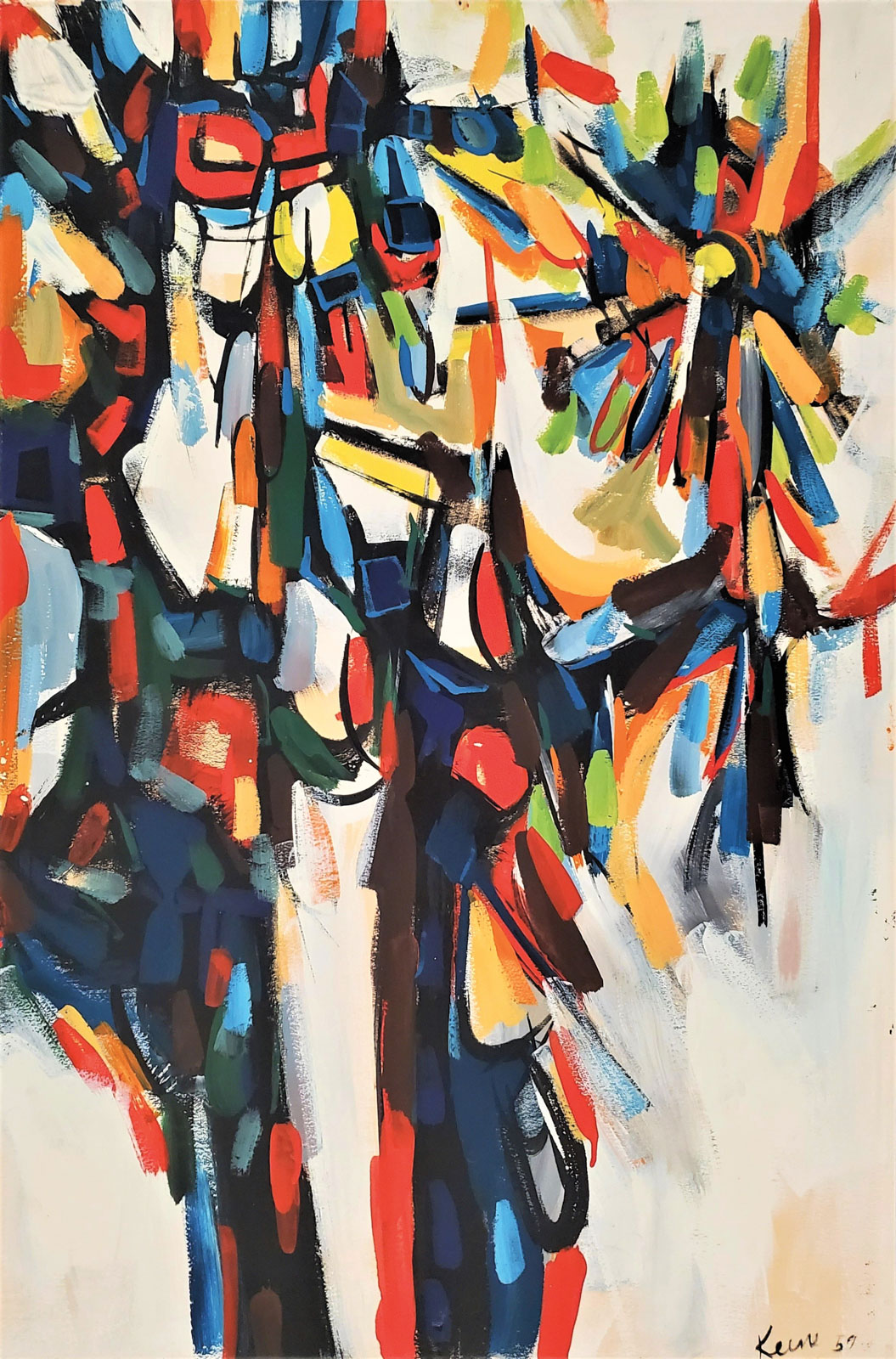 Paul F. Keene (1920-2009), Untitled, 1959. Oil on panel, 30 x 20 in. Courtesy J. Kenneth Fine Art.
Paul F. Keene (1920-2009)
Untitled
Paul Farwell Keene, Jr. was a Philadelphia-area artist and teacher whose work helped raise the visibility of Black American artists. As a self-described “abstract realist,” his story reflects both the accomplishments and the difficulties of African American artists in the 20th century. With color being central to his compositions, Keene explored the symbolism of African American life and culture. He created new icons of black urban life with his portraits of jazz musicians and documentation of the movement and vitality present in city life. In addition to window scenes and landscape studies, he often utilized grid-based compositions juxtaposed against concentric circles of radiating color that the artist saw as his unconscious, personal symbol.
J. Kenneth Fine Art
668 N. Palm Canyon Drive • Palm Springs, CA 92262 (802) 540-0267 • www.jkennethfineart.com
Powered by Froala Editor