A recent and significant acquisition of 29 artworks by the Asheville Art Museum has yielded a comprehensive conversation of late 19th through 21st-century trends, recognizing both national and regional artists. This includes the works of female artists like that of Claude Raguet Hirst’s (1855-1942) Roses—exemplifying her talents in the still life genre. Hirst exhibited under the male version of her name (born Claudine) “in order to access presentations of her painting in public settings,” say museum representatives.
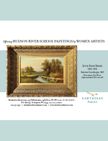
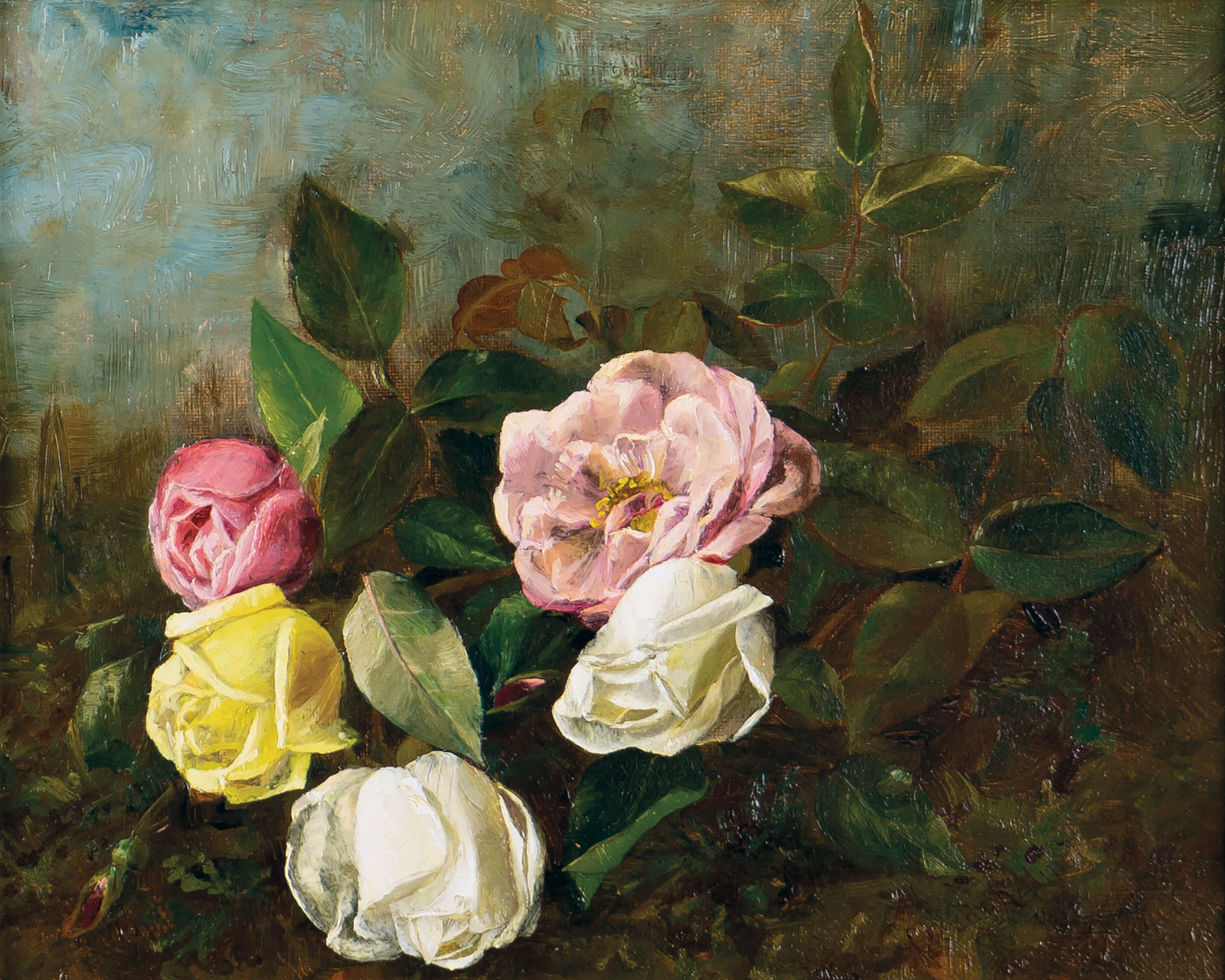 Claude Raguet Hirst (1855-1942), Roses, 1881. Oil on canvas, canvas: 8½ x 10½ in., frame: 157⁄8 x 18 in. Museum purchase with funds provided by 2022 Collectors’ Circle members Vito Lenoci and Frances Myers, 2022.43.01.
Born in Cincinnati, Ohio, Hirst attended the University of Cincinnati’s McMicken School of Design. Eventually moving to New York City, where “she studied privately and built her reputation as a skillful painter of fruit and floral still lifes,” according to the museum. Hirst also established her own studio in Union Square and excelled in painting in watercolor.
While the artist became known for undertaking very different subject matter and technique, Roses is an example of these early years she lived and worked in New York. “The image characterizes an important stage of her career before she turned to a more masculine subject,” reads the museum press release. Such subjects usually included the leisure activities more associated with the “male pastime,” featuring scenes involving pipes and hunting.
The museum goes on to note that “[Roses] engages important conversations in the history of modernism, and its subject demonstrates important trends in American art history at the turn of the 20th-century.”
Eventually, in her 60s, Hirst returned to subject matter more akin to Roses and “lightened her palette and rejected the pipes and masculine accessories.” Hirst was prolific in her artistic practice, continuing to “paint and exhibit into her eighties, [and] leaving a legacy of more than 100 still-life paintings.”
Roses is one of the earliest in the Asheville Art Museum collection created by a woman, and the museum feels that it’s important in the “conversation with all subjects in painting at the turn of the 20th-century.”
Powered by Froala Editor