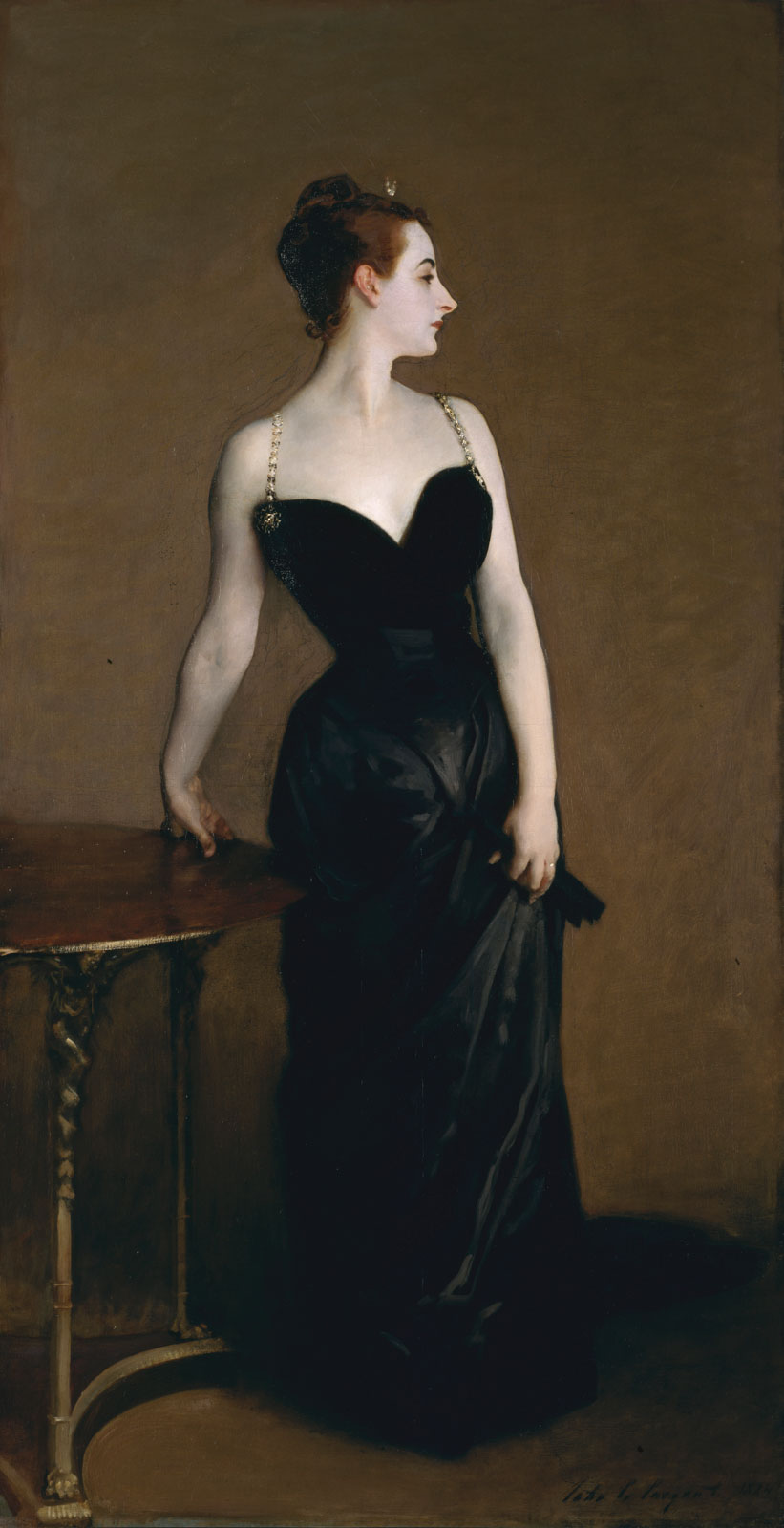
 John Singer Sargent (1856–1925), Madame X (Madame Pierre Gautreau [Virginie Amélie Avegno]), 1883-84. Oil on canvas, 821⁄8 x 43 ¼ in. The Metropolitan Museum of Art, New York. Arthur Hoppock Hearn Fund, 1916, 16.53. Image copyright © The Metropolitan Museum of Art. Image source: Art Resource, NY.
Hirshler is Croll Senior Curator of American Paintings at the Museum of Fine Arts, Boston, and Finch is assistant curator of 19th Century British Art at Tate Britain.
Organized with Tate Britain, the exhibition will be on view at the Museum of Fine Arts, Boston October 8 through January 15, 2024. The museum notes, “Alongside about 50 paintings by Sargent, over a dozen period garments and accessories shed new light on the relationship between fashion and this beloved artist’s creative practice. In addition to style icons like Madame X, Lady Agnew of Lochnaw and Dr. Pozzi at Home, the exhibition brings together several paintings with the garments worn by the sitters, among them Ellen Terry as Lady Macbeth with her beetle-wing encrusted costume, and Mrs. Charles Inches (Louise Pomeroy) with her red velvet evening gown. Visitors are invited to step into the making of a Sargent portrait and consider ideas of curating—and controlling—one’s image.”
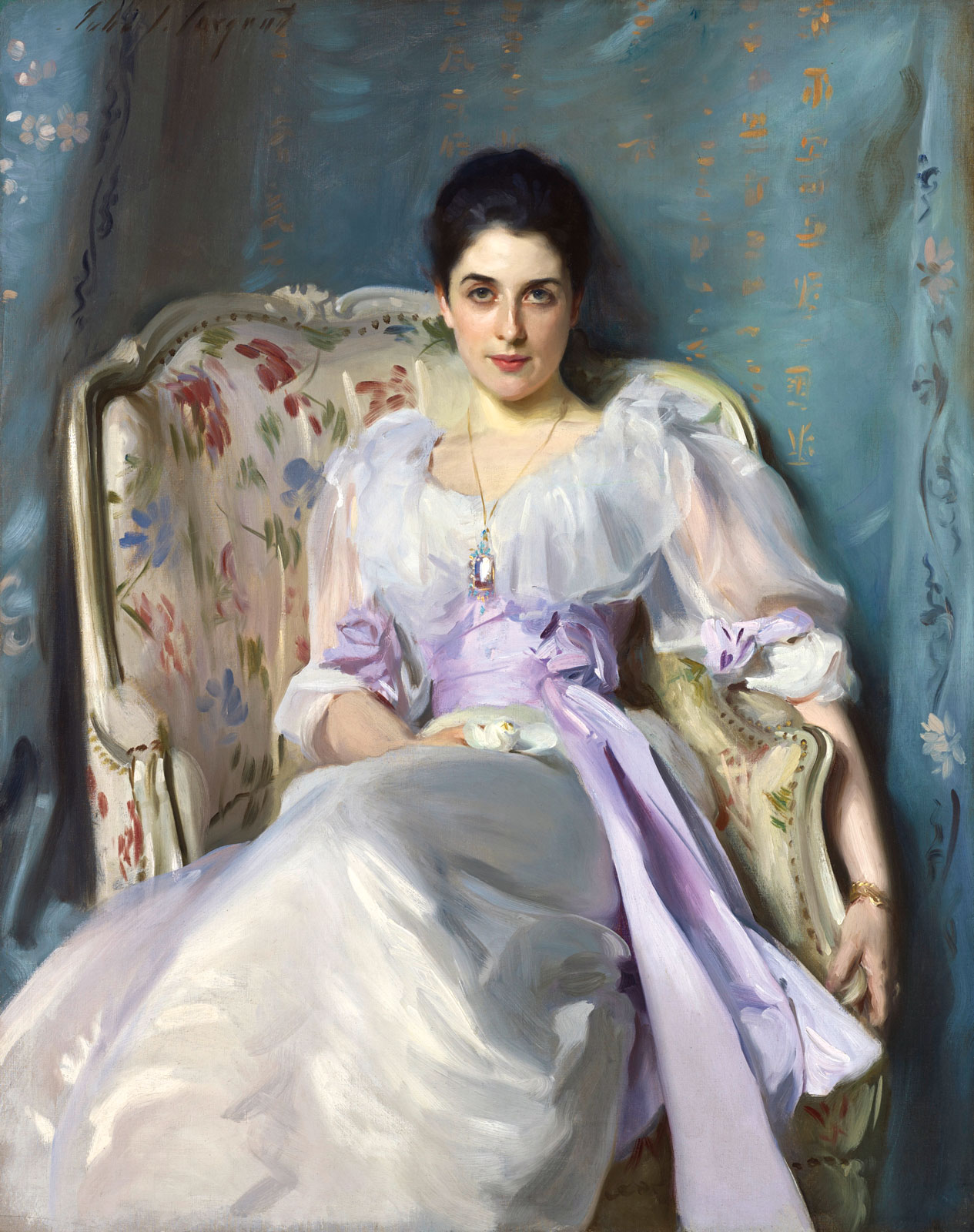 John Singer Sargent (1856–1925), Lady Agnew of Lochnaw (Gertrude Vernon), 1892. Oil on canvas, 49 ½ x 39 ½ in. National Gallery of Scotland, purchased with the aid of the Cowan Smith Bequest Fund, 1925, NG 1656. Courtesy, Museum of Fine Arts, Boston.
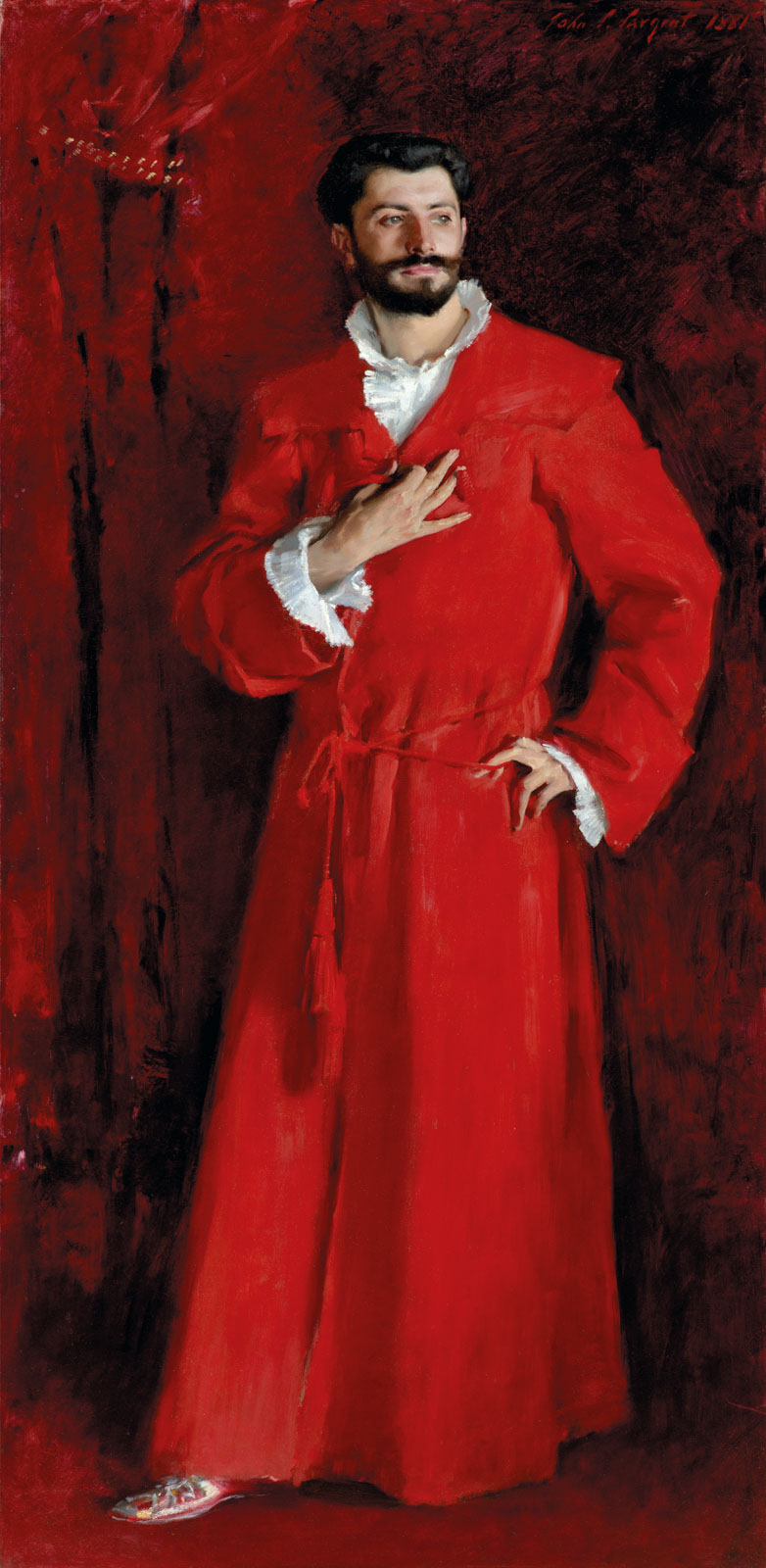 John Singer Sargent (American, 1856–1925), Dr. Pozzi at Home, 1881. Oil on canvas, 79 3⁄8 x 40 ¼ in. The Armand Hammer Collection, Gift of the Armand Hammer Foundation. Hammer Museum, Los Angeles. Courtesy Museum of Fine Arts, Boston.
John Singer Sargent (1856–1925) was the preeminent society portrait painter of his time. He has been both deified and dismissed. Born in Florence to ex-patriot American parents, he rose to the heights of society portraiture and became swallowed up by the progressive art movements of the early 20th century.
Isabella Stewart Gardner and her husband Jack were introduced to Sargent by the novelist Henry James in October 1886. He took them to Sargent’s London studio to see his provocative portrait, Madame X, now in the Metropolitan Museum of Art. Sargent had painted the portrait to enhance his reputation but, as the museum notes, “At the Salon of 1884, the portrait received more ridicule than praise.”
Mrs. Gardner loved it and invited Sargent to visit her home in Boston to paint her portrait. Beginning in December of 1887, Sargent struggled to capture his restless sitter. The finished portrait depicted her raised eyebrows (a bit too much décolletage to begin with) and Jack Gardner never allowed it to leave their home again nor to be shown there while he was alive. It now hangs in the Gothic Room of the Isabella Stewart Gardner Museum, their home in Boston.
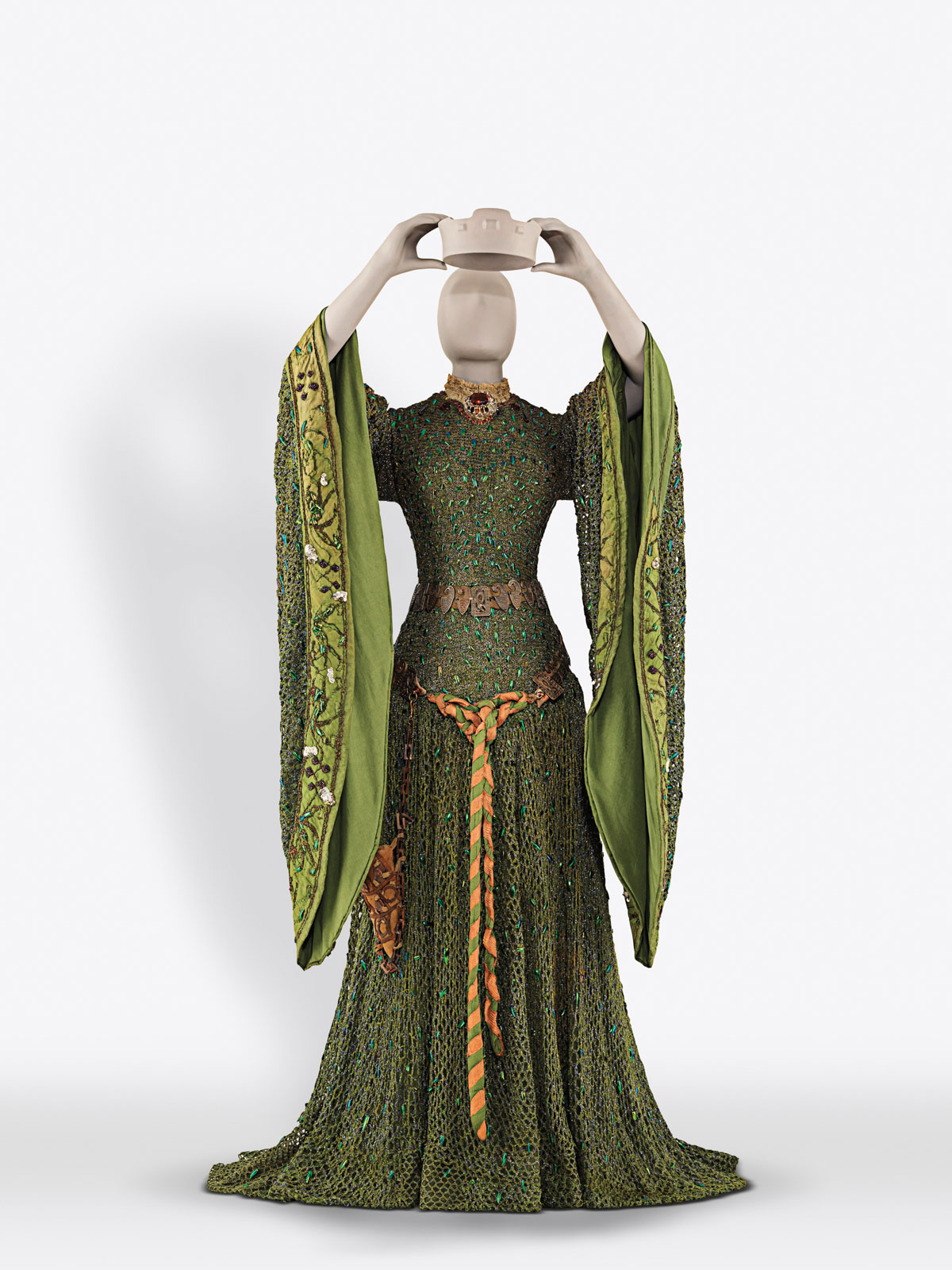 Alice Laura Comyns-Carr (1850-1927), cloak for the “Beetle Wing Dress” for Lady Macbeth, 1888. Velvet, silk damask, cotton, metal, glass Length: 88 5⁄8 in. National Trust, UK (Smallhythe Place, Kent) Photograph © National Trust Images/ Andrew Fetherston.
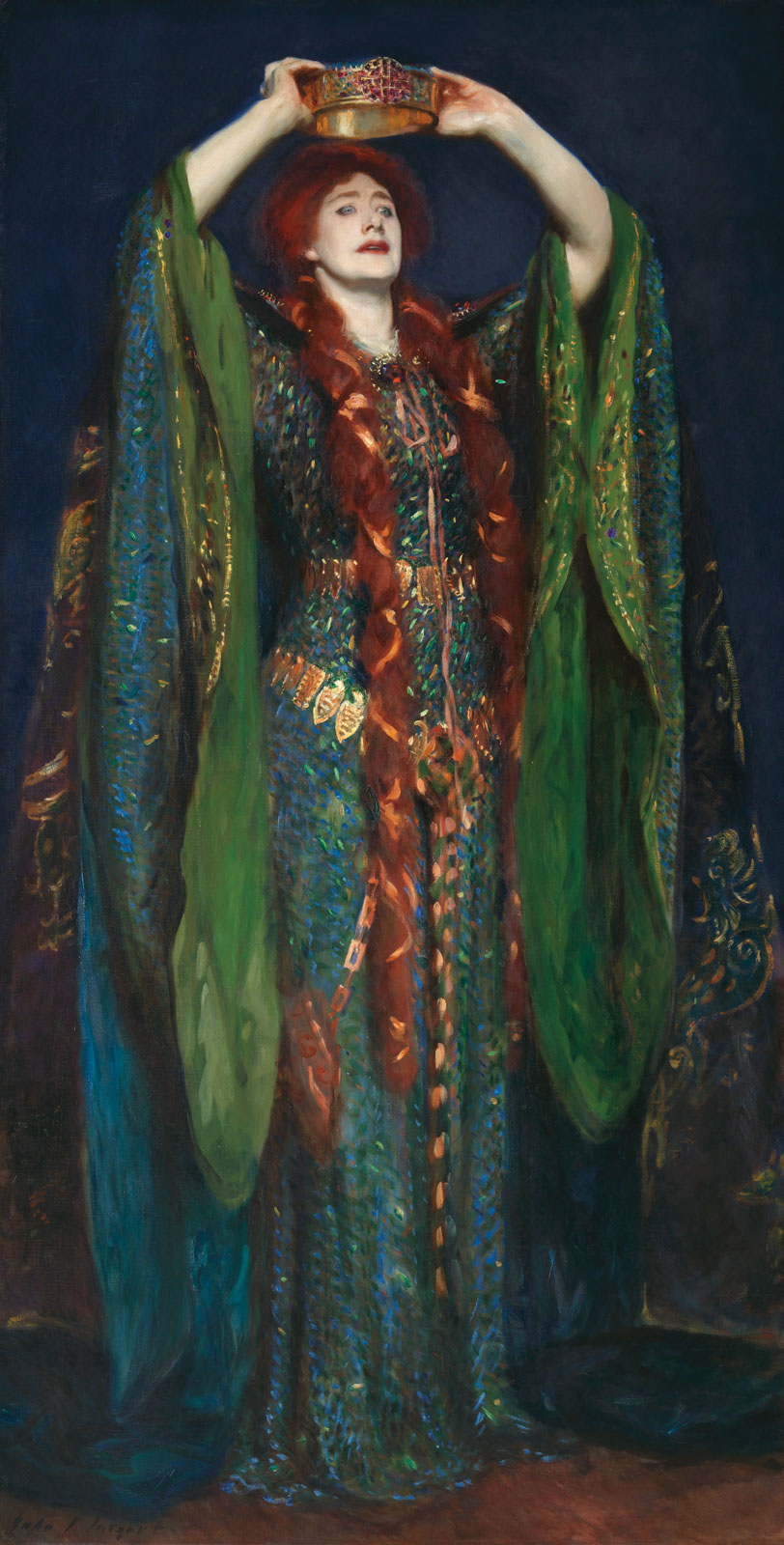 John Singer Sargent (1856–1925), Ellen Terry as Lady Macbeth, 1889. Oil on canvas, 87 x 45 in. Tate Britain Presented by Sir Joseph Duveen (the elder), 1906. Photograph: Tate.
Mrs. Gardner invited Sargent to be her artist-in-residence, setting up a studio in the Gothic Room where he painted five portraits. One of them is Mrs. Fiske Warren (Gretchen Osgood) and Her Daughter Rachel, 1903. Mrs. Gardner and the actress, poet and singer were close friends.
In his catalog essay, Sitting for Sargent, Richard Ormond, the artist’s great-nephew, observes, “Mrs. Fiske Warren’s dress is said to have been borrowed from her sister-in-law, who was several sizes larger, while her daughter was simply draped in a length of material of the desired color and texture.”
Sargent attended the opening night of Shakespeare’s Macbeth starring Ellen Terry in 1888. Terry’s stage partner, Henry Irving, commissioned Sargent to do a portrait of his friend, requesting that she be painted wearing everyday clothes. Sargent convinced them both that he had to paint her in the spectacular beetle-wing robes that had captured his attention in the performance.
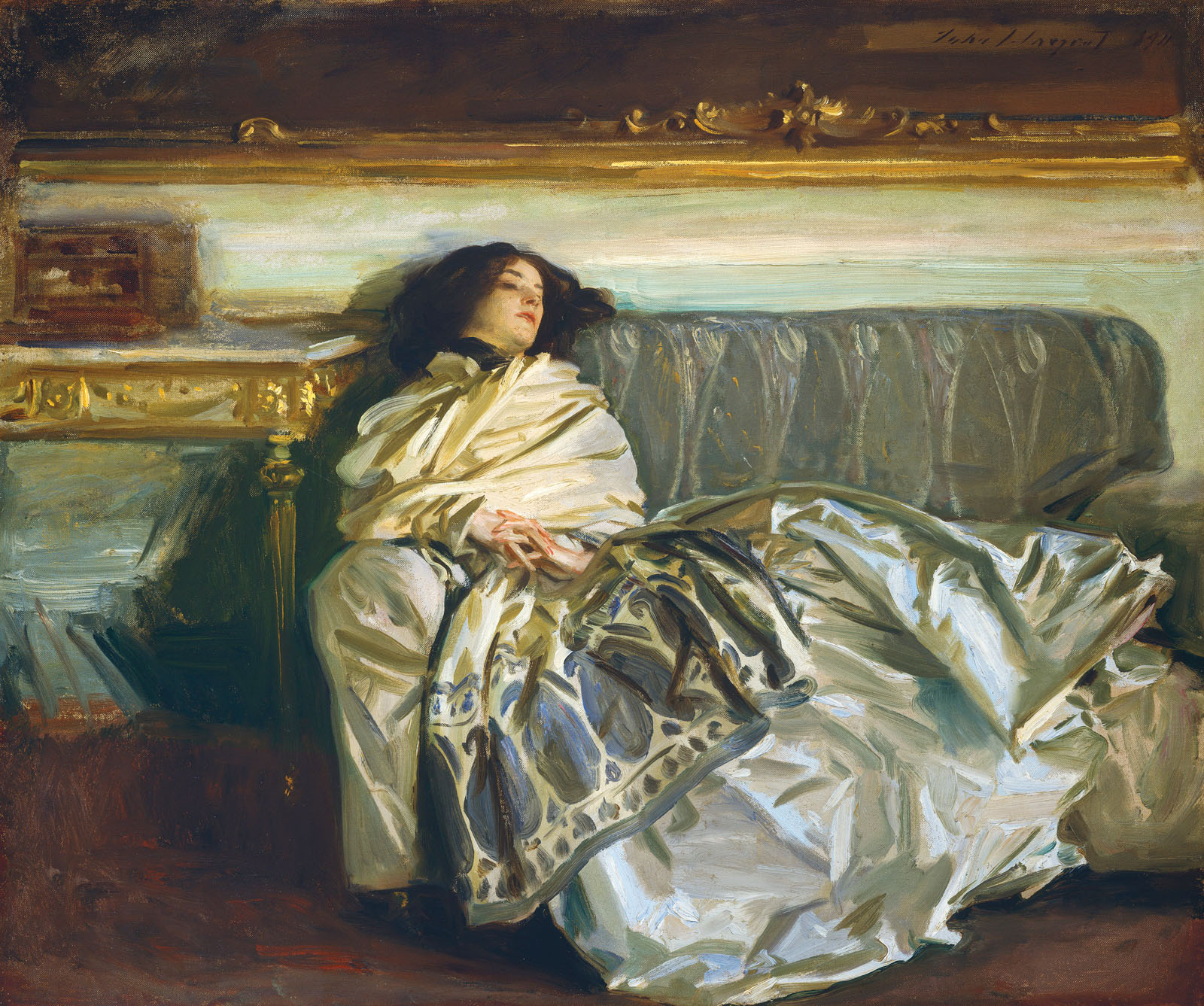 John Singer Sargent (1856–1925), Nonchaloir (Repose), 1911. Oil on canvas, 251⁄8 x 30 in. National Gallery of Art, Washington, DC. Gift of Curt H. Reisinger, 1948.16.1. Image courtesy National Gallery of Art, Washington, DC.
The costume designer Alice Comyns-Carr described the gown in detail. “It was cut from fine Bohemian yarn of soft green silk and blue tinsel…it was sewn all over with real green beetle wings and a narrow border of Celtic design worked out in [imitation] rubies and diamonds. To this was added a cloak of shot velvetin heather tones upon which griffins were embroidered in flame-colored tinsel. The wimple and veil was held in place by a circlet of [imitation] rubies and two long plaits twisted with gold hung to her knees.”
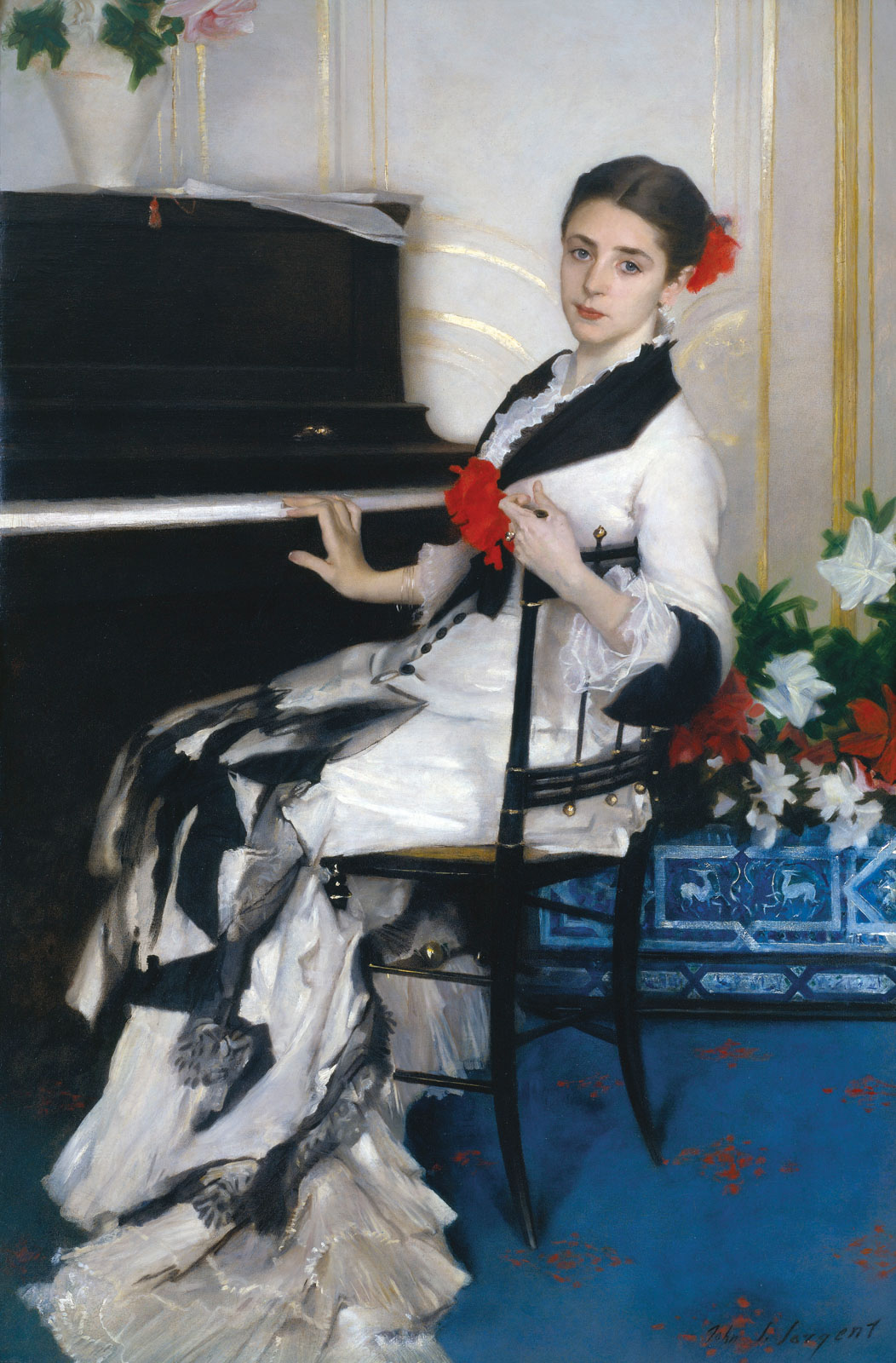 John Singer Sargent (1856–1925), Madame Ramón Subercaseaux (Amalia Errázuriz), 1880-81. Oil on canvas, 65 x 43 ¼ in. Sarofim Foundation. Photograph © The Museum of Fine Arts, Houston. Courtesy Museum of Fine Arts, Boston.
Sargent began to tire of formal portrait painting and often painted his niece and muse Rose-Marie Ormond. His 1911 painting of her, Nonchaloir (Repose), is in the collection of the National Gallery of Art in Washington, D.C. The museum notes, “In keeping with his newfound preference for informal figure studies, Sargent did not create a traditional portrait; rather, he depicted Rose–Marie as a languid, anonymous figure absorbed in poetic reverie. The reclining woman, casually posed in an atmosphere of elegiac calm and consummate luxury, seems the epitome of nonchalance—the painting’s original title. Sargent seems to have been documenting the end of an era, for the lingering aura of fin-de-siècle gentility and elegant indulgence conveyed in Repose would soon be shattered by massive political and social upheaval in the early 20th century.”
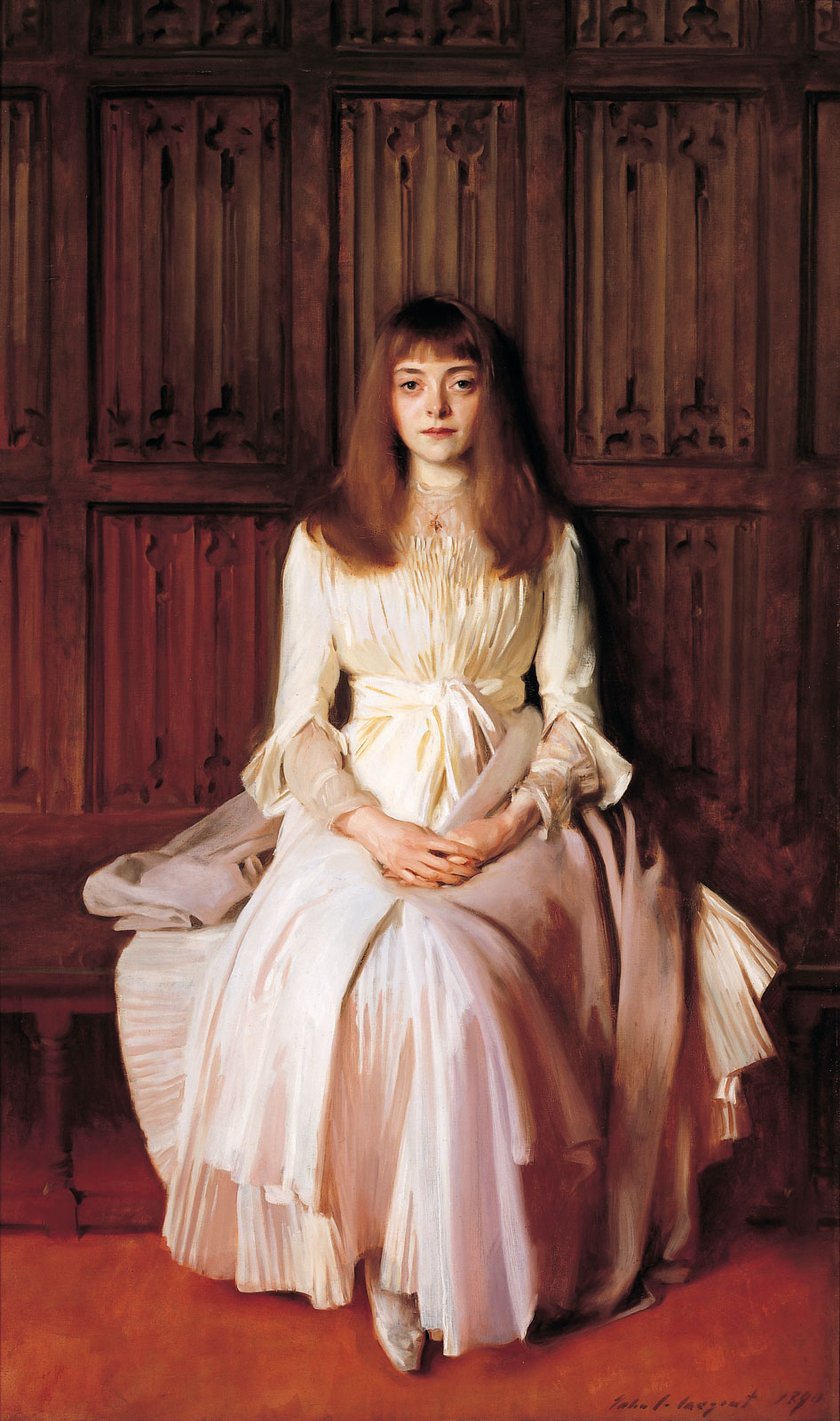 John Singer Sargent (1856–1925), Elsie Palmer, or A Lady in White, 1889-90. Oil on canvas, 75 1⁄8 x 451⁄8 in. Colorado Springs Fine Arts Center at Colorado College, Museum Purchase Fund Acquired through Public Subscription and Debutante Ball Purchase Fund, FA 1969.3.1. Courtesy Museum of Fine Arts, Boston.
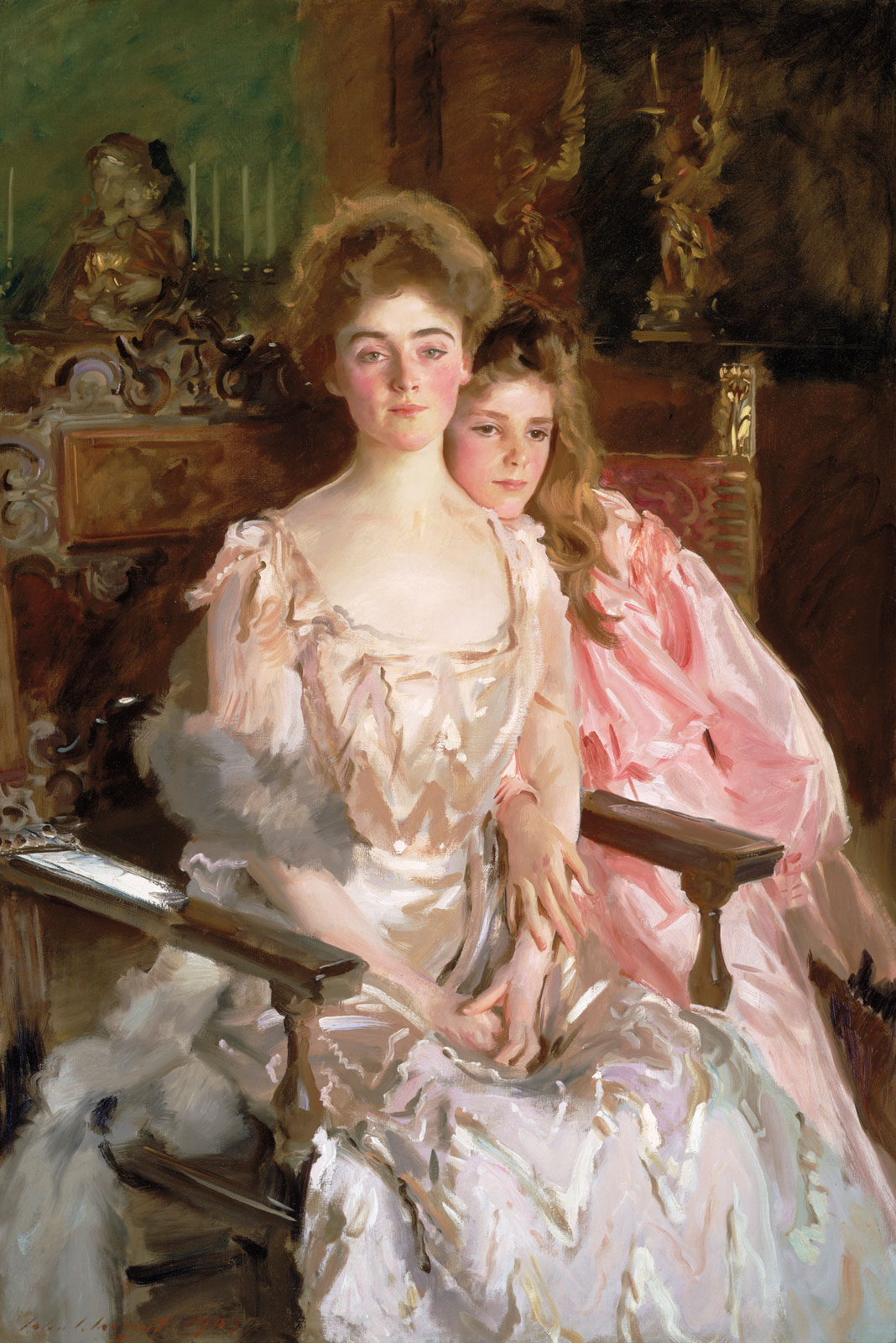 John Singer Sargent (1856–1925), Mrs. Fiske Warren (Gretchen Osgood) and Her Daughter Rachel, 1903. Oil on canvas, 60 x 40 3⁄8 in. Museum of Fine Arts, Boston. Gift of Mrs. Rachel Warren Barton and Emily L. Ainsley Fund, 1964, 64.693. Photograph © Museum of Fine Arts, Boston.
Rose-Marie is wrapped in a Kashmir shawl the pattern of which is repeated in the upholstery of the sofa. The shawl is in the exhibition. The critic Carter Ratcliff wrote that Sargent “presents a young woman as withdrawn into her mood as he is into the act of painting her. Artist and subject seem present to each other on terms resolved by the setting they share.”
In the early days of World War 1, Rose-Marie’s husband was killed in battle. On Good Friday in 1918, Rose-Marie was attending a concert in the Church of St. Gervais in Paris when a German bomb collapsed the roof and walls of the church, killing her and dozens of others. Hearing the news, Sargent said, “I can’t tell you how sorry I am…and how I feel the loss of the most charming girl who ever lived.”
October 8, 2023-January 15, 2024
Fashioned by Sargent
Museum of Fine Arts, Boston
465 Huntington Avenue, Boston, MA 02115
t: (617) 267-9300, www.mfa.org
Powered by Froala Editor