When the American artist James McNeill Whistler exhibited his impasto, soft-edged and beautifully bright Symphony in White at the Salon des Refusés of 1863, it attracted much attention from the press and people of Paris. The stunning painting was unmissable—prominently hung in a doorway so all the exhibit’s crowded visitors had to pass before it, a shocking contrast to the other works in the show. Critic Philip Hamerton described the impact it made, writing, “I watched several parties, to see the impression the ‘Woman in White’ made on them. They all stopped instantly, struck with amazement. This for two or three seconds; then they always looked at each other and laughed.”
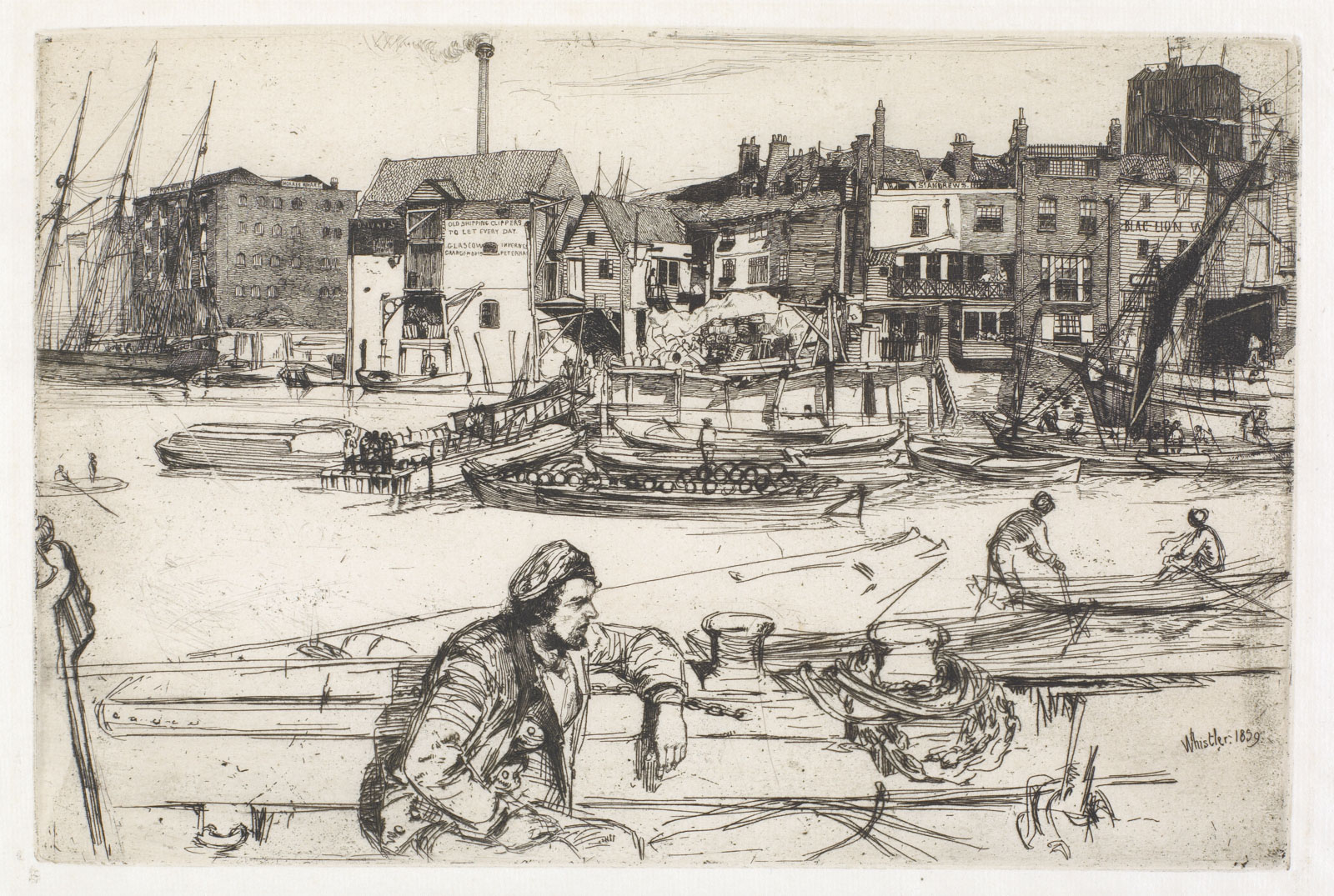 James Abbott McNeill Whistler (1834-1903), Black Lion Wharf, 1859. Etching in black ink on cream laid paper. Image: 57⁄8 x 87⁄8 in.; sheet: 615⁄16 x 915⁄16 in. The Lunder Collection, Colby College Museum of Art, 2013.323.
The 60 streetscapes by Whistler on view in the Davis Gallery at Colby College Museum of Art reveal a very different side of the painter’s complex personality. Whistler: Streetscapes, Urban Change was curated by David Park Curry, who selected paintings, etchings and drawings from the museum’s extensive holdings of the artist’s work, and wrote the catalog for the show. The exhibit focuses on drawings and paintings of urban streets of the fin de siècle, created as the artist witnessed the uncertain changes transforming the metropolitan life of the age.
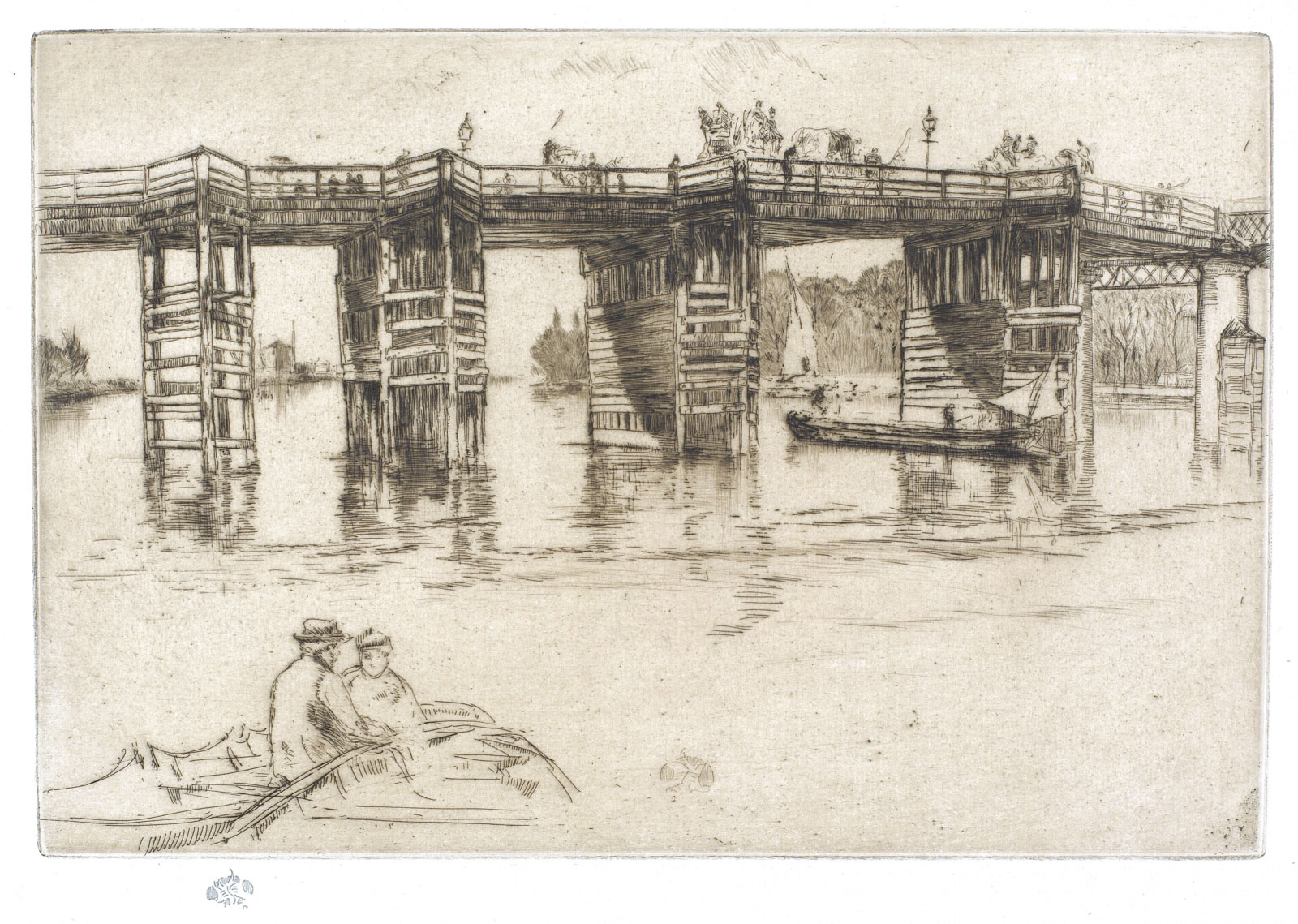 James Abbott McNeill Whistler (1834-1903), Old Putney Bridge, 1879. Etching and drypoint in dark brown ink on off-white laid paper; seventh (final) state, 7¾ x 11¾ in. The Lunder Collection, 2013.400.
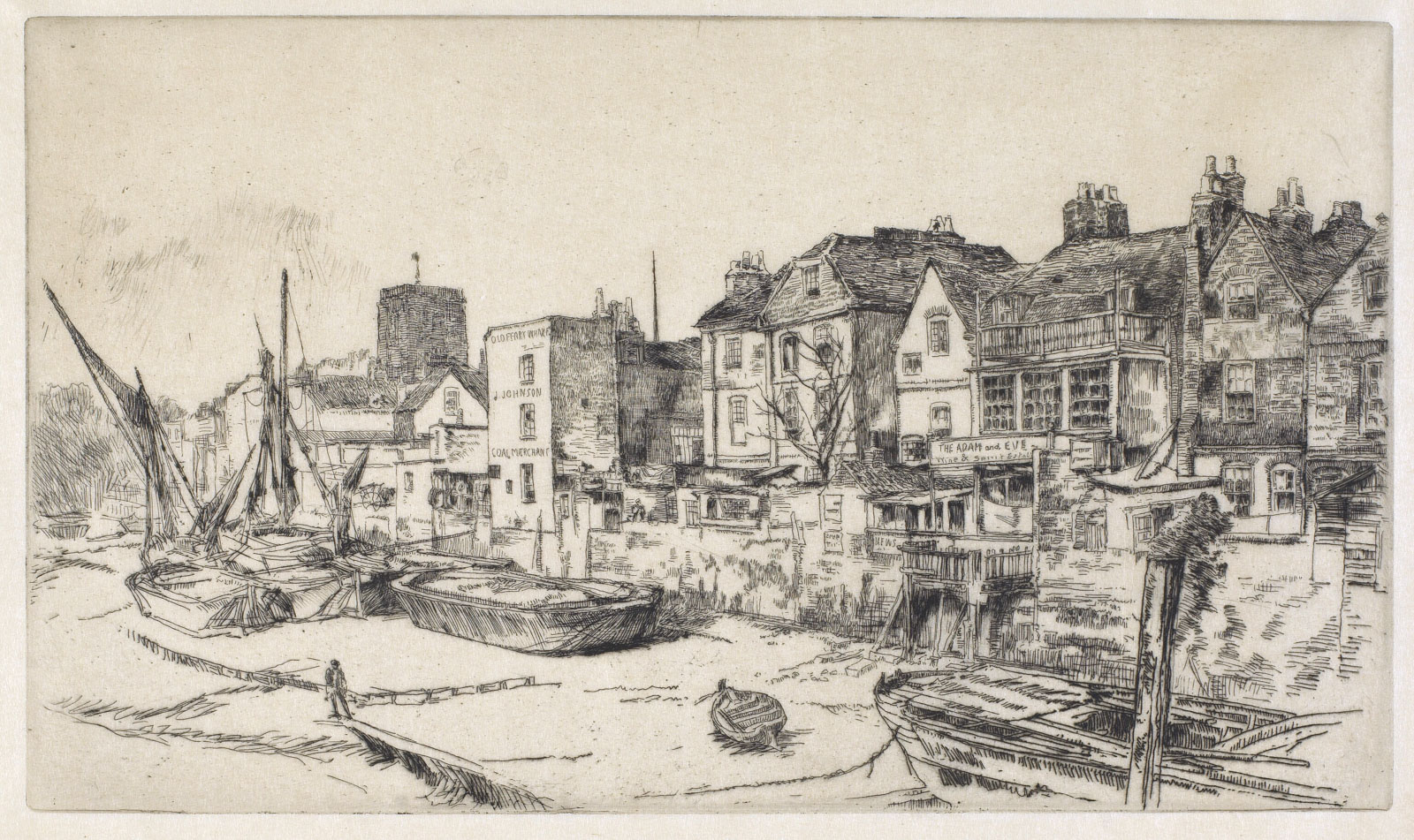 James Abbott McNeill Whistler (1834-1903), The ‘Adam and Eve’, Old Chelsea, 1879. Etching and drypoint in black ink on cream Japanese paper. 913⁄16 x 163⁄16 in. The Lunder Collection, Colby College Museum of Art, 2013.439.
Whistler, Henri Fantin-Latour, and Édouard Manet were the notorious stars of the Salon des Refusés, which transformed the art of the 19th-century—after it, the regular salons of the Academy would never again wield their exclusive power to rule the aesthetics of painting. After it, artists were liberated from the dogmas of academic dominance to sell their work directly to the rising middle-class audience. Whistler’s achievement was extraordinary. He is among the most significant American artists to appear in Western art history. He began the story of America’s dominance of modern art.
Born in Lowell, Massachusetts, Whistler rose to cutting-edge prominence as an expatriate artist in Paris and London. An obsessive sketcher, he captured many of the shopfronts and streetscapes close to where he lived and worked, but when he traveled to Venice, Amsterdam and Brussels, he also turned his sharp and selective eye to the changing faces of these great cities. His rich drawings of these vanished streets and businesses are important documents of a vanished past, as he captured many of these picturesque old neighborhoods soon before they were demolished. Curry explains, “Whistler’s diminutive shopfronts and streetscapes are packed with half-hidden references to the complex, changing urban culture in which he operated.” Paris was in a state of dramatic change, as the crowd and history of ancient neighborhoods was destroyed to create the delightful Paris of the new era, a new city of spacious parks and broad avenues. Whistler was always a modernist in his art, yet he gained a reputation as a champion of conservation.
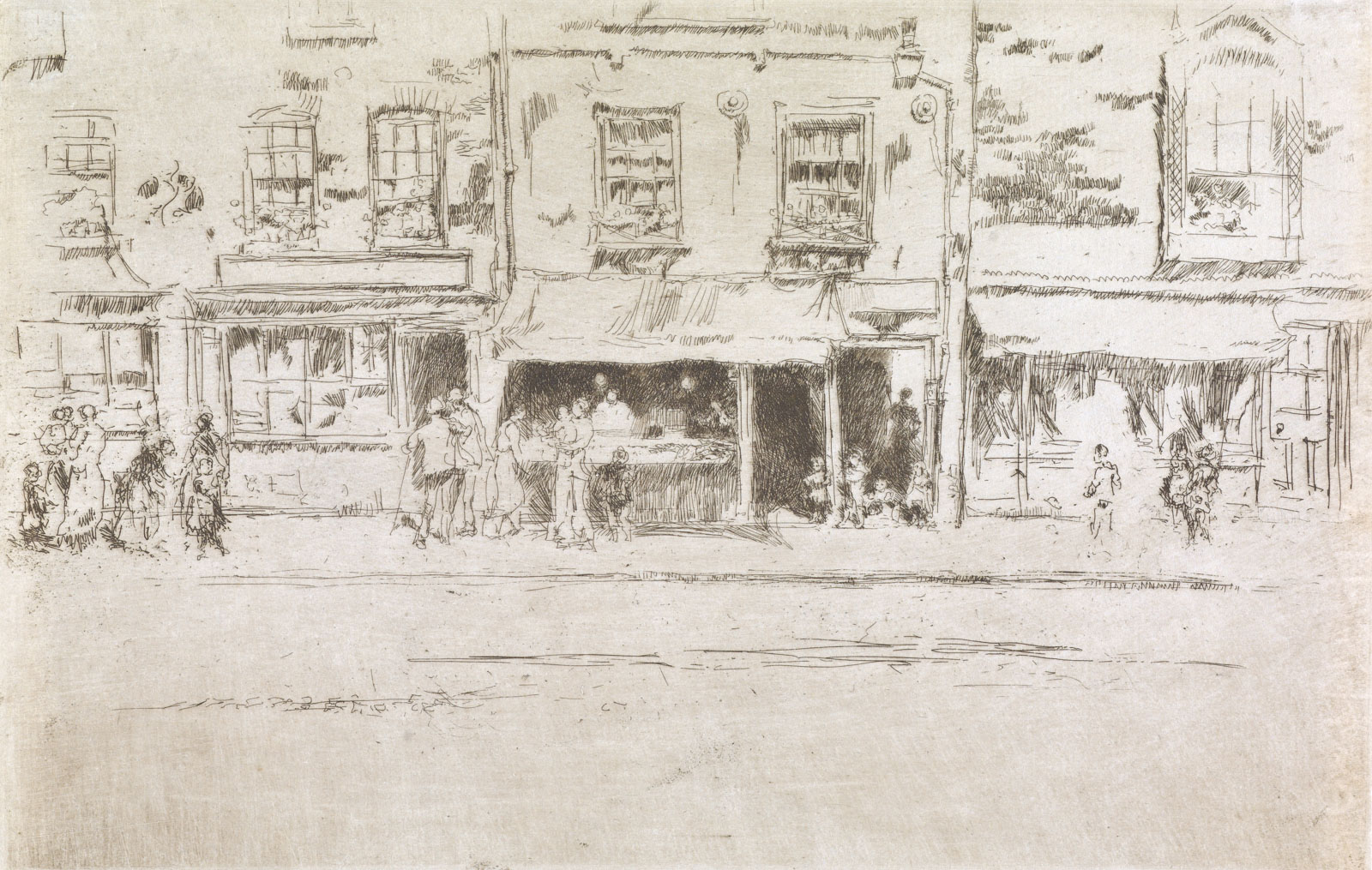 James Abbott McNeill Whistler (1834-1903), Fish Shop, Chelsea, 1886. Etching and drypoint in black ink on off-white laid paper, first state (of two). Colby College Museum of Art, The Lunder Collection, 2013.451. G.267, 22 impressions recorded, [book: fig. 52, p. 72].
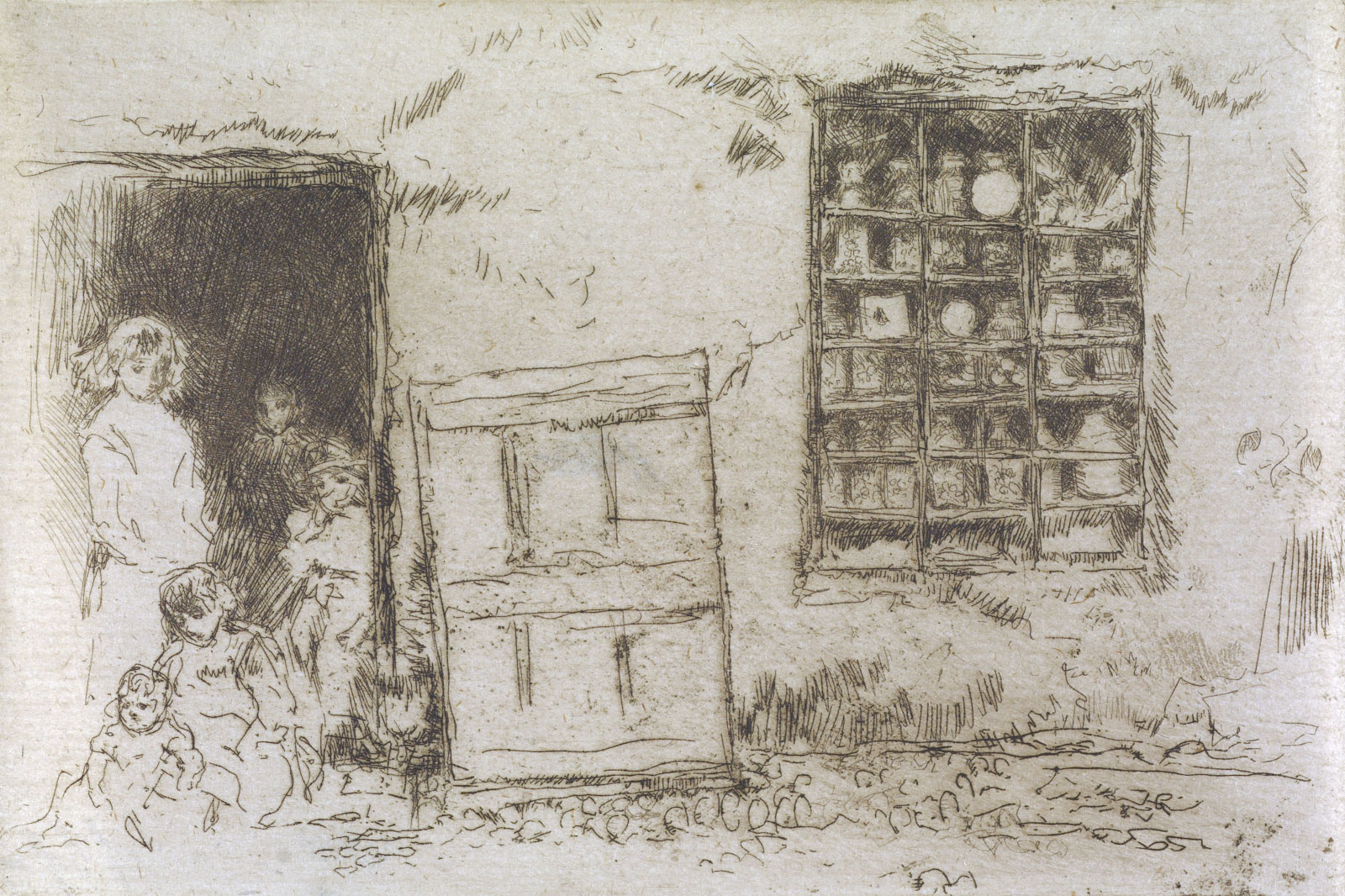 James Abbott McNeill Whistler (1834-1903), The Village Sweet Shop, 1886. Etching in dark brown ink on ivory laid paper, only state. Site: possibly Sandwich, Kent. Colby College Museum of Art, The Lunder Collection, 2013.486. G.266, 14 impressions recorded, [book: backmatter, p. 128].
The solid realism of Whistler’s etchings contrasts dramatically with celebrated paintings like Whistler’s famous Nocturne in Black and Gold—The Falling Rocket which he exhibited in 1877, and provoked the critic John Ruskin to famously exclaim, “I have seen, and heard, much of Cockney impudence before now, but never expected to hear a coxcomb ask two hundred guineas for flinging a pot of paint in the public’s face.”
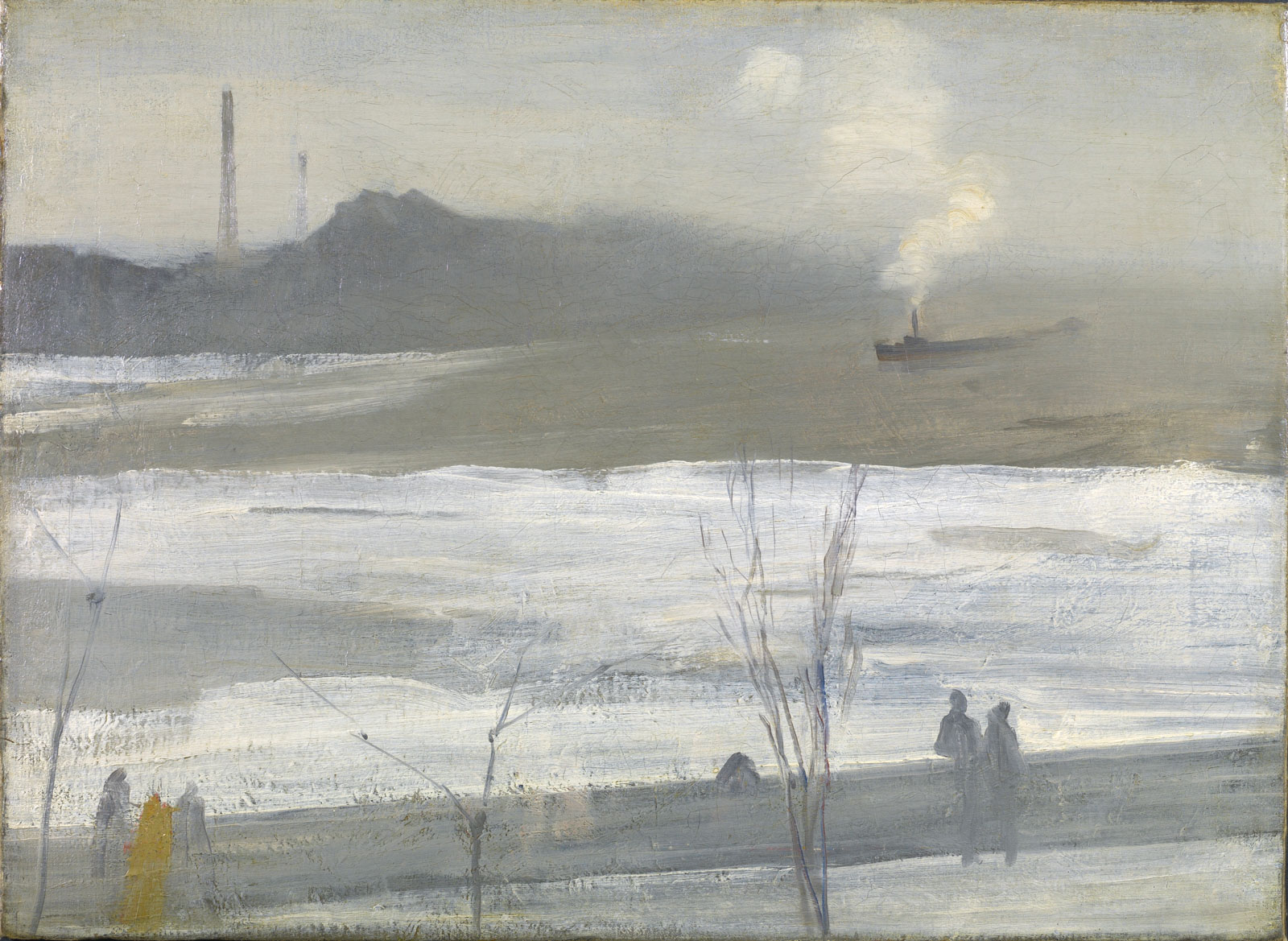 James Abbott McNeill Whistler (1834-1903), Chelsea in Ice, 1864. Oil on canvas, 17¾ x 24 in. The Lunder Collection, Colby College Museum of Art, 2013.293
Whistler sued Ruskin for libel. While he won only a farthing in compensation for his trouble, Whistler gained international publicity which cast him as a controversial innovator. Curry sees the realism of his streetscapes as the foundation for paintings like The Falling Rocket which gave him his notoriety as a prophet of modern art. “His art rewards scrutiny,” says Curry, who is also is author of James McNeill Whistler: Uneasy Pieces. “For each carefully staged image hints at the real world underlying his abstract compositions.”
The exhibit is a rare opportunity to see these fragile works on paper which can only be displayed for limited periods of time. The exhibition will travel to the Freer Gallery of Art at the National Museum of Asian Art, Smithsonian Institution, where it will be supplemented by the renowned Whistler collection established by Charles Lang Freer, with which Curry is intimately familiar.
Powered by Froala Editor