The range of American paintings in Art for the People: WPA-era Paintings from the Dijkstra Collection from, roughly, 1929 through the end of World War II is so rich that I feel certain I could write any number of essays on it without repeating myself. Collected by Sandra and Bram Dijkstra, University of San Diego, California, professor emeritus of American literature and culture, and author of American Expressionism: Art & Social Change, 1920-1950, the artists on view represent much of the nation during this time of tumult, hardship and resilience, expanding on the narrow art historical association of the period with the WPA artists.
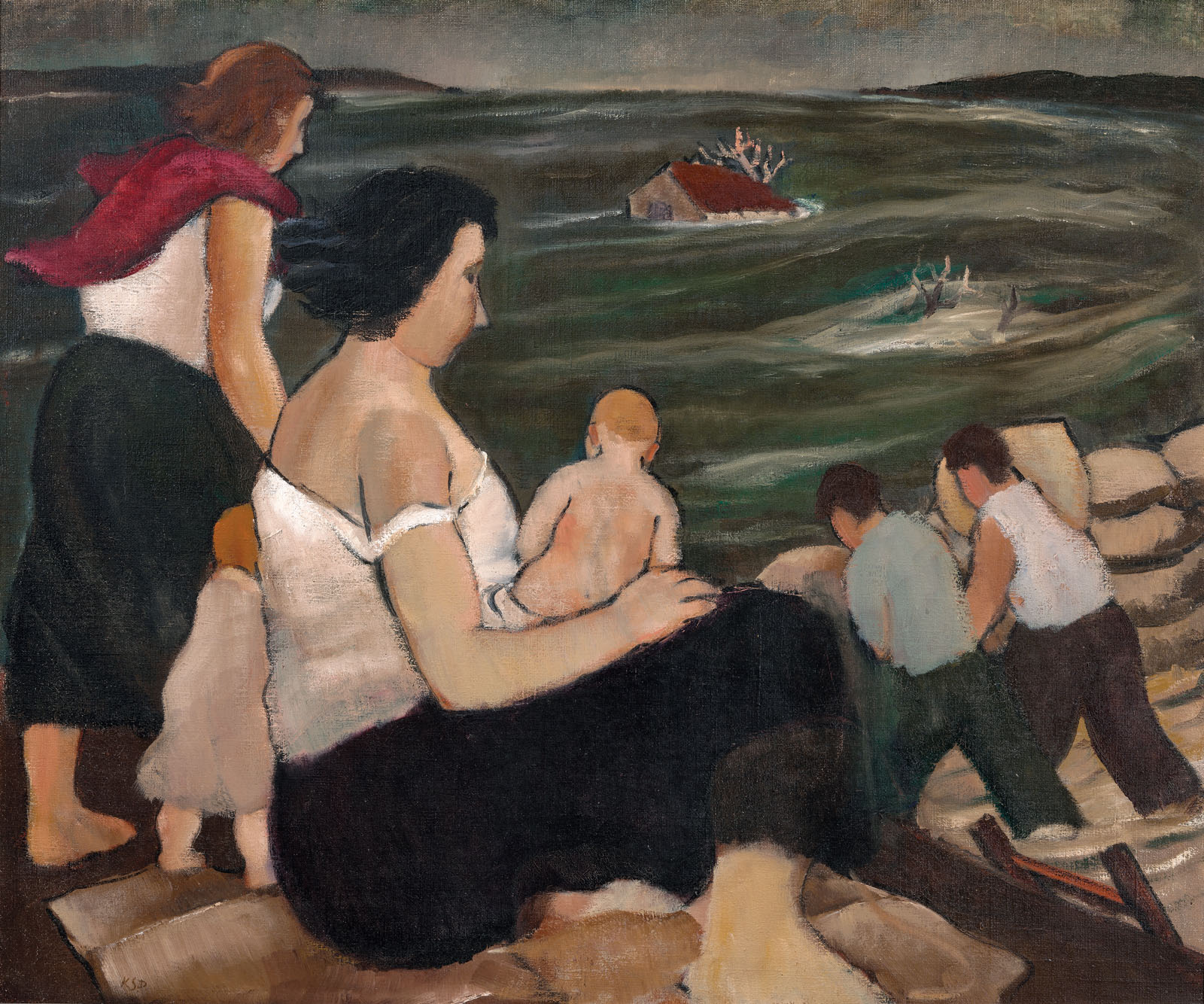 Arthur Durston (1897-1938), The Flood, ca. 1934. Oil on canvas, 30 x 36 in. From the collection of Sandra and Bram Dijkstra.
Even a quick survey of the artworks demonstrates that socio-economic tumult engendered artistic ferment. Social realism emerges as only a single aspect of American art of the era. Painting span the poles: real and surreal; impressionistic and expressionistic; boldly political, subversive, art for art’s sake beauty; muralistic and intimate; illustrative and non-objective. Through each work, a deep humanistic current runs, something like a bass line in a symphony. Even where the works seem, on the surface, to be ironic, empathy shimmers at their core. As I look at them, I want to amend the term “social realism” and rename it “communal realism” because the feeling of empathy between viewers, subjects and artists creates a kind of provisional, temporary community, one in which mutual aid is an organic social norm. Somehow—in ways that ought to be explored neurologically as well as aesthetically—even the most abstract works communicate our shared humanity. It’s a feeling we would all do well to remember.
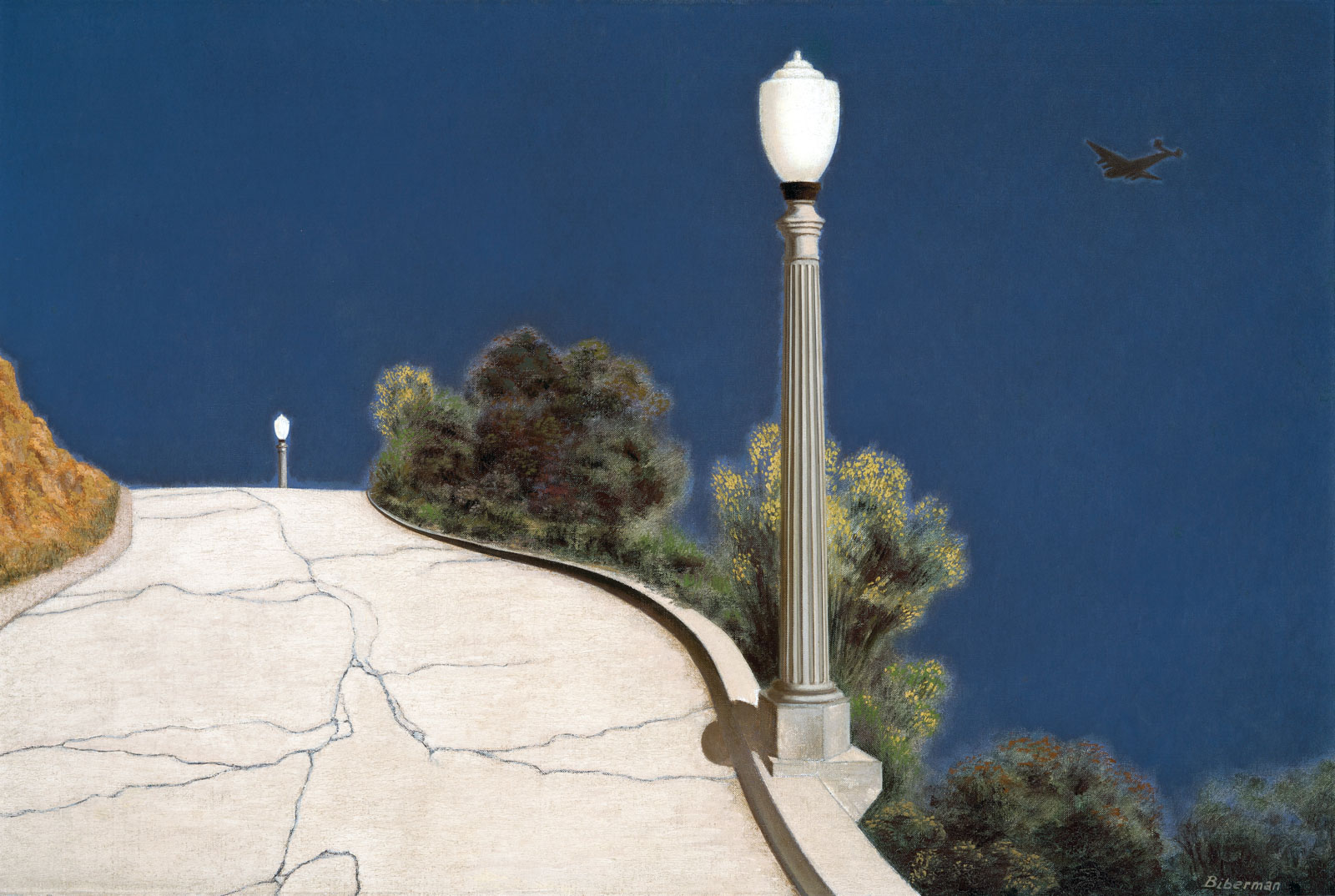 Edward Biberman (1904-1986), Slow Turn, 1945. Oil on canvas, 20 x 30 in. From the collection of Sandra and Bram Dijkstra.
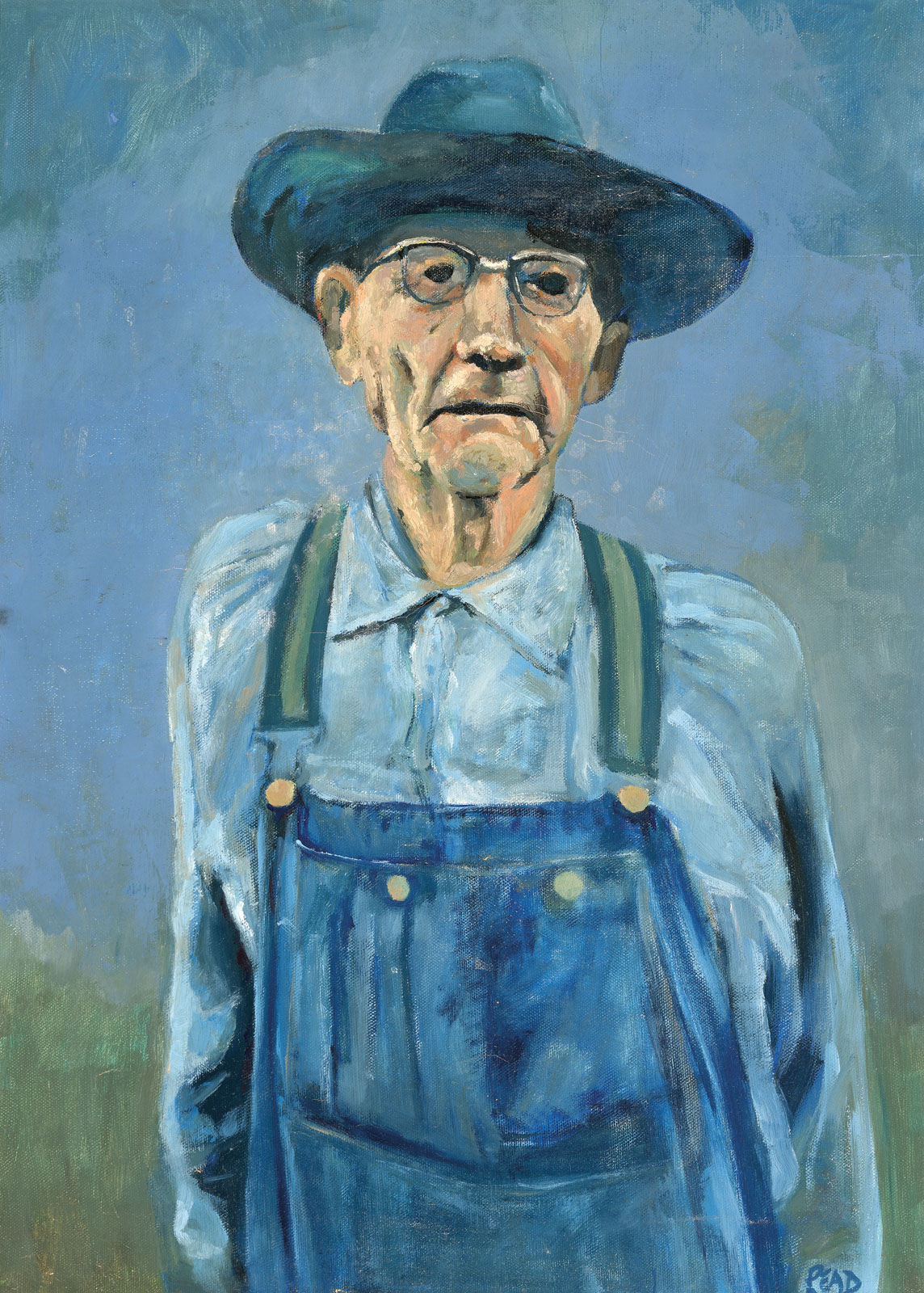 Helen Appleton Read (1887–1974), Portrait of a Midwest Farmer, ca. 1940. Oil on canvas, 24 x 17 in. From the collection of Sandra and Bram Dijkstra.
Art for the People: WPA-Era Paintings from the Dijkstra Collection is now view at its final stop at the Oceanside Museum of Art in Oceanside, California, though I suspect the exhibition will have many lives. I grew up in the Midwest, in Milwaukee, whose industrial roots found themselves in sync with the WPA program, linked as it was to the public art campaigns of Mexican muralists like Diego Rivera, David Siquieros and others. Mine is a blue-collar family that nevertheless loved and made art. My parents sang in the opera and performed in plays; my eldest brother is a painter and my uncle, Donald Humphrey, was a WPA artist who was given commissions to paint two murals—one in Spring Green, Wisconsin, the other in St. Paul, Minnesota—that are there for all to see to this day.
The murals celebrate labor and laborers, valorizing work in a technique that dates back to Egyptian and Greco-Roman wall friezes. By extension, all the WPA works that celebrate labor—at least, those I know of—are, at the same time, inherently critical of the political and economic systems that exploit workers and the land, extracting excessive profits that lead to the backbreaking hardships of recessions and depressions. In short, there are edges in the works in the Dijkstra Collection, ironies, codes, meanings within meanings, moments that shock, absences that speak volumes.
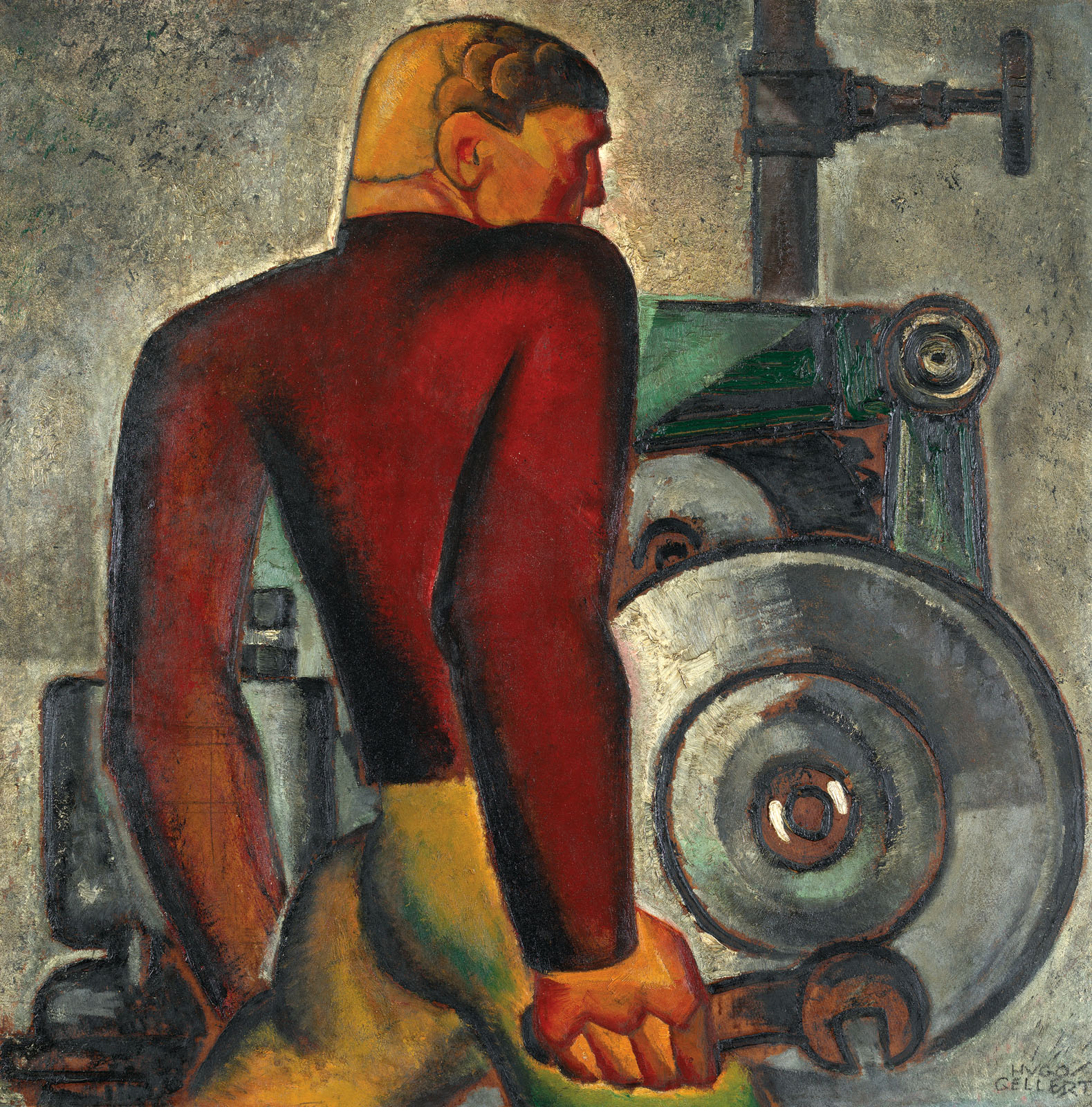 Hugo Gellert (1892-1985), Worker and Machine, 1928. Oil on panel, 30 x 31 in. From the collection of Sandra and Bram Dijkstra. © Hugo Gellert; Courtesy of Mary Ryan Gallery, New York.
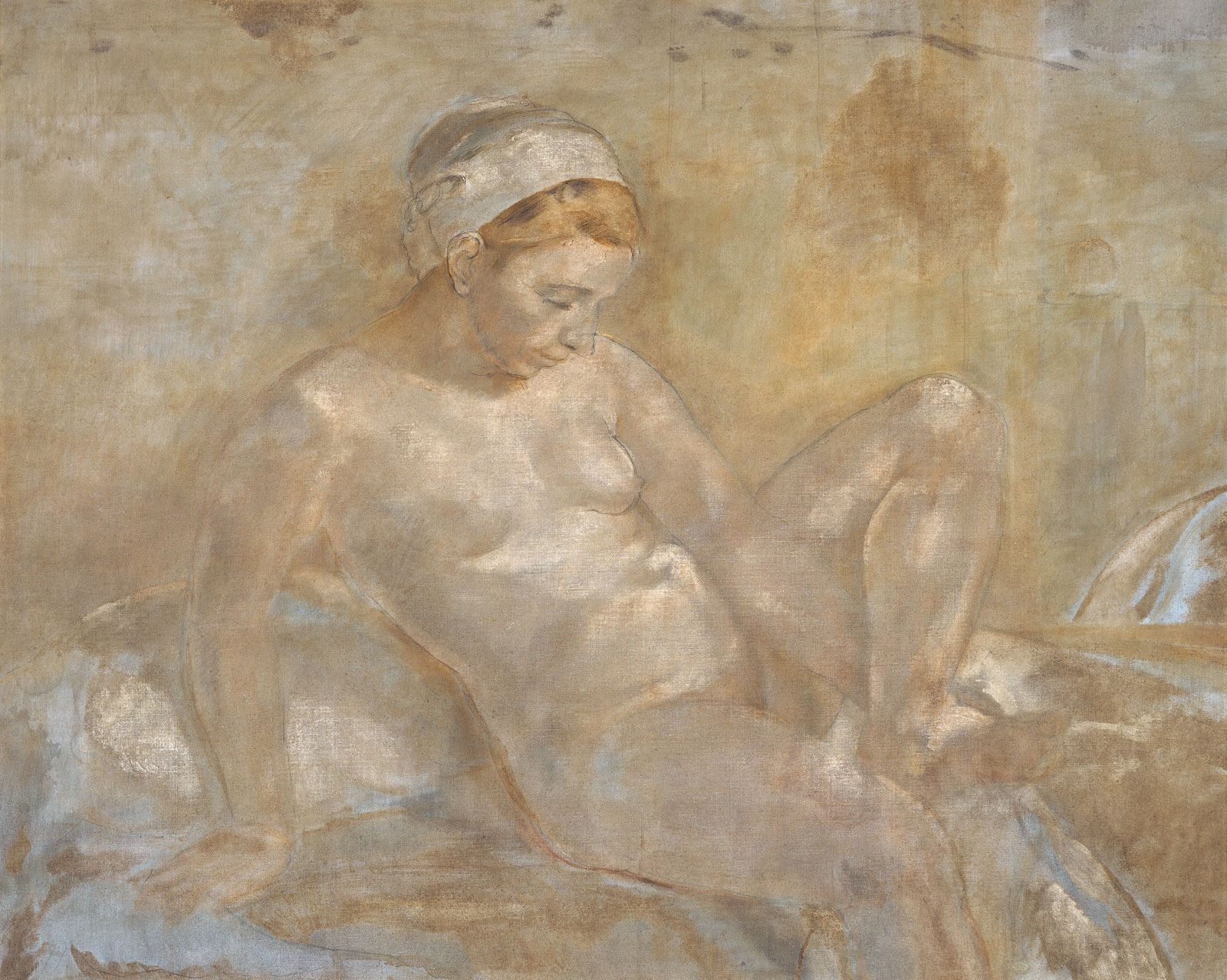 Isabel Bishop (1902–1988), Seated Nude, ca. 1934. Oil on canvas, 33 x 40 in. Collection of Sandra and Bram Dijkstra.
Seated Nude, a 1934 portrait by Isabel Bishop, an artist who is new to me, as many of the artists in the exhibition are, presents itself, at first, as a straightforward, academic painting. But the palette, limited to light, yellow browns, grays and lighter highlights, brings the work within the scope of the origins of the WPA in the classical frieze and the Mexican mural. The woman is real as opposed to ideal, as one would expect in a Rivera mural. Her head covering indicates a woman who puts her hair up to work, signaling that she is no goddess or dilettante. She seems to emerge from the background as if the artist has carved her in alabaster in shallow bas-relief. Her pose casts her in an eternal, even heroic light. The straightforward, art-for-art’s sake nude, a classical exercise and artform, becomes, on Bishop’s easel, something much more.
Contrast this with Hugo Gellert’s Worker and Machine, a 1928 painting in which man and machine are united you see the apparent heroism of the worker subverted pictorially. In this painting, which predates the onset of the Great Depression, the worker seems to give birth to the machine—or does the machine give birth to the worker? They are a monadic entity, one organism/mechanism, the kind of being that is created in German Expressionist filmmaker Fritz Lang’s seminal 1927 film, Metropolis. Is this good? Bad? A relentless future that must be borne, whatever the consequences? Gellert doesn’t judge. We, however, must. And that’s the point of the Dijkstra Collection.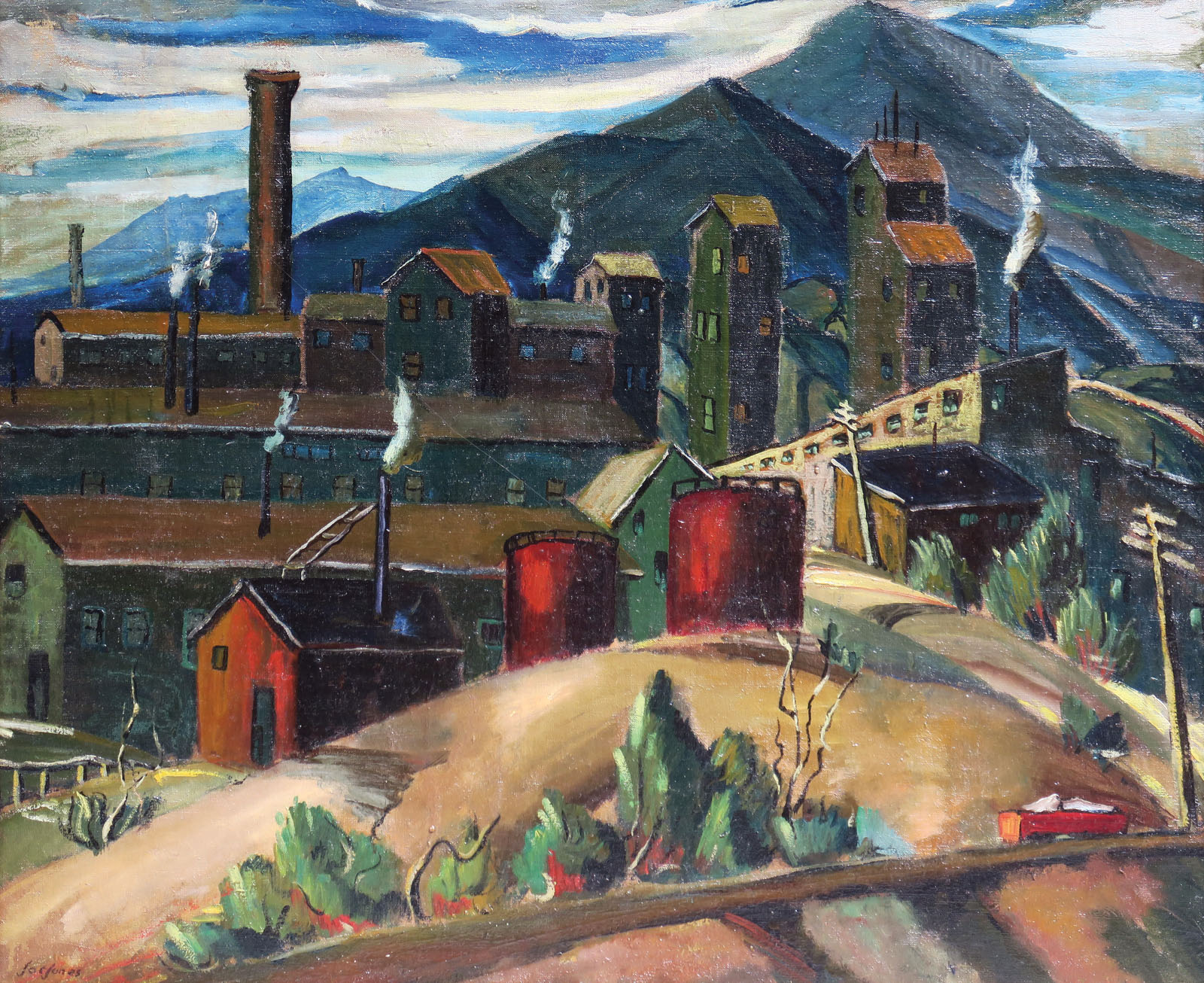 Joe Jones (1909-1963), Mining in the Mountains, ca. 1939. Oil on canvas, 30 x 36 in. From the collection of Sandra and Bram Dijkstra.
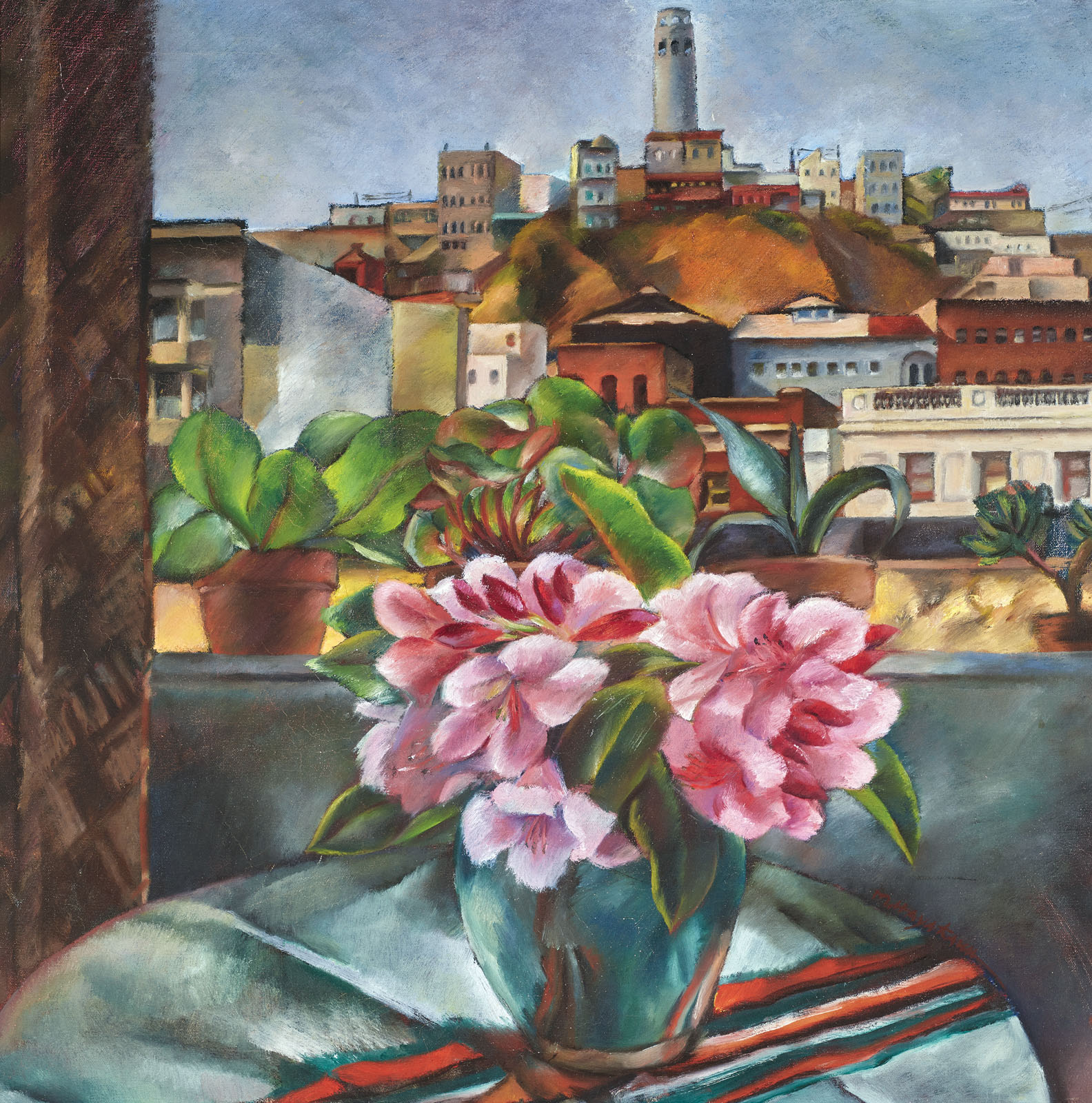 Miki Hayakawa (1904-1953), From my Window: View of Coit Tower, ca. 1935. Oil on canvas, 30 x 30 in. From the collection of Sandra and Bram Dijkstra.
Apprehending the paintings implicates us, compelling us to make meaning and to decide what kind of world we want to create and inhabit, and what we must do to get there. The exhibition shows us the myriad paths that American artists took, the styles they imported, imbibed, fused, constructed, deconstructed and reconstructed. It was as if American art had a mind of its own, a purpose even the artists weren’t entirely aware of, one that would take the rubble left in the wake of the Depression and the challenges the nation faced during World War II and make something of them, something new, something that didn’t shy away from the flaws in our society but nevertheless strove to heal them.
Arthur Durston’s The Flood, painted in 1934 when America was in the throes of the Great Depression, has stylistic affinities with late-1880s French Neo-Impressionism, Cloissonnism in particular, a technique modeled after the Japanese prints and porcelain designs that took art world by storm. Thick outlines delineate shapes and the artist creates colors, shades and textures inside the drawn shapes. The effect suggests the mass-produced lithograph, back-formed and reappropriated into a style of painting, and seems to be intended to connect a broad cross-section of viewers with the work, which combines tragedy, pathos, and perseverance. As two women and their children watch their homes and trees wash away in the floodwaters, two men erect a barrier of sandbags. Despite the “two-by-two” pairings, no Old Testament retribution for sins committed operates here. The scene isn’t a prelude to Noah’s Ark. It’s a question of humanity pitted against the odds—and the elements—with a hint, perhaps, that Nature might be angry at man’s inhumanity to man and to the natural world. Durston looks back in order to look forward, hoping to make his art and message available to the general public.
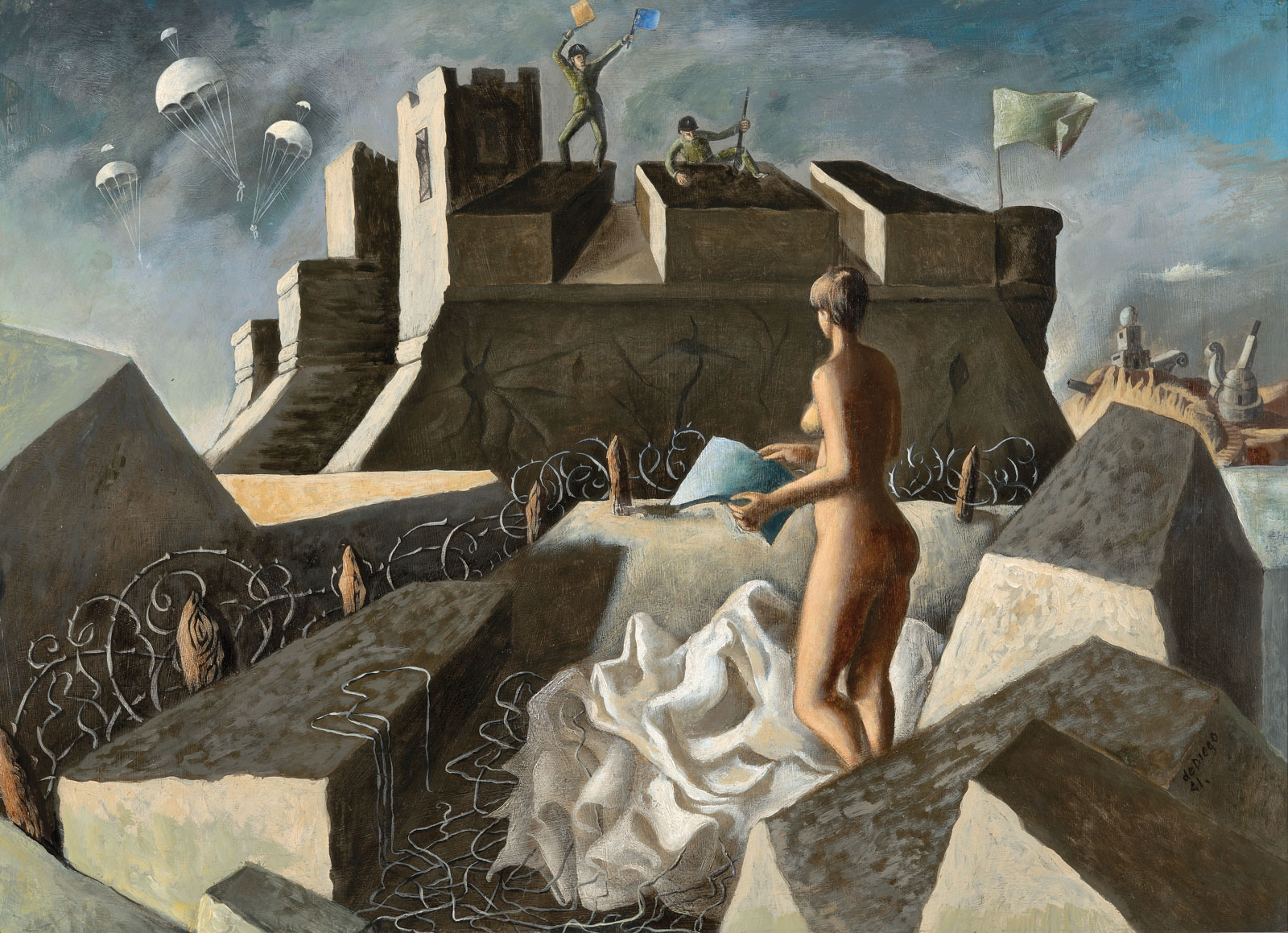 Julio De Diego (1900-1979), Beauty and the Beasts, 1941. Oil on panel, 20½ x 27¾ in. From the collection of Sandra and Bram Dijkstra.
Painted in 1945, the year that World War II came to an end, Edward Bieberman’s Slow Turn recalls Ralston Crawford’s Precisionist scenes of abstract roadways and bridges but adds a poignant layer of realism, a metaphor that meets the moment when it was painted. The American B-17 bomber at upper right is a modern machine of war, a dealer of death from the air, making its “slow turn” in a cloudless sky. In the foreground, taking up the bottom left quarter of the canvas, a cracked road winds up the side of a mountain, appearing to vanish into infinity over a rise. The only way we know the road goes on is by looking at the streetlight on the other side of the crest in the road. Where are we? Is this road somewhere in Europe, cracked from the concussions of aerial bombardment? Or might this be a road in the United States, ruined from neglect because so much of the nation’s energy and attention has gone into the war effort? In either event, the painting projects a sense that even as the world requires rebuilding, we ourselves require a philosophical tune-up in order to avoid making the same mistakes that will necessitate the fabrication of new and more deadly instruments of war.
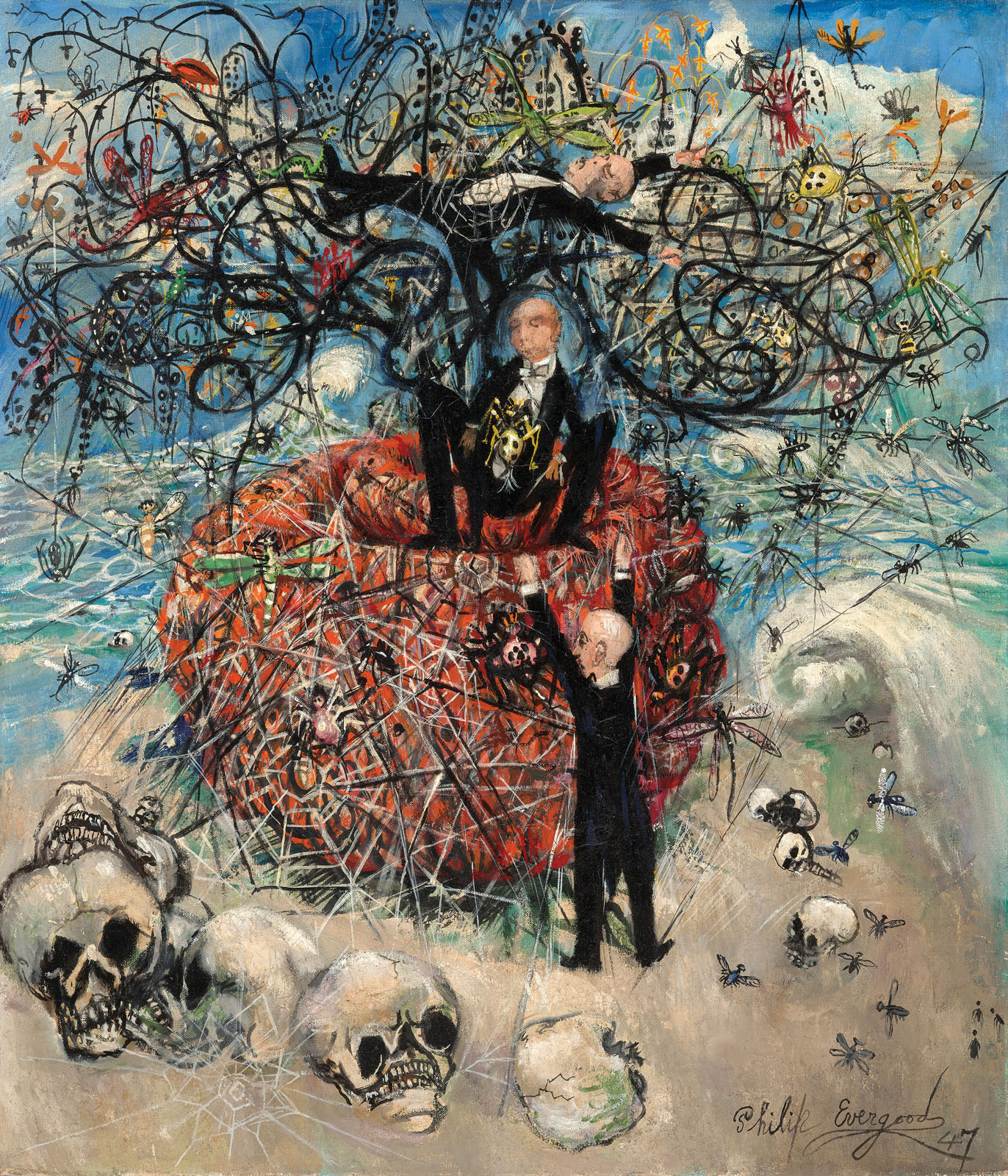 Philip Evergood (1901-1973), New Death, 1947. Oil on canvas, 37 x 32 in. From the collection of Sandra and Bram Dijkstra.
One of the most recently executed works in the Dijkstra Collection, Philip Evergood’s New Death, painted in 1947, two years after Hiroshima and Nagasaki, is a true allegory, one that embraces aspects of Abstract Expressionism even as it sends a direct political message. Tycoons in evening wear cling to webs and tangles of tentacles, becoming prey to spiders, insects, an arthropods that are beyond the reach of whatever power they wield. Waves deluge the thin spit of sand which is littered with skulls. The central image, an orange sphere collapsing in on itself, seems to be an abstraction of a mushroom cloud forming, while tentacles grow and the tendrils of plants emerge, dead, from its orifice. With calligraphic strokes that one might find in Arshile Gorky or Willem de Kooning, Evergood paints a bleak picture, a cautionary tale not of the world as it is, but as it might be if we continue to forget our shared humanity
As I said at the outset, there’s so much in this exhibition that a dozen essays wouldn’t exhaust it. The trick is to avoid pigeonholing American painting of the period as social realism only or as products of the WPA. The Dijkstra Collection bridges true American social realism, the work of John Sloan and George Luks, say, in the early 20th century, with the advent of magical realism and American surrealism in the work of say, Hughie Lee-Smith and Brian Connelly after World War II. It also runs alongside De Kooning and even Jackson Pollock, as evidenced in the paintings of Philip Evergood and others. Though at first it might seem difficult, perhaps impossible, to unite the works in the Dijkstra Collection, repeated viewings pay manifold rewards. There is unity in humanity in the exhibition and, it’s worth repeating—our common humanity is something we would all do well to remember.
Through November 5, 2023
Art for the People: WPA-Era Paintings from the Dijkstra Collection
Oceanside Museum of Art
704 Pier View Way
Oceanside, CA 92054
t: (760) 435-3720
www.oma-online.org
Powered by Froala Editor