
Through September 4, 2023, the Rockwell Museum hosts the Smithsonian American Art Museum’s touring exhibit of the work of African American artist William H. Johnson (1901-1970). Johnson was born in Florence, South Carolina. At 17 years old he traveled north to New York, where he studied at the National Academy of Design, taking classes from esteemed artists George Maynard and Charles Hawthorne. Hawthorne raised money to allow Johnson to follow the tradition of many American artists at the turn of the 20th-century and travel to France to study in Paris, then considered a necessary rite of passage. He left for Europe in 1927, painting landscapes in the golden light of the south of France and urban scenes on the streets of bohemian Paris.
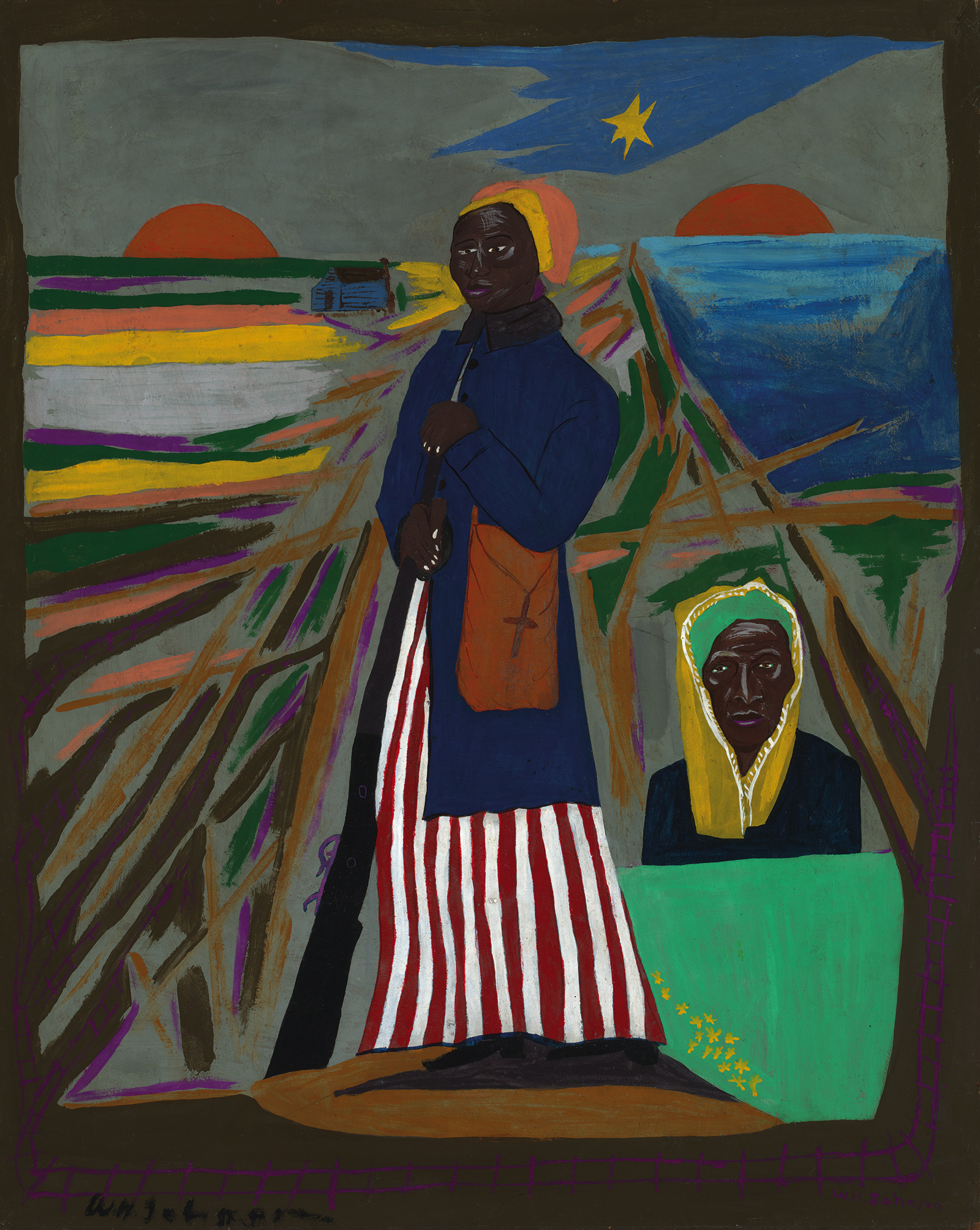
William H. Johnson (1901-1970), Harriet Tubman, ca. 1945. Oil on paperboard, 287/8 x 233/8 in. Smithsonian American Art Museum, Gift of the Harmon Foundation 1967.59.1146
After a brief return to the States in 1929, Johnson embarked for Europe again, working his passage across the ocean on a freighter, following the course set by his heart to rejoin his beloved, the weaver and ceramist Holcha Krake. In 1930, the couple married in Denmark, then settled in a Norwegian fishing village.
Johnson’s early work followed the modernist trends he encountered, and he created landscapes influenced by Chaïm Soutine, but he soon changed bearing for the primitivism which became his life’s work, perhaps influenced by the strength of simple Scandinavian folk traditions.
By 1938, Hitler’s threat to European peace could no longer be ignored, and the insidious fingers of National Socialism had touched Johnson and Krake’s lives—Krake’s brother-in-law, the expressionist sculptor Christoph Voll, had earned the enmity of the Nazi party, was fired from his professorship and his paintings were included in one of Goebbels’ infamous Entartete Kunst exhibits of degenerate art in Munich. Alarmed, Johnson and Krake sailed for New York. The move marked a dramatic shift in Johnson’s choice of subjects, from Scandinavian landscapes to the lives of African Americans in New York and the rural South.
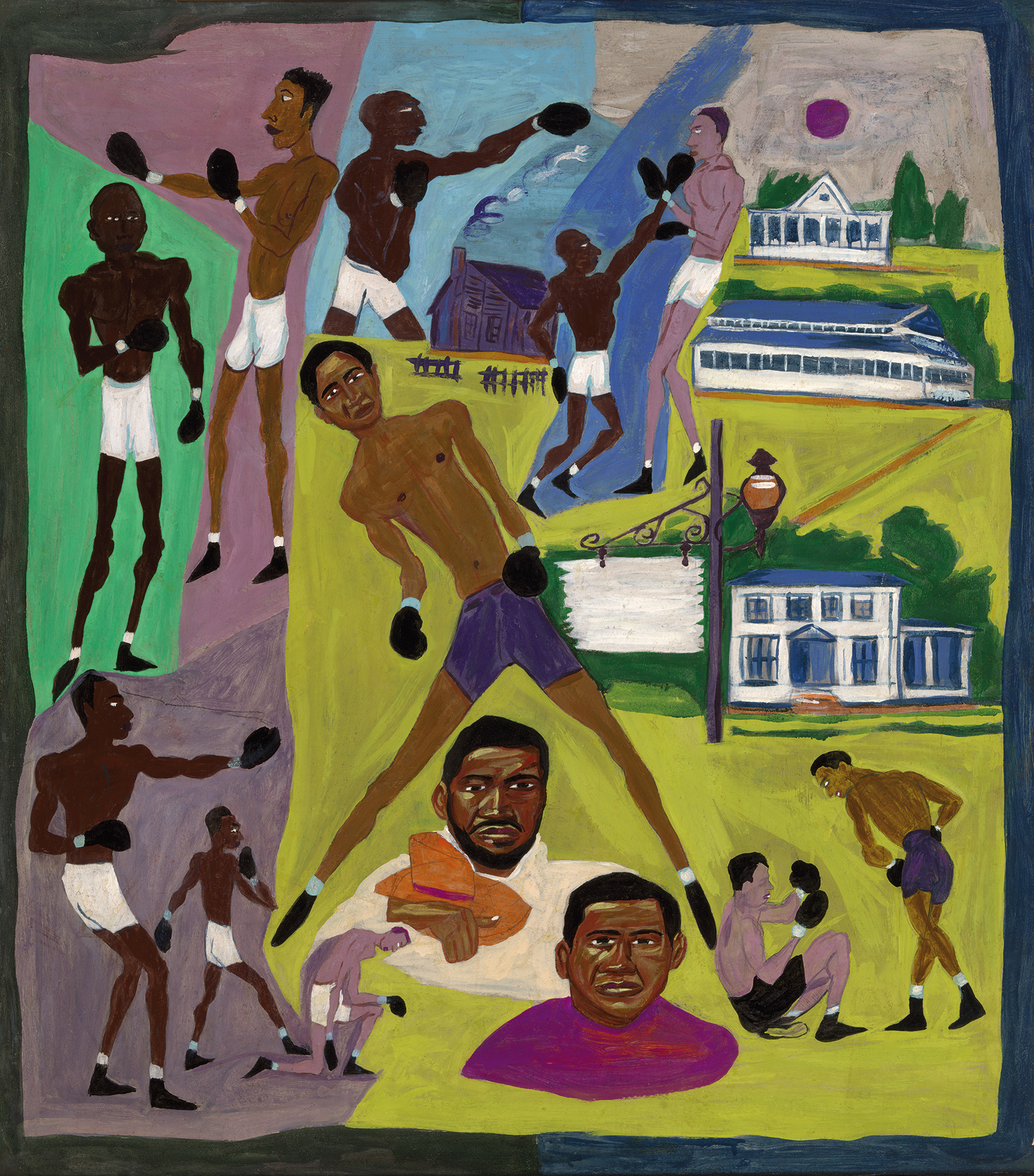
William H. Johnson (1901-1970), Boxers, ca. 1946. Oil on paperboard, 327/8 x 287/8 in. Smithsonian American Art Museum, Gift of the Harmon Foundation 1967.59.652
The Rockwell Museum’s executive director Brian Whisenhunt says, “In 2023, all of the Rockwell Museum’s programs and exhibitions revolve around the theme of ‘heroes’—celebrating and exploring people moved by conviction, truth and love to improve communities, society and our world.” Johnson created his Fighters for Freedom paintings as a tribute to the accomplishments of Black activists, scientists, teachers, performers and politicians. Whisenhunt says Johnson was, “…a hero in his own right, for drawing upon his creative genius and capturing the stories of these influential figures in his art. His commitment to social justice and racial equality continues to resonate with audiences today, and we are honored to showcase his legacy.”
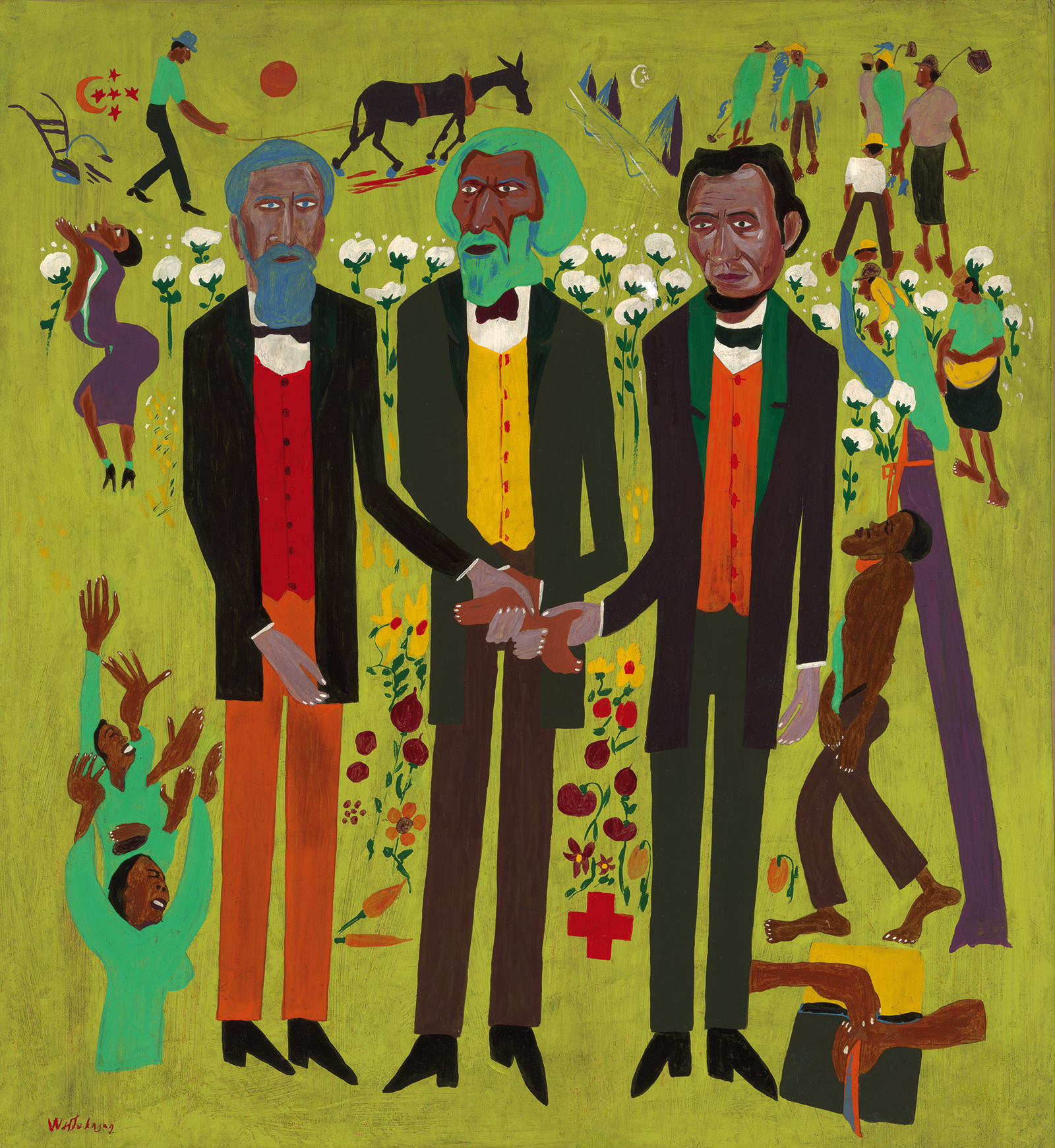
William H. Johnson (1901-1970), Three Great Abolitionists: A. Lincoln, F. Douglass, J. Brown, ca. 1945. Oil on paperboard, 373/8 x 34¼ in. Smithsonian American Art Museum, Gift of the Harmon Foundation 1983.95.51
Paintings in the show include Johnson’s primitive oil painting of Harriet Tubman. Following the tradition of appropriation common to outsider art, Johnson traced the image from a 19th-century woodcut reproduced in Carter G. Woodson’s book, The Negro in Our History. The shotgun-wielding Tubman stands in front of railroad tracks which are suggestive of the escape route she used to rescue fugitives from the South. Another oil painted on paperboard, Johnson’s Boxers, is a picture of fighters Jack Johnson, who was the first African American to become the heavyweight champion of the world, and Joe Louis, the “Brown Bomber,” who defeated the famed German boxer Max Schmeling in 1938.
The paintings exhibited in Fighters for Freedom: William H. Johnson Picturing Justice were among the artist’s last works, all painted in 1945. Krake died from breast cancer in 1944, and Johnson returned to Denmark, where his mental health deteriorated to the point that he was institutionalized, diagnosed with syphilis. He was repatriated to the United States and confined to Central Islip State Hospital in New York, where he died in 1970.
Powered by Froala Editor