



Sequence, repetition, progression, point of view, change-over-time, serialism; closeups, shapes at various scales, partialism: Consider how photography, still and moving, revealed these dynamics in both the natural and human worlds and how painters took them in and made them their own. It’s strange, though, and not a little ironic, that photography—which was supposed to reproduce reality, and perhaps even displace painting—should have had such a profound impact on the evolution of abstraction, as is seen in Georgia O’Keeffe: To See Takes Time, the new exhibition at the Museum of Modern Art.
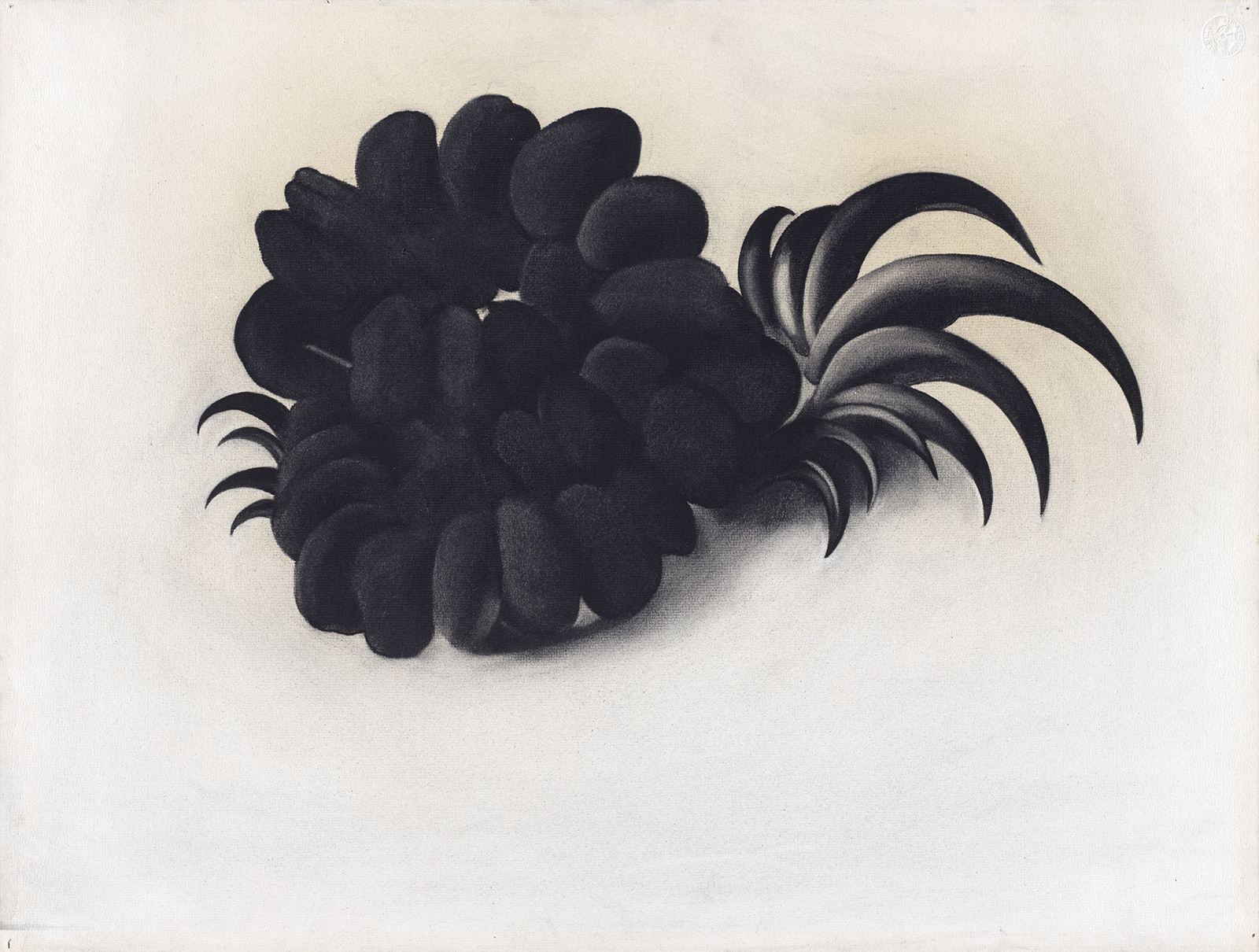
Georgia O’Keeffe (1887-1986), Eagle Claw and Bean Necklace, 1934. Charcoal on paper, 19 x 251/8 in. The Museum of Modern Art, New York. Given anonymously (by exchange), 1936. © 2022 Georgia O’Keeffe Museum / Artists Rights Society (ARS), New York
Georgia O’Keeffe (1887-1986) is easily the most famous American woman artist, though to say this is to discount the very real fact that she is one of the most famous American artists of any gender. She is to us what Frida Kahlo is to Mexico—and she and Kahlo were friends, and possibly even lovers. O’Keeffe is one of the first American modernists and the first, some say, to make abstraction the principal part of her facture. From her Lake George paintings to her sojourns in New York and world travels, and her ultimate association with New Mexico—where her paintings ultimately surpassed, in the eye of the American public at any rate, those of her many forebears: the Taos Society of Artists, Robert Henri, John Marin, and others—O’Keeffe pushed at the boundaries of what was possible in art. She sought to change the scale of human vision—to make the small large, the large small, and in so doing, release and reveal the structures hidden under the world we think we know.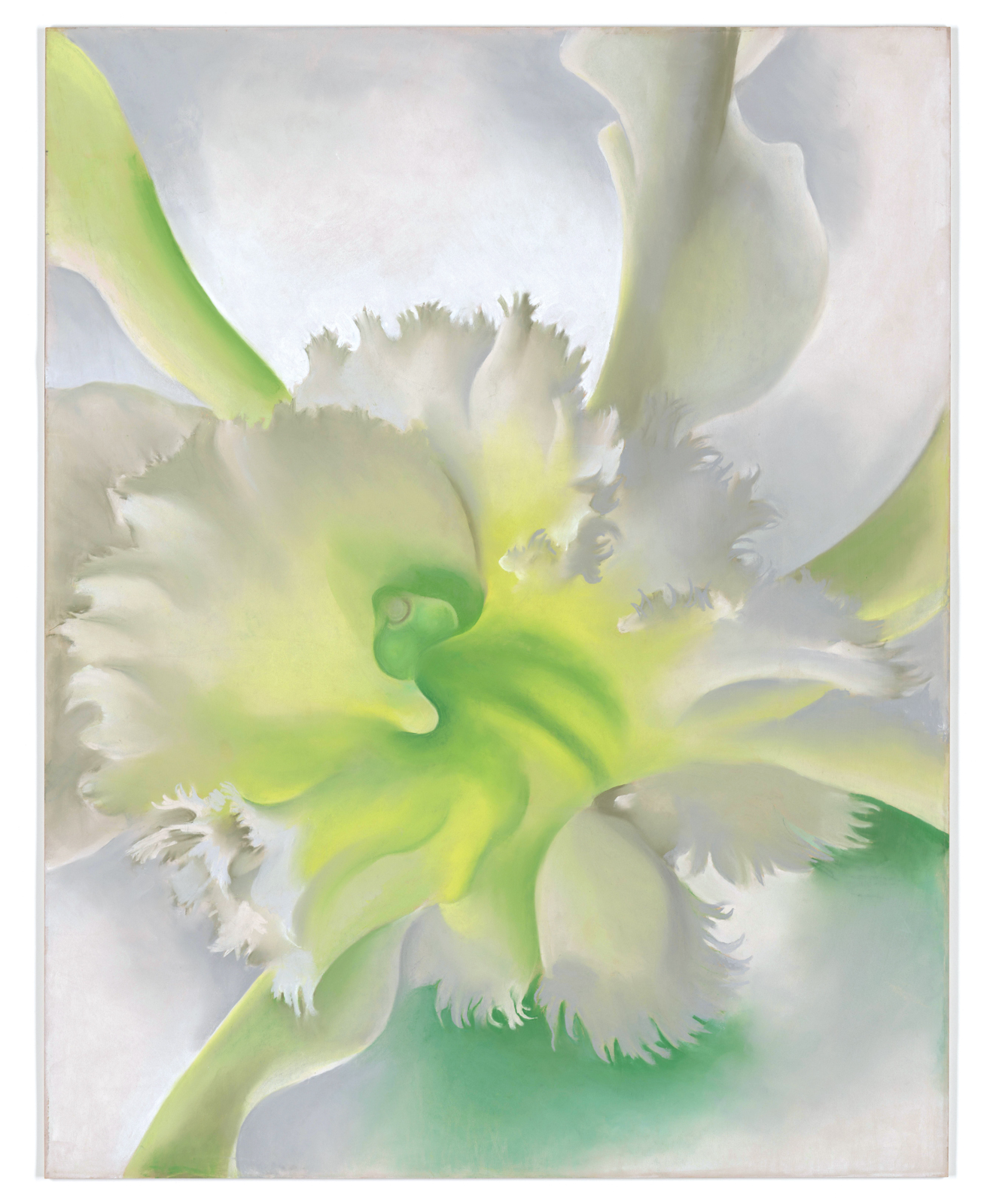
Georgia O’Keeffe (1887-1986), An Orchid, 1941. Pastel on paper mounted on board, 275/8 x 21¾ in. The Museum of Modern Art, New York. Bequest of Georgia O’Keeffe, 1990. © 2022 Georgia O’Keeffe Museum / Artists Rights Society (ARS), New York
From eye to mind’s eye; from mind’s eye back to eye; from eye to hand; from hand to brush or pen, Georgia O’Keeffe’s drawings record her training as she sought to align her vision—that is, what she imagined and what she saw—with her body in order to capture that vision on paper, and then, when she was satisfied, on canvas. To see does take time; to see, as O’Keeffe came to see, also takes rigorous, almost athletic training.O’Keeffe’s friendship and eventual marriage to pioneer photographer Alfred Stieglitz placed her at the forefront of the emergence of photography as an art form. She witnessed, firsthand, the processes I described above. Yet her own studies, first with the ideas of Arthur Wesley Dow at the University of Virginia and at Columbia University Teachers College, where she encountered their seminal book Art and Industry in Education, published in 1912. Dow stressed drawing as a physical exercise, akin to breathing, while Art and Industry in Education, taking its cue from manufacturing and the assembly line, emphasized repetition.
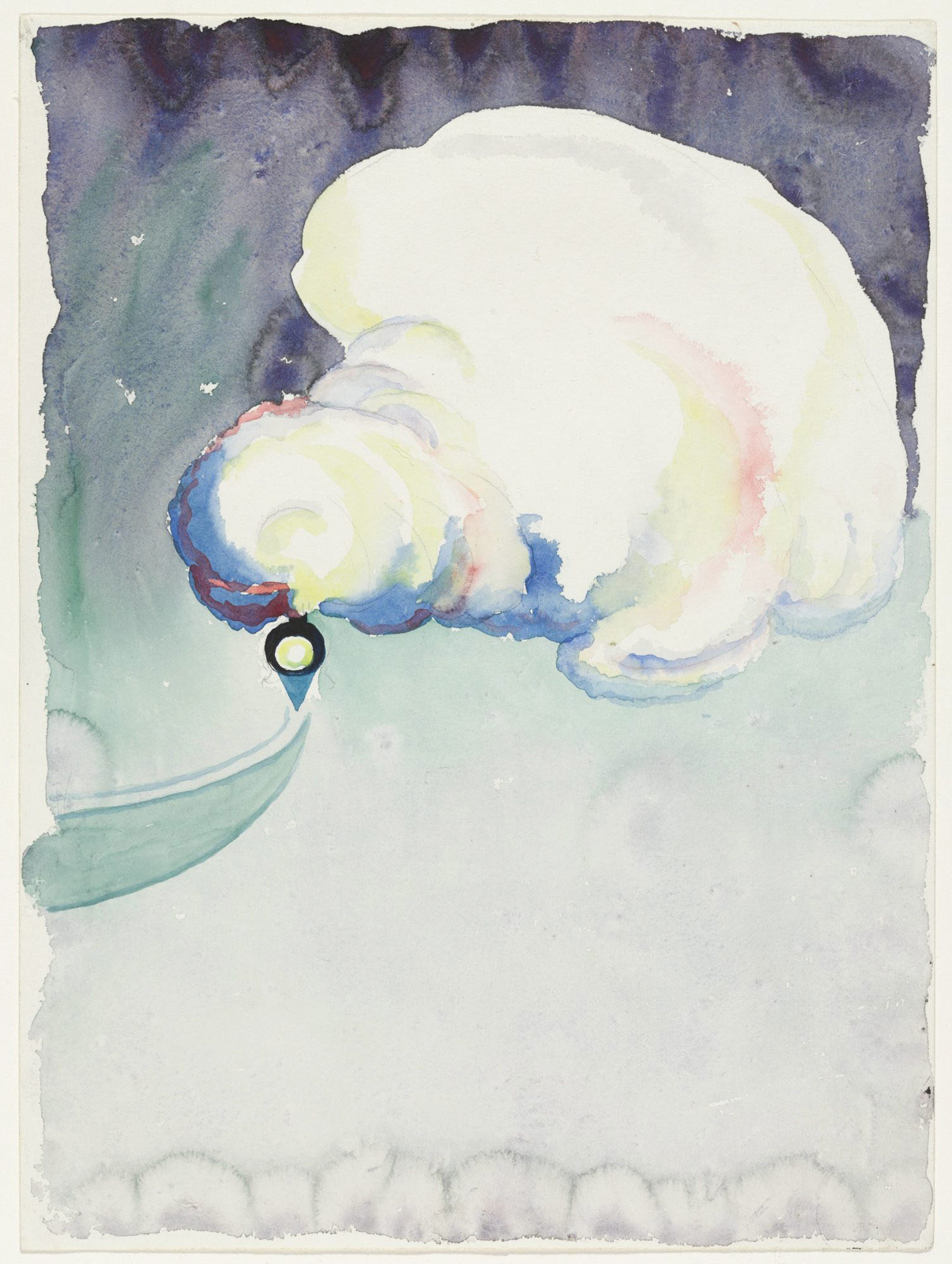
Georgia O’Keeffe (1887-1986), Train at Night in the Desert, 1916. Watercolor and pencil on paper, 117/8 x 87/8 in. The Museum of Modern Art, New York. Acquired with matching funds from the Committee on Drawings and the National Endowment for the Arts, 1979. © 2022 Georgia O’Keeffe Museum / Artists Rights Society (ARS), New York
In the 1910s, when she was teaching, traveling and drawing, O’Keeffe filled reams of inexpensive paper with drawings—first in charcoal, then gradually working up to pastel and watercolor. She often worked on the floor instead of at an easel or on a wall, and wrote of the pain she felt in her back, feet and legs. She was often discouraged and dissatisfied with her work. And yet, as time went on, the drawings that emerge from this period and the practice of drawing she would continue throughout her career, provided key ideas and motifs for her greatest paintings. She would come to call these drawings “Specials.” A look at some of her drawings shows how she moved from representational forms to abstraction, and imparted her abstractions with what I would call a natural reality.A 1916 watercolor, Train at Night in the Desert, gives us the night sky, stars, the locomotive lantern, the sweep of track, but what dominates the drawing is the almost shell-like cloud of steam from the smokestack. Despite the realism we make of the work with our own eyes, the composition is entirely ungrounded. The train is tiny, hanging by a cloud that billows out while turning back and in on itself. O’Keeffe would repeat this composition, “bridging observation and abstraction through radical reduction,” as Samantha Friedman writes in one of several incisive essays she contributes to the catalog, training herself to extract the essences of forms. Dating from the beginning of O’Keeffe’s life at Ghost Ranch in New Mexico, a 1934 charcoal, Eagle Claw and Bean Necklace, turns a sacred Indigenous adornment—fashioned out of natural things—into an abstract creature representative of some new species crawling across a seabed. O’Keeffe also drew this necklace more than once, and from other angles. To repetition then, we must add variation, and it is here that O’Keeffe’s practice begins to seem like music.
O’Keeffe insisted on the mystery of the series of drawings of which Special No. 39, 1919, is an important example. Special No. 39 evolved from a 1917 drawing of two orbs emerging from or receding into a slit or fold. In the earlier drawing, the folds are repeated and varied across the picture plane, suggesting drapery. Here, however, the artist strips away these origins in classical practice where the mastery of drapery was a hallmark of skill, concentrating instead on rhythm and arrangement, not as if the drawing represents musical notation but that in some sense it affects the viewer as music does, making music accessible to sight.
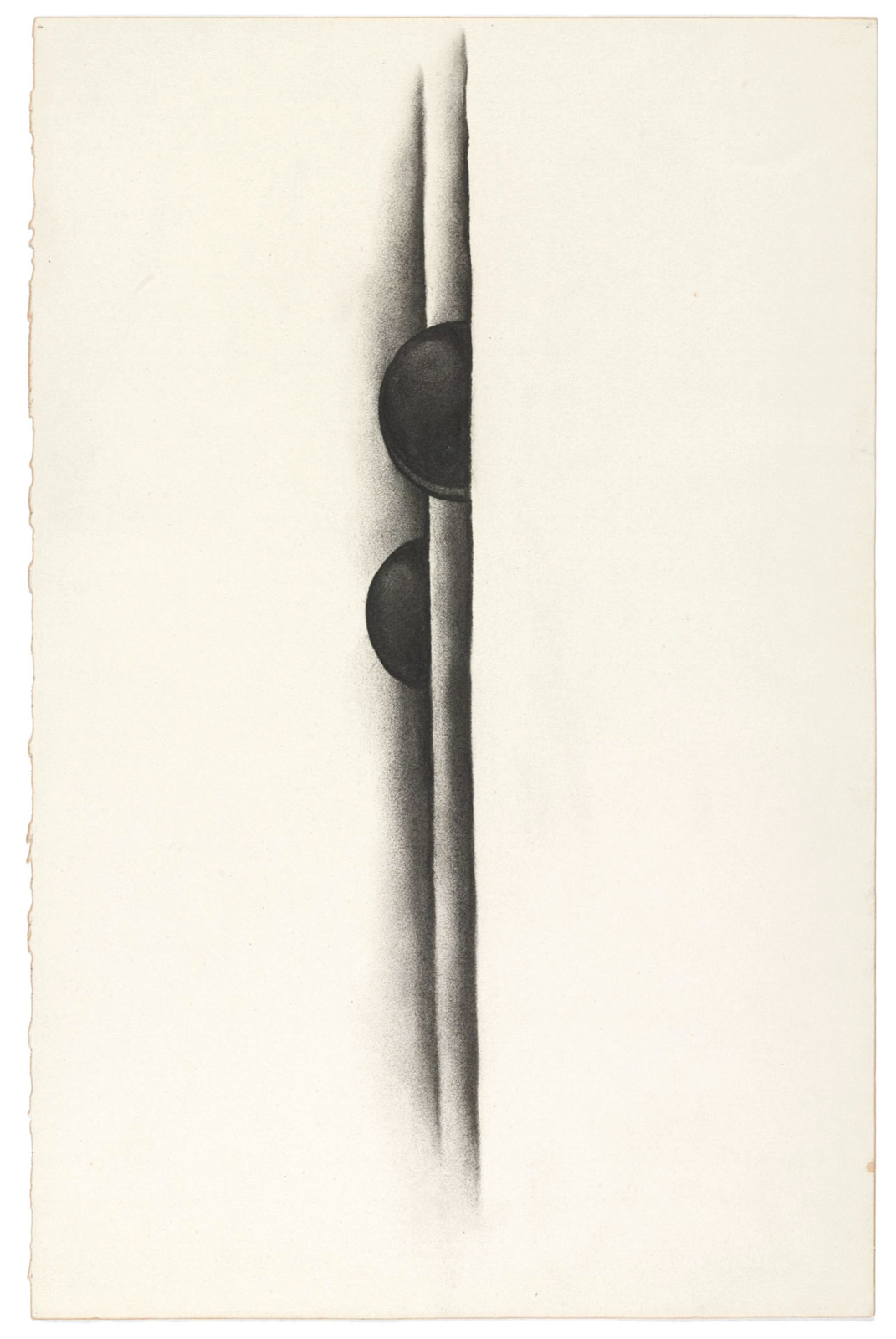
Georgia O’Keeffe (1887-1986), Special No. 39, 1919. Charcoal on paper, 195/8 x 12¾ in. The Museum of Modern Art, New York. Gift of The Georgia O’Keeffe Foundation, 1995. © 2022 The Museum of Modern Art / Artists Rights Society (ARS), New York
The progression of the three related 1917 watercolors entitled Evening Star gives us a sense of what O’Keeffe was after. Moving from a quasi-representational, astronomical composition to a strongly lined abstraction and then to a watery bioform, these kinds of shapes and lines find their way into all aspects of her art, from the rocks, skulls, and skies of New Mexico to the large closeups of flowers she is perhaps best known for.The shading, the furling and curling shapes, and the fractal nature of the Specials come to fruition and recur in the 1941 pastel, An Orchid. Here, of course, O’Keeffe is moving from abstraction back to natural reality, and yet, enlarged and in tight closeup, the flower is filled with energy, exploding off the paper out into our space. The orchid becomes an abstraction, something that, at this scale, is alien and new to us. The poet Dylan Thomas, who was O’Keeffe’s contemporary, once wrote of “the force that through the green fuse drives the flower,” where the green fuse is the stem and the flower is a firework of nature. We see exactly this in An Orchid, everything that O’Keeffe sought and labored, time and again, to achieve. The petal frills are reaching hands, and the fronds seem to be caught in the act of unfurling to the sun. There is at once something terrestrial and generative about the pastel and, at the same time, something ethereal and spiritual.
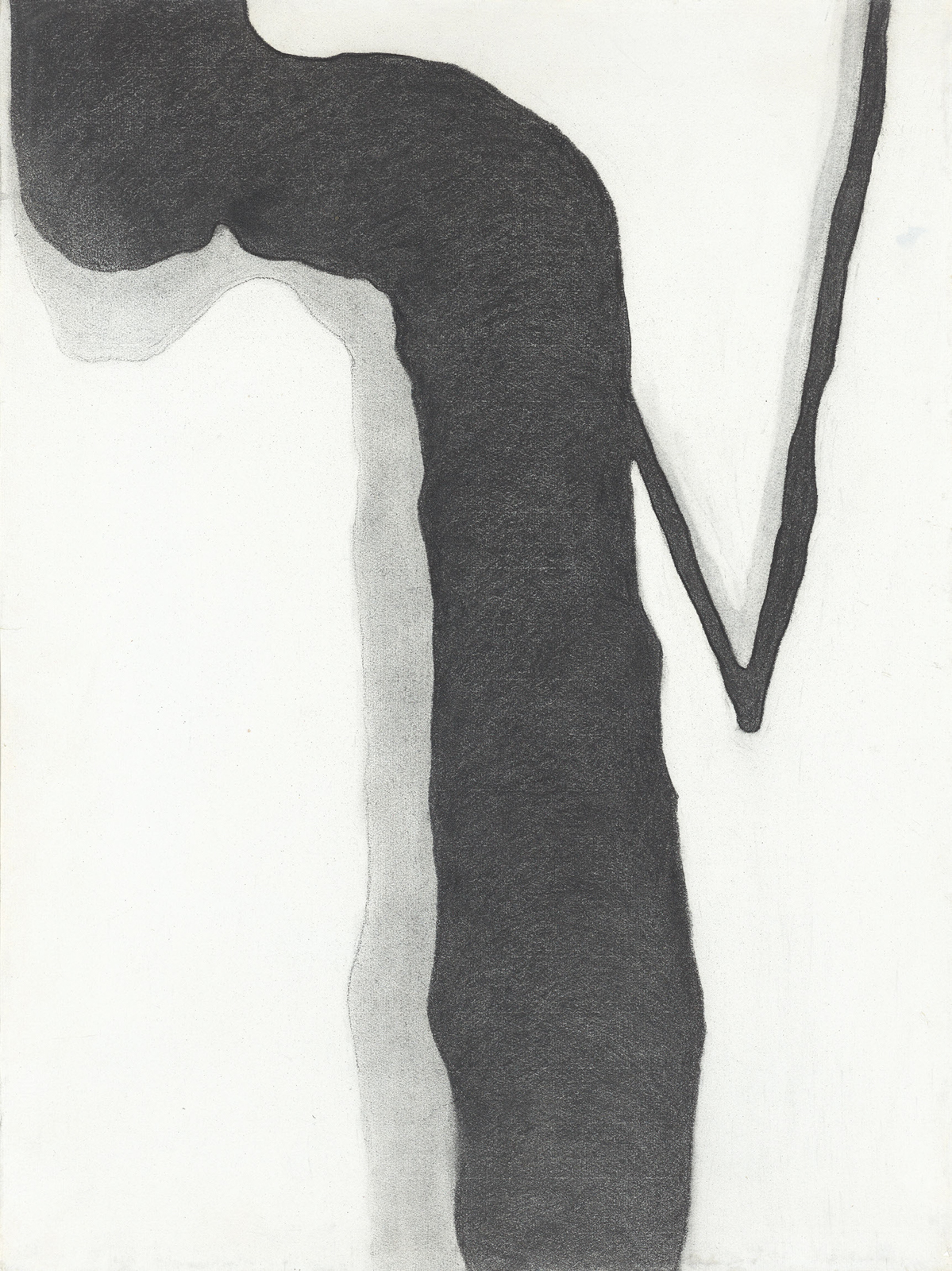
Georgia O’Keeffe (1887-1986), Drawing X, 1959. Charcoal on paper. 247/8 x 185/8 in. The Museum of Modern Art, New York. Gift of Abby Aldrich Rockefeller (by exchange), 1972. © 2022 Georgia O’Keeffe Museum / Artists Rights Society (ARS), New York
Georgia O’Keeffe loved to travel and circumnavigated the globe more than once. But she also loved to look out the windows of airplanes at the patterns of the landforms and waterways below. She especially liked rivers, sketched them from the plane and, later in her career, made a series of these sketches into large charcoal drawings, including Drawing X, 1959. She took care not to identify her drawings with any particular river, and, indeed, it would be impossible to correlate these abstractions with any real geography. The first thing to consider about these drawings is that they make the horizontal topography vertical, challenging gravity and nature. The second thing to consider in Drawing X is that no tributary creek ever bent at a “V”. The third thing to consider is that no river ever cast its own shadow, as is seen here. And so the river becomes something else, something other, a system of passages, tunnels, pipes behind transparent walls. O’Keeffe, as ever, is showing us the armature of life, the rhythm under the melody we concentrate on. The drawing is defiant, destabilizing, and utterly fascinating. I can imagine an exhibition of these riverine pieces alongside works by Franz Kline and Robert Motherwell.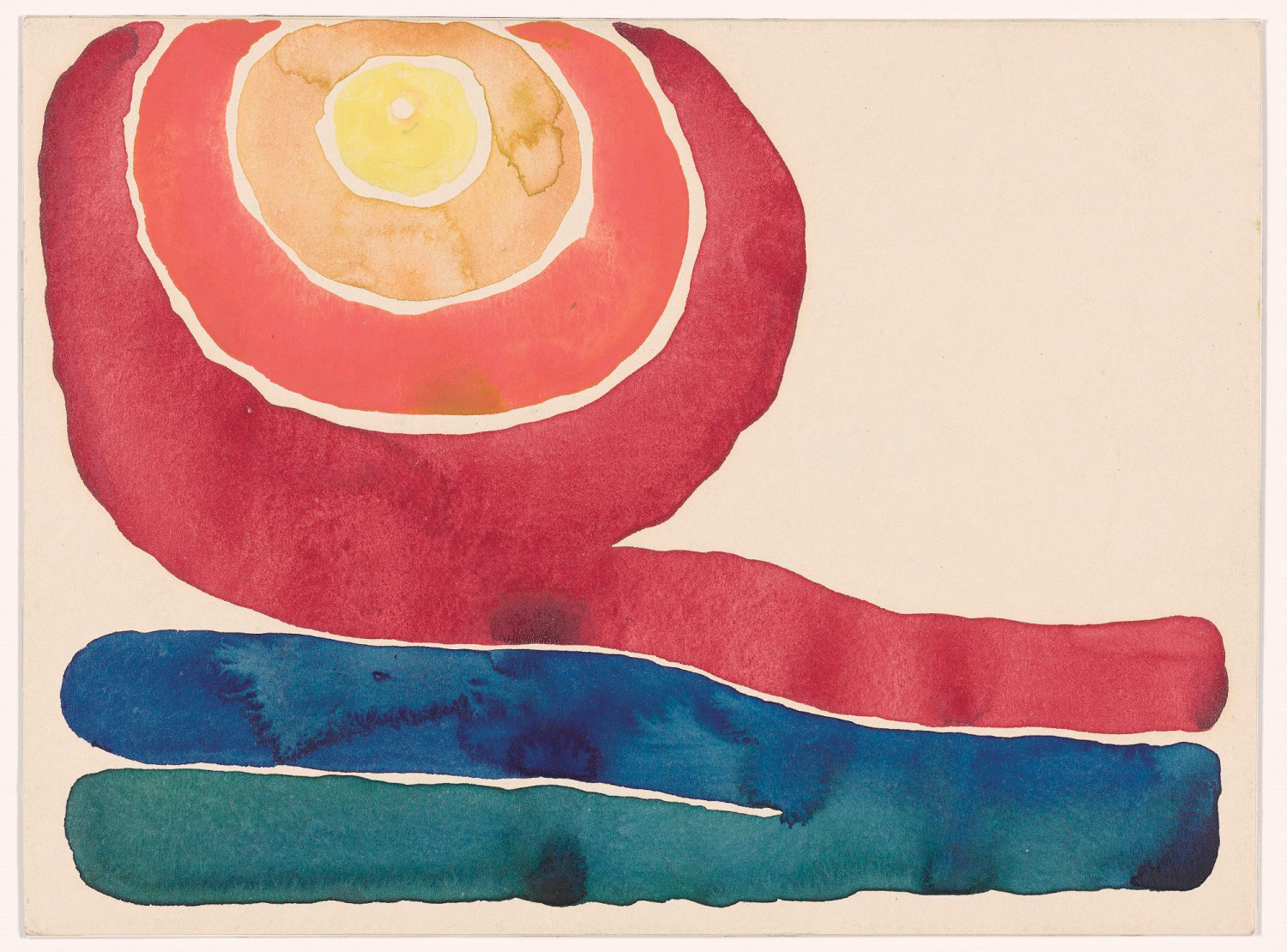
Georgia O’Keeffe (1887-1986), Evening Star No.III, 1917. Watercolor on paper mounted on board, 87/8 x 117/8 in. The Museum of Modern Art, New York. Mr. and Mrs. Donald B. Straus Fund, 1958. © 2022 Georgia O’Keeffe Museum / Artists Rights Society (ARS), New York
Perhaps this marks me as a citizen of the 20th and 21st centuries—industrial and post-industrial—but process interests me. I’m not sure how many people would agree, but drawings like O’Keeffe’s Specials often rekindle my interest in an artist. The great masterworks, the ones I see on posters and postcards, especially when they are gathered in a single exhibition, can seem daunting, even extravagant. They come with the baggage of popularity. I feel that I am supposed to see them, and I am glad I have, but I always suspect that in some way I haven’t seen them at all, save as products. But the intimacy of drawing, of the study, the Special, that offers a glimpse of the artist’s mind, trying and failing and trying again, this way and that, brings the idea of work back to the word “artwork.”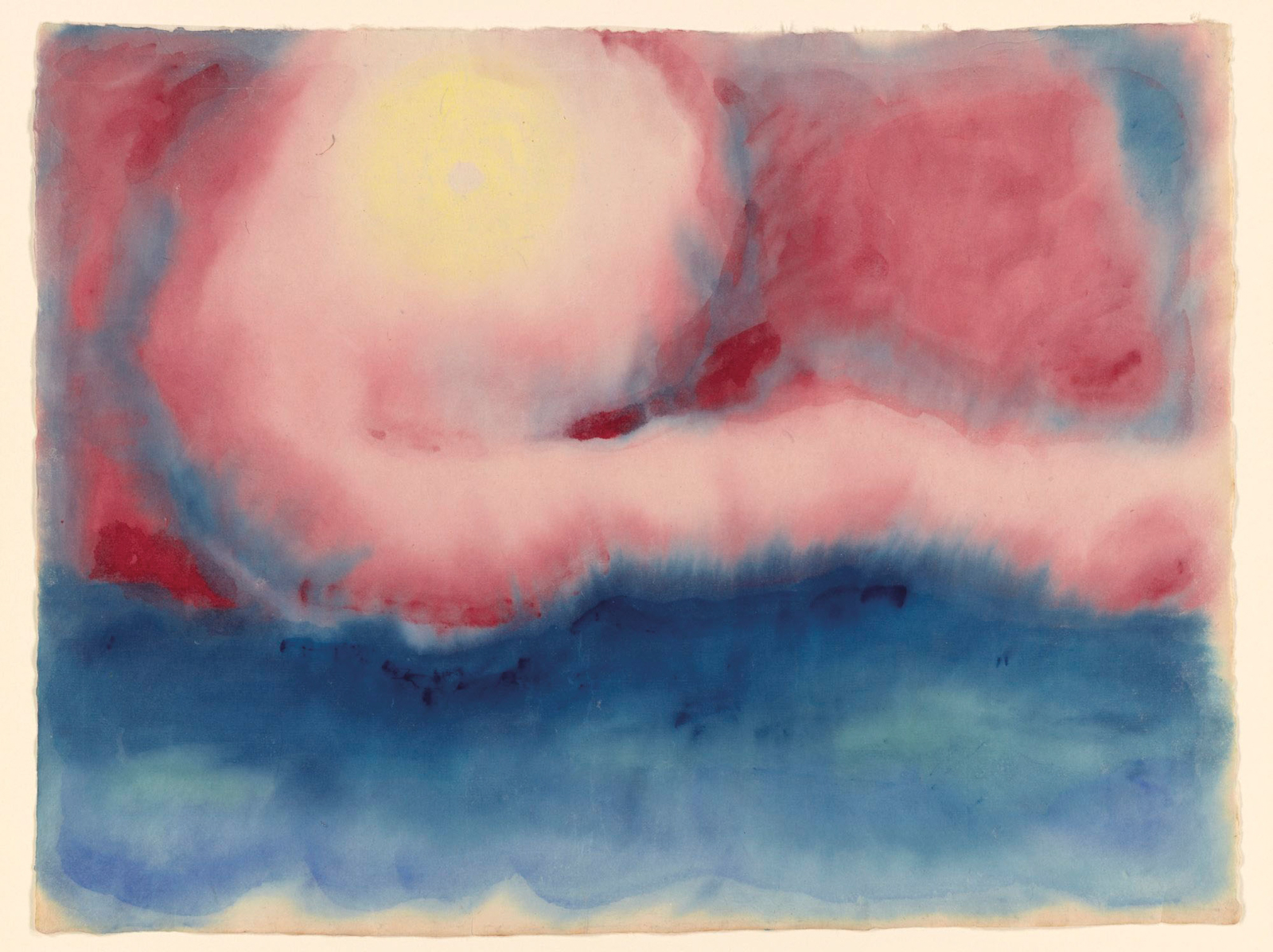
Georgia O’Keeffe (1887-1986), Evening Star, 1917. Watercolor on paper. 133/8 x 1711/16 in. Yale University Art Gallery. The John Hill Morgan, B.A. 1893, LL.B. 1896, M.A. (Hon.) 1929, Fund, the Leonard C. Hanna Jr., Class of 1913, Fund, and Gifts of Friends in Honor of Theodore E. Stebbins Jr., B.A. 1960. © 2022 Georgia O’Keeffe Museum / Artists Rights Society (ARS), New York
Later in life, Georgia O’Keeffe observed, “Objective painting is not good painting unless it is good in the abstract sense. A hill or tree cannot make a good painting just because it is a hill or a tree. It is lines and colors put together so that they say something.” To that, I would add that a masterpiece—objective or not—can be great but that it can’t be good without some sort of entry into the artist’s mind. By “good” here, I think I mean “human,” with all the greatness and hard work and imperfection the word implies. Georgia O’Keeffe: To See Takes Time is great—and good.Jim Balestrieri is the proprietor of Balestrieri Fine Arts, an arts consultancy service specializing in cataloguing, writing, marketing, collections management and sales.
Georgia O’Keeffe: To See Takes Time
Through August 12, 2023
The Museum of Modern Art
11 W. 53rd Street, New York, NY 10019
t: (212)708-9400
www.moma.org
Powered by Froala Editor


