Raymond Jonson (1891-1982) was first influenced by the modern art he saw at the Chicago hanging of the Armory Show in 1913 and several years later by Vasily Kandinsky’s book, The Art of Spiritual Harmony. Later, he came in contact with the ideas of Theosophy which taught “Behind everything seen or unseen there is an eternal, boundless, and immutable absolute Reality, which is beyond the range of human thought. Both matter and consciousness (or spirit) are the two polar aspects of this Reality.”
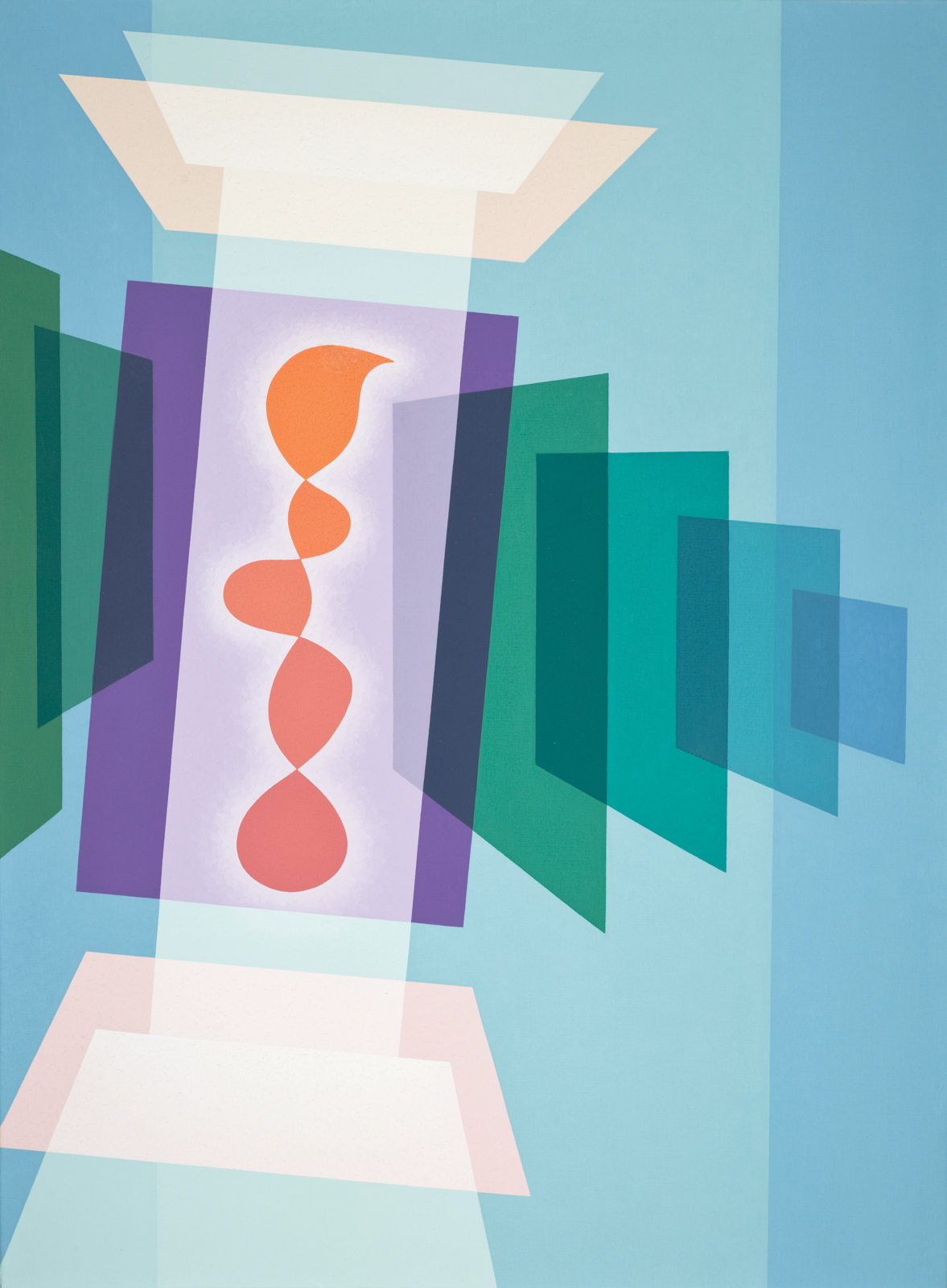
Raymond Jonson (1927-2015), Oil No. 9, 1942. Oil on canvas, 50 x 37 in. Los Angeles County Museum of Art, bequest of Fannie and Alan Leslie, © Raymond Jonson Estate, courtesy of University of New Mexico Art Museum, photo © Museum Associates/LACMA.
Emil Bisttram (1895-1976) came to the U.S. from Hungary. For Bisttram, painting was a means for gaining spiritual insight. Also influenced by Theosophy, he wrote, “It is my conviction that art…is a means to unfold the consciousness and thereby bring it to envision and experience wider horizons…an experience on a higher plane of emotion and intellectual perception without which there can be no real progress in man’s development.”Both artists moved to New Mexico where they and a loose configuration of other artists formed the Transcendental Painting Group in 1938. The purpose of the group was “to widen the horizon of art” and “to carry painting beyond the appearance of the physical world, through new concepts of space, color, light and design to the imaginative realms that are idealistic and spiritual.” They strove to express the spiritual essence of a form rather than the form itself. They intended to “transcend” the limits of realist painting and were not followers of the 19th-century Transcendentalism of Emerson and Thoreau.
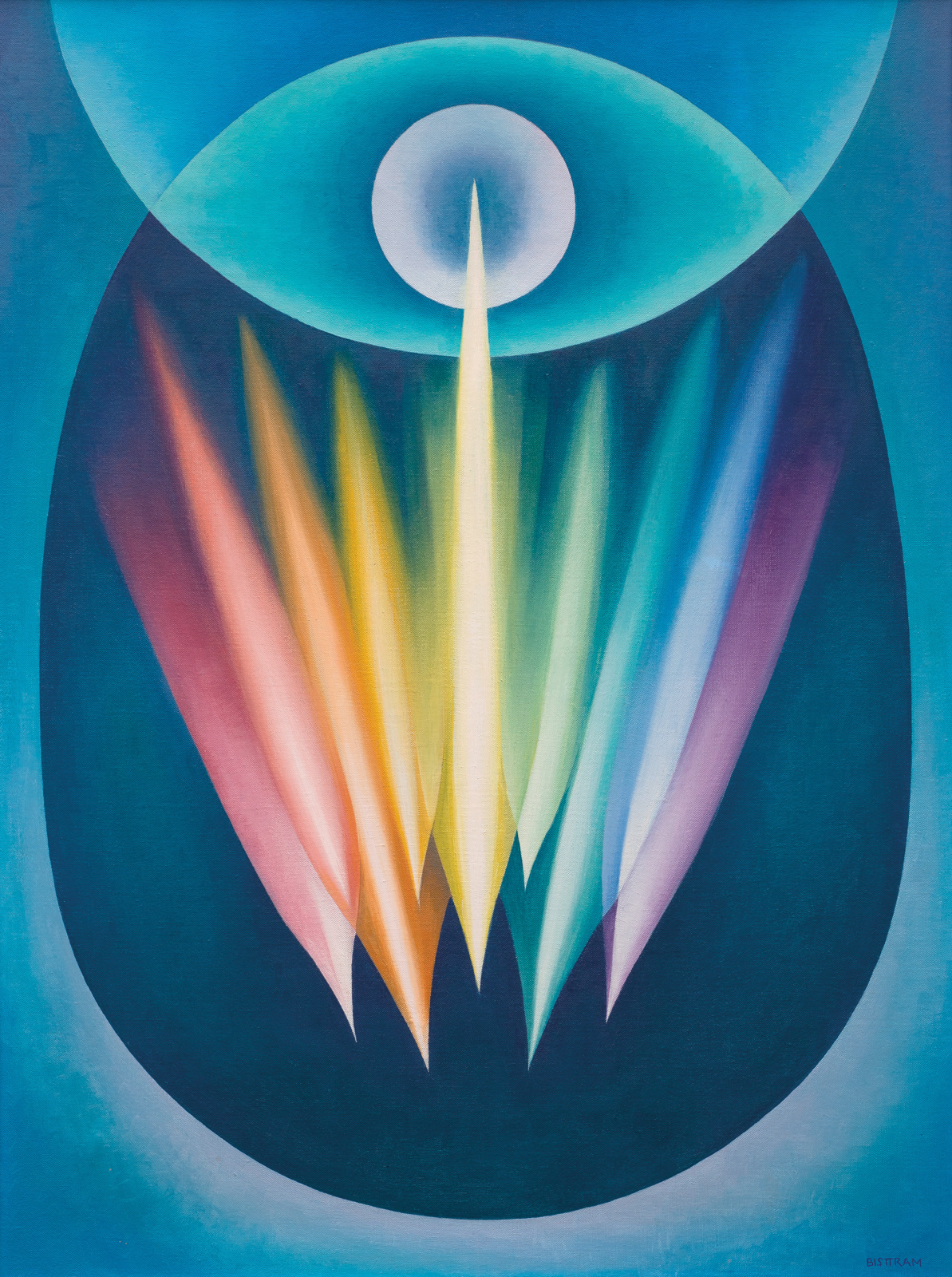
Emil James Bisttram (1895-1976), Creative Forces, 1936. Oil on canvas, 36 x 27 in. Private collection, courtesy Aaron Payne Fine Art, Santa Fe.
In addition to Jonson and Bisttram, the nine original members of the group were Robert Gribbroek, Lawren Harris, William Lumpkins, Florence Miller Pierce, Agnes Pelton, Horace Towner Pierce and Stuart Walker. They were later joined by Ed Garman. Another World: The Transcendental Painting Group, 1938-1945 continues in the Resnick Pavilion of the Los Angeles County Museum of Art through June 19.LACMA explains, “Organized by the Crocker Art Museum, Another World showcases 80 works by 11 artists associated with the group, with paintings and works on paper from the 1920s through the 1950s, including four works from LACMA’s collection by Emil Bisttram, Ed Garman, Raymond Jonson and Agnes Pelton. The exhibition will require no digital guides, maintaining a calm, technology-free environment to complement the meditative nature of the artworks.”
Jonson’s Oil No. 9, 1942, was painted during his tenure teaching at the University of New Mexico in Albuquerque. His early works in New Mexico began to show the abstraction of natural and built forms. In the late 30s, he began to use an airbrush, a mechanical device that, ironically, allowed him to express the spirituality of color more freely. The later development of acrylic polymer paint allowed him even more freedom.
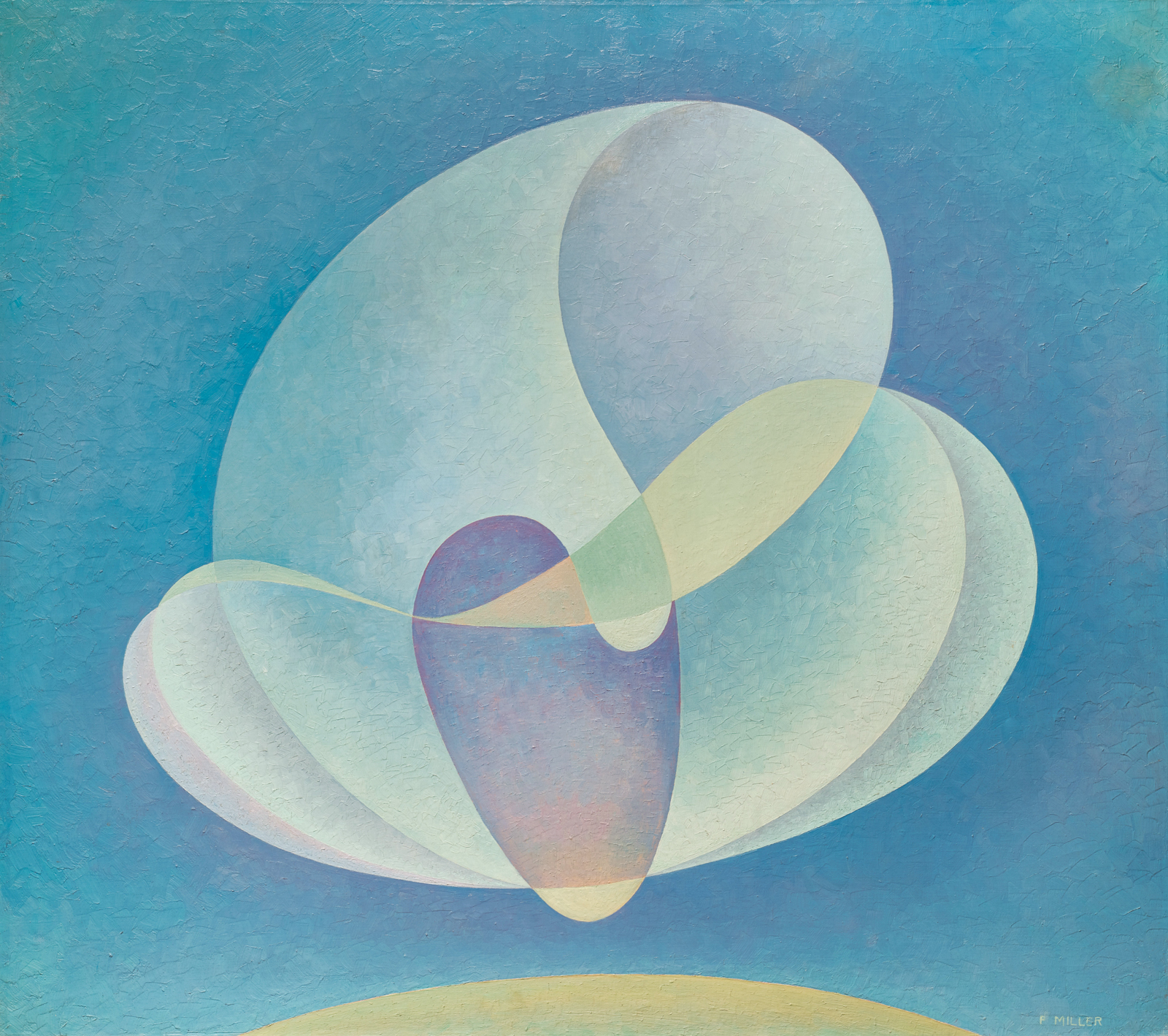
Florence Miller Pierce (1918-2007), Blue Forms, 1942. Oil on canvas, 29¾ x 34 in. Collection of Georgia and Michael de Dehavenon, New York.
By the 40s he moved toward “absolute painting.” He described the term: “By absolute painting we mean painting which is entirely creative...These environments are invented and imagined by the painter and knowingly have no connection with physical environments. These environments are therefore of another world, the inner or spiritual.” The museums add, “In Theosophic and occult belief systems, vibrations are responsible for realizing the material world. These vibrations are suggested in Jonson’s Oil No. 9 through the shapes radiating outward from the central form.”Bisttram espoused the geometric compositional principle of Dynamic Symmetry based partly on the Golden Section as seen in his Creative Forces, 1936. For Bisttram, painting was a means for gaining spiritual insight. He wrote, “It is my conviction that art…is a means to unfold the consciousness and thereby bring it to envision and experience wider horizons…an experience on a higher plane of emotion and intellectual perception without which there can be no real progress in man’s development.”
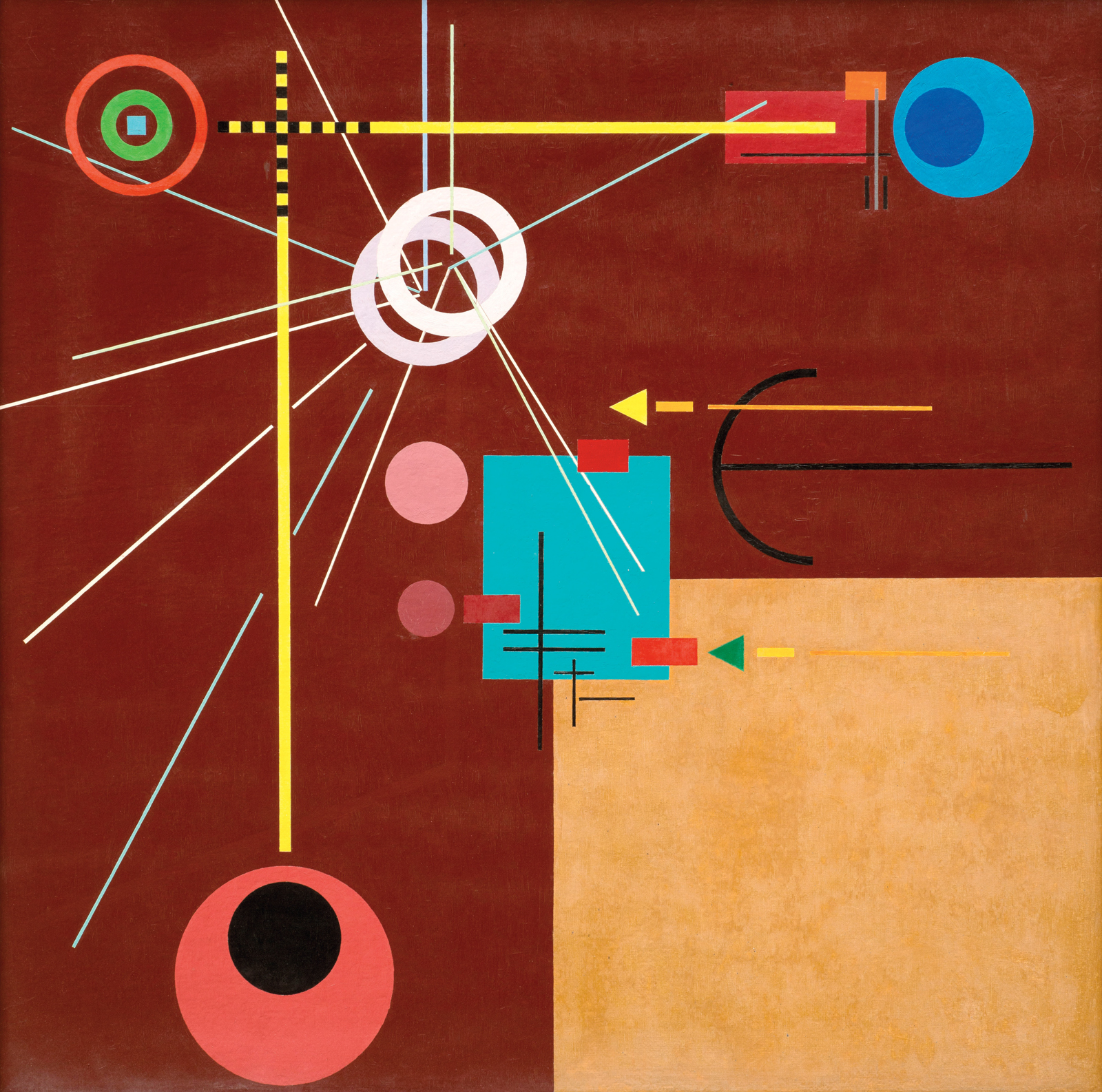
Ed Garman (1914-2004), Abstract No. 276, 1942. Oil on masonite, 30 x 30 in. Collection of Shane Qualls, Cincinnati, Ohio.
Florence Miller Pierce took classes from Bisttram in Taos. Trained traditionally, Bisttram’s approach too art, abstraction and spirituality came as a shock to her. She recalled, “He said that new art was going to be from the spirit and the head, a pure mental or spiritual image…. And we were in this incredible environment—that mystical, that powerful place up there.”
Blue Forms, 1942, is an ethereal example of her “trying to do the purest work I knew how,” she wrote. “What comes to mind is the Zen word that means original mind, about emptying mind and space.” Later, she applied resin and rich pigments to mirrored plexiglass that have been likened to a “living embodiment of light.”
Powered by Froala Editor


