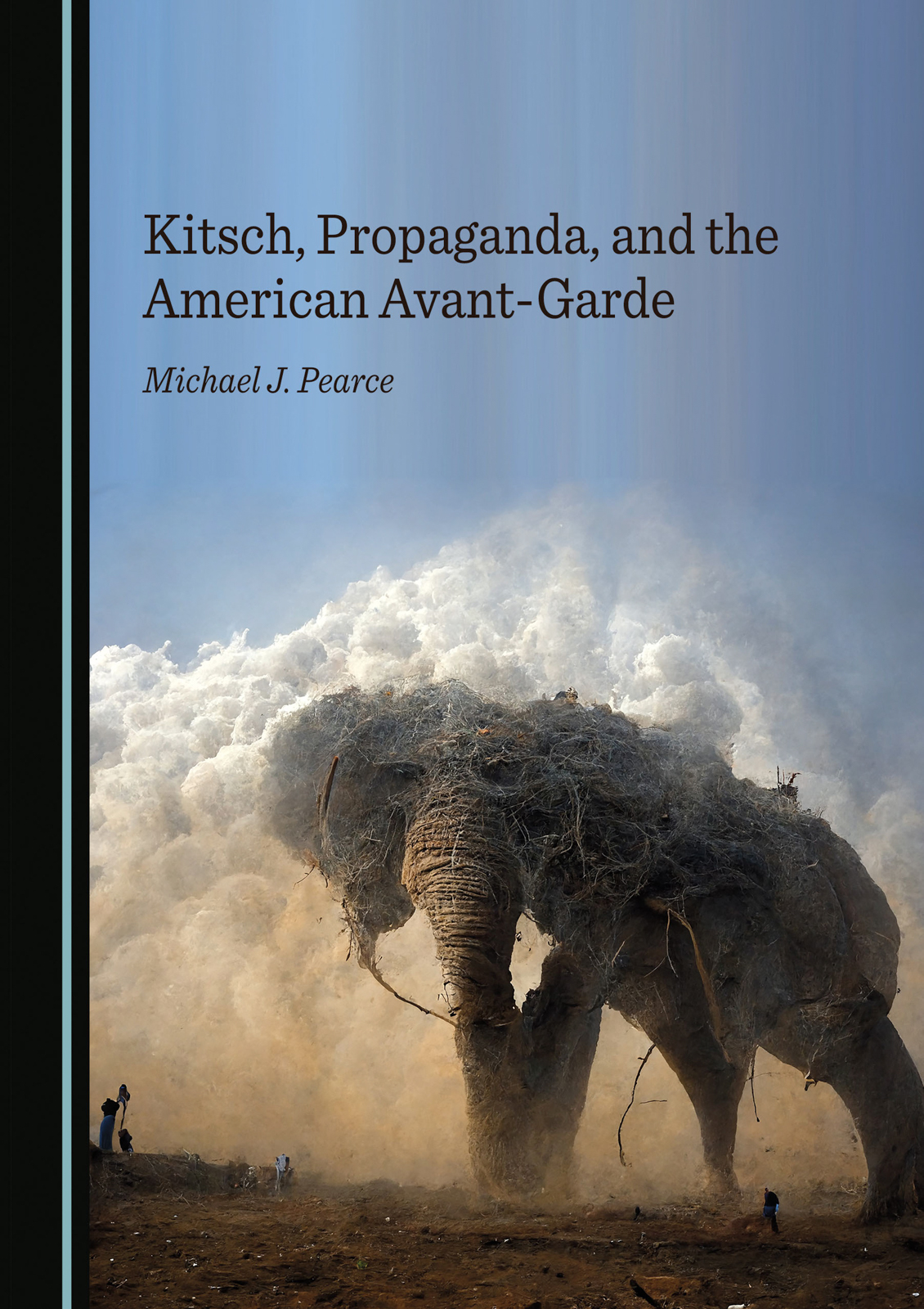
Kitsch, Propaganda, and the American Avant-Garde
by Michael J. Pearce
(Cambridge Scholars Publishing, March 24, 2023. Hardcover, 405 pages. $134.95)

What compelled you to write this book?
MP: I wrote Kitsch, Propaganda, and the American Avant-Garde because I wanted to know why the acidic idea of kitsch was so pervasive in the hostile rhetoric that was aimed against representational painting and sculpture during the 20th century.
According to theorists, kitsch art appealed to sentiment and sprang from popular taste unguided by critical elites who wished to use art to promote their ideas. Kitsch was sensual, seductive and spiritual. It was the antithesis of true art. Kitsch was fake, and evil, and manipulative. Kitsch was tied to representational art with a Gordian knot.
How did the book change once you dug into your research?
MP: At first, I thought that the book would be a pleasant study defending the ideas behind the sensual representational art of the past and the present, but it soon became clear that without the avant-garde, kitsch simply didn’t exist. To answer my questions about kitsch, I had to examine the history of avant-gardism, to understand what it was, where it came from and why it came into being.What did you discover?
MP: Avant-garde art had its proto-communist origins in France, where it was conceived as a militant tool explicitly wielded for propagandizing the revolutionary cause of collectivists, then later fully applied by the tyranny of the Soviet Union as socialist realism, and in the U.S. under Franklin Roosevelt, as social realism. Avant-garde art was a new kind of art for a new age, explicitly an age born of socialist revolution.
There is always a complex relationship between art, money and power guiding the erratic development of cultural streams. In Kitsch, Propaganda, and the American Avant-Garde, I have especially looked for these relationships in the history of the avant-garde.
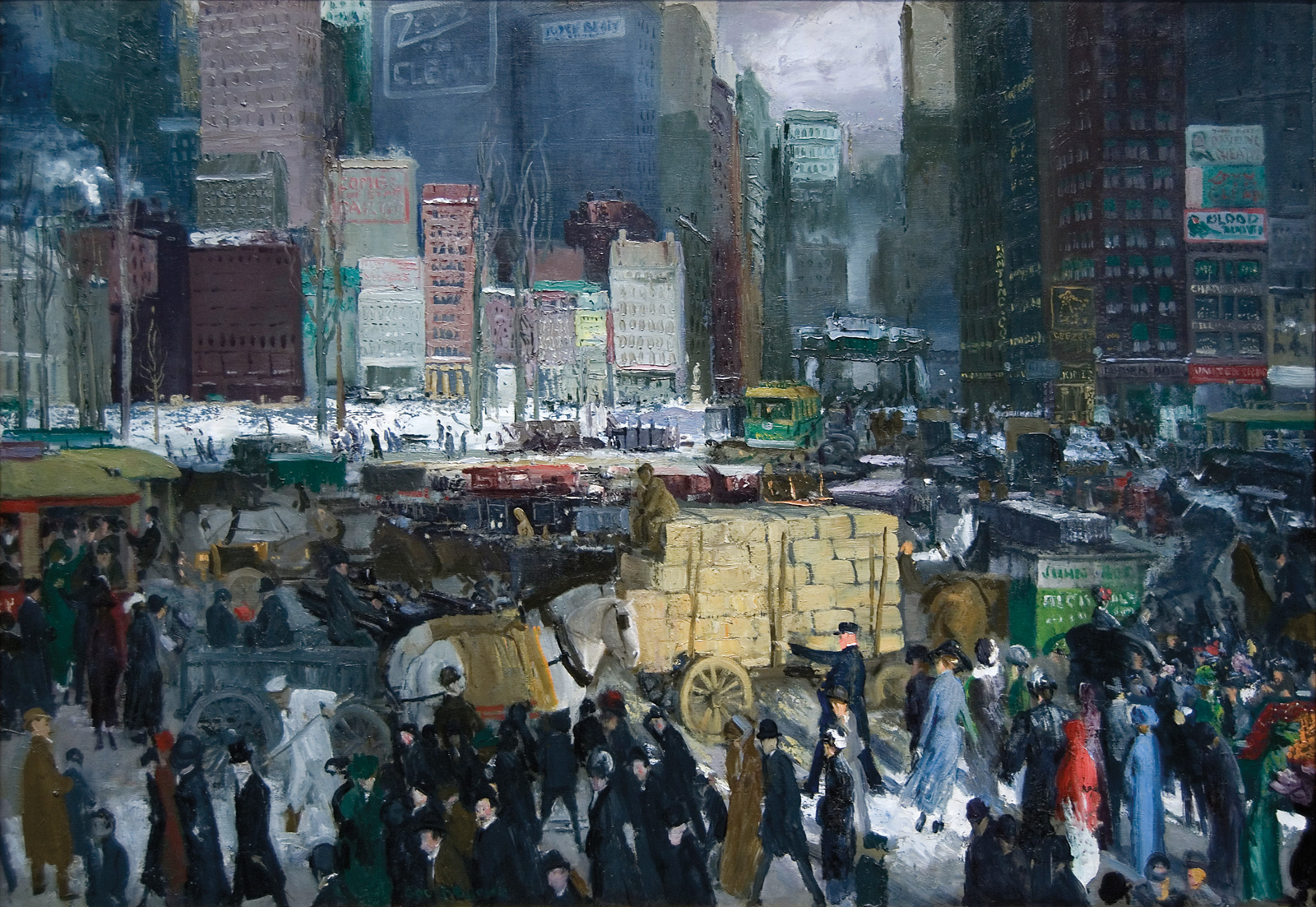 George Bellows (1882-1925), New York, 1911. Oil on canvas, 42 x 60 in.
Can you tell us about some of the dots you connected between art, money and power in the context of the American avant-garde?
MP: The American avant-garde did not achieve its position only because certain bohemian artists decided to follow a primrose path of reductively exploring media rather than mimesis, but also because very large sums of money changed hands, because it suited political needs, especially those of Nelson Rockefeller and Franklin Roosevelt, who astutely saw the necessity for crafting art into domestic propaganda, first in the form of paying for huge amounts of social realist painting in an attempt to raise America from the great depression, and then quite deliberately switching to funding a different kind of avant-gardism—an individualist, American brand of avant-gardism—as a counter to the impressive aesthetic efforts of Adolf Hitler and Joseph Stalin.
It was inevitable that when Stalin revealed the extent of his tyranny by allying himself to Hitler to attack Poland, the United States should seek an alternative to the embarrassment of using social realism—which was now clearly the art of the enemy—as its internal propaganda. Both Stalin and Hitler embraced representational art to propagandize their people, and oppressed individualism. In 1939, Rockefeller and Roosevelt opened their arms to American avant-garde art to symbolize the individual liberty of America’s citizens. Using the Museum of Modern Art as its flagship, this newly branded American avant-garde became a weapon precisely at the beginning of the Second World War, when the fine art made for the propaganda machine of Hitler’s aesthetic state required an allied response. After 1939, the word ‘avant-garde’ was used in a new, assertive and specifically American context by Clement Greenberg and Edward Jewell, to describe anti-conservative, radically individualist, progressive art, deliberately positioned as the antithesis of representational art.
What do you hope to have achieved in writing this book?
MP: Kitsch, Propaganda, and the American Avant-Garde provides a path through the last three centuries of art history that has been neglected in the received narrative of the avant-garde hegemony. I have depended upon first-hand accounts and sources as much as possible, because I dislike the artificial and saccharine flavor of propaganda that stains many of the histories I have tasted, and I don’t want my readers to taste it in my writing. I sincerely hope the book will make the remaining acolytes of the avant-garde uncomfortable, because while they have imagined themselves to be rebellious and cutting-edge and counter-cultural, in fact the U.S. government has used them as either oblivious or willing tools of the state. The truth is sharp enough to cut the knot.
Kitsch, Propaganda, and the American Avant-Garde is available on Amazon.com and at select book stores.
Powered by Froala Editor


