

Disclaimer: The following are composites of real people, places and events.
The Art Auction as Theater
The first thing to know about art auctions? Art auctions are theater. The theater is the place where dramatic narratives unfold in orchestrated patterns of tension and release, time pressure and turns of plot. In both, despite the orchestration, there is a high wire act of interpretation and improvisation. In the theater as in the art auction, there are players—the bidders—and spectators, mingling in the audience. There’s a director—the auctioneer—who leads the proceedings live and on the fly. There are those who are bidding for others and those taking bids for the auction house. Art handlers change the set every few minutes. Spotters, or ringmen, like ushers, move up and down the aisle, separating players from spectators. At the major sales, art journalists, like theater critics, give thumbs up or thumbs down to the rhythm of the sale and to the results.
A painting or sculpture comes to the block—let’s call it Lot 49. Different bidders, who often aren’t aware of one another, want Lot 49.
Conflicting desire ignites the drama. And the bidding begins. Bidding is acting.

In May of 2022, Sotheby’s live auction, The Macklowe Collection auction realized $246.1 million, for a total of $922.2 million across two auctions—making it the most valuable collection ever sold at auction.
Some bidders are scenery chewers. They want to let the world to know they’re bidding. Some prefer method acting and do all they can to conceal their identities. Some bid right away; some wait until the first bidders reach their limits before throwing up their hands or nodding discreetly. The auctioneer often represents absentee bids; phone bidders represent others in real time. Internet bidders hit “Bid Now” buttons. At the big houses, like Christie’s or Sotheby’s, the bidding is fairly stately. At others, especially in the American West, the bidding is fast and furious. That painting you coveted of the cowboy on a bucking bronc can blow by before you’ve had a chance to throw your hand up and whoop.
Missed bids, misunderstood bids, retracted bids, dueling bidders, bidders spending fortunes, dealers and art advisors spending bidders’ fortunes. As in the theater, let’s be honest, few dramas rise to the level of tragedy or high comedy—it isn’t Sophocles or Oscar Wilde—but there’s plenty of melodrama, and not a little slapstick. It’s the fierce competition that leads bidders and audience members, in a moment of supreme irony, to crow about “winning” say, our Lot 49, and “losing” when winning means paying and losing means keeping your powder dry.
The Mourners at the Auction
You walk into some auctions, just as you walk into some theaters, and you just know. There’s no energy. The room is flat. The reviews are out before the opening night curtain rises. This play is likely to be a stinker. Dealers who know one another—and are dressed like pallbearers—shake one another’s hands and utter quiet greetings. One is tempted to say, “How did you know the deceased?” The sag at these funerals for art often has little to do with the quality of the works. In life as in comedy—and the theater in general—timing is everything. A down market, a saturated market, a rise in interest in rococo birdhouses that signals a dip in art deco birdhouses, an event in the world that jolts oil, or currency, or frozen concentrated orange juice—when the two principal collectors of art deco birdhouses are rivals in the o.j. biz—a host of things can kill a sale before the opening hammer falls. Lots fall without bids. The sound of the word “pass” from the auctioneer’s lips, more enfeebled with each “passing” lot, is all that rivals the hum of the florescent lights. Beneath these tolling bells, however, a few enterprising souls are wondering whether they can’t capitalize on despair, calculating whether there might not be a buy to be had after the sale. The house doesn’t always win. This is the drama underneath the drama, the dream of an inheritance before the body is even in the ground.
The Hired Gun
As I wrote at the outset, there are many roles to play in art auctions. One role that isn’t often described is the hired gun.
The hired gun flies into a small airport after two or three connections, rents the last—perhaps only?—car in the lot, a model that hasn’t been made for at least 10 years, and was almost certainly discontinued because the manufacturer couldn’t keep up with the recalls, and drives on roads that get worse with every mile.
The hired gun has been hired by a collector to bid on an artwork in an auction of everything under the sun, except art. The auction is in a town that has two names, the second of which is something like “Gulch.” The town’s single stoplight blinks in a desultory fashion at the crossroads of Oblivion Street and Limbo Road. There’s a motel done up in the style of the Norman Bates School of Design. There’s a diner. “Scorpion Surprise” tops the menu and you have a moment when you wonder if that’s a joke. If you’re not in the Southwest, substitute “Hollow” for “Gulch” and “Woodchuck” for “Scorpion.”
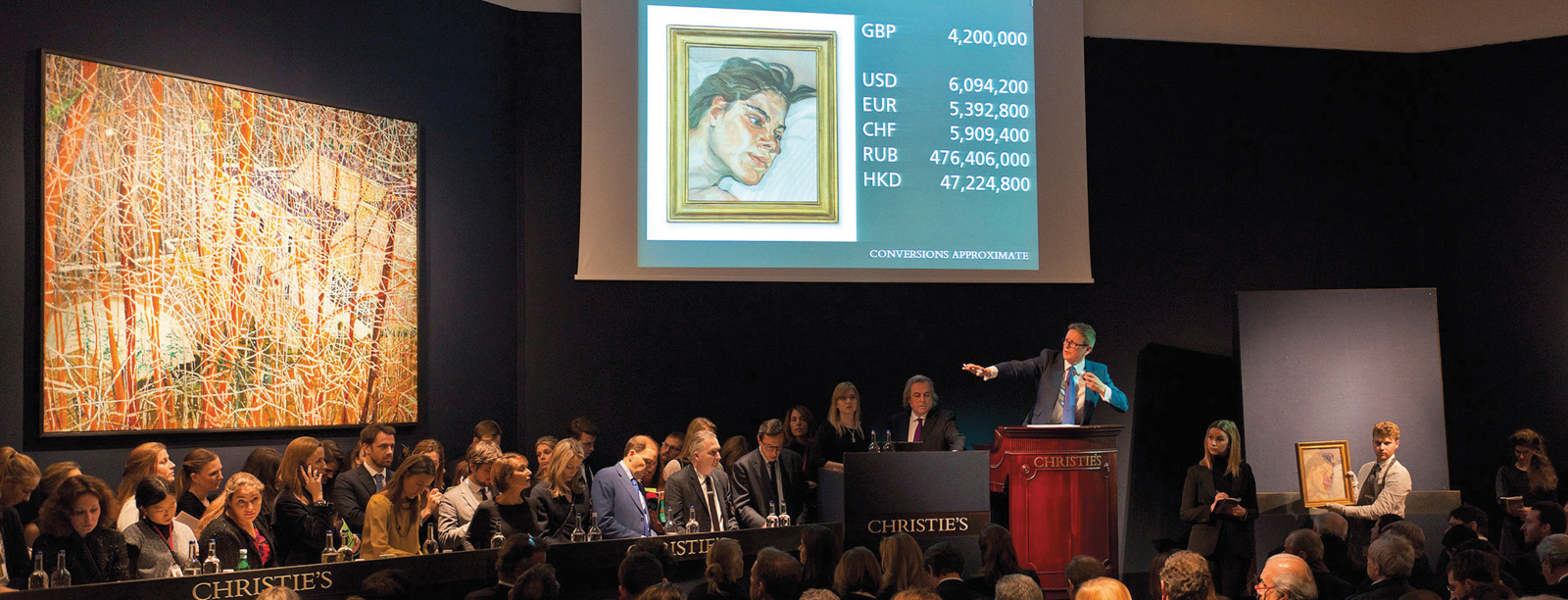
At the big houses, like Christie’s or Sotheby’s, the bidding is typically quite reserved. There are many overt and anonymous parties involved, with the auctioneer often representing absentee bids; while phone bidders often represent others in real time.
The auction itself is to be held in a haunted quonset hut in a field behind the gas station (local lore has it that Flight 219 got lost in the desert or forest or mountains while chasing a saucer-shaped object and was never heard from again). Headless Hummel, wooden boxes of dirty patent medicine bottles, and furnishings fit for the furnace dominate the sale. There are other paintings—all of them on velvet, some that glow under black light. You know this because you brought your own black light to examine the painting you are here to bid on—which is exquisite, a princess in a pigsty, crying out in silence to be swept away, taken away from all this. You feel like the agent who found Marilyn Monroe slinging hash at Schwab’s Drug Store. You betray none of this to the auctioneer, who is tuned to your every twitch. “It’s alright,” you say. “Just alright.”
You eat lightly, sleep lightly, and lie on the shabby bed looking at an asthmatic ceiling fan that can’t keep up with the heat. Did I mention that it’s hot? It’s always hot. This is when you really feel like a hired gun. What separates you from Bat Masterson is that you don’t know if there are any other mercs in town. You haven’t seen anyone. Is it possible that no one else knows about this painting in this sale?

Bidders fill a ballroom in Reno, Nevada, for the Coeur d’Alene Art Auction. The Western sales are known for their less formal presentation, especially compared to the New York sales.
You head over, not too early, but still way too early. If you thought it was hot in your room, the quonset hut—half of a giant tin can exposed to every ray of the sun—makes you feel like an ant under a magnifying glass. Spontaneous combustion isn’t a horror story trope. You wonder if Flight 219 didn’t just keep flying until they got to the beach, ditched their planes, and lived out their lives in breezy ease.
The auctioneer works through hundreds of lots of 20 dollar items that dealers are hoping to sell for 25.
First rule of Auction Club: know everyone in Auction Club, even, and especially, your competitors. Pitted out, getting dizzy from the pressure and the heat, you see him—a dealer you know. Another hired gun, meaning—a shootout. He nods. You nod. Then you both walk away and get on the phone. You call headquarters and your client, who ups the limit—or not—or wants to be on the phone with you during the bidding.
The painting is next. The bidding starts. It flies. Just the two of you. Back and forth. Him on his phone, you on yours. You tell your client where the bidding is. Your client keeps saying “Yes.” You’re north of a million bucks in under a minute. Whose chamber will empty first? Then the hammer falls. And you win! There are cheers, actual cheers. A woman draws a warm beer, hands it to you and says, “On me.” She winks at you, thinks it was your money. Your rival goes around telling everyone he was bidding for the gallery, not a client. You don’t blame him. It’s exactly what you’d say.
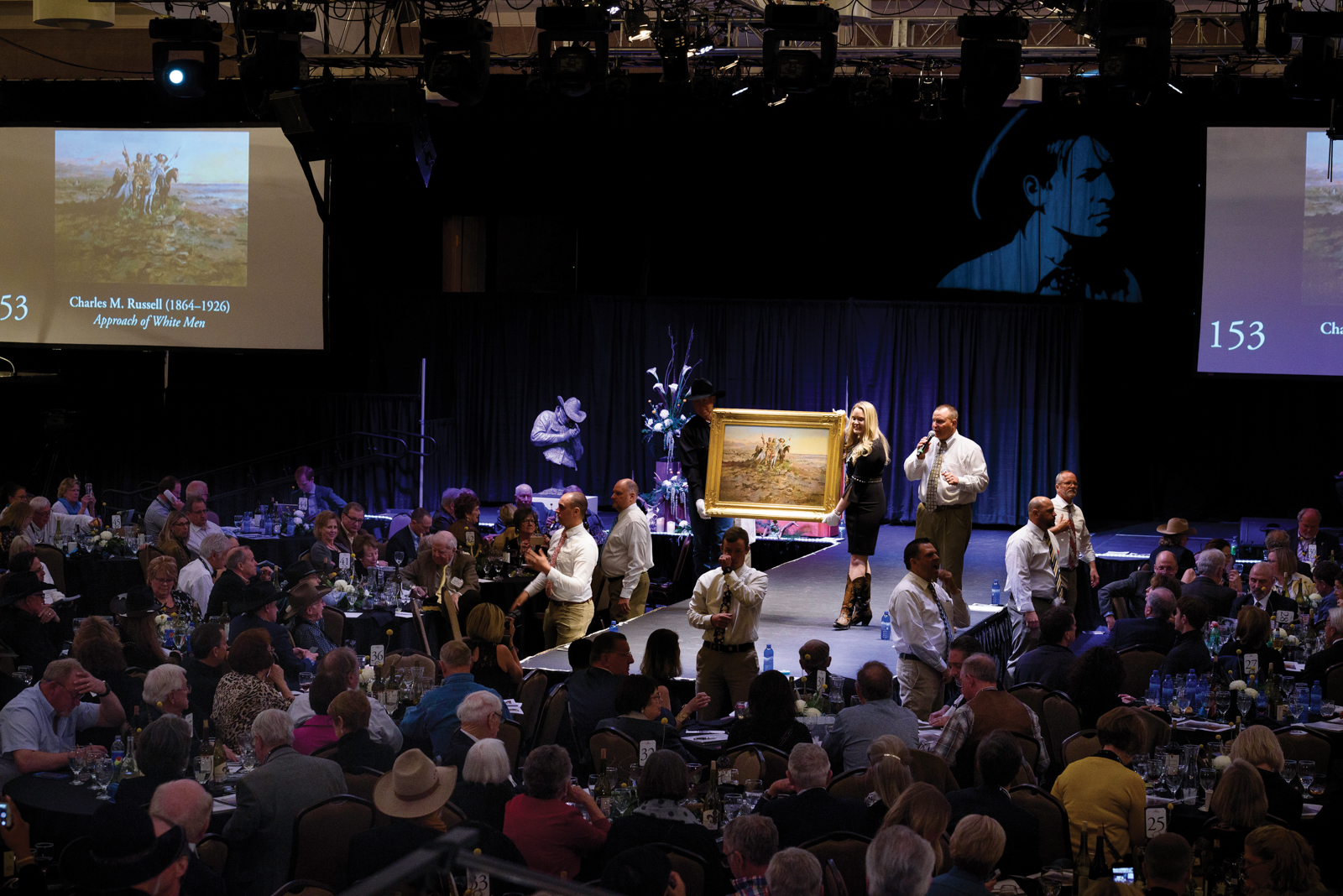
A work by Charles M. Russell is brought out onto the stage at The Russell in Great Falls, Montana. The auction routinely parades the artwork in front of bidders to generate excitement during the sale.
You settle up with the auction house. The next lot after the painting is a bottle. The bidding goes up in fifty-cent increments. The auctioneer, having had enough, says “It’s taking longer to sell a 50-dollar bottle than it did to sell a million-dollar painting!” The hammer starts falling faster and faster. The rest of the sale won’t make the auction house a fraction of the profits they’ve made from the painting.
You’re gone as fast as your K-Car or Pinto or Gremlin will take you. You might even sleep at the airport.
The Art Lover
If you think of the art auction as a kind of rotating, temporary, pop-up museum—and many art lovers do—the previews offer opportunities to see works long buried in private collections that may well end up in other private collections. Viewed from this perspective, artworks at auction transcend commodification. They become, once again, what they were created to be—works of art.

Thomas Moran’s (1837-1926), Green River of Wyoming, 1878. Oil on canvas, 25 x 48 in., signed ‘monogram’. In 2008, this work by Thomas Moran sold at Christie’s for $17.7 million, against a pre-sale estimate of $3.5/5 million. In addition to setting a record for the artist, it also set the record price for any 19th century work of American Art at auction.
If you get good at treating art auctions this way, and I urge you to do so, you will find that the big-dollar headliners might not be the works that grab you and hold your attention. A quiet passage in a painting by a lesser-known artist, or a line on a sculpture that draws you in and makes you circle it and see the work in space arrests your gaze. The lack of zeroes in the estimate and the absence of hoopla on the blogs suddenly mean nothing. Lot 49 or Lot 88, or whatever it is, is looking back at you, even as you look at it. You and the auction, are merely part of its story, its history, long or short. You’re seeing art as art, as a repository of history—as opposed to an artifact of history. Whether the work achieves a new world record, squeaks by, or passes without a bid—none of that matters. The sale, the changing of hands, the ultimate destination—which is never ultimate—is only part of that larger story. To extend the metaphor of the auction as theater, this is a personal, private experience inside the public performance.
I believe the old Latin saying runs thus: “Ars longa, vita brevis:” Art is long; life is short. In the life of an artwork, the auction is a finger snap, a fast-paced play in a run that never closes. Worth remembering...
Powered by Froala Editor