Long before her monumental black sculptures and iconic mink eyelashes, famed artist Louise Nevelson (1899-1988) was just a small immigrant girl growing up in Rockland, Maine.
Born Leah Berliawsky in Ukraine in 1899, Nevelson arrived in the United States with her family in 1905. The Jewish family struggled upon their arrival, both financially and as a religious minority. Still, Nevelson discovered her talent for art and set her sights on a bold, unconventional life.
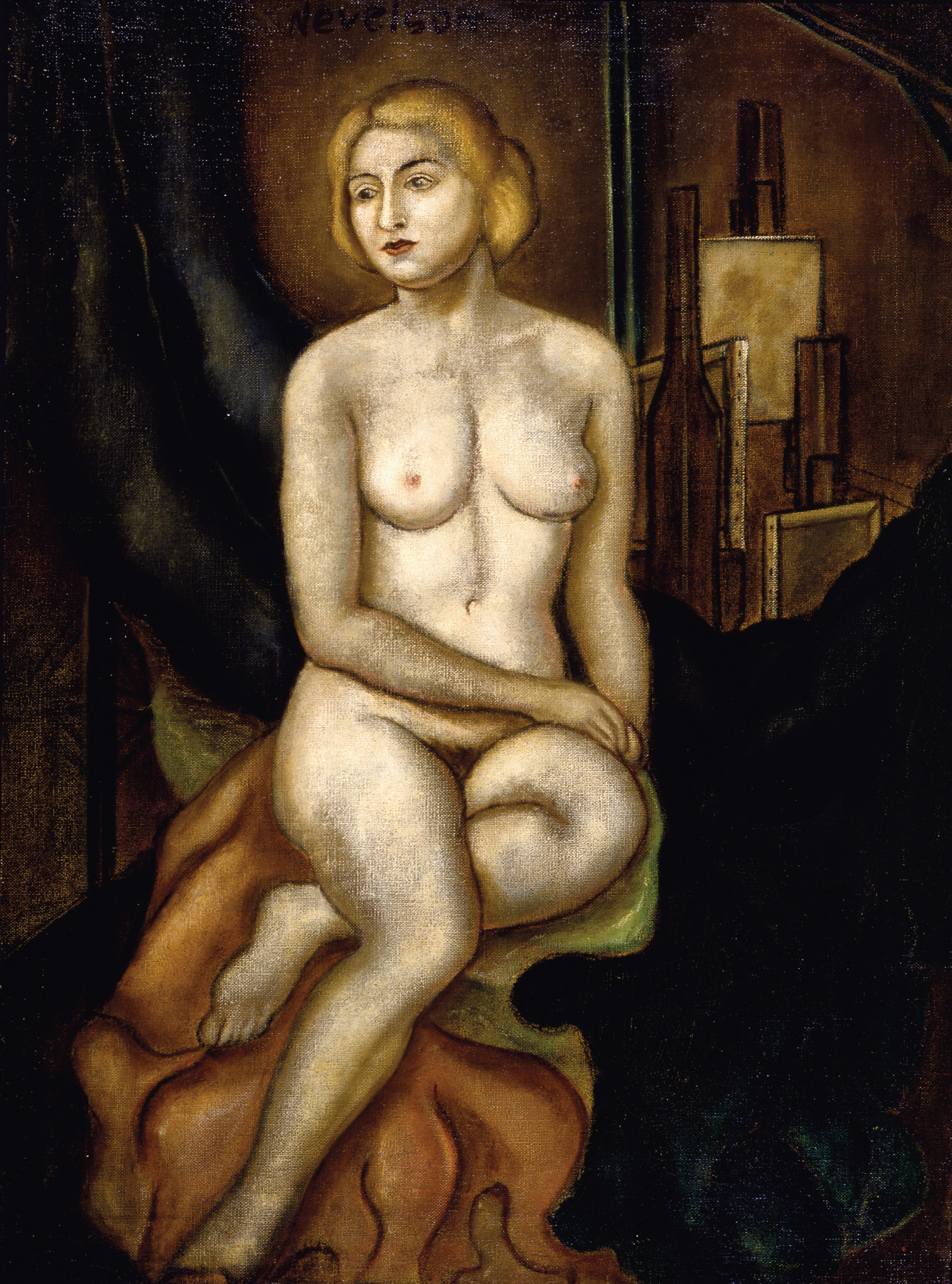 Louise Nevelson (1899-1988), Female Nude, ca. 1928. Oil on canvas, 30 x 22½ in. Gift of Louise Nevelson, 1981.2.1.
An exhibition currently on view at the Farnsworth Art Museum charts young artist’s journey to becoming a major American artist. Louise Nevelson: Dawn to Dusk features more than 40 works, including Nevelson’s early paintings, drawings and figurative sculptures, as well as later abstract painted wood constructions, collages and handcrafted jewelry. The exhibition runs through December 2024.
The show was curated by Suzette McAvoy, the Farnsworth’s former director and now independent curator and arts writer. All works exhibited are part of the Farnsworth’s collection, which is the second-largest holding of Nevelson’s work after the Whitney Museum of American Art.
McAvoy says the Farnsworth is uniquely poised to illuminate Nevelson’s artistic development. “Our collection is strong in Nevelson’s student work and formative paintings and sculptures,” McAvoy says.
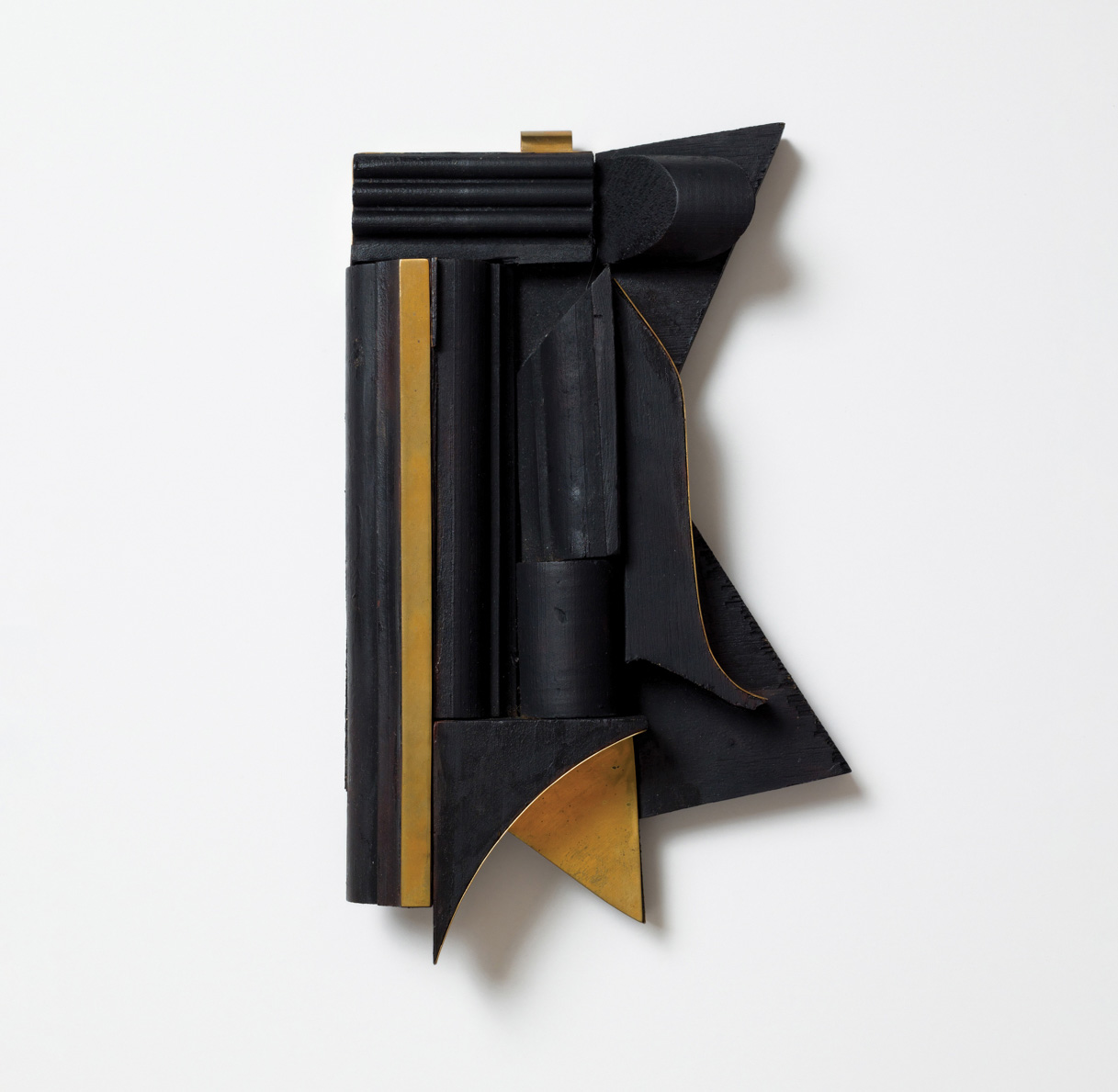 Louise Nevelson (1899-1988), Jewelry of Louise Nevelson, 1985. Painted wood and gold metallic overlay, 6½ x 2¾ x 15⁄8 in. Gift of Louise Nevelson, 1985.23.6.
Nevelson knew from an early age that she wanted to pursue a career as an artist. Despite recognition from her school teachers, she knew she would need to go further afield to pursue her dream. At age 20 she found a way out of Rockland. She married businessman Charles Nevelson and moved to New York City. She began taking classes at the Art Students League of New York. Her painting from this period, Female Nude, shows Nevelson’s early engagement with the fundamentals of oil painting. She studied with Kenneth Hayes Miller, a well-known and respected artist and teacher. Though Nevelson ultimately abandoned Miller’s traditional style, she took inspiration from him to find her own voice.
Nevelson had a son in 1922 and, like many female artists throughout history, she was torn between the duties of motherhood and the pursuit of her artistic passion. In 1931 she chose a taboo path and left her son, Mike, in the care of family so she could live in Europe and study with renowned painter Hans Hofman. She separated from her husband at this time. When she returned to New York, she and Mike were forced to live in poverty, sometimes scrounging firewood from the streets to burn in their fireplace to keep warm.
But even those struggles proved generative for Nevelson. She held aside some of the foraged scrap wood and began to build assemblages with it. Nevelson’s first New York show was in 1941. It took more than a decade before her reputation was sealed as an important artist. Her 1958 black, wooden wall piece, Moon Gardens + One, prompted the chief curator at the Museum of Modern Art to include her work in the 1959 Sixteen Americans show at MoMA, for which Nevelson created her famous work Dawn’s Wedding Feast.
The Farnsworth exhibit includes Dawn Column I, a segment from the room-size installation Dawn’s Wedding Feast. According to the National Museum of Women in the Arts, Dawn’s Wedding Feast’s abstract wood sculptures “represented a bride and groom, their guests, a wedding chest, pillow, and cake, and architectural elements suggesting the walls and columns of chapels.” Rather than black, the artist chose to paint the assemblage in white.
“For me, the black contains the silhouette, the essence of the universe,” Nevelson said. “But the whites move out a little bit into outer space with more freedom.”
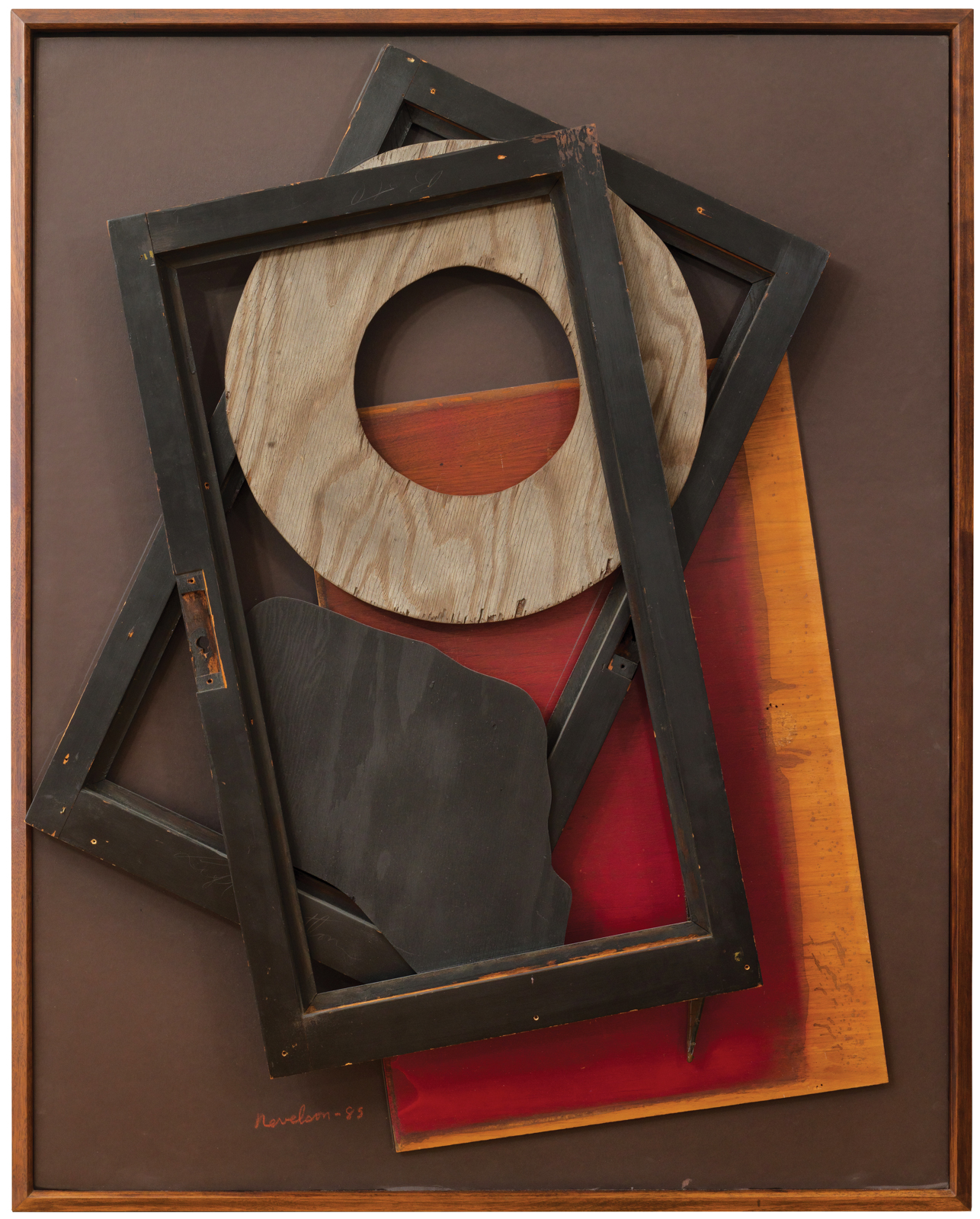 Louise Nevelson (1899-1988), Volcanic Magic XVI, 1985. Wood and paper collage, 431/8 x 35 x 4½ in. Gift of Louise Nevelson, 1985.
The various sculptures composing Dawn’s Wedding Feast were subsequently dispersed into many collections. A singular column cannot create the full immersive experience Nevelson intended. So the Farnsworth devised a workaround for Dawn to Dusk: they commissioned a full-size photograph of the original installation, with Dawn Column I on view as well. “We wanted to give audiences a context for the work,” McAvoy says.
Included in the exhibition is a black wall assemblage with very special ties to the Farnsworth. Nevelson first made The Endless Column in 1969. At the time, it consisted of three rows of boxes forming a tall rectangle. The piece was a chance for Nevelson to explore what she called “musical” variations formed by the shadows in the piece. Decades later when Nevelson was preparing the piece for her 1985 show at the Farnsworth, she added two rows of boxes at the top and vertical assemblages on either side to bookend the central piece. It was not unusual for Nevelson to transform her works after their initial incarnation. The Endless Column invites viewers to ponder the ways in which it is now site-specific.
Louise Nevelson was in her 60s when her career really took off. She produced numerous public art sculptures, and even has a plaza named after her in New York City. She was known as the grand dame of American sculpture. She had a flair for the theatrical and dressed in headscarves, layered kimonos, and dramatic makeup. She considered her persona as an extension of her sculptures.
“I think being an artist is a state of mind,” Nevelson once said. “I wanted harmony within myself, so I externalized it in my work.”
Though known as a master of the monumental, Nevelson also created very small sculptures in the form of pendants. Carefully crafted from wood and painted black, with accents of brass or silver, thirteen of these necklaces are currently on display in Dawn to Dusk.
Her love of ornamentation and theatricality can also be seen in Orfeo - Two Banners, which she created in 1984 for the Opera Theatre Saint Louis’ production of Orfeo and Euridice. Although it was her first experience designing for the stage, she had an interest in theater since the late 1920s when she studied at the American Laboratory Theatre in New York.
Nevelson was influenced by many artistic traditions, from ancient Mayans to Indigenous artists of the Pacific Northwest. Key among those influences was cubism. “When I found the cube, it stabilized me,” Nevelson said in an interview for Particular Passions: Talks with Women Who Shaped Our Times by photographer Lynn Gilbert. “If you study metaphysics, it has its own symbols. And the cube is the highest form that the human being has come to. First in consciousness you have a dot, then you have a line, then you have the square. Then you project it into a cube. That is as far as the human species can go.”
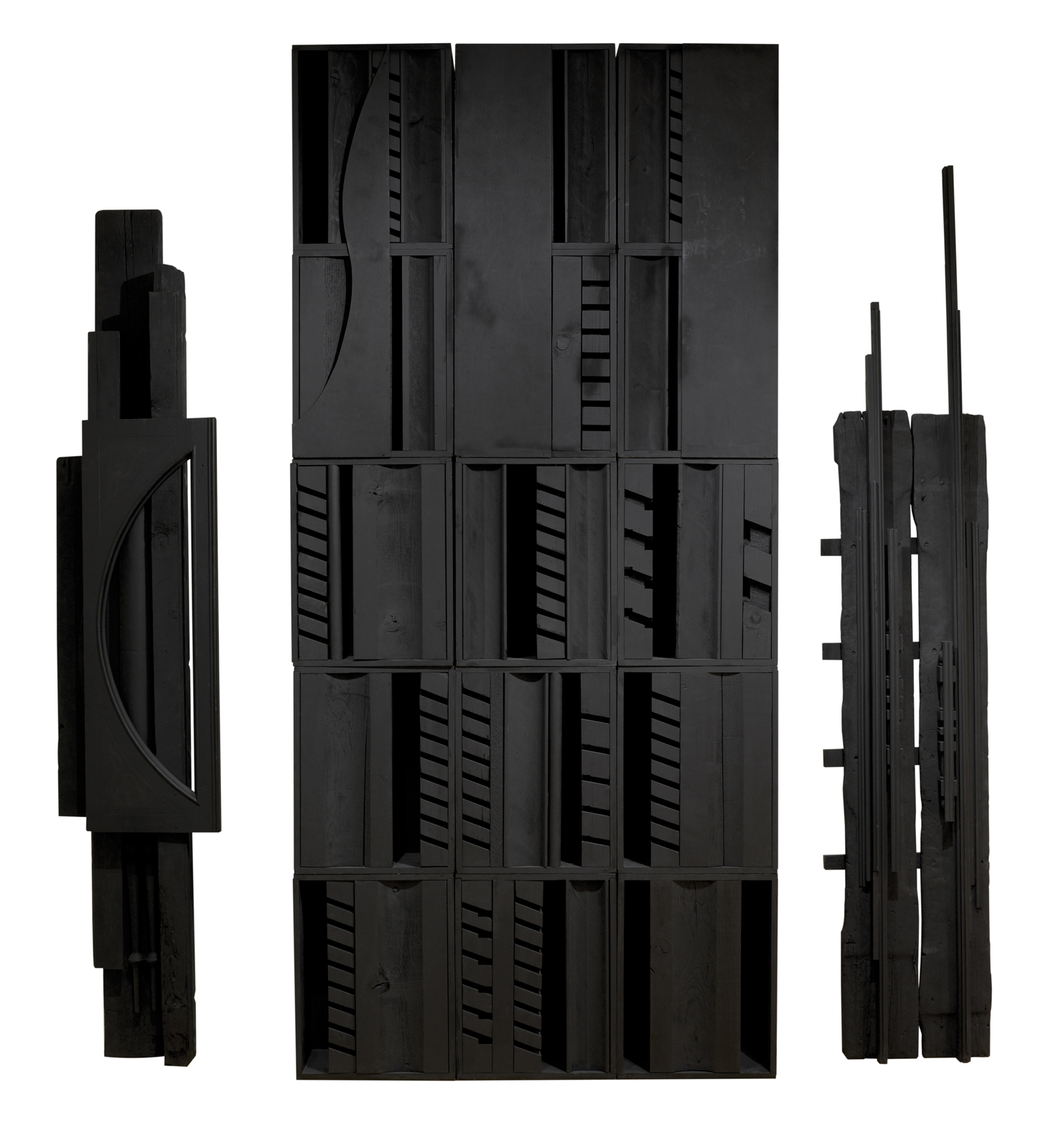 Louise Nevelson (1899-1988), The Endless Column, 1969-85. Painted found wood, left: 1097⁄8 x 22 x 91⁄8 in., center: 1281⁄8 x 591⁄8 x 11 in.,
right: 11413/16 x 21½ x 5¼ in. Collection of the Farnsworth Art Museum, Rockland, Maine. Bequest of Nathan Berliawsky, 1980.35.30.
© 2022 Estate of Louise Nevelson / Artists Rights Society (ARS), New York.
Late in her life, Nevelson came full circle and formed a connection with Rockland, the place of her youth. The Farnsworth held an exhibition of her work in 1985. In the four years preceding the exhibition, Nevelson donated 56 pieces of her own work to the museum. Her brother, Nathan Berliawsky, and sister, Anita Berliawsky Wienstein, also made significant gifts.
In response to the 1985 Farnsworth show, Nevelson said, “When I was growing up in Rockland from grammar school to high school, there was no museum. One of the great joys of my life is that we have a first-rate one now—a beautiful building that encloses creative works that can stand with the great ones.”
Nevelson died in New York City in 1988. She was 88 years old.
McAvoy says that, as a curator working in Rockland, it was heartwarming to see Nevelson reconcile with her hometown. “She came back and was so gratified to see the response to her work. To become an artist she had to go away. But then she came back near the end of her life and found respect and recognition.”
Included in the exhibition are several of Nevelson’s final works, the Volcanic Magic reliefs. Composed of a variety of found materials, these dimensional compositions relate to work created by Russian constructivist artists Vladimir Tatlin, Ivan Puni, Vassily Ermilov and others around 1915 to 1920.
Her later collage work was a personal and private mode of expression, according to Pace Gallery, which has represented her work since 1962. In a catalog for an exhibition of Nevelson’s collages in Palo Alto in 2022, the gallery noted that “tearing and re-combining traces of the past to produce a raw, unfiltered beauty, Nevelson developed an aesthetic of fragmentation and reassembly that animated the spirit of all her work as an artist.”
Nevelson’s work has huge relevance today, according to McAvoy. “If you think about what she was doing with discarded materials, using detritus and transforming it, that’s a very contemporary practice today,” McAvoy says.
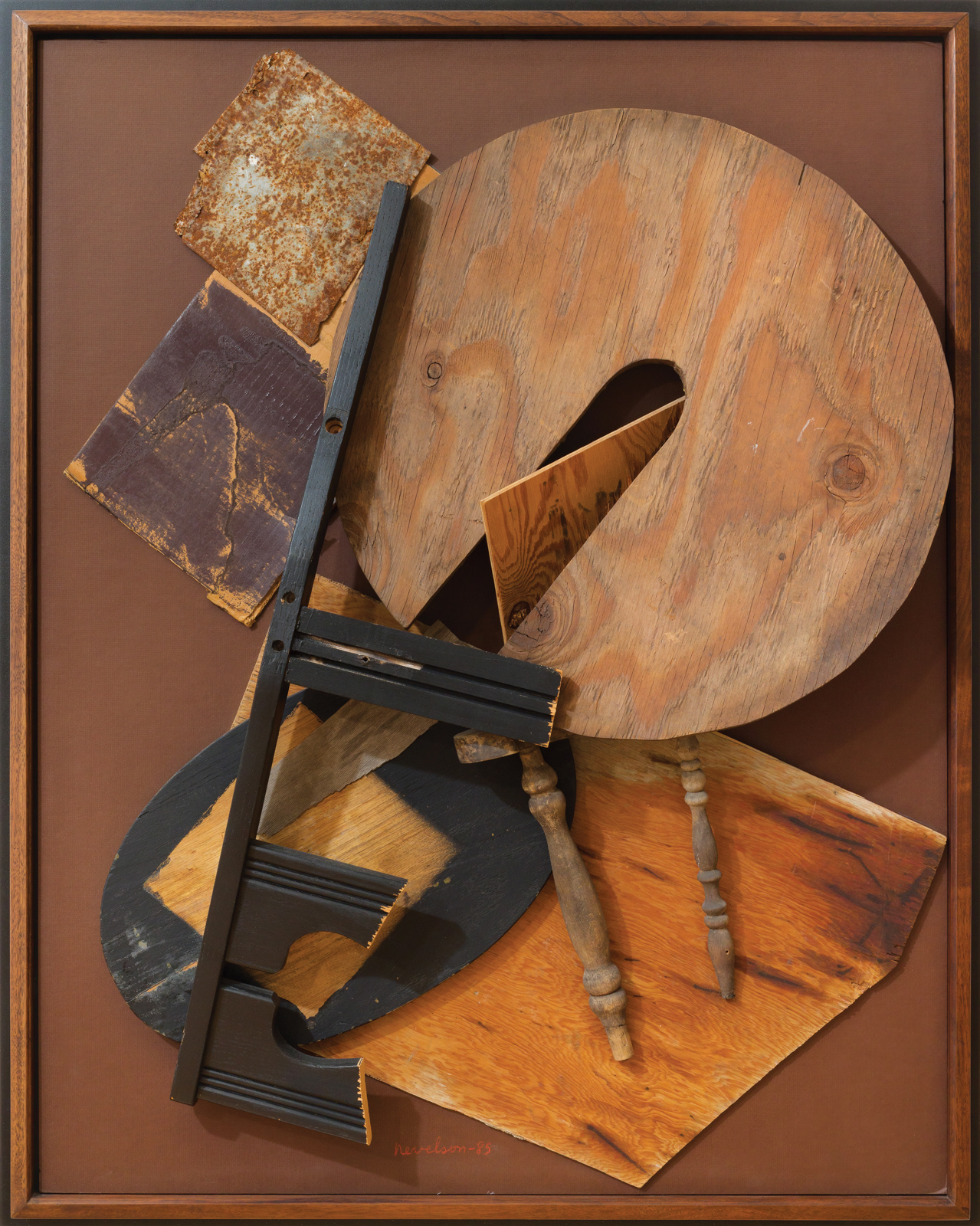 Louise Nevelson (1899-1988), Volcanic Magic XXII, 1985. Wood and paper collage, 431⁄8 x 35 x 4½ in. Gift of Louise Nevelson, 1985.
Recent years have seen a resurgence in interest in Nevelson’s work. The 2022 Venice Biennale featured a major presentation of her work. The exhibition, titled Louise Nevelson. Persistence, marked the 60th anniversary of Nevelson’s representation of the United States in the American Pavilion at the Biennale Arte in 1962.
Nevelson’s work can be found in the collections of major museums, including the Metropolitan Museum of Art, New York; the Museum of Modern Art, New York; the National Gallery of Art, Washington, D.C.; the Los Angeles County Museum of Art; the San Francisco Museum of Modern Art; Tate, London; the Galleria Civica d’Arte Moderna e Contemporanea, Turin, Italy; the Louisiana Museum of Modern Art, Humlebæk, Denmark; the Moderna Museet, Stockholm; and numerous others.
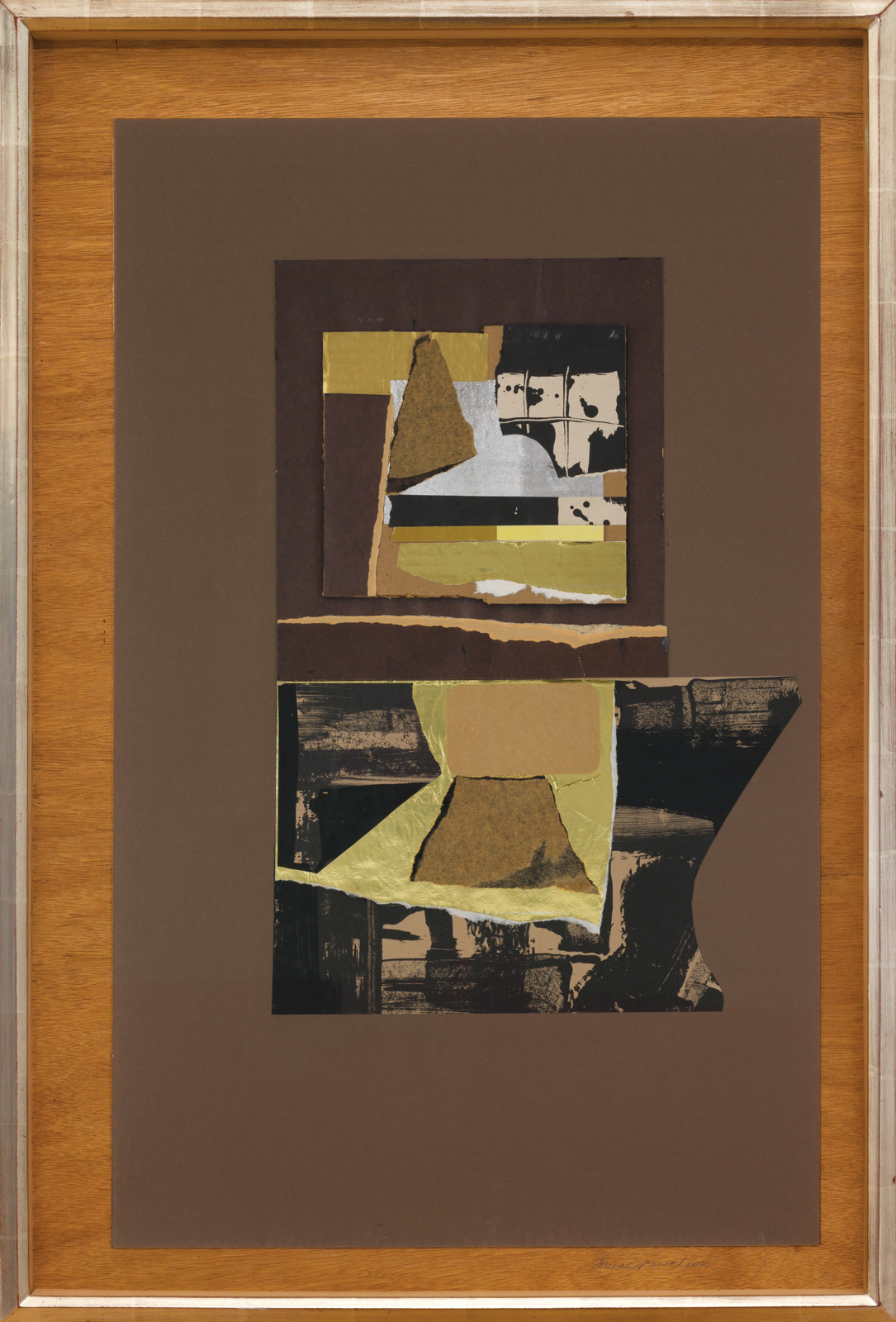 Louise Nevelson (1899-1988), Series of an Unknown Cosmos I, 1979. Wood and paper collage on plywood, 36 x 24 in. Gift of Louise Nevelson, 1985.23.25.
“I admire her so much as a woman and how she pursued her path despite many obstacles,” McAvoy says. “She never stopped. She was a hard worker, and once she found her voice and audience at age 60, those next 25 years were some of the most productive of her life. Just goes to show: never give up the dream.”
Powered by Froala Editor