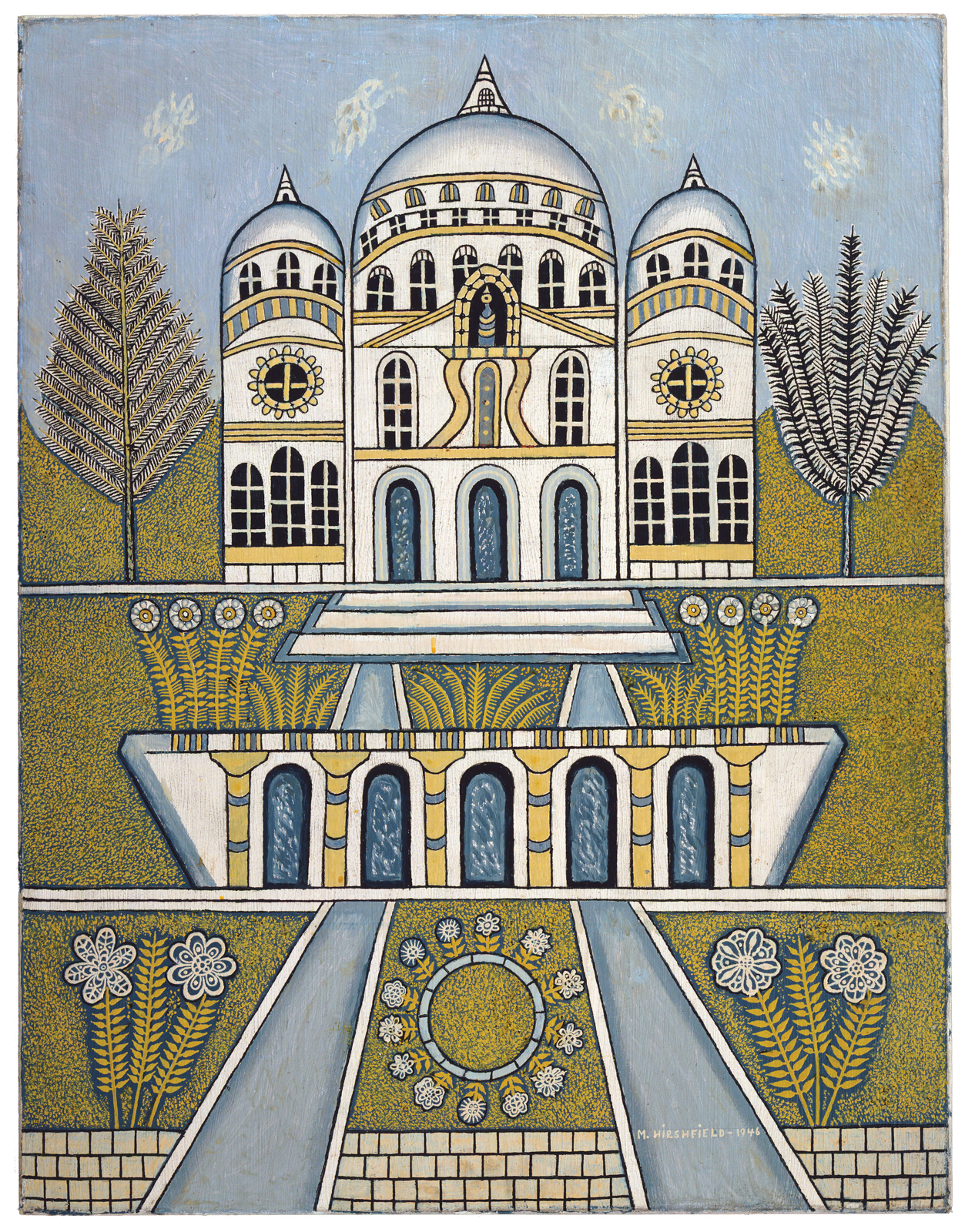
 Morris Hirshfield (1872, Poland–1946, United States), Parliamentary Buildings, 1946. Oil on canvas, 361⁄8 x 28 in. The Museum of Modern Art, New York, The Sidney and Harriet Janis Collection, 1969, 611.1967. © 2022 Robert and Gail Rentzer for Estate of Morris Hirshfield / Licensed by VAGA at Artists Rights Society (ARS), NY.
The one-of-a-kind exhibition Morris Hirshfield Rediscovered examines exactly what the title suggests—the surreal, colorful and all around breathtakingly unique paintings of the self-taught Polish immigrant, Morris Hirschfield. What began as a deep dive into the artist’s life and works in the book “Master of the Two Left Feet: Morris Hirschfield Rediscovered,” written by Richard Meyer, Robert and Ruth Halperin Professor of Art History at Stanford University and guest curator, is now a show of approximately 78 works of art.
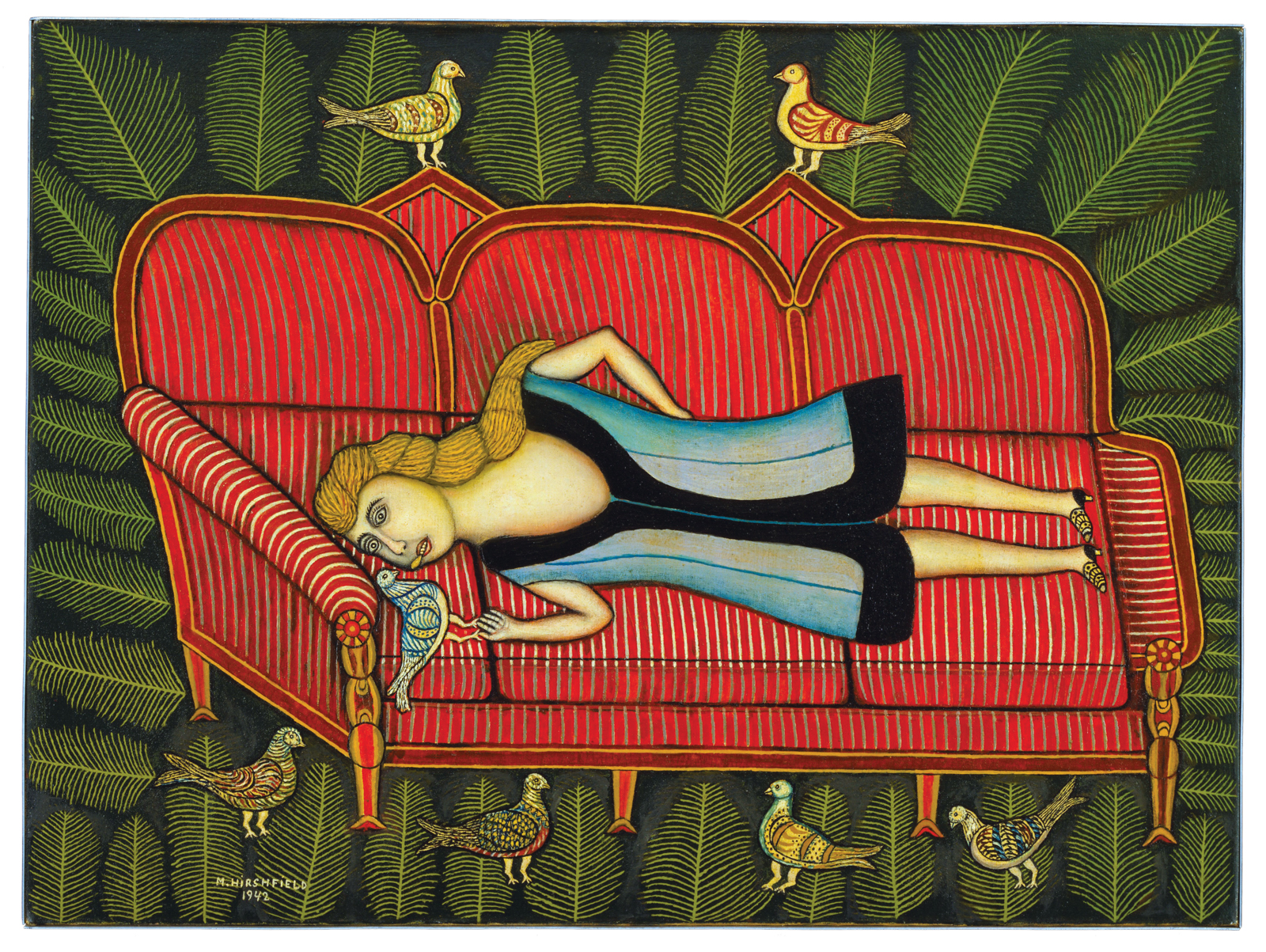 Morris Hirshfield (1872, Poland–1946, United States), Girl with Pigeons,1942. Oil on canvas 30 x 401⁄8 in. The Museum of Modern Art, New York,
The Sidney and Harriet Janis Collection, 1969, 610.1967. © 2022 Robert and Gail Rentzer for Estate of Morris Hirshfield / Licensed by VAGA at Artists Rights Society (ARS), NY.
“Some like to say that Hirshfield is ‘the most famous artist you’ve never heard of,’” says Meyer. “He was world famous in the 1940s, but has been largely forgotten and obscured—but not entirely. When first starting out, I realized I had only seen his works in reproduction and only knew of the controversy over his one-man show at MoMA in 1943.”
The controversy was largely about Hirschfield being an untrained artist, as he was more known for his work as a tailor and slipper and shoe maker. Meyer notes that many professional artists and critics of the time were wondering why someone like him was getting a one-man show, or being shown at all. But he did have friends and admirers such as Picasso and Marcel Duchamp, who saw him as a modern figure, even if he didn’t recognize it himself.
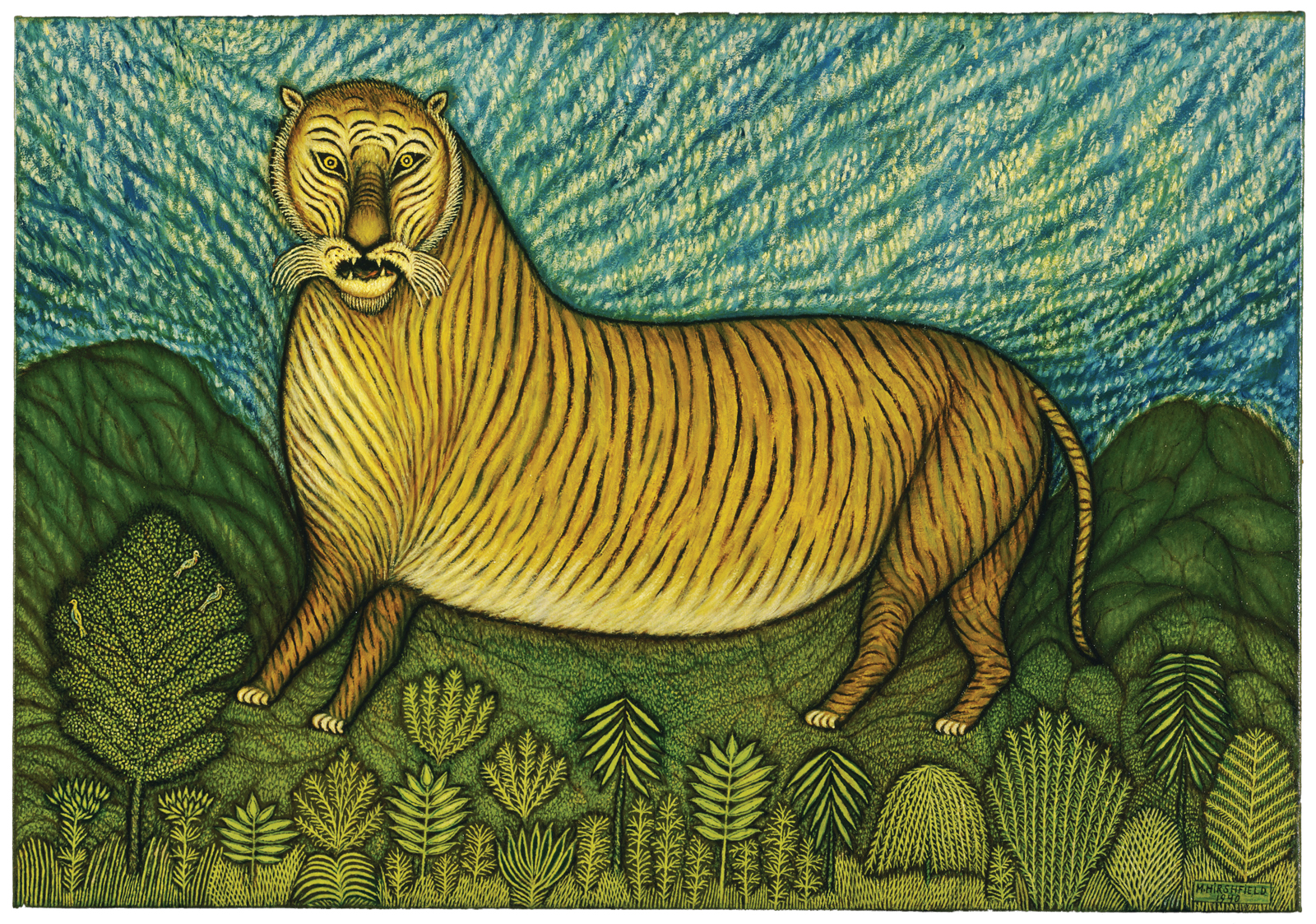 Morris Hirshfield (1872, Poland–1946, United States), Tiger, 1940. Oil on canvas, 28 x 39 7⁄8 in. The Museum of Modern Art, New York, Abby Aldrich Rockefeller Fund, 1941, 328.1941. © 2022 Robert and Gail Rentzer for Estate of Morris Hirshfield / Licensed by VAGA at Artists Rights Society (ARS), NY.
“Alfred H. Barr Jr., the founding director of MoMA, helped formulate how influential the museum was in its early years,” Meyer explains. “He was including photography, film, posters and industrial objects and was engaging internationally as well. A whole range of art that hadn’t been seen in U.S. museums before, helped create what we think of as modern art, and part of that creation taking form was what we know as folk art. The self-taught, folk art movement, inspired many artists to look around and not let all the rules get in the way of immediate self-expression. We can’t understand Hirschfield fully if we stay in the folk art frame and must expand our idea of fine art and folk art; modern and self-taught, so there can be a dialogue of what actually existed in the 30s and 40s.”
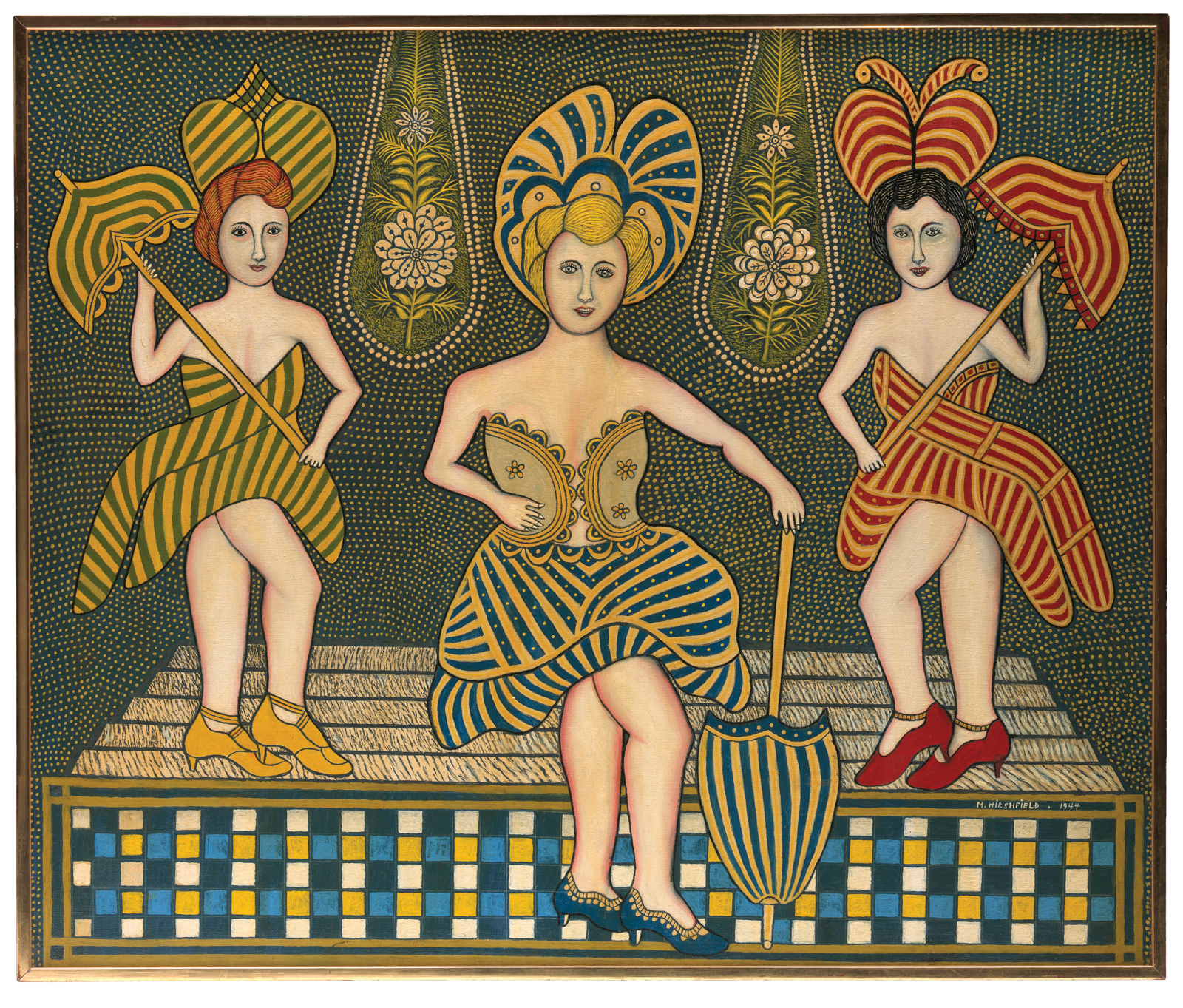 Morris Hirshfield (1872, Poland–1946, United States), Stage Beauties, 1944. Oil on canvas, 40 x 48 in. The Metropolitan Museum of Art, gift of Carroll and Donna Janis, 2013.1118. © 2022 Robert and Gail Rentzer for Estate of Morris Hirshfield / Licensed by VAGA at Artists Rights Society (ARS), NY.
Meyer goes on to explain that Hirschfield’s work appealed to the surrealists, and he was happy to be included among them, but was never intending anything purposefully dream-like. As in Girl with Pigeons, 1942, we see examples of this surreal perspective, where the woman is in a flattened state, set as though lying on a couch and surrounded by birds and a background of palm fronds. Hirschfield was not known for ever depicting his figures or subjects in a reclined state. “Most likely he painted her standing up and then rotated the canvas to show her lying down,” says Meyer. “Also, if you look closely, there’s something coming out of her mouth—a tear drop or a seed, as though she’s feeding it to the birds. Her gaze is one of shock or as if she’s in some alternate reality.”
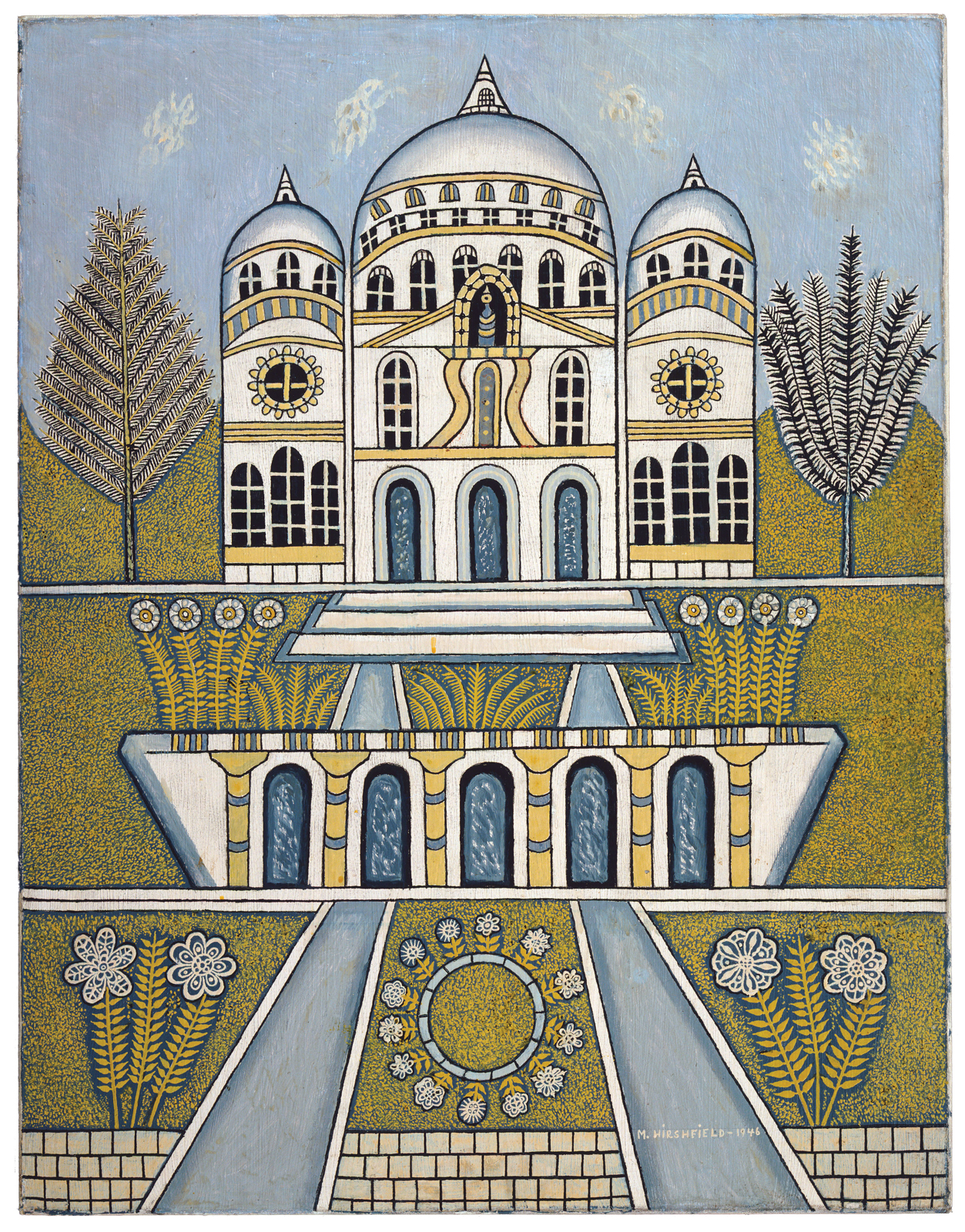 Morris Hirshfield (1872, Poland–1946, United States), Parliamentary Buildings, 1946. Oil on canvas, 361⁄8 x 28 in. The Museum of Modern Art, New York, The Sidney and Harriet Janis Collection, 1969, 611.1967. © 2022 Robert and Gail Rentzer for Estate of Morris Hirshfield / Licensed by VAGA at Artists Rights Society (ARS), NY.
Another important element to Hirschfield’s work is his use of “textile imagery”—also discussed widely in Meyer's book. “When you look closely, it looks like textiles, often in the skies, where clouds look like yarn (like in Tiger), or another part of a painting may look like wool or tweed (like the hair of the woman in Beach Girl),” he shares. “What I wanted people to take away, is yes, he’s painting, but, he’s painting with the memory and the skills of a lifetime of labor in the garment and footcare industry. I want to talk about how art is a part of life and it’s not separate from every day life. Here’s this poor immigrant person, his whole life he wanted to be an artist but that privilege was not available to him... He devised a way, in such an original manor, [to be a part of that world]. “I don’t think this happened to him despite being a tailor, it happened, in part, to bring those experiences into painting.”
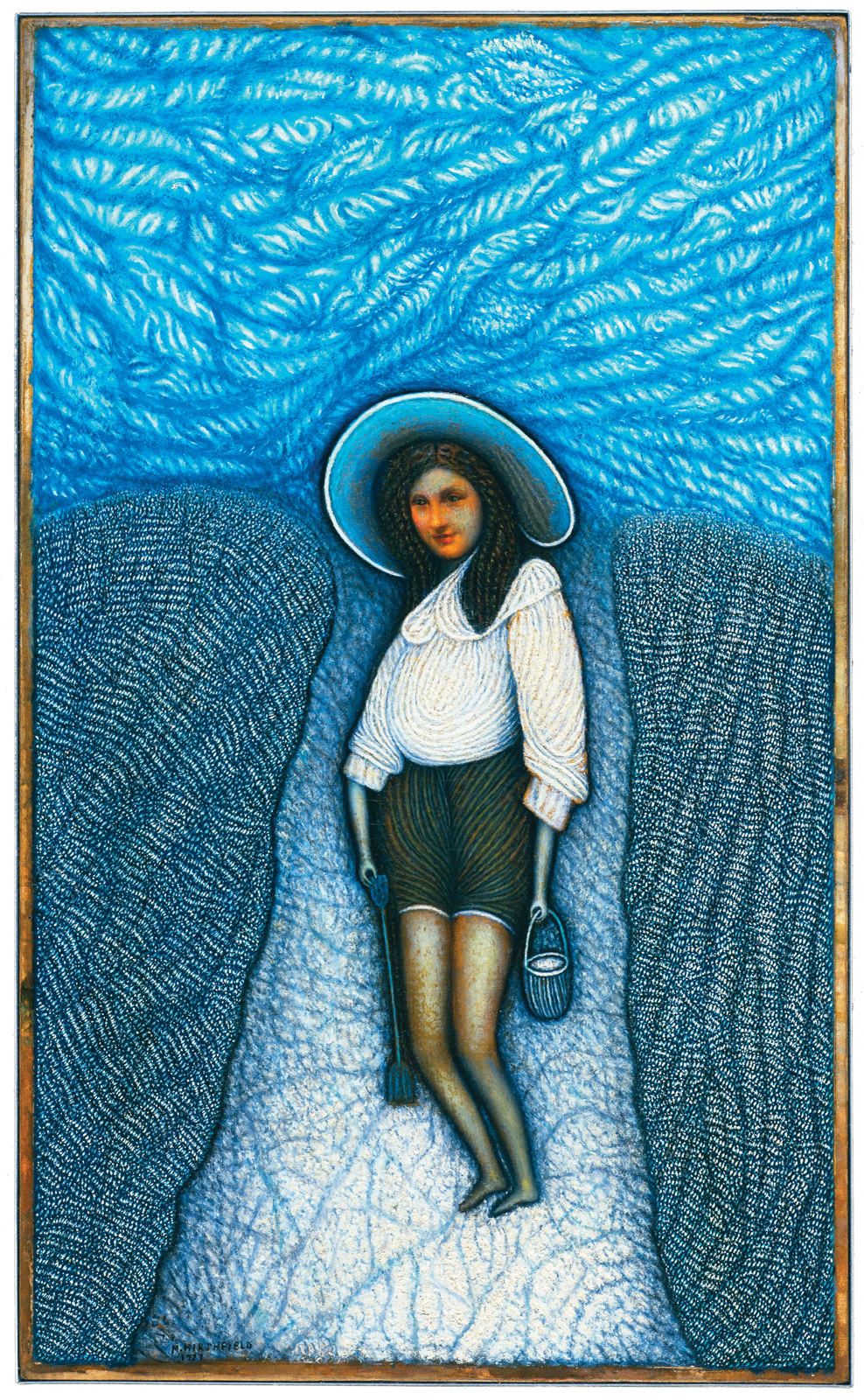 Morris Hirshfield (1872, Poland–1946, United States), Beach Girl, 1937–1939. Oil on canvas, 36¼ x 22¼ in. The Museum of Modern Art, New York, The Sidney and Harriet Janis Collection, 1967, 2097.1967. © 2022 Robert and Gail Rentzer for Estate of Morris Hirshfield / Licensed by VAGA at Artists Rights Society (ARS), NY.
In addition to drawings, studies and paintings, the American Folk Art Museum commissioned contemporary artist Liz Blahd to replicate Hirshfield’s boudoir slippers to specifications in his patented designs to also display. For additional dialogue, there will also be several other significant works by poignant artists hung alongside Girl with Pigeons.
Powered by Froala Editor