Charleston Farmhouse, with its walled garden and nearby pond occupies a bucolic setting in East Sussex in the United Kingdom. Charleston’s website states succinctly, “In 1916, the painter Vanessa Bell and her friend and lover Duncan Grant moved to Charleston along with Duncan’s partner David Garnett. It was the height of the first World War and, as conscientious objectors, Garnett and Grant needed to find farm work to avoid conscription.”
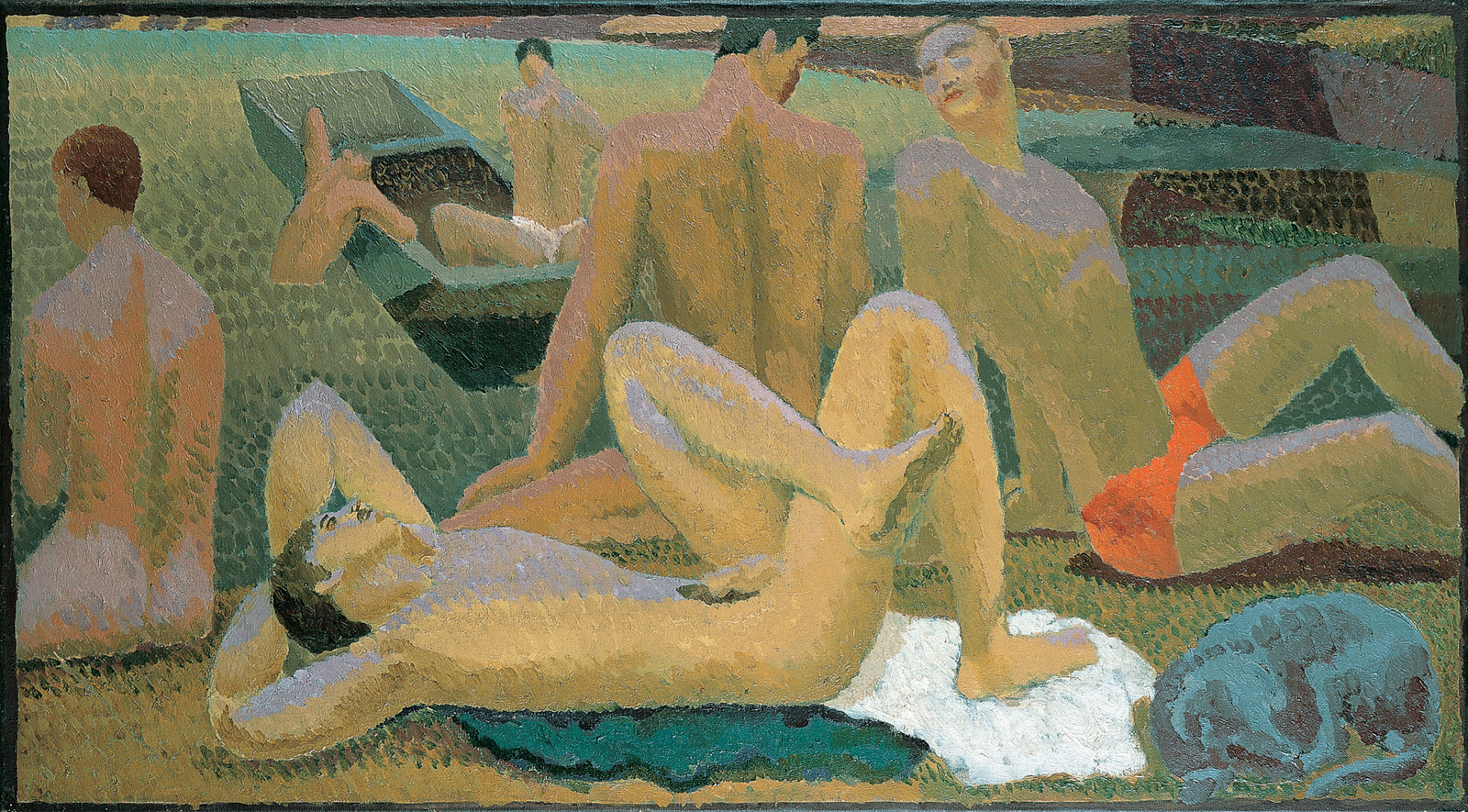 Duncan Grant, Bathers by the Pond, c. 1920–1921, 505 x 915 mm. Pallant House Gallery, Chichester (Hussey Bequest, Chichester District Council 1985)
© Estate of Duncan Grant. All rights reserved, DACS, London / ARS, New York.
The Bloomsbury Group, of which all three were members, was a group of writers, intellectuals, philosophers and artists. Vanessa Bell’s sister was the novelist Virginia Woolf. The name Bloomsbury refers to an area of garden squares in central London where they lived and worked. Writing about the fluid sexual dynamics of the members of the group, Dorothy Parker observed that they “lived in squares, painted in circles and loved in triangles.”
Grant and Bell painted nearly every surface of the farmhouse and its furnishings. Today, as an historic site, it continues its artistic tradition. An exhibition, Very Private?, explores “themes of sex, intimacy, gender and identity [and] presents a selection of Duncan Grant’s recently discovered erotic drawings alongside responses by six contemporary artists.”
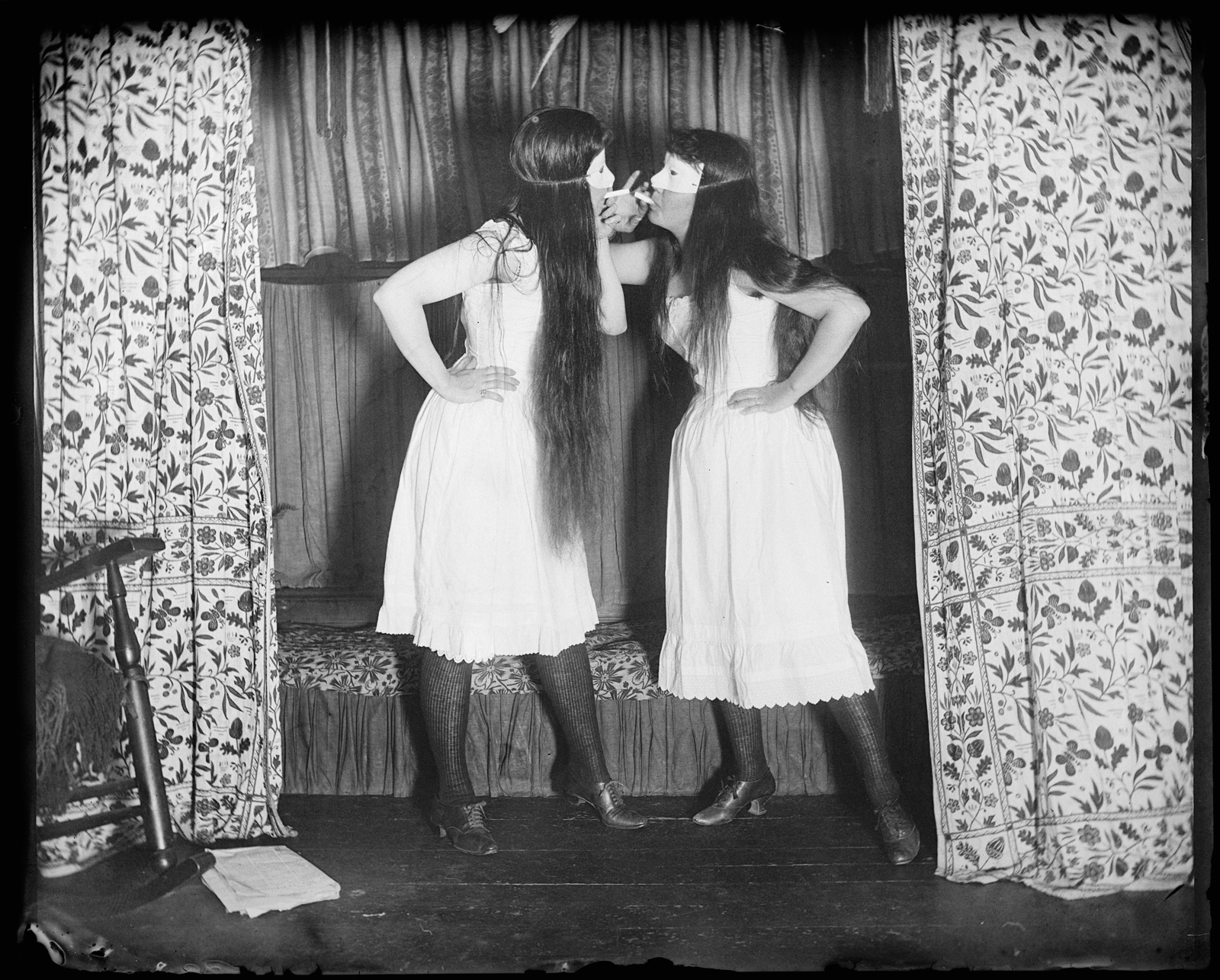 Left: Alice Austen, Trude & I Masked, Short Skirts, 1891. Silver gelatin glass plate negative, 4 x 5 in. Collection of Historic Richmond Town.
Grant painted Bathers at the Pond at Charleston and it is believed to have hung in the bedroom where the economist Maynard Keynes frequently stayed. Keynes may be the central reclining figure. Earlier, Grant and Keynes had been lovers.
Bathers at the Pond is included in the exhibition The First Homosexuals: Global Depictions of a New Identity, 1869-1930 at Wrightwood 659 in Chicago through December 17, 2023. Jonathan D. Katz, professor of practice in the history of art and gender, sexuality and women’s studies at the University of Pennsylvania, has assembled a group of 23 scholars and associate curator Johnny Willis to develop the exhibition, a second reiteration of which will appear in the fall of 2025.
The exhibition begins in 1869 “when the word ‘homosexual’ was coined in Europe, inaugurating the idea of same-sex desire as the basis for a new identity category. With more than 100 paintings, drawings, prints, photographs, and film clips—drawn from public and private collections around the globe and including works which have never before been allowed to travel outside their countries—this large-scale international exhibition offers the first multi-media survey of some of the founding works of queer art.”
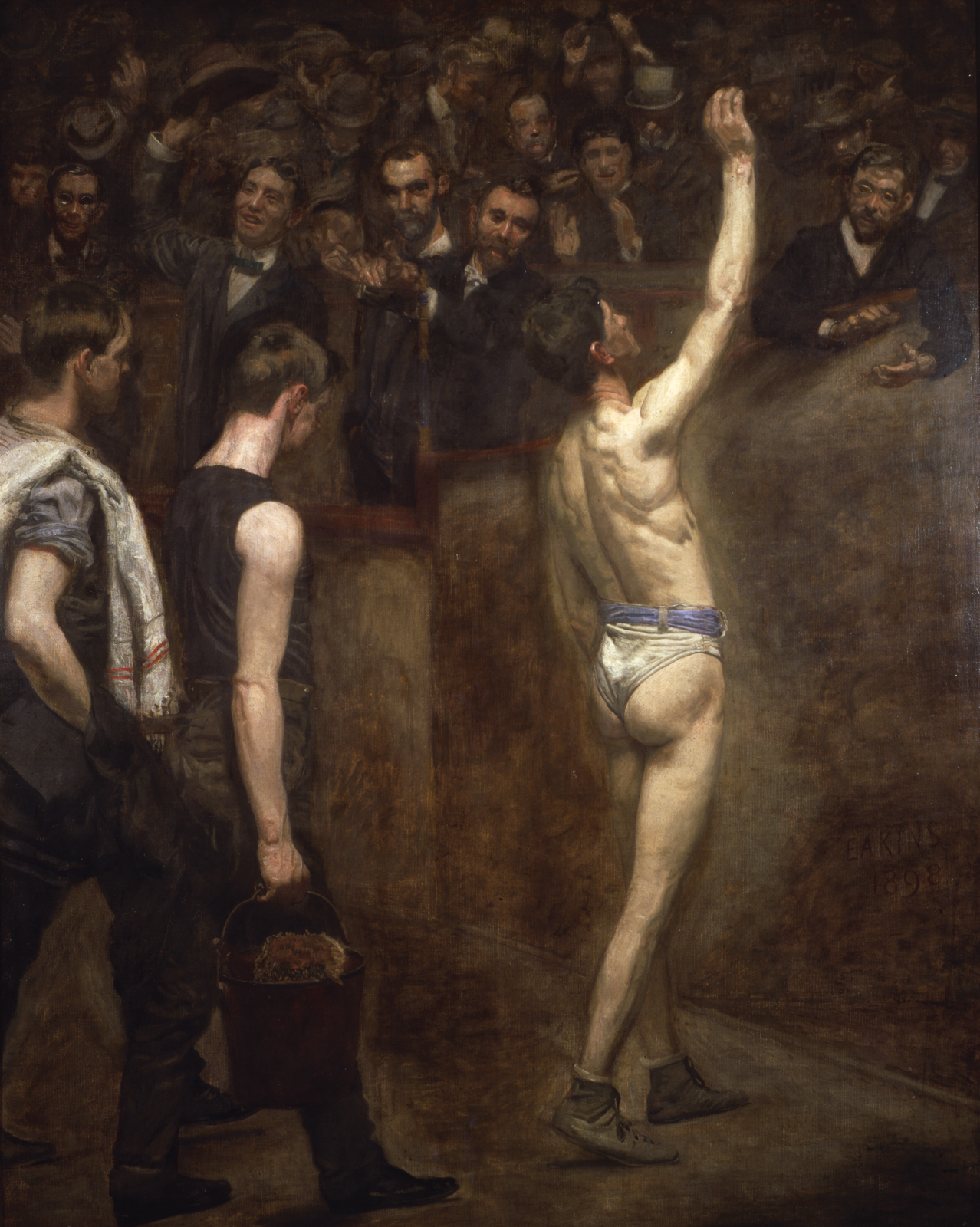 Thomas Eakins (1844-1916), Salutat, 1898, oil on canvas, 49¾ x 39¾ in. Addison Gallery of American Art, Phillips Academy, Andover, Massachusetts. Gift of anonymous donor. Replica of Thomas Eakins’ original frame created and given as a partial gift by Eli Wilner & Company with the additional support of Maureen Barden and David Othmer (PA 1959), 1930.18.
Dr. Katz notes, “The First Homosexuals demonstrates that as the language used to name same-sex desire narrowed into a simple binary of homosexual/heterosexual, art went the opposite direction, giving form to a range of sexualities and genders that can best be described as queer. Art became the place where the simplistic sexual binary could be nuanced and particularized, evoking emotions and responses that language couldn’t yet express.”
Thomas Eakins often photographed his male models in the nude as studies for his paintings and, in 1886, was forced to resign from the Pennsylvania Academy of Fine Arts for exposing a male model in the women’s life class. His painting Salutat features a scantily clad boxer saluting the all-male crowd at a boxing match. It is included “as an example of a scene engineered to focus attention on an erotic part of the young male body.” Dr. Katz observes that “the crowd appears to be not so much cheering a boxing victory as absorbing a perfect specimen of male beauty.”
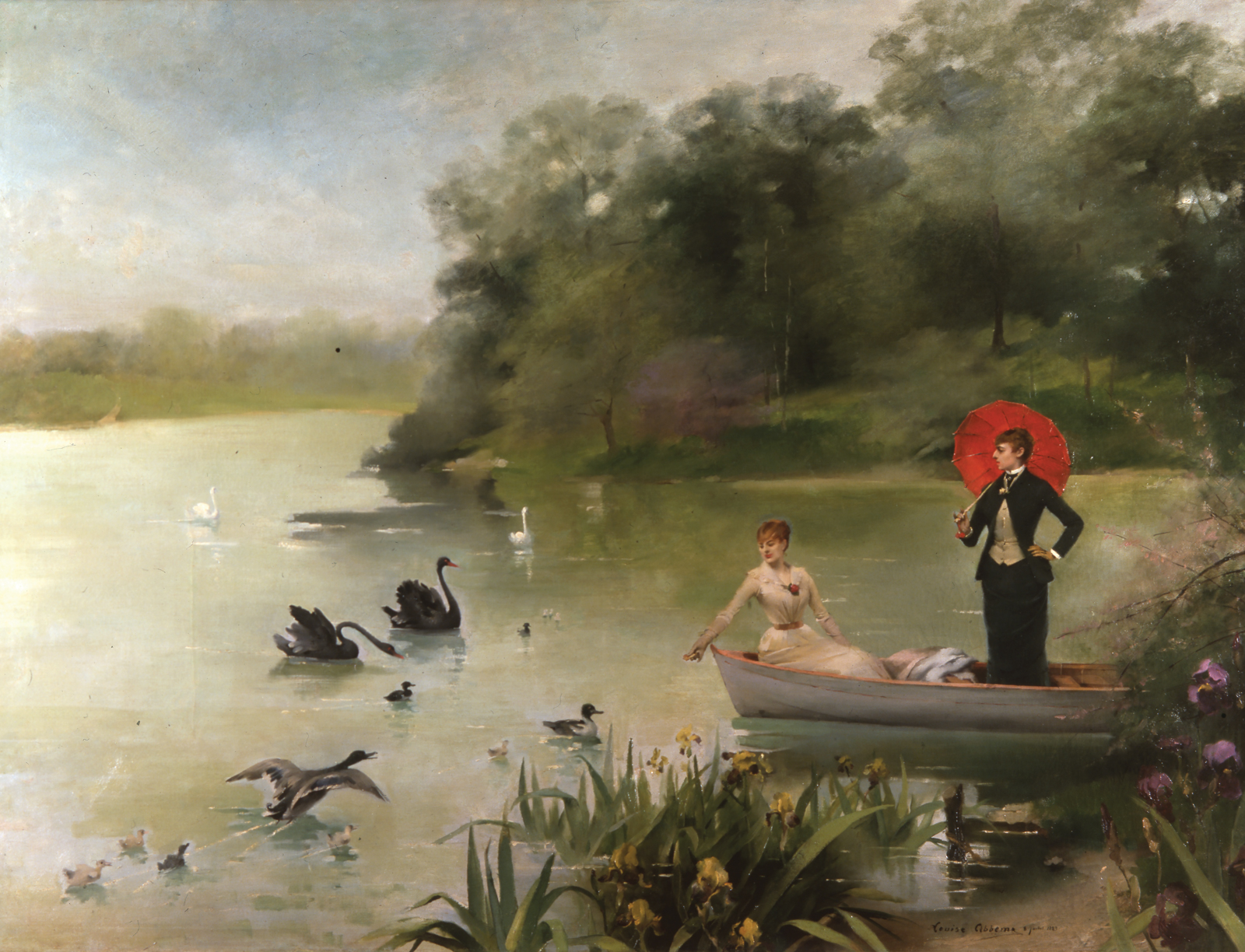 Top: Louise Abbéma (1853-1927), Sarah Bernhardt et Louise Abbéma sur un Lac, 1883. Oil on canvas, 63 x 83 x 1 in. (framed). Collections Comédie-Française.
Sarah Bernhardt was a renowned stage actor at the turn of the 20th century who led a colorful life with a boa constrictor, a son born out of wedlock and, later, a husband 11 years her junior. Her eccentricities were matched by her lover, the artist Louise Abbéma who dressed in men’s clothing and smoked cigars—and exhibited at the Paris Salon. Abbéma painted a double portrait, Sarah Bernhardt et Louise Abbéma sur un Lac, which is now in the collection of the Comédie Francaise in Paris. A letter accompanying the gift states, “Painted by Louise Abbéma on the anniversary of their love affair.”
The Swedish painter Owe Zerge’s paintings and drawings of young boys in sailor or farmer outfits, as Saint Sebastian or simply nude or draped, are discreet renditions of youthful male beauty. In a society still permeated with Puritan morality, questions arise about paintings such as Model Act as to the age of the models, exploitation, and the artist’s motivation and sexual interest.
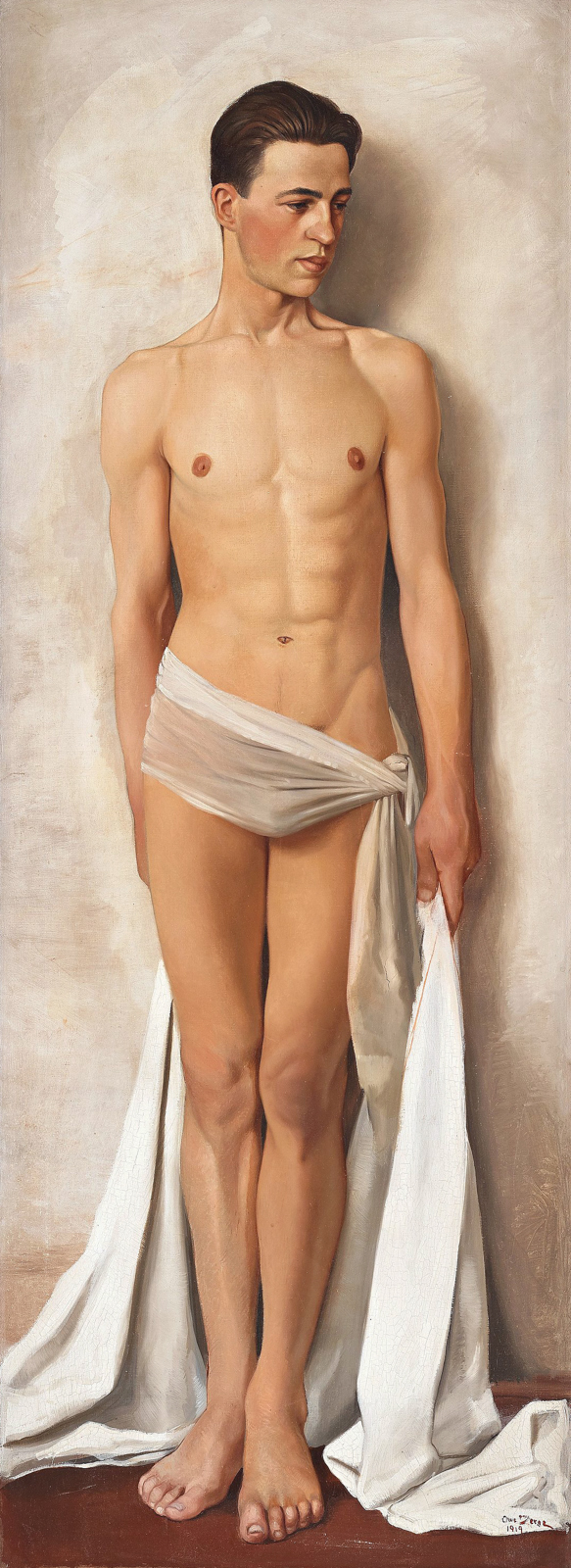 Owe Zerge (1894-1983), Model Act, 1919. Oil on canvas, 53 x 20 in. Private Collection.
In his epic “The Nude: A Study in Ideal Form,” Kenneth Clark writes, “No nude, however abstract, should fail to arouse in the spectator some vestige of erotic feeling, even if it be only the faintest shadow—and if it does not do so it is bad art and false morals.”
Powered by Froala Editor