Work. The dignity of work. Work from home. Back to work. Essential workers. Labor. The labor force. Labor unions. Right to work. Live to work. Work-life balance. Work to live. The great resignation. Quiet quitting. Start-ups. Sole proprietorship. Work for yourself. The pandemic brought work—as an idea, a philosophy, as opposed to the jobs we go to and do everyday—into sharp relief, and into question. One of the other hats I wear, as writer-in-residence for the Clark Hulings Foundation, has been to write a book about Clark Hulings’s art. The title? Clark Hulings: The Work of Art and the Art of Work. But none of this is new. Pandemics have had this effect in the past. The Black Plague reduced the labor force in Europe so greatly that workers began to make demands, form guilds and, ultimately, helped bring the feudal system to an end.
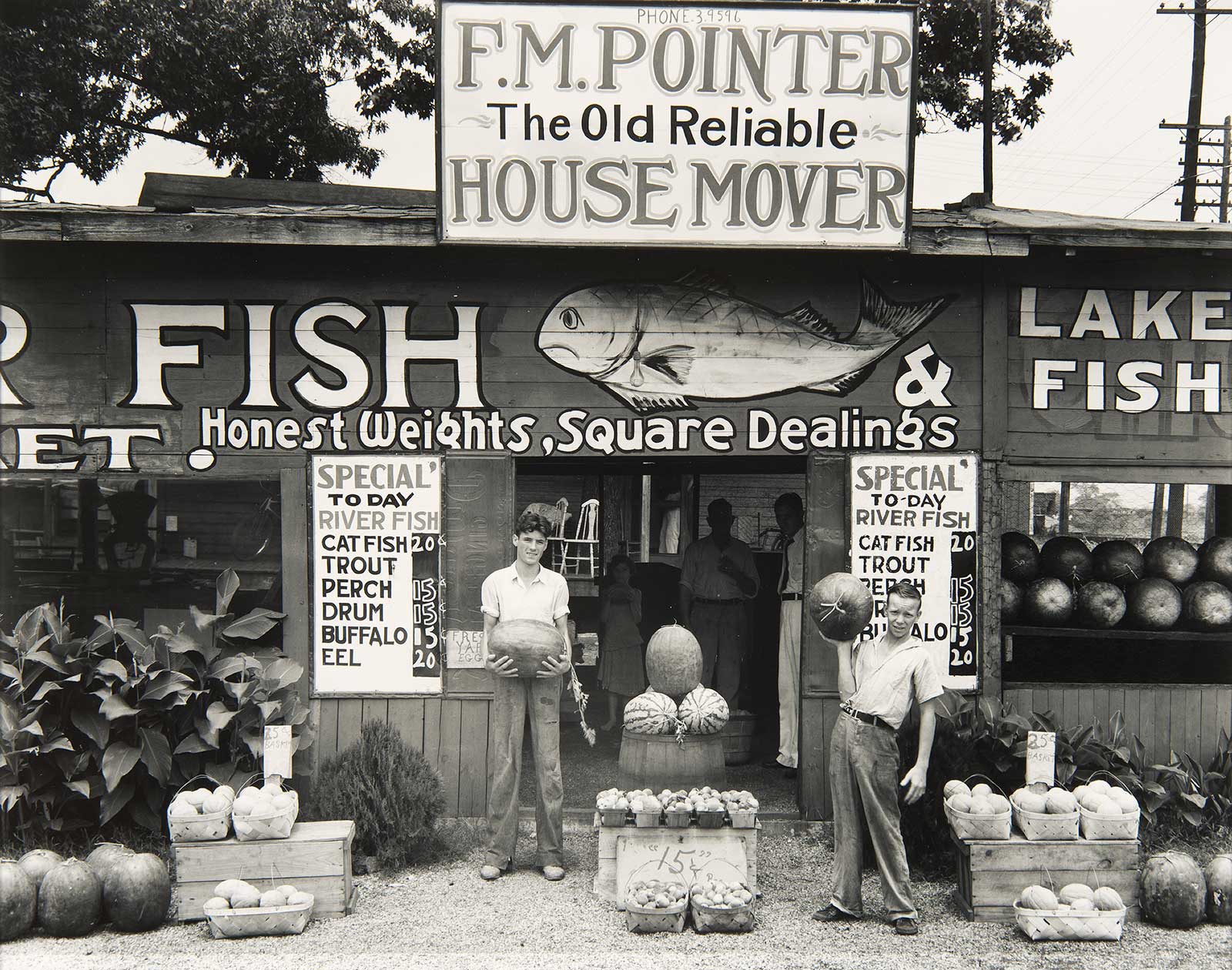 Walker Evans (1903-1975), Roadside Stand, Near Birmingham, Alabama, 1936. Gelatin silver print, 16¾ x 21 in.
Art has always taken a keen interest in work. Though this is not appreciated everywhere, whether one is carving gargoyles on a cathedral, painting frescoes on the walls of a salon, or composing a poem, art is, in fact, work.
The Grohmann Museum at the Milwaukee School of Engineering, celebrating its 15th year, stands at the vanguard of our reappraisal of the value and meaning of work. The museum hosts “more than 1,700 paintings and sculptures dating from 1580 to the present. They reflect a variety of artistic styles and subjects that document the evolution of organized work: from farming and mining to trades such as glassblowing and seaweed gathering.” Their new exhibition, A Time of Toil and Triumph: Selections from the Shogren-Meyer Collection of American Art, centers on American art created during the Depression, when—because of the WPA and other projects—art, work, and government were closely intertwined.
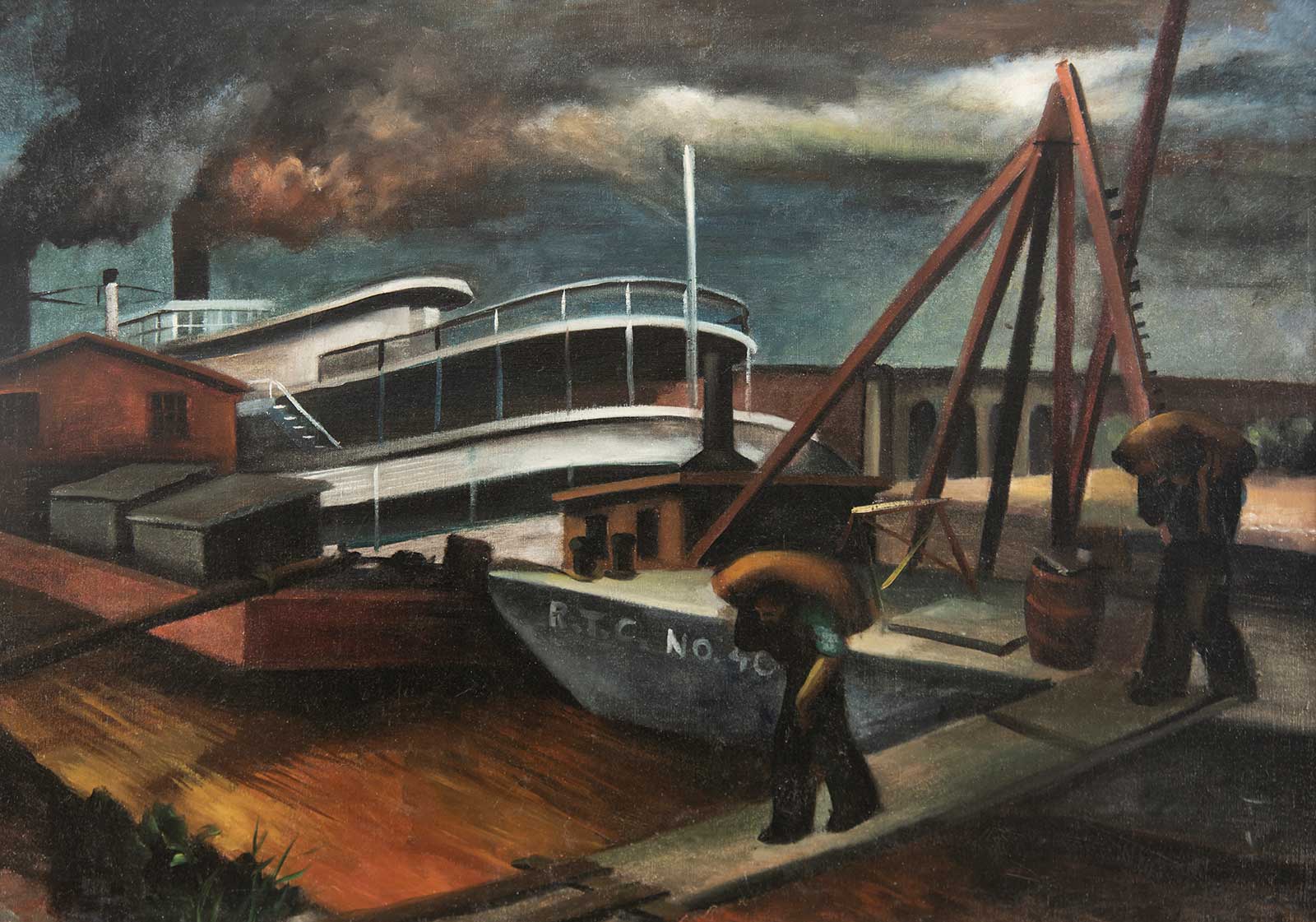 Joe Jones (1909-1963), Levee, 1933. Oil on canvas, 30 x 41 in.
The 1930s were an aesthetically rich period. Social realism and regionalism, born of a kind of zeitgeist need to record the hardships of the times while celebrating the heroic nature of the work of the “common man,” combined with Art Deco, surrealism, cubism and Futurism—key aspects of the modernist project. In the development of this approach—one the exhibition calls the American Scene—the influence of José Clemente Orozco, David Alfaro Siqueiros and Diego Rivera, the three principal Mexican muralists, must also be noted.
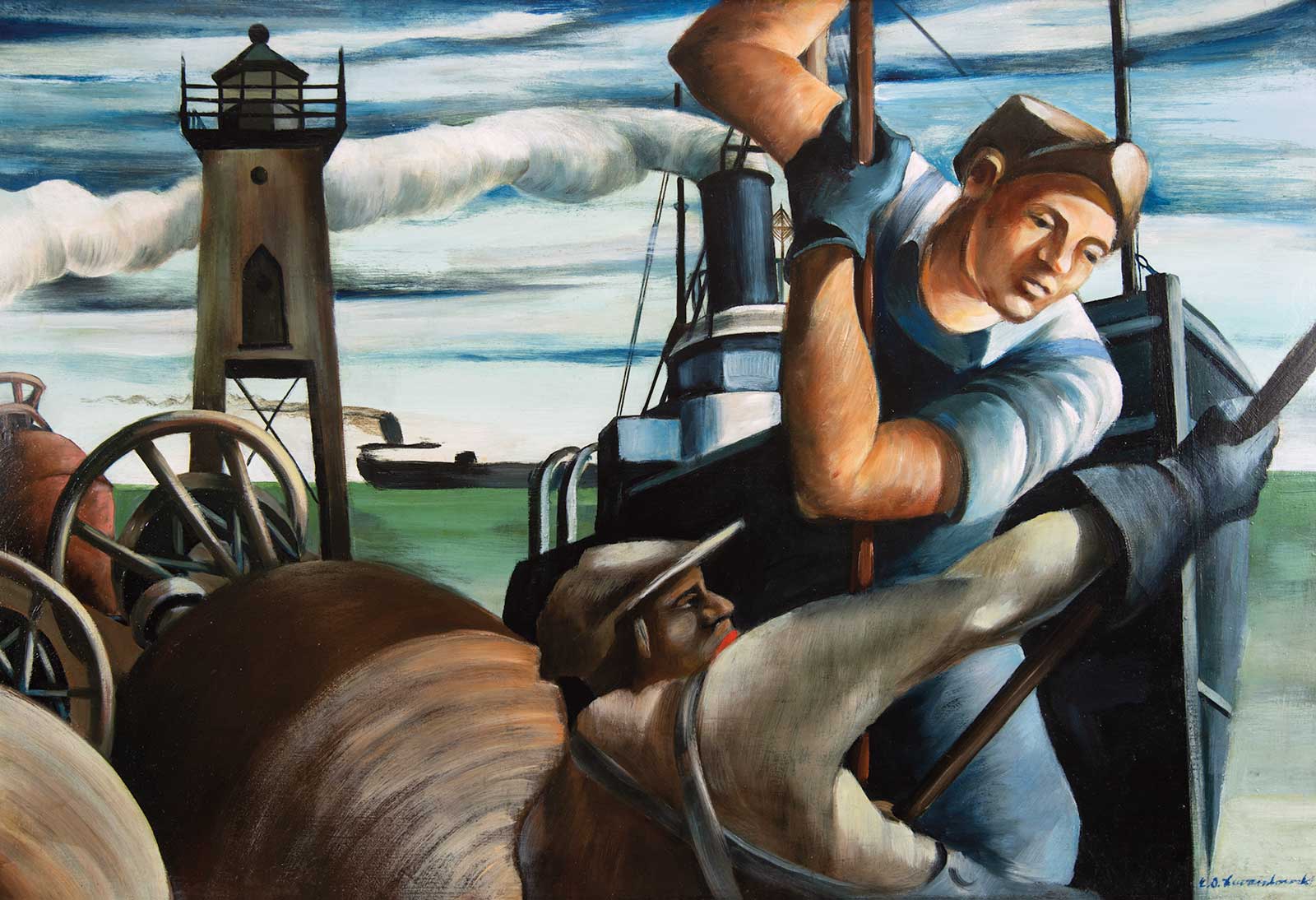 Edmund Lewandowski (1914-1998), The Waterfront (Buoy Tenders), 1935. Oil on canvas, 32 x 47 in.
The roster of artists in A Time of Toil and Triumph is stellar. Photographs by Walker Evans, Lewis Hine, Dorothea Lange, Imogen Cunningham, Berenice Abbott and Margaret Bourke-White; paintings by Aaron Bohrod, John Steuart Curry, Reginald Marsh, Edmund Lewandowski, Thornton Oakley and Joe Jones, to name a few.
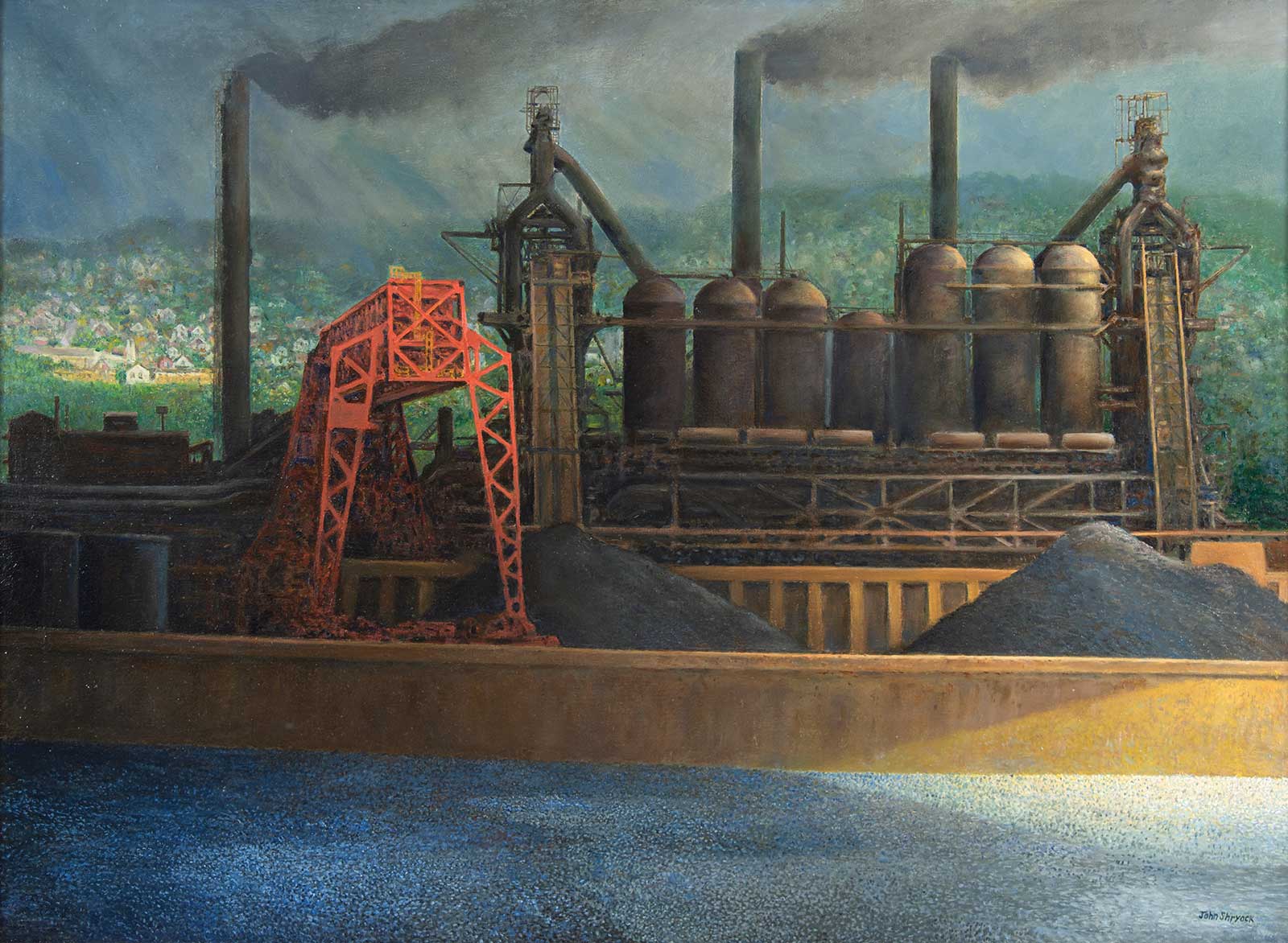 John Carter Shryock (1914-2007), Steel Mill, Pittsburgh, Pennsylvania, ca.1950. Oil on canvas, 35½ x 48 in.
This first difference, between painting and photography in the collection and exhibition, has an immediate impact on the viewer’s eye. Walker Evans and Dorothea Lange’s indelible black-and-white images have become, in many ways, our images of Depression-era life from the Dust Bowl to the Deep South. Evans’s Roadside Stand, 1936, for example, conveys an idea of people doing anything and everything to get by—from moving people’s belongings from house to house to selling fresh-caught fish and homegrown fruits and vegetables. Conversely, Wisconsin artist Esther Bubley’s Liftman, Ore Docks, Duluth, Minnesota, 1947, exudes post-war—and post-victory—confidence in America. Both photographs document actual people in real settings, but where Evans’ work captures people and a place in a moment of time, Bubley idealizes the Liftman. The Ore Docks are part of humankind’s taming of the Earth’s natural resources, the place where iron wrested from the Earth will be shipped to be refined and made into steel. Moving from Bubley to Joe Jones’ (1909-1963) 1933 painting, Levee, or Edmund Lewandowski’s (1914-1998) 1935 canvas, The Waterfront (Buoy Tenders), the photograph and paintings share a classical and Renaissance interest in the human form twisting in space, straining.
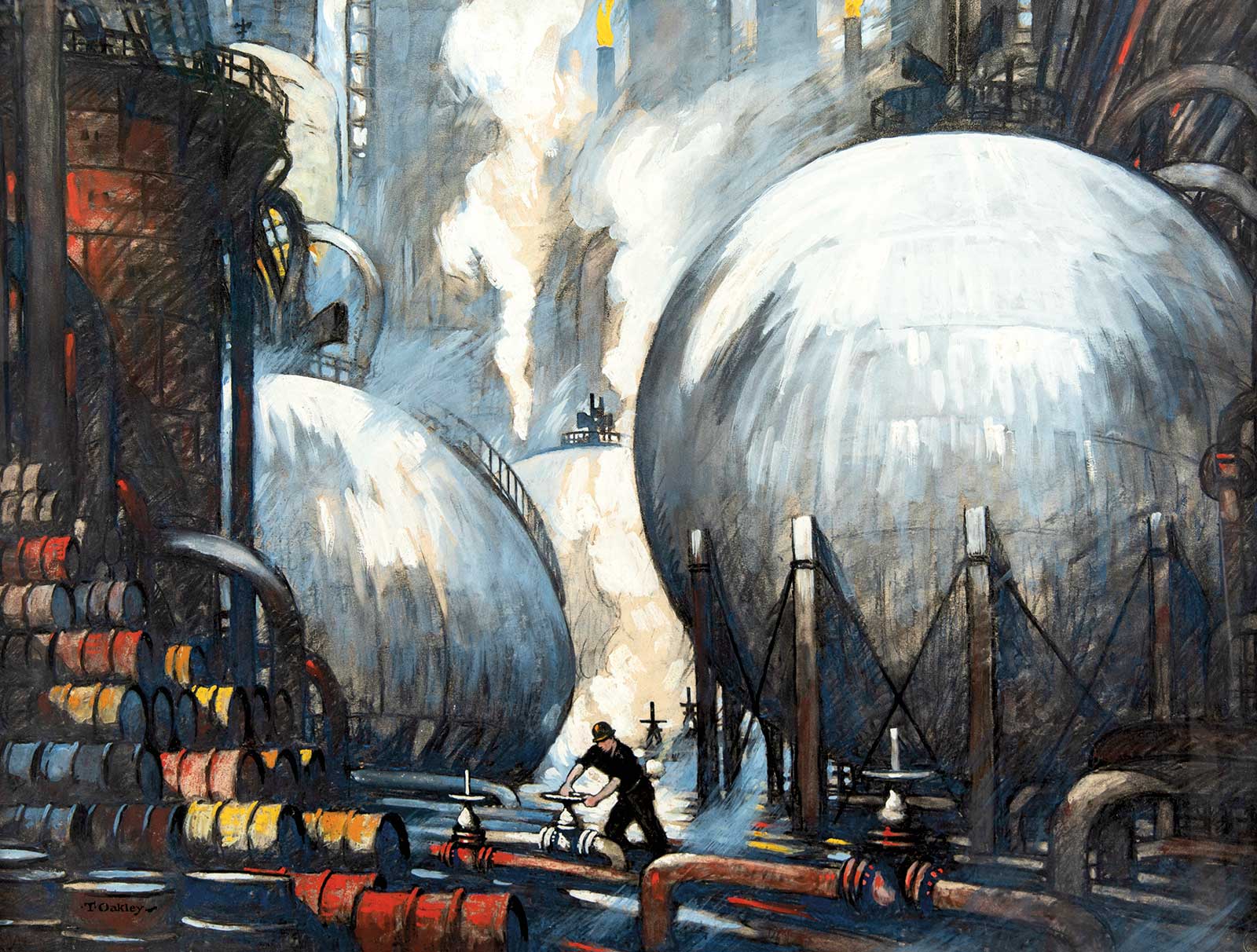 Thornton Oakley (1881-1953), The Wonderland of Oil, ca. 1942. Pastel and gouache on paper, 30 x 40 in.
Other works concentrate on the formal aspects of industry, the factories and plants without people, realistic Cubism, or, as it is sometimes known, Precisionism. The absence of the people who designed and built these wonders of the modern world—not to mention those who labor and make a living in them—suggests that they may well endure beyond their creators. Somewhere between Edward Hopper and Ralston Crawford, these paintings without people have an eerie quality that reverberates—perhaps now, in our Rust Belt era, more than when they were painted—beyond the aesthetics of their structures and modernist appeal. Philip Pinner’s (1910-1977), Roof Tops, 1932, recalls Hopper, John Carter Shryock’s (1914-2007), Steel Mill, Pittsburgh, Pennsylvania, painted around 1950, made me think about work and art in a very personal way.
My MFA thesis play was on the history of Homestead, a steel town of Hungarian and Italian and Black Americans attached to Pittsburgh, that was bulldozed to make way for a larger war plant at the start of World War II (You may have heard of the Homestead Grays of the old Negro Leagues).
I sneaked around the then-vacant plant as it was being dismantled and barged to China, avoiding security and the police, and took notes on conversations I had with some of the last old timers, often in bars where I was not welcome (I hear Homestead is upscale now, entirely remade). I fought with archivists and librarians to gain access to records and letters and I labored to rewrite (many times) scenes that fell far short when they came out of actors’ mouths. All that for a play that’s never been performed. I recently stumbled onto it in a file and read it. It was so long ago it was like reading someone else’s play. You know what? It was good. Really good. And I take pride in the work that went into it, hard work. So
I look at Shyrock’s Steel Mill, Pittsburgh, at the black billows that caused Frank Lloyd Wright, when he saw Iron City at its steel mill height, to say, “Abandon it!” and I see the town on the hill in the distance bathed in soft light behind the screen of smoke and wonder if that might be the ghost of old Homestead, the town that once sat on a hill across the Monongahela, not all that far from my old apartment on Oakland Square. Who says paintings can’t stir memories and deep emotions?
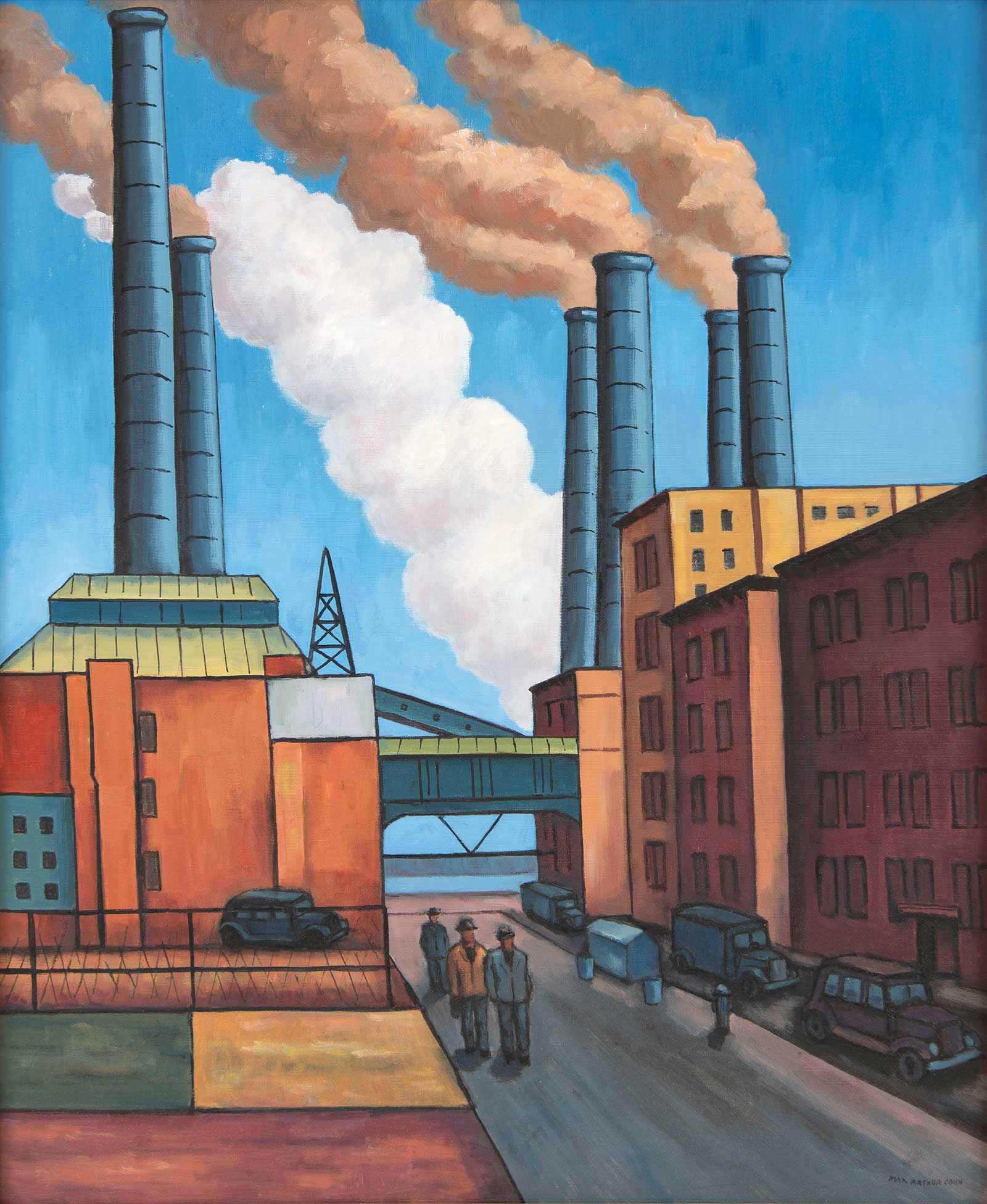 Max Arthur Cohn (1903-1998), Powerhouse (Edison Plant), 1959, Oil on canvas, 30 x 23 in.
As the exhibition makes clear, Wisconsin incubated the ideas of arts for and by the people. “The Wisconsin Idea,” as it was known, stated that the University of Wisconsin, as Grohmann Museum director James Kieselburg writes in the catalogue, “should not be of service only to those in attendance, but rather its impact should be felt throughout the state, in centers of education to become known as the University of Wisconsin-Extensions. UW-Extensions, situated in counties across the state, taught summer courses, sponsored art and craft displays, and held workshops in everything from turning pottery to potted plants. Art and education were not regarded as matters only to be explored in urban areas or centers of higher education. Instead, their reach was to be expanded to provide all the opportunity to participate in—and create—American culture.” It would seem that this idea permeated my own family and got under my own skin.
But painters of work also think about the future of work.
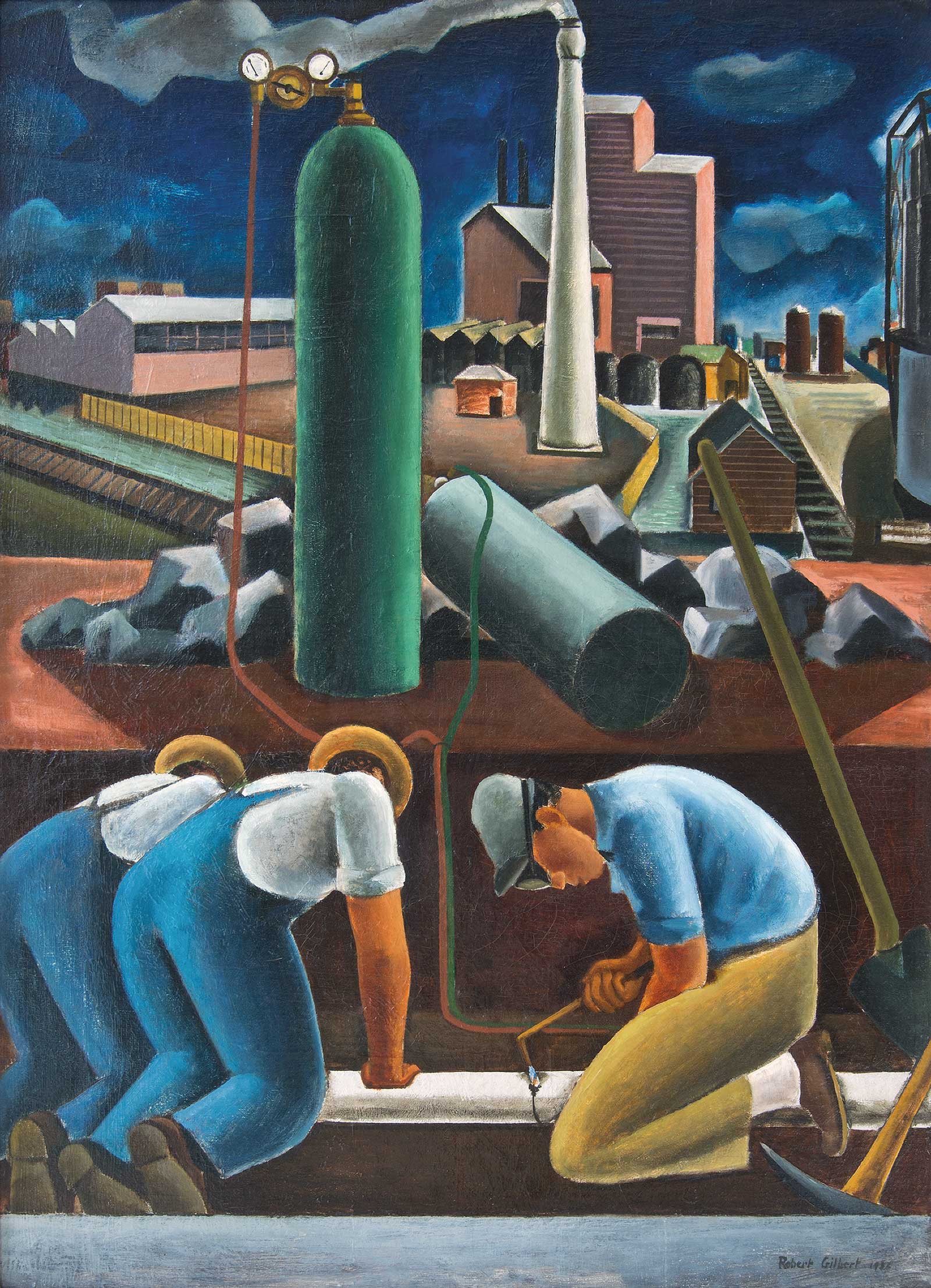 Robert Gilbert (1907–1988), Industrial Composition, 1932. Oil on canvas, 47 x 34 in.
The title of Thornton Oakley’s (1881-1953) pastel and gouache The Wonderland of Oil, executed around 1942, is revealing. “Wonderland” is where Lewis Carroll’s Alice goes. “Wonderland” is an amusement park whose attractions envision amazing futures, “wonders” of the modern world that echo and even surpass the Seven Wonders of the Ancient World. It is worth noting that Oakley studied under Howard Pyle and the Brandywine School and that his early illustrative work exhibits his teacher’s influence and dovetail with other Brandywine graduates, such as N.C. Wyeth. In short, his work is generally human-centered, heroic and narrative. Yet here, in The Wonderland of Oil, the effect is far closer to a cover of a science fiction magazine, Amazing Stories, say, or The Magazine of Science Fiction and Fantasy. Nature is absent. The giant spheres seem like visions of satellites—Sputniks, perhaps, or Telstars—about to be launched into space. One worker, minuscule in this landscape of smoke and steel, turns a valve. There is a sense that technology is in charge and that humanity—where humans are necessary at all—serves technology. At the end, the viewer’s eye falls on the light on the pastel barrels at left, light that gives them an ominous precariousness, as if the stack could fall and bury this last, lone figure. No one would hear him scream.
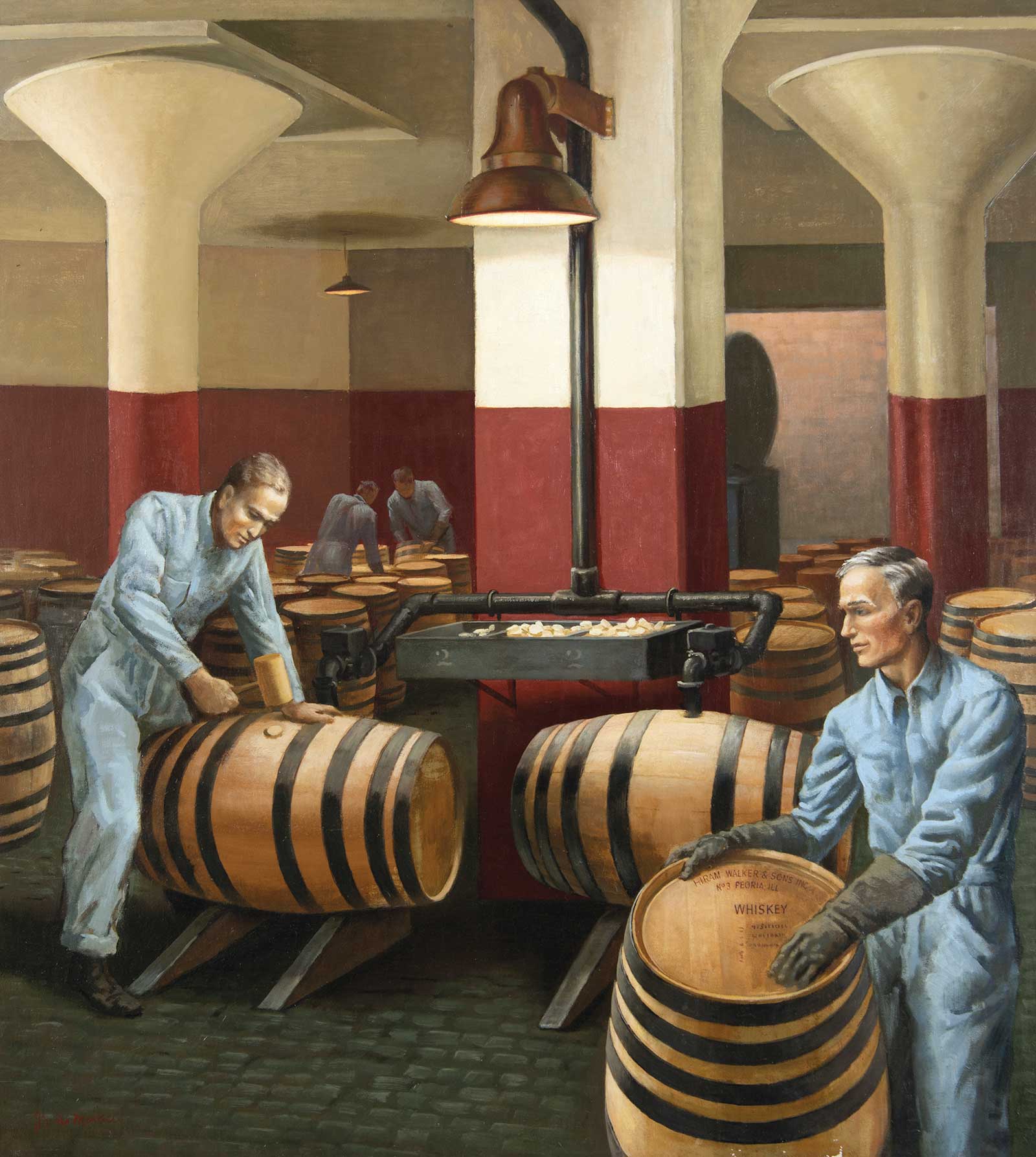 John Stockton De Martelly (1903-1979), Whiskey Going into Barrels to Age (Marking the Casks), 1946. Oil on canvas, 36 x 33 in.
Full disclosure. I was born and raised in blue-collar Milwaukee. For the last 25 years of their working lives, my father and two of my brothers worked third shift on the loading docks at the Pabst Brewery, just a few Cream City blocks from the Grohmann. They were hard-working union men. They were also artists. My dad sang opera and kept singing long after he retired. My oldest brother is a painter who studied at Milwaukee’s Layton Art School and then went to Florence to complete his education. He ran a gallery on the city’s East Side by day and worked at Pabst at night. He later spent 20 years teaching and painting in Japan. My other brother’s interests were more mechanical. Among other things, he used to restore vintage racing cars, which might be science, though it seemed an awful lot like art to me.
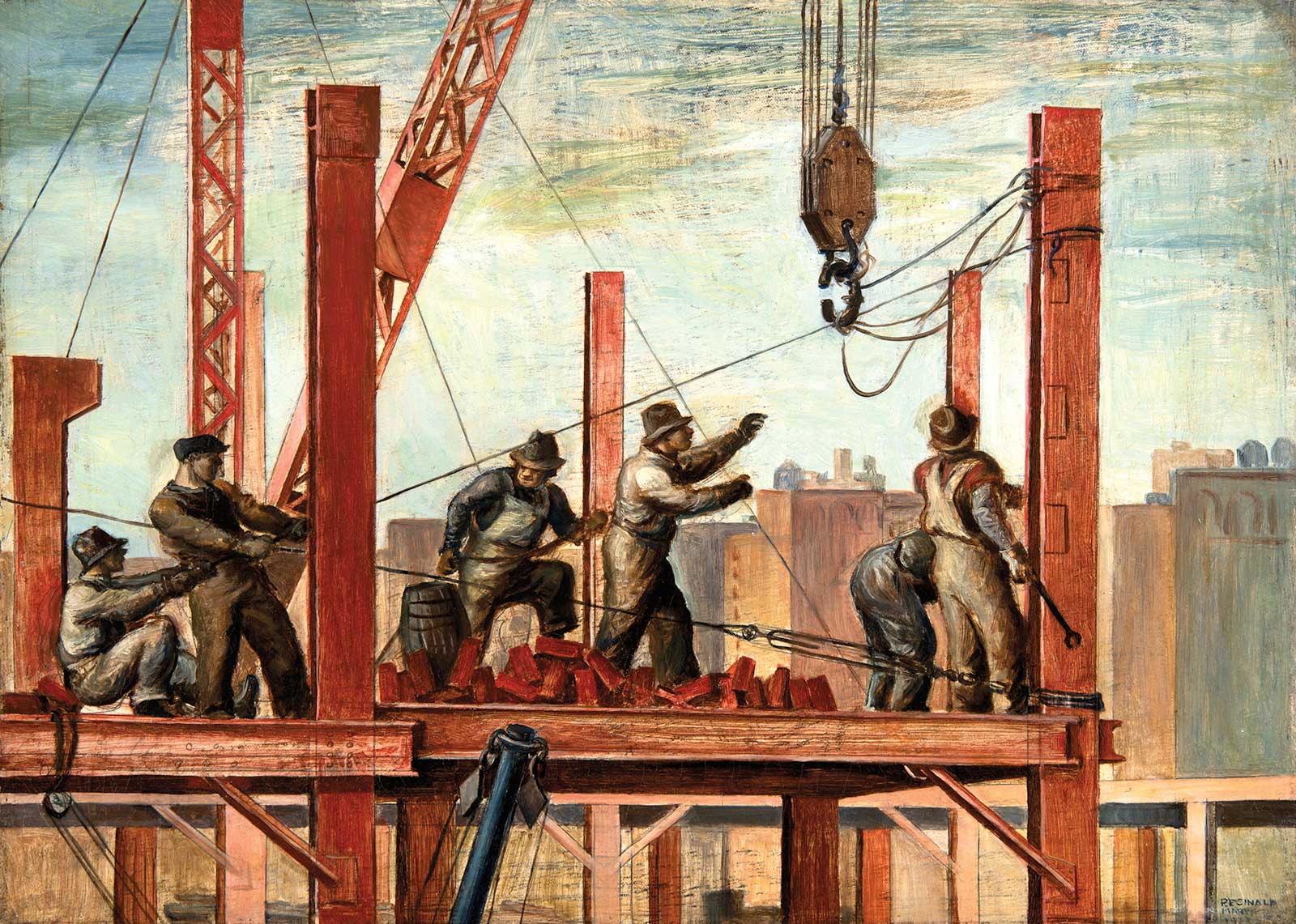 Reginald Marsh (1898-1954), Iron Workers, 1923, Oil on canvas, 17½ x 24½ in.
Work and art, art and work. They are in my blood. I’ve worked all my life to support myself and my family. At the moment, I pretty much write for a living. About art, artists and exhibitions. Which is work. And when I’m not writing for a living, I am often, writing. As I always have. Stories. Plays. Scripts. In short, art. Working to make art—
I left that out of my list at the top. It’s what the vast majority of artists do. Yes, art seems dreamy, romantic, detached from reality. But only from the outside. Perhaps, down the line, the Grohmann should celebrate the actual work of art—the work that art takes. Paintings, photographs, sculptures, films, installations, performances, all featuring the sweat and toil of ballet dancers, actors, performers of symphonies and rock and rap, stone carvers, mural painters, sewists and craftists—artists of every stripe—and the myriad talented people behind the scenes who make what they do possible. I’ve done some time in factories, so let me leave you with this—the blank page or screen sometimes makes me pit out a shirt as fast as a July day at the plant. Faster,
in fact.
Through February 26, 2023
A Time of Toil and Triumph: Selections from the Shogren-Meyer Collection of American Art
Grohmann Museum
1000 N. Broadway
Milwaukee, WI 53202
t: (402) 277-2300
www.msoe.edu
Powered by Froala Editor