During the first quarter of the 20th century, a rich cauldron of abstraction was bubbling in Europe, from Cubism, Bio-morphism and Constructivism, to the spiritual abstraction of Kandinsky which captured the imagination of a small number of individual American artists. By the middle of the third decade, a critical mass of European emigres and American artists working in abstraction banded together to found two significant organizations. The largest of these loosely affiliated groups was the American Abstract Artists, founded in New York in 1936, whose leading spokesmen were George L. K. Morris, Carl Holty and Charles Green Shaw.
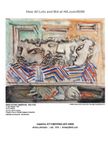
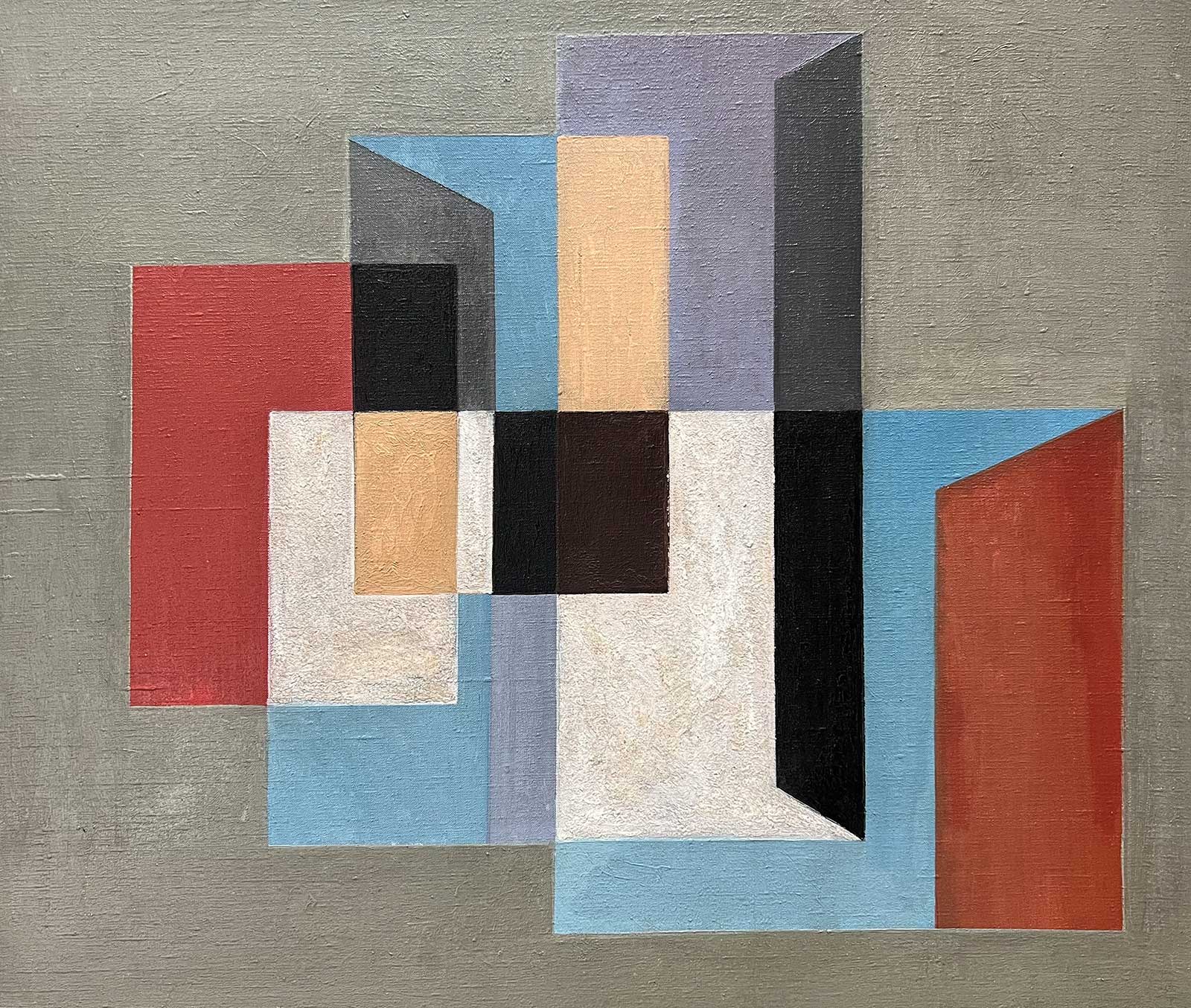 Charles Green Shaw (1892-1974), Polygons, 1936. Oil on canvas, 20 x 24 in., signed and dated on the reverse.
The majority of the members worked in a hard-edge Cubist style and were more generally concerned with the formal aspects of abstraction emanating from synthetic-cubism in Paris. The smaller Transcendental Painting Group, formed two years later in 1938, was centered around Santa Fe, New Mexico. It was led by Emil Bisttram and Raymond Jonson who saw abstraction as a gateway to the spiritual as articulated by Wassily Kandinsky. Both groups had difficulty having their work accepted for exhibition and receiving critical recognition. Social Realists and American Scene painters, the mainstream of American art at the time, disparaged their efforts as irrelevant; the conservative academic artists thought them both elitist and unintelligible; while devotees of European Modernism, such as Alfred Barr, director of the Museum of Modern Art, regarded them as merely derivative.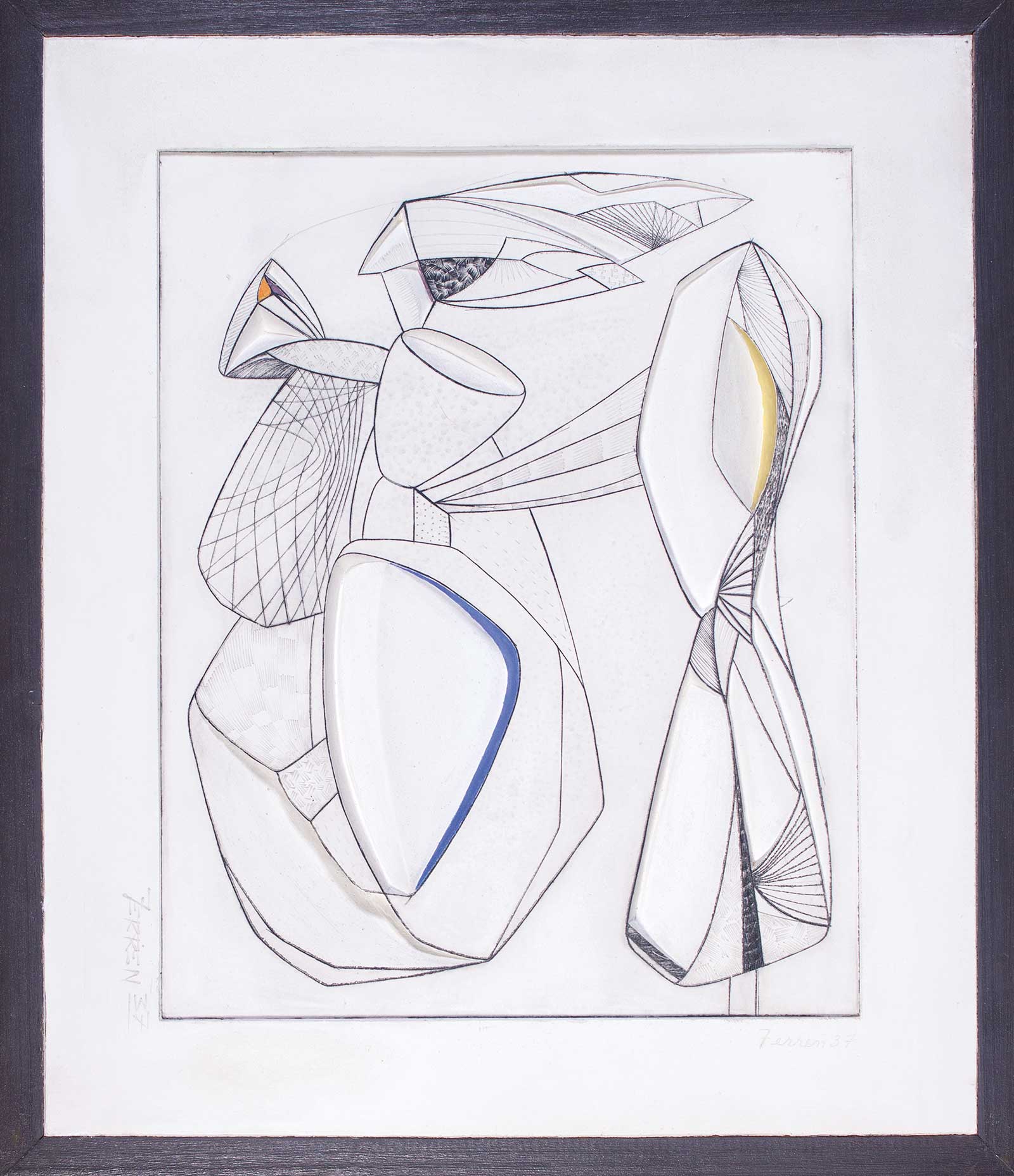 John Ferren (1905-1970), Abstraction on Plaster, No. 29, 1937. Carved plaster, ink, colored pigments, 12½ x 15 in., signed and dated lower right and and lower left: ‘37’; signed, dated and numbered on the revers: ‘29’.
Today, with the advantage of historical perspective, the imagination and authentic nature of these American interpretations of European abstraction can now be fully appreciated. Artwork from this era provides a sense of the American response to the diversity of stylistic ideas current during this turbulent time in the decade before the second World War.
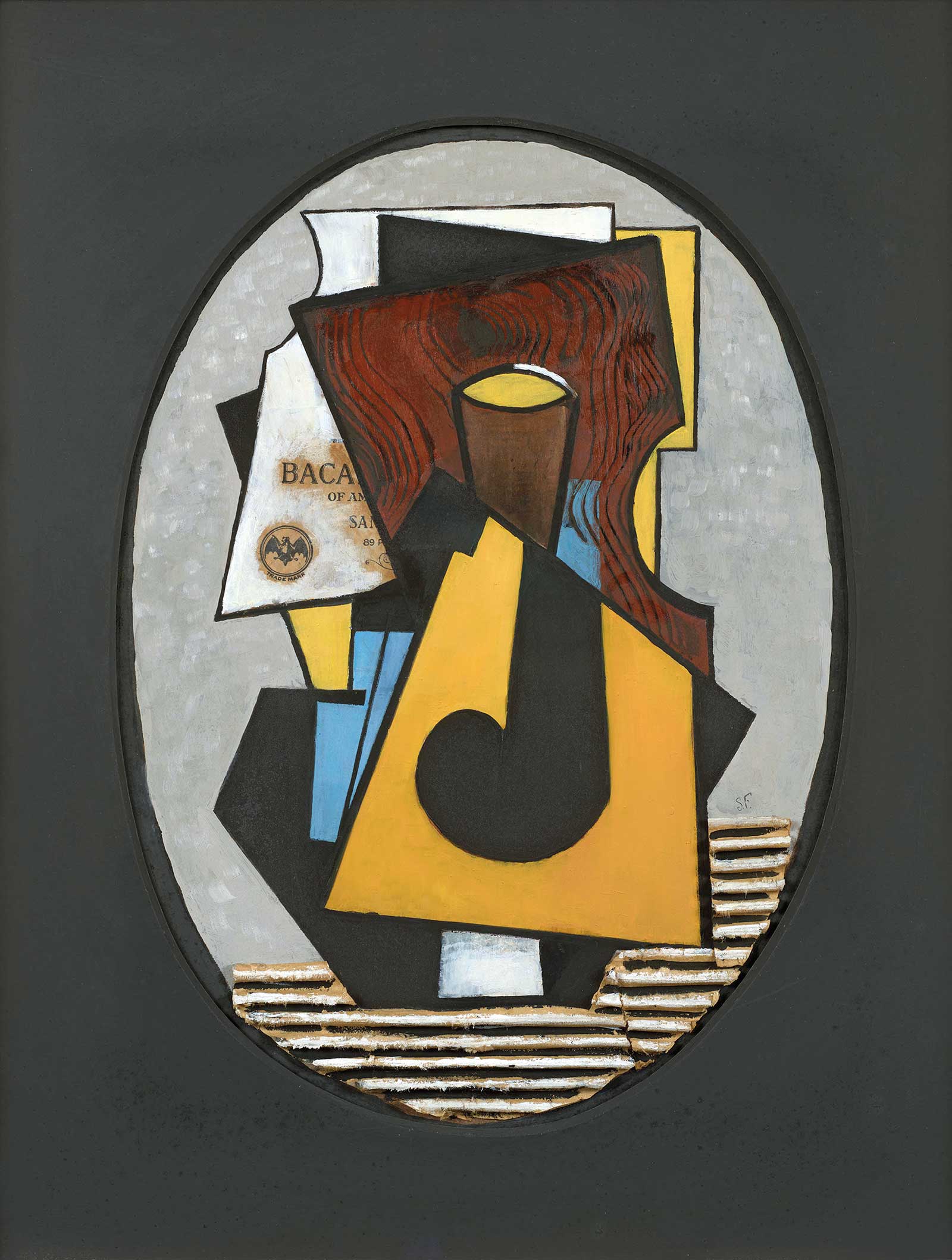 Opposite page: Suzy Frelinghuysen (1911-1988), Composition, 1940-42. Oil and paper collage on Masonite, 16 x 11¼ in., signed with initials right center: ‘SF’.
After graduating from Yale, Charles Green Shaw (1892-1974) briefly studied architecture at Columbia University and later enrolled at the Art Students League in New York. During travel in Europe in 1929, and again in 1932, Shaw visited the studios of Picasso, Leger and Braque, as well as those of the artists who were to be a significant influence on his early stylistic development: Jean Hélion and Jean Arp. During the course of the 1930s in New York, Shaw sought to establish his own voice as an artist by adapting the concepts of European abstraction to an American environment and, through the authority of his writings, became an influential figure in the formation of the American Abstract Artists.
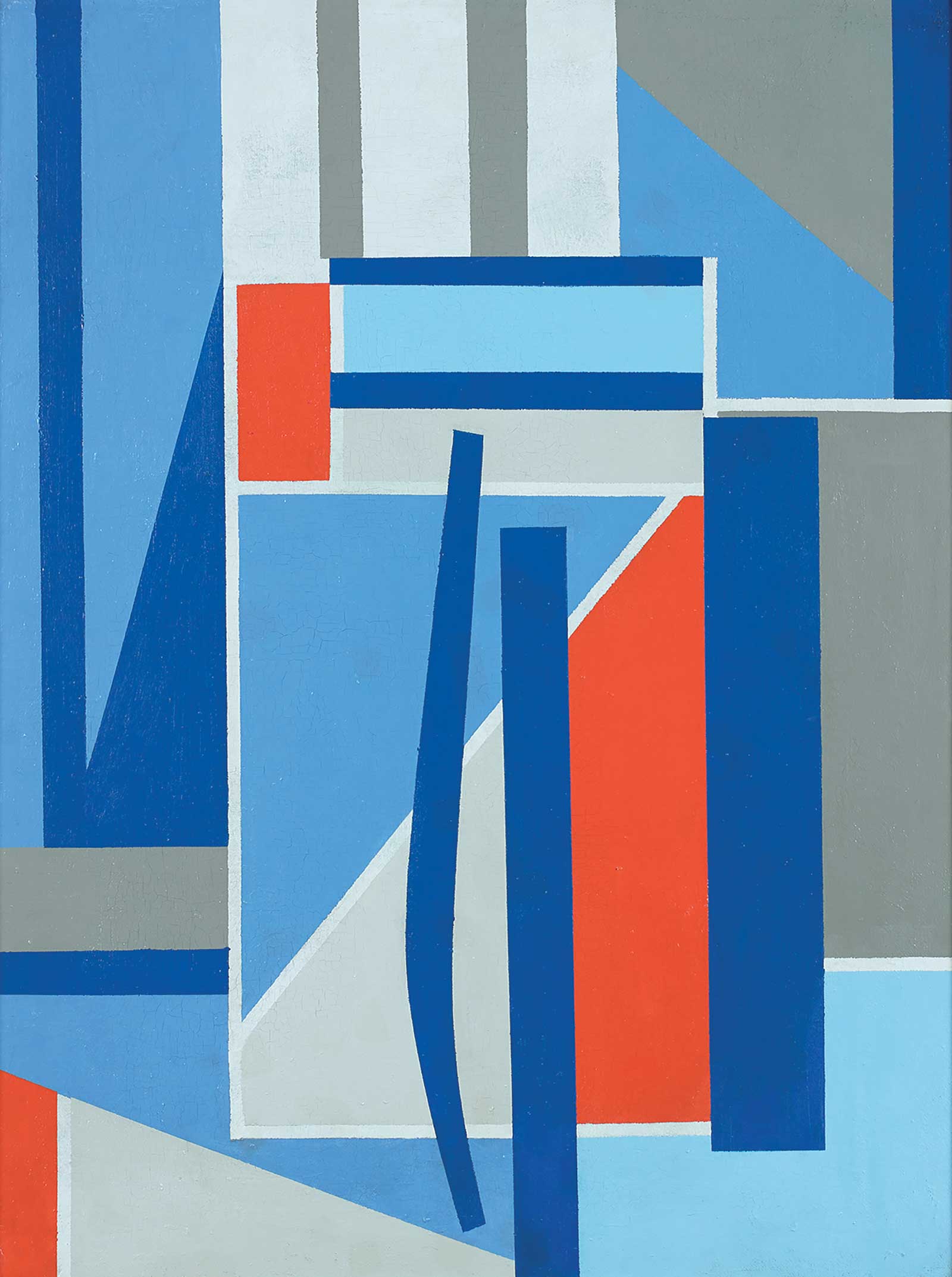 Carl Holty, (1900-1973), Blue Progression, ca. 1941. Oil on Masonite, 48 x 36 in, signed on the reverse.
Polygon, 1936, is one in a series of complex interactive paintings inspired by the shape of the skyscrapers that were rapidly changing the skyline of New York. In an essay on his Plastic Polygon compositions published in 1938, Shaw defined them as emblematic of his approach to abstracting the visual qualities of his city. In this example, the artist presents ambiguous, overlapping transparent rectangles that emerge and recede in a continually shifting unresolved visual puzzle. This quiet, contemplative composition evokes the physicality of tall buildings with lyrically harmonious colors set within a neutral field. It is the simplicity and directness of this image, its lack of artifice and finesse, and its uniqueness as a national symbol that informs an American sensibility. This work shares its pared-down directness with other forms of American artistic expression of the time that commonly sought to speak with a similar vernacular voice such as John Steinbeck’s The Grapes of Wrath and Aaron Copland’s Fanfare for the Common Man.
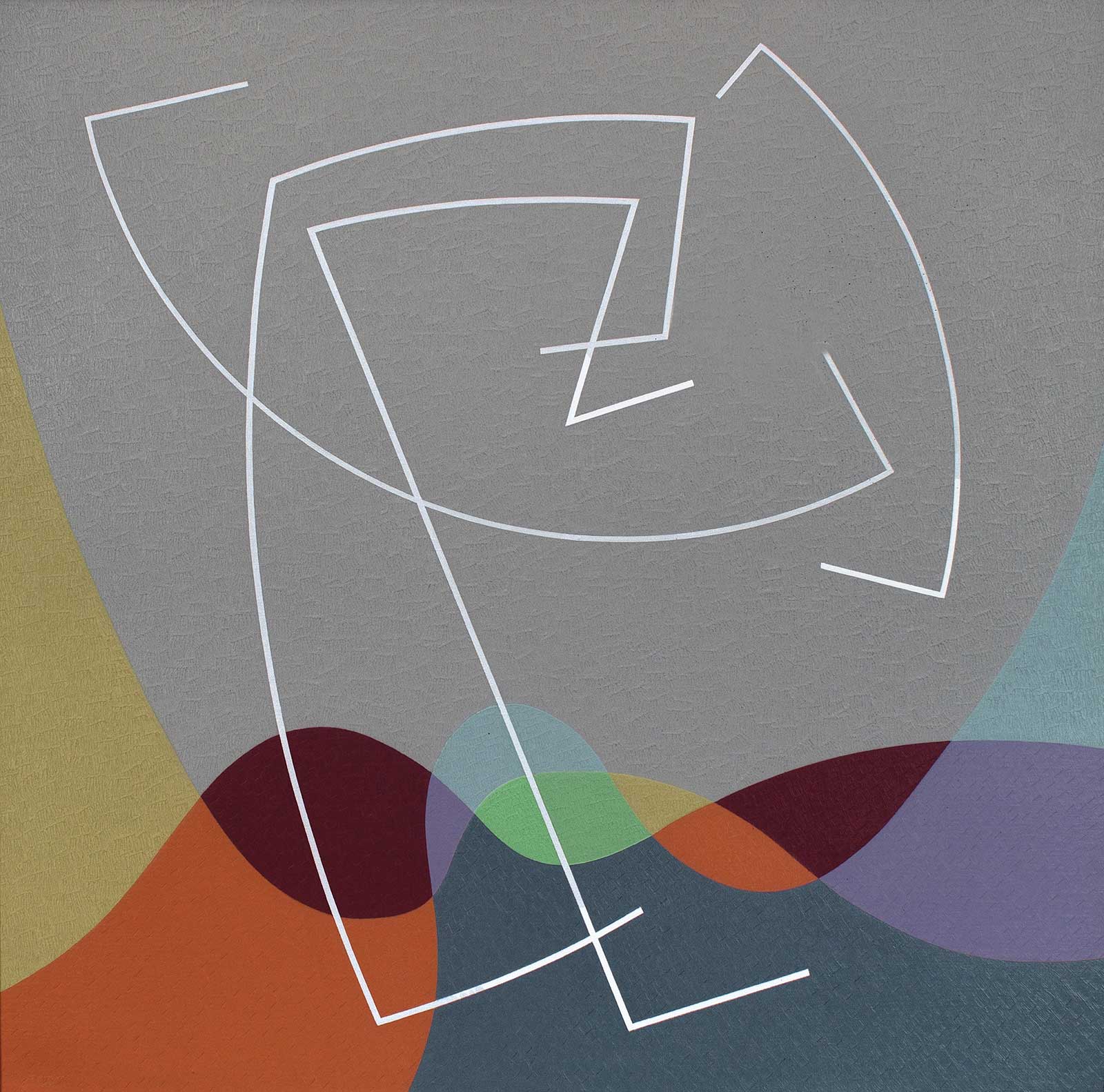 Raymond Jonson (1891-1982), Oil No. 10, 1946. Oil on canvas, 40 x 40 in. Signed lower left and signed and dated on the reverse. Private Collection.
John Ferren worked as a decorative stonecutter in San Francisco before saving enough money to move to Paris in 1929. This informed his creation of a series of bas-relief plaster constructions that he exhibited to great critical and financial success at the Pierre Matisse Gallery in New York in 1936, and again in 1938. Ferren became an accepted member of the avant-garde fraternity in Paris, friendly with Picasso, Mondrian, Miro, Hélion and later Kandinsky. The influence of Kandinsky’s hard-edge style, and the austere formalism of Mondrian can be seen in Ferren’s unique amalgam of sculpture and painting which brought the young artist instant recognition, with examples acquired by The Museum of Modern Art, The Solomon Guggenheim Collection and the collection of Peggy Guggenheim.
Like other abstract artists at the time, Ferren plays with our perception of emerging and receding planes to create a structured ambiguity. Ferren’s originality in these works resides in the contradictory interplay between physical and implied perspective of line, color and depth. Even the thin black lines that run throughout the work are both incised into the surface and painted to appear simultaneously linear and sculptural. Abstraction in Plaster is a dialogue between drawing and sculpture. Ferren’s flat, dark outer frame suggests a two-dimensional work on paper, the carved step in the plaster simulating a paper mat. The shadow, cast by the edge of this false mat, reads like a ink line, mocking the distinction between what is painted and what is carved. Light, falling from the left on the hollowed out plaster surface, creates a graduated shadow resembling shading in graphite drawing. Touches of color, judiciously applied to both the deeply carved recesses and the flat plane, contribute to the interplay between surface and depth, creating a work of art whose subject is the duality of dimensions.
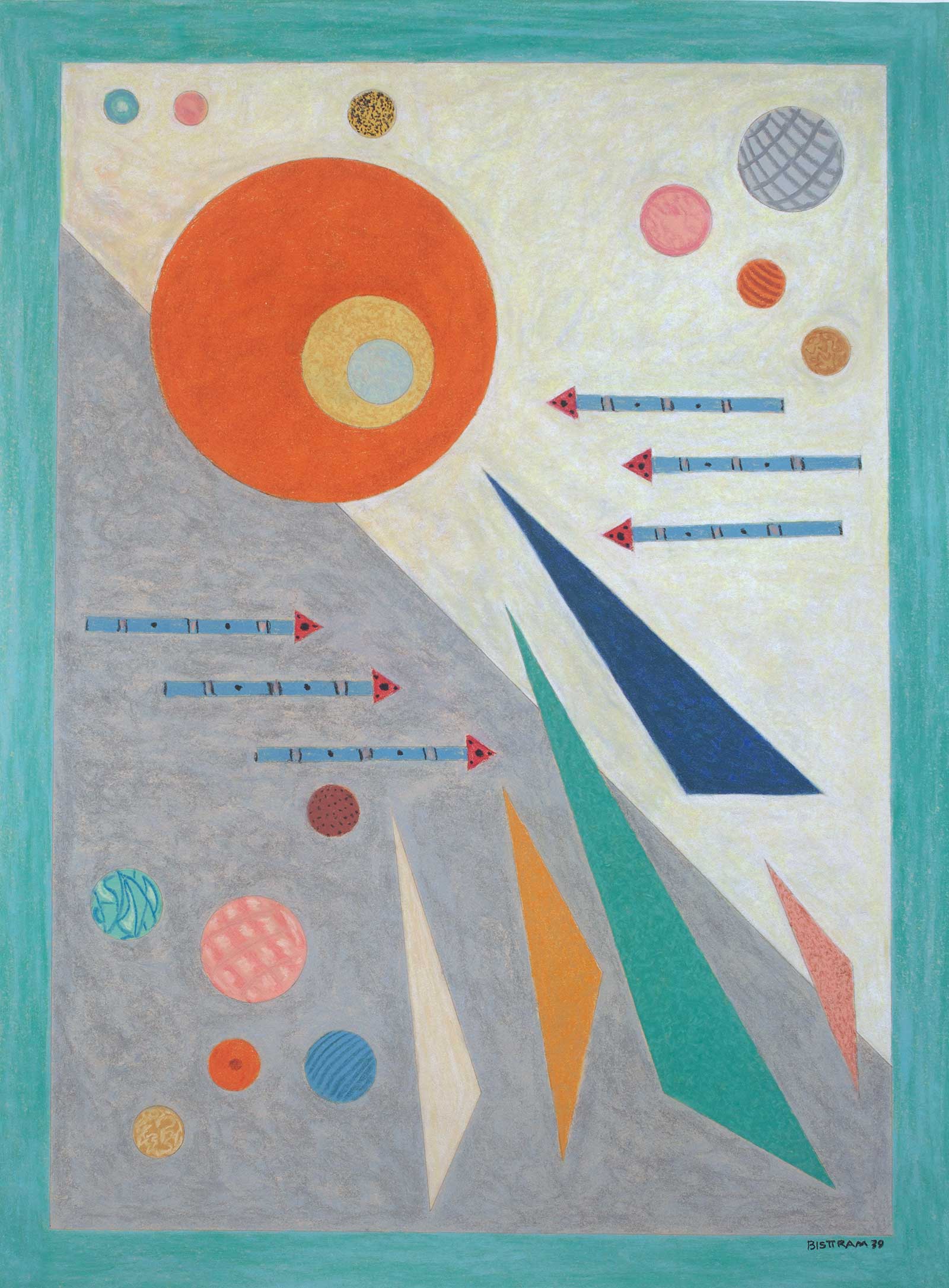 Emil Bisttram (1895-1976), Abstract Composition, 1939. Encaustic on paper, 24 x 18 in, signed and dated lower right: ‘Bisttram 39’.
The painter Suzy Frelinghuysen adopted abstraction after her marriage to George L.K. Morris in 1935. First exhibiting her work in 1936 at the Whitney Annual, she later joined the American Abstract Artists in 1938, where she continued to show yearly. Frelinghuysen also exhibited at Albert Gallatin’s Museum of Living Art at New York University where she was the first woman artist to be represented in their collection. In Composition, circa 1940-42, Frelinghuysen references the angular elements, subdued palette and flat, airless surface of an early oval Picasso cubist collage. Appropriating the black outline pictorial language of cartoons, she reimagines this historical form as a three dimensional image, creating a stylistic predecessor of the later Pop Art creations of Roy Lichtenstein.
Frelinghuysen transforms Picasso’s conventional oval shape to suggest a spotlight or peephole within by a black curtain for dramatic effect. The crisply defined layered shapes form a central figure whose weight and dimensional perspective contradict Picasso’s impenetrable flat surface. To further the sense of three dimensional space, the artist suggests a receding plane with ascending horizontal lines set against a stippled light grey-blue background. Frelinghuysen brightens Picasso’s sober, faded palette, intensifying her colors to imply depth through advancing and receding hues. The artist further borrows such Picasso-esque elements as the collaged label and painted faux-wood grain, including a whimsical collaged element of corrugated cardboard at the base of the central form to further play with the illusion of space. Frelinghuysen’s comment on a classic cubist collage breaks all the rules to produce a satirical American response to Picasso’s prototype with a typical directness that is both witty and monumental.
After study at the Art Institute of Chicago, Parsons School of Design in New York, and in Munich with Hans Hoffman, Carl Holty moved to Paris in 1925 where he was influenced by Picasso’s cubism and the neoplasticism of Piet Mondrian. Returning to New York in 1935, Holty rejoined his friends from Paris, Stuart Davis and Vaclav Vytlacil, in the growing modernist movement and became a founding member and later chairman of the American Abstract Artists.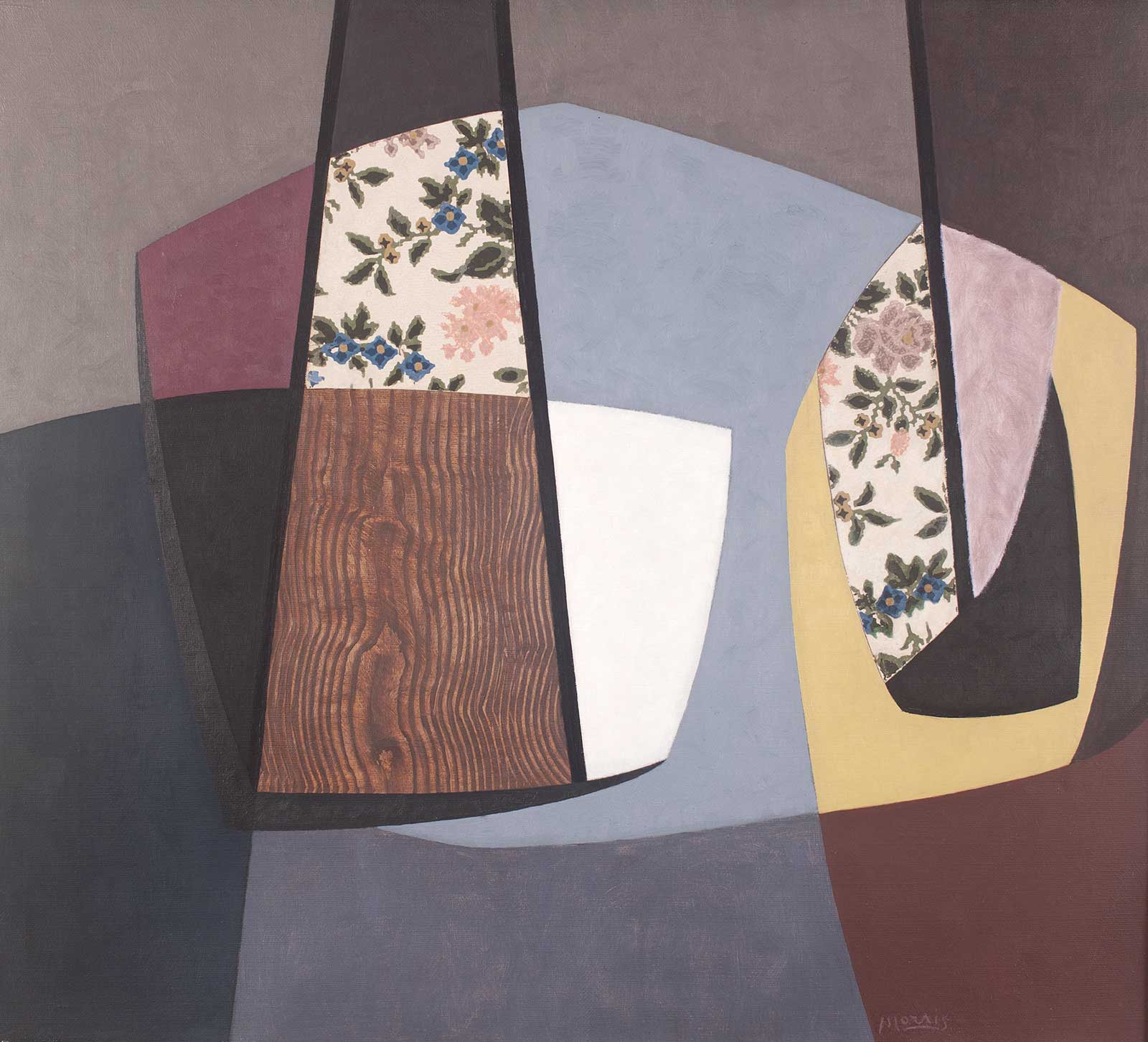 George L.K. Morris (1905-1975), Collage, 1941. Oil on canvas with wallpaper collage, 18 x 20 in., signed lower left: ‘Morris;’ signed, titled and dated on reverse: ‘George L. K. Morris / Collage 1941’.
In Blue Progression, created around 1941-42, Holty takes the pure red and blue from Mondrian’s limited palette of primary colors and modulates them to produce shifting relationships of dimension. He appropriates Mondrian’s composition of horizontal and vertical linear elements but introduces truncated triangles and overlapping shapes which, through their configuration, position and relationship, imply fields of depth and shifting planes that contradict Mondrian to evoke the nature of an American industrial landscape with girders and smokestacks.Raymond Jonson (1891-1982) was a cofounder of the Transcendental Painting Group, established in New Mexico in 1938, which embraced the geography, color and spiritual nature of the American Southwest as inspiration for their abstract works in contrast to the popular Native American realist subjects of the Taos School. Oil No. 10, 1946, is from a series of 17 paintings Jonson completed in 1946-47 inspired by the Native American petroglyphs found in the mountains of New Mexico near where he lived. It was the materiality of lines incised into rock, rather than the design of any petroglyph that impressed the artist and led him to adopt a method to suggest incised lines in his painting. There is a precision and gentle arc to these lines interlaid over each other, their quiet, disconnected interplay and static nature inviting contemplation. The overlapping rounded forms, evoking the rolling hills and giant skies of New Mexico, recall the patterns of colored theatrical spotlights Jonson employed as a young man working in the theatre. Jonson’s use of an airbrush to distance individual human gesture from the painting’s surface and the lyrical forms and colors he employed, both serve to evoke an emotional and spiritual response to his landscape.
During the decade from 1935 to 1945, the influence of European abstraction and synthetic cubism in particular, came into fruition in America, when the major figures found the fullest expression of their voices, promoted their cause and organized themselves into influential bodies. The handful of examples presented here illustrates the variety of influences germinating in America in this period and demonstrates the vitality and originality of these responses reflecting the American character.
Powered by Froala Editor