Order/Reorder: Experiments with Collections, the exhibition now on view at the Hudson River Museum in Yonkers, New York, is a study in deliberately unlikely juxtapositions. Co-curated by Laura Vookles, chair of the curatorial department at the Hudson River Museum, and Bentley Brown, adjunct professor of art history at Fordham University and PhD fellow at New York University Institute of Fine Arts, the works—paintings, sculptures, prints, photographs, and decorative arts—are organized into familiar categories: portraiture, figural studies, still life, landscape and abstraction. These categories are then grouped into genres and themes: labor and leisure; friendship, family and intimacy; the body and the gaze; finding home and community; and the production of meaning in portraiture, still life and landscape. The overarching idea is one of exploring “new approaches to looking at American art that reconsider past and present expressions of American identity.”
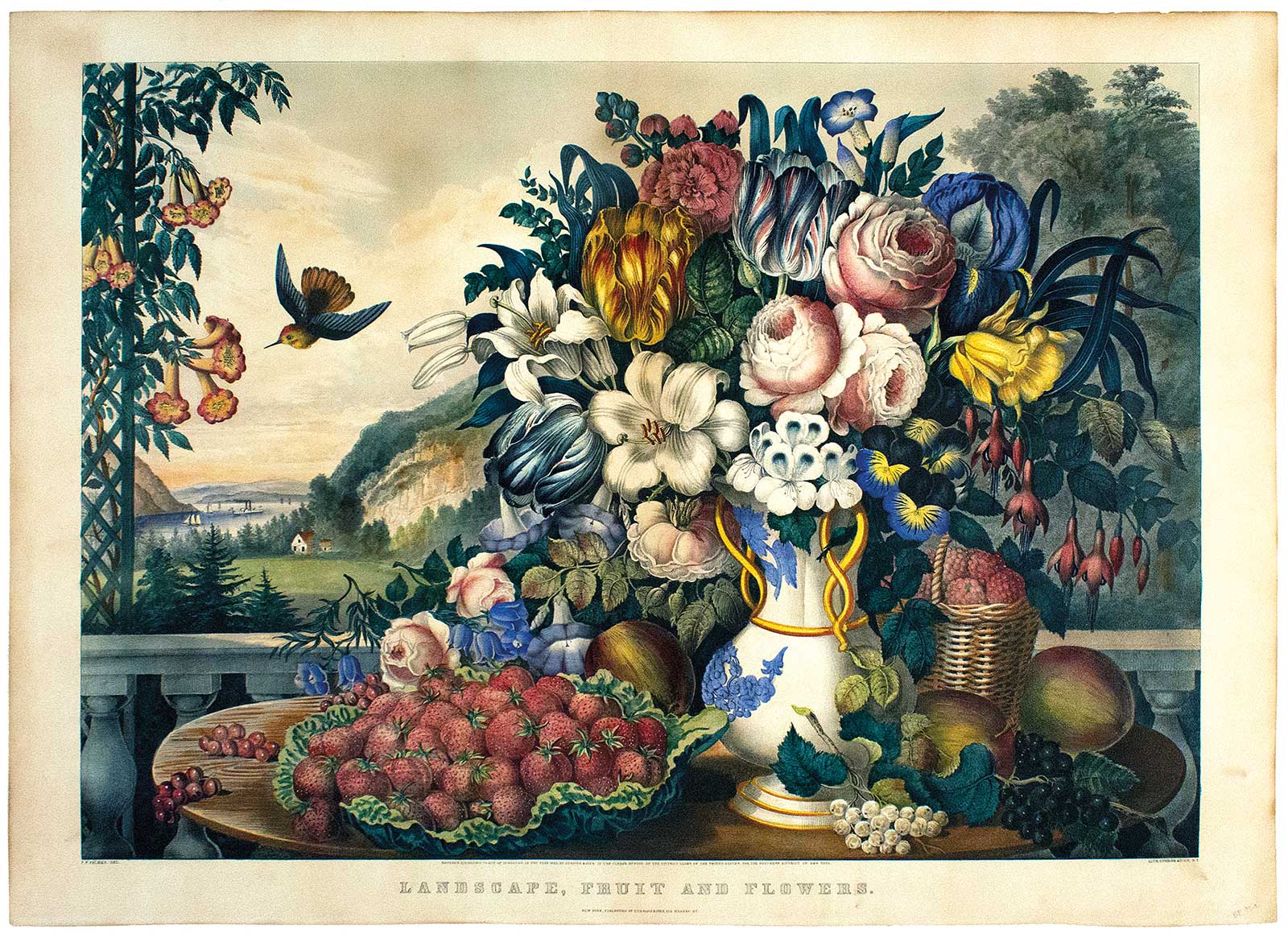 Frances Flora Bond Palmer (1812–1876), Landscape, Fruit, and Flowers, 1862. Two-color lithograph, hand colored. Collection of the Hudson River Museum. Gift of Mrs. George J. Stengel, by exchange, 2017 (2017.05).
Embracing 19th-century works, recently acquired pieces by contemporary artists, and some fine pieces on loan from the Joslyn Art Museum in Omaha, Nebraska, the exhibition asks us who we, as Americans, are—or imagine ourselves to be. In isolation, each work has a unique, discernible voice. In aggregate, the works murmur cacophonously. Or take a visual approach, as if each work is a mirror. In each piece, we can see our own reflection, sometimes readily, sometimes dimly, sometimes resistantly. Taken together, what we confront, for that is the correct verb—confront—is a house of mirrors that challenge our notions of identity, both as individual human beings, and as Americans.
It should be noted that the curators insist on the provisional nature of their organization of the works and encourage visitors not only to envision different, disparate groupings, but to create their own on a wall of reproductions of the works in the museum lobby. So, while I will hew somewhat to the exhibition’s order to things, I will also feel free to deviate from the curatorial path and make observations and comparisons that strike me. What intrigues me is the way even the most disparate works can somehow lead and link to one another.
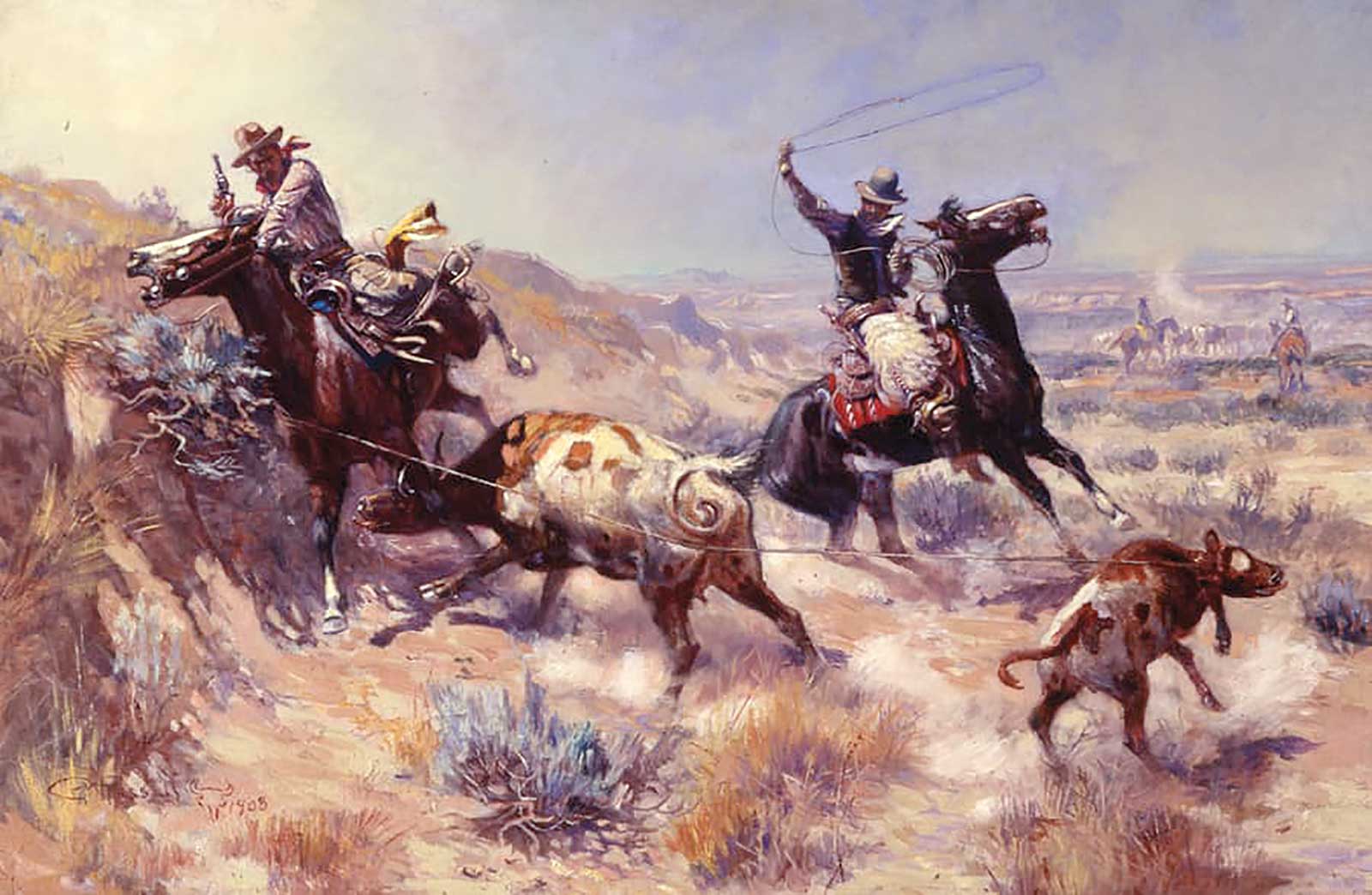 Charles M. Russell (1864–1926), Range Mother (A Serious Predicament), 1908. Oil on canvas. Collection of the Joslyn Art Museum. Gift of Foxley & Co., 2000 (2000.27).
For example, Frances Flora Bond Palmer’s 1862 lithograph, Landscape, Fruit, and Flowers, done for Currier & Ives, might seem at first to be antithetical to Charles M. Russell’s 1908 oil, Range Mother (A Serious Predicament), yet a second look at the two works, side-by-side suggests a number of congruities. First, sheer space. In both works, an active foreground recedes to an idea of American vastness and promise. Second, color. Color explodes in both works, from edge to edge. The negative spaces are big skies. The blues of the Russell’s sky and the flowers and flowers painted on the vase in Palmer’s work pop. Third, abundance. Fruits and flowers in Palmer’s imagery, pollinated by a hummingbird. In the distance, tidy dwellings beside what looks to be the Hudson River, plied by sailing ships and boats. In Russell’s oil, cowboys wrestling with an angry cow protecting her calf. Yes, this is a dangerous moment, but, in the distance, an entire herd on the move. Fourth, and most important, abundance tamed and made useful. Palmer’s cut flowers serve an ornamental purpose, while the succulent berries and grapes indicate a land of plenty. Russell’s cows are beef on the hoof. What’s absent in both, of course, is any suggestion of Indigenous presence or of a potentially hostile wilderness. Yes, the range mother is angry, but her fate is sealed. She may be wild, but only for the moment.
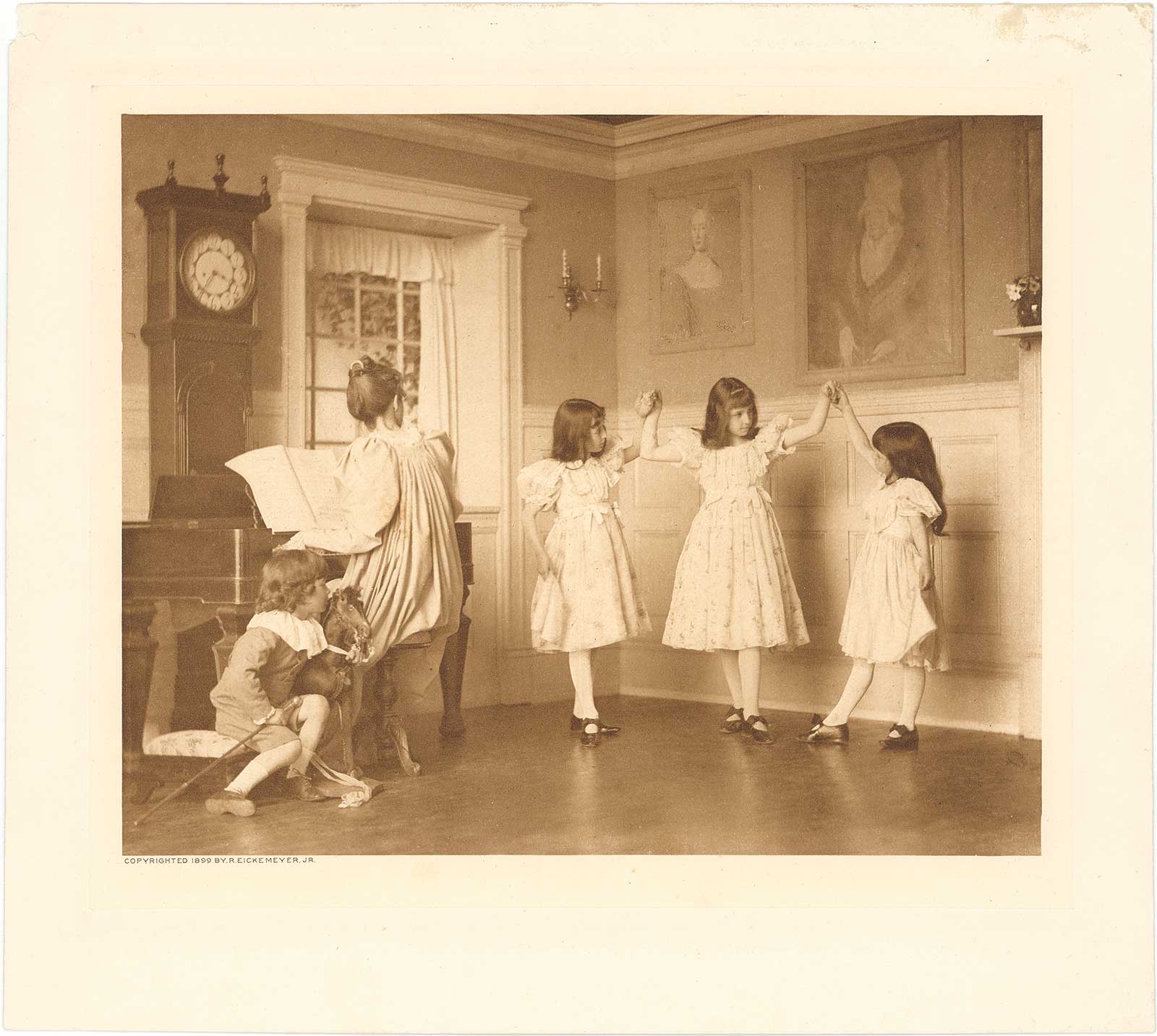 Rudolf Eickemeyer Jr. (1862–1932), The Dance, 1899. Photogravure. Collection of the Hudson River Museum. Gift of Mrs. Erik Kaeyer, 1975 (75.29.37).
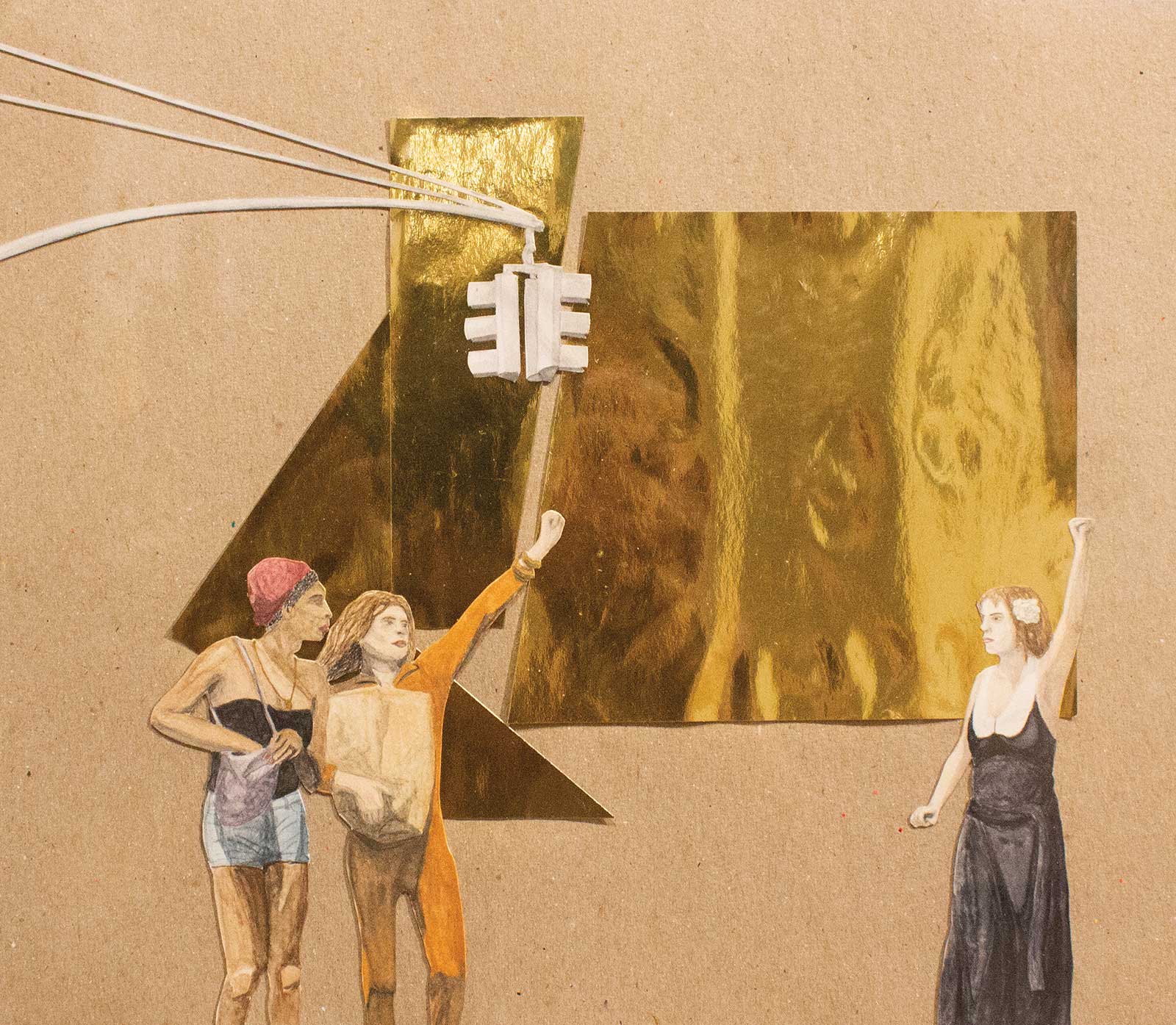 Tuesday Smillie (b. 1981), S.T.A.R., from the FREE OUR SIBLINGS///FREE OURSELVES series, 2012. Watercolor on paper, collage on board. Collection of the Hudson River Museum. Gift of Mrs. Eleanor Lewis, by exchange, 2021 (2021.2). Recent acquisition. © Tuesday Smillie.
Consider this pairing: Seongmin Ahn’s 2019 drawing, Aphrodisiac 30, and Alvin C. Hollingsworth’s portrait Aspects of Women, painted circa 1987. Again, at first, how could these seem at all similar? And yet, walking back and forth between them, how could they not? The rich, golden backgrounds against which both works are set recall Gustav Klimt’s sumptuous portraits, as does the shared verticality of both. In Aspects of Women, there is a regality in the length of the woman, especially her neck, a nod, surely, to Modigliani, but also to African traditions. With her hair breaking free of the picture plane, it is as if she—goddess-like—is about to grow even taller and more majestic, transforming, perhaps, into a tree—or a mountain. This symbolic shift, from individual to aspect of landscape, is a very American conceit, where we conflate beauty and power and seek to align ourselves and our heroes with the forces of the natural world.
Ahn humanizes and “humorizes” this notion in Aphrodisiac 30. Water dripping from noodles rolled onto chopsticks falls into a bowl, making huge waves that rock mountains and spill over onto the gold background. The surreal nature of the work is self-evident as it destabilizes our sensibility and forces us to engage it from different points of view. And yet, underneath this, there may well be a more serious intention. Food is so much a part of American culture. Yet how many ethnic cuisines have conquered America, even when the people who brought those cuisines have themselves been treated as second-class citizens—that is, when they were allowed to be citizens at all?
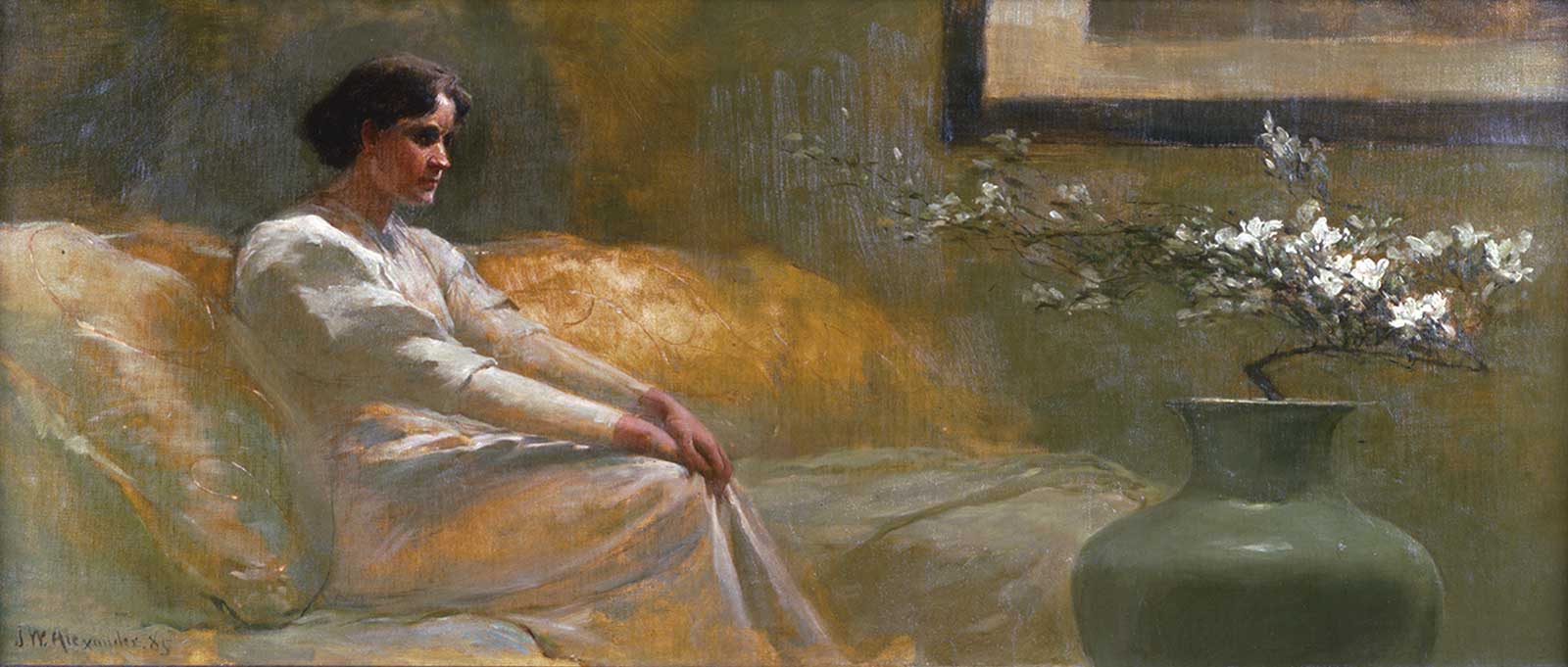 John White Alexander (1856–1915), Azalea (Portrait of Helen Abbe Howson), 1885. Oil on canvas. Collection of the Hudson River Museum. Gift of Mrs. Gertrude Farnham Howson, 1974 (74.19.6). © John White Alexander.
A single, simple formal moment links Rudolf Eickemeyer Jr.’s 1899 photogravure, The Dance, with Tuesday Smillie’s 2012 watercolor and collage, S.T.A.R., from her FREE OUR SIBLINGS///FREE OURSELVES series—and that is that raised hands of the girls in Eickemeyer’s photograph and the raised fists of the women in Smillie’s work. For despite the overwhelming sense of regimentation in The Dance—the girls in identical clothes, dancing to the pianist’s tune and beat, while a boy trussed up in Little Lord Fauntleroy garb looks on, with his arm around his hobby horse and a rider’s crop at his side, the girls are looking, not at any of this, nor the dour portraits that hang over them like the nooses of legacy, but at one another. They are lost in one another, quite oblivious, at least for the moment, to the weight of the patriarchy—and matriarchy—that surrounds them. For the moment, in the moment, they are free.
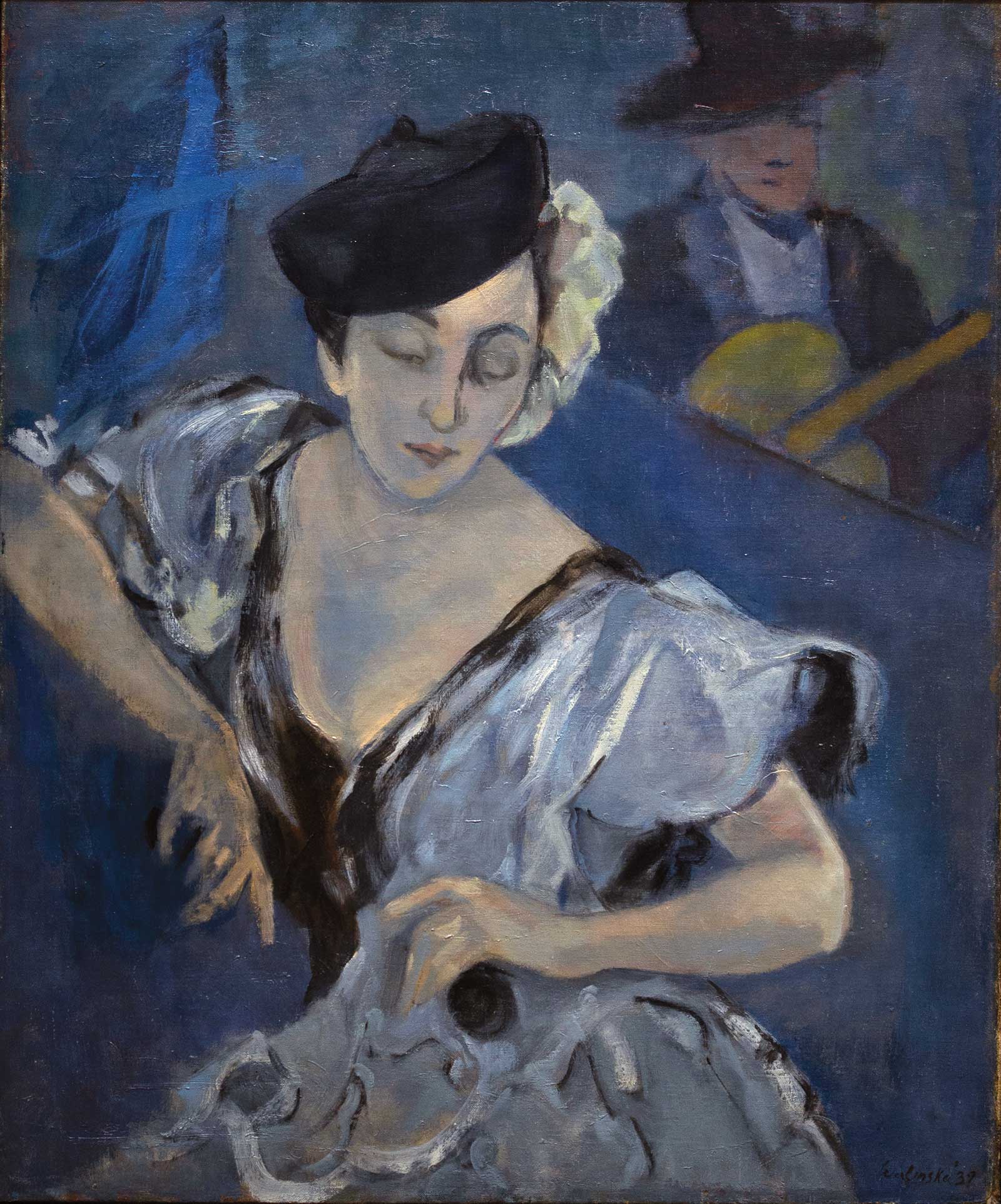 Anna Walinska (1906–1997), Self-Portrait: Flamenco, 1939. Oil on canvas. Collection of the Hudson River Museum. Gift of Rosina Rubin, 2020 (2020.12). Recent acquisition. © Anna Walinska.
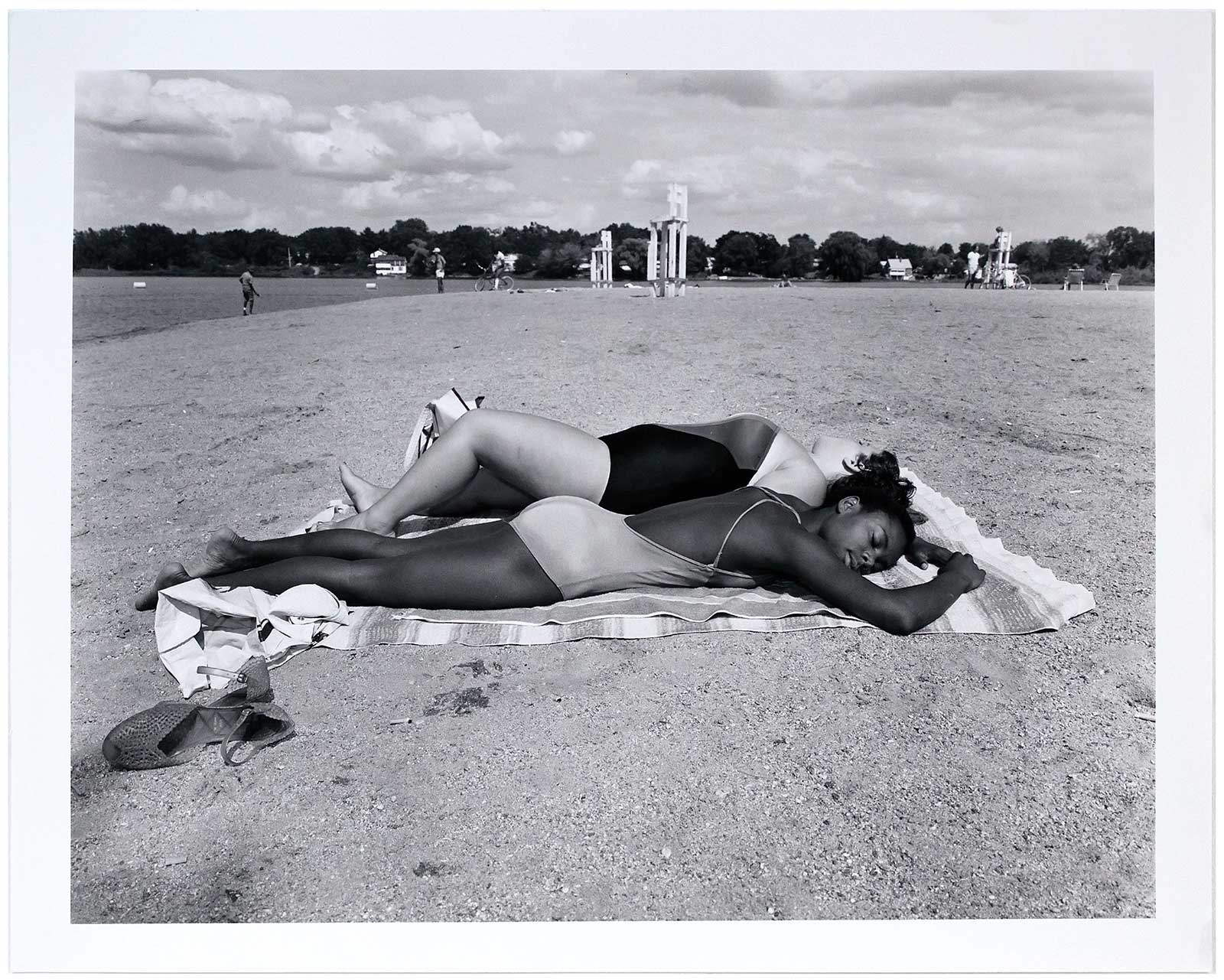 Mary Frey (b. 1948), Girls Sunbathing, from the Domestic Rituals series, 1979–83.Gelatin silver print. Collection of the Hudson River Museum. Gift of the artist, 1984 (84.22). © Mary Frey.
Smillie’s S.T.A.R., a spare watercolor and collage, makes the fleeting recognition in The Dance overt. In fact, the woman at left, in a long black dress with white lapels and a flower in her hair might well be a woman from the past, from a past not too far from the world of The Dance—perhaps 1910 or 1920. The raised fist of the woman at right, as well as the moment of recognition from the woman beside her, might just be a gesture of sisterhood expressed over time. The abstract shapes behind the women—two joined at left, separated by a slender gap from the one at right—echo the figures. The arm of the woman at right, extended, bridges the gap and unites the women and the composition. The streetlight that hangs at left doesn’t reveal whether it says “Walk” or “Don’t Walk.” And it doesn’t matter.
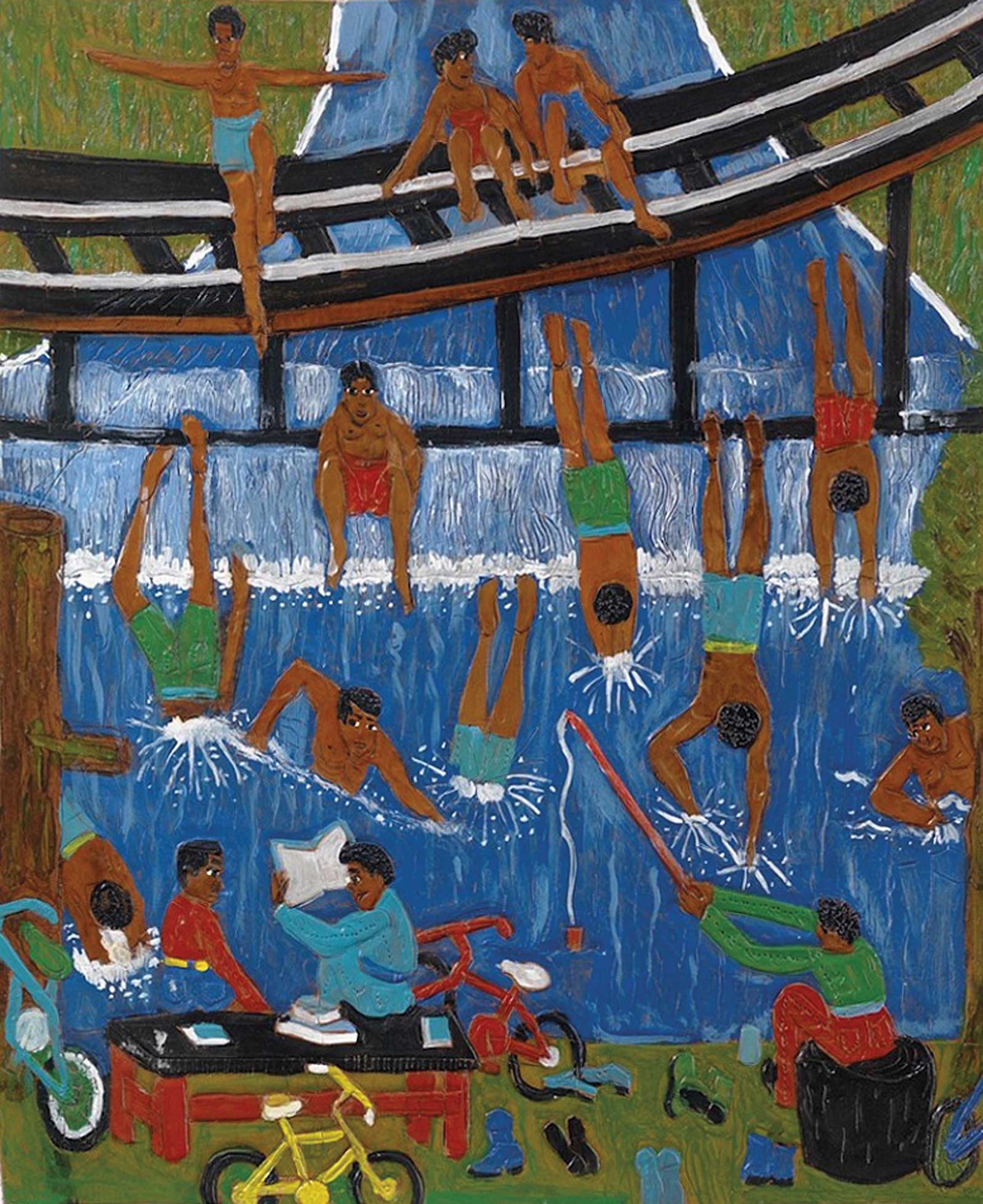 Winfred Rembert (1945–2021), The Curvey II, 2014. Dye on carved and tooled leather. Collection of the Hudson River Museum. Gift of Jan and Warren Adelson,2020 (2020.11). Recent acquisition. © Winfred Rembert.
Like The Dance, Anna Walinska’s 1939 Self-Portrait: Flamenco subverts the kinds of expectations we find in, say, Degas’ dancers where the gaze of the viewer is almost a transgression. Walinska, who was an important arts organizer as well as a painter, is the one painting herself dancing. The exercise is reflexive, a circle already closed by the artist as artist who is also the artist as subject and, perhaps, the intended viewer. We can observe her heightened state of being but can no more break into it than the guitarist who accompanies her. Contrast this, for a moment, with John White Alexander’s 1885 painting, Azalea (Portrait of Helen Abbe Howson). The correlation between the potted azalea branch and the stillness of the classic, “woman in white” portrait defines one standard of American beauty in the late 19th century. Swing back to Hollingsworth’s Aspects of Beauty. Both exude stillness, yet there is potential energy in the towering black woman in Hollingsworth’s painting, while Helen Abbe Howson’ stillness seems restrained. Her arms, hands, and jaw want to move, to explode, but they cannot. Is this deliberate on the part of the artist, or does it express something of the era’s zeitgeist, or both?
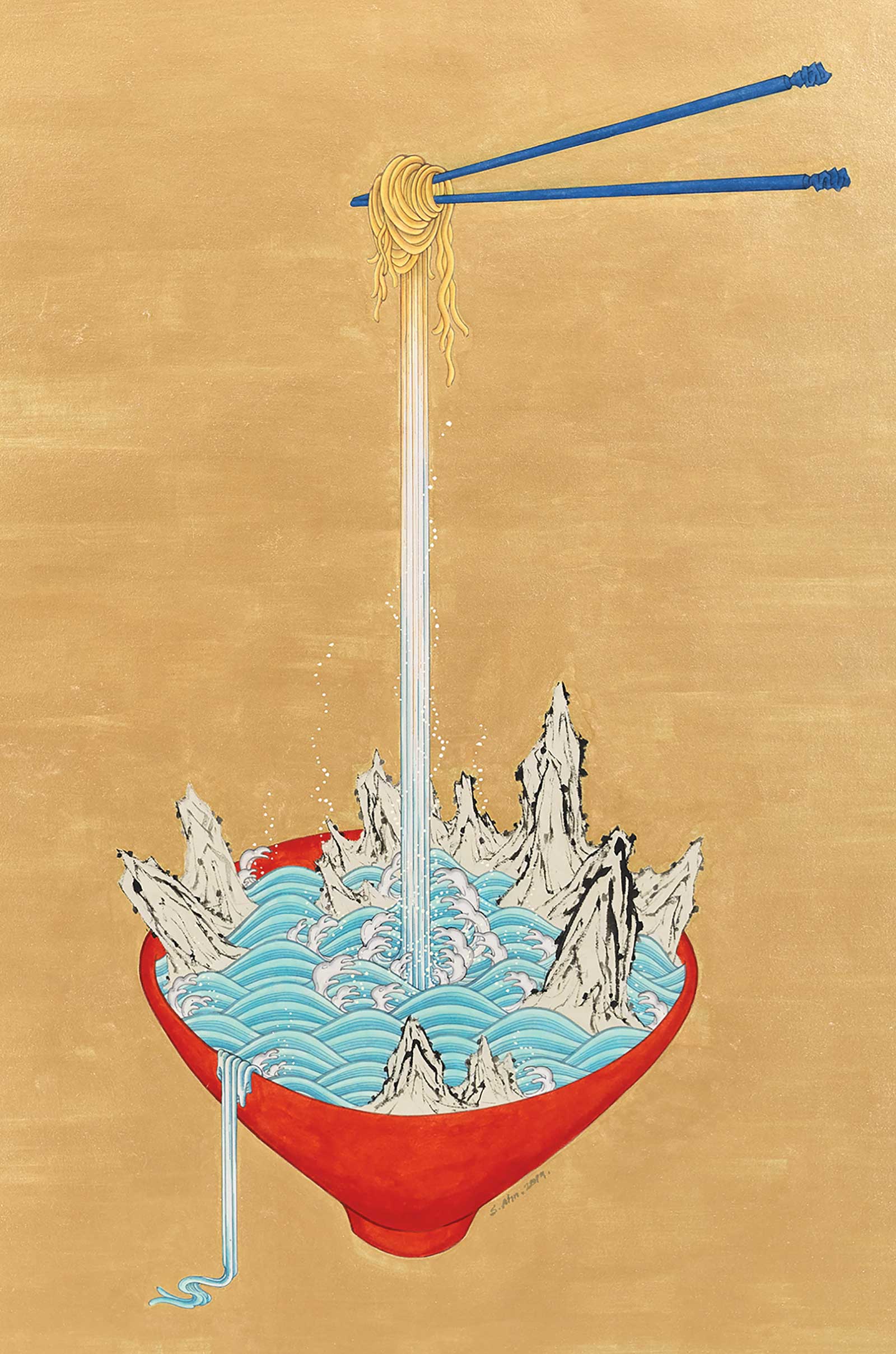 Seongmin Ahn (b. 1971), Aphrodisiac 30, 2019. Ink, pigments and wash on mulberry paper. Collection of the Hudson River Museum. Museum Purchase, 2021 (2021.6). Recent acquisition. © Seongmin Ahn.
Mary Frey’s photograph, Girls Sunbathing, and Winfred Rembert’s painting, The Curvey II return us to an innocence that is part and parcel of America’s dream of itself in an eternally renewable youth, a childhood we never see as childish, even when we ought to. Images like these, however, of young Black Americans in the joy of swimming—at leisure and at rest—are images we rarely see, images that should not be so uncommon. Indeed, compare these to Ghanaian artist Tijay Mohammed’s 2021 work, Ruby Bridges, and the weight of history on children in Black America is made manifest. Bridges, whose role as a 7-year-old girl in the desegregation of American schools in 1960 continues to inspire, is here superimposed on a five-dollar bill. With concentric gold haloes around her head, Mohammed’s work offers a new vision of a new America, from an African artist’s point of view.
So, who are we? Order/Reorder: Experiments with Collections asks the questions and leaves the answers to us as we shuffle and reshuffle the works in the exhibition. Are we powerful, beautiful, innocent, joyous? Are we despotic, self-absorbed, corrupt, melancholy? Are we childlike with wonder when we look at one another and the natural world? Or are we childish conquerors of everything and everyone we see?
Art always seems to ask if we’re makers or takers. But perhaps there is no either or. Perhaps, no matter how we juxtapose the images, we’re all of the above at one time or another. And “all of the above,” after all, is a very American idea.
Powered by Froala Editor