John Singer Sargent (1856–1925) was the preeminent society portrait painter of his time. I was brought up with easy access to the Museum of Fine Arts and the Isabella Stewart Gardner Museum in Boston. His portraits became favorite old friends to revisit. At the Gardner Museum, one of the first paintings visitors encounter is his monumental (91 5/16 x 137 in.) painting of a flamenco dancer, El Jaleo, one of his submissions to the Paris Salon of 1882. Mrs. Gardner created a dramatic setting for the painting in her newly-built Spanish cloister and lit it from below echoing the floodlights in the painting. It was easy to imagine hearing the music, castanets and snapping figures as I gazed at the impressive painting that provides a rather large clue to another aspect of Sargent’s interests and oeuvre.
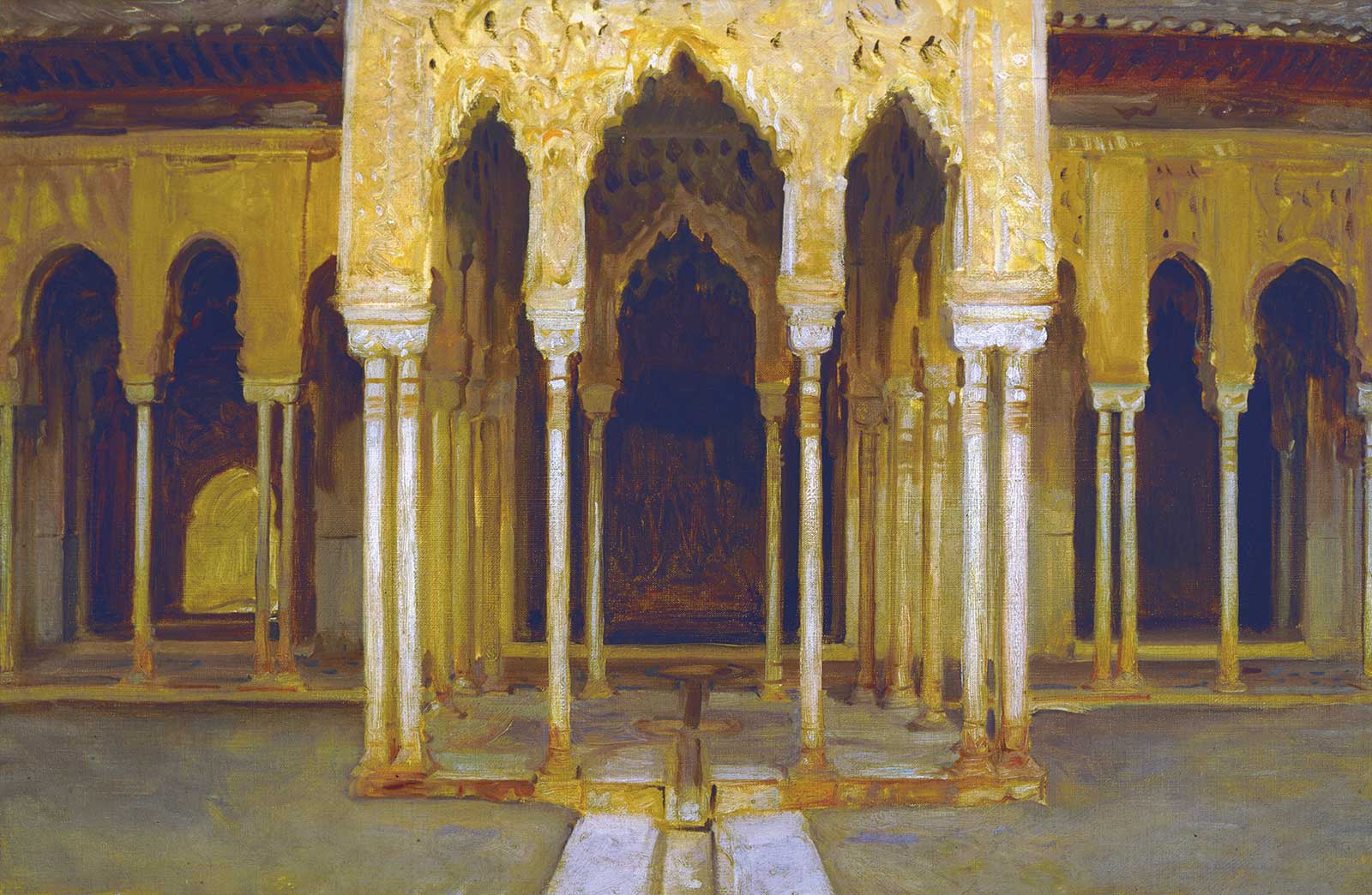 John Singer Sargent (1856-1925), Alhambra, Patio de Los Leones (Court of the Lions), 1895. Oil on canvas, 293/16 x 40 in. Private collection.
Drawings for El Jaleo are included among the 120 oils, watercolors and drawings, in the exhibition, Sargent and Spain, at the National Gallery of Art in Washington, D.C., October 2 through January 2, 2023, and at the Fine Arts Museums of San Francisco, Legion of Honor, February 11 through May 14, 2023.
The museums note, “His captivation with Spain, although lesser known, resulted in a remarkable body of work documenting his immersion in the country’s rich culture: landscapes and marine scenes, pictures of everyday life, and architectural studies, as well as sympathetic portrayals of the locals he found there, including its celebrated dancers…. Sargent and Spain reveals—for the first time—the depth of this engagement and the deliberate approach the artist adopted in depicting the rich subject matter he discovered. Also featured from his travels are some 28 never-before published photographs, several almost certainly taken by the artist himself.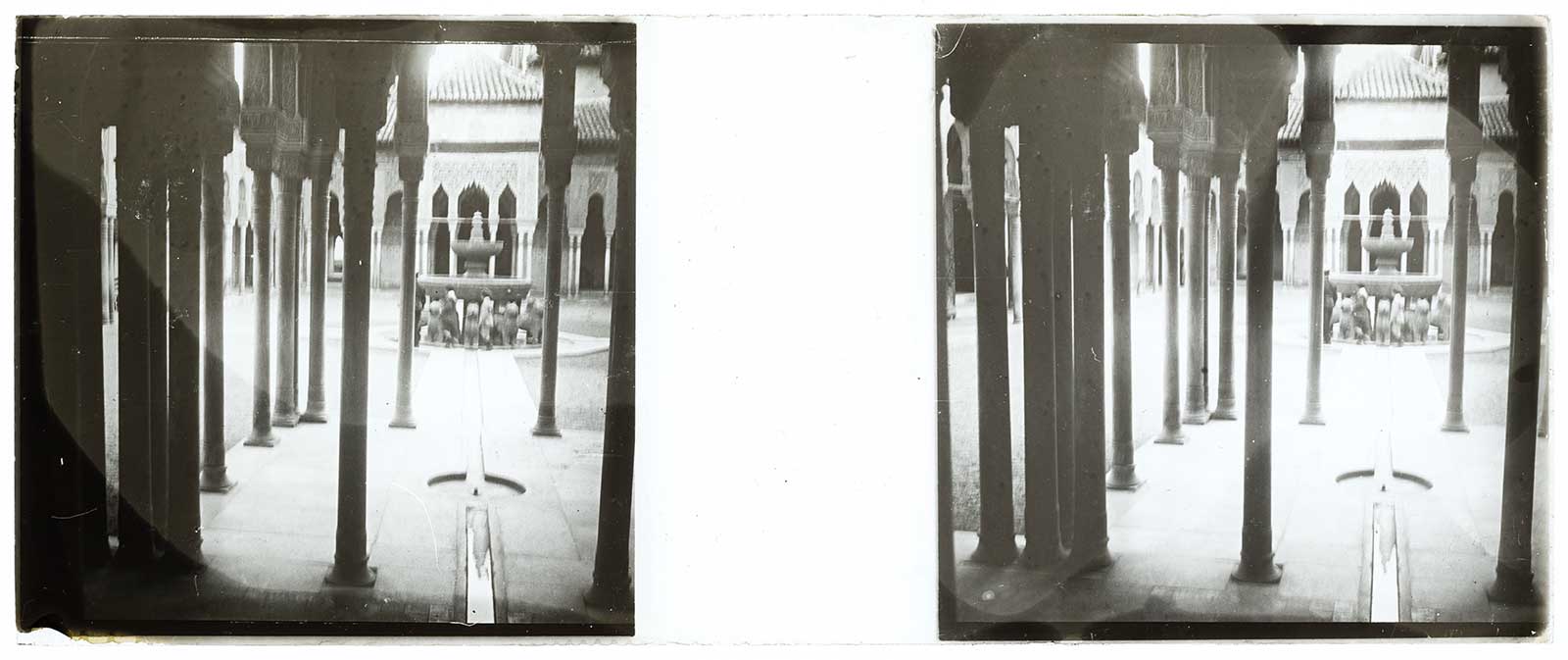 Likely John Singer Sargent, Alhambra, Patio de los Leones (Court of the Lions), probably 1912 stereoscopic glass transparency, 1¾ x 4¼ in. Private collection.
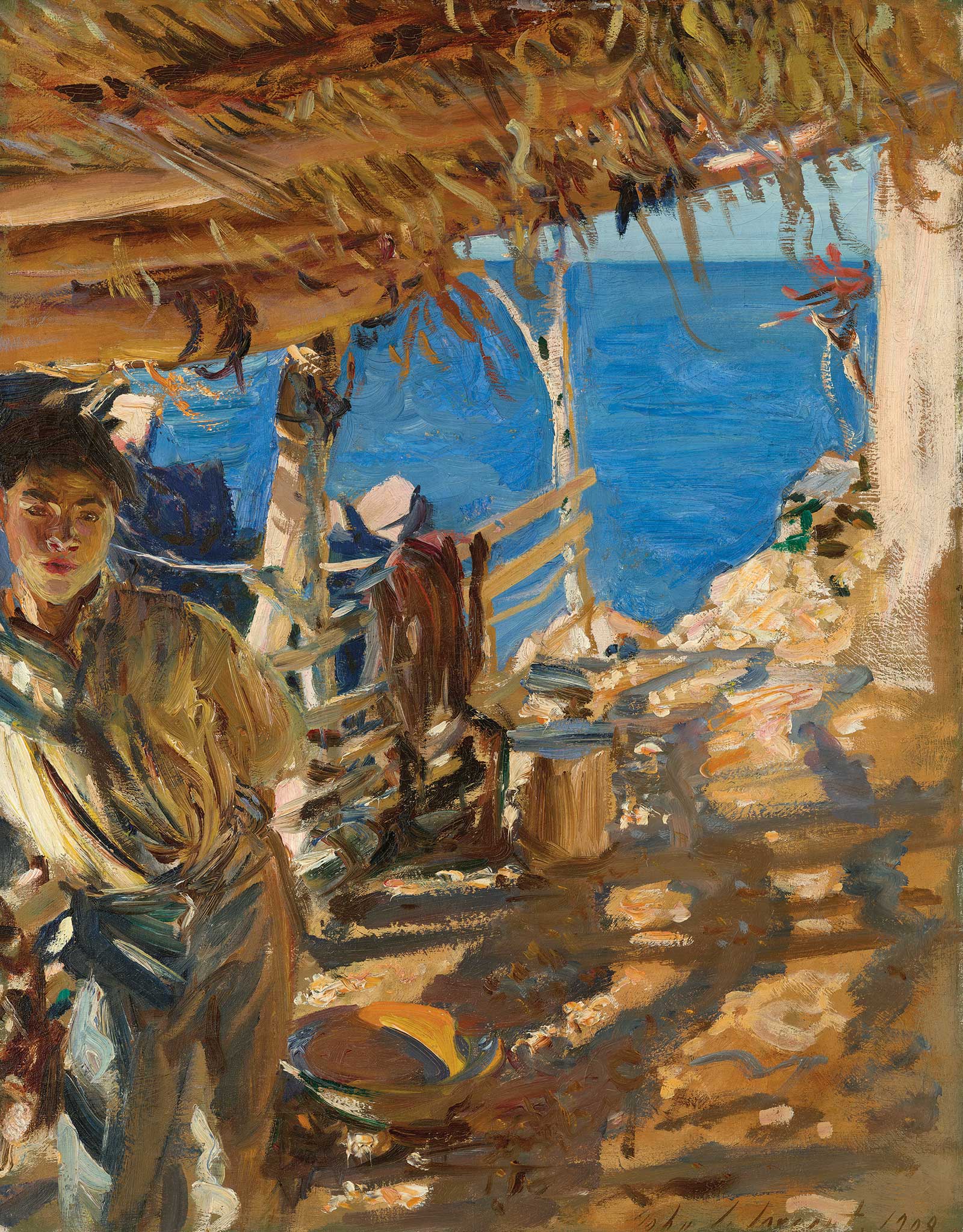 John Singer Sargent (1856-1925), Majorcan Fisherman, 1908. Oil on canvas, 35¼ x 29½ in. Private collection.
“The exhibition is curated by Sarah Cash, associate curator of American and British paintings at the National Gallery of Art, with Richard Ormond and Elaine Kilmurray, leading authorities on the artist and authors of the John Singer Sargent catalogue raisonné.”
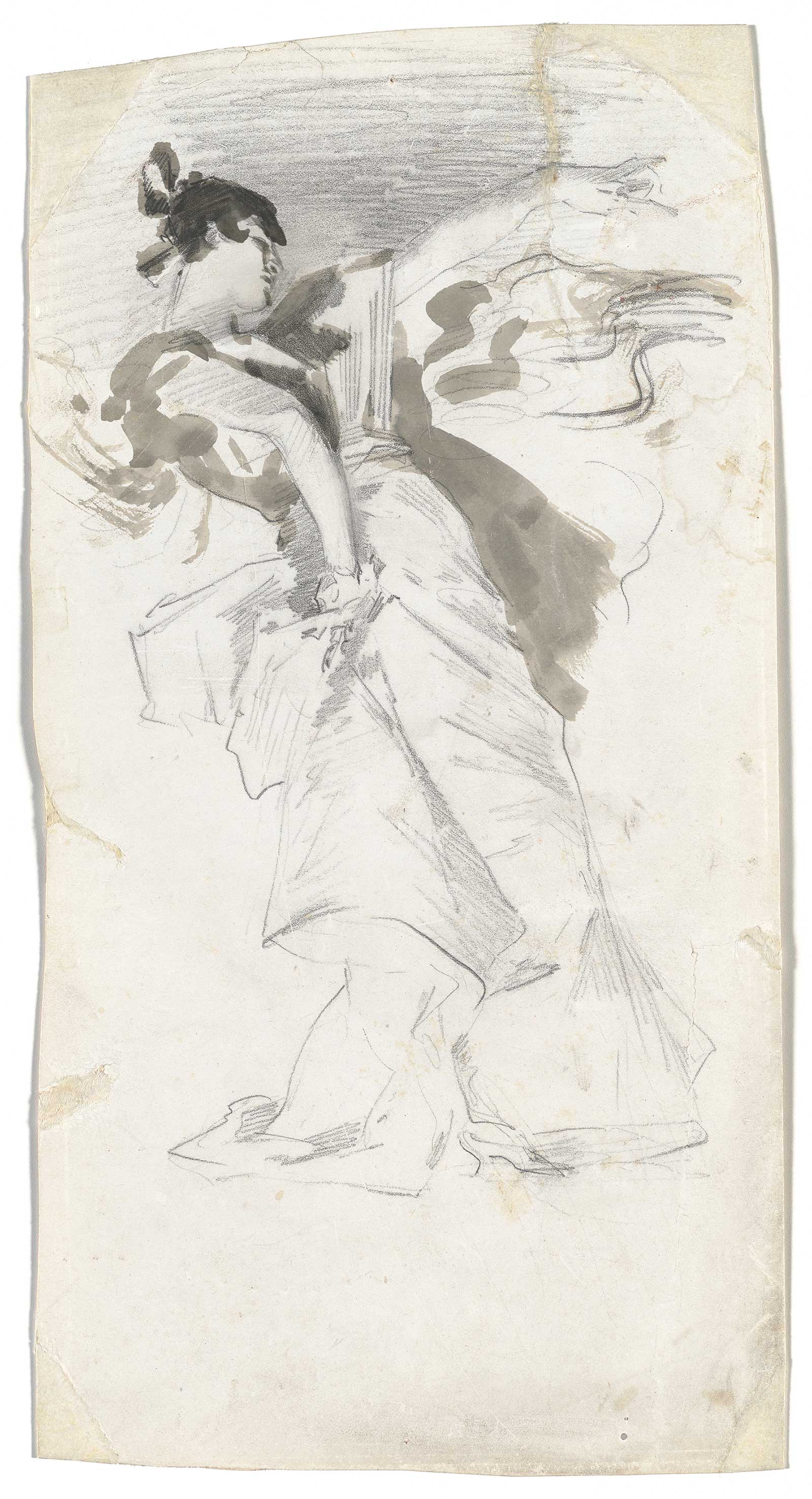 John Singer Sargent (1856-1925), Sketch of Dancer, after El Jaleo, ca. 1882. Graphite and watercolor on prepared clay-coated paper, 101⁄8 x 5 in. The Metropolitan Museum of Art, gift of Mrs. Francis Ormond, 1950 (50.130.139). Image copyright © The Metropolitan Museum of Art. Image source: Art Resource, NY
In their catalogue essay, Ormand and Kilmurray explain, “Spain engaged John Singer Sargent’s imagination in a profound and sustained way. Over seven extended visits made from 1879 to 1912, he responded to the country’s people, art, culture, dance, and music, its deep reserves of spirituality, its landscape and architecture. It inspired over 150 oil paintings and watercolors as well as a large cache of drawings, and it left its mark on many aspects of his art. The paintings of the 17th-century master Velázquez exerted a lasting influence on his portraiture, while his Triumph of Religion murals in the Boston Public Library are indebted to the imagery of Spanish religious art. Sargent had friends in Spain, among them leading artists and art critics; he promoted the work of Goya and El Greco and was involved in the acquisition of Spanish works of art for American collections.”
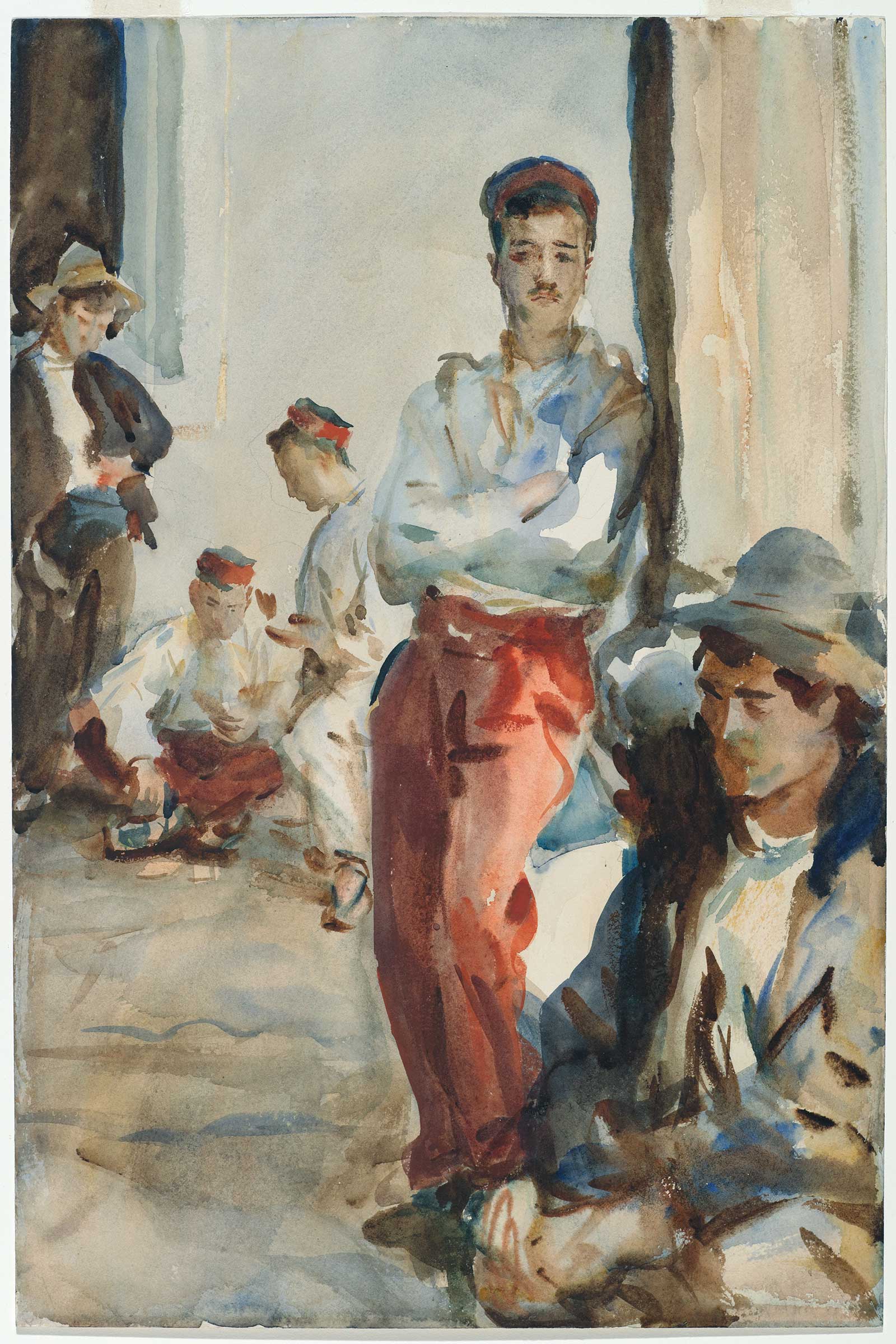 John Singer Sargent (1856-1925), Spanish Soldiers, ca. 1903. Watercolor over graphite, with gouache, on paper, 181⁄16 x 121⁄16 in. Brooklyn Museum, purchased by special subscription 09.840.
Sargent often traveled with friends, painting them painting together or in repose. In the exhibition is his painting of Eliza Wedgwood, ca. 1908-1909, a friend of his and his sister, Emily, a member of the English porcelain manufacturing family.
In Spain, Sargent was captured by the people as they danced, worked and, in the case of Spanish Soldiers, ca. 1903, convalesced in a Renaissance hospital in Santiago de Compostela.
His fascination with and command of light can be seen in Majorcan Fisherman, 1908. Sarah Cash describes the painting as “his Majorcan figural tour de force. A young fisherman, leaning to his right as if to reveal the cool blues of sea and sky beyond his compound, confronts the viewer with a piercing stare. Yellows and oranges convey the intense heat of the sun, while intersecting shadows coalesce with the verticals, horizontals, and diagonals of the thatched structure to form a nearly abstract mosaic.”
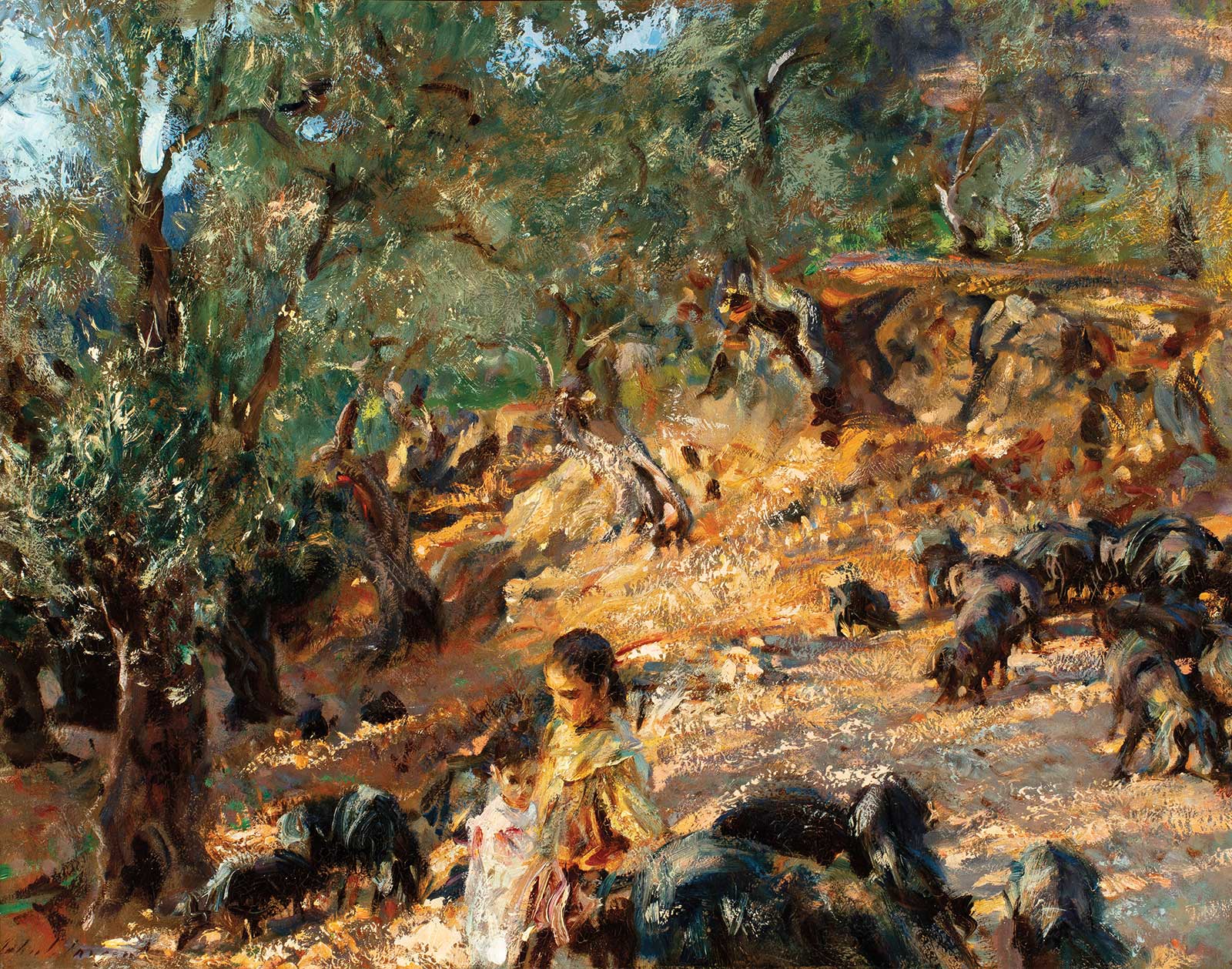 John Singer Sargent (1856-1925), Under the Olives, 1908. Oil on canvas, 22 x 28 in. Cedarhurst Center for the Arts, Mount Vernon, IL. Gift of John R. and Eleanor R. Mitchell, 1973.1.54. Photograph by Daniel Overturf.
By 1912 he was very interested in photography. Cash notes that he was adding “commercially produced prints to his collection but also photographing buildings, fountains, gardens and local people. As he wrote excitedly to his friend William Rathbone, he ‘brought back a lot of work but principally oils—and photographs! Very few watercolours.’”
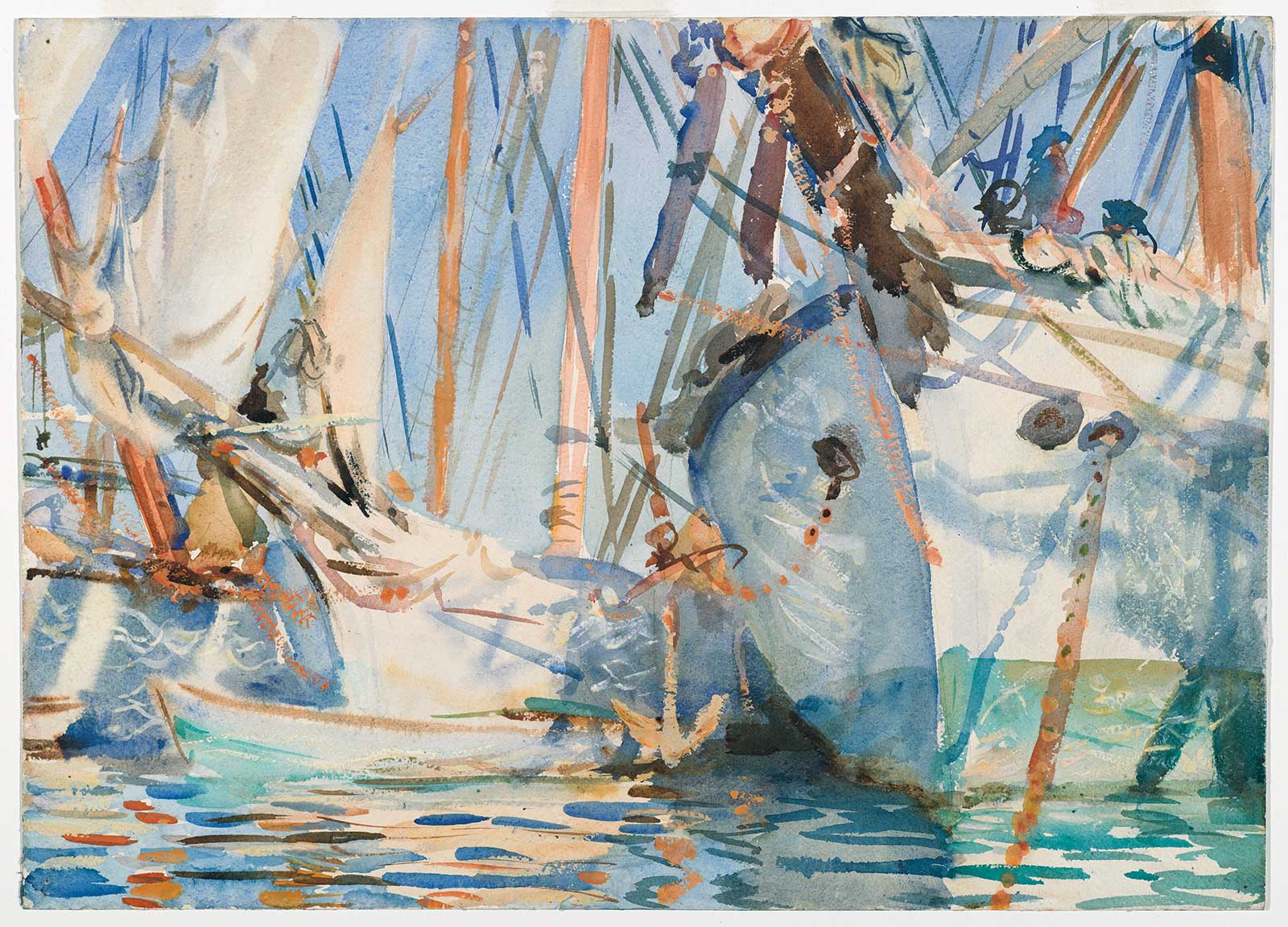 John Singer Sargent (1856-1924), White Ships, 1908. Watercolor over graphite, with gouache and wax resist, on paper, 137/8 x 193/8 in. Brooklyn Museum, purchased by special subscription 09.846.
His ca. 1912 stereograph of the Court of the Lions at the Alhambra, is a more distant view of the subject he painted in 1895.
“In Majorca, the artist brought his interest in ornament to bear not only on the built environment, but on the natural world,” Cash comments. She continues, “Under the Olives with its near blending of the girls’ and pigs’ textured forms into the sloping olive grove—call to mind The Hermit of the same year. Here, as fellow artist Kenyon Cox noted, Sargent rendered the scene ‘as one might perceive it in the first flash of vision if one came upon it unexpectedly.’ Cox’s description could just as readily apply to the three landscape pictures.”
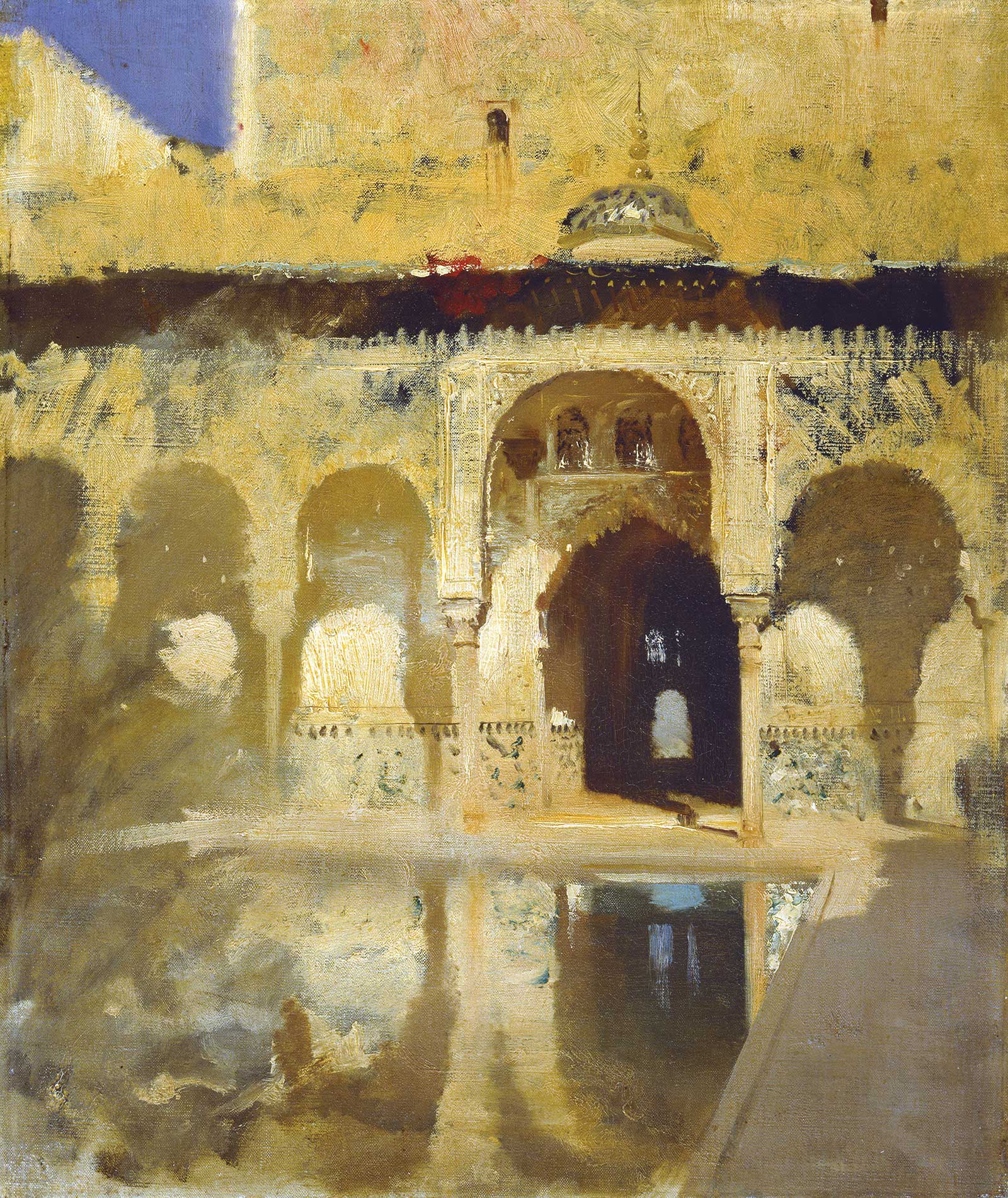 John Singer Sargent (1856-1925), Eliza Wedgwood, ca. 1908–1909.Watercolor over graphite on paper, 21 x 14½ in. The Hevrdejs Collection.
Light and shadow broaden out in Sargent’s luminous Alhambra, Patio de los Arrayanes (Court of the Myrtles), 1879. Cash describes the composition and the artist’s control of light and shadow. “…It shows a cropped asymmetrical view, down the reflecting pool to the north arcade. Unlike the muted tones of the synagogue interior, here Sargent reveled in the play of the bright sun on the richly toned building and the water. The nearly palpable heat contributes to the impressionist feel of the scene, as does the blurring of the lower left quadrant and certain architectural details. The off-center sight line and the recession of spaces seen through the central archway, from light to dark to light again, augur Sargent’s use of these pictorial devices in his Venetian interiors so influenced by Velázquez.”
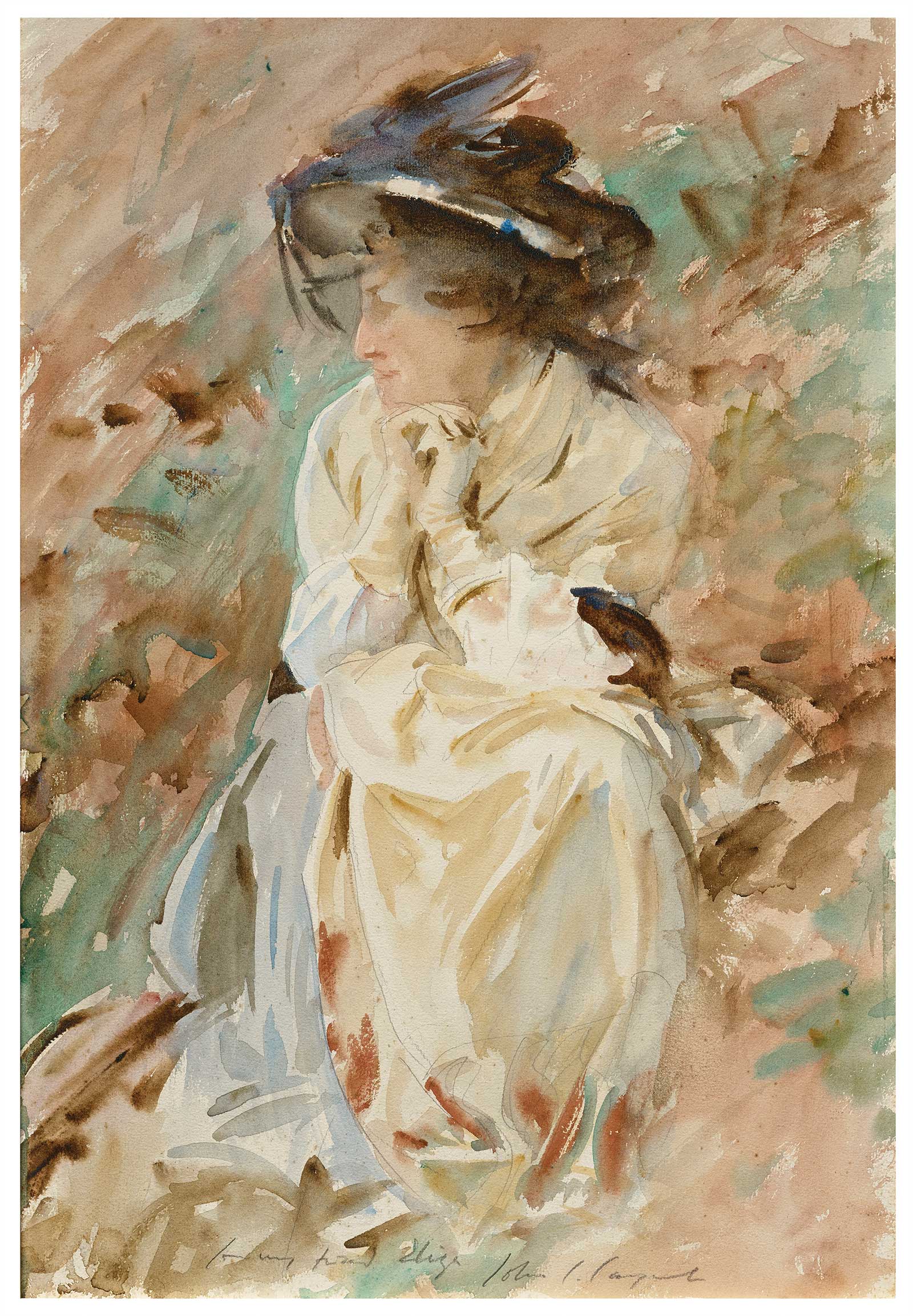 John Singer Sargent (1856-1925),Alhambra, Patio de los Arrayanes (Court of the Myrtles), 1879, oil on canvas, 225/8 x 19¼ in. Private Collection.
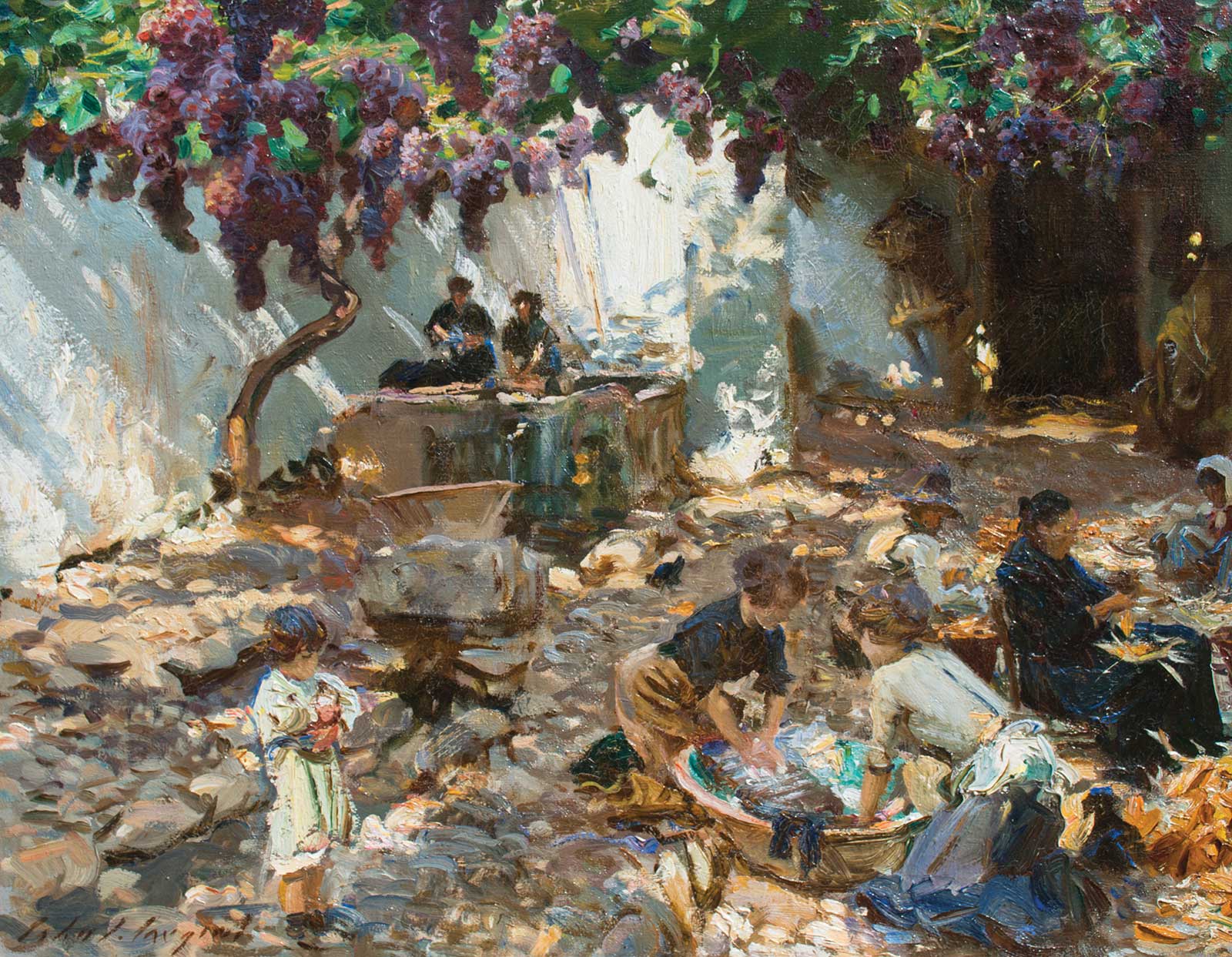 John Singer Sargent (1856-1925), Women at Work, ca. 1912. Oil on canvas, 34½ x 40½ in. Private collection; Seattle, WA. Image courtesy of A.J. Kollar Fine Paintings, LLC, Seattle, WA.
Cash observes, “Sargent visited many other locales over his long career that inspired deep investigations of people, architecture, land and sea. However, his enduring engagement with his surroundings in Spain remains singular.”.
Powered by Froala Editor