Now open at the Fenimore Art Museum in Cooperstown, New York, is Drawn from Life: Three Generations of Wyeth Figure Studies, an exhibition that will not only focus on the three iconic Wyeth artists—N.C., Andrew and Jamie—but also highlight drawings by Carolyn Wyeth, who was N.C.’s daughter, Andrew’s sister and Jamie’s aunt.
Adding another layer to many generations within the Wyeth Family is Victoria Browning Wyeth, Andrew’s granddaughter, who is the author of the exhibition’s catalog, which shares its name with the exhibition itself. This is the third major exhibition Victoria has collaborated on related to the Wyeths—the first was The Wyeths: A Family Legacy in 2013, followed by Andrew Wyeth at 100: A Family Remembrance in 2017.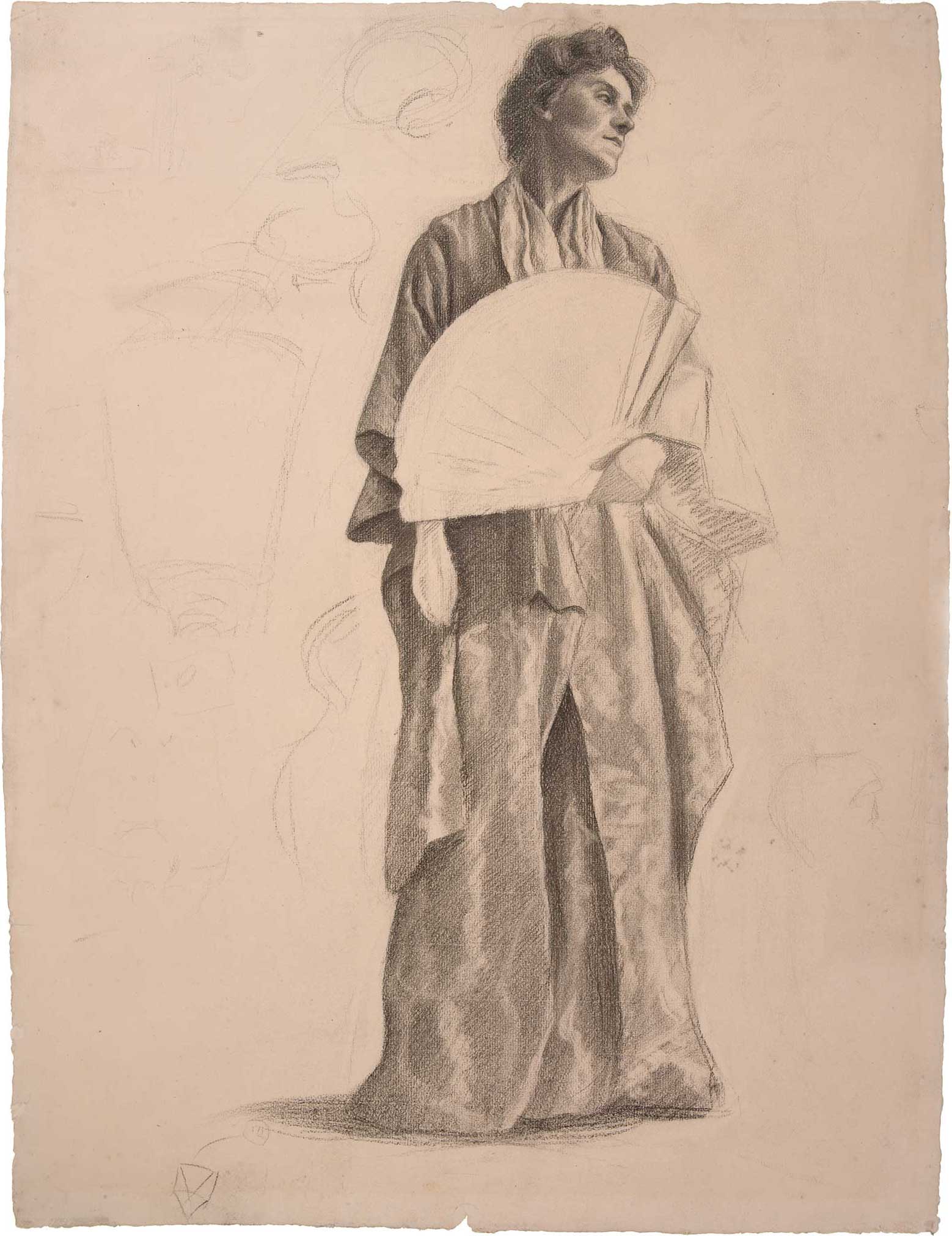 N.C. Wyeth (1882-1945), Untitled (Study of woman in kimono), ca. 1902. Charcoal on laid paper, 24¾ x 18 in. Portland Museum of Art, Maine. Museum purchase, 1982.180. Image courtesy of Luc Demers.
“The figure lies at the heart of much of my family’s work, and the foundations were laid in the early classroom and studio studies they created in their adolescence and early 20s. N.C. Wyeth’s early sketches show the promise of his later illustrations, while Andy’s show his father’s guidance in explaining the figure. Jamie’s anatomical work provides a deeper dive into understanding the figure at its most elemental level,” writes Victoria in the catalog’s introduction. “Looking at the early anatomical drawings by my family gives us a peek into the beginnings of their careers as artists, acute observers of their environment, and brilliant draftsmen. Without these basic figurative drawings, we never would have had Blind Pew from N.C.’s Treasure Island, Christina Olson from Andy’s Christina’s World, or Jamie’s countless paintings of Rudolph Nureyev. In examining these early works, we gain insight into the artistic process encountered by all three generations. To paraphrase my Uncle Jamie, studies, like these many, never-before displayed early works, represent ‘a doorway’ to the work that was to come.”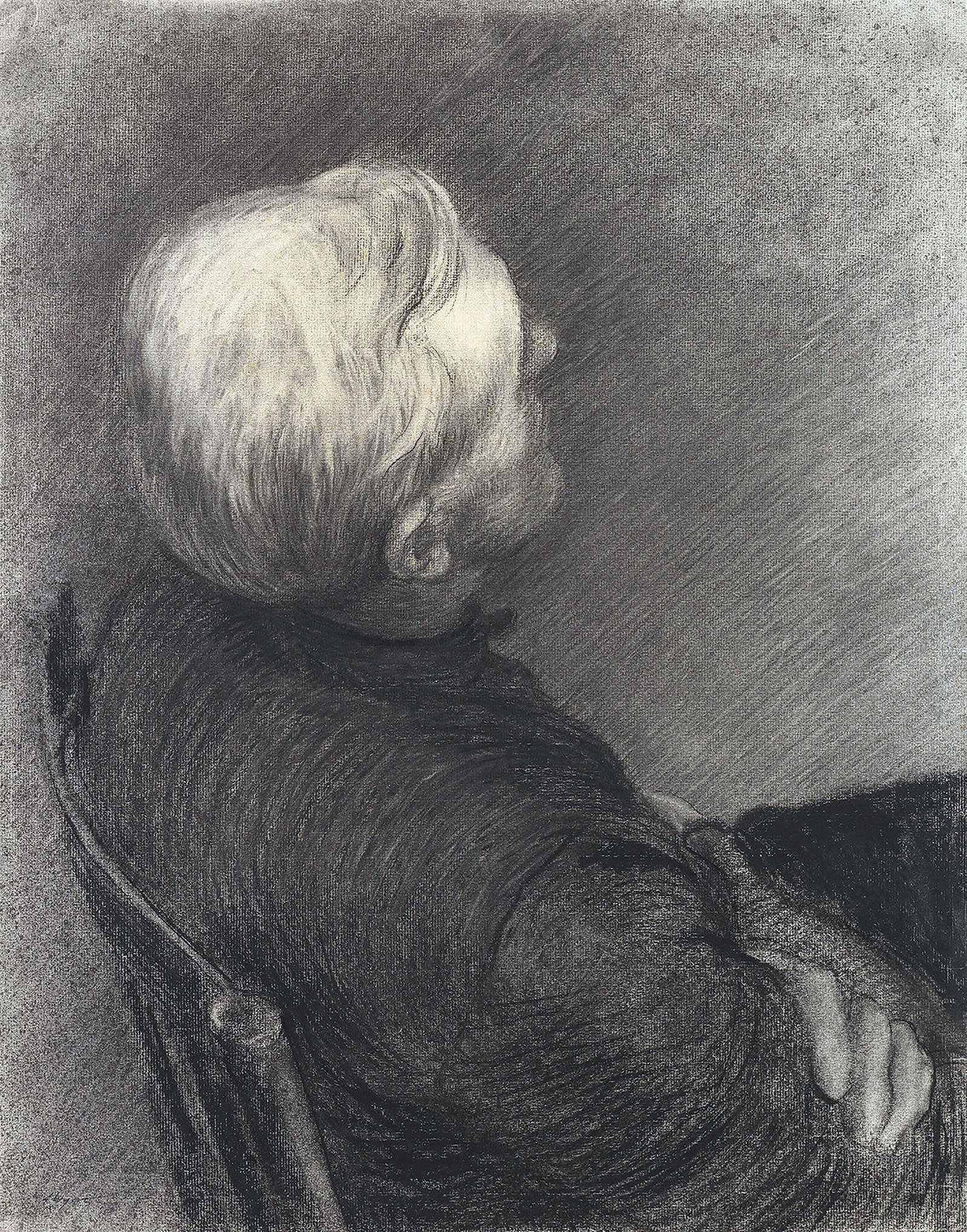 Andrew Wyeth (1917-2009), Untitled (#2313), 1936. Charcoal on paper. Collection of the Wyeth Foundation for American Art. © 2022 Andrew Wyeth/Artists Rights Society (ARS).
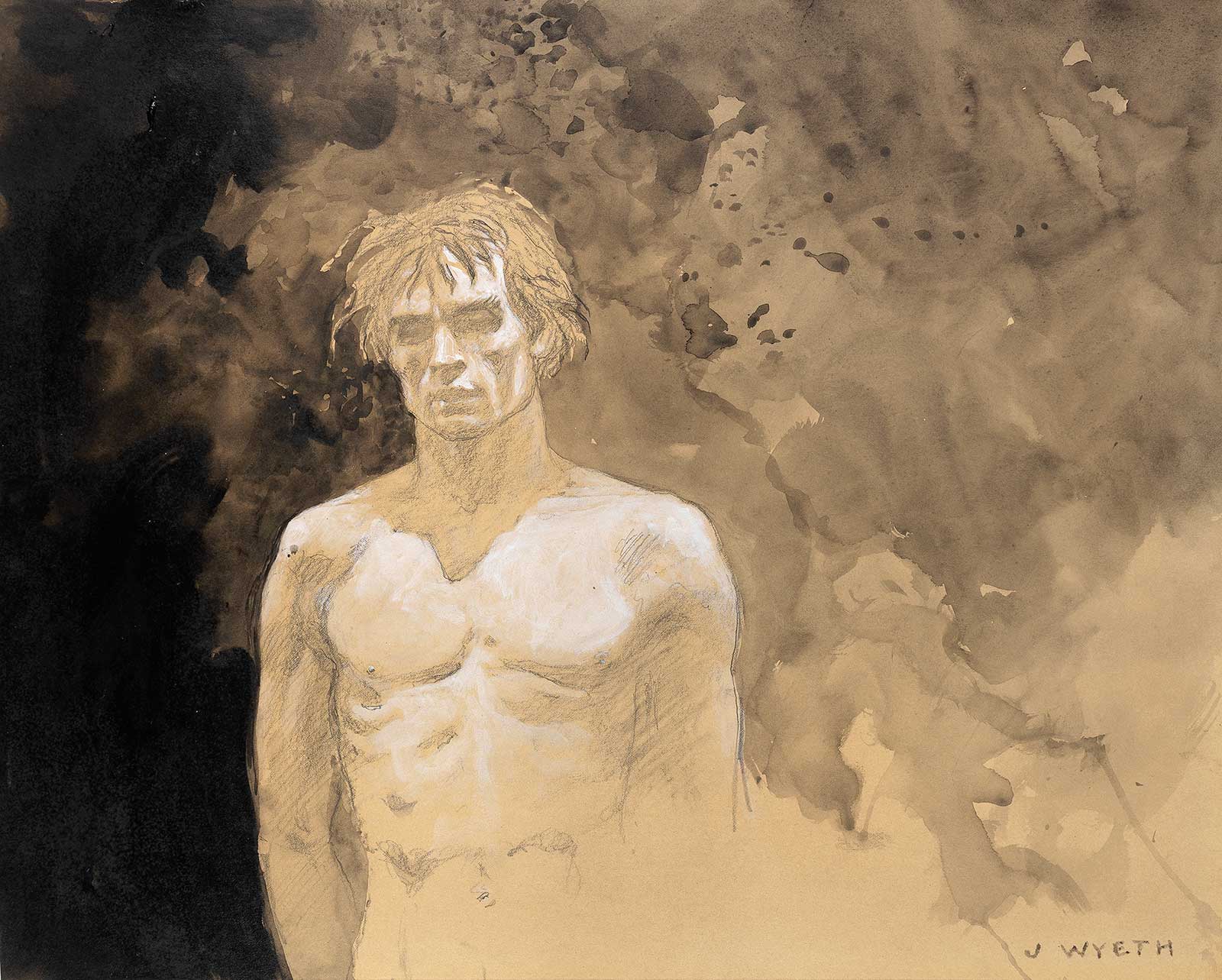 Jamie Wyeth (b. 1946), Black Wash Background, Torso, Nureyev, (Study #14), 1977. Mixed media, pencil, and wash on paper. Brandywine Museum of Art. Purchased with funds given in memory of Dr. Margaret I. Handy, 1980.
Many of the works, particularly those by Jamie, will reveal early sketches of famous works such as images of Nureyev and Orca Bates, showing a naked male subject seated in front of a large jawbone and teeth of a whale. “Orca Bates became the subject of many of Jamie’s works ‘because he just fascinated me as an individual. I was fascinated by his circumstances. At the age when I painted him, you didn’t know if it was a boy or a girl. That fascinated me…and so I just wanted to make a record of it,’ Victoria writes about the sketch. “The final portrait of Orca became ‘like Jonah and the whale. You notice there is water on the floor by his feet. So, it’s like he was part of the sea and came out from the inside of a whale. And there he appeared.’ When asked about the inclusion of the digital watch, Jamie explained that he included it ‘because it was contemporary at the time. I bounce between reality and imagination. And that is the whole point of painting.’”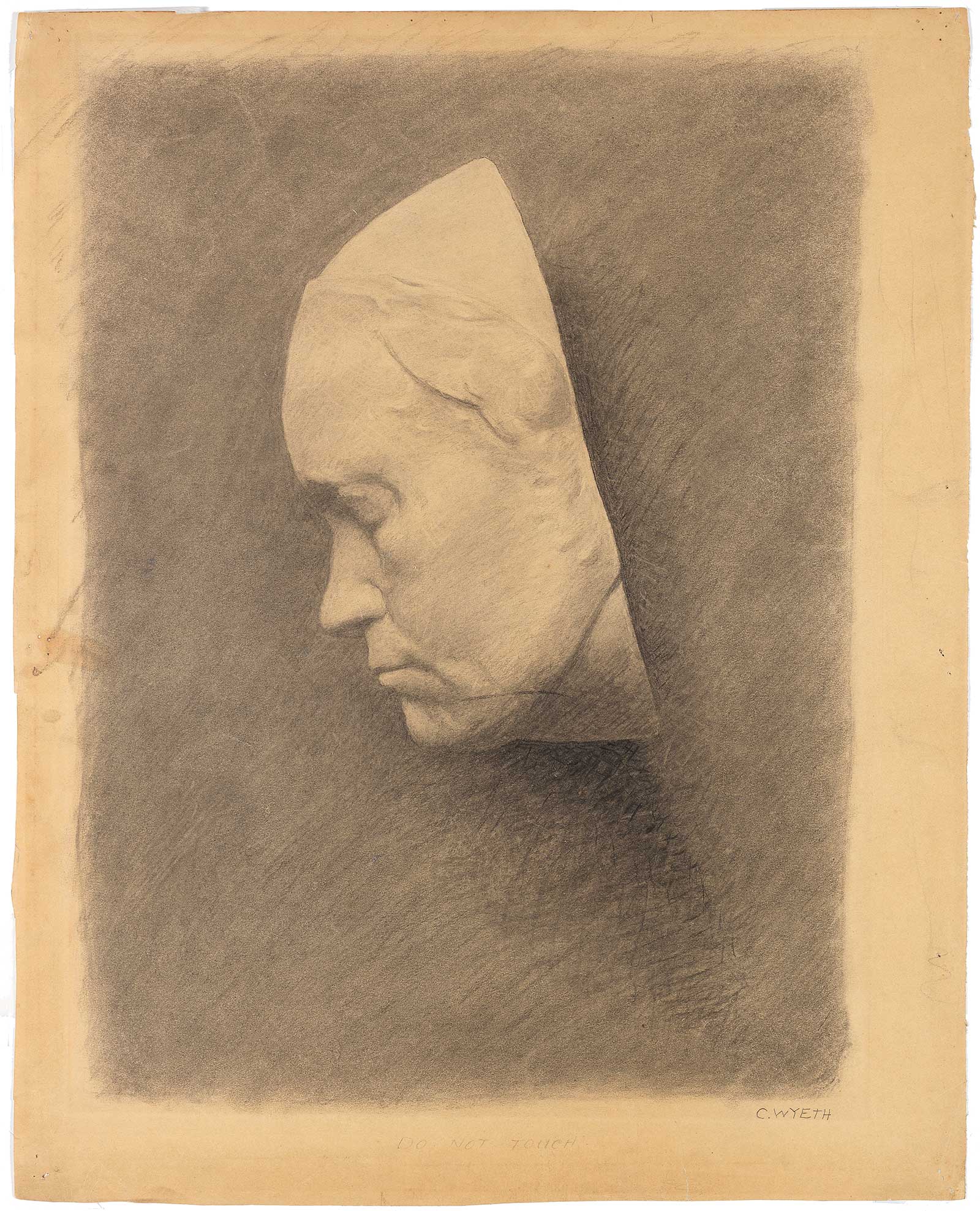 Carolyn Wyeth (1909-1994), Ludwig van Beethoven, ca. 1925. Pencil on paper. Brandywine River Museum of Art, Purchased with Museum funds, 2010.
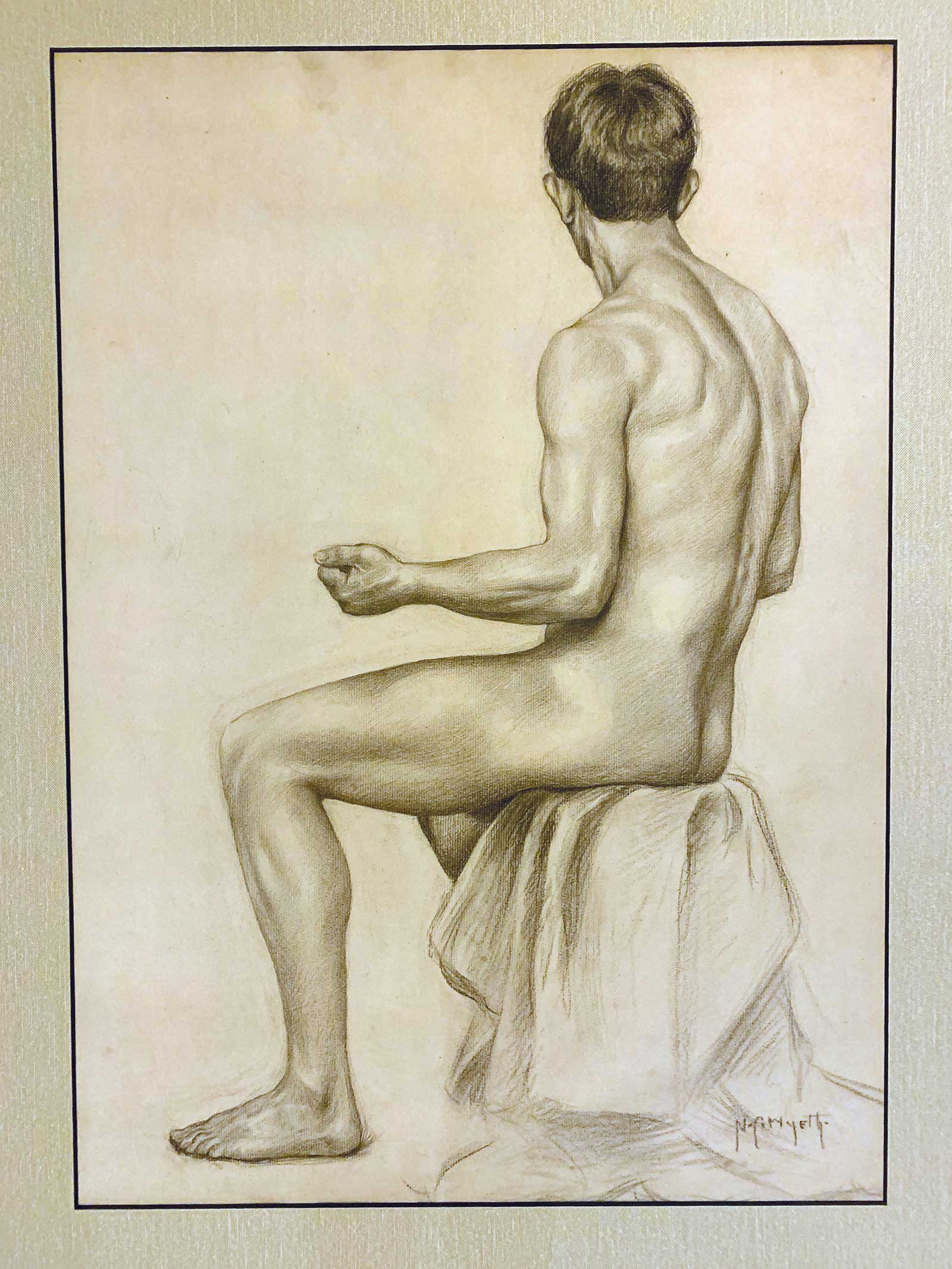 N.C. Wyeth (1882-1945), Untitled (seated male nude), ca. 1900. Charcoal on paper. Collection of Colquitt County Arts Center, Frank McCall Jr. Permanent Collection, SUPP2000.1475.
Another highlight is Carolyn’s Ludwig van Beethoven, which was drawn after studying a plaster cast. “Carolyn and her brother Andy studied exclusively with their father, N.C., in his studio behind the house in Chadds Ford, Pennsylvania. Their sister, Henriette, also an artist, studied with N.C. and later at the Pennsylvania Academy of Fine Arts. As part of their training, the Wyeth children were compelled to draw from plaster models,” writes Victoria. “Carolyn, whose work outside the classroom was free and imaginative, found the drawing exercises annoying. Jamie observed that Carolyn’s sketch of the mask of Beethoven. ‘…is just beautifully done…But it bears no relation to her other work. It is like a different hand.’ When Jamie asked his Aunt Henriette about that, she said, ‘Pa just imposed on Carolyn, ‘You WILL draw this as it is.’ And she did finally…I think she handled charcoal better than almost anyone I know.” —
Powered by Froala Editor