In 1862, the American-born painter James McNeill Whistler (1834-1903) painted The White Girl and submitted it to the Royal Academy of Arts summer exhibition in London. The subject was his partner and model, Joanna Hiffernan (1839-1886), a striking, red-haired Irish girl. Whistler painted her in a simple white cambric dress she might have worn in the privacy of her home, her pose relaxed, her hair un-coiffed and standing in front of a white-curtained window.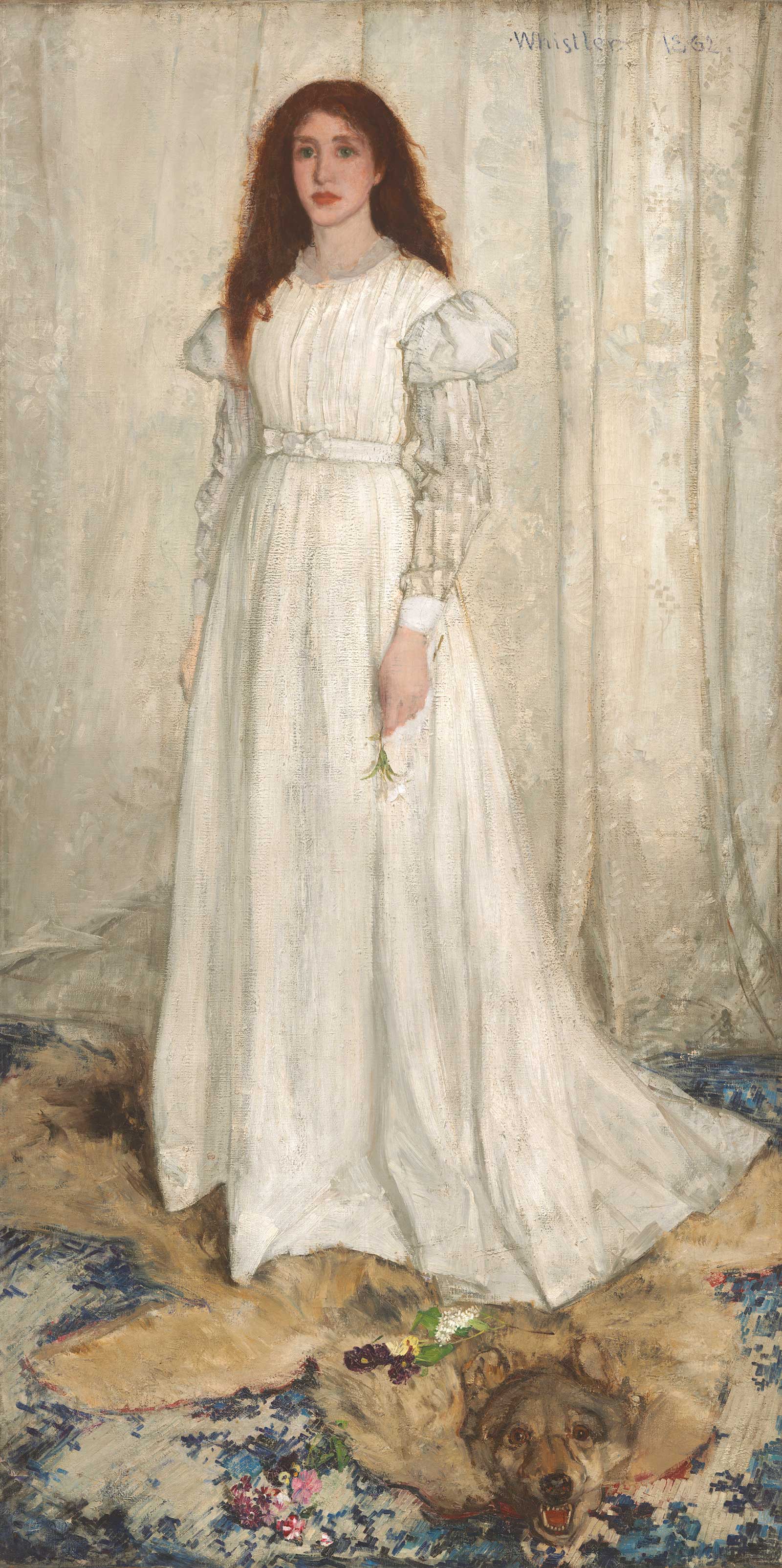 James McNeill Whistler (1834-1903), Symphony in White, No. 1: The White Girl, 1861-63, 1872. Oil on canvas, 837⁄8 x 42½ in. National Gallery of Art, Washington, DC, Harris Whittemore Collection.
Hiffernan wrote to a friend of Whistler’s family, “…the W[h]ite Girl has made great sensation—for and against. Some stupid painters don’t understand it at all while Millais for instance thinks it speandind, [sic] more like Titian and those old swells than anything he [h]as seen—but Jim says that for all that, praps [sic] the old duffers may refuse it altogether.”
Years later, Whistler recounted going to the Royal Academy to see his painting. There were more than a thousand paintings in the summer exhibition, hung floor to ceiling in an overwhelming display. He visited on Varnishing Day, the day when, originally, artists put the final touches on their paintings. He wrote, “I went on Varnishing Day to see where they had put her. She was not in the first room, nor the second, nor the third—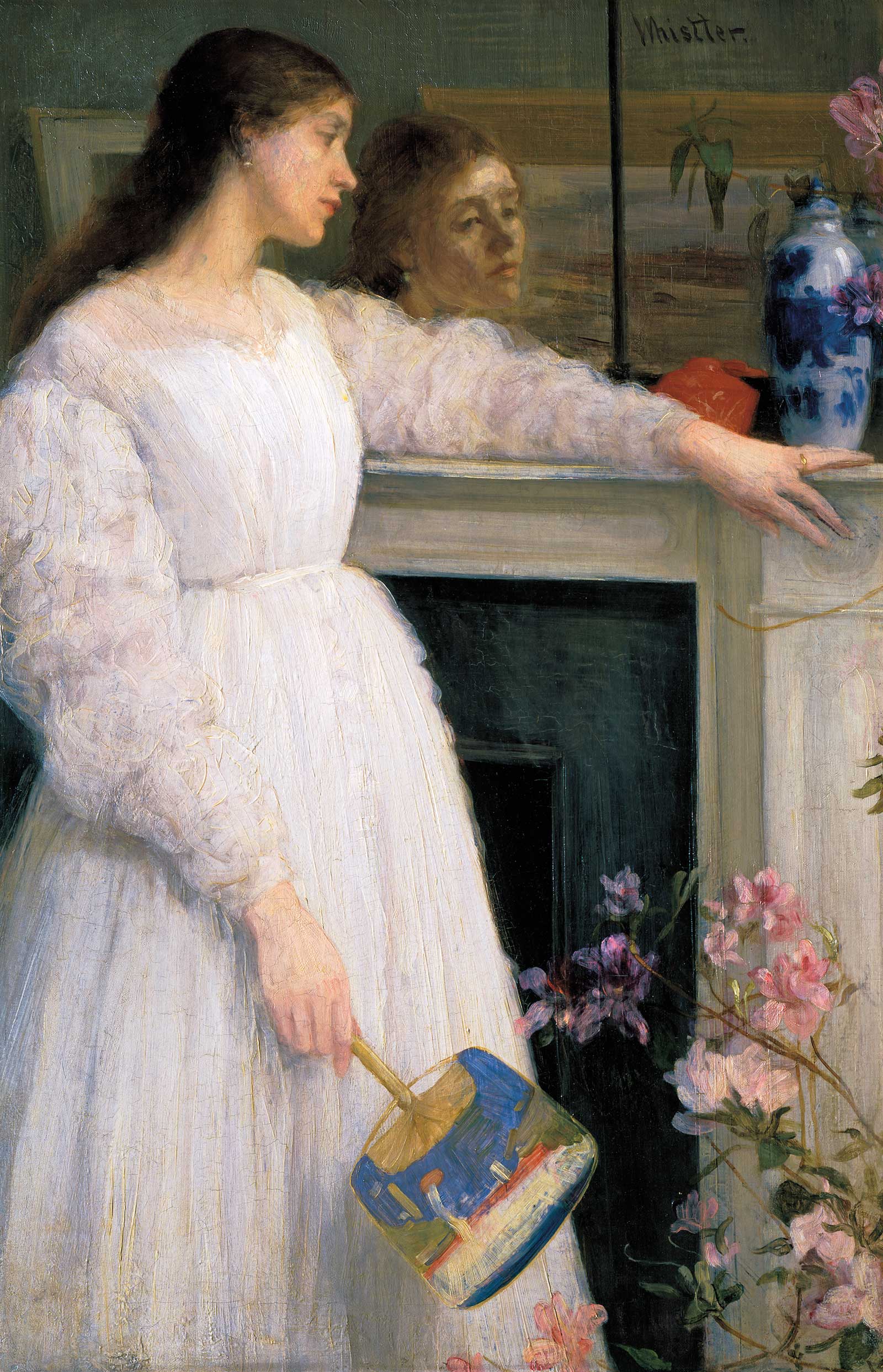 James McNeill Whistler (1834-1903), Symphony in White, No. 2: The Little White Girl, 1864. Oil on canvas, 301⁄8 x 201⁄8 in. Tate, London, Bequeathed by Arthur Studd, 1919. © Tate, London 2017.
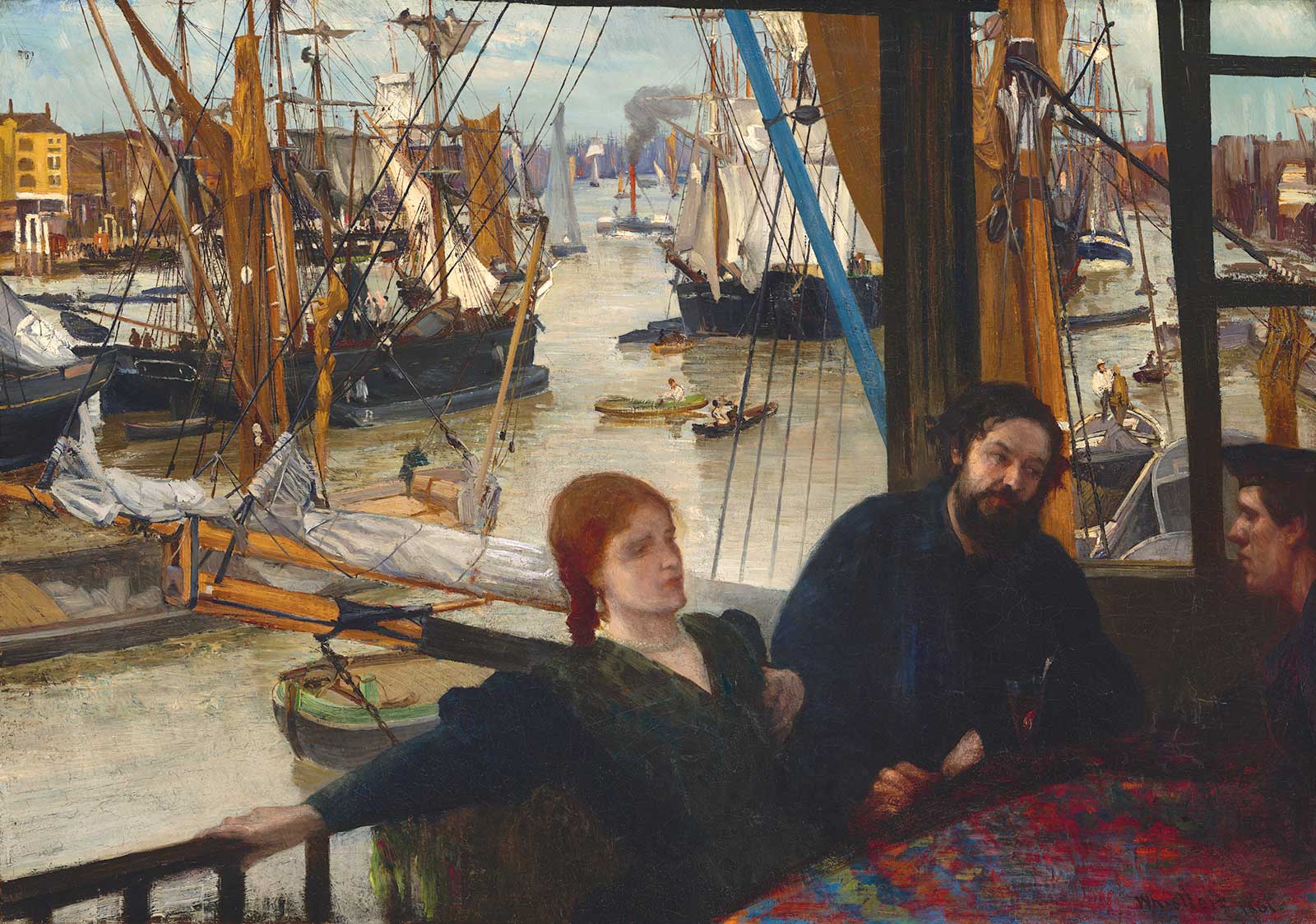 James McNeill Whistler (1834-1903), Wapping, 1860-1864. Oil on canvas, 283/8 x 401⁄16 in. National Gallery of Art, Washington, D.C., John Hay Whitney Collection.
I felt at little anxious—but I wandered on, and on, through room after room, and when I came to the last of themI knew she was rejected! Still, I thought I might have missed her, somewhere in the crowd of pictures; so I went all over them again, growing positively sick. And then I went downstairs and poked around until I found her leaning against a wall…and I knew that she was beautiful and was consoled.”
The “old duffers” had rejected the painting undoubtedly because it didn’t tell a story—a Victorian expectation—and the model wasn’t suitably put together for public presentation. In 1863 the painting was rejected at the Paris Salon but was shown in the Salon des Refusés.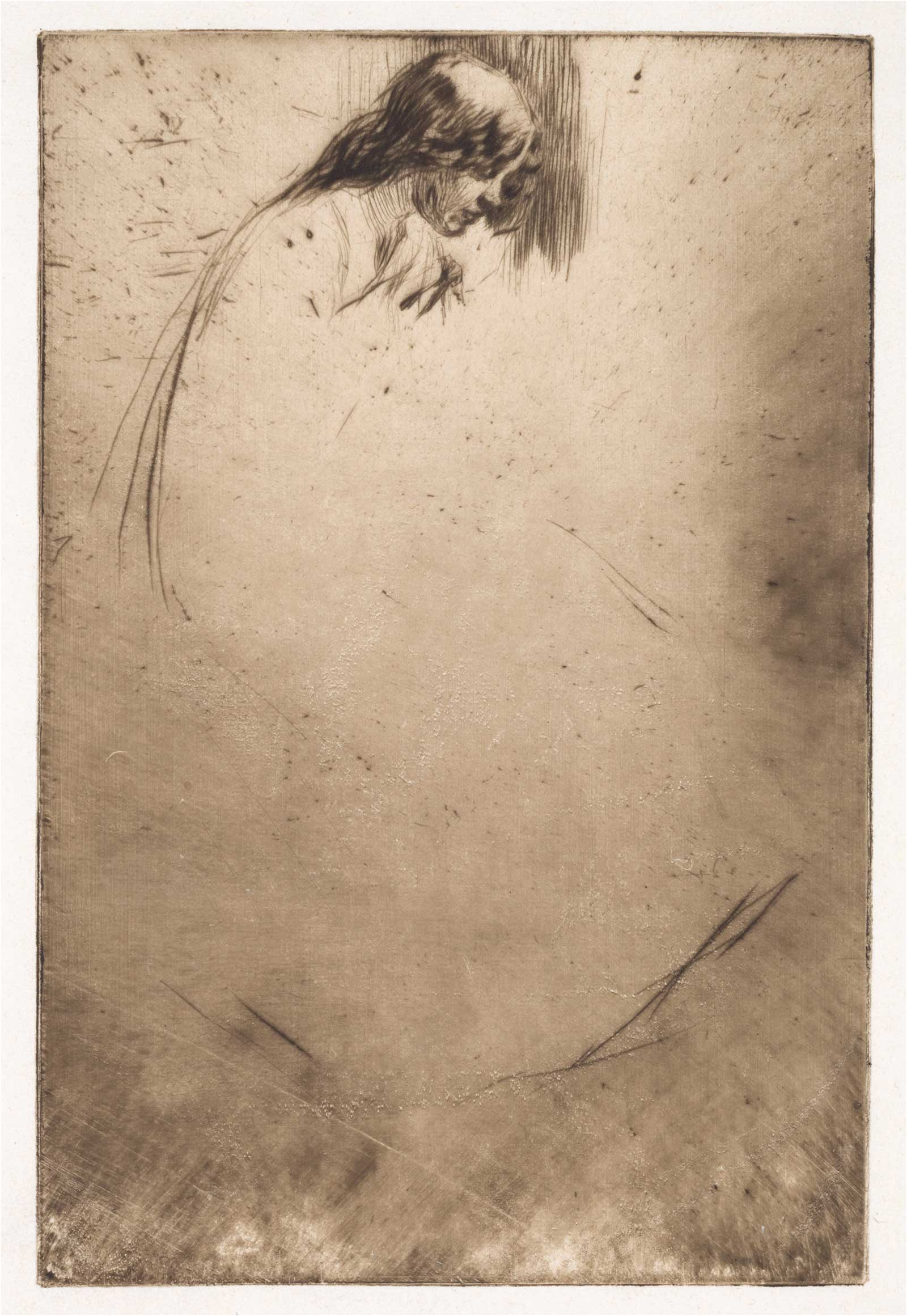 James McNeill Whistler (1834-1903), Jo’s Bent Head, 1861. Drypoint on cream laid paper with IV countermark, 9 x 6 in. (plate). Collection of the University of Michigan Museum of Art, Ann Arbor, Bequest of Margaret Watson Parker, 1954/1.350.
In 1864 his painting Wapping was shown in the 96th Exhibition of the Royal Academy. He had worked on it for several years. It is a scene in a pub on the waterfront with extraordinary detail in the ships and rigging. A red-haired woman (Hiffernan) sits at a table on the balcony of the pub. Whistler wrote to his friend, the French artist Henri Fantin-Latour, “She has the most beautiful hair that you have ever seen! A red not golden but copper—as Venetian as a dream!—skin golden white or yellow if you will—and with the wonderful expression…an air of saying to her sailor ‘That’s very well my friend! I have seen others!’ you know she is winking and laughing at him!..she…looks supremely whorelike.”
Both paintings now reside at the National Gallery of Art in Washington D.C., the earlier painting now titled, Symphony in White, No. 1: The White Girl. Both are also in the museum’s exhibition, The Woman in White: Joanna Hiffernan and James McNeill Whistler, opening July 3 and continuing through October 10. The exhibition is a collaboration between the National Gallery and the Royal Academy of Arts in London. It was curated by Margaret F. MacDonald, professor of art history, University of Glasgow, in collaboration with Ann Dumas, curator, Royal Academy of Arts, and consulting curator of European art, Museum of Fine Arts, Houston, and Charles Brock, associate curator, department of American and British paintings, National Gallery of Art.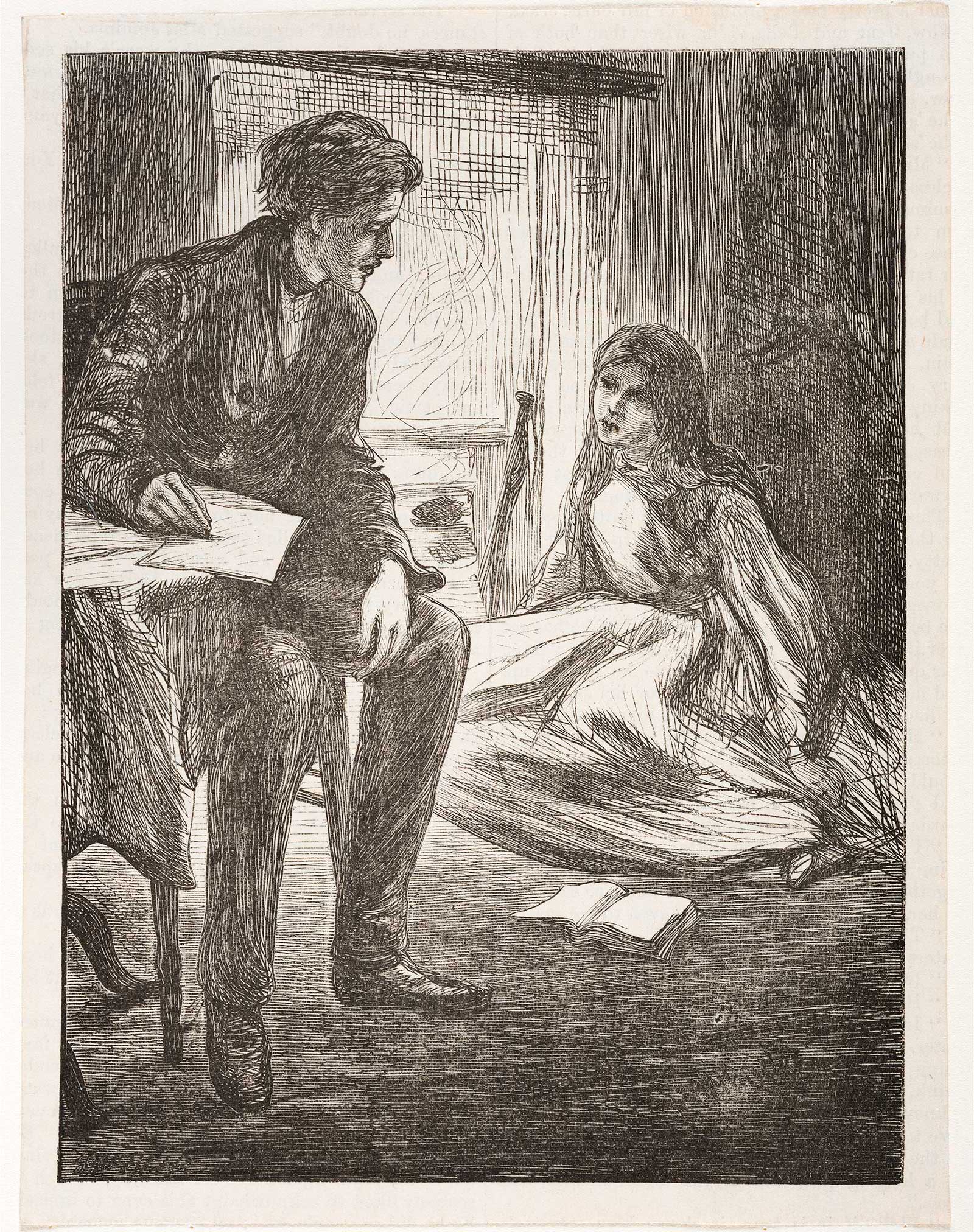 James McNeill Whistler (1834-1902), engraved by the Dalziel Brothers Kenneth and Lena Graeme in “The Trial Sermon,” 1862. Wood engraving, 6 x 47⁄16 in. Image, The Syndics of the Fitzwilliam Museum, University of Cambridge. © The Fitzwilliam Museum, Cambridge.
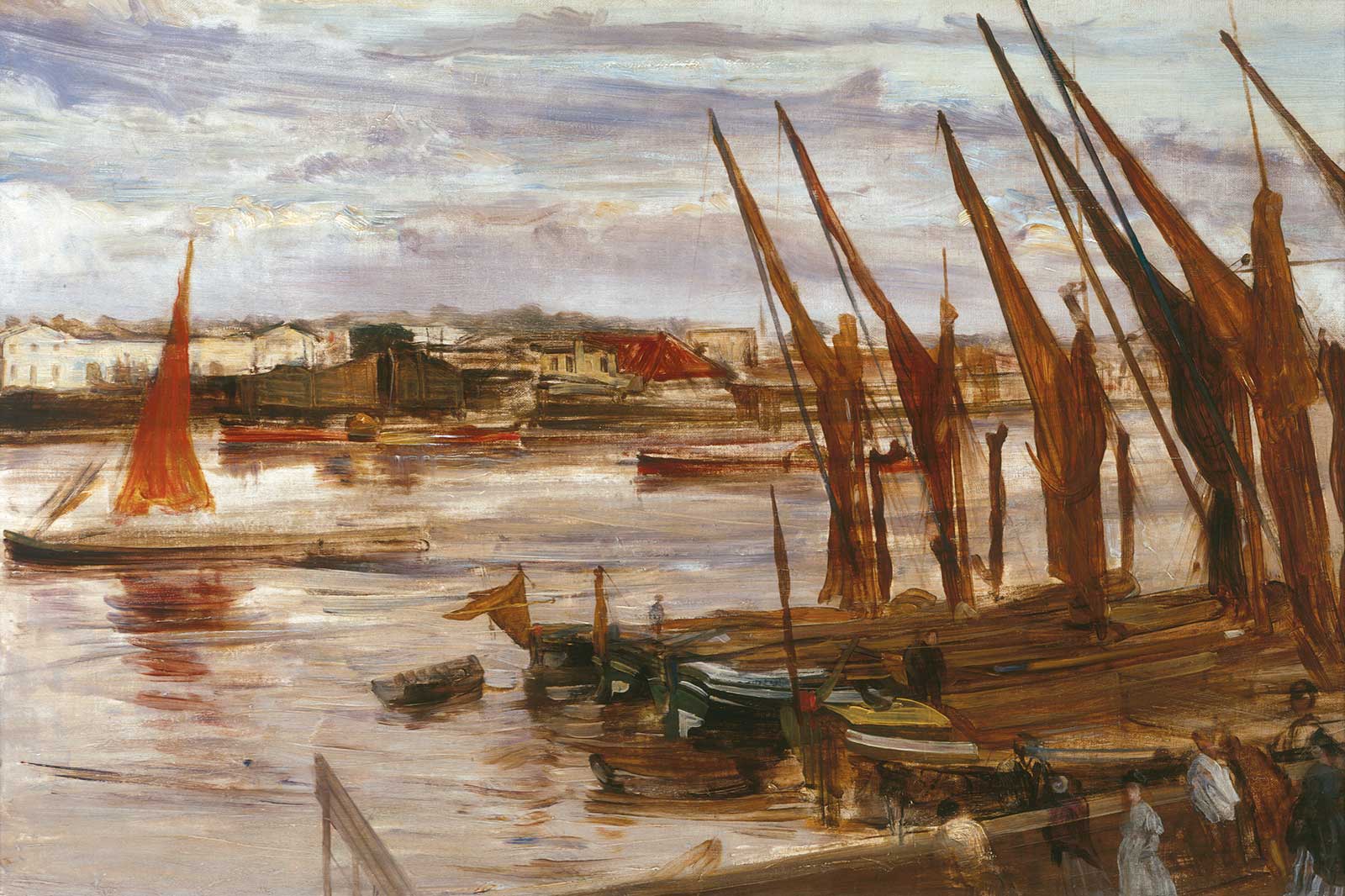 James McNeill Whistler (1834-1903), Battersea Reach, 1860/1863. Oil on canvas, 20 x 301⁄16 in. National Gallery of Art, Washington, D.C., Corcoran Collection. Bequest of James Parmelee.
The National Gallery’s Symphony in White, No. 1 joins Whistler’s second and third Symphony in White paintings, for the first time in the United States. The exhibitions 60 works include paintings, drawings and prints, “Bringing together nearly every known depiction of Hiffernan, as well as relevant documents and letters, this exhibition explores who Hiffernan was, her partnership with Whistler, and her role in the creative process” according to the gallery.
Kaywin Feldman, director of the National Gallery, says, “This is the first exhibition to delve deeply into how these exquisite depictions of Joanna Hiffernan were made, what they mean, who Hiffernan was, as well as the broader influence and resonance of Hiffernan’s collaboration with Whistler for Victorian culture in the late 19th century.”
Hiffernan entered Whistler’s sphere in 1860, becoming his primary model, managing his studio and financial affairs. Whistler had an affair while living with Hiffernan that resulted in the birth of a son. Hiffernan and her sister raised the boy.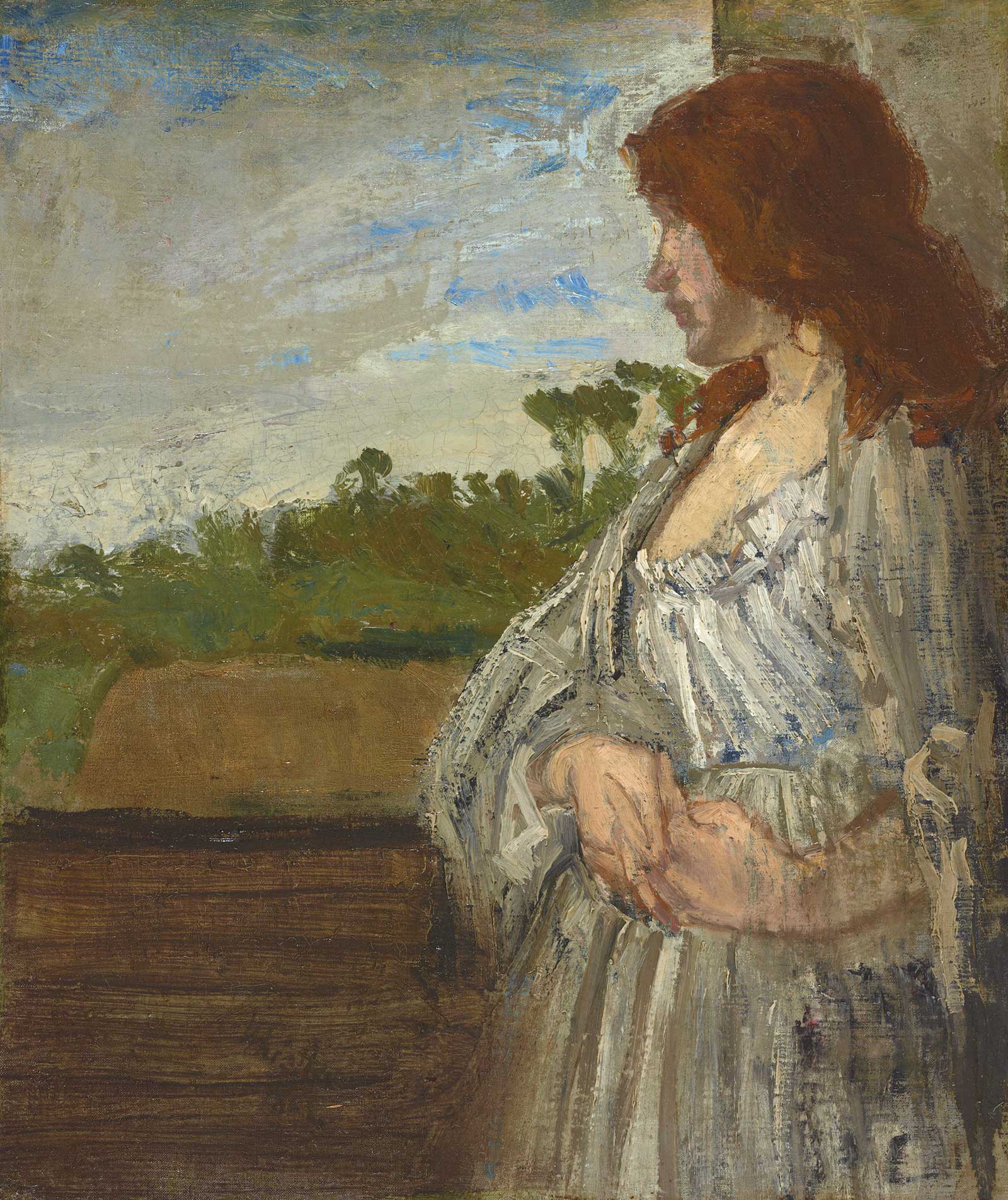 James McNeill Whistler (1834-1903), A White Note, 1862. Oil on canvas, 14½ x 12½ in. Framed: 25¾ x 235⁄8 x 23⁄8 in. The Lunder Collection, Colby College Museum of Art, Waterville, ME, 021.2011.
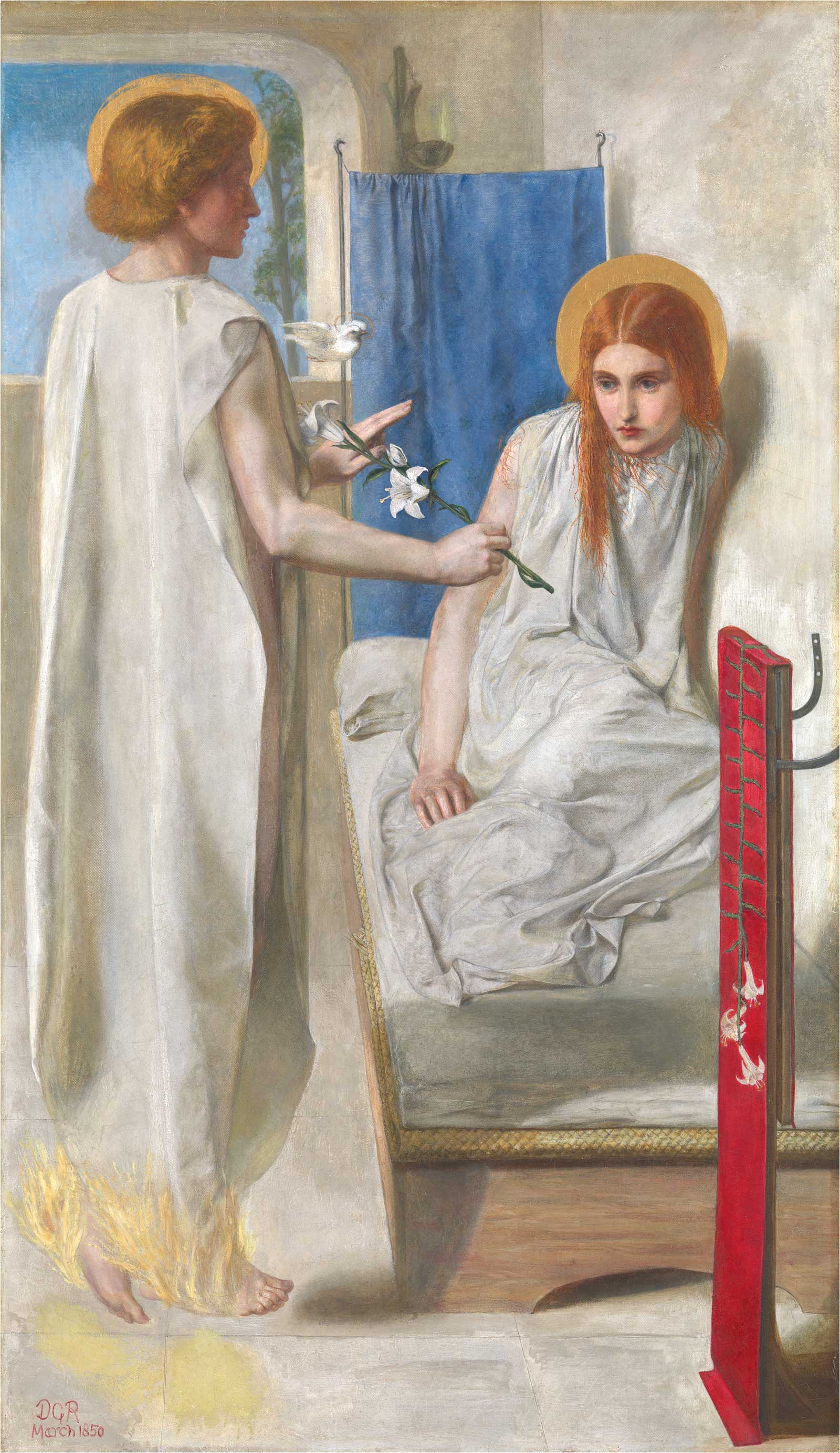 Dante Gabriel Rossetti (1828-1882), Ecce Ancilla Domini! (The Annunciation), 1849-1850. Oil on canvas, 29 x 16 ½ in. Tate, London. Purchased 1886. © Tate, London 2017.
In Charles Brock’s essay for the catalog accompanying the exhibition he writes, “The many paintings, drawings and prints of Hiffernan—none more so than The White Girl—proclaimed her importance while at the same time neglecting her personhood: she often went unrecognized in deference to the more impersonal, idealized claims of aestheticism and ‘art for art’s sake.’ Hiffernan’s personal and artistic status, both individually and in relation to Whistler, although self-evident in the many works of art in which she appears, nevertheless remained uncertain and was rarely forthrightly acknowledged. In an all-too-familiar story for creative women, Whistler became famous while Hiffernan was largely forgotten.”
In addition to his paintings, Whistler was a printmaker. Among the depictions of Hiffernan is his drypoint, Jo’s Bent Head, 1861.
In his essay “The Red Rag” in a collection of his critical reviews titled The Gentle Art of Making Enemies, Whistler wrote, “Art should be independent of all clap-trap—should stand alone, and appeal to the artistic sense of eye or ear, without confounding this with emotions entirely foreign to it, as devotion, pity, love, patriotism, and the like. All these have no kind of concern with it; and that is why I insist on calling my works ‘arrangements’ and ‘harmonies.’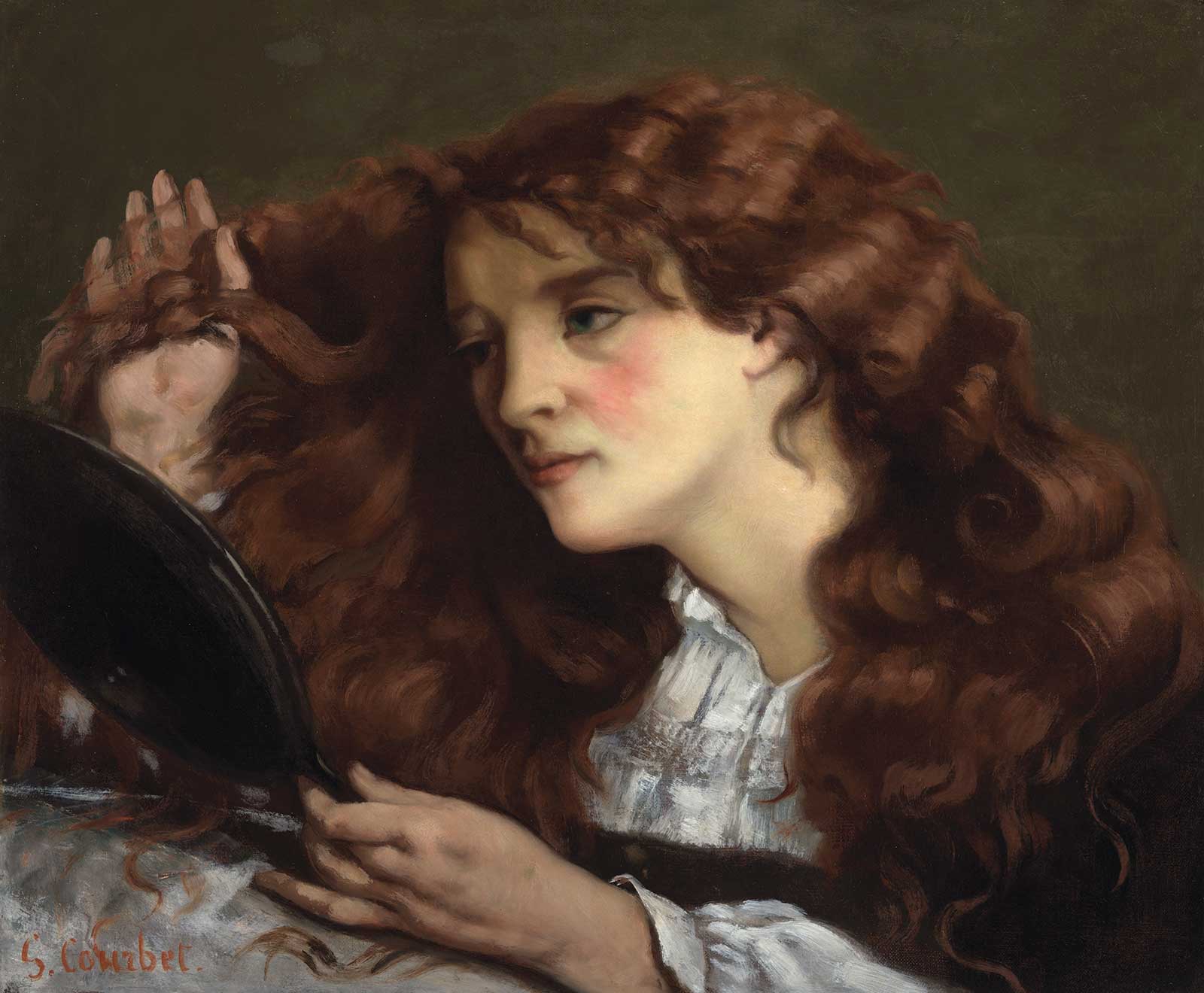 Gustave Courbet (1819-1877), Jo, the Irish Woman, ca. 1866/68. Oil on canvas, 213⁄8 x 25 in. The Nelson-Atkins Museum of Art, Kansas City, MO. (Purchase: William Rockhill Nelson Trust).
“Take the picture of my mother, exhibited at the Royal Academy as an ‘Arrangement in Grey and Black.’ Now that is what it is. To me it is interesting as a picture of my mother; but what can or ought the public to care about the identity of the portrait?”
Margaret Macdonald writes, “Because it provided no such clues, ‘The White Girl’ left viewers to create their own scenario, as they do to this day. An abstract concept, the emphasis on color alone, was totally alien at that time. With its elusive exploration of realism and aestheticism, and the allure of its enigmatic subject, ‘The White Girl’ heralded a modernist view of art and proved a lasting inspiration for artists in Europe and the United States.” —
July 3-October 10
The National Gallery of Art
Constitution Avenue NW, Washington, D.C. 20565
t: (202) 737-4215, www.nga.gov
Powered by Froala Editor