
In Herman Melville’s Moby Dick, Ishmael, who never lacks for an opinion, comments, “…For all these reasons, then, any way you may look at it, you must needs conclude that the great Leviathan is that one creature in the world which must remain unpainted to the last. True, one portrait may hit the mark much nearer than another, but none can hit it with any very considerable degree of exactness. So there is no earthly way of finding out precisely what the whale really looks like. And the only mode in which you can derive even a tolerable idea of his living contour, is by going a whaling yourself; but by so doing, you run no small risk of being eternally stove and sunk by him.”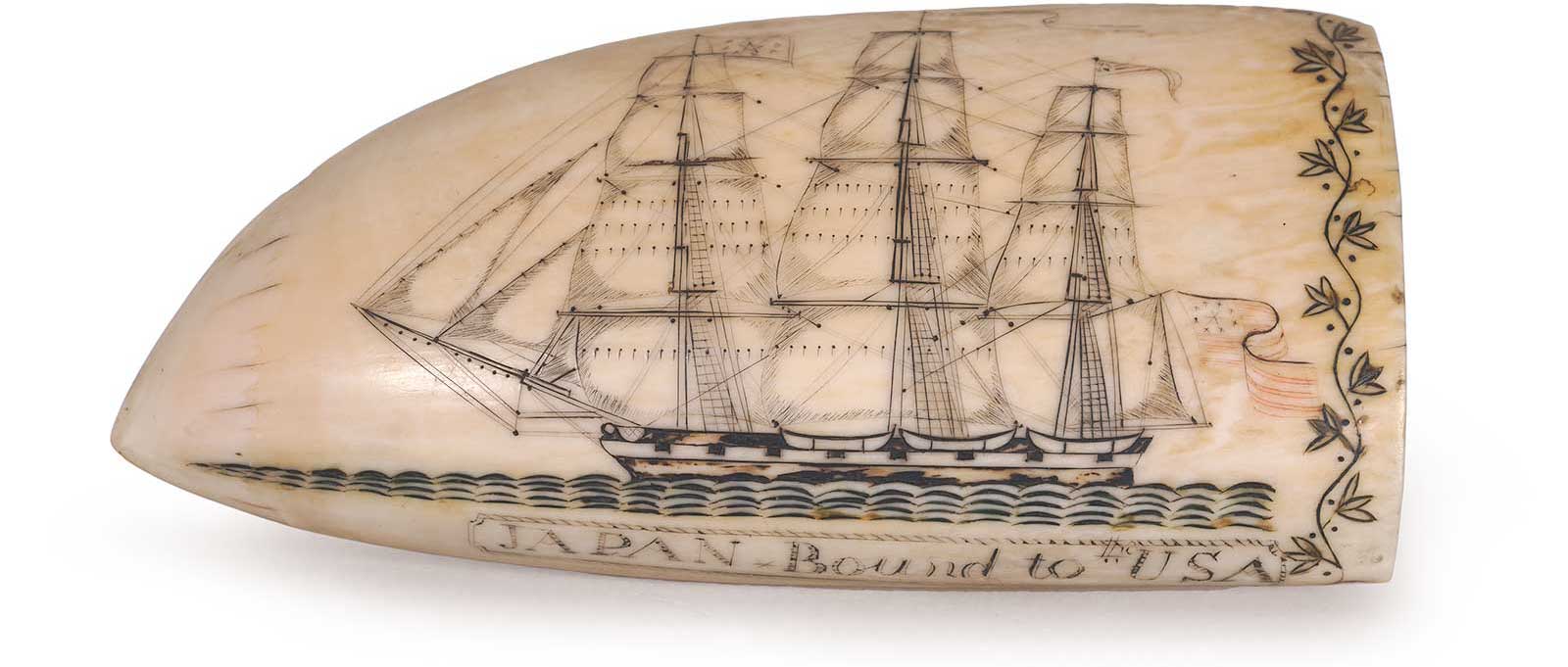 Attributed to Edward Burdett (1805-1833), Whaleship Japan of Nantucket Homeward Bound to the USA, ca. 1825-1829. Whale tooth, pigment, 5¾ in. Private collection.
Later he describes those who have actually gone a-whaling. “Throughout the Pacific, and also in Nantucket, and New Bedford, and Sag Harbor, you will come across lively sketches of whales and whaling-scenes, graven by the fishermen themselves on Sperm Whale-teeth, or ladies’ busks wrought out of the Right Whale-bone, and other like skrimshander articles, as the whalemen call the numerous little ingenious contrivances they elaborately carve out of the rough material, in their hours of ocean leisure. Some of them have little boxes of dentistical-looking implements, specially intended for the skrimshandering business. But, in general, they toil with their jack-knives alone; and, with that almost omnipotent tool of the sailor, they will turn you out anything you please, in the way of a mariner’s fancy.”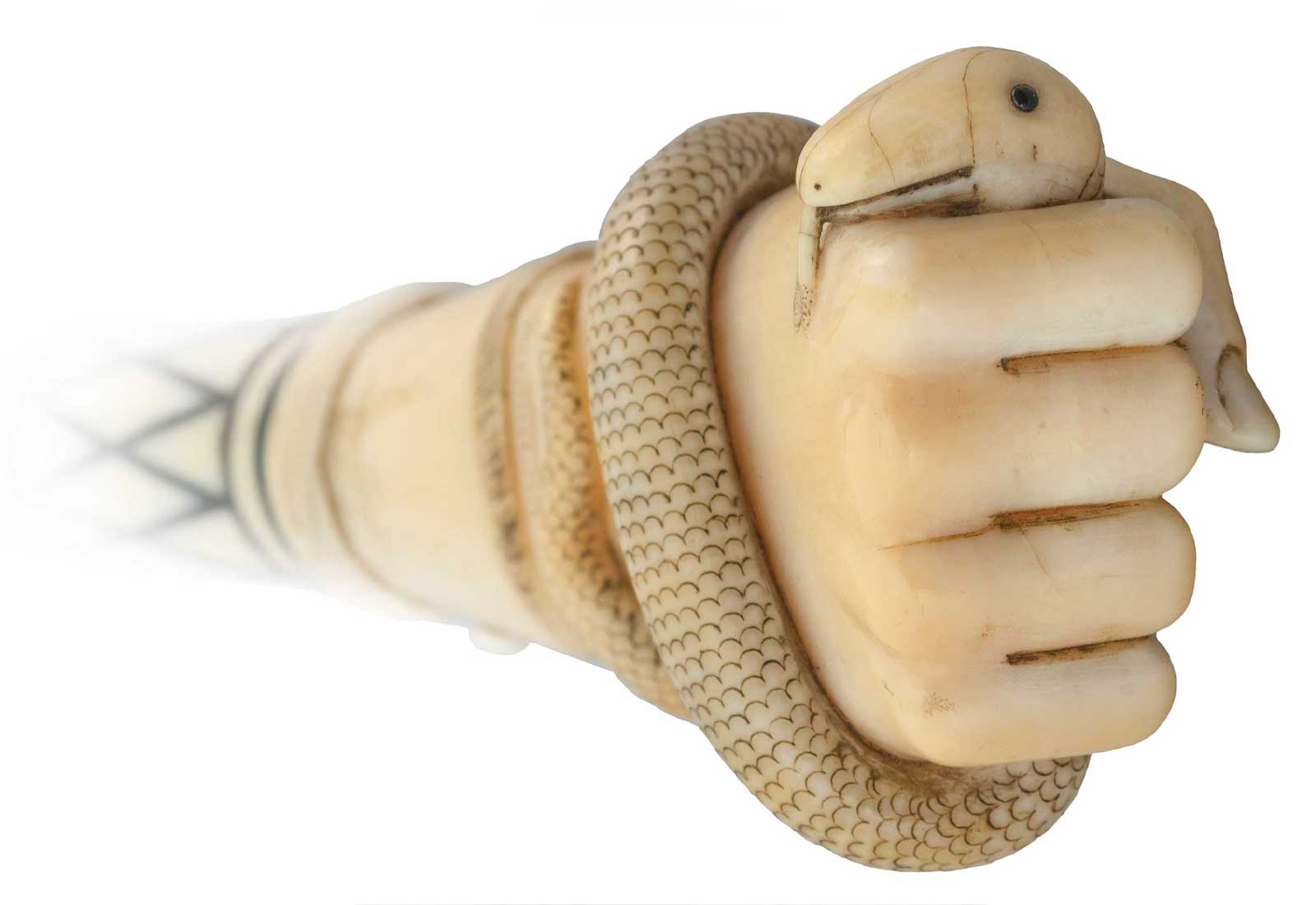 Cane with Fist Crushing Serpent. Whale ivory, inlaid silver and tortoiseshell. Private collection.
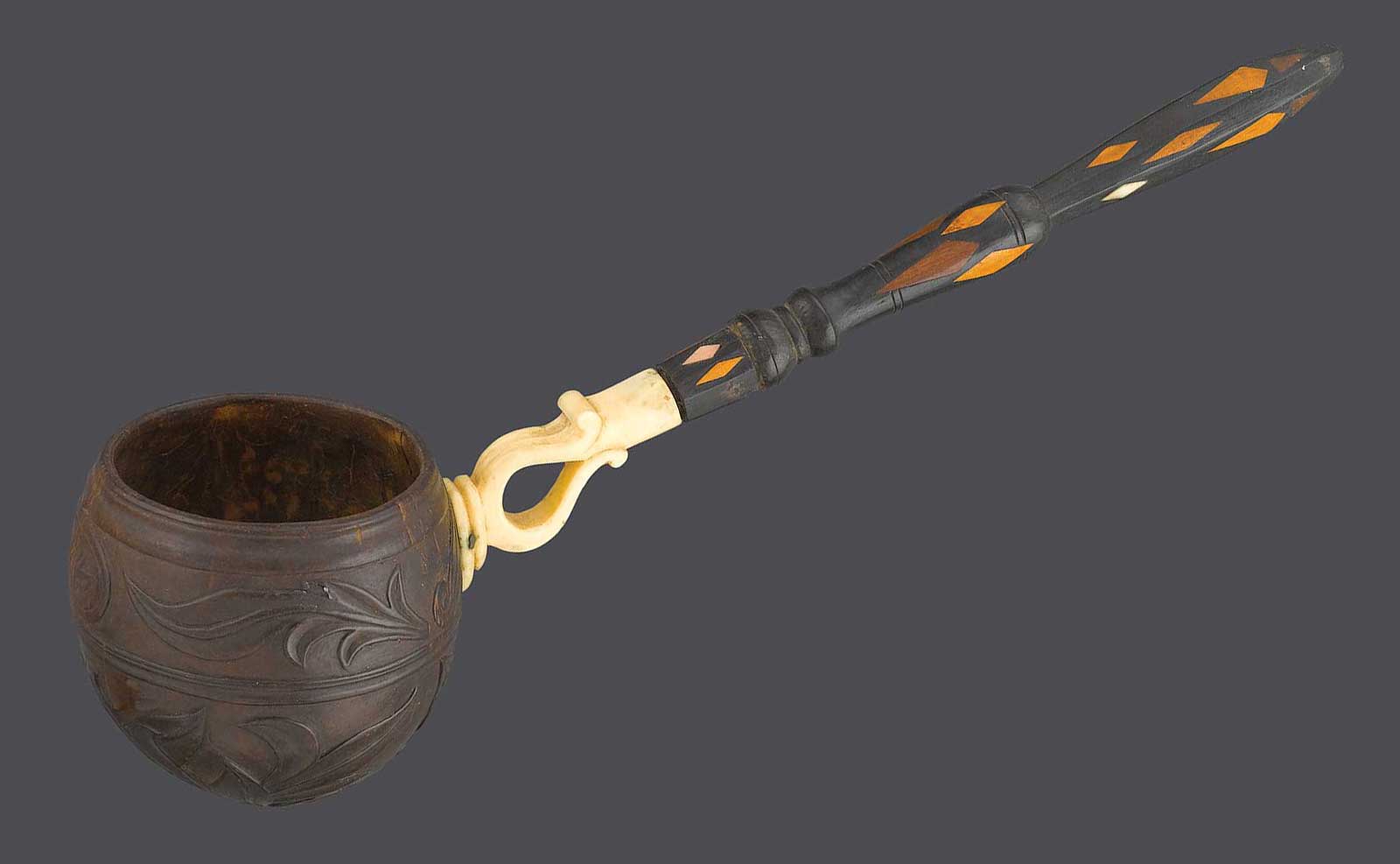 Dipper, ca. 1840. Coconut shell, whale ivory. Collection of the Nantucket Historical Association.
An exhibition, Scrimshaw: The Whaler’s Art, highlighting these “ingenious contrivances” is being shown at the Cahoon Museum of American Art in Cotuit, Massachusetts, through October 20. Curated by Dr. Alan Granby, author of the accompanying book, Wandering Whalemen and their Art, the exhibition “features more than 250 decorative and utilitarian objects including chisels, boxes, baskets, walking sticks, and implements for the kitchen such as pie crimpers and utensils, items for sewing including needlecases and yarn swifts as well as pictorial scenes of whales and whaling, portraits, and naval and patriotic images.”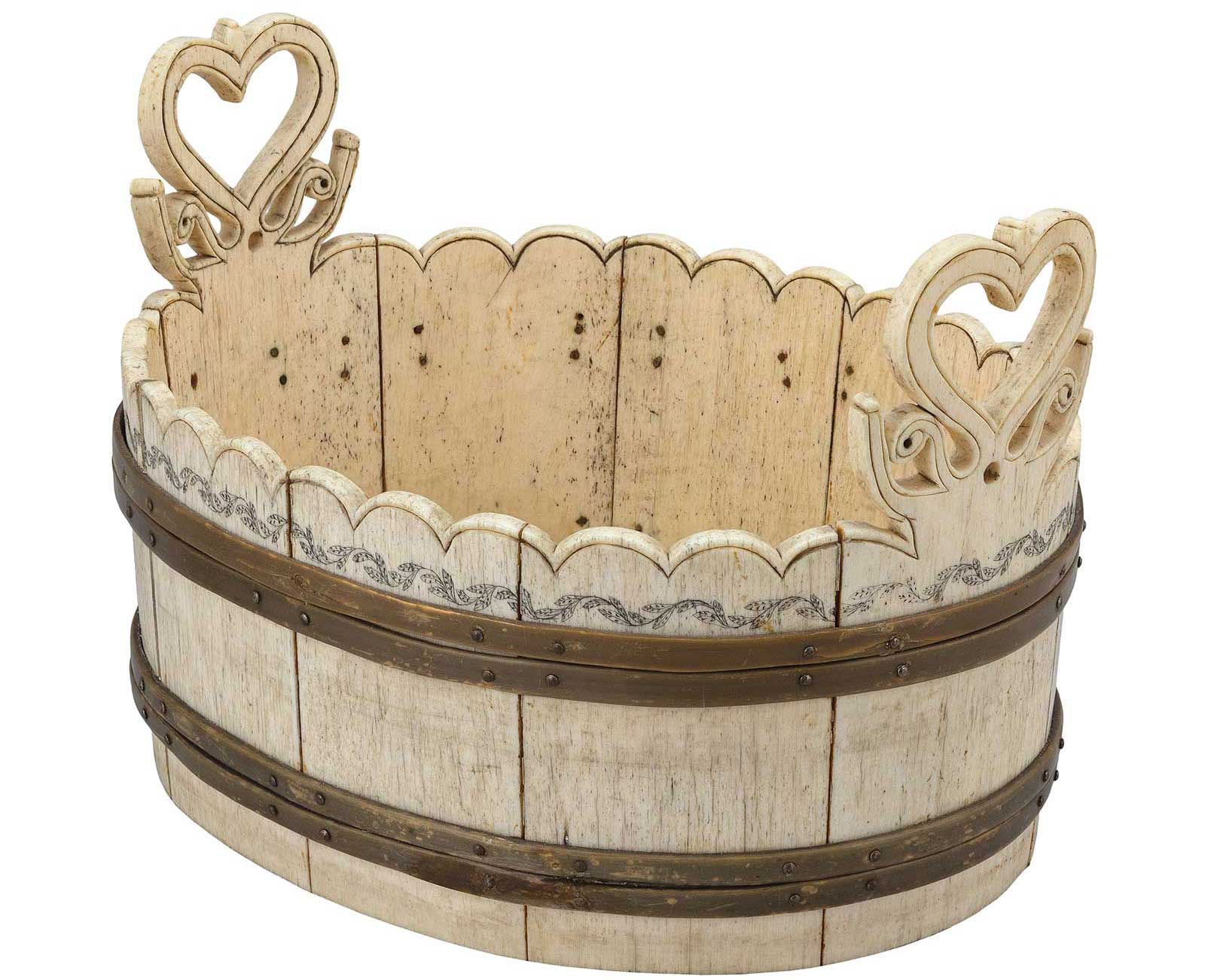 Round basket. Whale bone, wood, iron. Collection of New Bedford Whaling Museum
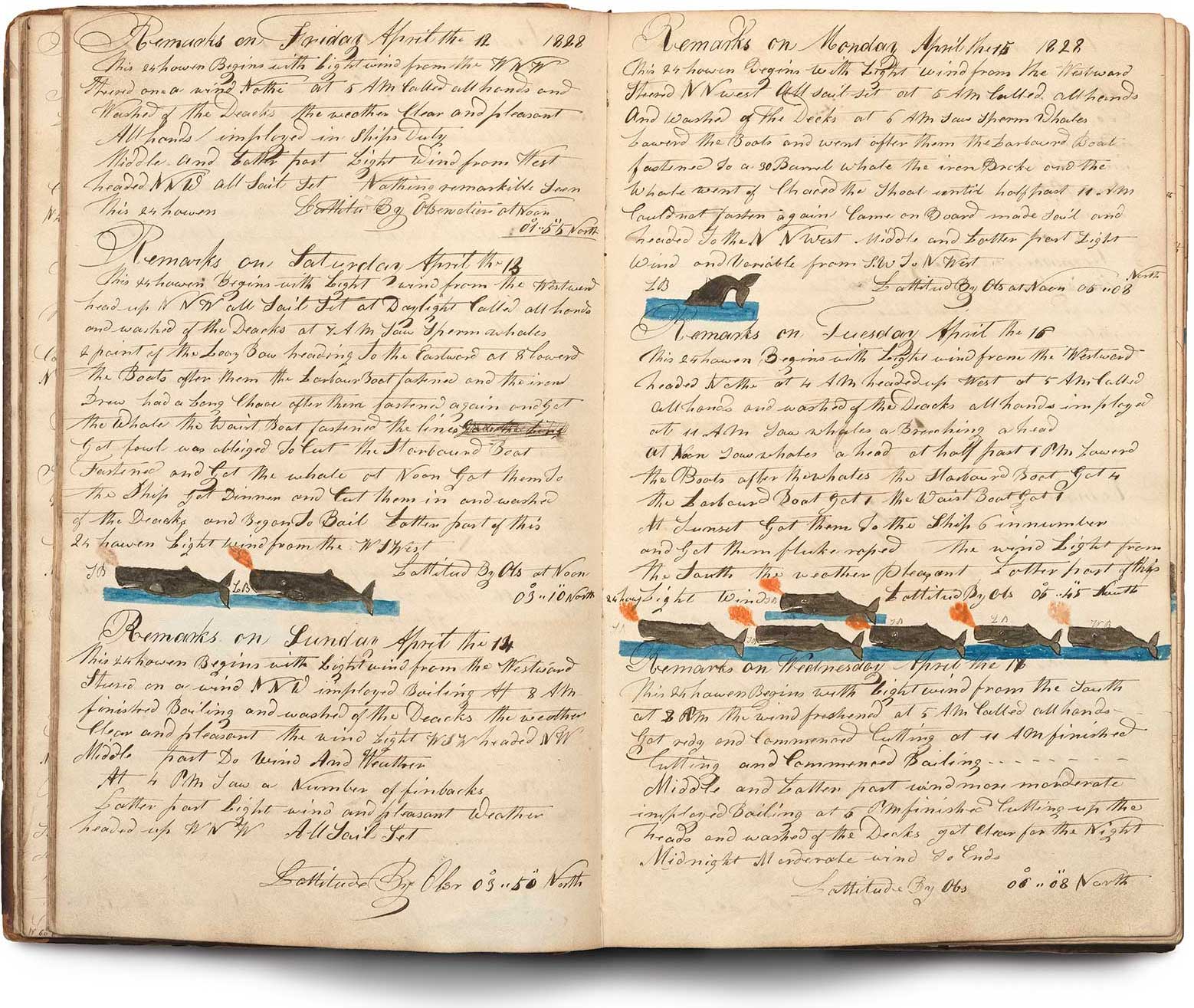 Journal of a Whaling Voyage of the Ship Rodman, 1827-1830. Private Collection.
The exhibition goes beyond the romance of whaling and reveals unexpected aspects of its history from native Wampanoag whalers, women whalers and the legend of a female pirate.
In his foreword to Wandering Whalemen and their Art, “A Feast of Scrimshaw Art,” Dr. Stuart M. Frank writes, “The authentic definition of scrimshaw is quite specific, and has more to do with the actual products used than the method or means of production: scrimshaw is the indigenous occupational shipboard pastime of whalemen in the 19th and early 20th century Age of Sail, using the hard byproducts of whaling—sperm whale ivory, walrus ivory, skeletal bone and baleen, often in combination with other ‘found’ materials—to produce practical, utilitarian, decorative, and ornamental objects for themselves and as gifts for folks back home. Scrimshandering was also occasionally practiced by the wives and children of the whaling captains with whom they sometimes went to sea, and was sometimes taken up by seamen in the navy and, less often, in the merchant carrying trades.”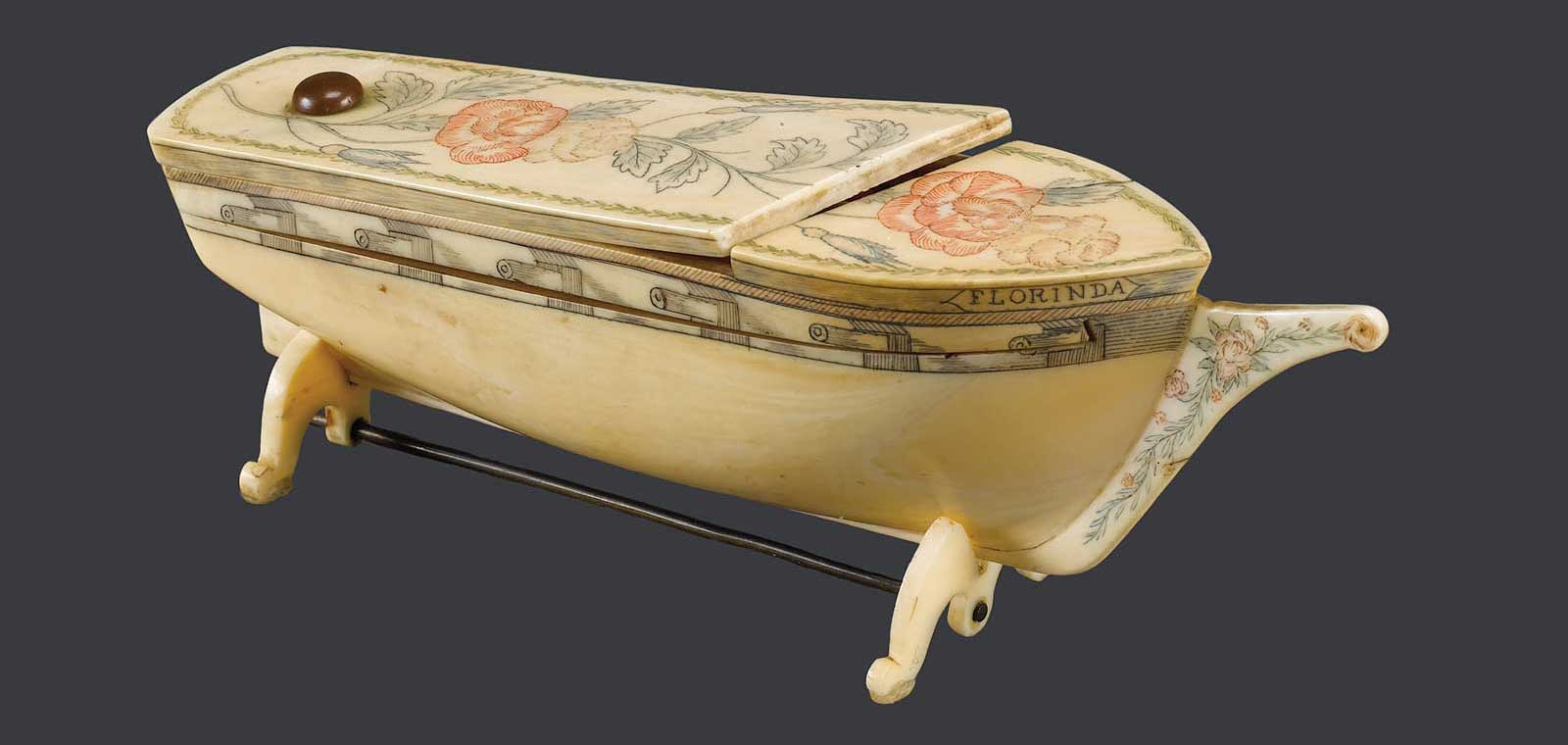 Manuel Silvia, Ship Hull Trinket Box. Whale ivory. Collection of the Nantucket Historical Association.
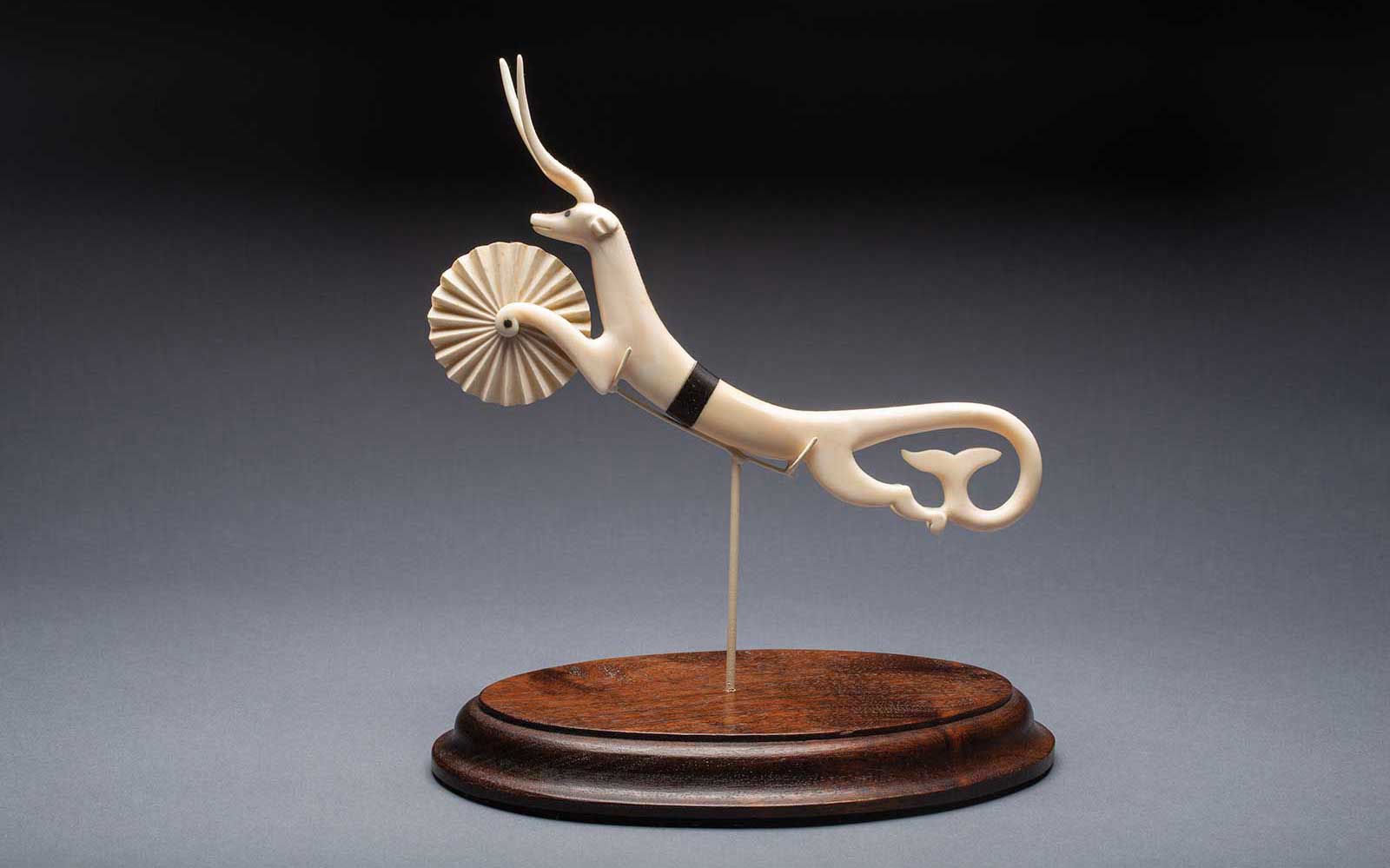 Running Dog in the style of Unicorn Crimper. Whale bone, baleen, 7 in. Private collection. Photo Credit: Jim Goodnough Photography.
The museum notes, “The whaling industry of the 19th century was spurred by the global demand for whale oil, which became increasingly necessary during the industrial revolution. Whales were hunted for oil, meat, and blubber; however, no whales were killed for their bones, teeth, or baleen. These byproducts were readily available to ordinary seamen to use as material for creating tools and decorative objects because they had no monetary value and would have otherwise been thrown into the sea.”
A highlight of the exhibition is a classic whale tooth engraved with a whaling vessel. The Nantucket scrimshander Edward Burdett (1805-1833) engraved the tooth with an image of the ship Japan on which he sailed between 1825 and 1829. It is the first time the piece has been seen publicly. In a monograph on Burdett’s work at the Kendall Whaling Museum in Sharon, Massachusetts, Dr. Frank writes, “When Edward Burdett first started engraving whale teeth as a young professional sailor not yet out of his teens, pictorial scrimshaw was a new art. There were no precedents to follow, and each step was, by definition, groundbreaking. As he went along, not only did his iconography and execution mature, with new variations, permutations, and complexities incorporated into the unvarying geometry of his ship-portraiture, but he also took the virtually unprecedented step of signing his name to his work, the first America known to have done so.”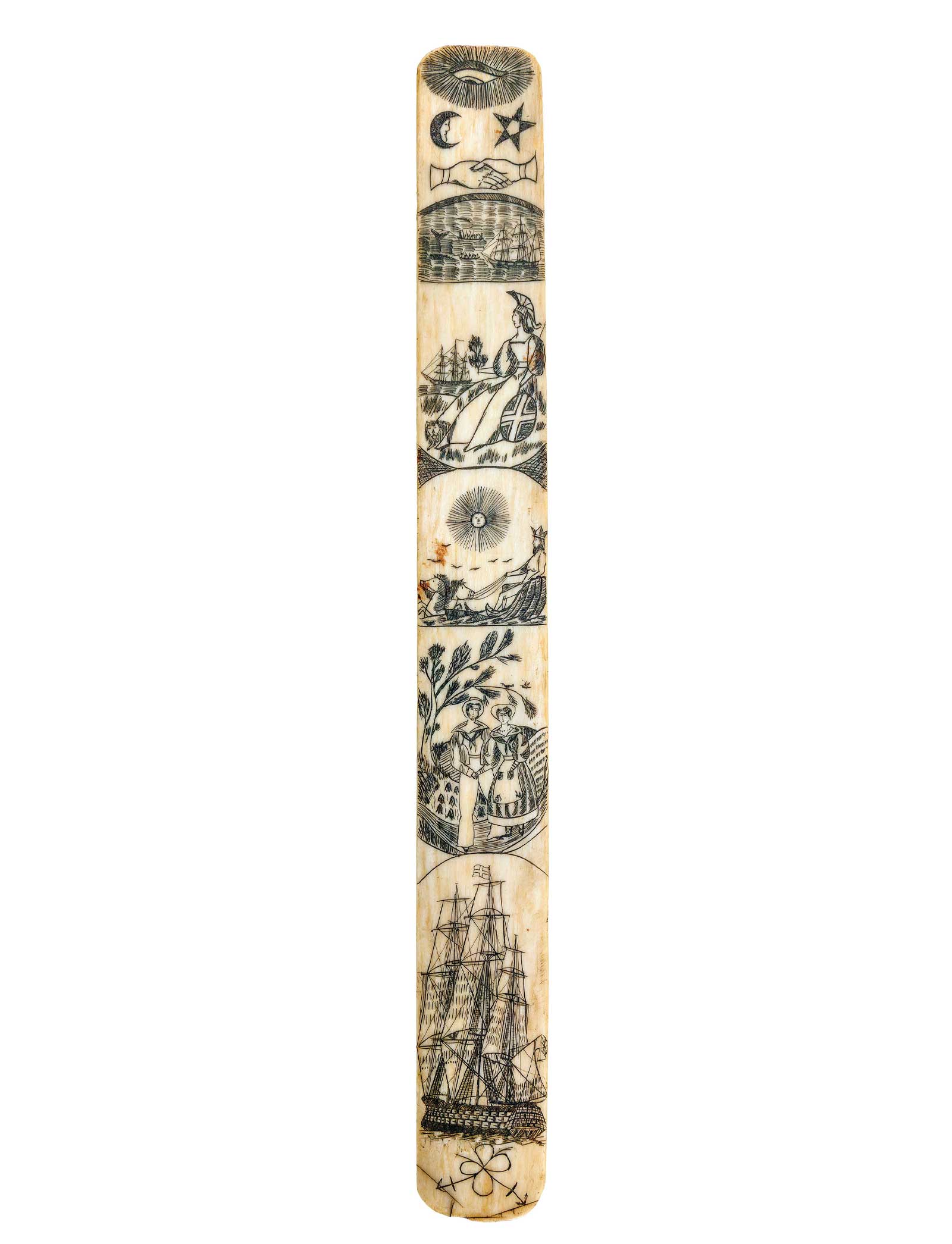 Wall pocket. Whale bone, 29 x 257⁄8 in. Private collection.
Another tooth was engraved by James Adolphus Bute aboard H.M Sloop Beagle and features scenes from Charles Darwin’s 1834 voyage. It depicts the Beagle laid on shore for repairs near the tip of South America.
Scrimshanders’ contrivances went beyond engraved whale’s teeth. They carved whale bone into utilitarian items such as pie crimpers used to seal the pie crust against the pan or the bottom crust before it went into the oven. A crimper with a dog’s head and a whale’s tail is included in the exhibition.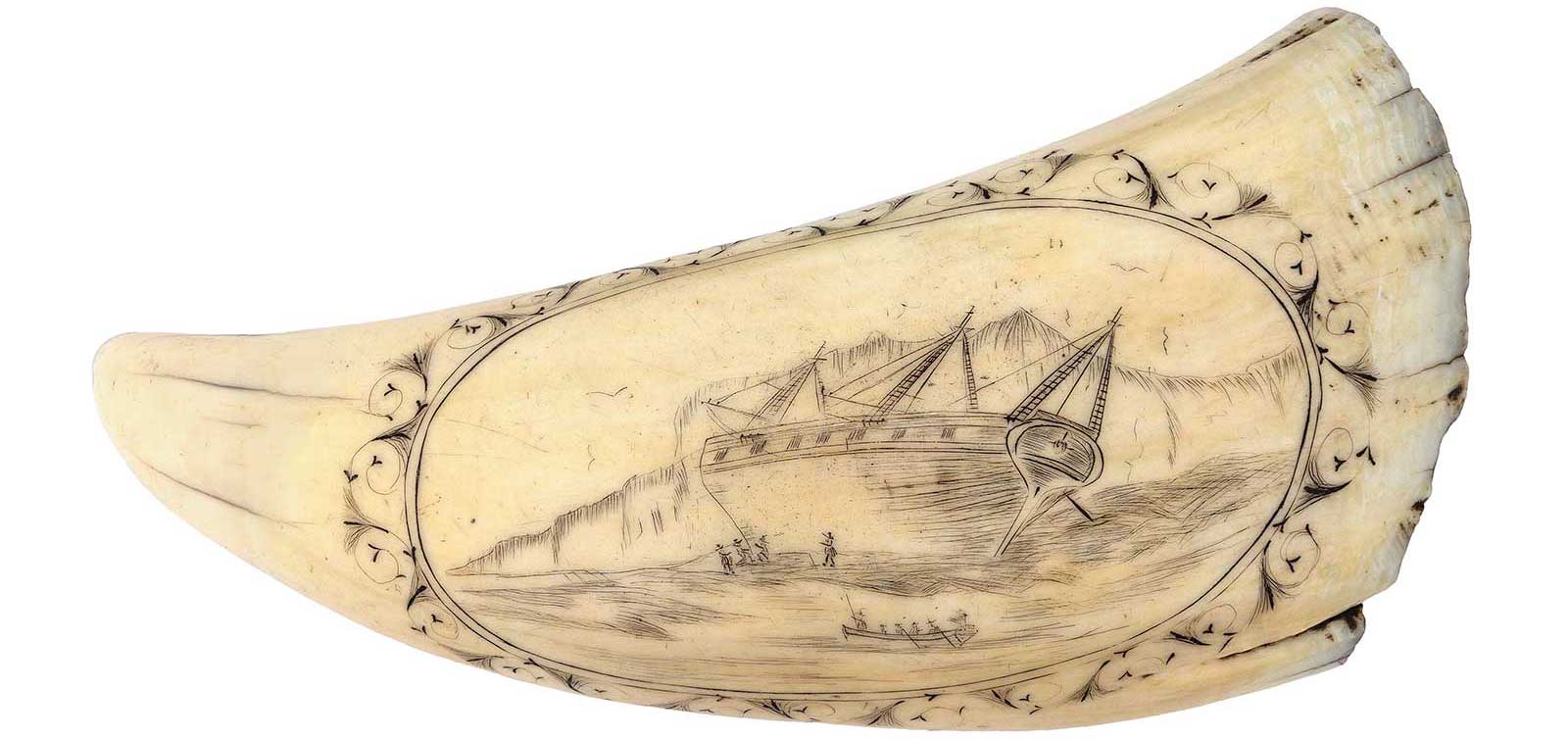 James Adolphus Bute, Darwin Expedition, ca. 1834. Whale tooth, pigment, 6½ x 3 in. Private collection.
A wall pocket measuring 29 by 25⅞ inches is one of the most complex items in the exhibition. It is described in Wandering Whalemen. “A wall pocket was meant to be wall-mounted and used to hold newspapers, letters, and periodicals. This pocket is composed of large slabs of panbone carved into extremely complex open-carved sections, all of which are joined with copper rivets and pins. Each corner of the pocket bears a single star with an acorn-shaped turned whale ivory finial at its center. Nine additional turned acorns are applied to the pocket sides and bottom edge. Other decorative shapes include additional stars, circles, and geometric shapes. The hanging section is hinged at the back and has a complex carved interlocking circle pattern.” Dr. Granby comments, “I hope that visitors will understand the significance that scrimshaw holds as not merely an interesting form of American folk art, but as the stand-alone art genre it truly is.” —
Powered by Froala Editor