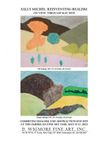
This exhibition of 30 paintings by Sally Michel, created between 1950 and 1985, aims to show how her art bridged the gap between representational and abstract painting, in a style that successfully refreshed and moved realism forward. Michel’s story cannot be told without bringing in her life partner, Milton Avery.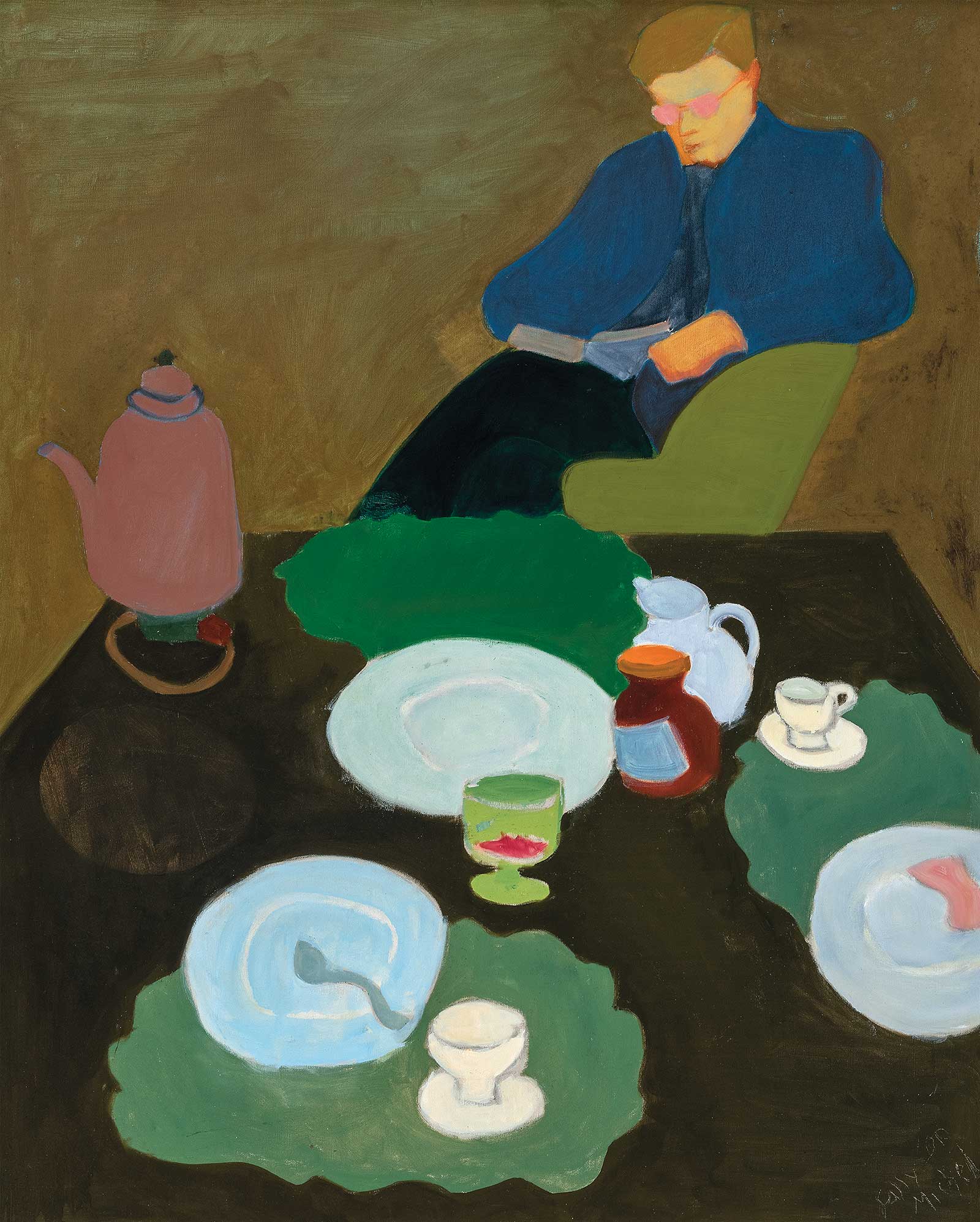 Sally Michel (1902-2003), After Dinner, 1970. Oil on canvas, 42 x 34 in., signed and dated lower right, titled verso.
Avery (1885-1965) and Michel (1902-2003) met painting in Gloucester, Massachusetts in 1924. They admired each other’s dedication to sketching all day. Married in 1926, Michel and Avery worked in New York as a unit until Avery’s death in 1965. To provide support, Michel worked as a freelance illustrator, an occupation she could pursue at home. This allowed her to remain by the side of Avery and their young daughter, while continuing to develop her own painting. The couple would rise at six in the morning and draw or paint straight through to dinner. Michel was gregarious and Avert was taciturn, so she became his spokesman. Every Saturday they went to New York’s galleries and museums. They continued to sketch from a model at the Art Students League and later with a group of their artist friends, at each other’s studios. Through the 1930s, fellow artists of Michel’s generation, including Mark Rothko, Adolph Gottlieb and Barnett Newman frequently came to the Avery home to discuss art. By the mid-1940s Avery and Michel had each developed their own parallel but unique approaches to painting. 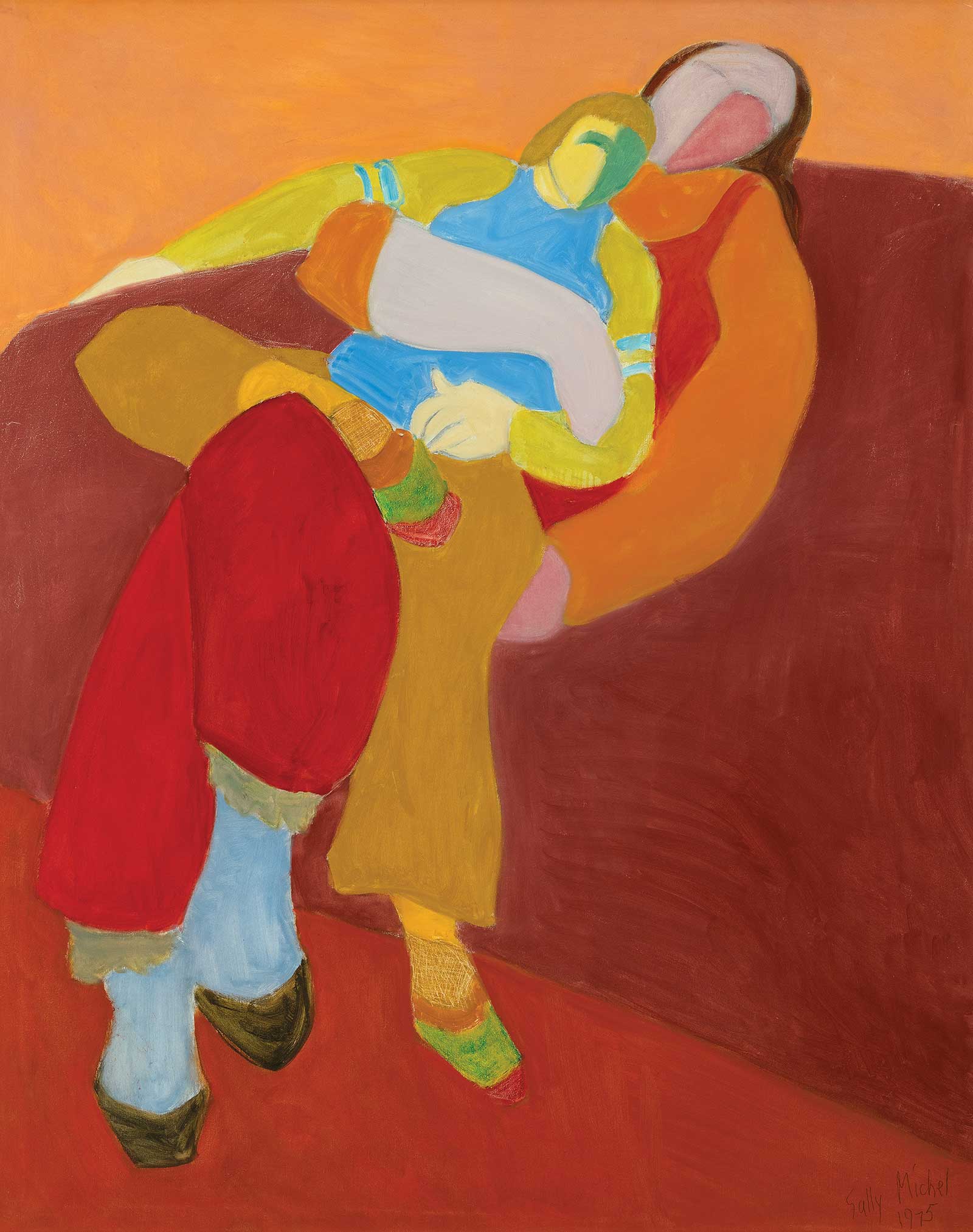 Sally Michel (1902-2003), Mother & Child, 1975. Oil on canvas, 49 x 39 in., signed and dated lower right.
The refinement of their artistic visions evolved over many years of sketching, painting, looking and sharing ideas on art. The Averys structured their year so that summers could be shared creating together and later with their artist daughter March (born 1932). Because rental apartments in New York were plentiful, Avery and Michel were able to leave the City each summer and return in the fall. They sketched non-stop on their trips, gathering source material for future paintings to be executed in the studio. A list of the summer trips gives some indication of which location inspired a painting’s subject. With limited funds in the 1930s, the Averys drove to summer locations in Connecticut (1930); Gloucester, Massachusetts (1926-1933); Vermont (1937, 1939, 1940); and the Gaspé Peninsula, Québec (1938). In the 1940s they traveled further: to California with stops in Yellowstone and Glacier National Parks (1941), Mexico (1946), and the Canadian Northwest and Oregon (1947). After their 1952 trip to Europe, the Averys’ later years saw summers spent closer to home: Woodstock, New York; the art colonies Yaddo (1955) and MacDowell (1953, 1954, 1956); as well as Provincetown, Massachusetts (1957-1961). Under doctor’s orders, Avery spent the winters of 1949 to 1950 and 1950 to 1951 recuperating in Maitland, Florida, where he and Michel were Bok Fellows at the Research Studio. Later they wintered again in Florida (Key West) in 1959. 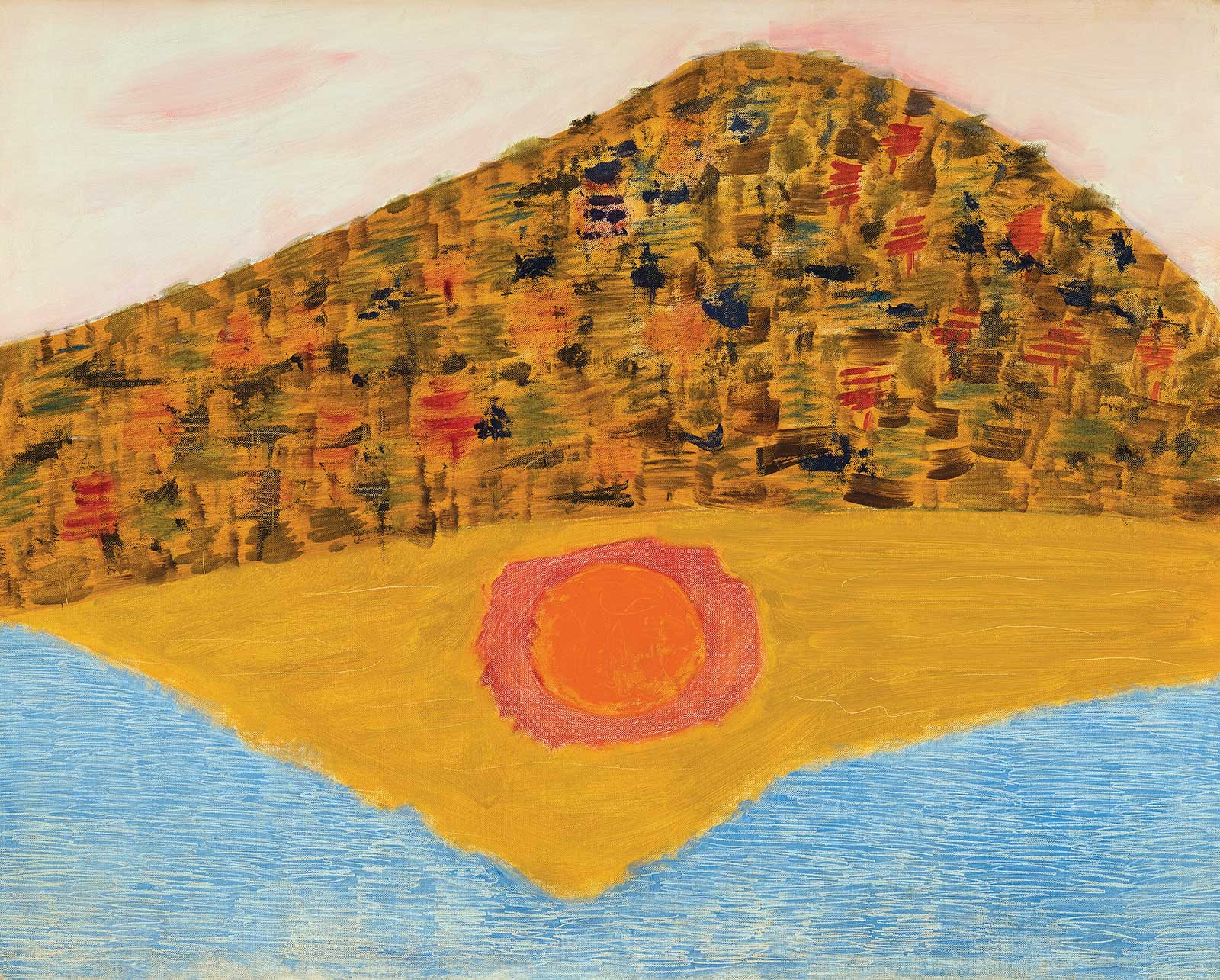 Sally Michel (1902-2003), Autumn Reflection, ca. 1950s. Oil on board, 24 x 30 in., estate stamp verso.
Michel did paint directly from nature throughout her career, but developed most of her artwork from sketches. She often created an intermediary watercolor or gouache that then informed the finished oil, transmitting a mood, time of day, weather or season. The fluidity and luminosity of gouache and watercolor provided freedom to experiment with color and tone, which could be duplicated on canvas by painting with thinned pigments. To create an overall textural softness, Michel used a stiff brush to apply matte pigments in thin layers. If a pigment became too thick it could be scraped from the canvas to reveal lower coats of pigment and achieve the desired tone. In looking over a group of sketches to select one to paint, she considered contrasts between straight and curving lines, discrepancies in scale, and different views of a single scene. Michel’s portraits of individuals were often close-ups isolated against flat backgrounds as seen in Mother & Child, a portrait of Sally’s daughter March Avery and her grandson. After Dinner, 1970, is another portrait with an extreme angle, this time focusing on the still life arrangement of dishes and placemats on the table. Scale distortion, exaggerated color or caricature could provide social commentary when she desired it. This sketch-to-painting approach allowed Michel to achieve simplified and abstracted shapes locked together into finely balanced compositions. 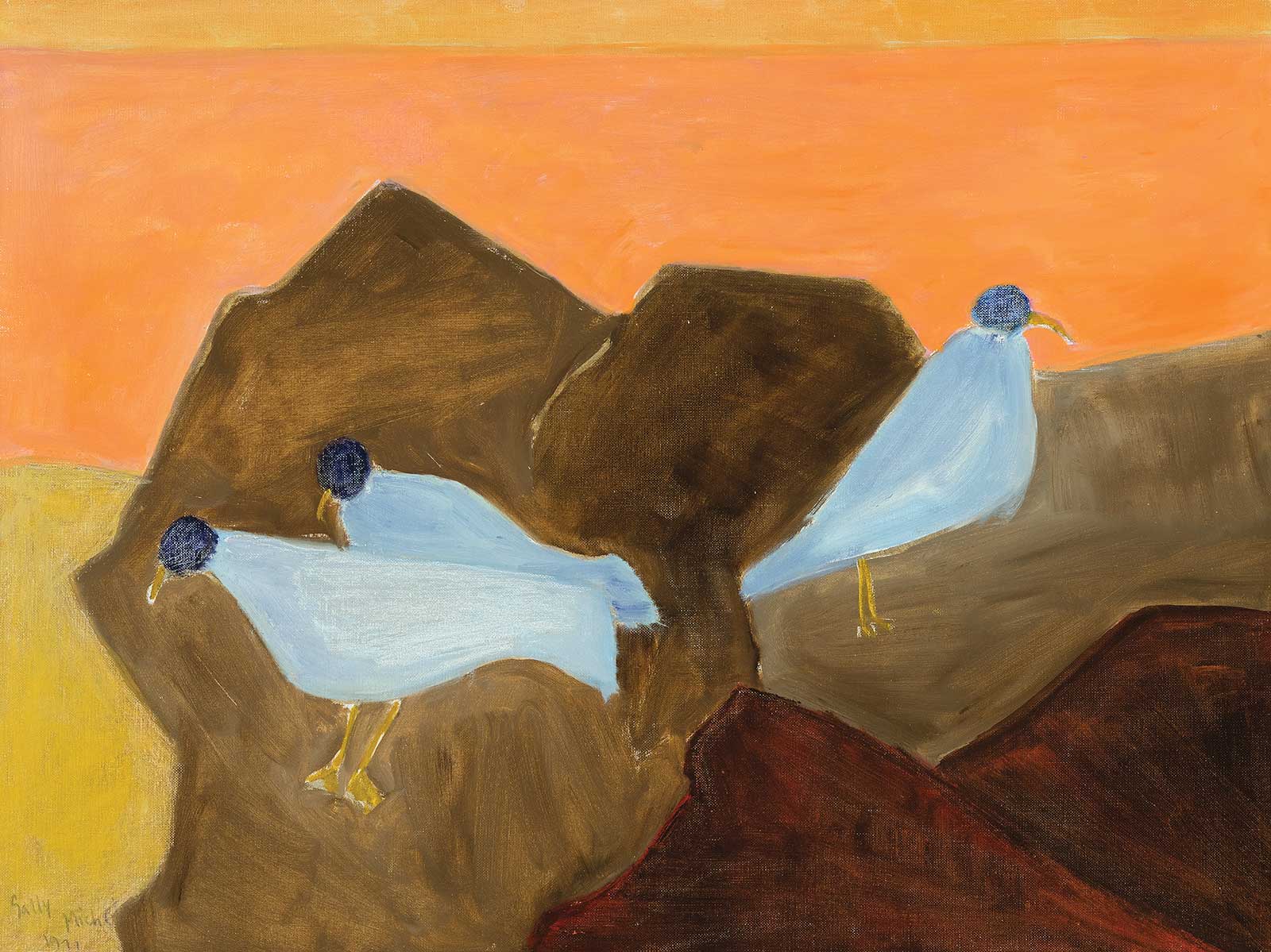 Sally Michel (1902-2003), Birds by Pink Sea, 1977. Oil on board, 18 x 24 in., signed and dated lower left, titled verso.
Avery and Michel were artists dedicated to painting what they saw at a time of uncertainty for realism in American art. From 1946 to 1958 abstract expressionism, a gestural or action painting style with roots in European surrealism, was at its height of popularity. Abstract expressionists considered any reference to recognizable imagery to be parochial, out of date and taboo. The Averys saw that bridges between realism and abstraction can go both ways and color, structure and light are the common denominators. This realization led to recognizing that shapes, spaces and color form a set of unique relationships independent of any subject matter. The Averys modernized realism by using the shapes of things, the spaces around them and color in new ways. They treated color less naturalistically to reflect mood and transcend the factual aspects of realistic subjects, such as the colorful water in Birds by Pink Sea, 1977. Realism traditionally relies on light and dark contrasts to create depth. They found the use of non-naturalistic color suppressed that contrast and led to a new challenge of how else to produce depth. The solution they found was that a highly structured composition would still be read as a landscape, still life, or figure. To capture further universality and interconnections in their paintings, the Averys worked with shapes and their edges. They used thinly applied paint so the canvas ground was revealed around the edges of shapes, making the bare canvas function as color. The boundaries of soft shapes could be achieved through intricate color transitions, creating contiguous forms that blend into one another, like the land and lake in Old Apple Tree, 1970. This approach led to a new and important discovery that the distinctions between objects in a painting are fundamentally illusions and that the borders between shapes are what create representational art. The Averys also found that reducing the number of shapes and colors in a painting and eliminating illusionistic rounded volumes and modeled forms added modernity to a scene. Shape and color could become equal when shapes were used as containers of color. Also areas of color could be stacked as abstract signs of foreground, middle ground, distance, and sky like in Strange Landscape, 1970. The Averys used patterns, organic or geometric, to express the forces as well as the forms of nature. Liquid or transparent areas of paint could embody the forces of wind and water. This demonstrated that painterly surfaces associated with the Abstract Expressionists could be used in realism to express more than angst. 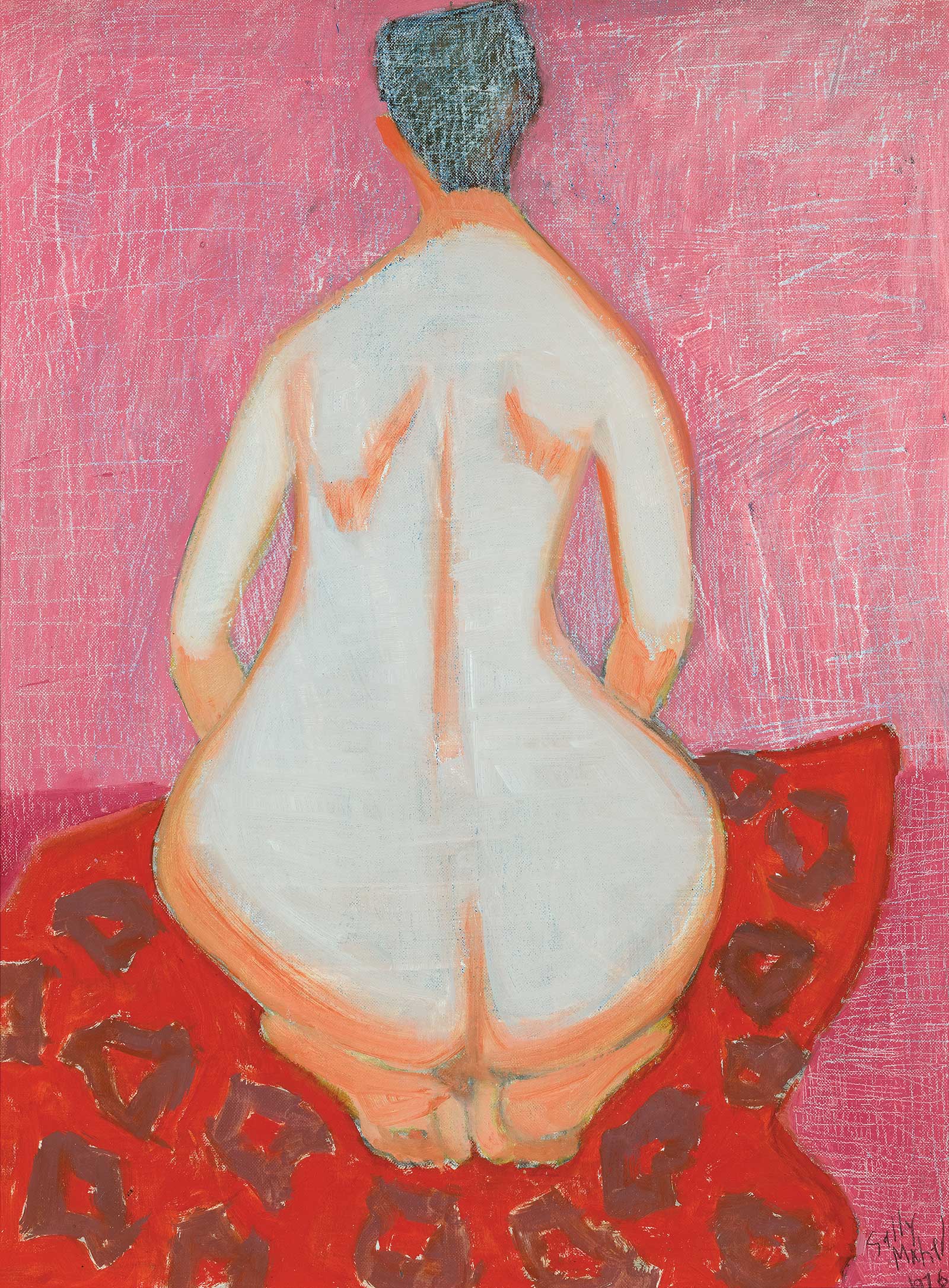 Sally Michel (1902-2003), Back View, 1976. Oil on board, 24 x 18 in., signed and dated lower right.
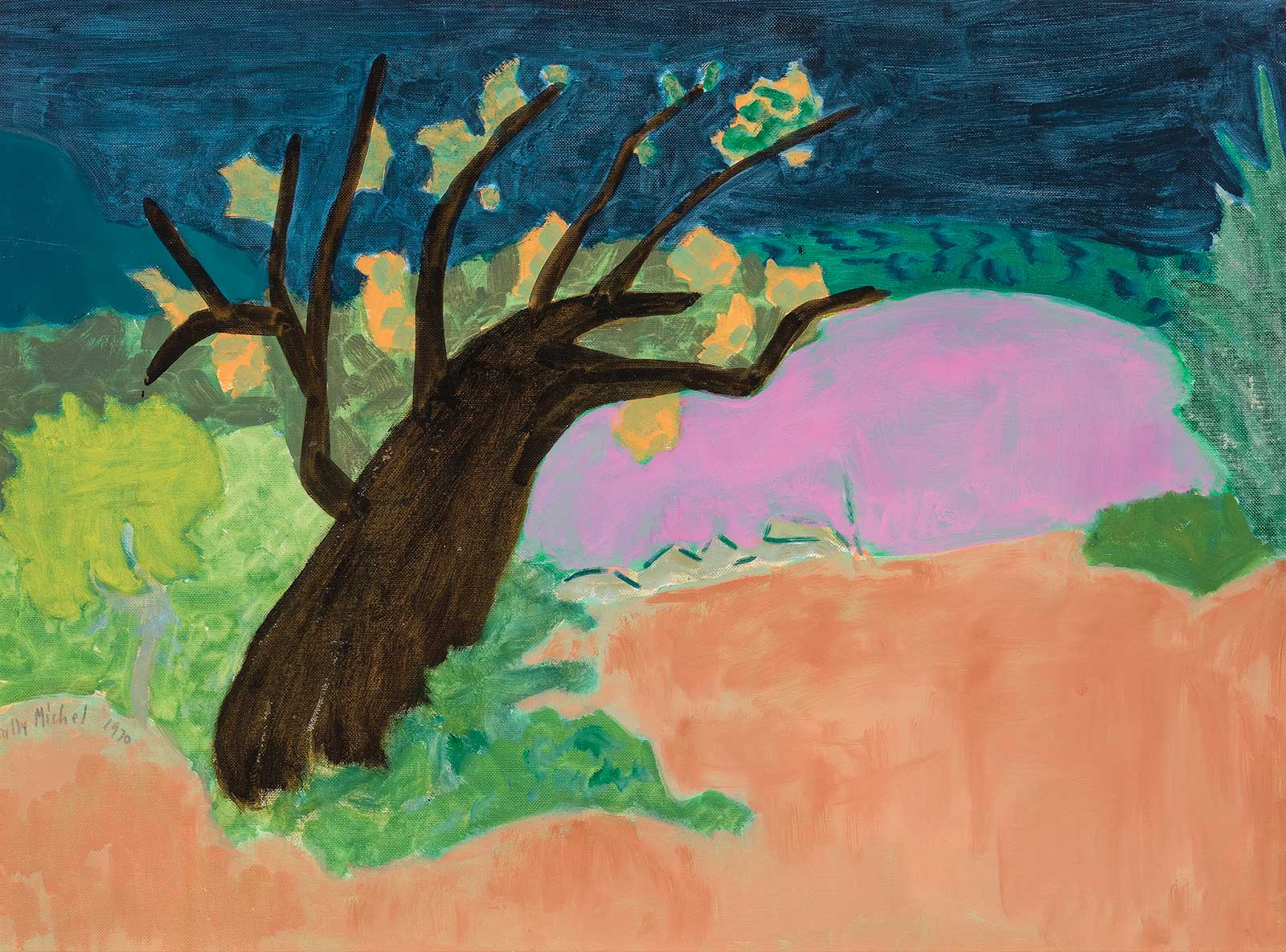 Sally Michel (1902-2003), The Old Apple Tree, 1970. Oil on board, 18 x 24 in., signed and dated lower left, titled verso.
In March of 1964 Milton’s health put him in a New York hospital where he died in January of 1965. Sally worked tirelessly to ensure Avery’s legacy while also continuing to paint and evolve the way she used materials for another twenty-five years. To achieve a dry paint surface with a soft matte feel, she mixed large amounts of turpentine with her paint rather than linseed oil. Always frugal with pigment, Michel used rags to moderate layers of color in a shape, and added luminosity by tinting colors with white pigment. Her experimentation with color harmonies was often daring. When she wanted textural interest or to bring attention to the two-dimensional surface of a canvas, she scratched into the paint as seen in Autumn Reflection, circa 1950s, and Back View, 1976. In the figures, animals, still lifes and landscapes she painted, Michel worked to achieve mood and movement rather than detailed representation. She continued to find her imagery in the visible world, often inspired by her own travels. To present it in a modern way took careful consideration and skill in her non-associative color choices for mood, selection and placement of realistic shapes, and attention to the edges of her reductive forms to achieve flattened compositions. In her art, Michel understood and adapted elements from the two streams of representation and abstraction to refresh realism, keeping it relevant after abstract expressionism.
D. Wigmore Fine Art will also exhibit works by Michel at The American Art Fair, May 14 through May 17, at the Bohemian National Hall. —
Powered by Froala Editor