
Things Heard & Seen, the new Netflix film based on Elizabeth Brundage’s novel All Things Cease to Appear is a fairly standard haunted house movie, complete with unhappy marriages, unquiet apparitions, a piano that plays itself and a seance that goes haywire. I haven’t read the novel, so I can’t speak to its success at resuscitating the genre, though the old adage, “The book was better,” may well apply here. What was of particular interest to me—and, I hope, to you—is the fact that the character of the husband is an art history professor specializing in the work of George Inness (1825-1894), an American painter who is often—and the film is no exception—classified as a Hudson River School painter. And yet, a closer look at Inness and his painting, while conceding his interest in and debt to the Hudson River School, especially early on, after he viewed the works of Asher B. Durand and Thomas Cole, reveals an artist whose influences were many and varied. What’s more, as George Inness: Works in the Collection, on view through June 16, 2024, at the Montclair Art Museum in New Jersey, makes clear, Inness lived in New York City, Massachusetts, Florida and, for the most part, New Jersey—that is, when he wasn’t traveling and painting in Europe. George Inness not only never lived in the Hudson Valley, he rarely painted there.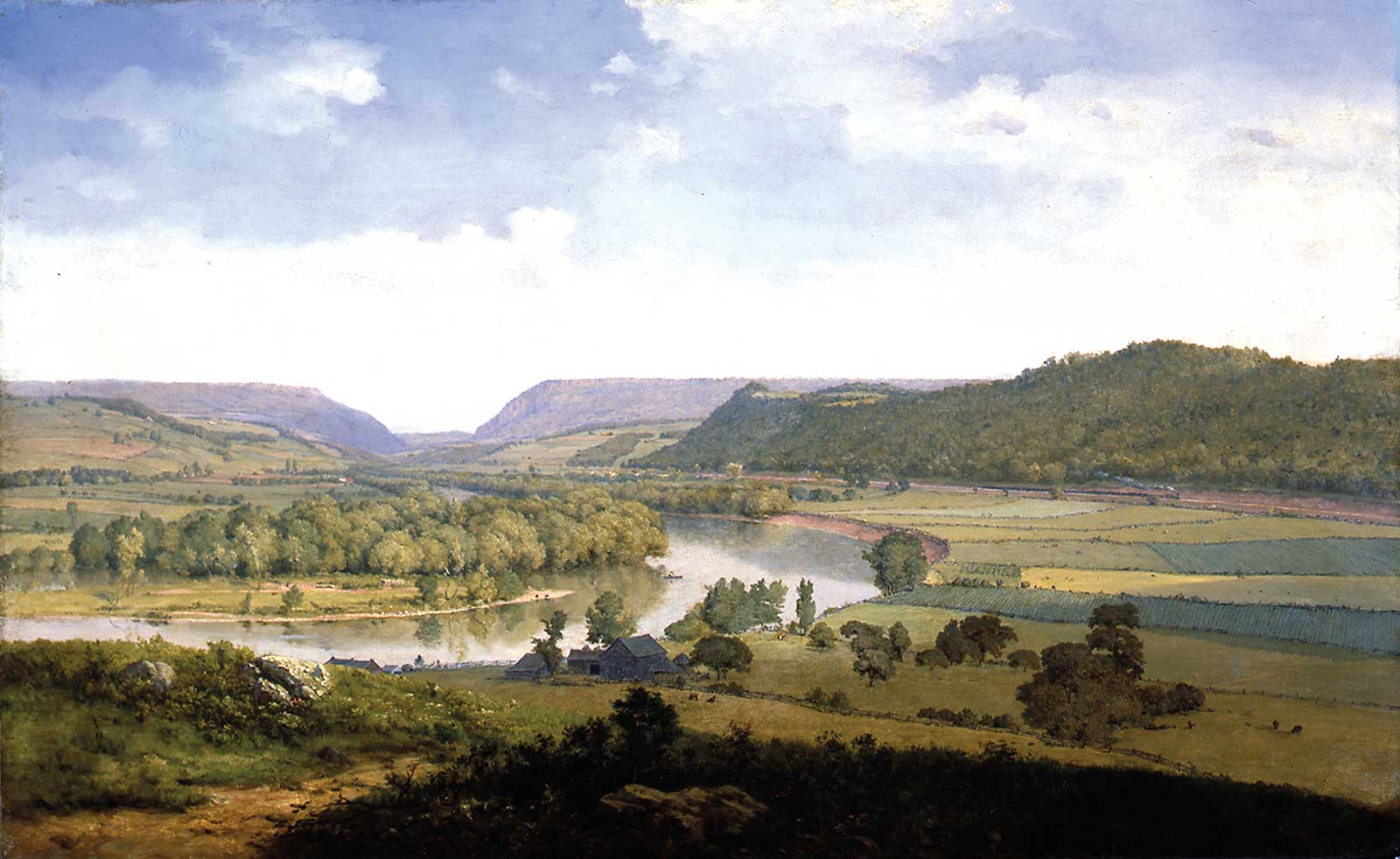 George Inness (1825-1894), Delaware Water Gap, 1857. Oil on canvas, 32 x 52¼ in.
In Things Heard & Seen the young post-doc, who lives with his wife and daughter in New York City, gets an offer of a post at a small college “upstate” in the town of Chosen, New York, along the Hudson River. We learn that the main reason for his appointment is a chapter in his dissertation on the impact of the philosophy and theology of Emanuel Swedenborg on the paintings of George Inness.
Swedenborg (1688-1772) was a Swedish polymath whose interest embraced everything from the form of the neuron to heavier-than-air flight. In 1744 he began to experience visions and turned from science to theology, seeing himself as a prophet of a true Christian religion, one in which the spiritual and physical worlds are intricately intertwined. For Swedenborg, life was a journey from the material to the spiritual in which all things in the physical world, including human beings, corresponded with their counterparts in the spiritual world. This concept of the immanence of the spiritual in the physical—as well as Swedenborg’s optimism about the possibility of our spiritual progress—permeated philosophy, becoming one of the pillars of American transcendentalism. Swedenborg’s mysticism percolated through European and American arts and letters from shortly after his death until well into the 20th century.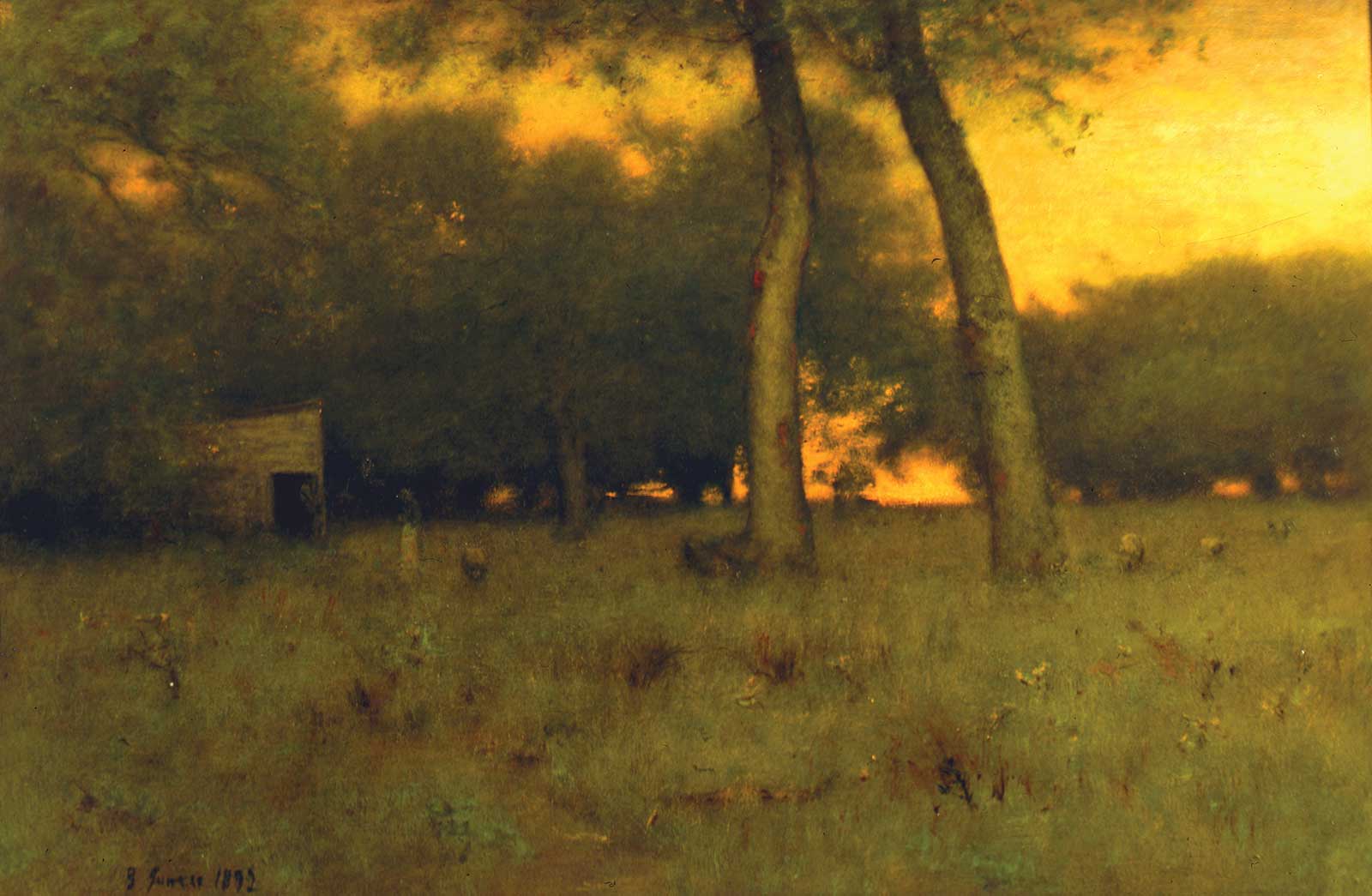 George Inness (1825-1894), Sunset, 1892. Oil on panel, 30 x 45 in.
Inness first learned about Swedenborg from fellow American expatriate artist William Page while painting in Rome in 1851, yet it would be almost 30 years before the Swedish mystic’s ideas began to make themselves manifest in his art.
Before the Swedenborgian paintings, Inness—in the manner of French master Paul Gauguin—worked his way through the styles and schools of the past and of the day in an almost ontological way, making them his own before moving on. Unlike his French contemporary, Inness made use of all of these styles—and the techniques that accompanied them—throughout his career. The examples in the exhibition at the Montclair Art Museum cover a good deal of the territory. Two additions, Autumn Oaks and Summer Landscape, fill out the artist’s myriad interests and influences.
The 1857 oil, Delaware Water Gap, is an excellent example of Inness working in the classical French landscape mode of Claude Lorrain (ca. 1600-1882) and Nicolas Poussin (1594-1665). Inness emphasizes the pastoral and integrates the industrial—the train in the distance—into the landscape. Nature and culture are balanced and harmonized by the point of view which places us at a distance. Sunlight falls on the sheep at left, the river is a placid mirror, and the Delaware Gap seems to have parted just for us. The only shadow is a shallow triangle from a passing cloud at bottom in the foreground that points the way to the tidy farm by the riverbank.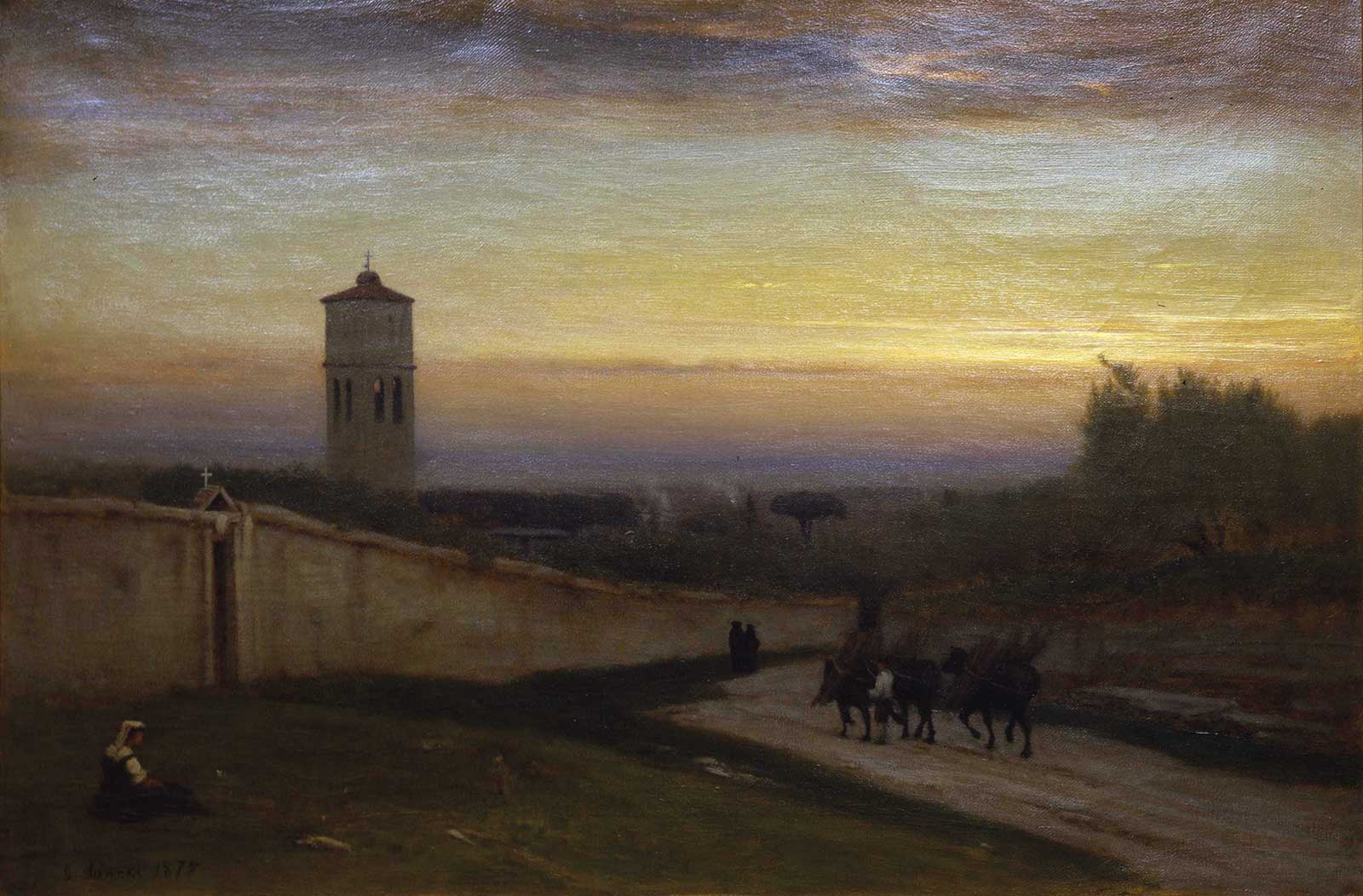 George Inness (1825-1894), Twilight, 1875. Oil on canvas, 20¼ x 30¼ in.
 George Inness (1825-1894), Early Autumn, Montclair, 1888. Oil on canvas, 30 x 45 in.
Autumn Oaks, an 1878 oil owned by the Metropolitan Museum of Art, hearkens back to Inness’s interest in the Hudson River School with its dramatic contrasts of light and dark, storm and sun, peaceful and violent. Like Thomas Cole and Asher B. Durand, two Hudson River painters Inness admired, trees in autumn glory take center stage. What separates Inness from the Hudson River School by 1878 is the speed of the brushwork as opposed to the more meticulous modeling of elements—especially trees—that you expect to see in Cole, Durand and their peers.
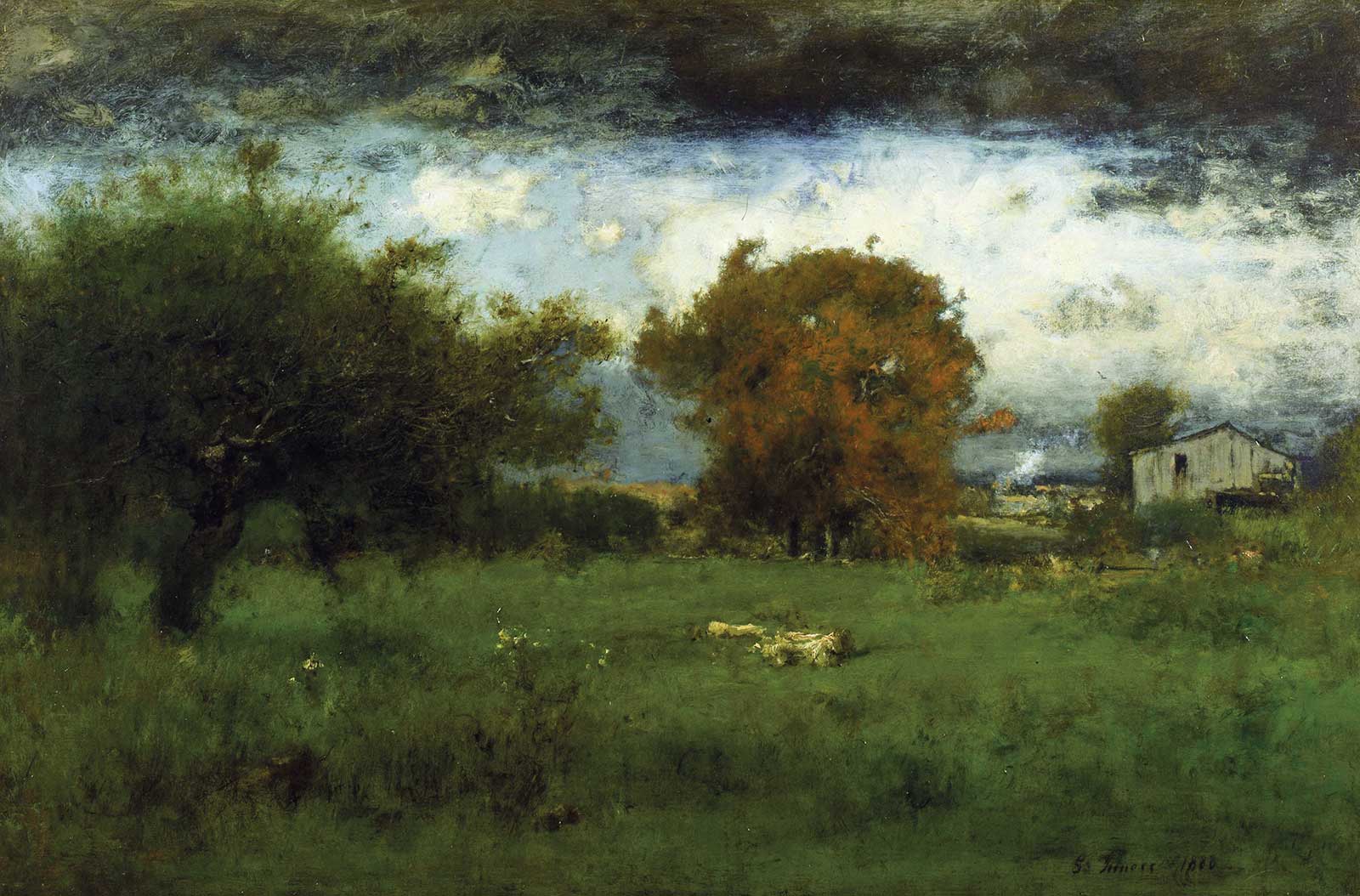
Two landscapes, Early Autumn, Montclair, painted in 1888, and Summer Landscape, painted in the last year of Inness’s life, 1894, offer windows into the artist’s incorporation of French Barbizon approaches to painting, especially as seen in the works of Jean-Baptiste-Camille Corot (1796-1875). Corot’s combination of spiky brushwork and extreme sfumato—which lends the haziness to his trees—finds its way into Inness’s practice, imparting a dreamlike quality to the two works seen here. Where the 1894 canvas is a hazy, lazy dream of summer, executed in warm yellows and pale oranges and greens, the 1888 work meets our eye with the turbulent change from summer to fall, as the darkening sky drops the heavy shadow of the first chill onto the field. In each work, however, the Swedenborgian influence is present—elements are less differentiated than in earlier works. The poetry of the arrangement of elements—their spiritual aspect—is more important than the material reality of the scene.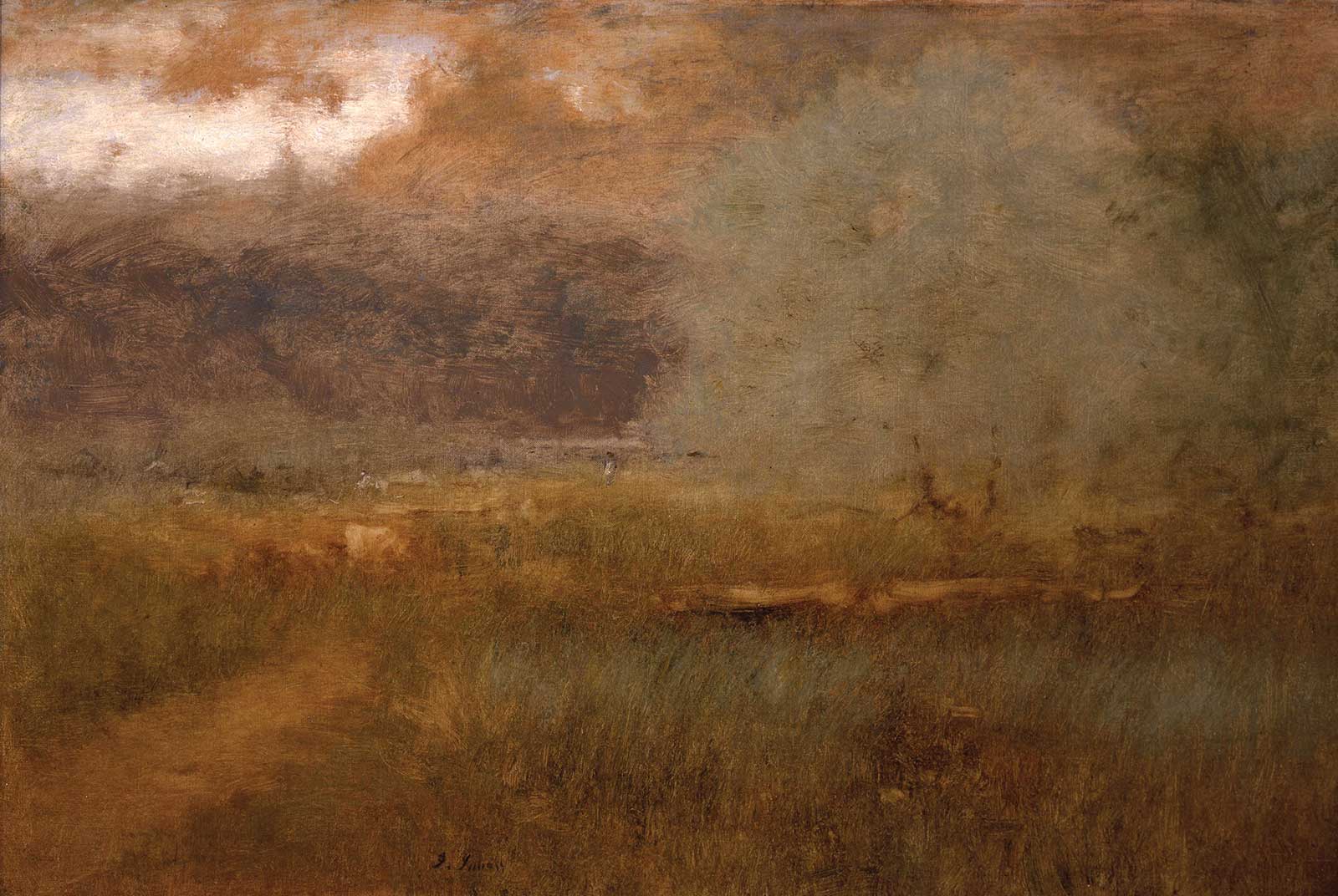 George Inness (1825-1894), Gathering Clouds, Spring, Montclair, NJ, ca. 1890-94. Oil on canvas, 24¼ x 36¼ in.
Luminism grows out of the Hudson River School, seeking a renewed emphasis on light and color, on sky and water, and their reflections. John Frederick Kensett (1816-1872) and Alfred Thompson Bricher (1837-1908) are two better-known exponents of the Luminist landscape style. Inness’s 1875 painting, Twilight, bears some characteristics of Luminism, particularly in the bands of color that comprise the last light in the sky. On the other hand, the brushwork and the city gates and figures fading into darkness repudiate the finish that the Luminists strove to achieve. In Twilight, light and darkness contend rather than complement one another. This, too, is a nod to the Manichaean duality that underpins Swedenborgian thought as expressed in Inness’ work.
Just as he is often classified as a Hudson River School painter, Inness is also often called a tonalist and placed on a list with James McNeill Whistler (1834-1903), Ralph Albert Blakelock (1847-1919), Albert Pinkham Ryder (1847-1917) and Alexander Wyant (1836-1892). Like Blakelock and Wyant, Inness began to paint under the influence of classicism and the Hudson River painters but shifted towards more mood-inflected, all-but-impenetrable scenes that attempted to capture the very first or last light of day, or landscapes under moonlight, or the deep shadows in thick forests. Tonalism is often seen as a bridge in American art between impressionism and modernism, yet the blurred lines between matter and spirit and the thinnesses between the realms of the poetic and the real spring from Swedenborg and make their way through Inness onto the paintings that are most associated with his name, works like Sunset, 1892 and Gathering Clouds, Spring, Montclair, NJ, painted around 1890-94. Indeed, aspects of Barbizon painting and even traces of luminism lurk in Sunset. But the size and strength of the masses that compose the picture move us ever closer to modernism. We have to look, to search, for elements to hold onto—the shack at left, the lone figure, a woman all but vanished into the falling night, and the sheep grazing beside her. The experience of looking at Inness’ Sunset is akin to reading poetry. We have to work at it to get to the beauties beyond the surfaces. We not only have to interpret it, we have to know that we are interpreting it, and that our interpretation is ours alone. This is, in effect, precisely what we have to do when we look at modern art.
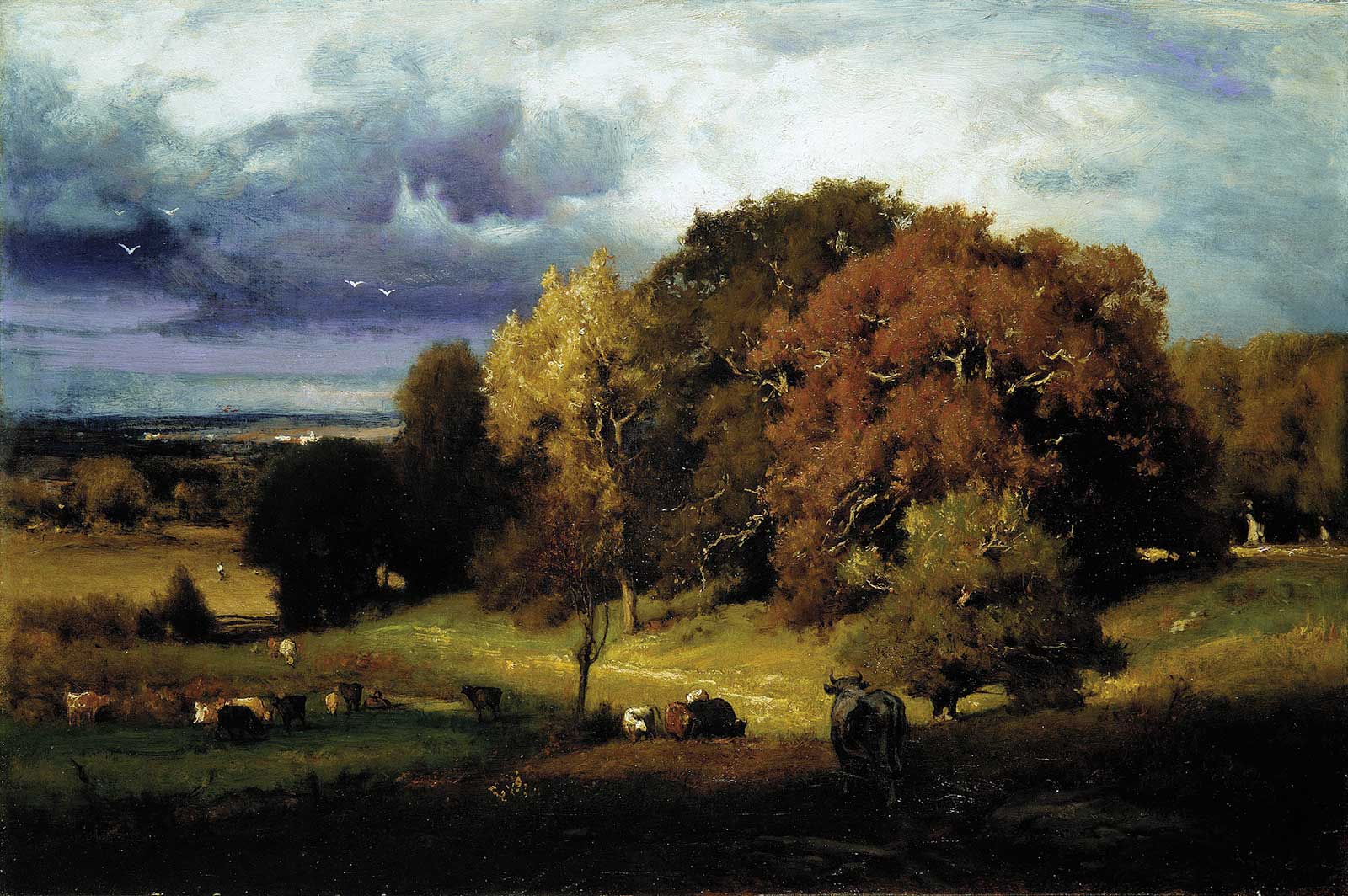 George Inness (1825-1894), Autumn Oaks, 1878. Oil on canvas, 20 3/8 x 30 1/8 in. Metropolitan Museum of Art. Gift of George I. Seney, 1887. Accession Number: 87.8.8.
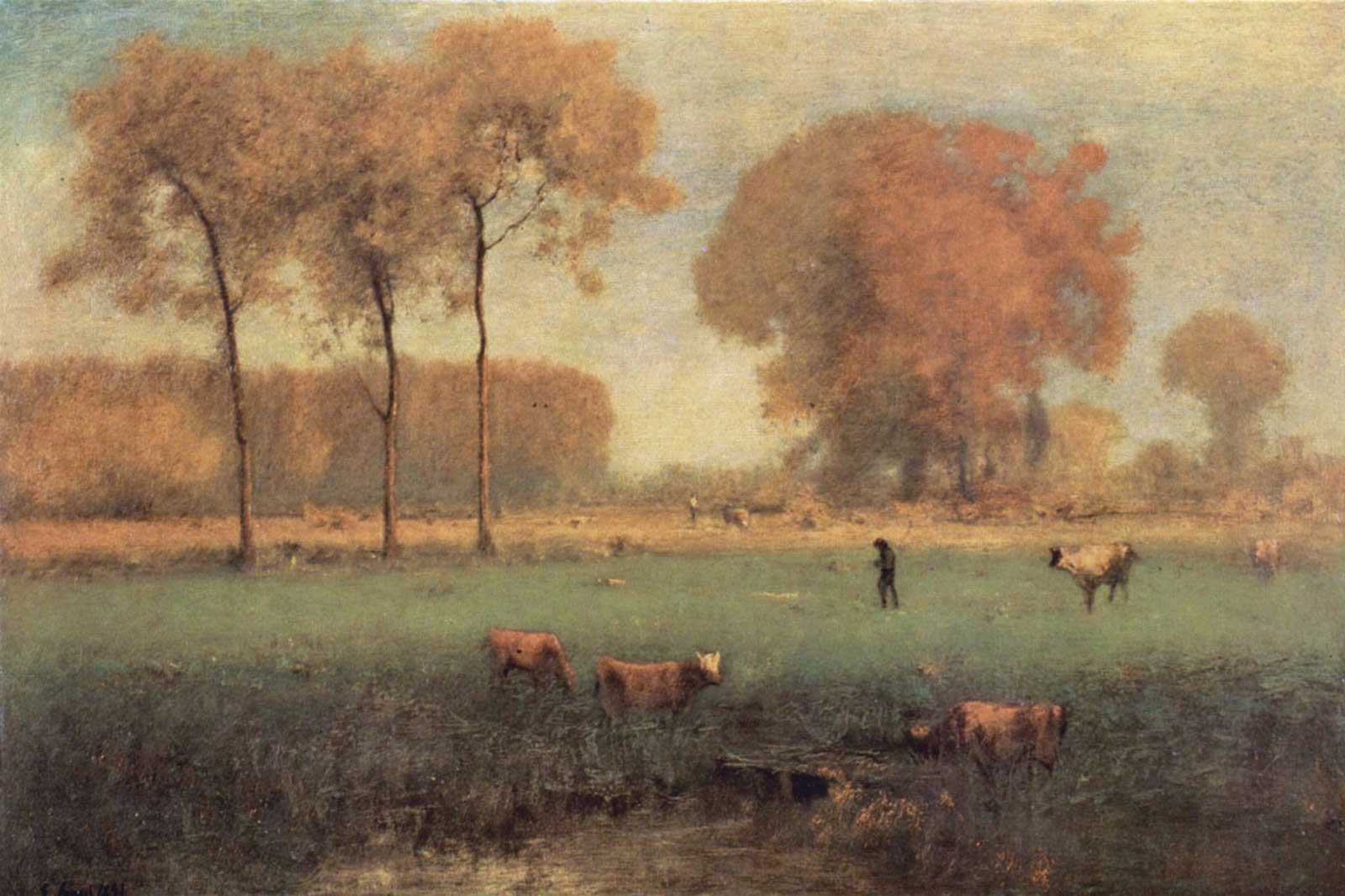 George Inness (1825-1894), Summer Landscape, 1894. Oil on canvas 30 x 45¼ in.
In contrast with the 1894 work I discussed earlier, Summer Landscape, Gathering Clouds, Spring, Montclair, NJ pushes past any Barbizon influences, pulling the rug out from under our expectations. Tree, clouds, grasses, path—our eye can hardly differentiate one from another. The tiny figure just left of center and the abstract forms of a few cows barely separate themselves from the landscape. This misty mysticism—misticism, perhaps—aligns Inness’s late works more closely with the late paintings of British artist J.M.W. Turner (1775-1851) than with the Tonalists. In the end, though individual artists—like George Inness—do, on occasion, receive exhibitions, the dynamic period of American painting that falls between the Hudson River School and John Singer Sargent begins to seem ill-defined and poorly studied, with terms stuck to artists like post-it notes. After the Civil War, American artists, patrons and the public sought refuge in different orders of dreams and imagery—Westward expansion, genre scenes of home and hearth, Grand Guignol horror, and illustrations of world events—scientific wonders, wars on the other side of the world, tragedies at home. George Inness and others like him sought to merge the material and spiritual worlds, to see and paint the poetry underneath reality, to find the light in darkness and to unearth the darkness in light, to reveal the things that are all but unseen, the things that go all but unheard. —
James D. Balestrieri is the proprietor of Balestrieri Fine Arts, specializing in arts consulting, sales, research and writing. He is currently the writer-in-residence for the Clark Hulings Foundation, as well as estate and collections consultant for The Couse Foundation and communications manager for Western Spirit: Scottsdale’s Museum of the West. He was director of J.N. Bartfield Galleries for 20 years, worked with the Scottsdale Art Auction for 15 years and has written over 150 essays for various art publications.
George Inness: Works in the Collection
Through June 16, 2024
Montclair Art Museum
3 South Mountain Avenue, Montclair, NJ 07042
t: (973) 746-5555, www.montclairartmuseum.org
Powered by Froala Editor