In its exhibition American Masters: Art of the 20th-21st Centuries, Somerville Manning Gallery in Greenville, Delaware, showcases parallel movements in realism and modernism from Hans Hoffman to Jamie Wyeth. The exhibition opens May 27 and continues through June 25.
The gallery notes, “The American Masters exhibition juxtaposes the artworks of N.C., Andrew and Jamie Wyeth with the artists of their respective eras, including current. This exhibition showcases some of the most celebrated artists of the 20th and 21st centuries.”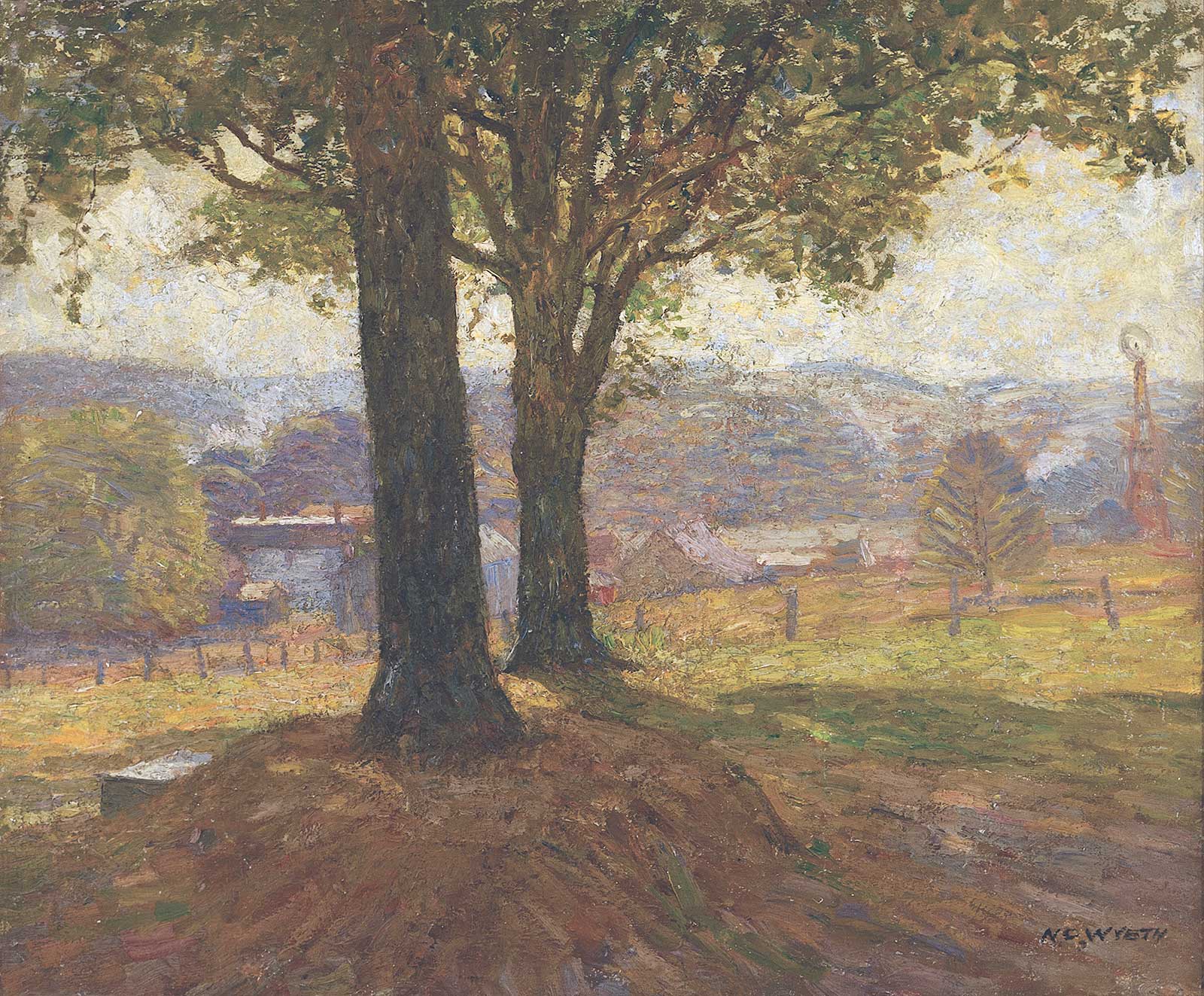 N.C. Wyeth (1882-1945), Hazy Afternoon, 1908/1911. Oil on canvas, 24 7/8 x 29 7/8 in.
N.C. Wyeth (1882-1945) and Hans Hofmann (1880-1966) were contemporaries. Famed for his illustrations for a series of books beginning with Robert Louis Stevenson’s Treasure Island in 1911, Wyeth is represented by easel paintings and rare sketches. Hazy Afternoon, 1908/1911, is a muted view of Chadds Ford, Pennsylvania, where Wyeth lived.
Hans Hofmann spent his early years studying in Paris and came to the United States in the 1930s. In Paris, he absorbed the tenets of cubism and fauvism. He became known for his use of color and developing a theory of “push and pull” in which the illusion of space and depth could be achieved in non-objective compositions by the use of color and shape. He was also a teacher. Among his students were Helen Frankenthaler, Allan Kaprow, Lee Krasner, Louise Nevelson, Joan Mitchell and Wolf Kahn. His Blue Arcata, 1955, manifests his assertion that, “My aim in painting is to create pulsating, luminous, and open surfaces that emanate a mystic light, in accordance with my deepest insight into the experience of life and nature.”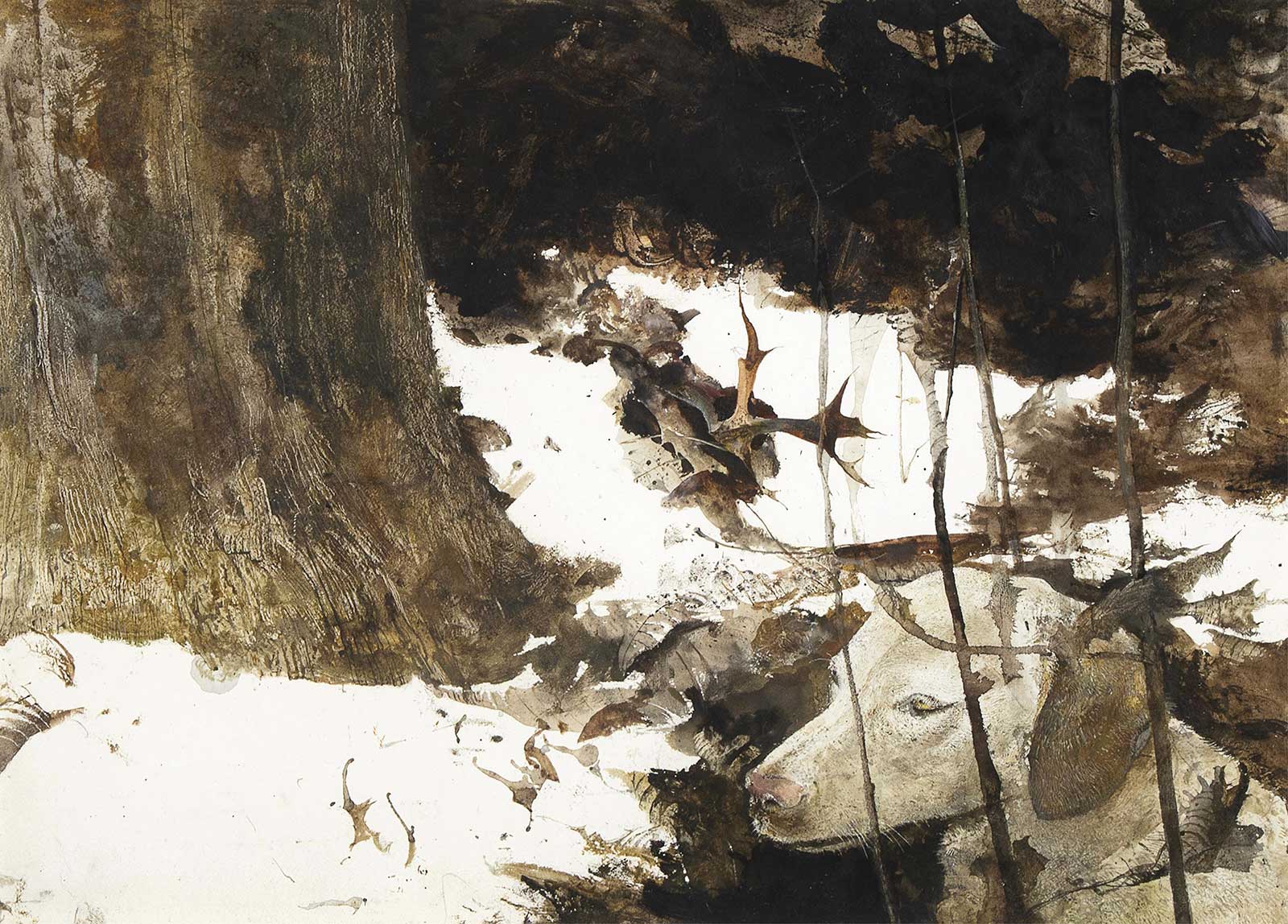 Andrew Wyeth (1917-2009), Nell, 1976. Watercolor on paper, 20 7/8 x 29½ in.
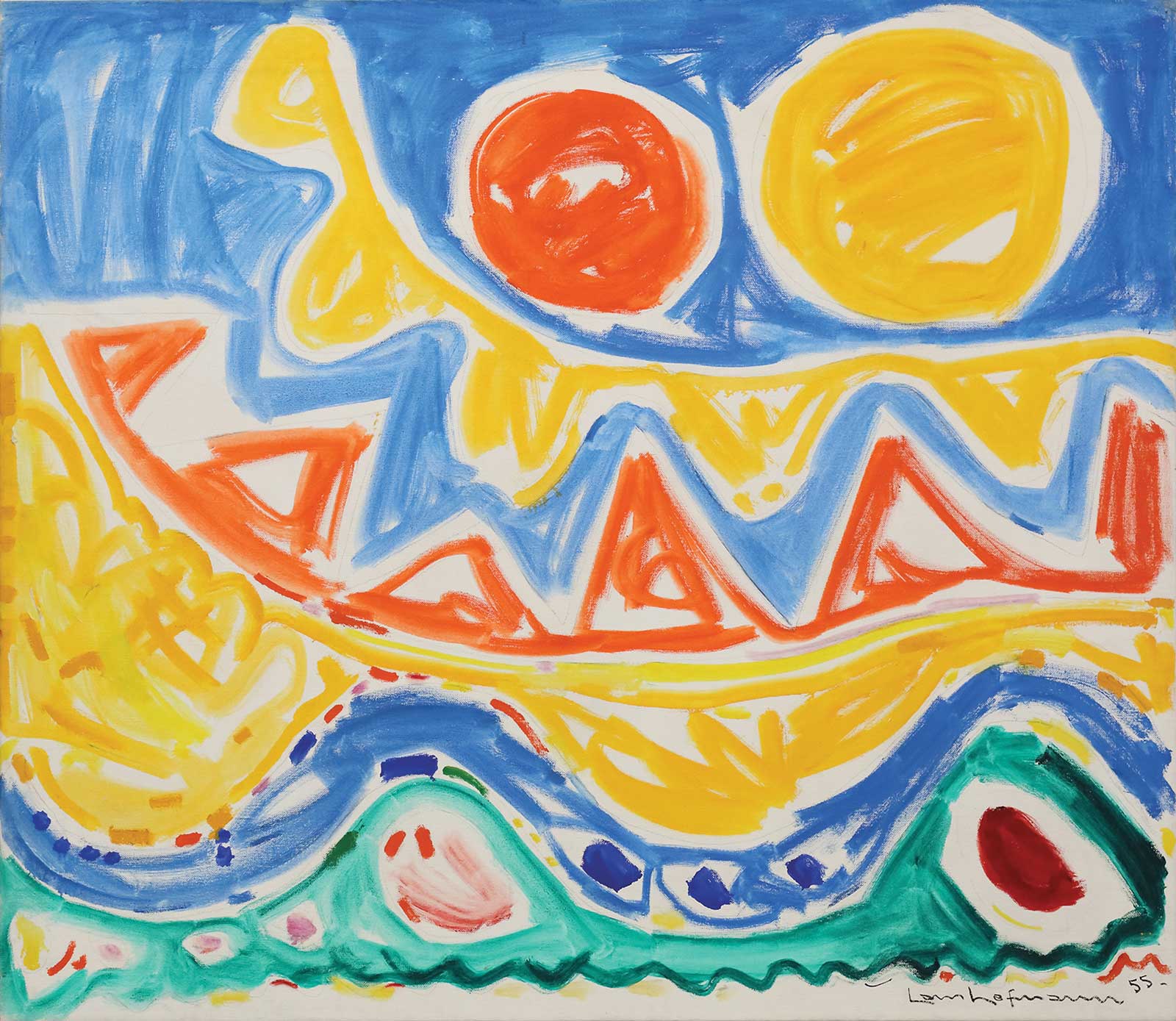 Hans Hofmann (1880-1966), Blue Arcata, 1955. Oil and pencil on canvas, 52 x 60 in.N.C. Wyeth’s son, Andrew (1917-2009) painted his watercolor Nell in 1976. His dog, Nell Gwyn, named after the mistress of King Charles II of England and Scotland, was frequently a model. Here, Nell becomes part of the landscape, blending into the monochromatic winter scene. Wyeth wrote, “I love the bleakness of winter and snow and get a thrill out of the chill…I’m taken by the bleakness—not the melancholy of the feeling of snow. My winter scenes differ from those of other artists in that they’re not romantic. No! They capture that marvelous, lonely bleakness, the quiet, the shill reality of winter.”
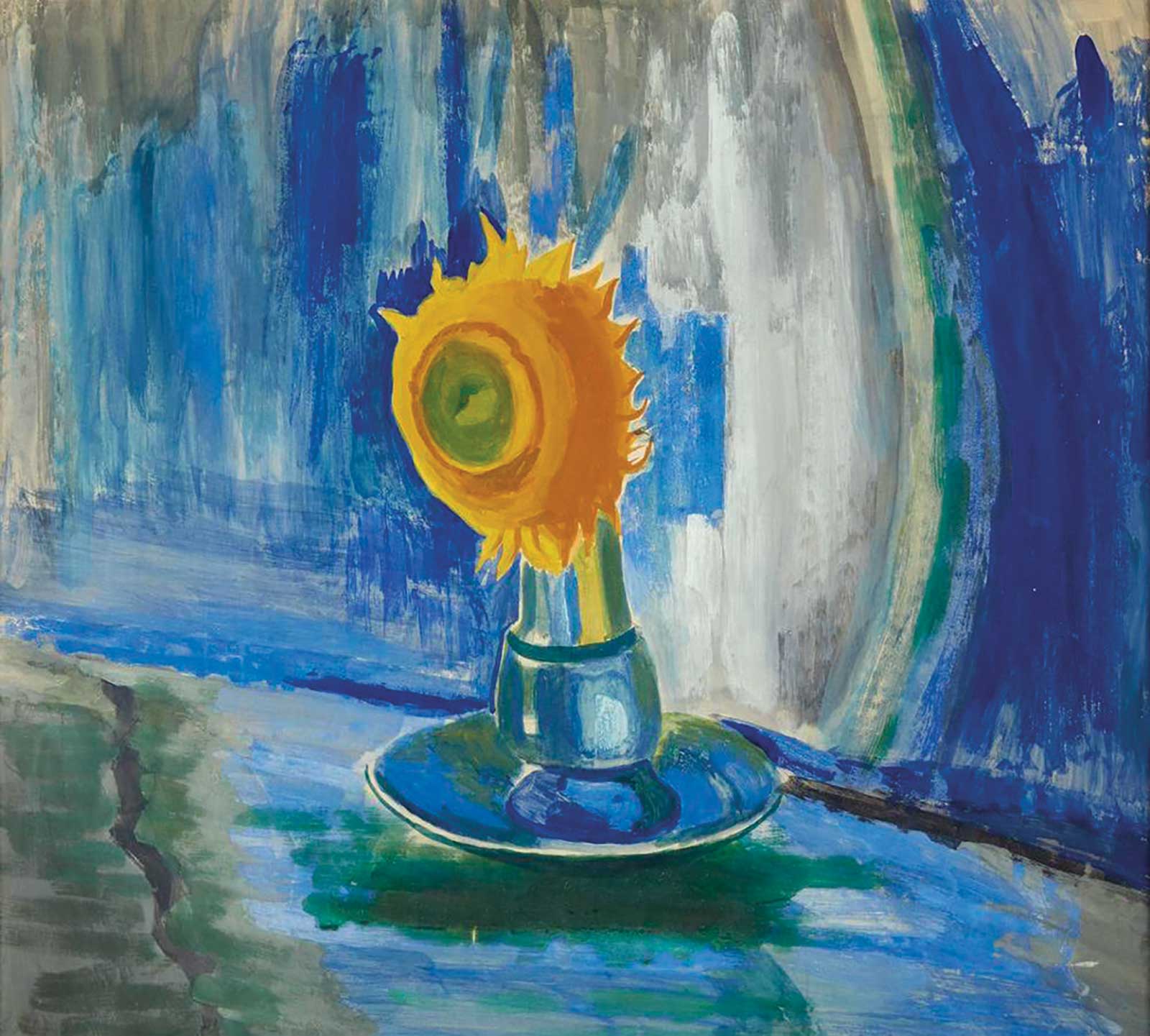 Joseph Stella (1877-1946), Sunflower, ca. 1929. Gouache on paper, 27¾ x 30½ in.
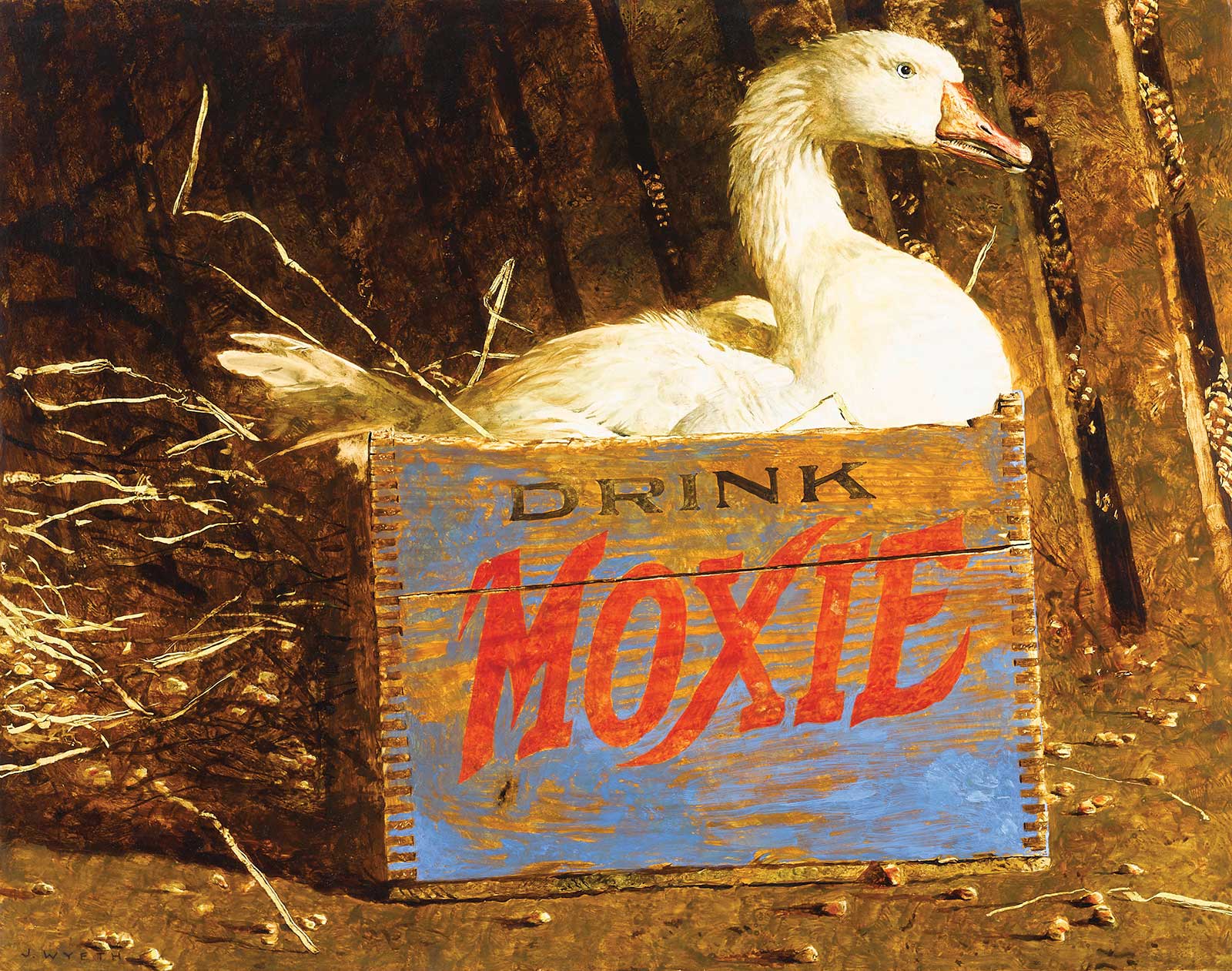 Jamie Wyeth (b. 1946), Moxie. Mixed media on paper, 22¾ x 28 7/8 in.
Jamie Wyeth, Andrew’s son, frequently brings humor into his paintings. In Moxie, a duck sits in in a Moxie soft drink crate with a look of “Don’t mess with me!” in its eye. Moxie originated in 1876 as an elixir called Moxie Nerve Food. It evolved into the carbonated beverage with a bitter aftertaste that is now the official soft drink of Maine. Wyeth observed, “My father’s work is rather mysterious, not much said, and my grandfather’s is robust, bursting off the walls.” His own work can be both, subtly humorous or, as in his series on the seven deadly sins enacted by sea gulls, terrifying.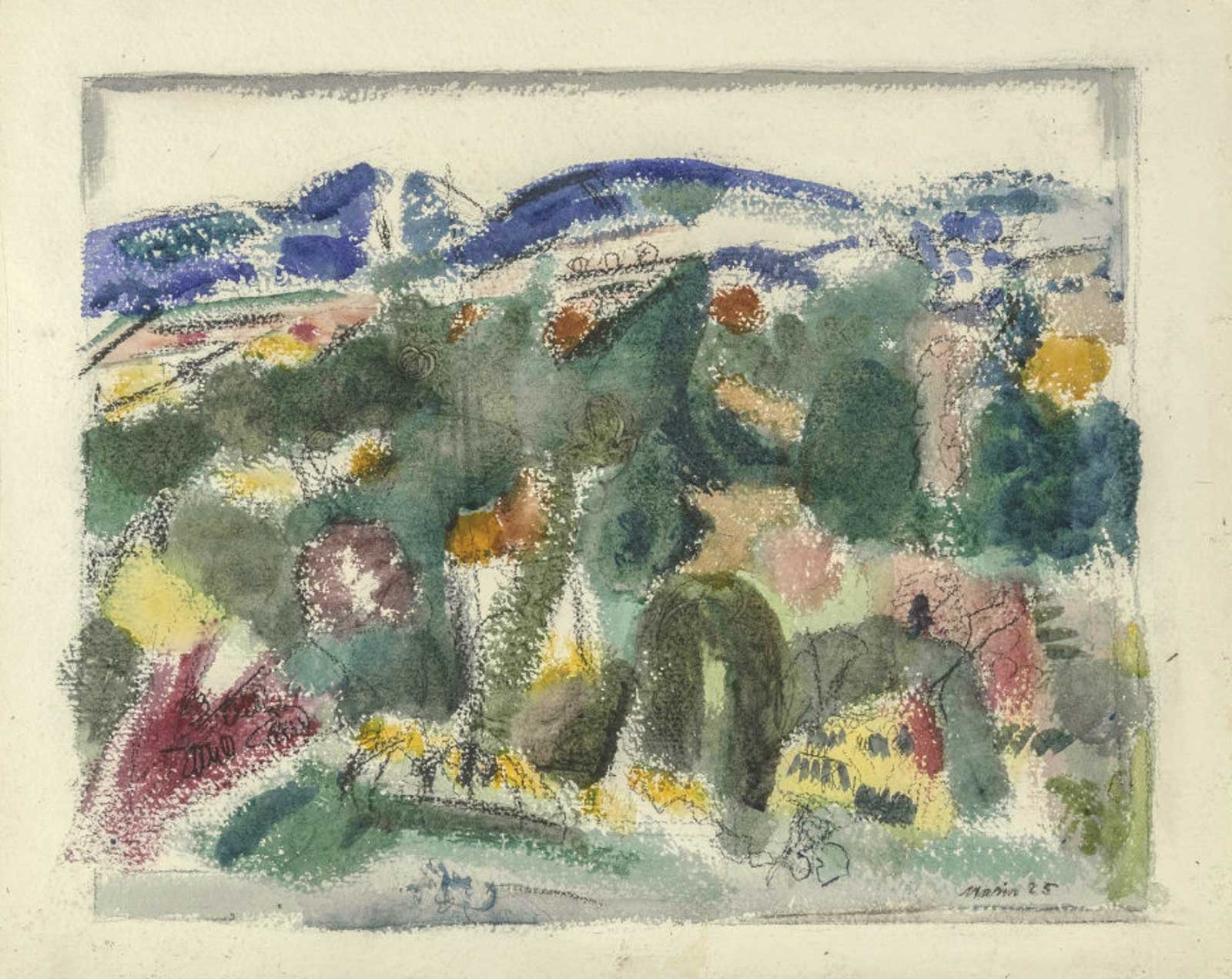 John Marin (1870-1953), Back of Sparkill, New York, 1925. Watercolor on paper, 15½ x 19 in.
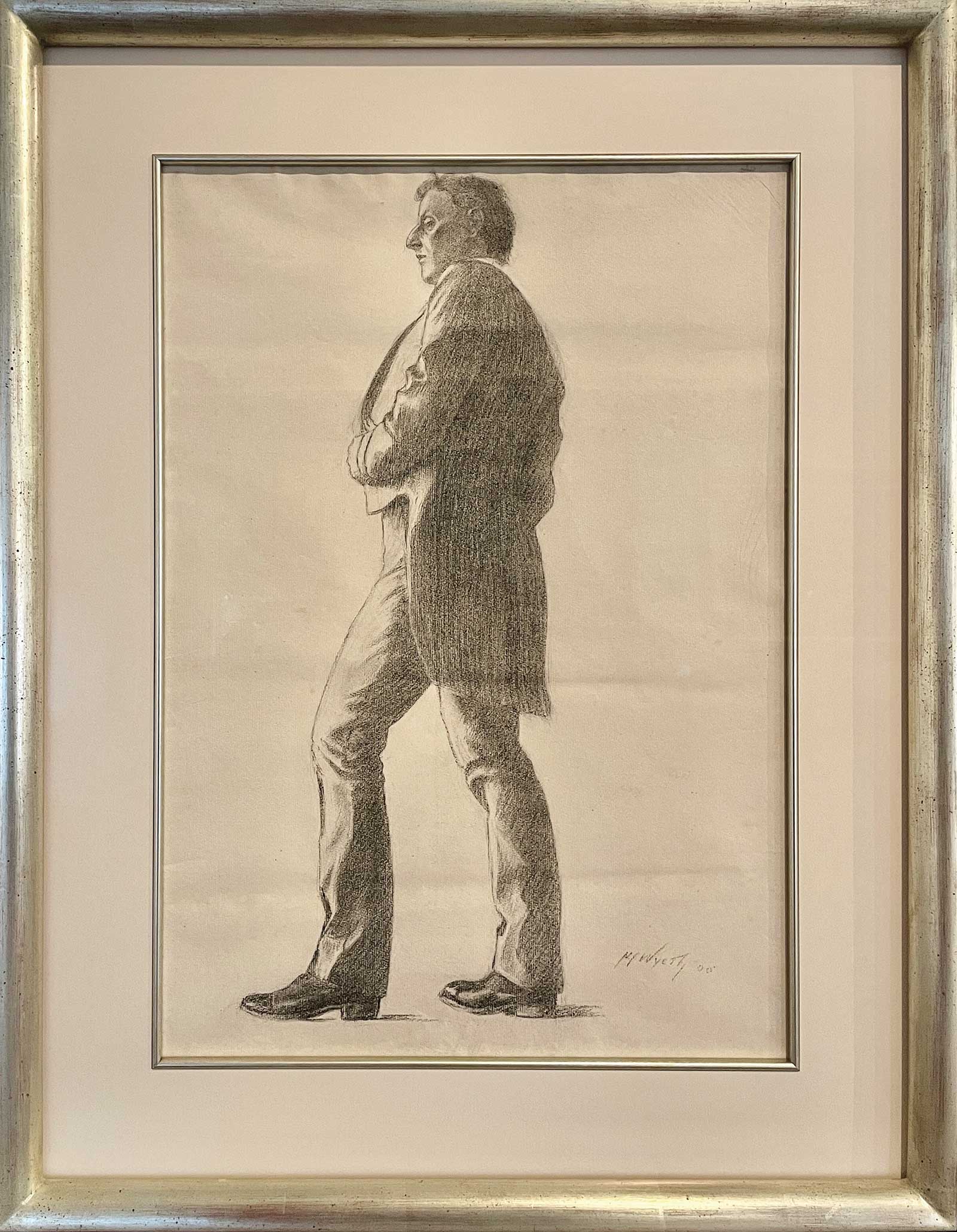 N.C. Wyeth (1882-1945), Untitled (standing male figure, from the side), 1900. Charcoal on paper, 24½ x 19 in.
John Marin (1870-1953) was famed for his watercolors of which Back of Sparkill, New York, 1925, is an example. Alfred Stieglitz (1864-1946) first exhibited his watercolors in 1910 and encouraged him to continue painting in the medium. Marin wrote, “How to paint the landscape: First you make your bow to the landscape. Then you wait, and if the landscape bows to you, then, and only then, can you paint the landscape.” —
Powered by Froala Editor