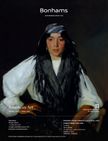
In connecting the work of early- to mid-20th century American realist painters with contemporary artists similarly embracing a realist approach, Alone Together: Encounters in American Realism, a forthcoming exhibition at the Westmoreland Museum of Art, doesn’t so much marvel at the historic painters’ foresight or the contemporary painters’ innovation—although it does both—as it places them side by side to reveal how little the human condition changes. Isolation and victimization are observed in equal measure with recreation and amusement. Then and now.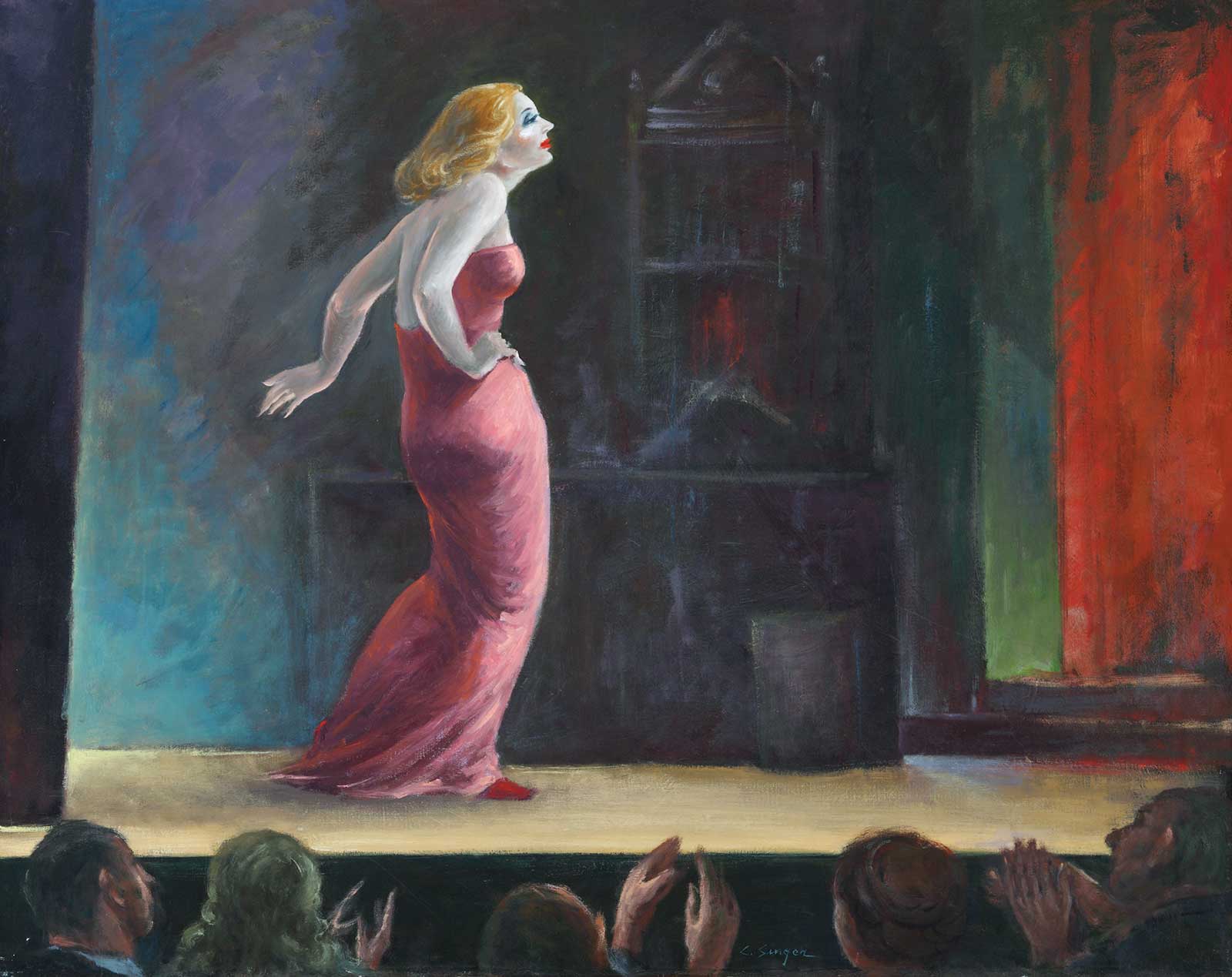 Clyde Singer (1908-1999), Talullah, 1958. Oil on canvas, 27 x 30 in. Gift of John J. McDonough. The Westmoreland Museum of American Art.
Guest curator Alex J. Taylor doesn’t need to present the work of living artists depicting brutalized protestors, police violence, the beleaguered working class, the forgotten elderly; the paintings he’s selected from 50 or 80 years ago tell those stories, reminding us that life has always been hard. Times have always been hard. Then and now.
“The show doesn’t seek to make direct parallels between events past and present, but to more simply use these paintings to reflect on the shared experience of living in difficult times,” Taylor, an assistant professor at the University of Pittsburgh History of Art and Architecture Department, says. “It was impossible, however, to look at images of violence unfolding in the shadow of monuments—such as the works by O. Louis Guglielmi and Henry Billings featured in the show—without seeing their resonances with images on our screens.”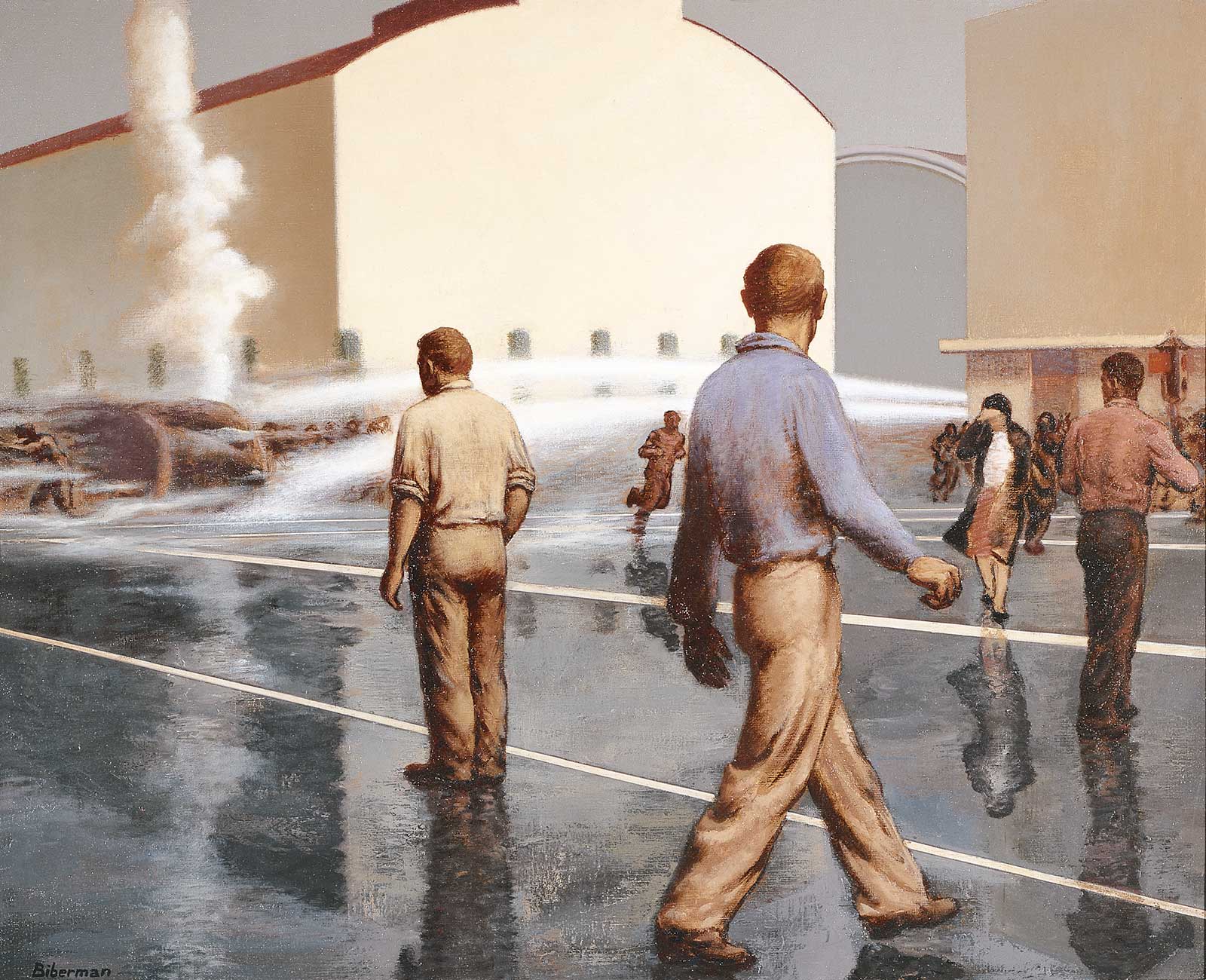 Edward Biberman (1904-1986), Tear Gas and Water Hoses, ca. 1945. Oil on canvas, 29 x 36 in. The Schoen Collection.
The contemporary context of pandemic, social justice and increasing class disparities ceases to be a moment in time or an era and is revealed as a continuum. Do not, however, mistake exhibition as documentary.
“In selecting contemporary work for this show, I was especially attracted to the work of contemporary artists that turn away from the kind of self-conscious, presentational images that define so much imagery on social media, and instead favor more introspective imagery, scenes that seem to unfold behind the fourth wall without recognizing that we are watching,” Taylor says.
The curveball arrives with the attention Taylor pays to entertainment.
Life has always been hard; people have always needed an escape from it. 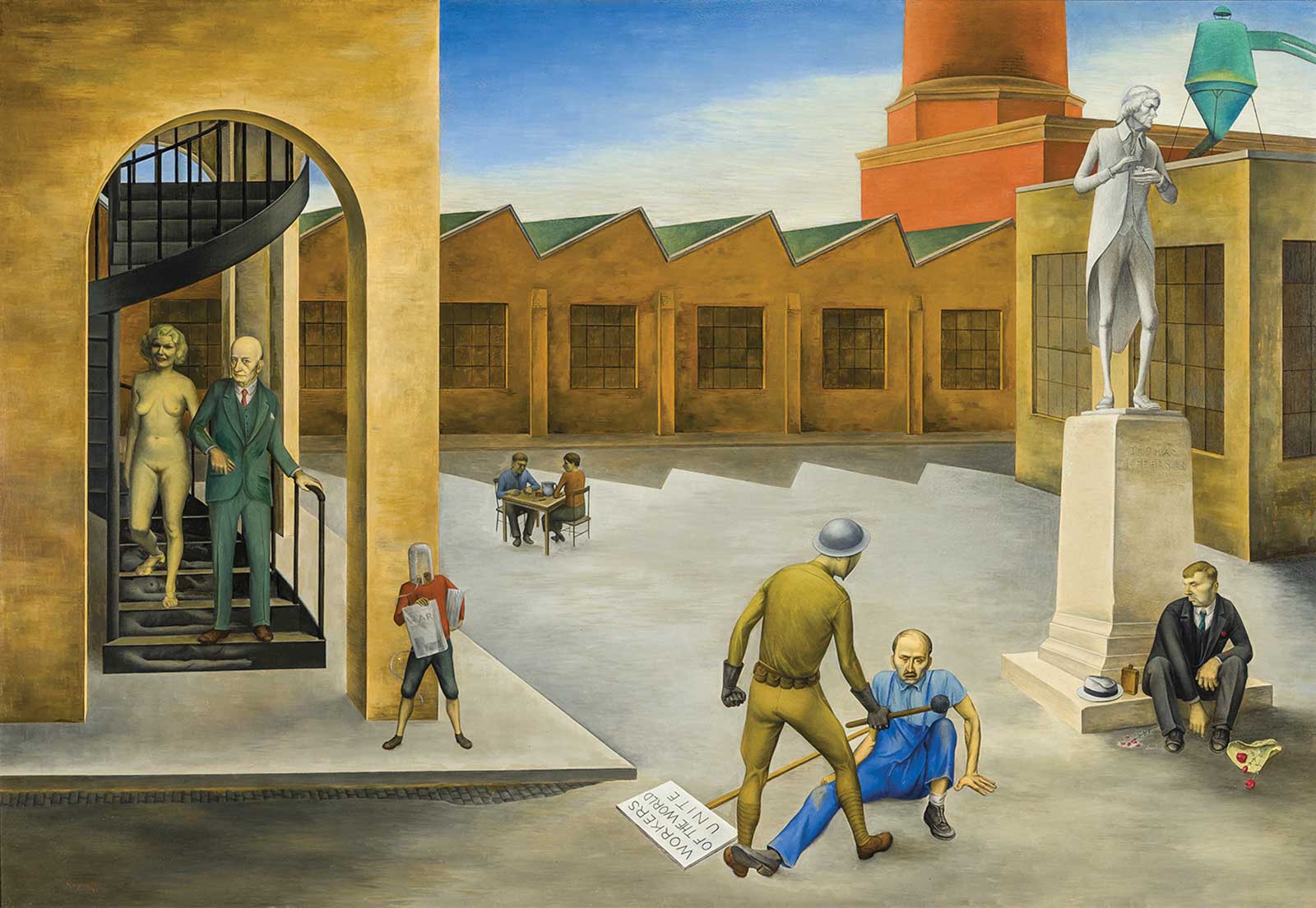 O. Louis Guglielmi (1906-1956), The American Dream, 1935. Oil on Masonite, 21½ x 32 in. Hirschl and Adler.
“Several works in the exhibition capture the experience of losing ourselves in the fantasies of the screen, whether in the crowded cinema scenes of printmaker Mabel Dwight, or in the ways that we withdraw into the worlds of our smartphones and other devices, as is evident in several of the contemporary artists in the show,” Taylor says.
Matt Bollinger’s painted animations from the past few years are a particular delight.
“(His) animations not only bring to life the narrative potential within his realist paintings, but also record something of the labor of their making,” Taylor explains. “I am very interested to see how his works cultivate the imaginative potential of other works in the exhibition.”
Alone Together at the Westmoreland Museum of Art in Greensburg, Pennsylvania, can be seen May 29 through September 25. —
Powered by Froala Editor