Albert Bierstadt satisfied Americans’ desire to have a Swiss Alps of their own by painting theatrical and, sometimes imaginative, scenes of the Rocky Mountains and points west. Our collector purchased a Bierstadt painting of the Swiss Alps as a 50th birthday present for her now late husband, beginning a focus on mountains in their collection.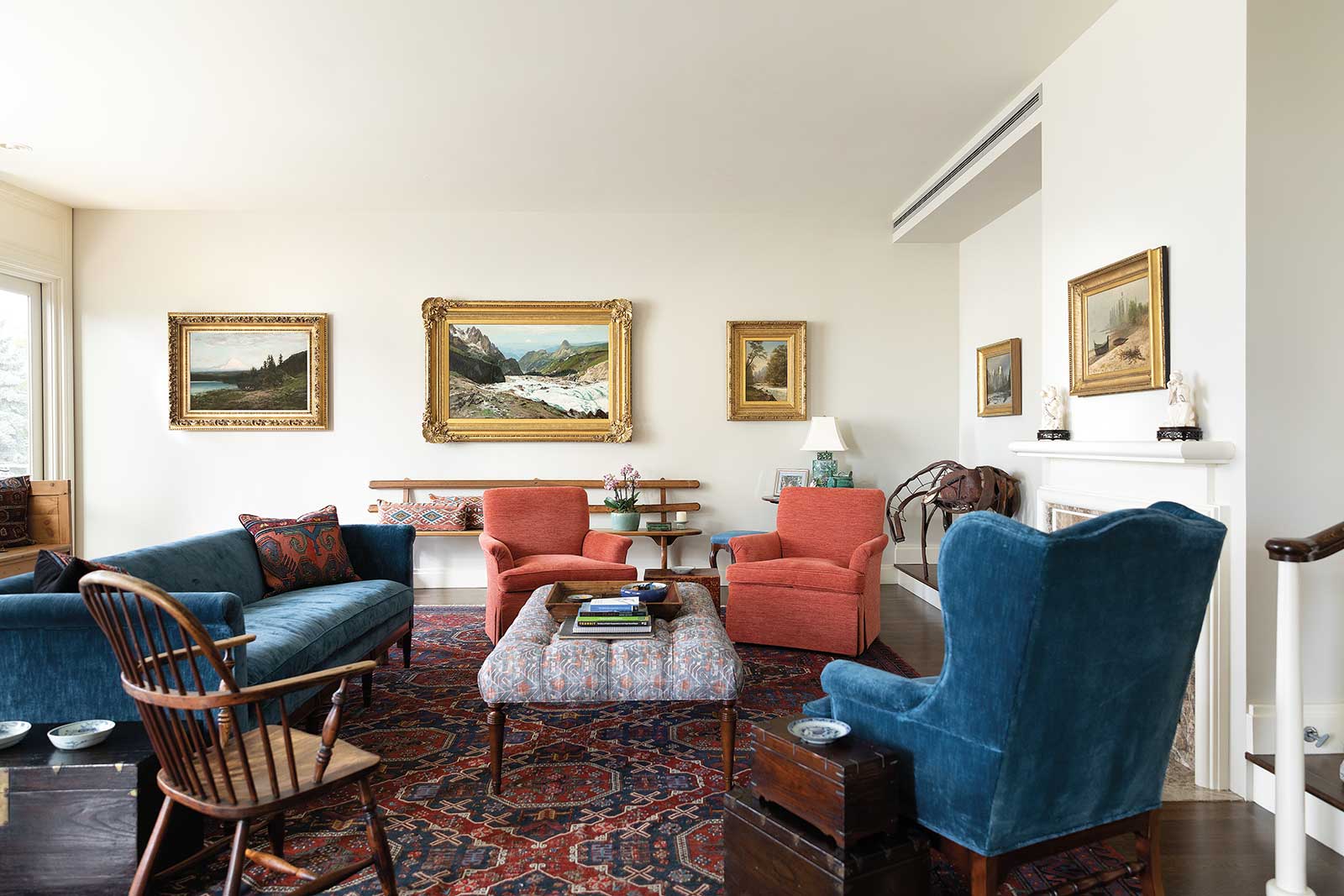 In the living room are three paintings by William Keith (1838-1911), from left: Mt. Tahoma (Rainier), 1891, oil on canvas; Nisqually Glacier, 1880s, oil on canvas; and Lower Yosemite Valley, 1863, oil on paper on canvas. On the side wall are two Albert Bierstadt works, from left: Cathedral Rocks, Yosemite Valley, California, an 1872 oil on paper, and Puget Sound Shoreline with Longboat, oil on paper on board. The horse sculpture is Deborah Butterfield’s Wheelbarrow, 1993, found steel welded.
The Bierstadts in her collection have the freshness and spontaneity of field studies from before the artist developed them into overwrought studio paintings. “I prefer a natural feeling in the paintings,” she comments.
She and her husband met in college in the East, married and moved to the Pacific Northwest where he began building a company and she began building its corporate collection. She says, “When the business was starting in 1981, we started buying local artists right away. We didn’t start seriously collecting until we had the capacity. Buying art for the office was one of our competitive advantages for our employees.”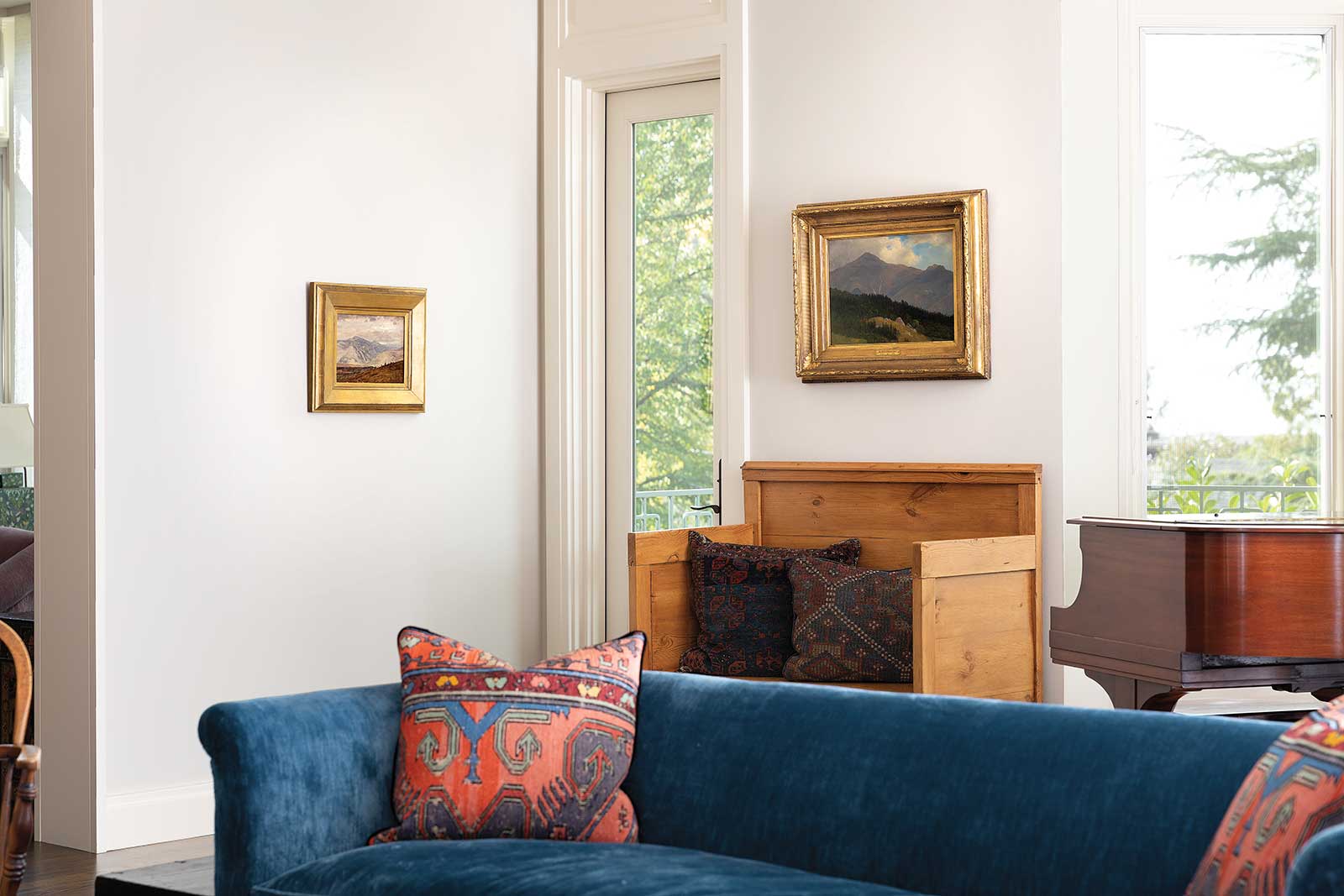 On the left is View of Kaaterskill Clove, NY, 1867, oil on paper, by Frederic Edwin Church (1826-1900). Above the settee is Rocky Mountains, oil on paper on board, by Albert Biertstadt (1830-1902).
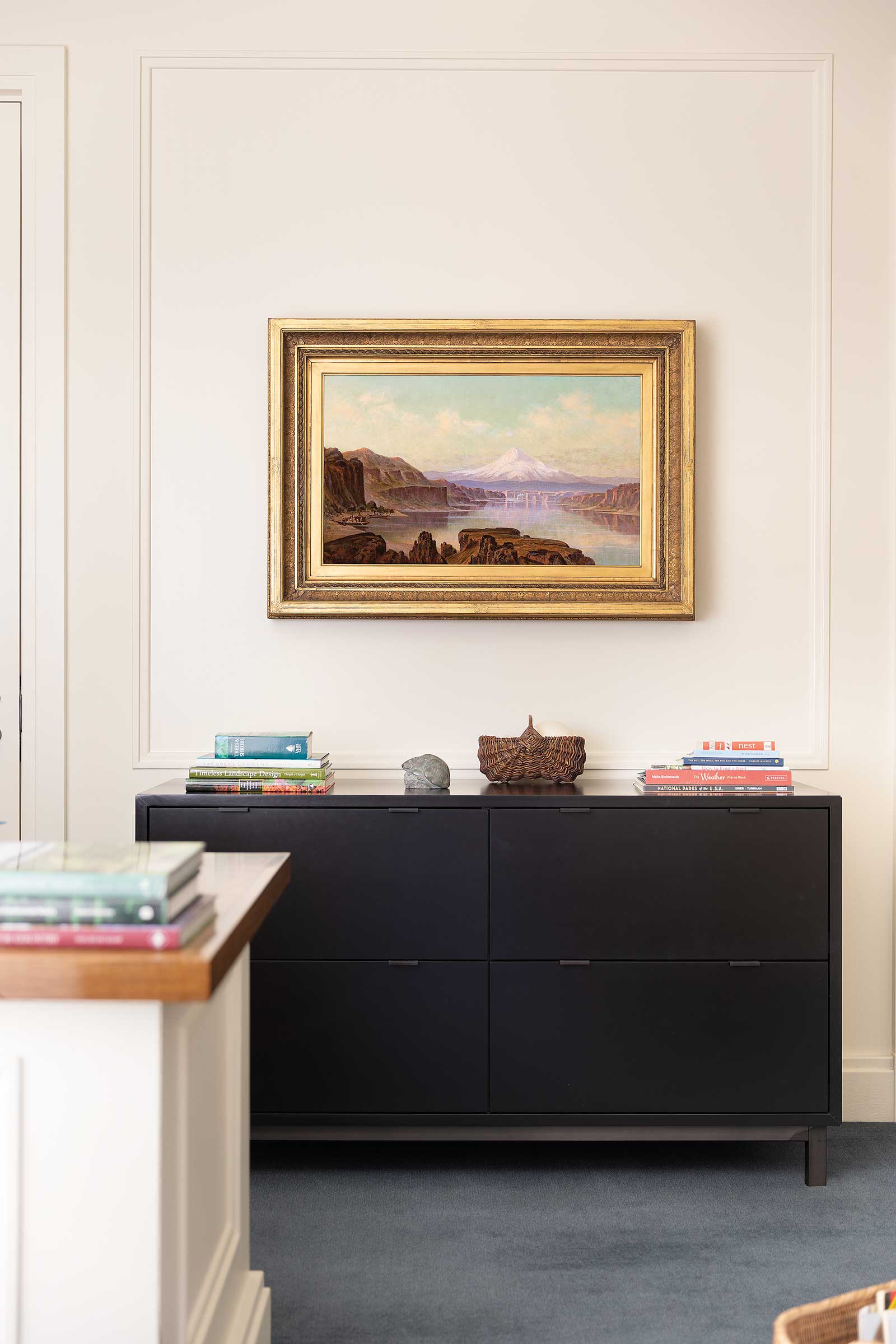 Hanging above the credenza is Mt. Hood, Oregon, 1889, oil on canvas, by Grafton Tyler Brown (1841-1918).
The collector continues, “My husband was brought up in South Carolina. His grandfather began traveling to Europe in the ’50s when he could buy art inexpensively. Back in South Carolina he started collecting artists he came in contact with locally. I grew up in the northeast where there is always an art gallery in the community. During summers on Nantucket and in Maine there were always artists around, and my parents bought art and pottery. When I was 19, I bought four pieces, a flower series, that our daughter now has.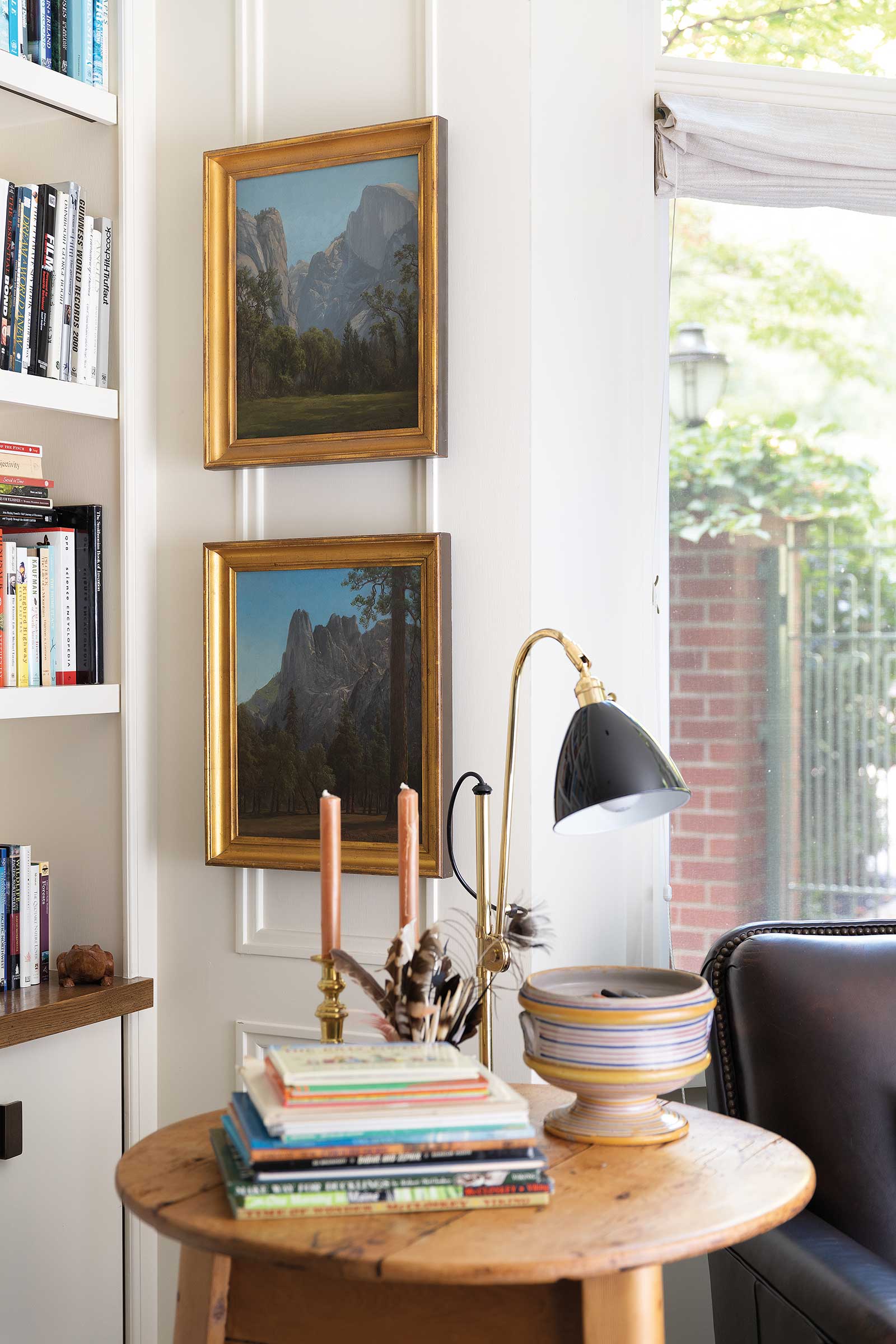 Two paintings by James David Smillie (1833-1909) hang on the wall: Half Dome Yosemite and Sentinel Rock Yosemite, both 1871, oil on gessoed paper.
“When we were assembling the corporate collection, we knew we had to do it really well,” she shares. “We were interested in the history of the Northwest and the West in general and found 19th-century landscape painting, which celebrated the West, was the richest vein to mine.”
Allan Kollar, the Seattle dealer in American paintings from 1840 to 1950, describes her painting Nisqually Glacier, by William Keith, as “a masterpiece.” “It could have been painted yesterday,” the collector says. “It’s not a dated technique. Keith accompanied John Muir on an ascent of Mount Rainier. You can imagine him sitting there doing his sketches. The painting’s resonance is more than being just a mountain picture. The glacier is now almost gone.”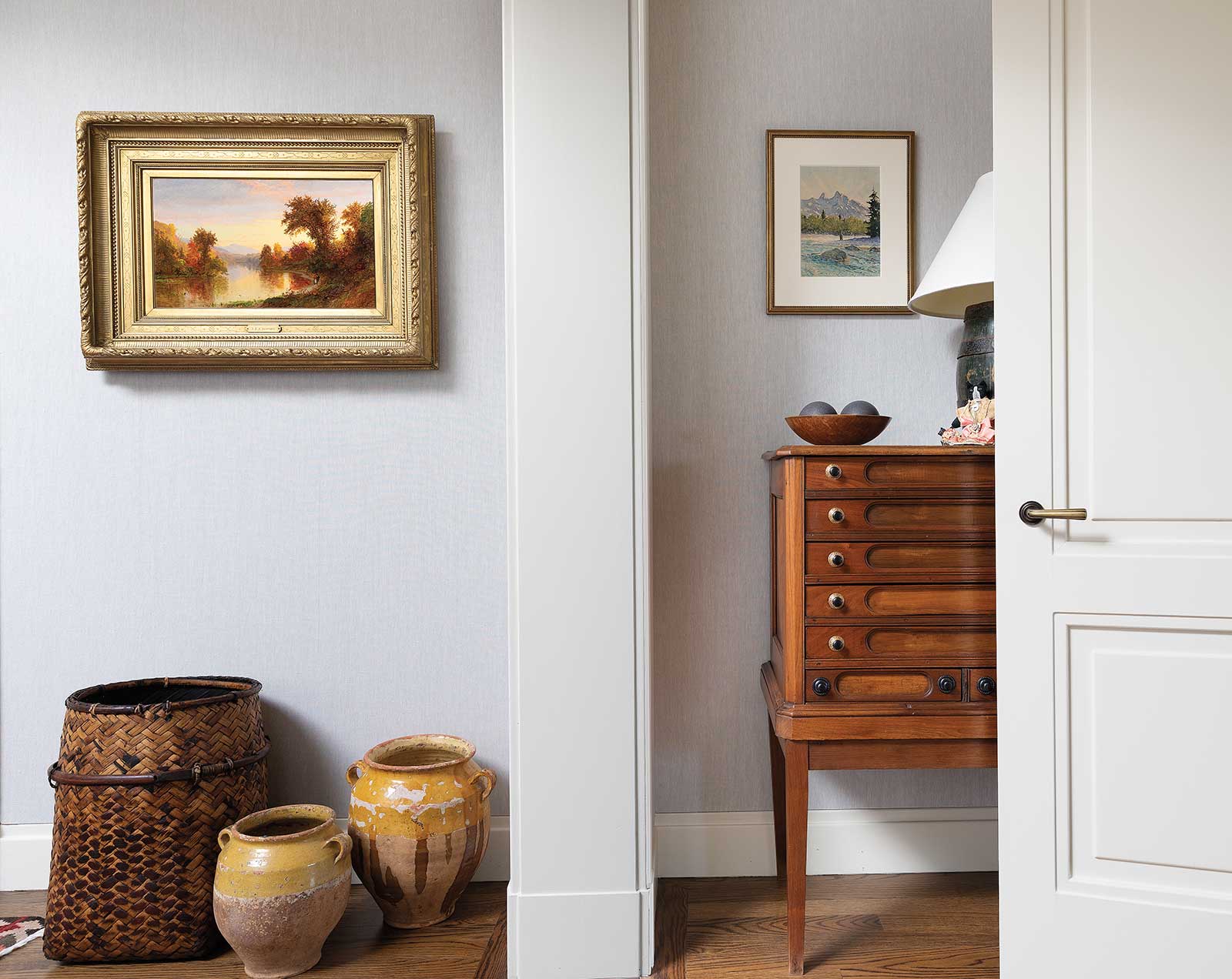 On the left is Lake in Autumn, 1871, oil on canvas, by Jasper Francis Cropsey (1823-1900). Above the cabinet is Fishing Rapids with View of Gunn Peak Near Index, Washington, watercolor on paper, by Eustace Paul Ziegler (1881-1969).
While knowledgeable about and fond of her 19th-century mountain scenes, she also collects modern artists of the Northwest School such as Mark Tobey, Morris Graves, George Tsutakawa and James Washington Jr., all of whom shared an affinity with the natural world.
“Until recently, I had never come across a piece by Morris Graves that I wanted or that made sense in the collection,” the collector explains. “Pitcher, 1971, felt right in terms of size and subject matter. Graves and Washington were seeing the world visually in similar ways. It’s as if Washington took Graves’ ideas and put them into stone.” Washington once said, “In my work with stone it is as if nature speaks, and I listen. Then I speak. And with the help of my hands, we speak together.”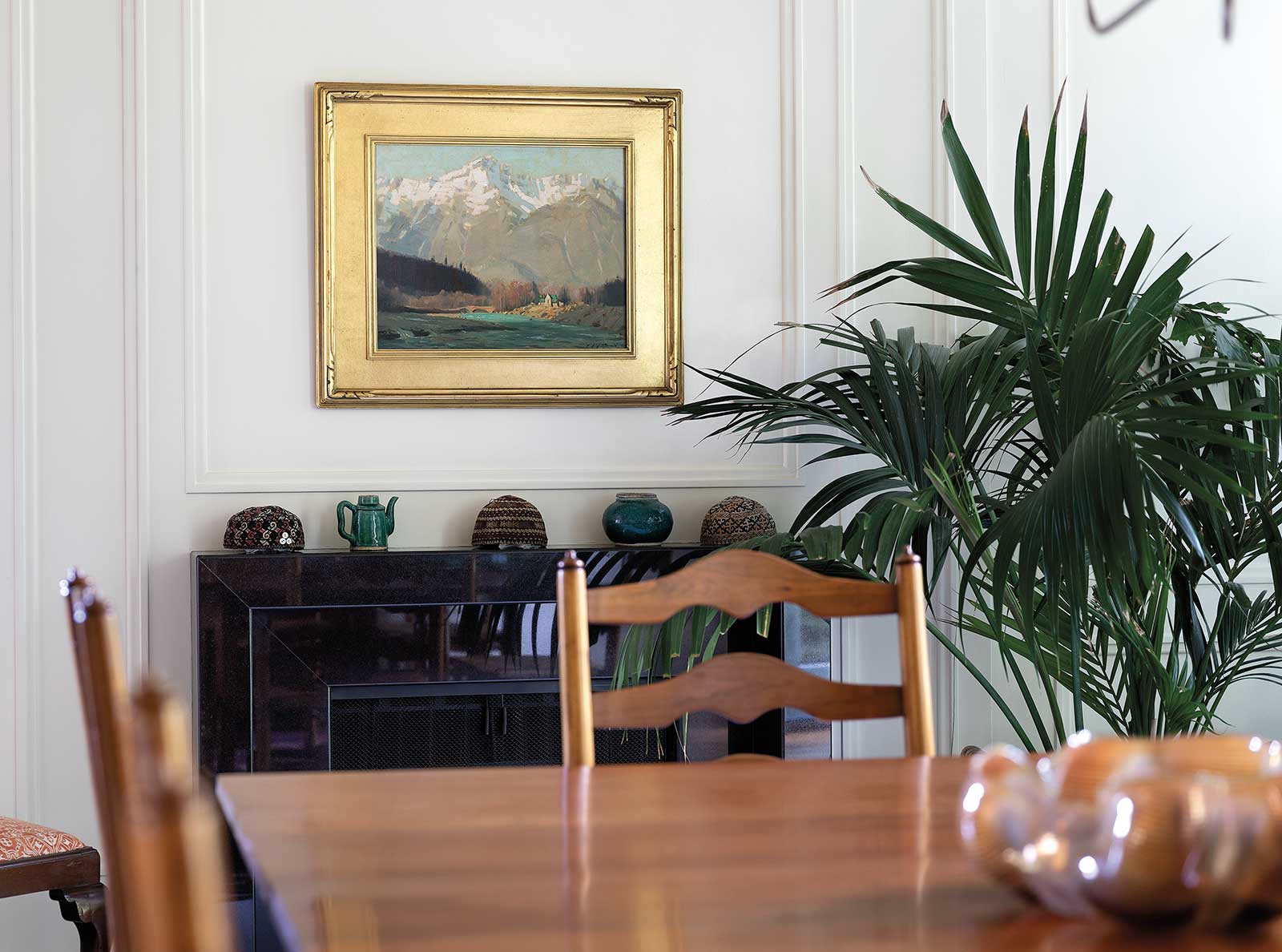 In the dining room is On the Skykomish River (Cascade Mountain Range), oil on canvas, by Edmond James Fitzgerald (1912-1989).
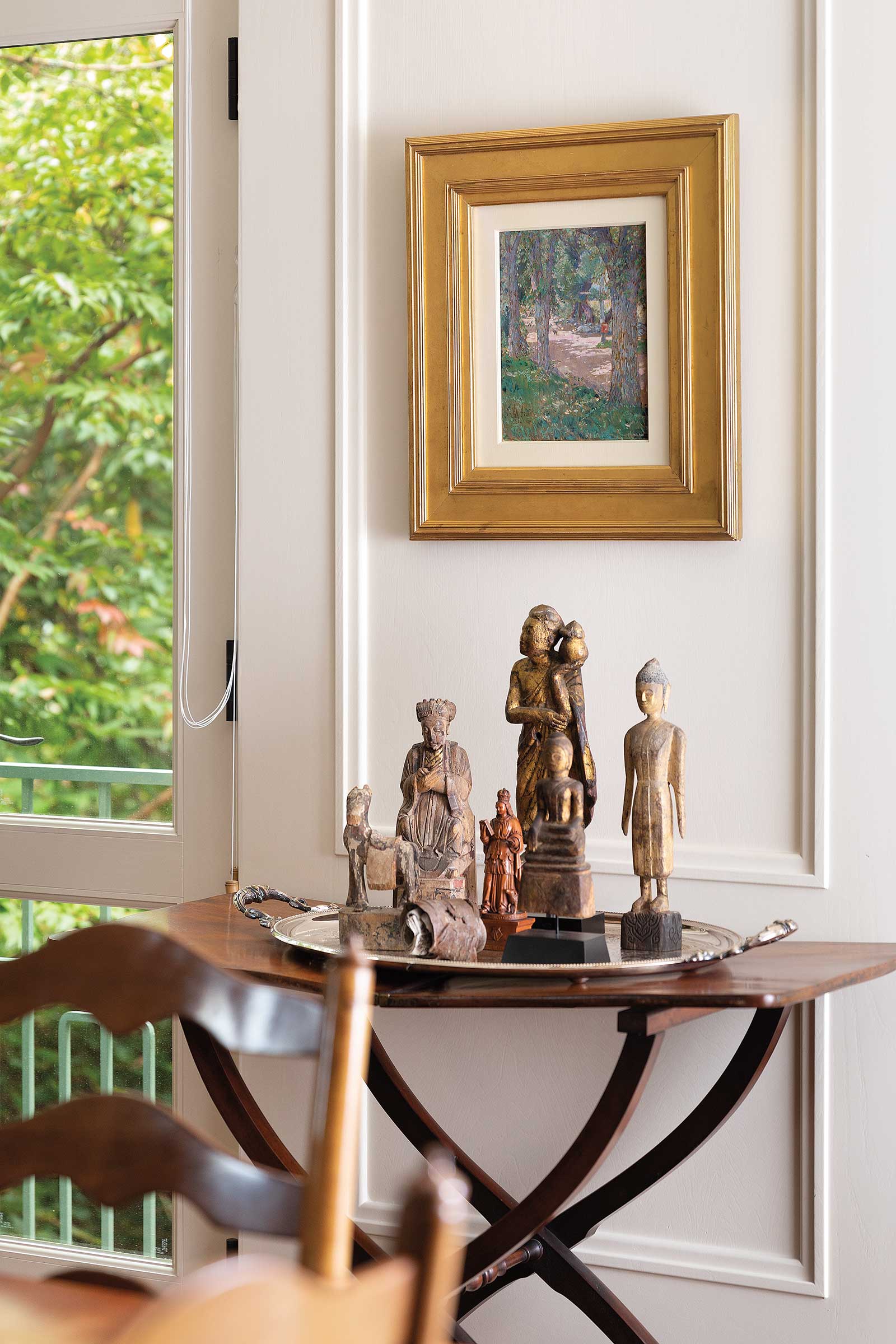 Letter Box, Gloucester, 1899, watercolor, ink and Chinese white on paper, by Childe Hassam (1859-1935), hangs above a group of figurines.
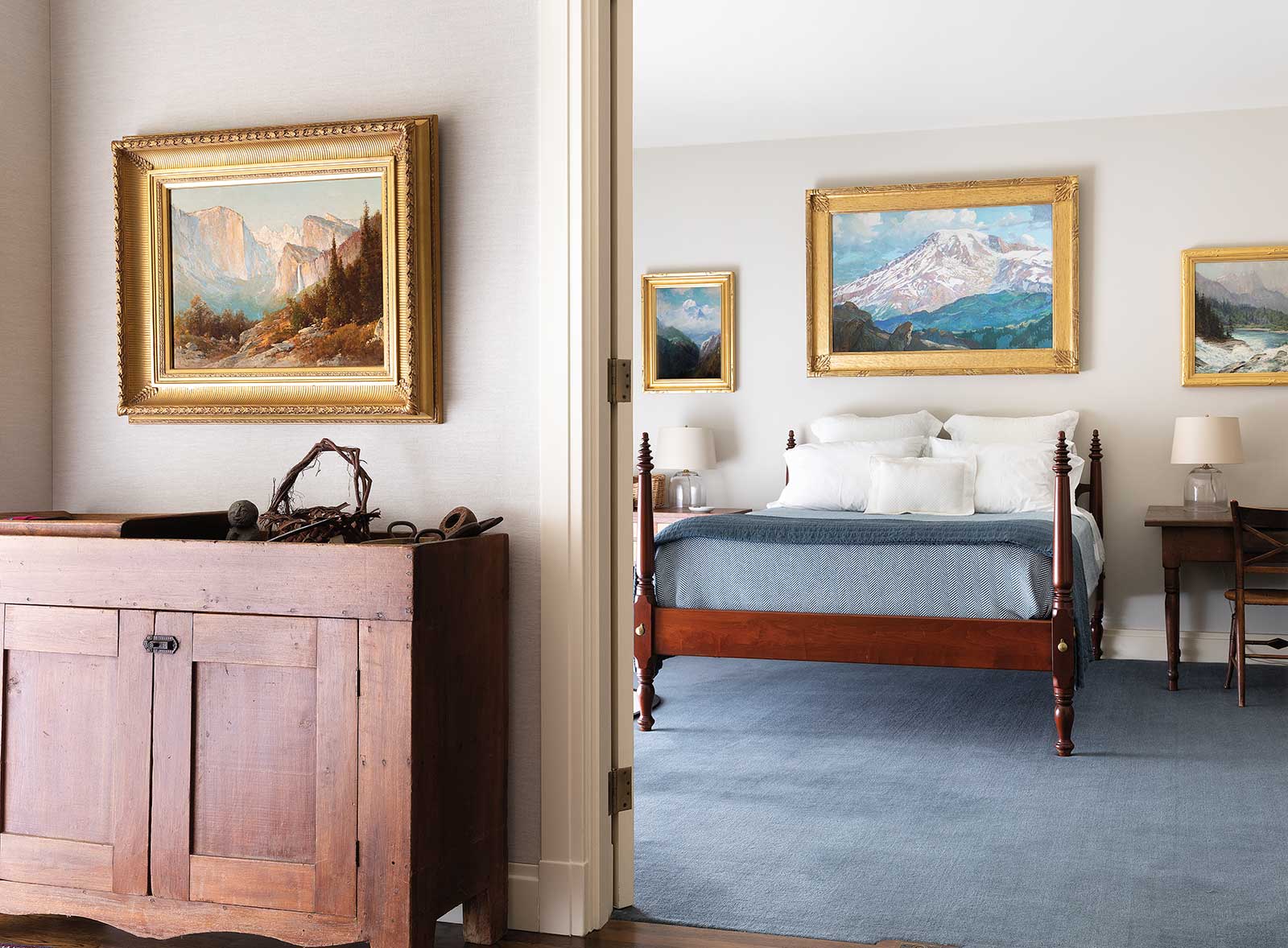 Hanging above the washstand is Yosemite Panorama, 1883, oil on paper laid down, by Thomas Hill (1829-1908). Above the bed are, from left, Mt. McKinley, oil on panel by Sidney Laurence (1865-1940); Mt. Rainier, gouache on board, by Gunnar Mauritz Widforss (1879-1934); and Mt. Index from Sunset Falls, Washington State, by Louis Aston Knight (1873-1948).
She welcomes input from friends and advisors. “I have a friend who collects American art,” she says. “He would often get in touch and say, ‘This is a painting you need to have,’ or he would have the gallery send a piece, which would suddenly arrive on my doorstep. I had met Allan Kollar at an art fair. He alerts me if he finds something that might fit in the collection. He found the Grafton Tyler Brown and had it cleaned. It’s beautiful. Brown was the first African-American artist to work in the Pacific Northwest.” 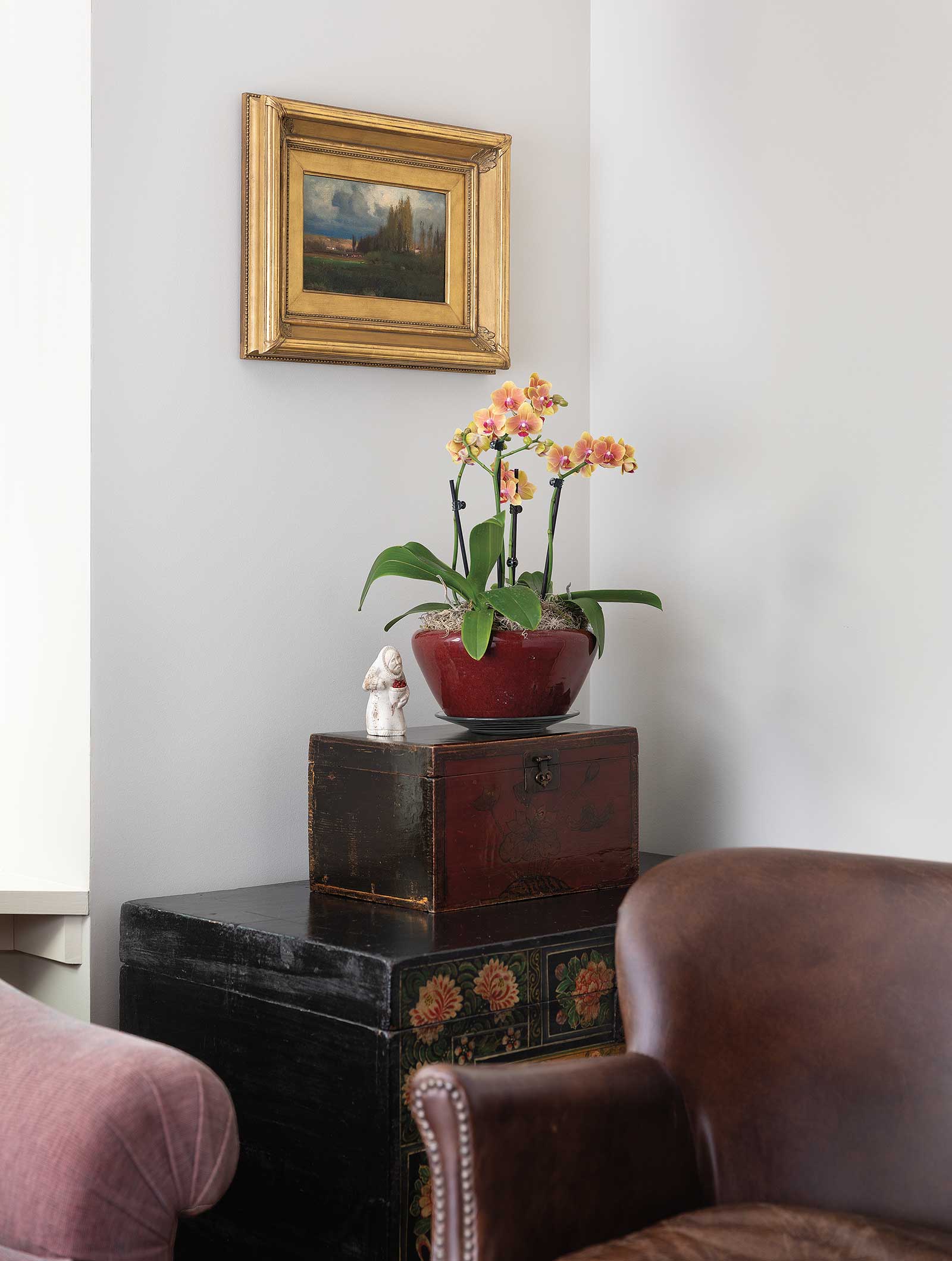 Landscape Study, 1876, oil on panel, by George Inness (1825-1894), hangs above the chests.
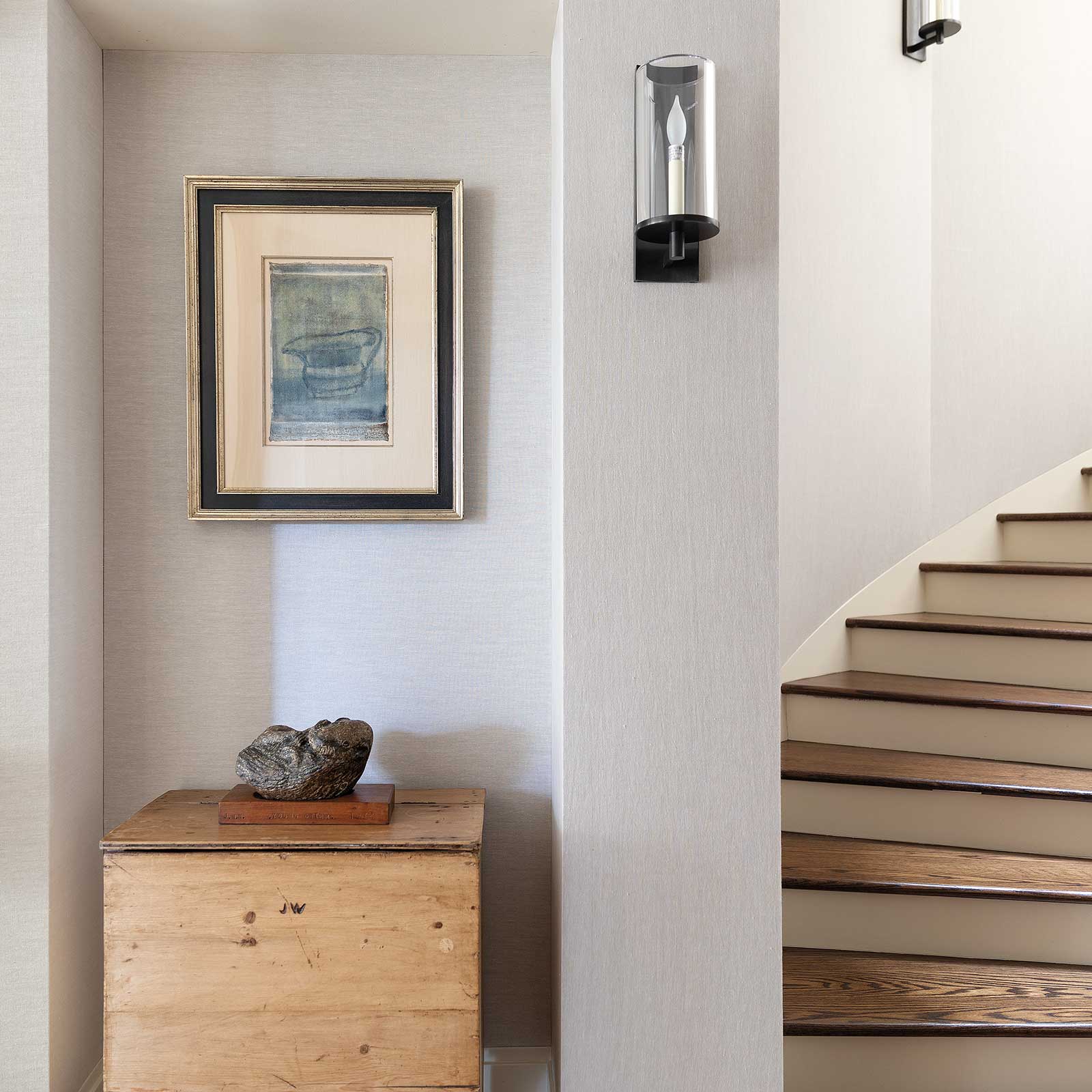 Hanging above the chest is Pitcher, 1971, watercolor and tempera on paper, by Morris Graves (1910-2001). Sitting on the chest is Young Otter, granite with wood base, by James Washington Jr. (1909-2000).
Occasionally there are works in collections that lie outside the collector’s concentration. “Even though there’s a focus,” Kollar observes, “someone who loves art can see something outside their focus that stirs the heart or the psyche. She has a passion for art.” The collector describes Childe Hassam’s Letter Box, Gloucester, 1899, as “a lovely piece. It was my choice. The depiction of the sunlight is amazing. There’s a red postbox on what appears to be a forest trail.”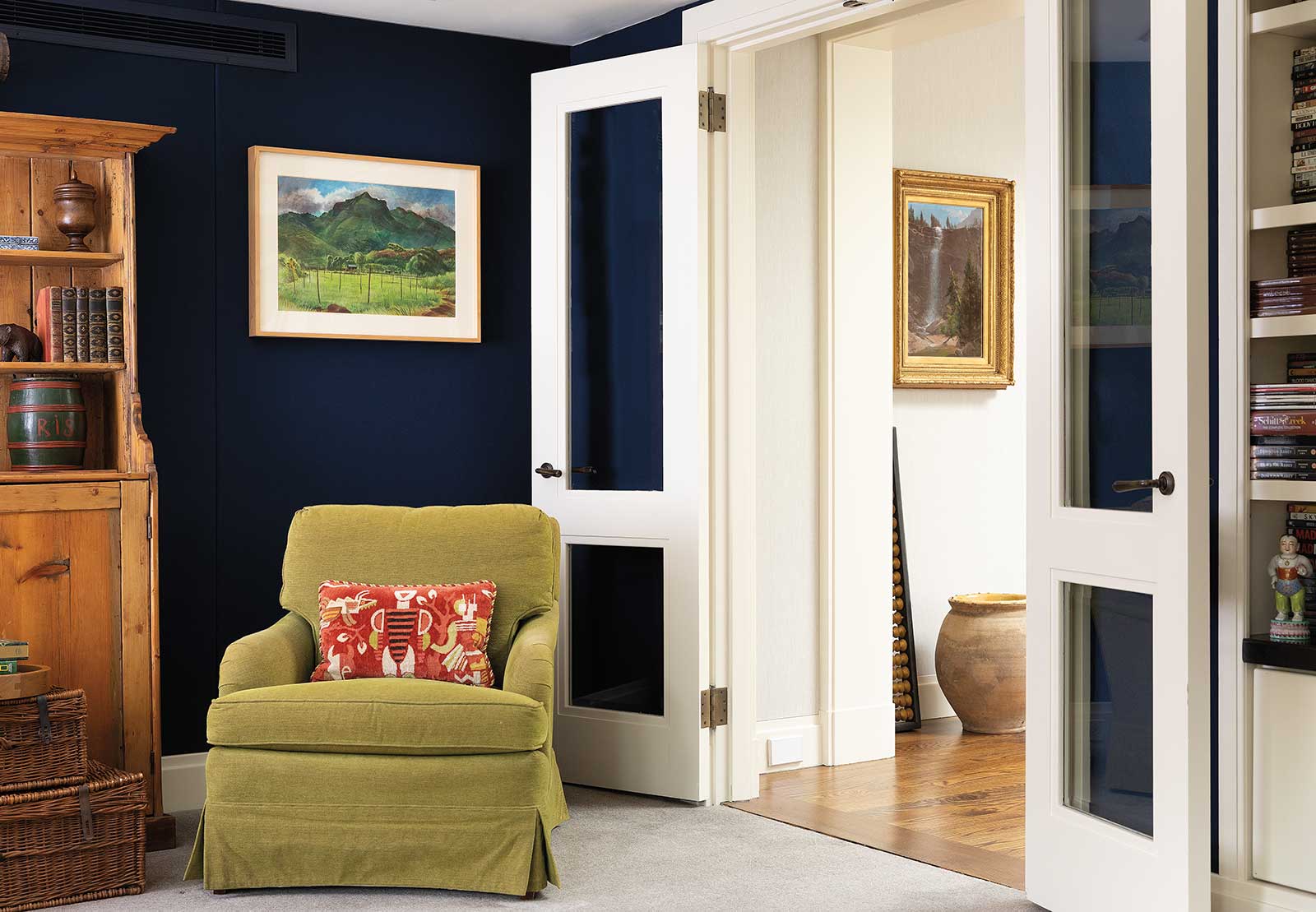 On the left is Rice Field, Kauai, Hawaii, watercolor on paper, by Ray Hill (1891-1980). In the adjoining room is Nevada Falls, Yosemite, oil on canvas, by Thomas Hill (1829-1908).
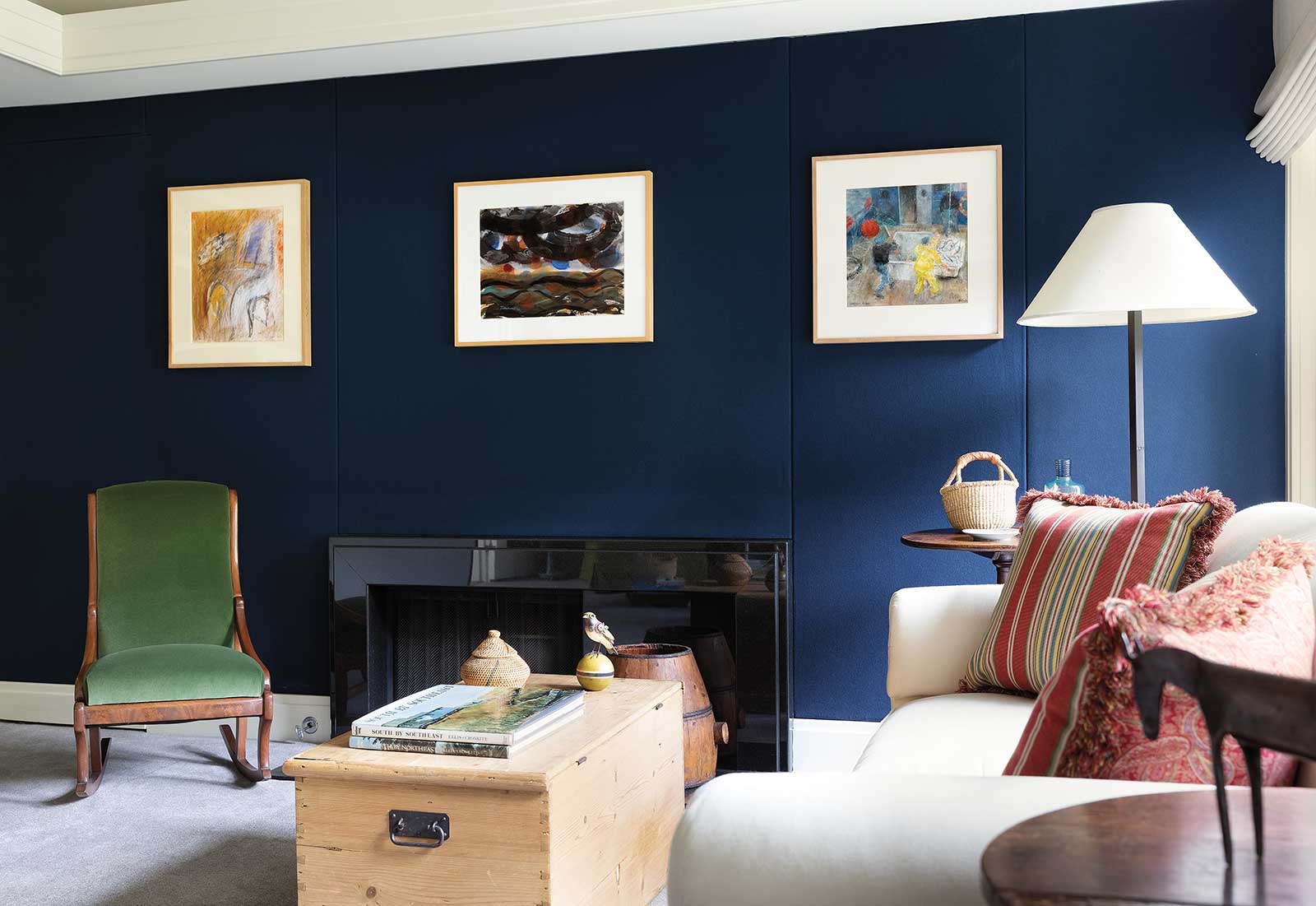 The paintings are, from left, Untitled, mixed media on paper, by William Ivey (1919-1992); Untitled, 1972, watercolor on paper, by George Tsutakawa (1910-1997); and Unloading Tender, 1995, watercolor and pencil on paper, by Piet Klaasse (1918-2001).Beneath the Hassam is a collection of figures from Buddhist deities to Saint Marguerite. “They’re mostly decorative,” she says. “I’m struck by the drive of humans to create decorative elements.” Displayed throughout her home are pottery, baskets and other utilitarian items. “It’s the heart of human art making to make even these utilitarian things beautiful. I really admire Northwest Native basketry. There are also wonderfully embroidered Central Asian hats that men of the Steppe region wear. I’ve also bought Central Asian flat weave rugs. Like the baskets, they’re painstakingly woven without machinery. For me, there’s an appreciation of what it takes to make something, especially pieces not done by trained people. I love the paintings, but the artifacts are part of the whole.” —
Powered by Froala Editor