French Impressionism was once considered the most outrageous and misunderstood artwork created in the 19th century, but the artists and their work would have the honor of becoming among the most recognized and adored in the history of art. While the style was met with much dismay and even shunned at first in Paris at the juried Salon—being called mere sketches or unfinished works by both critics and collectors—this radically different genre later made its way to America and became one of the most widespread genres of American fine art.
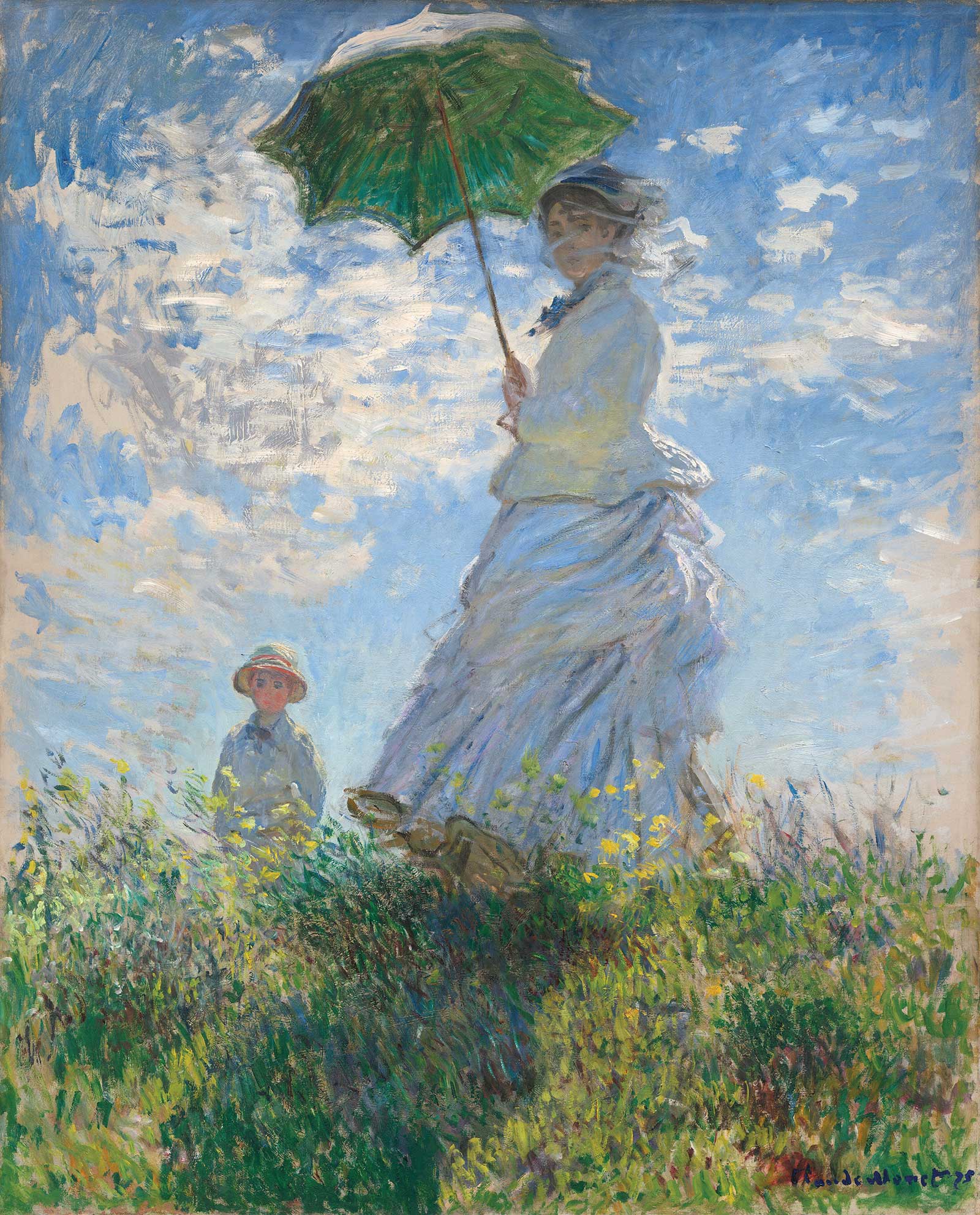 Claude Monet (1840-1926), Woman with a Parasol – Mme Monet and Her Son, 1875. Oil. National Gallery of Art.
AMERICAN ART
The American art world was poised and somewhat ready for the arrival of impressionism. There was an open mind mentality of the “New World” and newly wealthy art patrons that were ready to try new things. Prior to the arrival of this style from France, America had made a mark with its depictions of vast landscapes. Artists and artwork in America had started out with a focus on portraits of land-owning, wealthy patrons, and the rigid, classical realism of Europe was still revered. It was difficult to import works from Europe, and America needed to develop its own works and styles. American artists often made the difficult journey to Europe to study at the traditional ateliers only to return and continue with this realist tradition at home. Portraits created by artists such as John Singleton Copley prevailed in the late 1700s and early 1800s. These works depicted men in white wigs with fine clothing and family portraits that only the wealthy could afford. A portrait of George Washington in his glory was created by artist Charles Willson Peale, and John Trumbull’s Declaration of Independence was a multifigure work with sophisticated perspective that was considered a triumph.
America indeed was the New World, a world where open land abounded, so it’s no wonder this subject soon took its place in American art. A painter’s job was often to document and capture the greatness of this landscape and the achievements of the country. As new lands were discovered and natural wonders admired, they were translated to paintings. America began to expand west, and at this time the subjects in American art began to change. Newly famed frontier artists traveled with groups to the West and artists such as George Catlin even spent time among Native American camps, documenting the kindness of the people and creating portraits and larger works celebrating them on their horses. These were everyday scenes of people doing everyday activities. Paintings came back East showing the new lands, and collectors marveled at the never-before-seen terrain. In Boston and New York, these artists consequently also started to introduce the idea of painting everyday life. Gradually, they began to just vaguely resemble the subjects and some of the ideologies of French Impressionism, which valued depictions of daily life and a sense of naturalism as opposed to classical themes.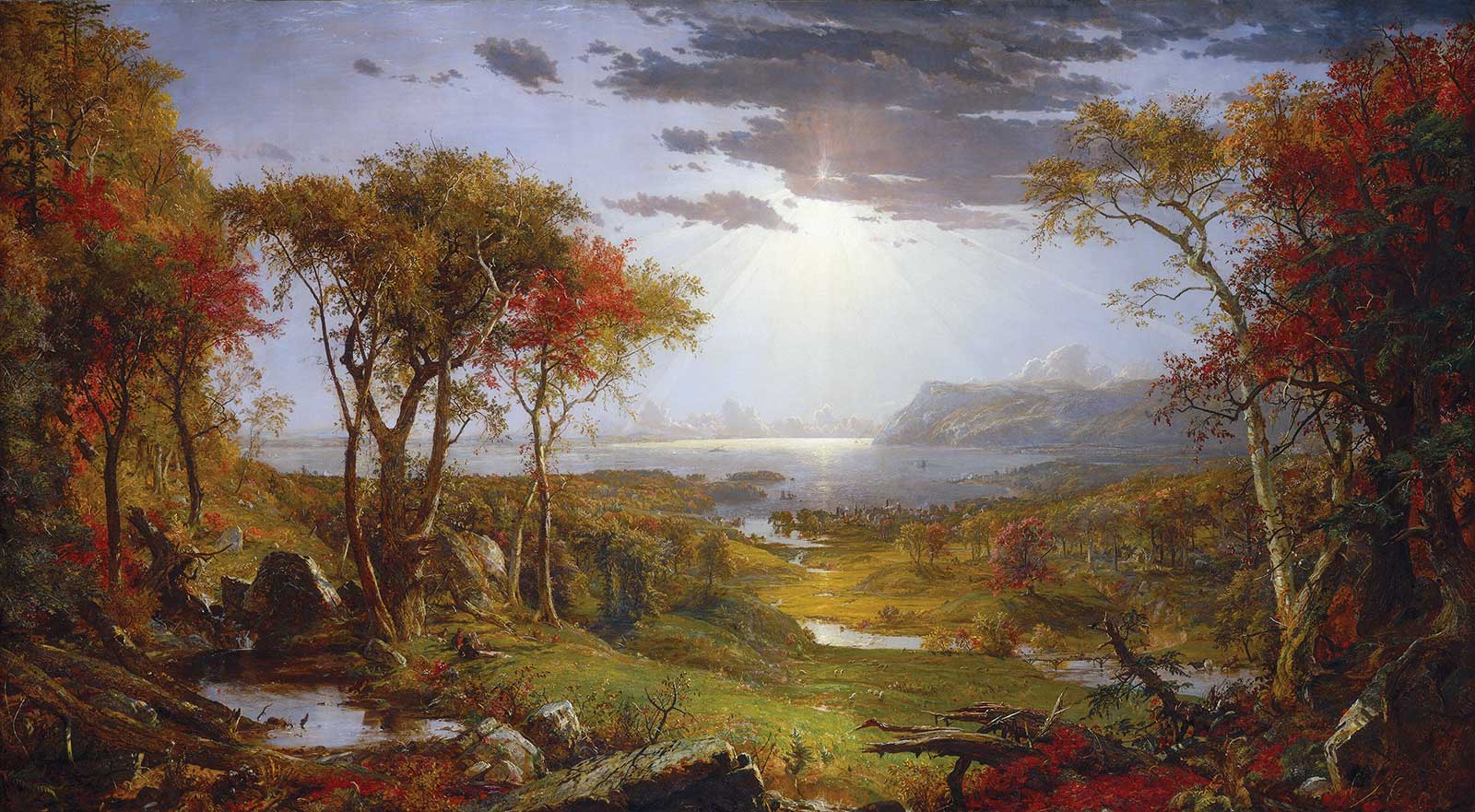 Jasper Francis Cropsey (1823-1900), Autumn on the Hudson River, 1860. Oil on canvas, 59¾ x 108¼ in. National Art Gallery.
It is interesting to note that sketches and reference paintings done by Catlin and others on location now started to have value in themselves as a subject that could be a final work of art. It was not just a sketch and the subject was not to commemorate a battle won, but rather simply they were about a man and his horse. Realism remained the style and genre of choice at this time, the subject of works, however, had simply broadened. The influence of French and German realism that was brought back to America from artists such as George Inness—who had traveled France to the Barbizon school, focused on open air landscape painting—was still the main genre. Keep in mind it was the Barbizon school in France that inspired Monet to first paint outdoors at this same time overseas in the forest of Fontainbleu.
The newly found Hudson River School began soon after and became known for naturalist-realist landscapes of the rich terrain found north of New York. It was only when the American artists started to make the change to landscape painting and later plein air, on location painting, that America had found its “own” pictorial style and genre with landscape paintings. A style called luminism also arrives in artists’ works with an intention to add a stream of light from above into the landscape and produce light atmospheric effects with subtle tonal gradation. This can be seen in Jasper Francis Cropsey’s Autumn on the Hudson River, 1860. Albert Bierstadt became one of the most successful artists of this time, simply from his painting large scale works of the Rockies and the monumental, almost heroic beauty, of the vast landscapes.
It is important to note that at this time in America, the stage is set with a trifecta of accepted traditions for the arrival of impressionism: the influx of landscape as a main subject, scenes of everyday or “modern” life starting to be accepted as art, and the use of light in luminism becoming an acknowledged theme and aspect of creating fine art.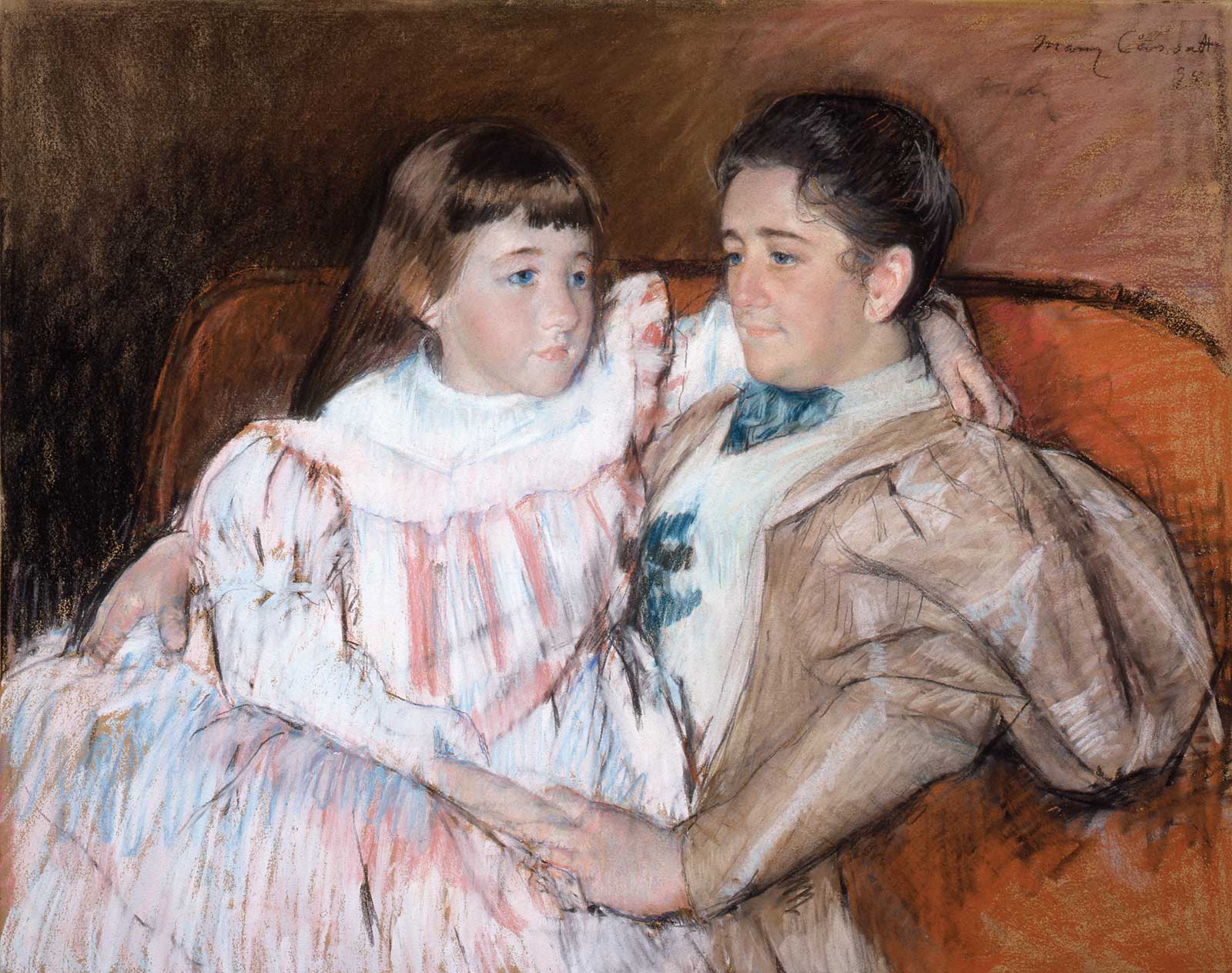 Mary Cassatt (1844-1926), Louisine Havemeyer and Her Daughter Electra, 1895. Pastel on wove paper, 24 x 30½ in.
Collection of Shelburne Museum, museum purchase. 1996-46. Photography by Bruce Schwarz. Courtesy Shelburne Museum.
AN AMERICAN IN PARIS
Amid the discovery and acceptance of landscape painting as a genre, French Impressionism was soon to have its debut in America. With the help of artist Mary Cassatt and pivotal art dealer Paul Durand-Ruel, French Impressionist works are brought to America and introduced to the public and an influential society of collectors.
Cassatt, who would become among the most important American representatives of impressionism, had studied fine art at the Pennsylvania Academy of the Fine Arts and was already a professional artist creating prints, illustrations and oil paintings. Her works in America had just a hint of the style of the new art emerging, incorporating natural outdoor scenes with some luminism and light. She went on to work and live in Paris, and while there quickly fell in love with impressionist works at the Durand-Ruel gallery. She even said, “How well I remember nearly 40 years ago seeing for the first time Degas pastels in the window of a picture dealer, in the Boulevard Haussmann, I would go there and flatten my nose against that window and absorb all I could of his art. It changed my life.”
With the pure prismatic colors laid directly on the canvas, loose brushwork and a focus on filtered flecks of light instead of the traditional modeling and rendering in realism and subjects depicting everyday life, the French Impressionist style was truly avant-garde but spoke to her.
Cassatt later met and befriended Edgar Degas, who was classically trained but was part of the Impressionist group. Degas conversely admired her work when he saw it in the 1874 Paris Salon and they end up working often together and influencing one another. She was soon asked to exhibit with the impressionists in Paris and immediately accepted. Her work and that of Berthe Morisot, the other female Impressionist member, focused mainly on domestic scenes with women and children as their subjects. The group of forward-thinking impressionists accepted their works, treated them with respect and allowed them to flourish as artists. Cassatt was the only American artist to ever show with the Impressionist group and became their greatest exponent. She labored continuously and relentlessly on behalf of the impressionists to encourage the sale of their works. Cassatt had a business relationship with gallery owner Durand-Ruel, and was bringing him clientele and, in part, encouraging him to send French Impressionist works to America because she was confident buyers would be open to the work.
While in Paris, Cassatt meets Louisine Elder (later Havemeyer), an affluent woman visiting from America, with whom she develops a great friendship. Havemeyer sits for the artist who paints her often and begins to educate and advise her on collecting art. She encourages Havemeyer to be sympathetic to new art and to collect not only well-known artists such as Courbet, but the new impressionists as well. Havemeyer describes a purchase of Degas for her collection from 1875: “It was so new and strange to me!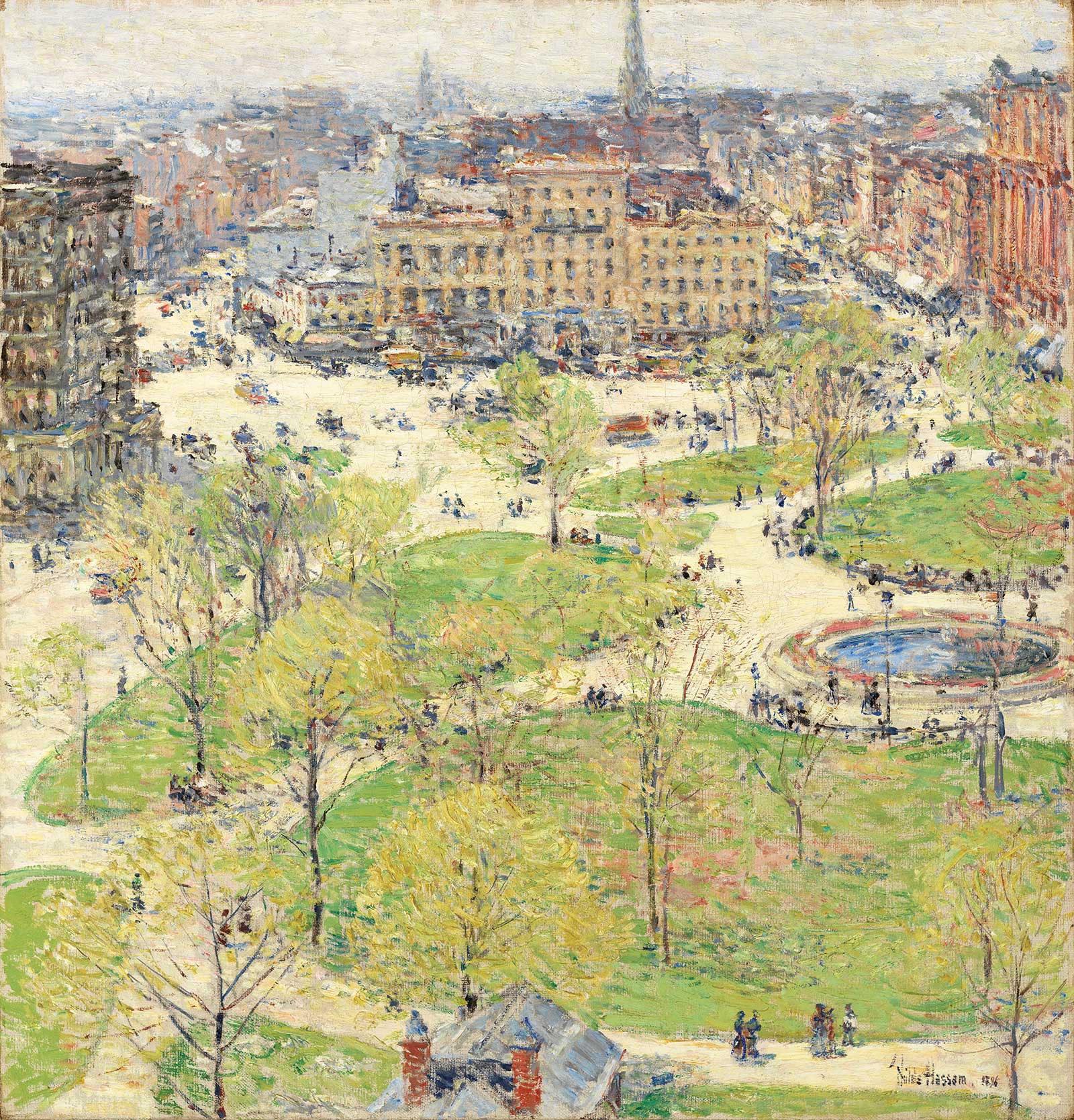 Childe Hassam (1859-1935), Union Square in Spring. Oil on canvas, 21½ x 21 in. Purchased with the Winthrop Hillyer Fund, Smith College Museum of Art, Northampton, MA. SC 1905.3.1.I scarcely knew how to appreciate it or whether I liked it or not, for I believed it takes a special brain to understand Degas. There was nothing the matter with Mary Cassatt’s brain cells, however, and she left me in no doubt as to the desirability of the purchase and I bought it upon her advice.”
With that purchase of 500 francs in Paris (about $100 today) and eight years before the French Impressionists came to America, she became the first American patron of their work and would be the beginning of an entire collection. (The Havemeyer collection makes up most of the Metropolitan Museum of Art’s American collection today.) Cassatt’s brother, Alexander Cassatt, who was first reluctant, but respecting his sister’s judgement, also makes purchases of the works in Paris for his collection early in 1880. These purchases end up greatly influencing the arrival of this exciting genre to America.
IMPORTING WORKS TO AMERICA
America was open to receive these works because of where fine art stood at the time. With Cassatt’s encouragement and influence, the style became widely accepted and loved by art patrons as well as the press and art critics in America.
Durand-Ruel, with the help of Cassatt and other connections, was able to include works in the 1883 Boston Foreign Exhibition. He wrote to Pissarro, “One must try to revolutionize the New World at the same time as the old.” However, this first glimpse of the works in America went unnoticed, and it wasn’t until 1885 when James F. Sutton, a representative of the American Art Association of New York, visited Durand-Ruel in Paris was there a momentum. The Havemeyer families were supporters of the association, but many of the French Impressionists were reluctant to give works to sell. In the end they forged ahead and Durand-Ruel sent nearly 300 paintings by Monet, Degas, Pissarro and more. There was low risk to try it as fees for shipping, insurance and publicity were to be covered by the association. It was on April 10, 1886, the “Impressionists of Paris” were unleashed to the American public, marking an important turning point for art in America.
The American press related its remarks and, as it was in France, the style was again met with controversy and there were some poor critiques about the works. Some traditional artists condemned it as unpolished and too spontaneous. There were, however, some enthusiastic notes with writers admiring the landscapes of Monet and the figures of Degas, alluding to the fact that the delightful use of sunshine overcame the inadequacy of the drawings. It is safe to say that overall Americans were more open and less hostile to the new work.
Let us briefly recall that the emergence and influence of the French Impressionists was discussed already critically in the American press as early as May 1876 when writer Henry James writes a seemingly positive and sympathetic review of the Durand-Ruel gallery exhibition back in Paris for the New York Tribune, calling the work “decidedly interesting.” At the 1886 exhibition, then, it seems the American public, accustomed to seeing landscapes as fine art by then, and celebrating the effects of light with some of their well-known luminists, as well as sketches and works that were about everyday life, were less affected by these brave new works. Perhaps they simply understood that these works were more about the lighting effects and found the bold colors to be invigorating and delightful.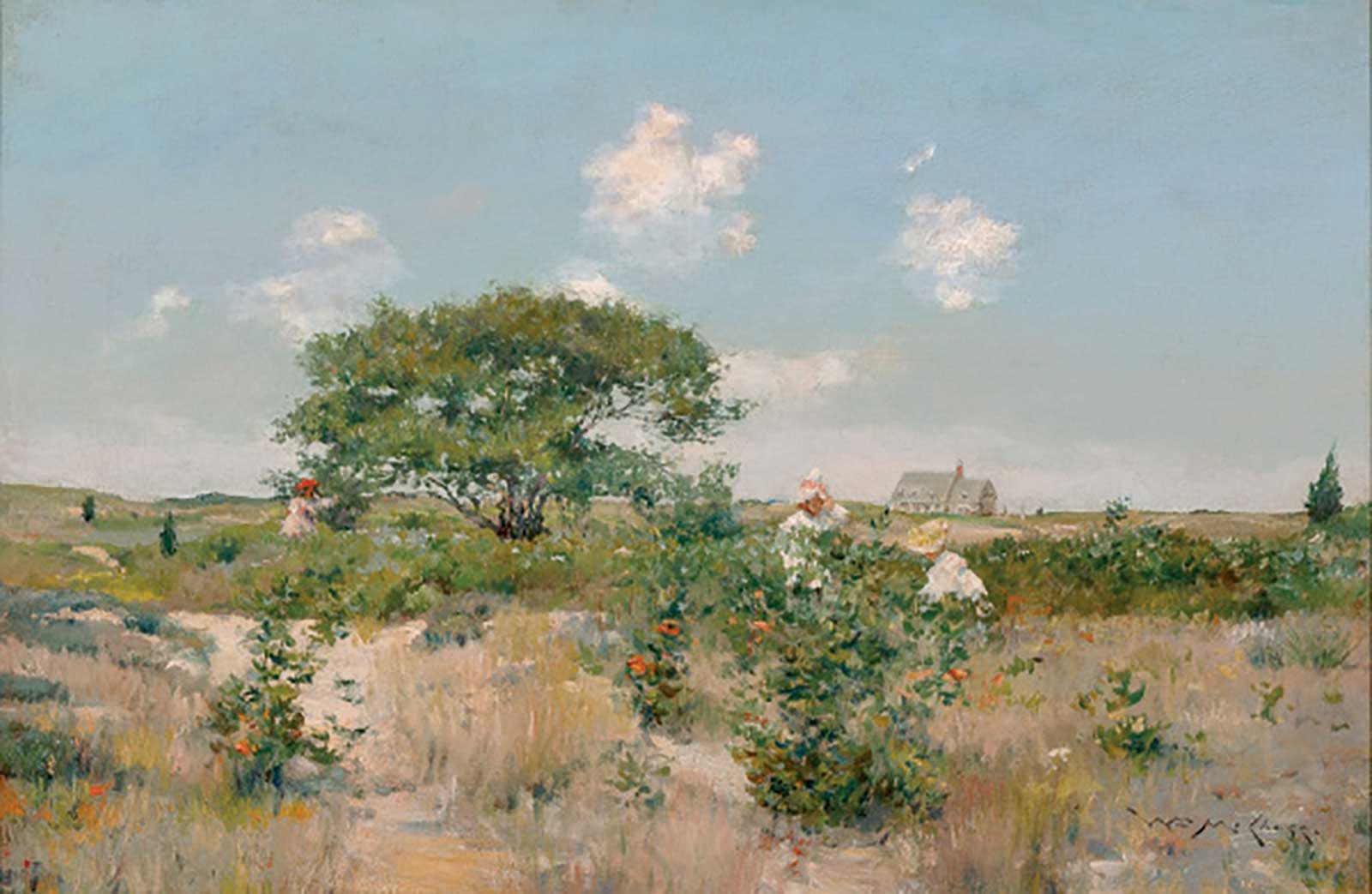 William Merritt Chase (1849-1916), Shinnecock Landscape, ca. 1894. Oil on canvas, 16 x 24 in. Permanent collection of the Parrish Art Museum, Water Mill, NY. Courtesy Parrish Art Museum, Water Mill, NY.AMERICAN IMPRESSIONISM
The American collectors and artists seemed to understand that the style of impressionism abolished the classical distinction between a sketch and a more finished painting, letting a work be looser in style, with bolder brushwork and lighting effects with modern life subjects. American impressionism that was rooted in natural landscape and realism took on many of the French Impressionist painting aspects including dabbled brushwork and color, and seemed to combine realism and impressionism in a brand-new way…a specifically American translation.
In the 1890s Childe Hassam, one of the most celebrated of the American impressionists who had seen the works live in New York, was clearly influenced. Soon after he went to study in France. In 1887 and 1888 his style changed from tonalist grays with finished smooth rendered strokes to a looser style perhaps influenced directly by Pissarro and his visible brushworks. In his early impressionist work, as in Union Square in Spring, there is a similarity between he and Pissarro’s Paris streets and style with its focus on the park trees and flecked strokes with light atmosphere in the distance. Hassam’s fascination with depicting weather in the city continues as he sets the modern cityscape as a viable new subject. In 1898 Childe and nine fellow artists, including J. Alden Wier and Tarbell, started the group The Ten, which that lasted for 20 years. They created their own group exhibitions with the primary motivation of supporting and continuing the impressionist style, beliefs and tradition.
From around 1887 to 1990, many American artists traveled to Europe, and particularly Paris, to paint with the impressionists and in the French schools. Formal outdoor teaching—“en plein air”—by impressionist-inspired Americans who were trained in Europe became popular and led to many art colonies. John Singer Sargent, Theodore Robinson, Lilla Cabot Perry, Frederick Carl Frieseke and Guy Rose all spend time with Monet in Giverny and France and carry back his colorful and light aesthetic to America and started an array of successful regional schools.
An important leader in the beginning of the success of American impressionism is William Merritt Chase, who adopted their techniques for his landscapes. He started a school in Shinnecock, Long Island, and also taught in Manhattan, Brooklyn and Europe. His earlier style stemmed from Munich school or tonalist works but developed into brighter light filled works with flickering patterns and brushwork. Other important schools of impressionism and outdoor painting pop up. John Twachtman and Hassam called Old Lyme, Connecticut, the “American Giverny.” Weir was in upstate New York, and Robert Vonnoh made his mark in the Boston schools. Tarbell and Benson were with the Hoosier school in Indiana.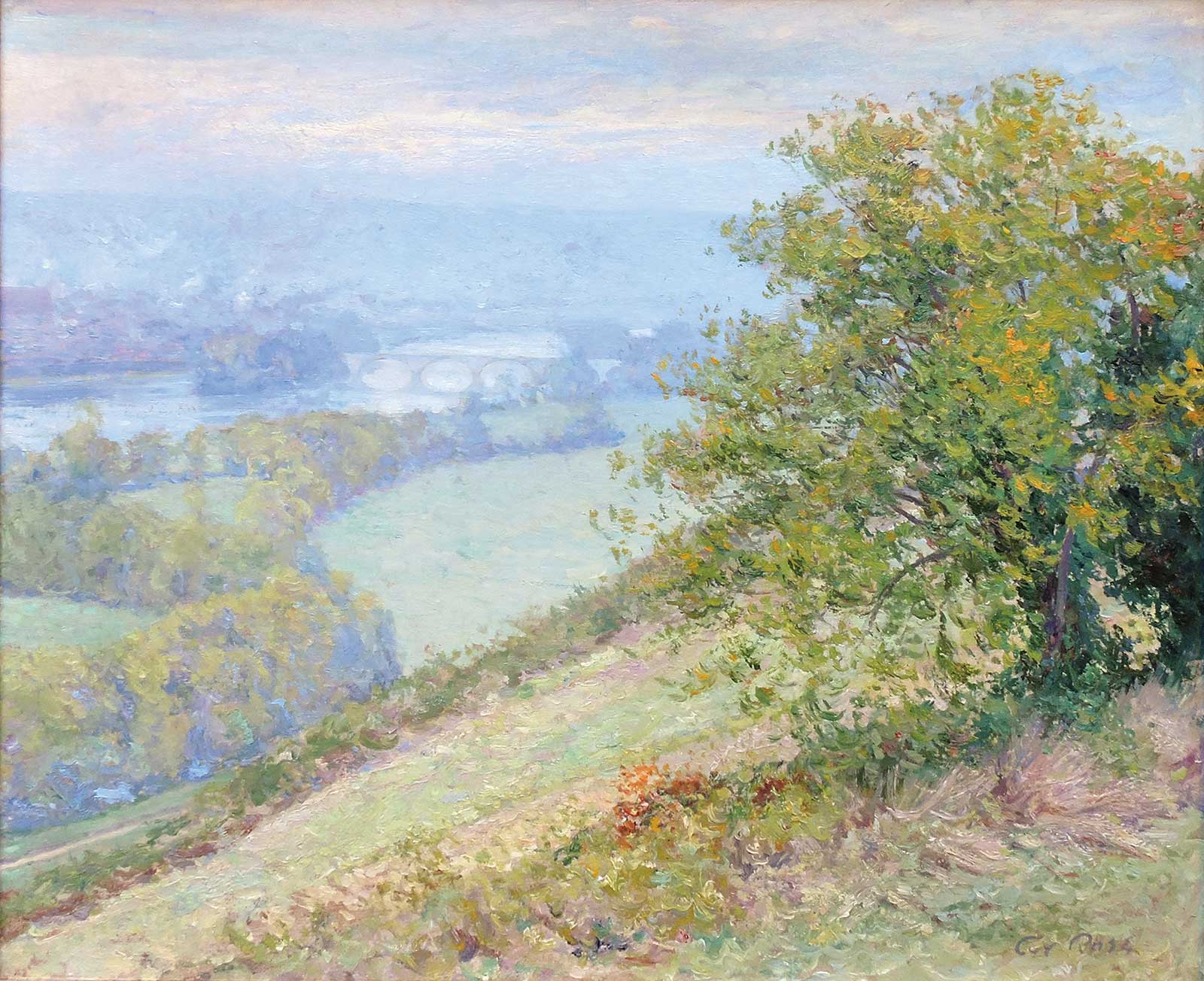 Guy Rose (1867-1925), Giverny Valley. Oil on canvas, 24 x 29 in. Courtesy Steven Stern Fine Art, Los Angeles, CA.
Eventually the style makes its way all the way to California where it enjoys a 30-year endless summer before the world turns to modernism. The Hudson River love of nature and subject of landscapes as fine art set the scene for California artists such as Rose. He traveled to France and spent time in Giverny between 1890 and 1904 painting alongside Monet with a group of Americans that called themselves “Giverny Luminists.” He then brings his teachings and use of color and light directly back to California, a land filled similarly with color this time in the way of blue ocean and orange poppies, further influencing generations of artists to continue these traditions. Landscape painting, then simply called California Impressionism, was created with the direct influence of French Impressionists landscapes with the abundance of natural subjects in the state. Works in this style from both historical and contemporary, still flood the California markets and have become, along with the East Coast impressionist works, many of the most sought after works of American art commanding top prices at auctions
to this day.
Impressionism had not only made its beautiful mark in America, but it also became so beloved and widespread that it inspired a new style and genre all its own. Now officially written up in books, and articles such as this, it takes its place in art history known plainly as American impressionism, but plain certainly does not describe this wonderful and colorful history. —
+++
Vanessa Françoise Rothe is a curator, writer, gallery owner and fine artist working in California, Paris and New York.
Powered by Froala Editor