Some artists enjoy success while they are alive and their deaths only seem to increase their fame. For others, the converse is true. Fame is followed by a fall into obscurity after death. Still others rise and fall, or fall and rise only to fall away again, in and out of favor with the winds of the zeitgeist. The reasons for this are often shrouded in mystery, or we like to think they are, reasons having to do with the art market—which we barely understand—and the question of taste—which we don’t understand at all and, wisely or unwisely, rarely speak of or write about. Occasionally, however, an artist comes along whose trajectory we can trace, whose public prominence when he was alive is readily understood, and whose swift lapse into the shadowed corridors of art history is equally unsurprising.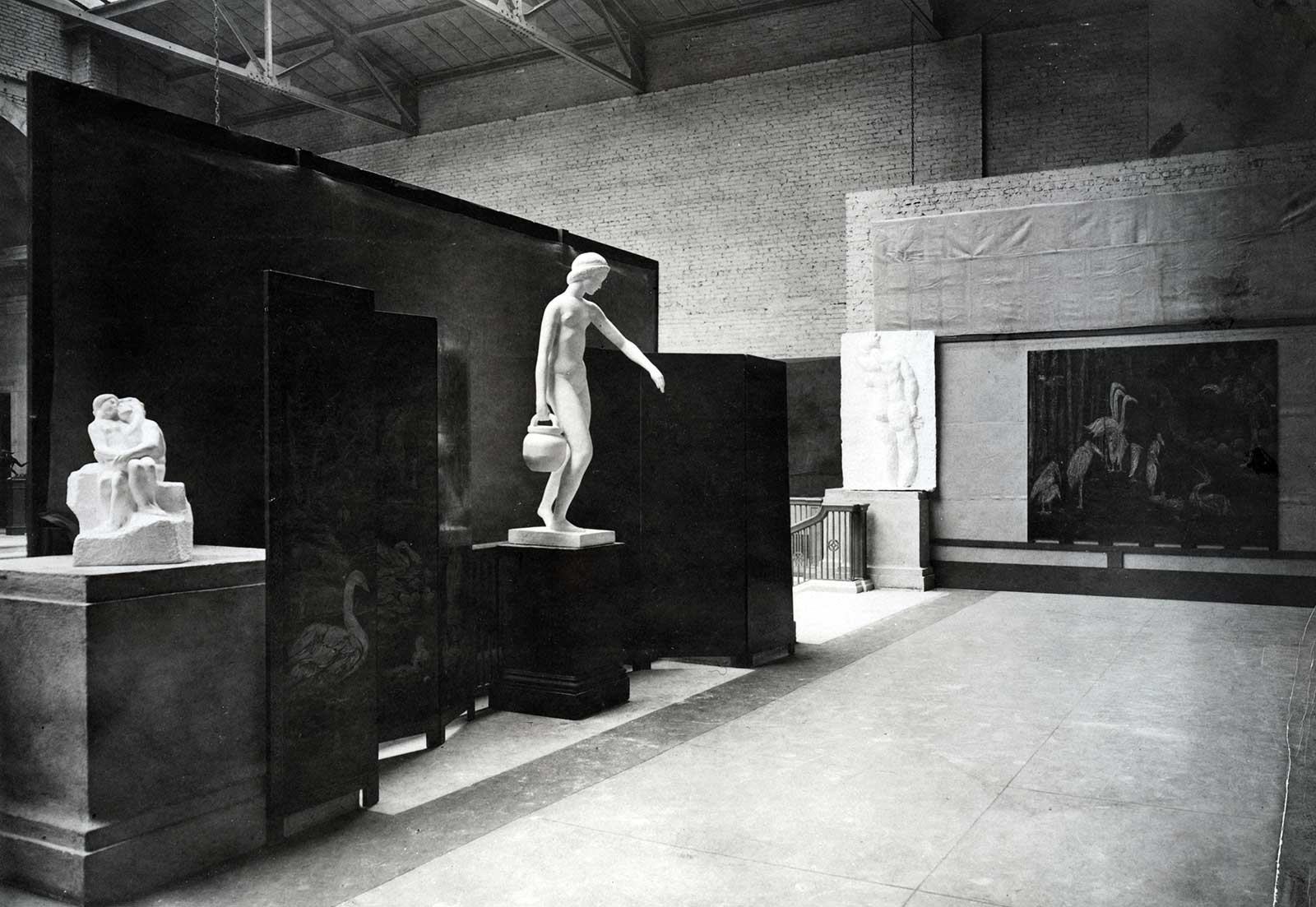 Armory Show, International Exhibition of Modern Art. French Paintings and Sculpture, Gallery 50 (top of the grand staircase, north), Art Institute of Chicago, March 24–April 16, 1913. Two screen paintings by Robert Winthrop Chanler are seen among sculptures by Jospeh Bernard, at foreground, and Henri Matisse at back.
Robert Winthrop Chanler (1873-1930) is a case in point. Chanler worked at his art, studied abroad for years, found success and a career, and developed a fascinating, utterly unique style. Of all the American artists represented in the 1913 Armory Show—alongside Picasso, Matisse and the flower of European Modernism—Chanler had far and away the most pieces in the exhibition, no fewer than 25. A photograph from the Armory Show tour to Chicago on these pages shows two of his painted screens—more on that in a bit—not far from a major Matisse. Yet Chanler’s frequent appearances in the papers and magazines—his obituaries are particularly telling—sensationalized his Bohemian lifestyle while only mentioning his art in passing. These days, he would be a provocative, viral sensation and an influencer with sponsors to spare.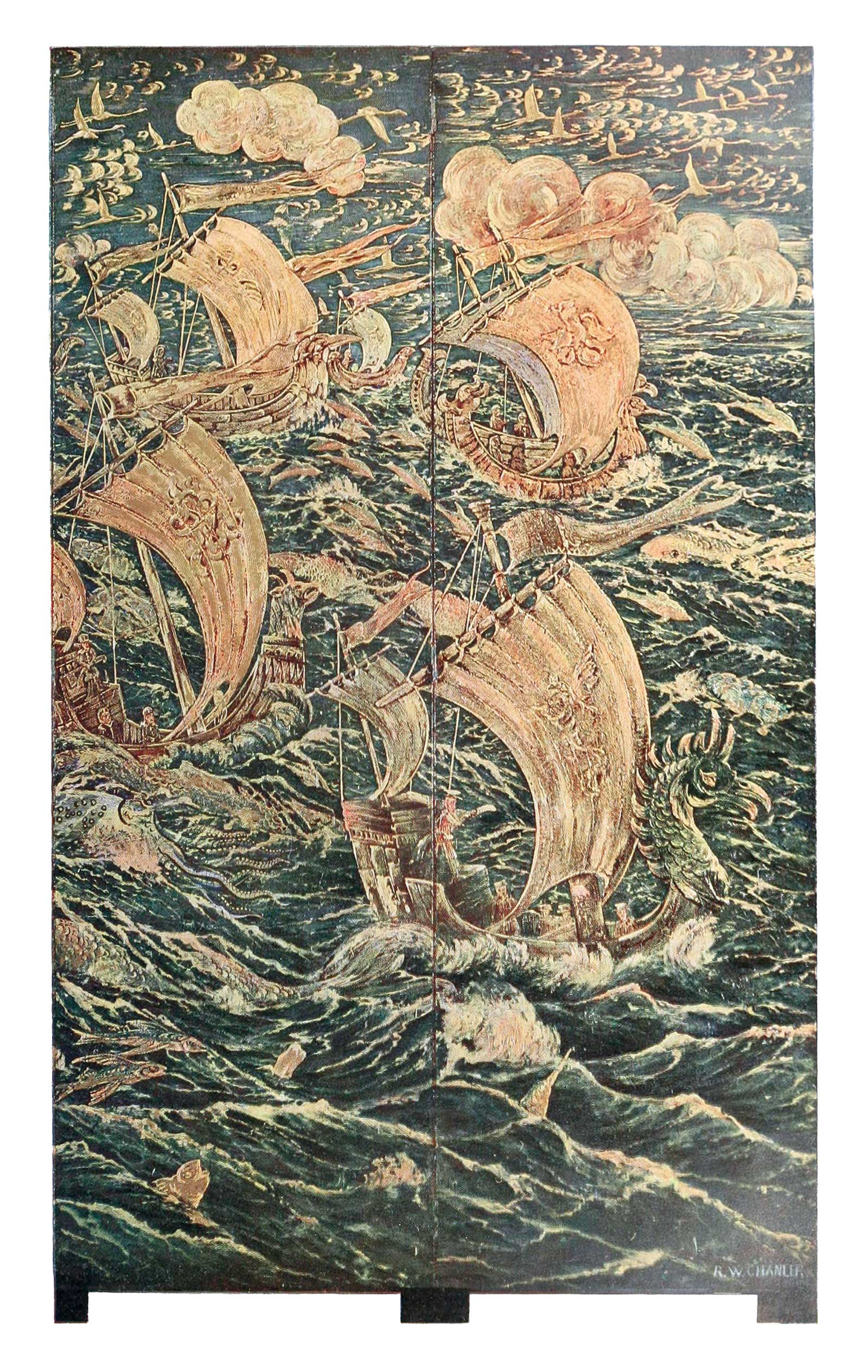 Robert Winthrop Chanler (1873-1930), Before the Wind.
Chanler was born into old New York money. Among his ancestors were Peter Stuyvesant, the Dutch founder of New Amsterdam, and John Jacob Astor. His family was a political force in the state, but Chanler took no interest—until he did.
Fine, let’s get the sensational stuff out of the way so we can get to Chanler’s art. In 1910, Chanler married—his second marriage—Lina Cavalieri, a Roman flower girl whose voice and beauty carried her all the way to the Metropolitan Opera. Three months later, the pair had separated. In the ensuing divorce, a pre-nuptial agreement emerged in which Cavalieri got everything Chanler owned. Now, as it happened, Chanler had a brother, John, who, quoting Chanler’s obituary, had run “amuck, shooting his butler, and effecting a spectacular escape from the Bloomingdale Hospital for the Insane (Manhattan). He fled to Virginia, was judged legally sane, changed his name to ‘Chaloner’ and set a brass plate in his dining room floor ‘To the Memory of a Faithful Servitor.’ No sooner did the news of Artist Bob’s marriage to the spectacular Cavalieri [and pre-nup] reach Virginia, than Brother John sent his most famous telegram: ‘WHO’S LOONY NOW?’”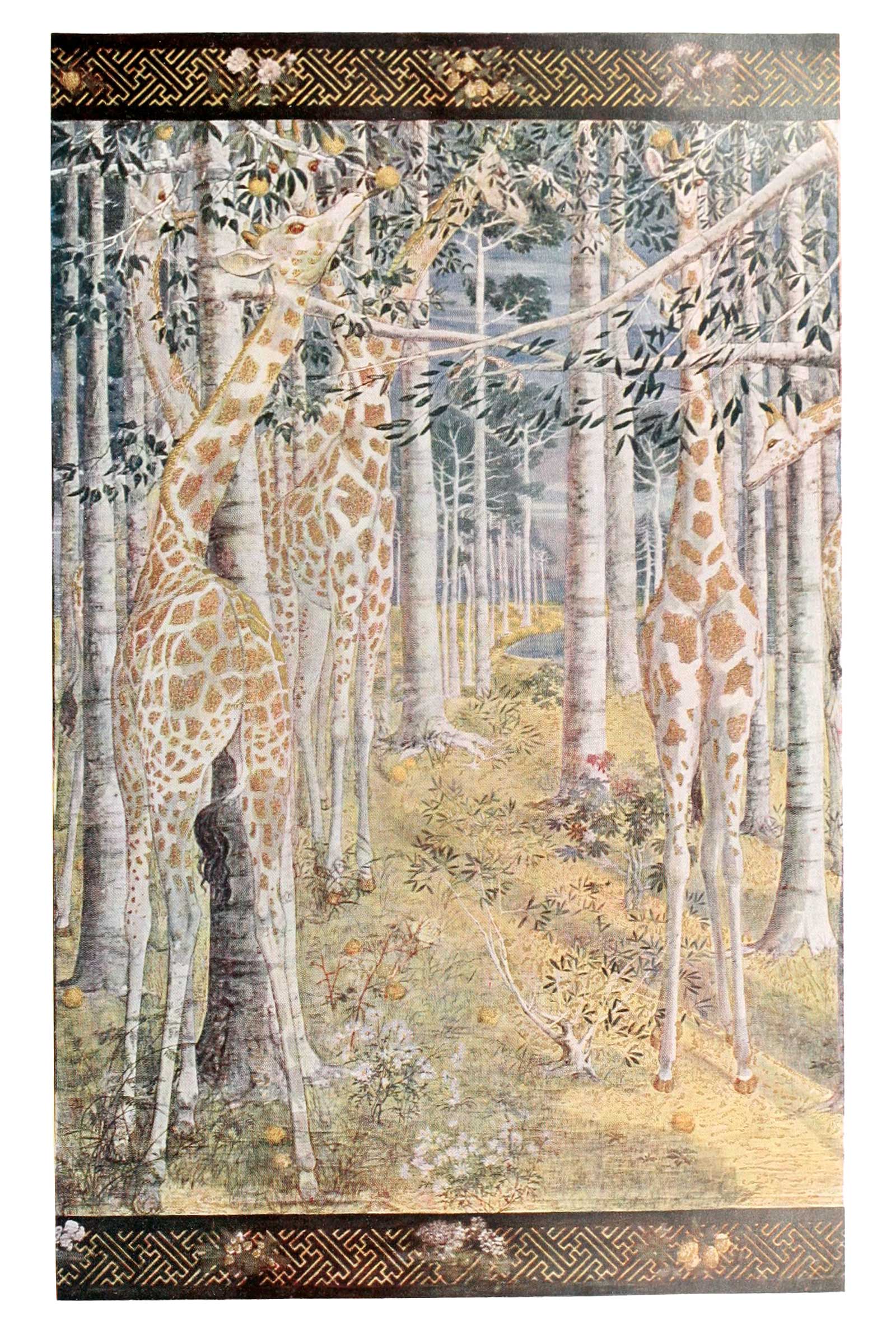 Robert Winthrop Chanler (1873-1930), Giraffes.
Then, in Chanler’s first foray into politics, as sheriff of Dutchess County, New York, he determined that the best way to win the votes of the many dairy farmers there was to purchase a prize bull and lend him out gratis to all his potential future constituents. Chanler and his bull coasted to victory.
All of this, and more, from the East 19th Street apartment everyone called the House of Fantasy, hit the papers with astonishing regularity.
But enough of American Bohemia.
The second reason why Chanler is not better known has nothing to do with his outsize appetites and everything to do with his art.
After reading a lengthy 1922 essay in International Studio magazine, written by a Russian émigré named Ivan Narodny—whose story is also worth a look—and an obituary by the artist’s friend, painter Guy Pène du Bois, I came to understand something of the profundity of Chanler’s aesthetic and how his lust for life both fed and was fed by his art.
First of all, Chanler saw no dividing line between fine art and decorative art. This, in itself, poses a problem for traditional art criticism and history. For him, design and “dynamic symbolism” were the conditions of art, descendants of folk art, myth and mysticism, and, ultimately, the primordial art of the caves. For Chanler, art had to be sensuous and mysterious above all. To suit his aesthetic, Chanler largely painted on screens, executed murals, and worked in stained glass. Because many of his screens remain in private collections and his murals and stained glass are in situ works that cannot be moved for exhibition, a serious Chanler exhibition would be difficult to mount.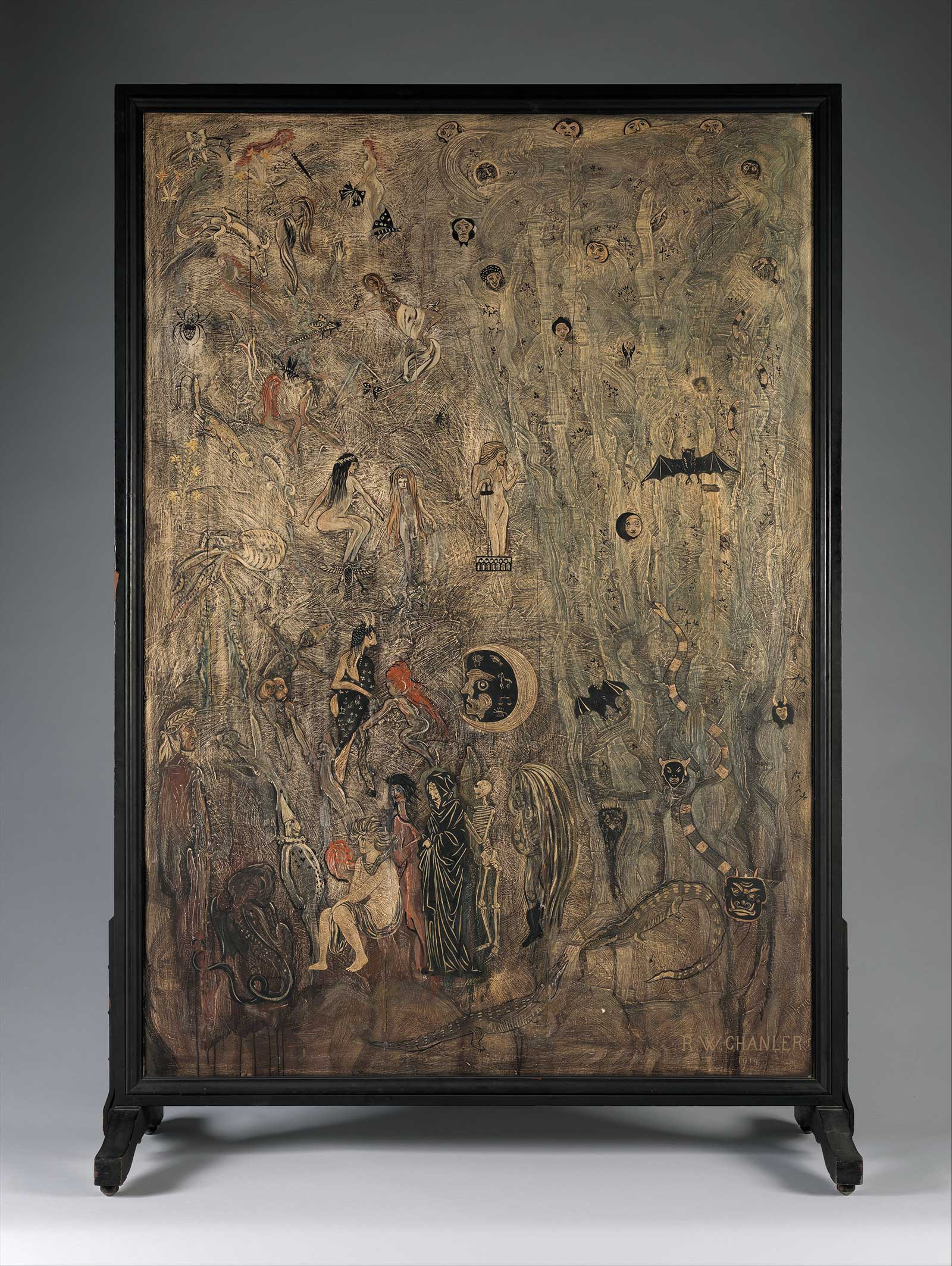 Robert Winthrop Chanler (1873-1930), Screens: Nightmare and Porcupines, 1914. Oil on wood,
69½ x 48¼ in. Gift of Mrs. John Jay Chapman, 1927. 27.30. The Metropolitan Museum of Art Collection.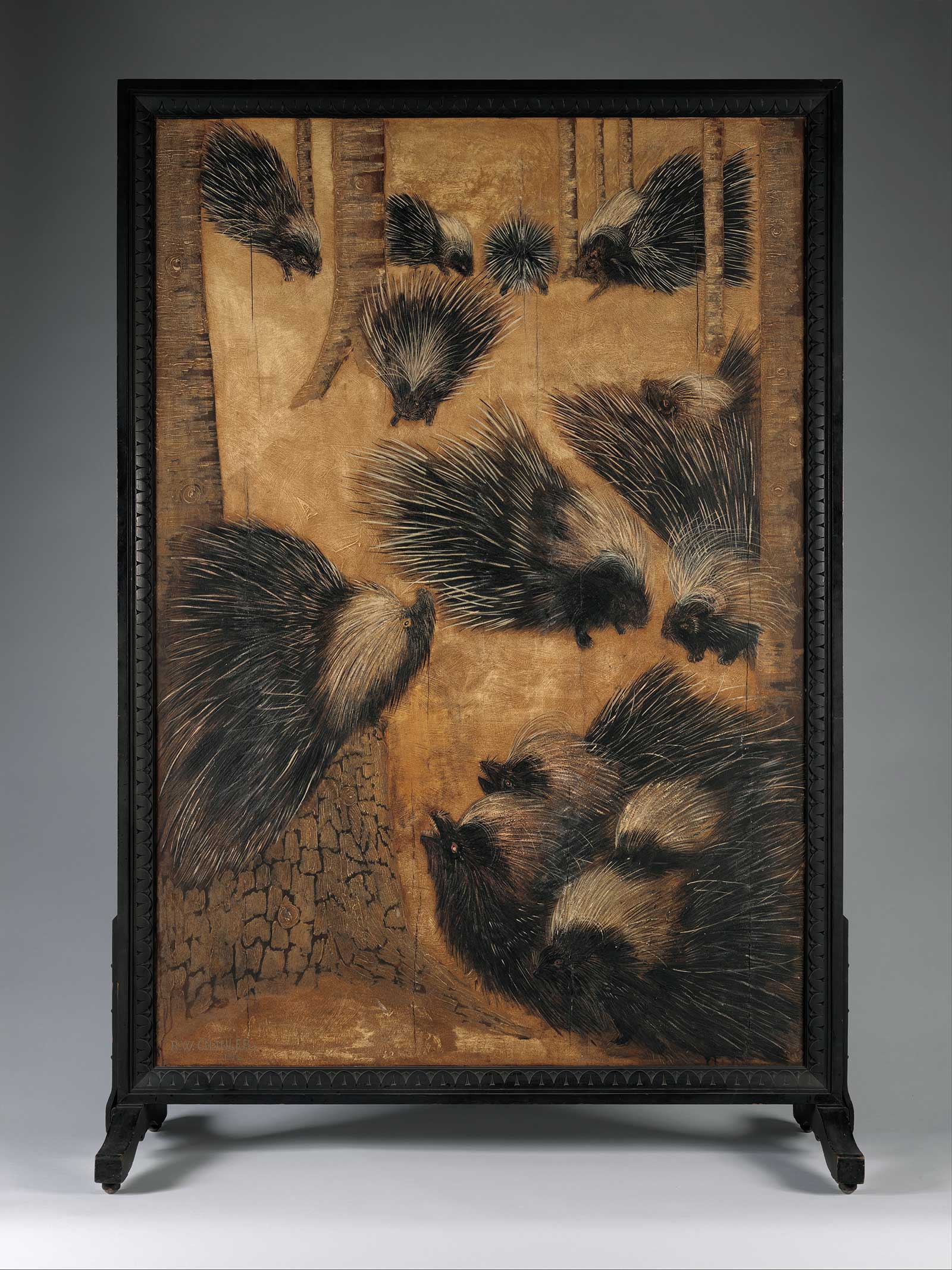 Robert Winthrop Chanler (1873-1930), Screens: Nightmare and Porcupines, 1914. Oil on wood,
69½ x 48¼ in. Gift of Mrs. John Jay Chapman, 1927. 27.30. The Metropolitan Museum of Art Collection.
Of his preference for painting on screens, Narodny writes, “A screen by its very nature is a peculiar piece of art, far more unusual than the ordinary picture. First of all, a screen is easily movable from place to place in a room; by means of it the whole atmosphere can be changed at will. Second, it adds mystery to a prosaic room…In Chanler’s estimation, a screen is not an objective but a subjective piece of art and as such, it differs fundamentally from a painting which we hang on the walls. Its purpose is to create an atmosphere of romance and mystery by providing a visible space and an invisible: beyond the screen is a domestic sanctuary.”
Chanler’s work is often described as allegorical, baroque, ornate—and all those adjectives apply—and yet there is something of the mysteries of science in them, as if they are part medieval bestiary, part natural history folio, woven into a wild tapestry. Every creature in them—and they are filled from edge to edge—is on the move, overlapping and evolving in the plenitude of life. In Before the Wind, the giant squid and all the fish skim the surface of the rhythmic waves while the cranes pace the clouds. The mythical creatures that form the figureheads of the prows of the ships, are as alive as the creatures of the sea and air. Wind fills the ships’ sails and the sailors, representing humankind, are just part of it all, along for the ride.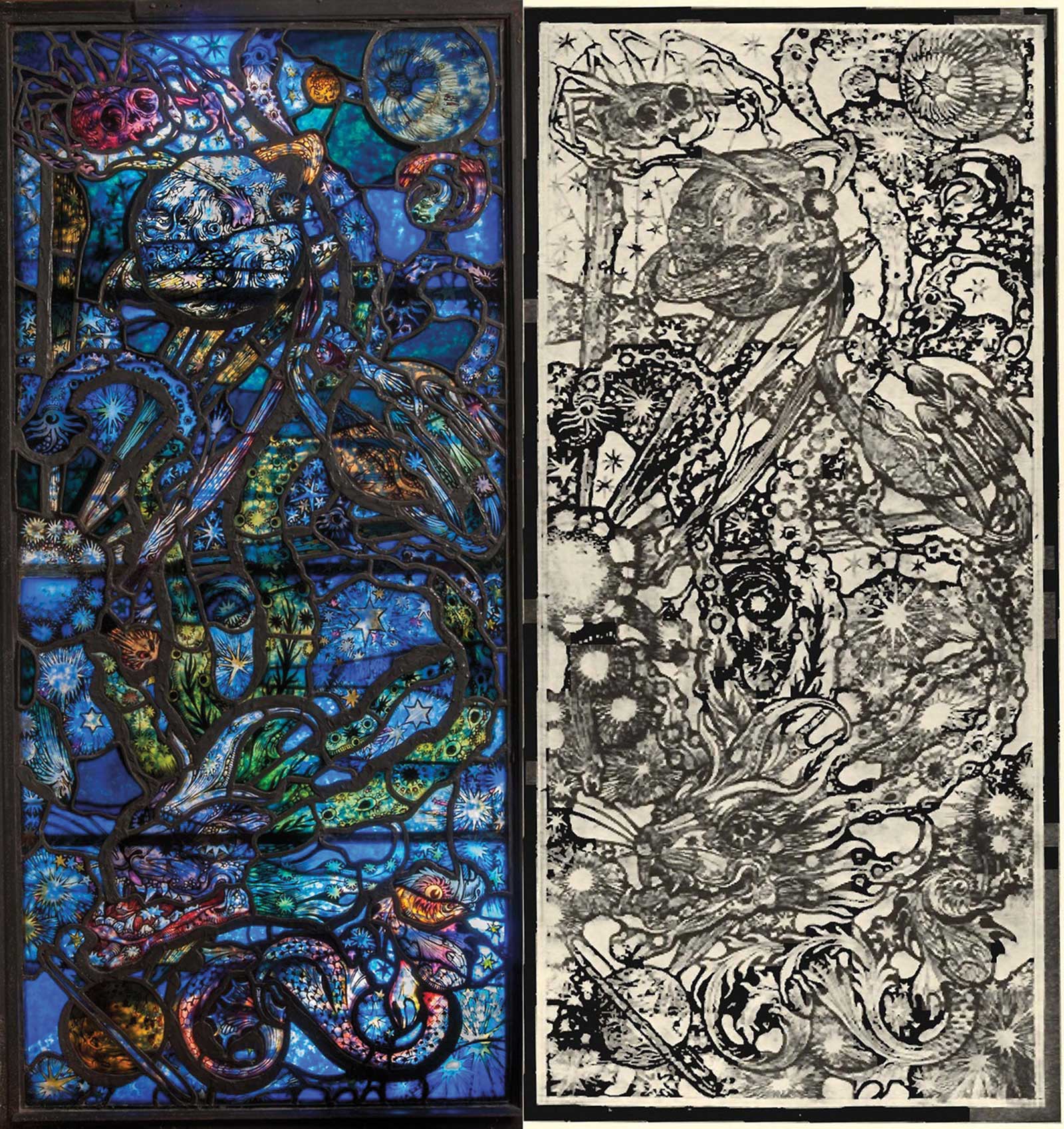 Robert Winthrop Chanler (1873-1930), One of seven stained glass windows for the Whtiney Studio, New York City, 1918-23. Alongside is a detailed study drawing. Private collection.
Giraffes, a major Chanler panel executed in 1905, was purchased by and can still be found in the Musée de Luxembourg in Paris. In the animals, stretching for fruits, and in the avenues of trees, and even in the scattering of leaves and the painted borders, the artist conveys the fullness of the natural world—nature is ample and its amplitude ought to be enough to occupy us for lifetimes. Flamingoes (though the screen is replete with other birds) is a study in cinnabar, drawing from the tradition of deeply incised Chinese lacquer boxes. The birds, the lotus, the water and the strange, insect-like fairy creatures that border the painting all seem to be emerging into life from a single, primary color.
Deep Sea Fantasy and the Stained Glass constellations in the night sky, from the Whitney Studio, though they depict divergent aspects of the cosmos, share the same sense of the cycles of birth and death, and the notion that the universe, from the smallest things to the largest, is ever evolving and never still.
By contrast, the 1914 screen Nightmare, straddles expressionism and surrealism, unmooring hellish motifs of various spiritual traditions from their narratives, while an incarnation of Dante in a black robe at bottom, pursued by a skeleton, tries worriedly to navigate the terrifying landscape. 1914 marks the start of World War I, and Chanler appears to be anticipating and responding to the mechanized horrors that would destabilize Western philosophical and religious tradition. We’re close here, to Max Ernst’s haunting bird people, an abstraction away from Arshile Gorky’s amorphous incubi, and yet, not all that far from Gustave Doré’s 19th-century illustrations for Dante’s Divine Comedy. The verso of the screen is his Porcupines.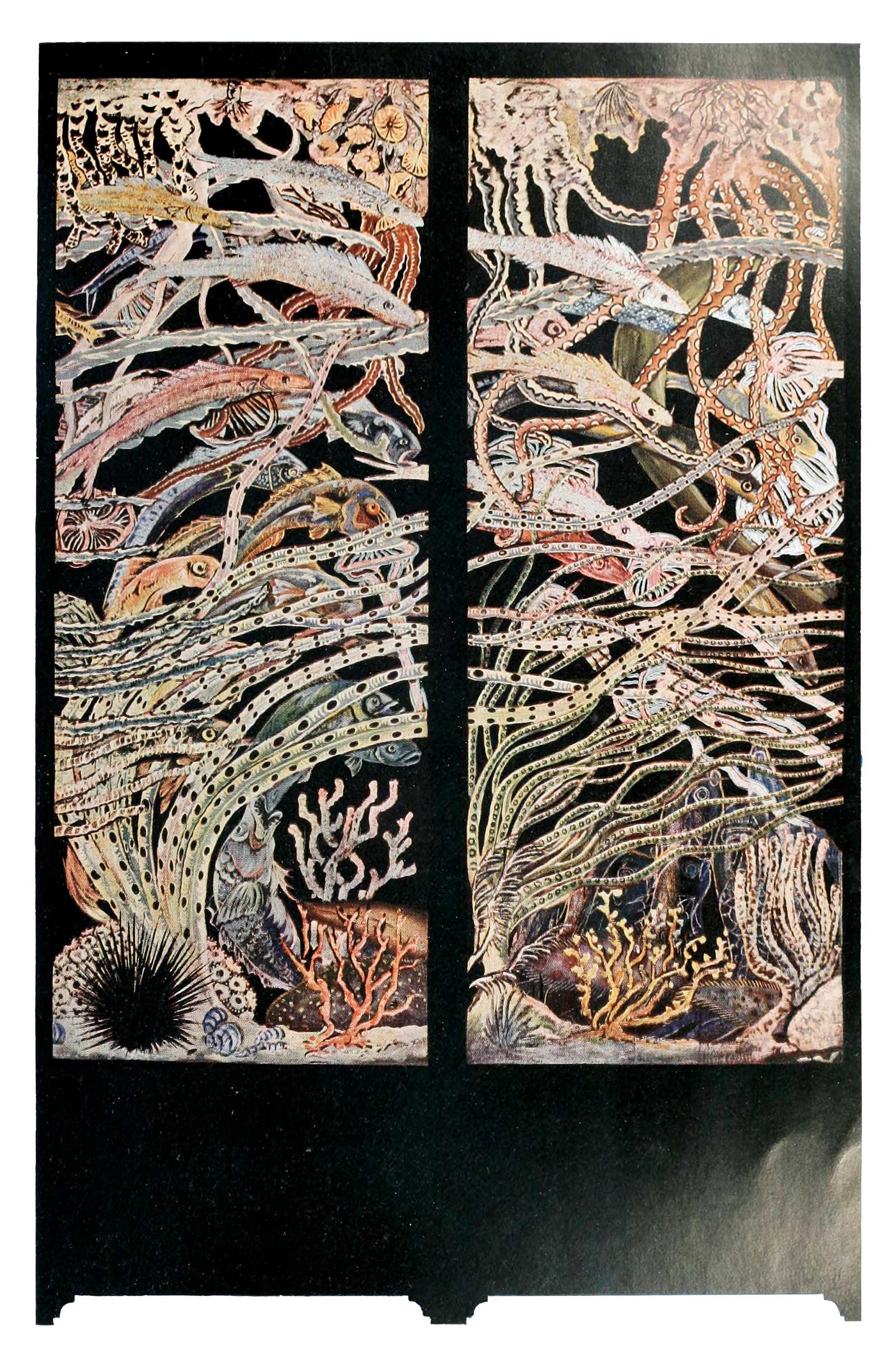 Robert Winthrop Chanler (1873-1930), Deep Sea Fantasy.
As you may have guessed, if you have read the last few of my essays in American Fine Art Magazine, I picked Chanler from the Jerome Milkman Archive that came my way some months ago. This time, at least, I had heard of the artist on the manila folder and read about the restorations of his murals and installed works in the Whitney Studio. And as tempestuous as Chanler could be with aristocrats and patricians of his own set, he was—as the autograph letter to the director of the Carnegie Institute in Pittsburgh in the folder attests, thanking him for “placing my works of art with your magnificent specimens of Nature” in the flower exhibition—a gracious man, generous with his time and full of admiration for young artists, models and all those who worked for and with him. At the end of his life, when his health failed, he turned to quick, spare portraiture, as if trying to document his friendships and life. Everything I have read about him, especially from those who knew him, describes him as simultaneously “refined” and “Rabelaisian.” If you don’t know what Rabelaisian means, or who Rabelais was, well, there’s something for you to Google, and—if you’re of a mind—a very old and very funny book for you to dip into. Suffice it to say that our word “gargantuan” comes from a character in Rabelais’ novel, Gargantua and Pantagruel, a learned and ribald text if ever there was one.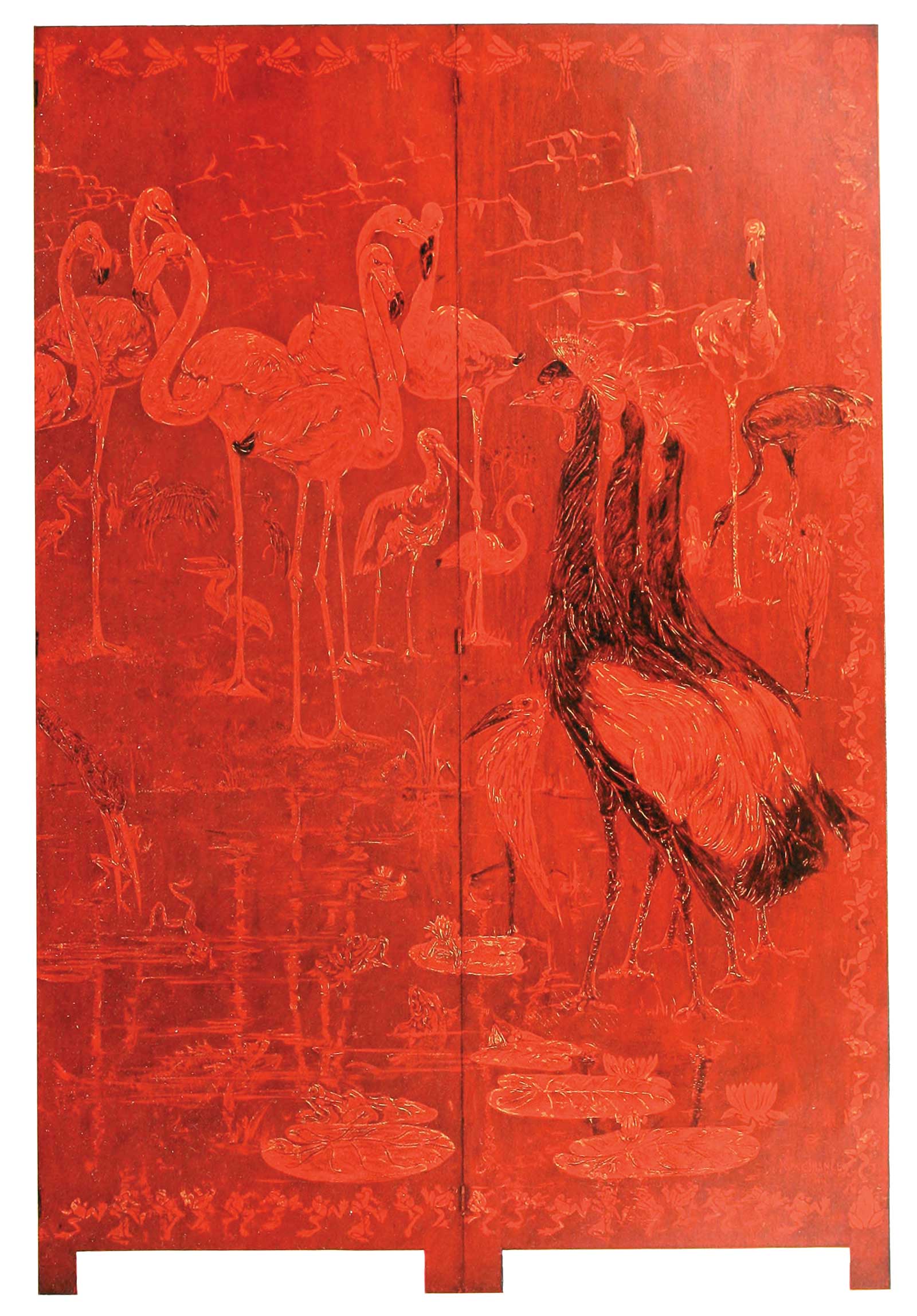 Robert Winthrop Chanler (1873-1930), Flamingoes.
Narodny speaks of seeing in Chanler, the “tendency of an individual imagination to mirror and display the cosmic forces of universal life, utterances of a new dawning epoch of inter-racial solidarity,” by which I think he also means an interspecies solidarity, a oneness with nature and the greater universe.
I suspect, as I begin to learn more about neglected and forgotten American artists, that the tapestry of American modernism is still very much on the loom, and that threads of art such as Chanler’s hopeful, even joyous modernism have yet to be woven into it. —
+++
James D. Balestrieri is the proprietor of Balestrieri Fine Arts, specializing in arts consulting, sales, research and writing. He is currently the writer-in-residence for the Clark Hulings Foundation, as well as estate and collections consultant for The Couse Foundation and communications manager for Western Spirit: Scottsdale’s Museum of the West. He was director of J.N. Bartfield Galleries for 20 years, worked with the Scottsdale Art Auction for 15 years and has written over 150 essays for various art publications.
Powered by Froala Editor