Winslow Homer (1836-1910), well-known for his bucolic paintings and those of ocean waves on the rocky shore, began his career making wood engravings of battle and bivouac scenes from the Civil War for Harper’s Weekly. The men in his Civil War images were drawn as individuals, not as idealized homogeneous warriors. His paintings often depicted sailors, their wives and children pitted against the vagaries of the ocean.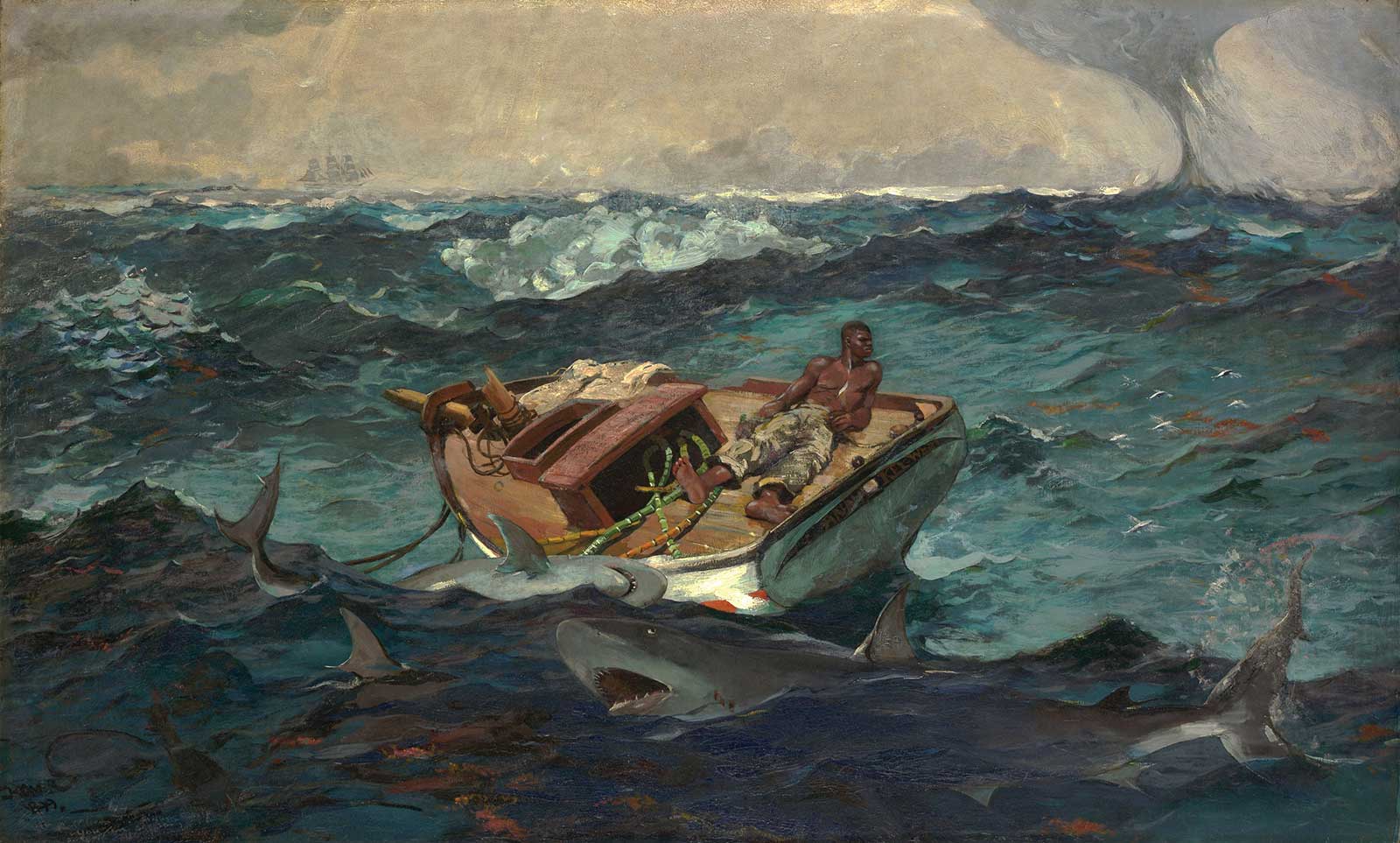 Winslow Homer (1836-1910), The Gulf Stream, 1899. Oil on canvas, 28 1/8 x 49 1/8 in. The Metropolitan Museum of Art, Catharine Lorillard Wolfe Collection, Wolfe Fund, 1906 (06.1234). Photo courtesy of The Metropolitan Museum of Art.
The Metropolitan Museum of Art in New York City explores this aspect of his work in the exhibition Winslow Homer: Crosscurrents, opening April 11 and continuing through July 31. The museum explains that the exhibition reconsiders “the artist’s work through the lens of conflict, a theme that crosses his prolific career. A persistent fascination with struggle permeates his art—from emblematic images of the Civil War and Reconstruction that examine the effects of the conflict on the landscape, soldiers and formerly enslaved to dramatic scenes of rescue and hunting as well as monumental seascapes and dazzling tropical works painted throughout the Atlantic world.”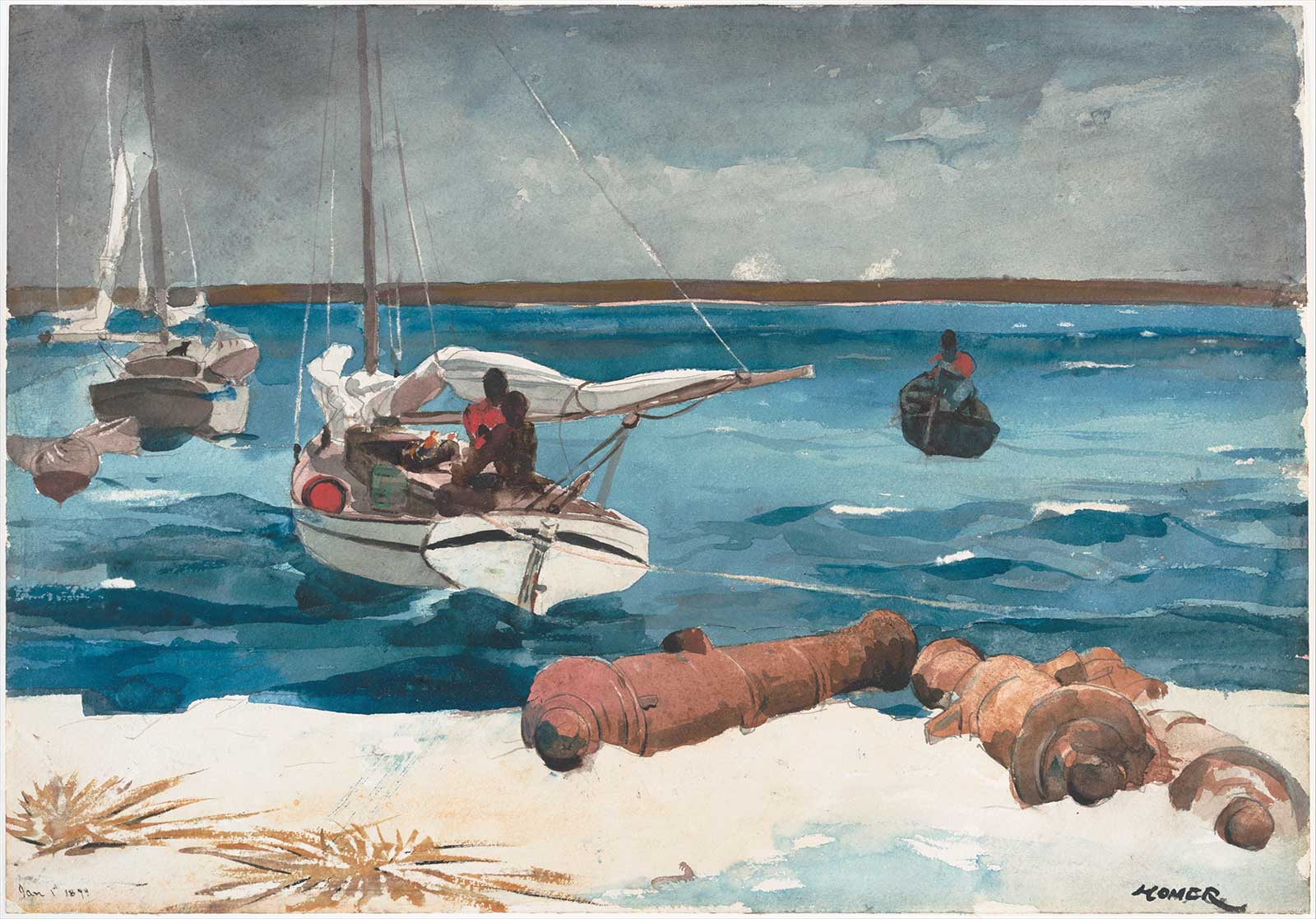 Winslow Homer (1836-1910), Nassau, 1899. Watercolor and graphite on off-white wove paper. 14 7/8 x 21 3/8 in. The Metropolitan Museum of Art, Amelia B. Lazarus Fund, 1910. Photo courtesy of The Metropolitan Museum of Art.
The first of his paintings to enter the Met’s collection is The Gulf Stream, 1899. In the 1880s Homer made several trips to the Bahamas producing watercolors that he would work into oil paintings in his studio at Prout’s Neck, Maine. The painting depicts a Black fisherman marooned on the deck of his de-masted, rudderless boat in rough seas with sharks menacingly close. After showing it in Philadelphia in 1900, Homer worked on it again when it returned to Prout’s Neck. 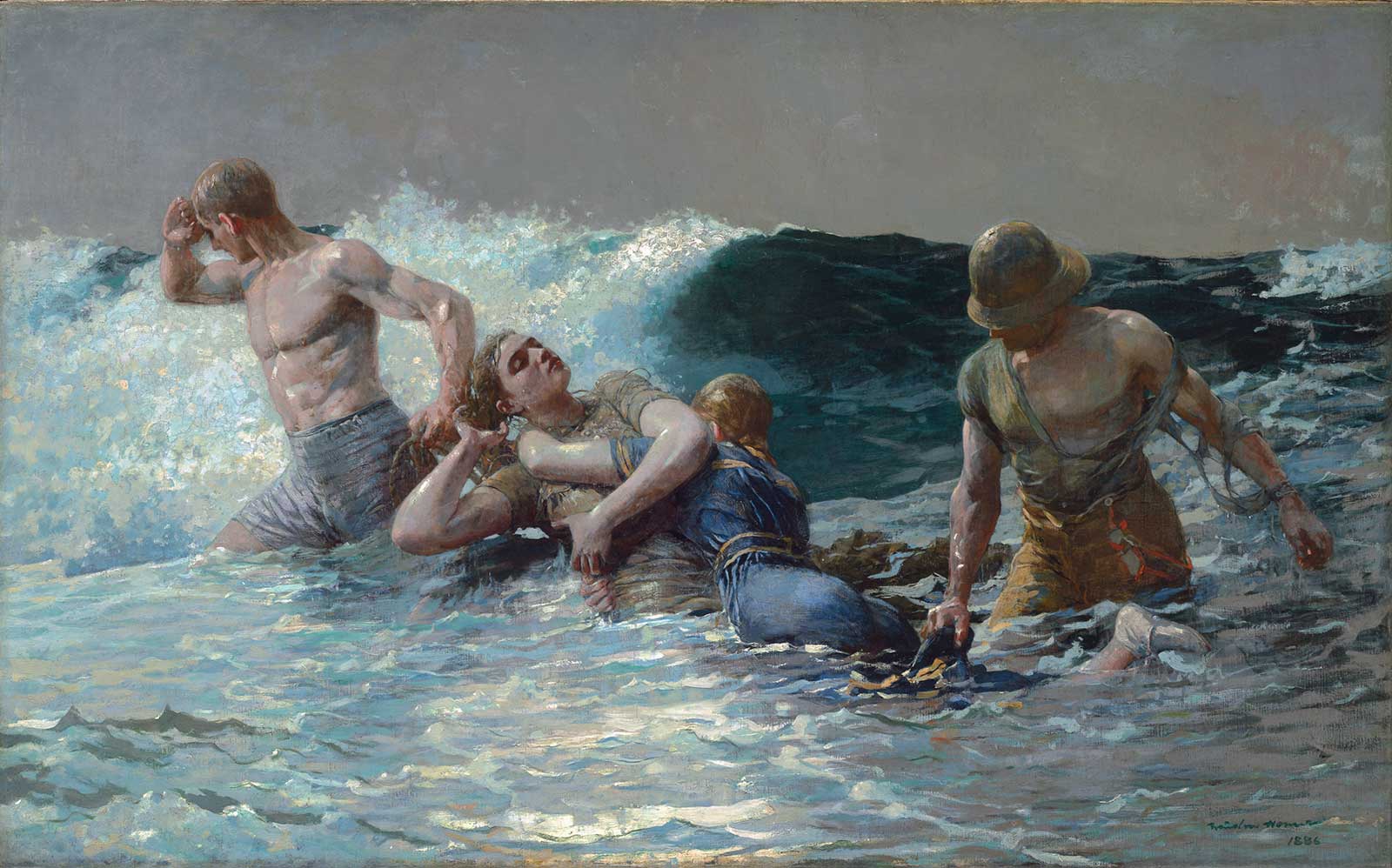 Winslow Homer (1836-1910), Undertow, 1886. Oil on canvas. 29 13/16 x 47 5/8 in. The Clark Art Institute, 1955.4.
He wrote, “I have painted on the picture since it was in Philadelphia and improved it very much (more of the Deep Sea water than before).” In fact, among other changes, he added a schooner on the upper left possibly to relieve the sense of doom viewers felt for the fisherman. He later wrote acerbically in response to questions about the man’s fate, expressing regret that he painted a work that needed a description, but sharing, “I have crossed the Gulf Stream 10 times & I should know something about it. The boat & sharks are outside matters of very little consequence. They have been blown out to sea by a hurricane.” The man on the boat would be rescued and return home.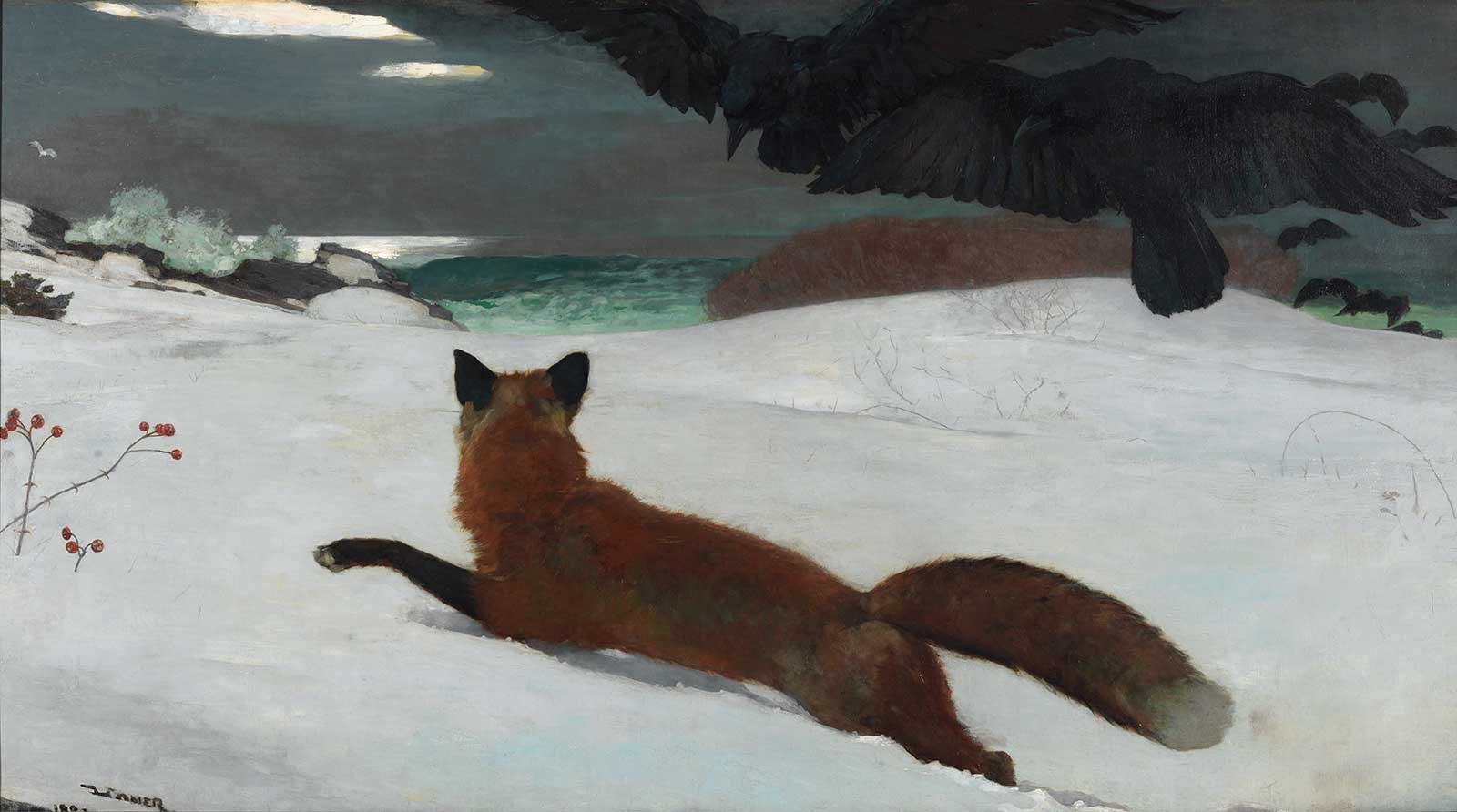 Winslow Homer (1836-1910), Fox Hunt, 1893. Oil on canvas, 38 x 68½ in. Pennsylvania Academy of the Fine Arts, Joseph E. Temple Fund (1894.4). Photo credit: Barbara Katus.
His watercolors from the Bahamas portray his Black figures as individuals rather than as stereotypes just as he did in his wood engravings of Civil War soldiers.
Homer painted conflicts with nature by depicting man’s struggles against the sea. He also painted conflict in nature itself. In Fox Hunt, 1893, the predator becomes prey as the fox becomes bogged down in deep snow. At first glance the fox seems intent on its own prey until the dark forms of the crows become clear, ominously hovering above and converging from the distance. The dramatic, nearly 6-foot-wide painting was purchased by the Pennsylvania Academy of the Fine Arts in 1894, the first of his paintings to enter a public collection.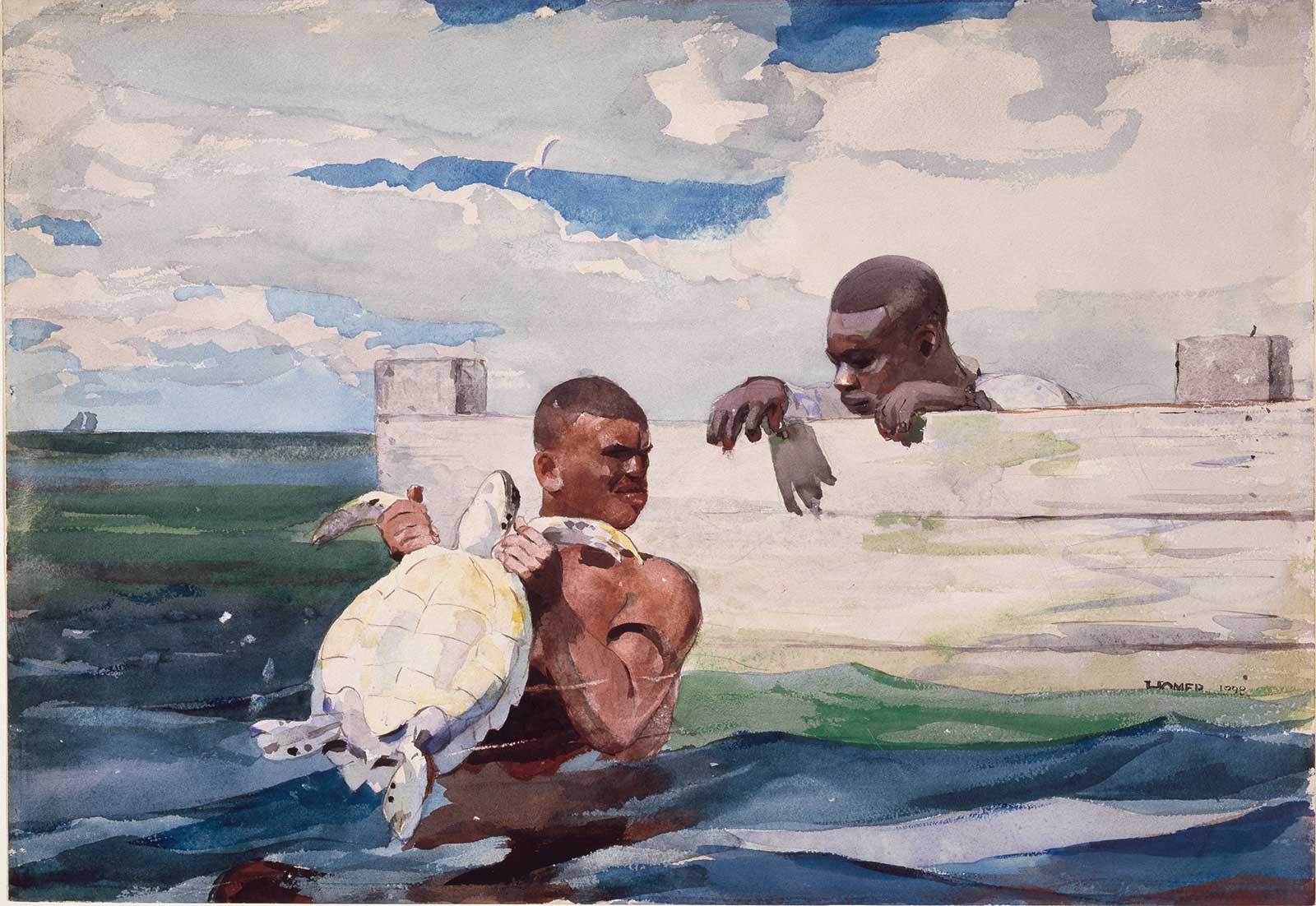 Winslow Homer (1836-1910), The Turtle Pound, 1898. Watercolor over pencil, 14 15/16 x 21 3/8 in. Brooklyn Museum, Sustaining Membership Fund, Alfred T. White Memorial Fund, and A. Augustus Healy Fund, 23.98. Photo: Brooklyn Museum.
The scene is near his Prout’s Neck studio where winter carries on while the drama unfolds. The sun breaks through the clouds of the passing storm as the waves crash on the shore and a seagull looks for its next meal. Red berries from the past season hold the promise of spring.
The exhibition is curated by Stephanie Herdrich, associate curator of American painting and sculpture, and Sylvia Yount, Lawrence A. Fleischman Curator in Charge of the American Wing at the Met, in collaboration with Christopher Riopelle, the Neil Westreich Curator of Post-1800 Painting at the National Gallery, London. —
Powered by Froala Editor