Joan Mitchell (1925-1992) grew up on the shores of Lake Michigan, always aware of its changing moods and colors. She took her first painting classes at the Art Institute of Chicago when she was in second grade and later received her MFA there. She excelled as an abstract expressionist painter in the male-dominated art scene of the 1950s and had her first major European museum solo exhibition at the Musée d’Art Moderne de la Ville de Paris in 1982. She was the first female American artist to have an exhibition there.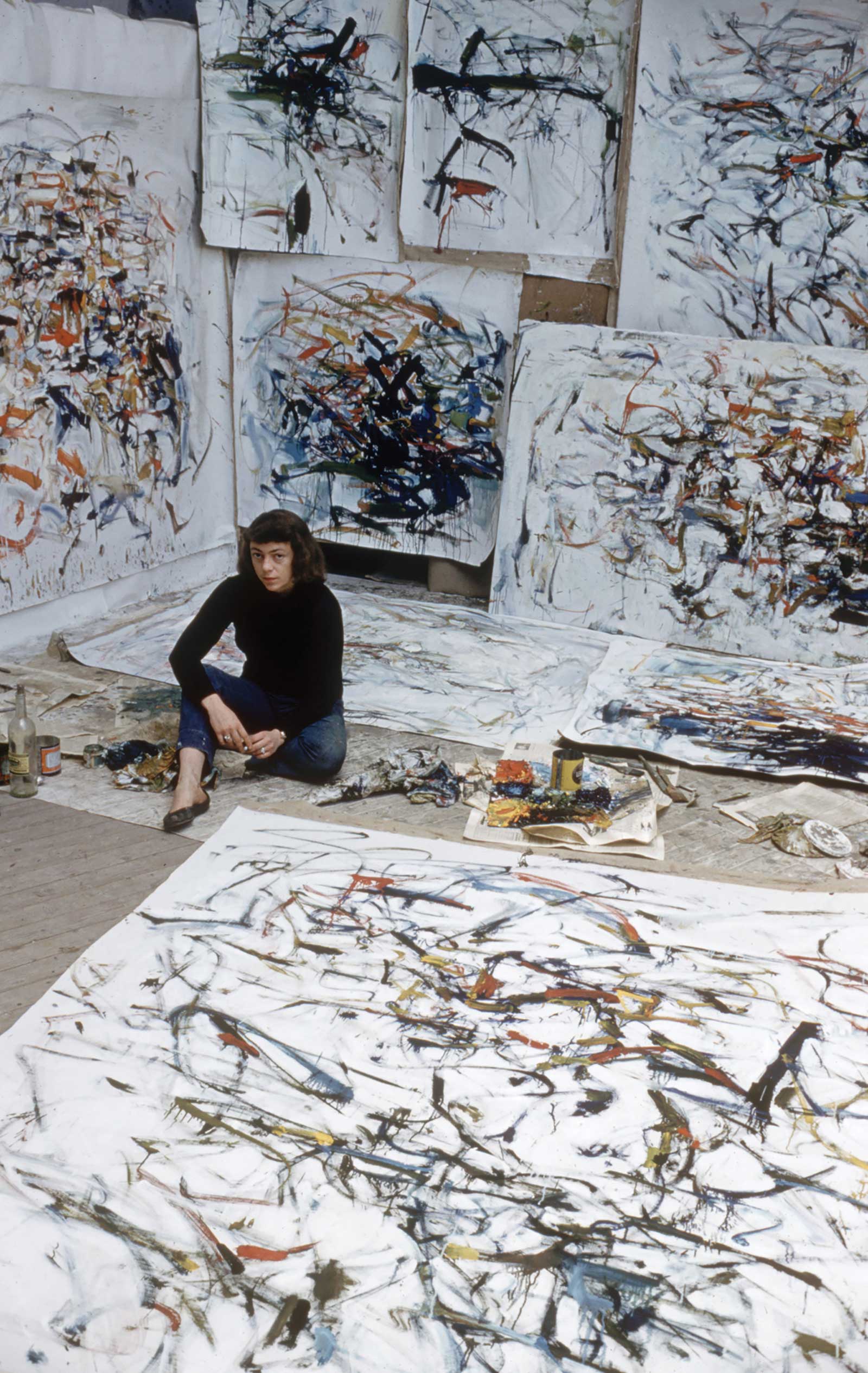 Joan Mitchell in her studio at 77 rue Daguerre, Paris, 1956. Photo: Loomis Dean/The LIFE Picture Collection/Shutterstock.
Landscape stayed with her. She wrote, “I paint from remembered landscapes that I carry with me—and remembered feelings of them, which of course become transformed. I could certainly never mirror nature. I would like more to paint what it leaves me with.” At another time she wrote, “I can’t quote Van Gogh but it’s in one letter he wrote, where he says he gives credit to the sunflower because it exists. And that’s all what my painting is.”
Paintings from her entire career are showcased in the comprehensive retrospective Joan Mitchell at the San Francisco Museum of Modern Art through January 17. It will be shown at the Baltimore Museum of Art in Maryland from March 6 through August 14, and at the Fondation Louis Vuitton in Paris in the fall. It has been co-curated by Sarah Roberts, head of painting and sculpture at SFMOMA, and Katy Siegel, senior programming and research curator at the Baltimore Museum of Art.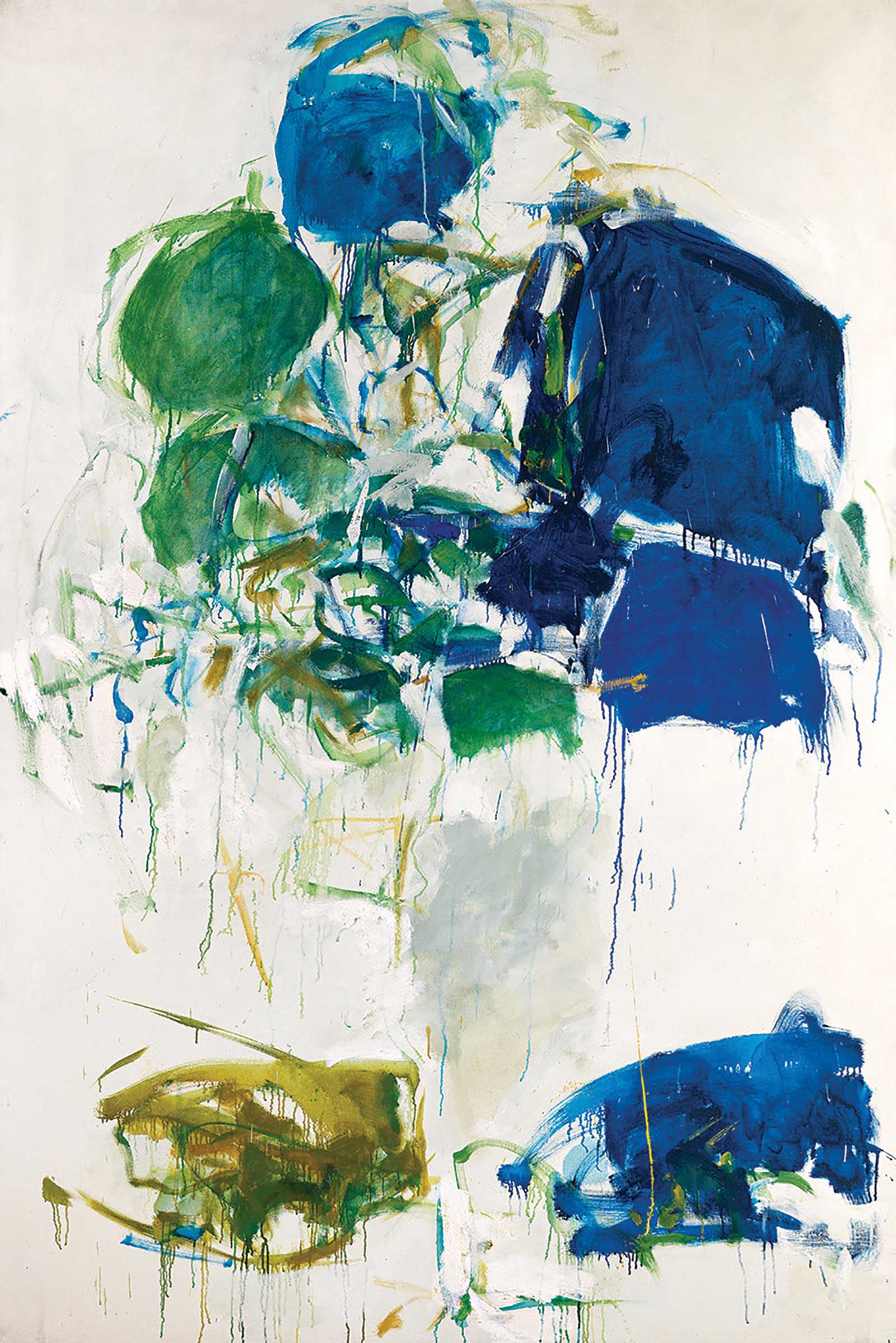 Joan Mitchell (1925-1992), Vétheuil, 1967-68. Oil on canvas, 76¾ x 49 7⁄8 in. Private collection, New York. © Estate of Joan Mitchell. Photo: Brian Buckley.
In their joint catalog essay, the curators write, “History is full of women: overlooked women, difficult women, unloved women, forgotten women, unrealized women, overshadowed women. With this book and the exhibition it accompanies we wanted to tell the story of a woman who while all or many of these things, was foremost and without qualification a great artist. To see Joan Mitchell this way is to acknowledge not only the monumentality of what she accomplished but also the nature of her own desire. She never aspired to anything less than greatness—as it was understood and pursued in her historical moment (a time when such terms were rarely applied to women) and, ultimately, as she came to define it for herself.”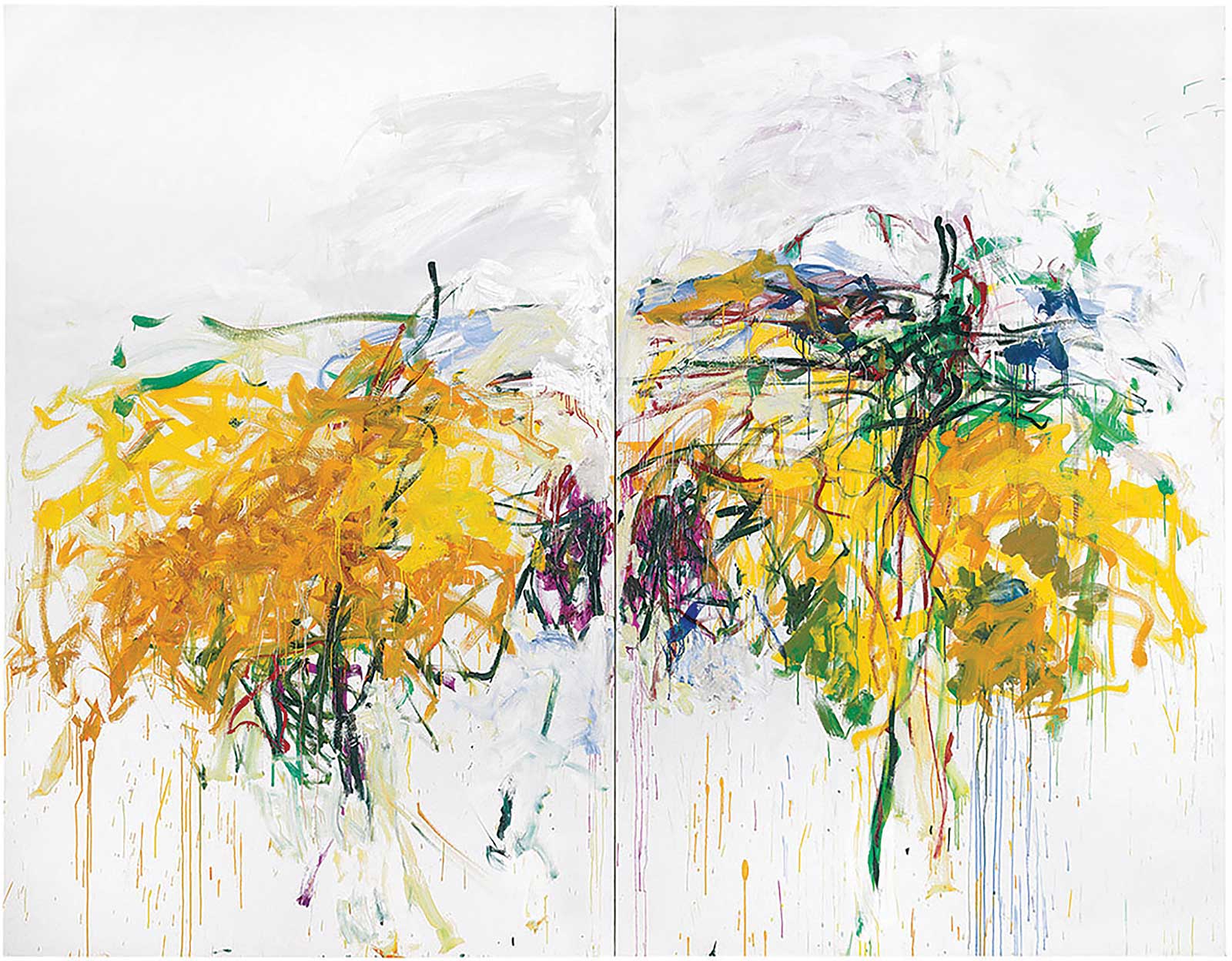 Joan Mitchell (1925-1992), Untitled, 1992. Oil on canvas, 110¼ x 142 in. Komal Shah and Gaurav Garg Collection. © Estate of Joan Mitchell.
Mitchell, whose mother was an editor of Poetry magazine, and published one of her daughter’s poems when Mitchell was 9, painted poetically and often wrote poetically. “Painting is a means of feeling ‘living’…Music takes time to listen to and ends, writing takes time and ends, movies end, ideas and even sculpture take time. Painting does not. It never ends, it is the only thing that is both continuous and still.” 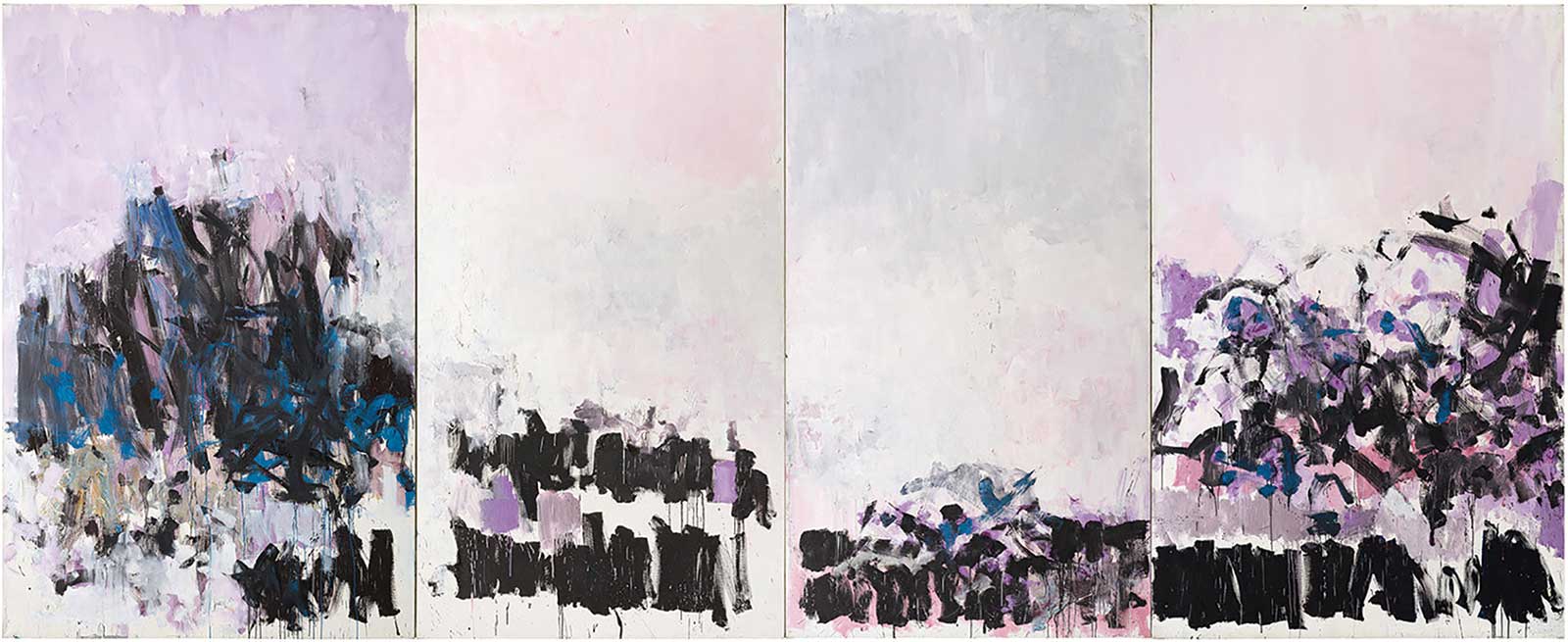 Joan Mitchell (1925-1992), La Vie en rose, 1979. Oil on canvas, 110 3/8 x 268 ¼ in. The Metropolitan Museum of Art, New York, anonymous gift and purchase, George A. Hearn Fund, by exchange, 1991 (1991.139a-d). © Estate of Joan Mitchell.
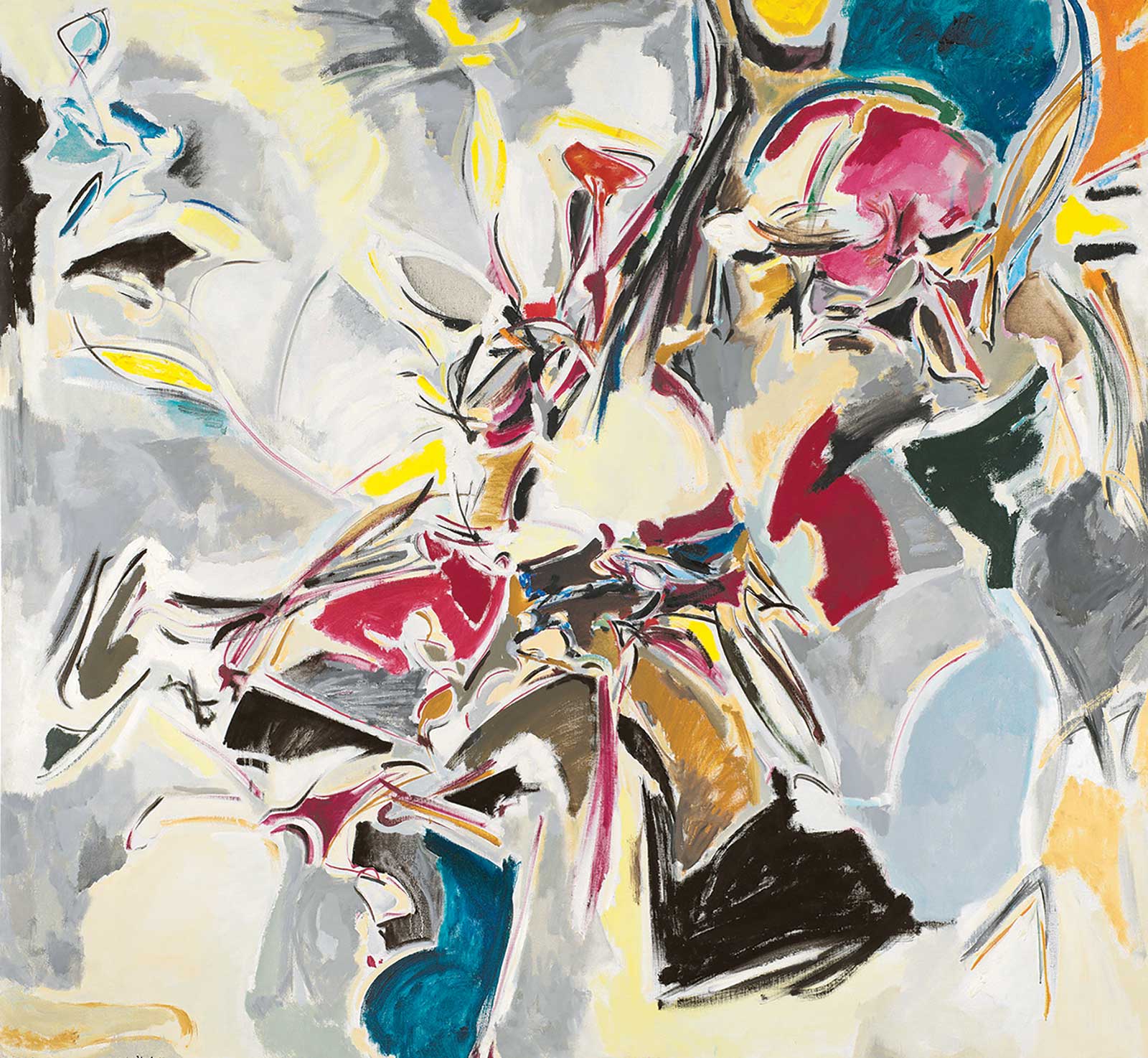 Joan Mitchell (1925-1992), Lyric, ca. 1951. Oil on canvas, 68 x 72½ in. Frances Lehman Loeb Art Center, Vassar College, Poughkeepsie, New York, gift of William Rubin. © Estate of Joan Mitchell. Photo: Chip Porter.
In 1967 she bought a house in Vétheuil outside Paris. La Tour had a view of the Seine and the landscape beyond, an area where Monet had worked before moving to nearby Giverny. La Tour was surrounded by trees and gardens where she grew many varieties of plants and flowers, especially sunflowers which she particularly loved.
Sarah Roberts writes, “In the last paintings she would make, Mitchell pared down sunflower and tree figures and placed them eloquently in fields of white canvas. No longer memories of views or captured feelings of the natural world in her grandeur, they are declarations of identity. Achingly beautiful, Untitled, 1992, carries the weight of Joan Mitchell’s life as a painter as she closed off to all but herself, alone with painting. With the sparest of means, these paintings crystalize her central concerns at the end of her life. They are about her, but they do not reveal her; they are about sunflowers, Van Gogh, beauty and death, but convey far more. Singular and uncategorizable, they are neither abstraction nor abstraction, but beyond both.” —
Powered by Froala Editor