

Artists taking the night sky and the objects that swirl there as subjects for their art is as old as art itself. Renderings in ochre and ash on cave walls tens of thousands of years old appear to represent celestial conjunctions, or a phase of the moon, or a comet streaking by. The constellations themselves might be considered an art form, a connect-the-dots aesthetic that makes one culture see as asterism of stars as Ursa Major, or the Big Dipper, while others see the same asterism as a salmon weir, wain or plough. These forms, moving against the black velvet curtain of the cosmos, become illustrations for stories, myths, faiths. Fast forward to Vincent van Gogh, who was drawn to the wheeling stars, making the Big Dipper the center of a lush 1888 oil called Starry Night over the Rhone, a precursor, perhaps, to The Starry Night, one of the world’s most celebrated and reproduced art images, painted a year later.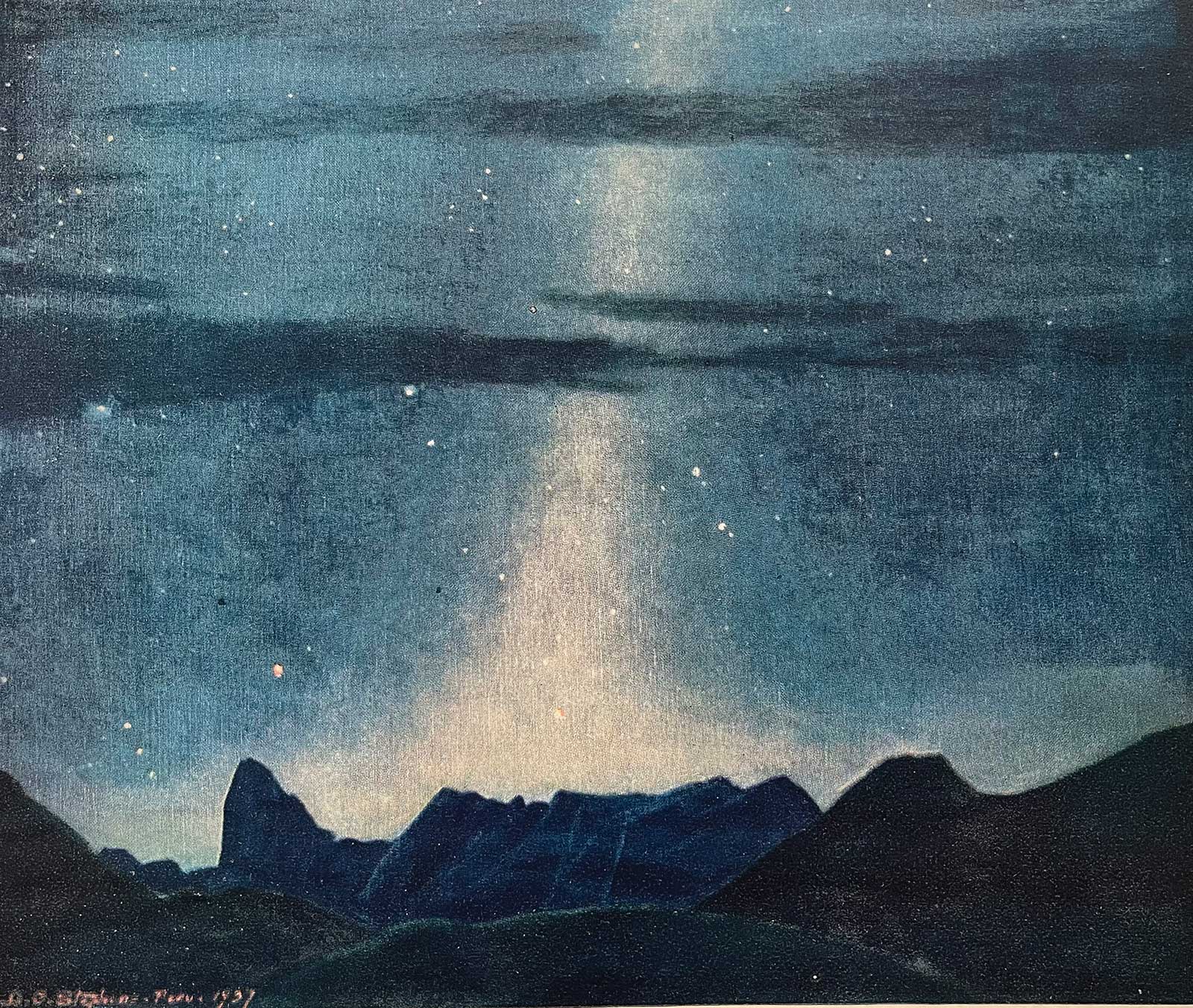 Zodiacal Light
Almost as soon as photography is born in the 1830s, practitioners of the new art turn their devices toward the heavens and begin to render images of the moon, planets and sun, in detail available only to those with access to the best telescopes. The rendering of the night sky soon becomes almost the sole province of this new combination of science and art. Almost. Artists like Lockwood de Forest (1850-1932) devoted painting after painting to studies of the moon and the effects of moonlight, while in our time, Apollo 12 astronaut Alan Bean (1932-2018), the fourth human being to walk on the moon, spent his later years painting scenes from his incredible journey. In another vein, contemporary artist John Stoney (b. 1966) represents faint images of faraway galaxies through pyrography—an age-old technique, employing a burning tool, to create infinitesimal images of unimaginably infinite heavenly bodies, wheeling and burning across infinities. Of course, the art of the cosmos finds a new home in science fiction, where renderings of alien worlds, alien beings and the technology of the far—or not so far—future spring anti-gravitationally from science to imagination to the covers of pulp magazines and paperbacks.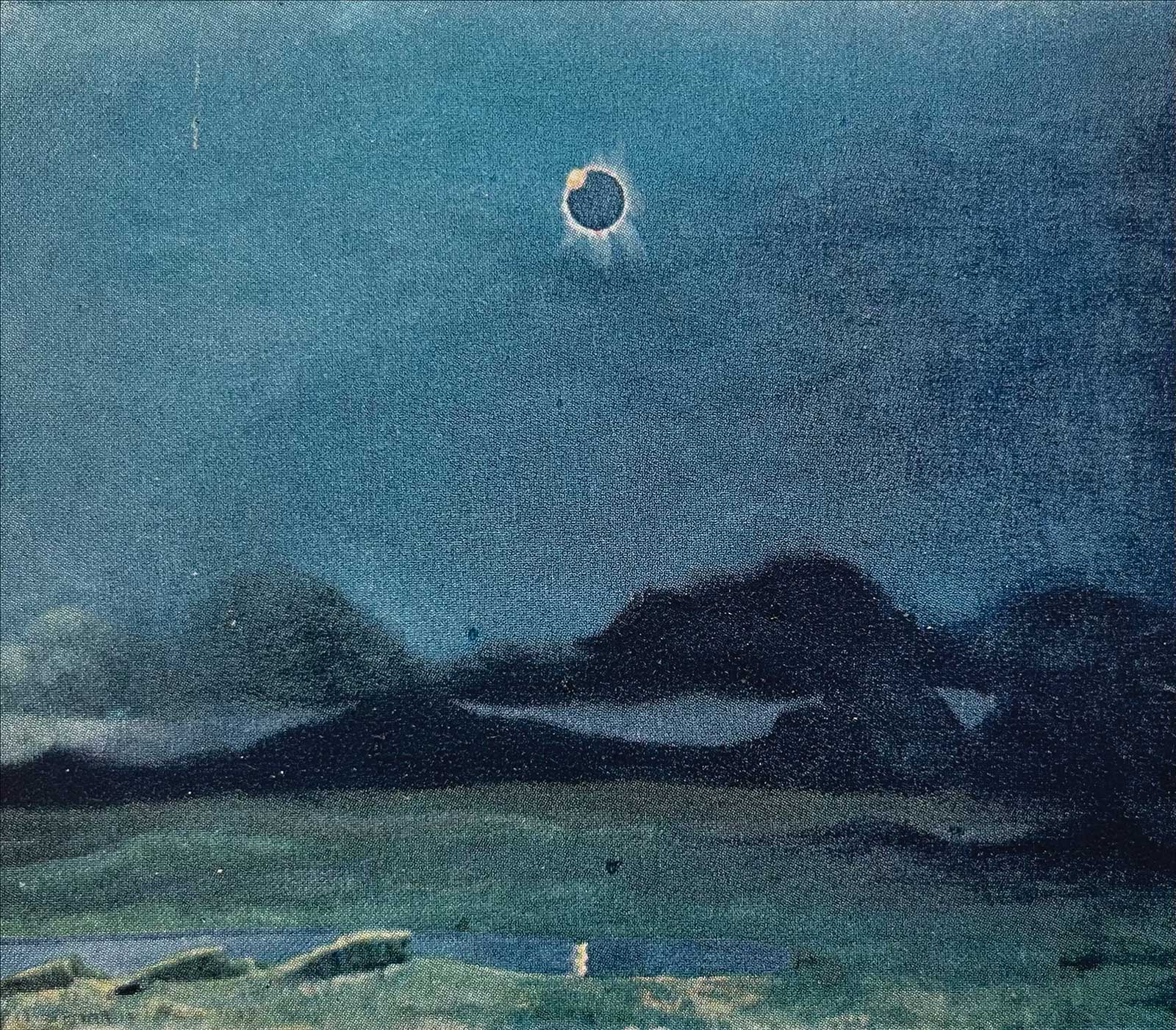 Diamond Ring
One artist who straddled these vast worlds was Daniel Owen Stephens (1893-1937)—whose name is often written D. Owen Stephens. Stephens was a child of artists who chose, at first, to study astronomy at Swarthmore College. But he soon gave up hard science for a life as a painter—specifically, a painter of eclipses and other celestial phenomena. The question arises: If astrophotography could capture what the eye, hand and brush could not—why would he contemplate such a move? In a word: color. Black-and-white astrophotography could achieve substantial levels of detail, but color photography had not yet been perfected. Indeed, in the 1920s and ’30s color imagery was still in its infancy. In truth, there is little biographical information about Stephens, especially as regarding his motives for pivoting from science to science through art—indeed, the essay you are reading stems from yet another of the Jerome Milkman folders I am working my way through, which you can get a peek at in “To the Ends of the Earth: The Arctic and Antarctic in American Art” in the September/October issue of American Fine Art Magazine. Yet, this last phrase, “science though art,” appears to have been important in Stephens’ thinking, the thrust of which was, “How can science communicate through art?” or, perhaps, “How can art help science communicate?” To give an example outside of painting by way of proof, in 1936, Stephens wrote and published a book for children explaining evolution, an idea certainly novel, and probably revolutionary, in its time.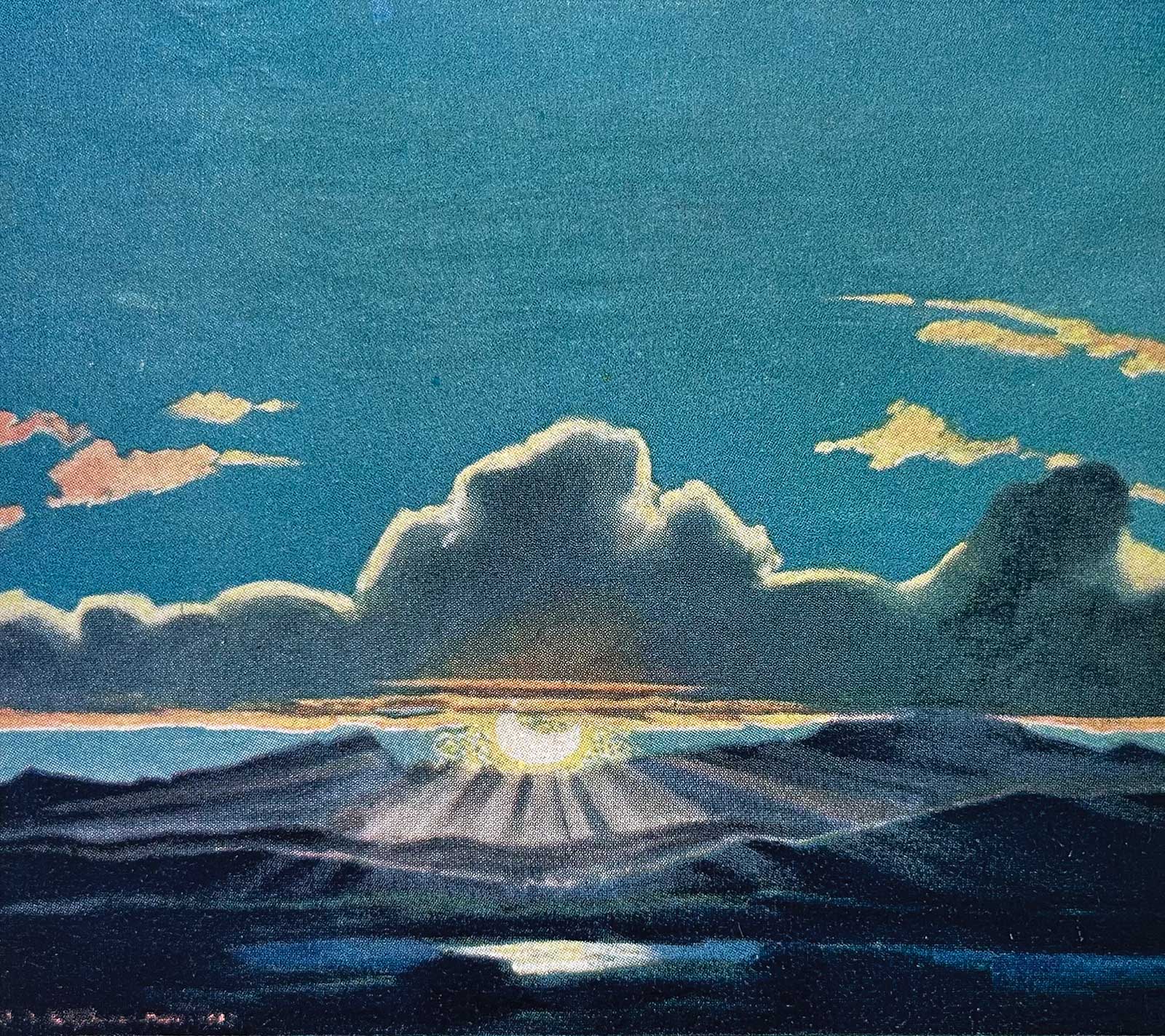 Magnificent Sunset
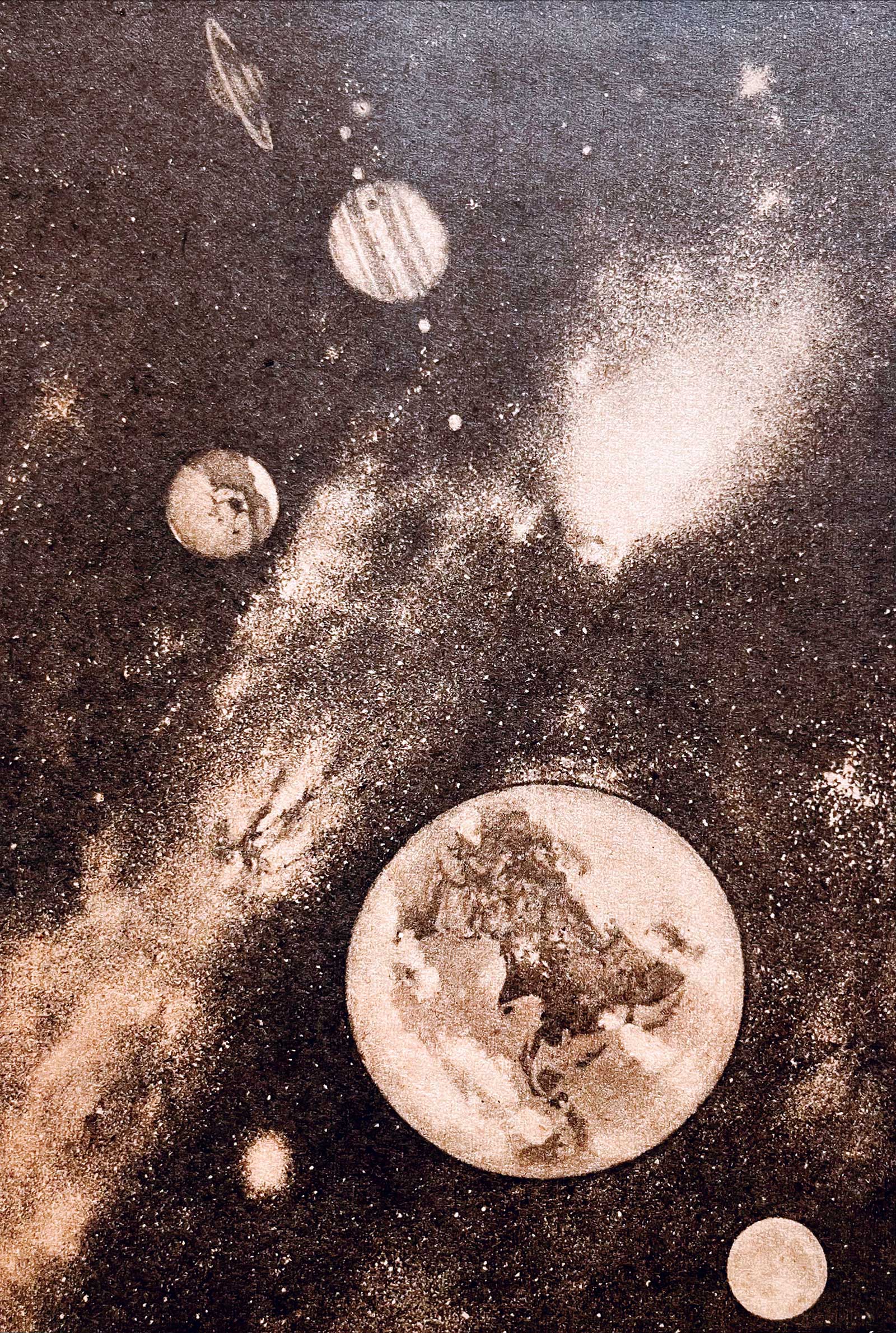 Every Star Has Been a Nova in its Time
That Stephens and his art are relatively unknown is in large measure due to the brevity of his career and life. In 1937, at the age of 43, Stephens suffered a fatal stroke on board the S.S. Santa Clara, a research vessel of the Hayden Planetarium—Grace Eclipse Expedition on its way back from the viewing of a total solar eclipse on June 8 from Cerro de Pasco, Peru, some 5,000 feet above sea level. Stephens painted his final, and perhaps finest works on this voyage, some of which are reproduced on these pages.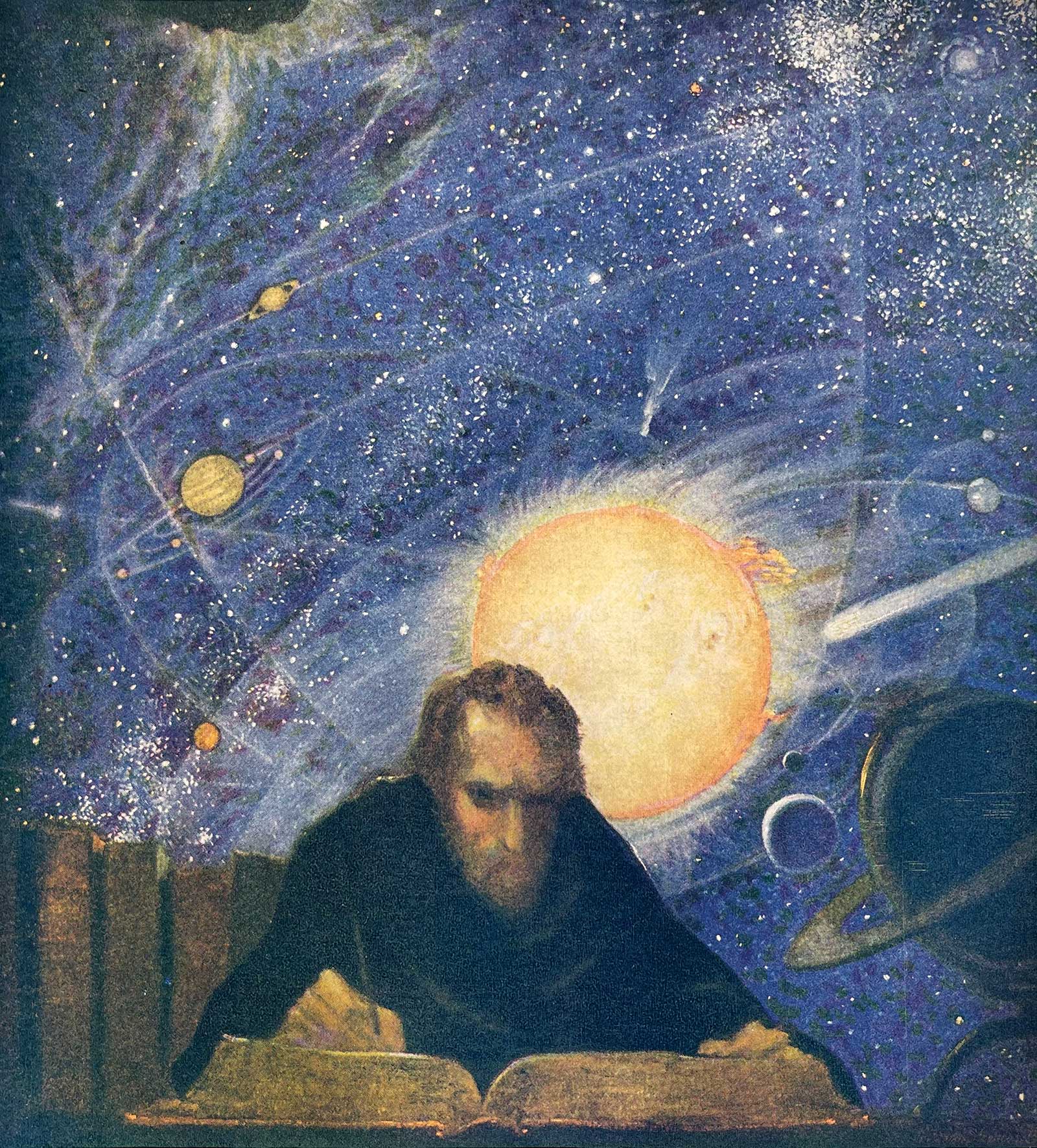 The Astronomer
When you look at a painting like The Moon Swallows the Sun During Totality, a work from the 1937 expedition, you are seeing a solar eclipse as the very first humans did, from their vantage point. Stephens takes pains with the colors of the corona and the flares in the ring and apprehends the unearthly gloom relieved only by the remaining band of light at the horizon. The clouds and landforms are equally solid and concrete, as if darkness hardens the earth. The moon, “swallowing” the sun—an ancient, campfire metaphor, if ever there was one—comes across as an absence, a hole in the firmament, that might just let all the air, and life, out of our world. In fact, the eclipse, as Stephens sees it, is doing a passable imitation of a black hole. Diamond Ring, on the other hand, gives us the final glimpse of light shining between two mountains on the moon, an effect soon snuffed out in totality. With clouds and landforms indistinct here, the one thing that connects us to the event is the squiggle of light on the water near the bottom of the canvas.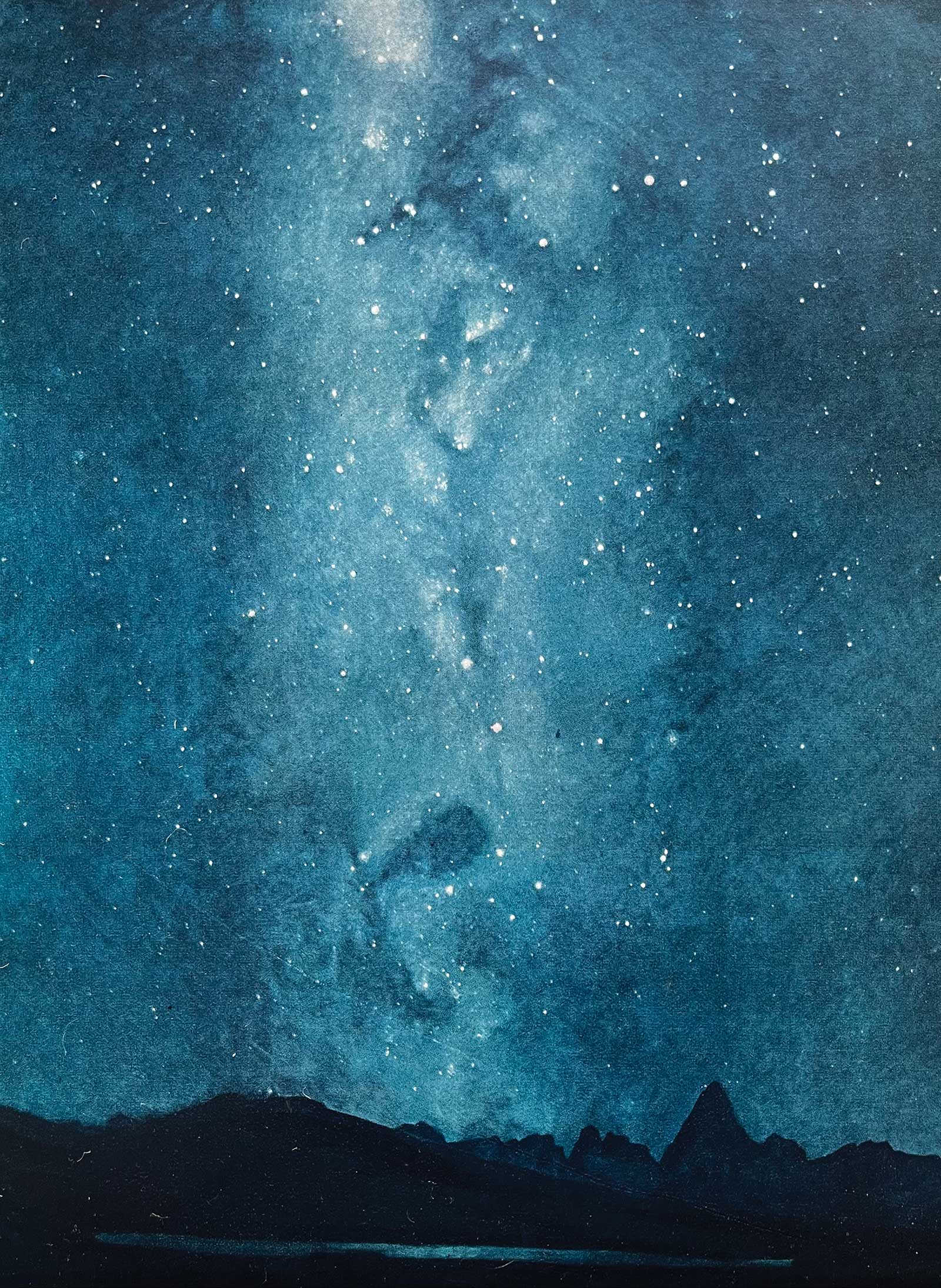 Whirling Clouds of the Southern Milky Way Rise Over the Andes
In Zodiacal Light, Stephens shares a phenomenon rarely observed to this day—a cone of light that catches the interplanetary dust of comets at dusk and dawn, at just the right angle, and then appears to shoot up from the horizon into the stars. Retreating Shadow of the Moon, to me, has a wonderful kinship with Victor Higgins’ paintings of a ceremonies in Taos at night. The gathering of eclipse observers at the huts in the foreground are, in every sense of the word, pilgrims and penitents who are simply paying tribute to a different deity—or to the same deity in a different way. And then, in the fantasy work, Every Star Has Been a Nova in its Time, the plenitude of the universe—blooms as if straight from the mind of Giordano Bruno (1548-1600), the Dominican friar burned at the stake for his belief that the stars were other suns, and that other planets revolved around them, planets that might harbor life. In Stephens’ painting, everything evolves from the same forces—Carl Sagan’s “starstuff”—and the work serves as metaphorical reminder that though we may seem insignificant in the grand scheme of the universe, we each—star, planet, person, peony, bacterium—have our place, worth and role to play. Whirling Clouds of the Southern Milky Way Rise Over the Andes reminds us of all of this without resorting to fantasy. Look up!, it says, and wonder. Perhaps awe is what Stephens saw as lacking in science. Perhaps his mission was to restore awe in order that scientists and non-scientists alike might remember where science begins—in a contemplation of the magnificence of creation that leads to a desire to know more, delve deeper, understand why.
The Astronomer personifies this. As Stephens conceives him, he writes his great tome, hearing the music of the spheres as his imagination creates fantastic realms in the very air around him.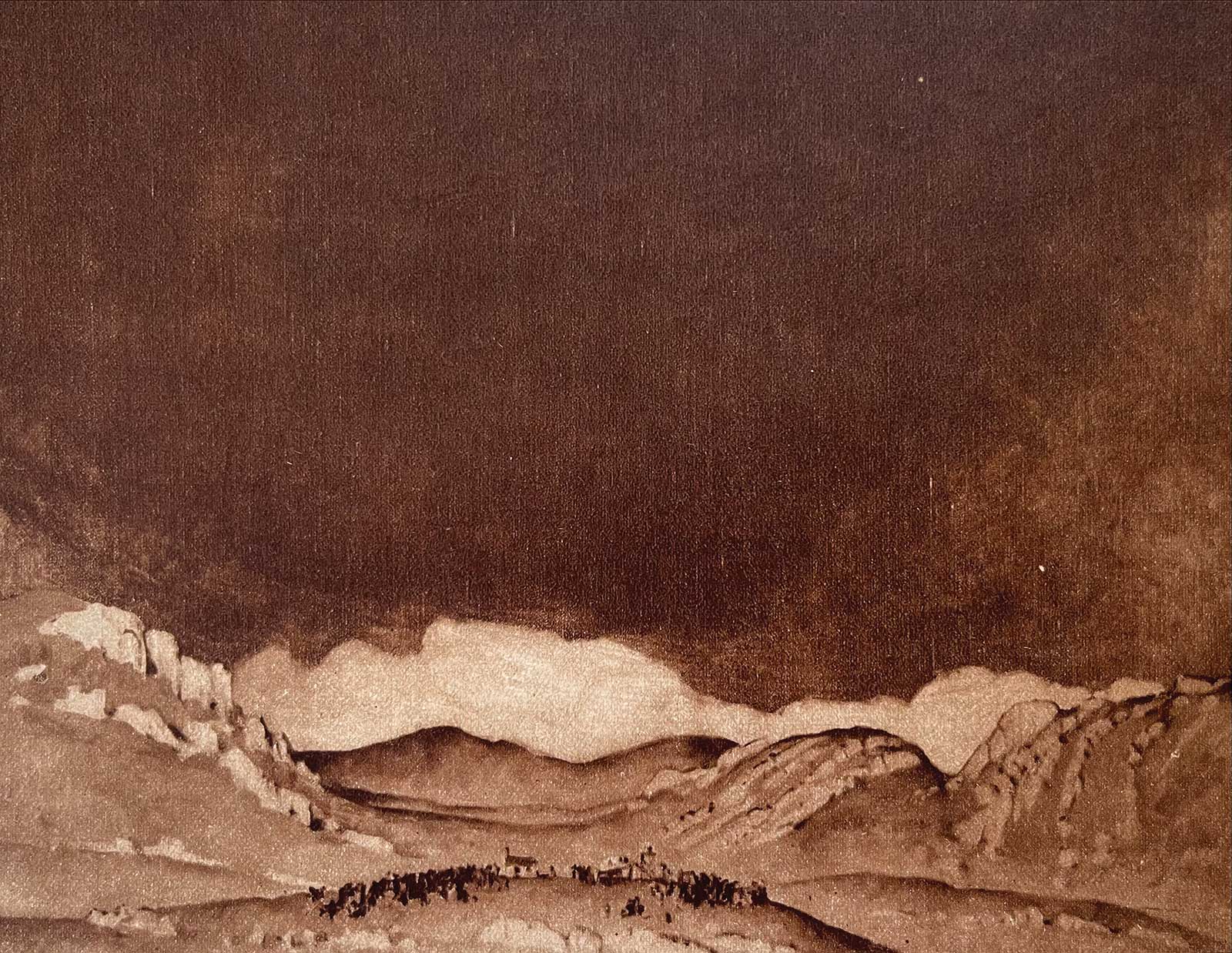 Retreating Shadow of the Moon
It’s interesting to note and compare the painters of the Transcendentalist Movement—Raymond Jonson, Agnes Pelton and others—whose aesthetic of spiritual geometry arises at about the same time as Stephens comes into his own, just prior to his early demise. Both seem to seek the same sort of grandeur and aspirations for the human imagination—the Transcendentalists by looking inward for the shapes of timelessness; Stephens by looking up into the heavens, back into nature, back—with every star he paints—into time itself. The congruences of forms in both, however, are undeniable. It is as if they arrived at the same conclusion about what art needed to be in the 1930s, but from entirely different starting points.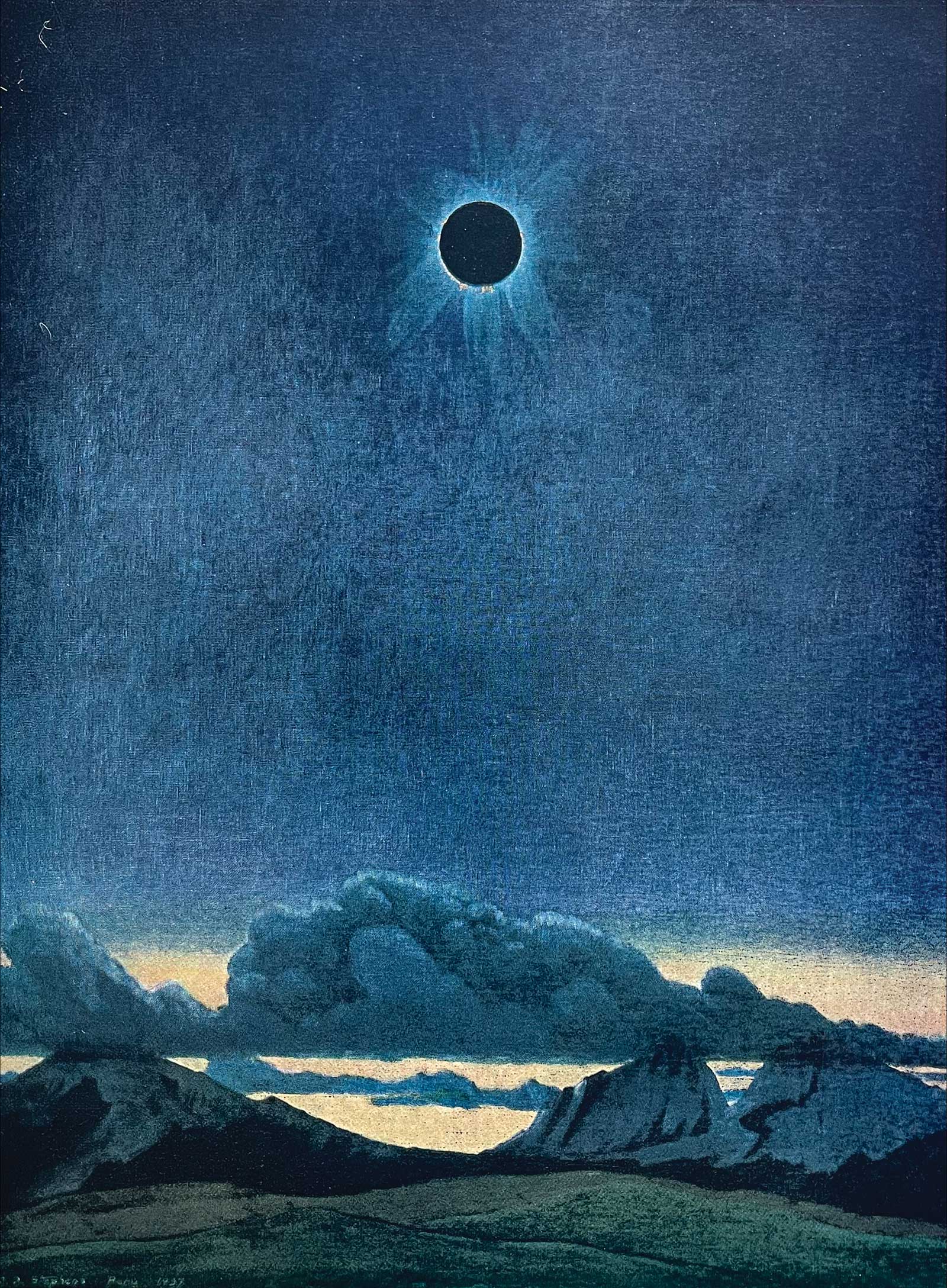 The Moon Swallows the Sun During Totality
Over the years, my daughter and I have fancied ourselves amateur astronomers and have attempted some of the challenges found on the website of the Astronomical League. The League, amazingly, encourages and sometimes insists on participants drawing what they see through the eyepiece. Their rationale is that it shows the uniqueness of every perception and adds a feeling of ownership to the experience. When my daughter and I compare our renderings of the same object, they often differ from one another, leading to discussions about what we saw and why we drew it the way we did. This is science at its most basic, and most human. What Stephens sought—to communicate science through art—is critical in light of the climate crisis, the pandemic and the myriad environmental challenges we face, and will certainly face in the future. Communication and messaging are something every college and university science department, and every museum, is discussing in earnest and working to refine. Stephens intuited, early on, that we would need art to translate and transmit science in language and images accessible to a larger audience—and that awe might be a good place to start. After all, how many NASA scientists credit Star Trek for inspiring them to pursue science? Our times suggest that it might be time for a reacquaintance with the life, aims and art of D. Owen Stephens. —
+++
James D. Balestrieri is the proprietor of Balestrieri Fine Arts, specializing in arts consulting, sales, research and writing. He is currently the writer-in-residence for the Clark Hulings Foundation, as well as estate and collections consultant for The Couse Foundation and communications manager for Western Spirit: Scottsdale’s Museum of the West. He was director of J.N. Bartfield Galleries for 20 years, worked with the Scottsdale Art Auction for 15 years and has written over 150 essays for various art publications.
Powered by Froala Editor