The exhibition The O’Keeffe Circle: Artist as Gallerist and Collector sheds new light on one of the country’s most celebrated artists, Georgia O’Keeffe. At the Reynolda House Museum of American Art through March 6, it presents her active role in the galleries of her husband, Alfred Stieglitz, and her being a collector and friend of the avant-garde artists of her time.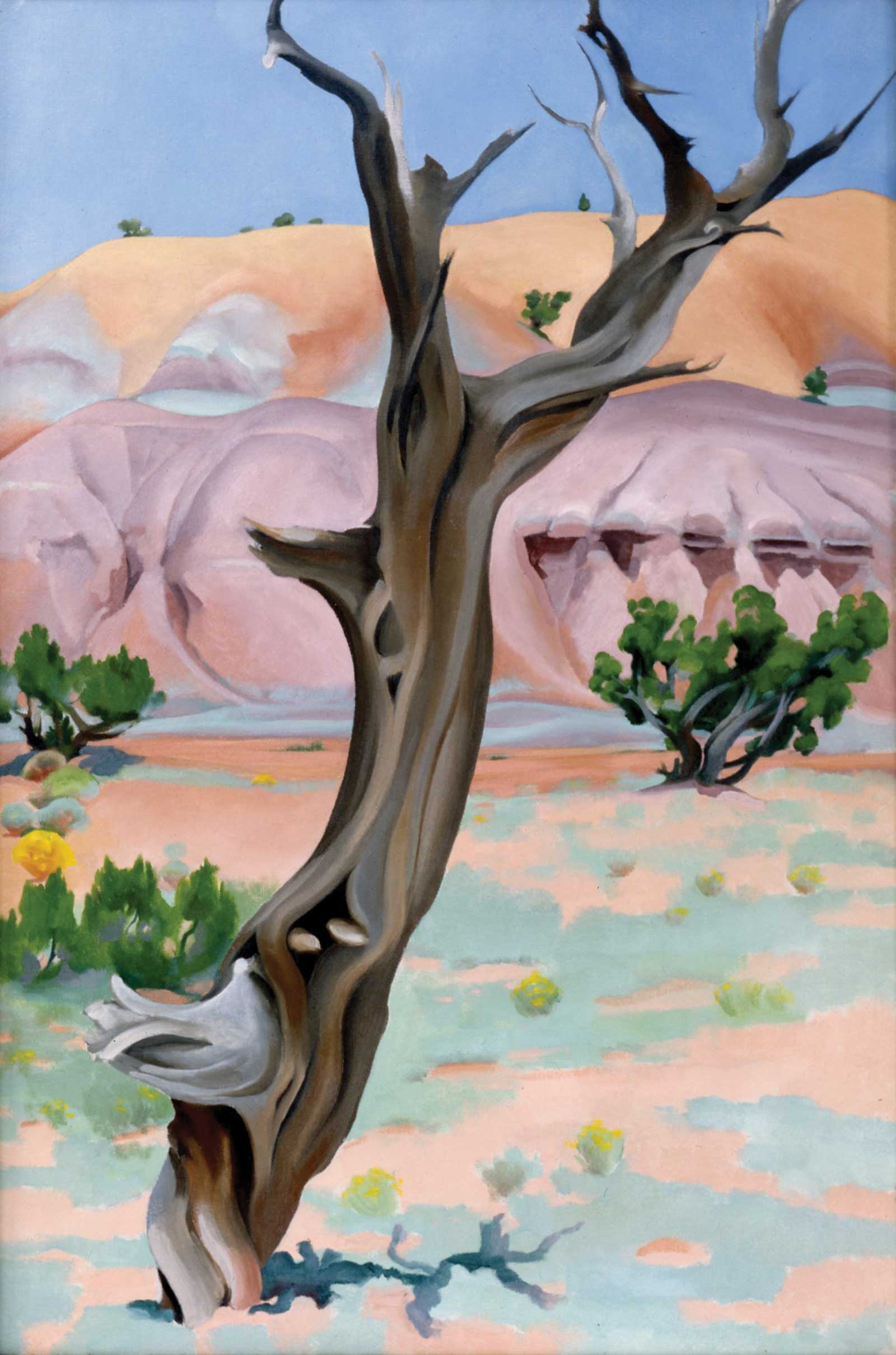 Georgia O’Keeffe (1887-1986), Cedar Tree with Lavender Hills, 1937. Oil on canvas, 30 x 20 in. Promised gift of Barbara B. Millhouse. © 2021 Georgia O’Keeffe Museum/ Artists Rights Society (ARS), New York.
Phil Archer, the museum’s deputy director and curator, notes, “I hope people will leave with a fuller image of O’Keeffe’s engagement with the art of her time. She developed a persona (helped by Stieglitz) of the remote, contemplative, detached doyenne of the desert. But she was keenly interested in her contemporaries’ work and unstinting with both praise and criticism. Their radically modern art, cultivated and sustained in the fertile hothouses of Stieglitz’s little galleries, would grow to redefine American art in the 20th century.”
The museum’s O’Keeffe, Pool in the Woods, Lake George, 1922, will be joined by the recent promised gift of her Cedar Tree with Lavender Hills, 1937, as well as works by Isamu Noguchi, Alexander Calder, John Marin, Marsden Hartley, Charles Demuth and Arthur Dove. 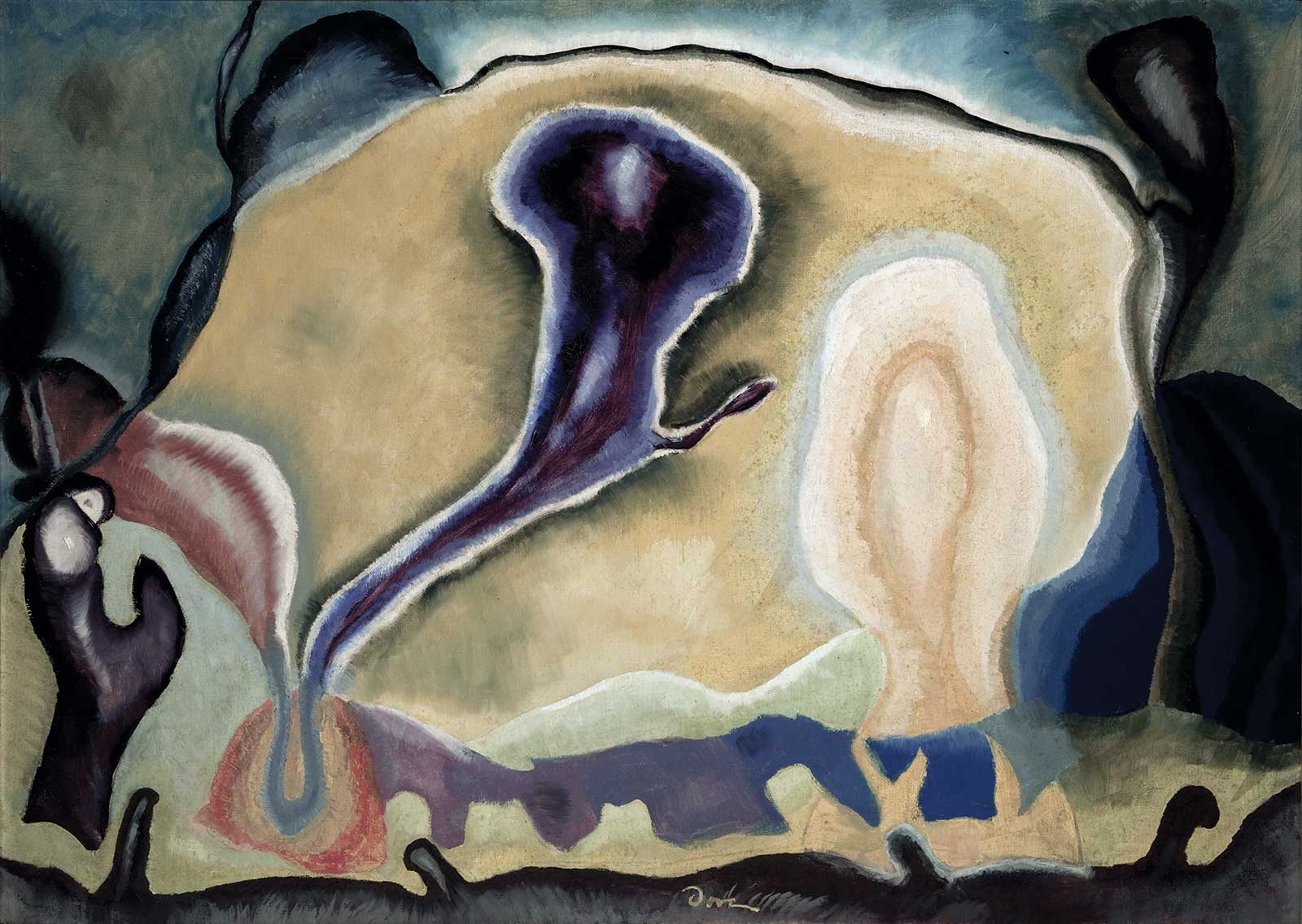 Arthur Dove (1880-1946), Dancing, 1934. Oil on canvas, 24 5/8 x 34¾ in. Gift of Barbara B. Millhouse, Reynolda House Museum of American Art.
Stieglitz showed O’Keeffe’s work at his New York gallery, 291, in 1917. “In Georgia O’Keeffe, whom he married in 1924,” Archer writes, “Stieglitz found a restless innovator and a partner in his struggle to champion radical authenticity in art. At times, O’Keeffe functioned as co-curator with the oracular Stieglitz, and the other artists in Stieglitz’s circle soon came to trust O’Keeffe to hang their shows with the same sure, unerring eye that she brought to her own annual installation.”
In 1934, O’Keeffe began staying at Ghost Ranch, north of Santa Fe, New Mexico. In 1937, she wrote to Stieglitz, “I’ve been painting an old dead cedar against those purple hills I’ve painted so often. It is a tree that I made a drawing of long ago when I first came up here [to Ghost Ranch]…It looks promising. It’s one of those things I’ve had in my so-called mind for a long time.” Two weeks later, Asher notes, she announced, “I think I am through with my tree—It is the first thing I have done that when
I stand it by the window and look at it—then I look out the window—it looks like what I see out the window, tho it was painted a mile away. I think it really looks like here.” The painting is Cedar Tree with Lavender Hills.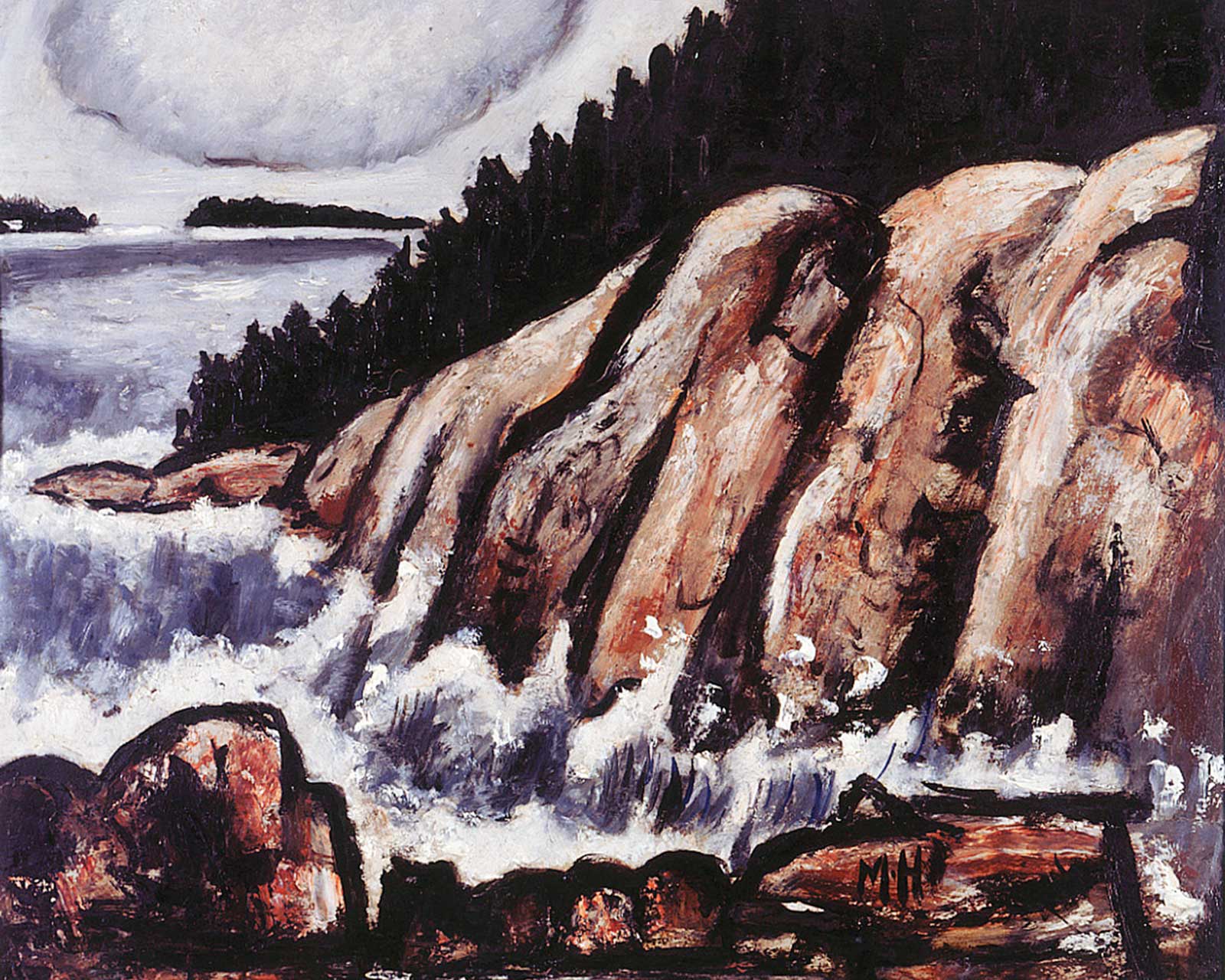 Mardsen Hartley (1877-1943), End of Storm, Vinalhaven, Maine, 1937-38. Oil on academy board, 24½ x 28½ in. Courtesy of Barbara B. Millhouse.
She had been attracted to an exhibition of Marsden Hartley work at 291. The two became fast friends. Asher says, “Hartley’s abstract attempts at what he called ‘subliminal or cosmic cubism’ represented a fully mature response to the bold experiments of Matisse and Picasso, and they dazzled O’Keeffe, who compared their potency to ‘a brass band in a small closet.’ Hartley and O’Keeffe shared more than the steadfast support of Alfred Stieglitz; they also share a marked sense of place as a wellspring of inspiration, with north-central New Mexico representing a spiritual home for both artists and coastal Maine consuming Hartley’s attention in later life.”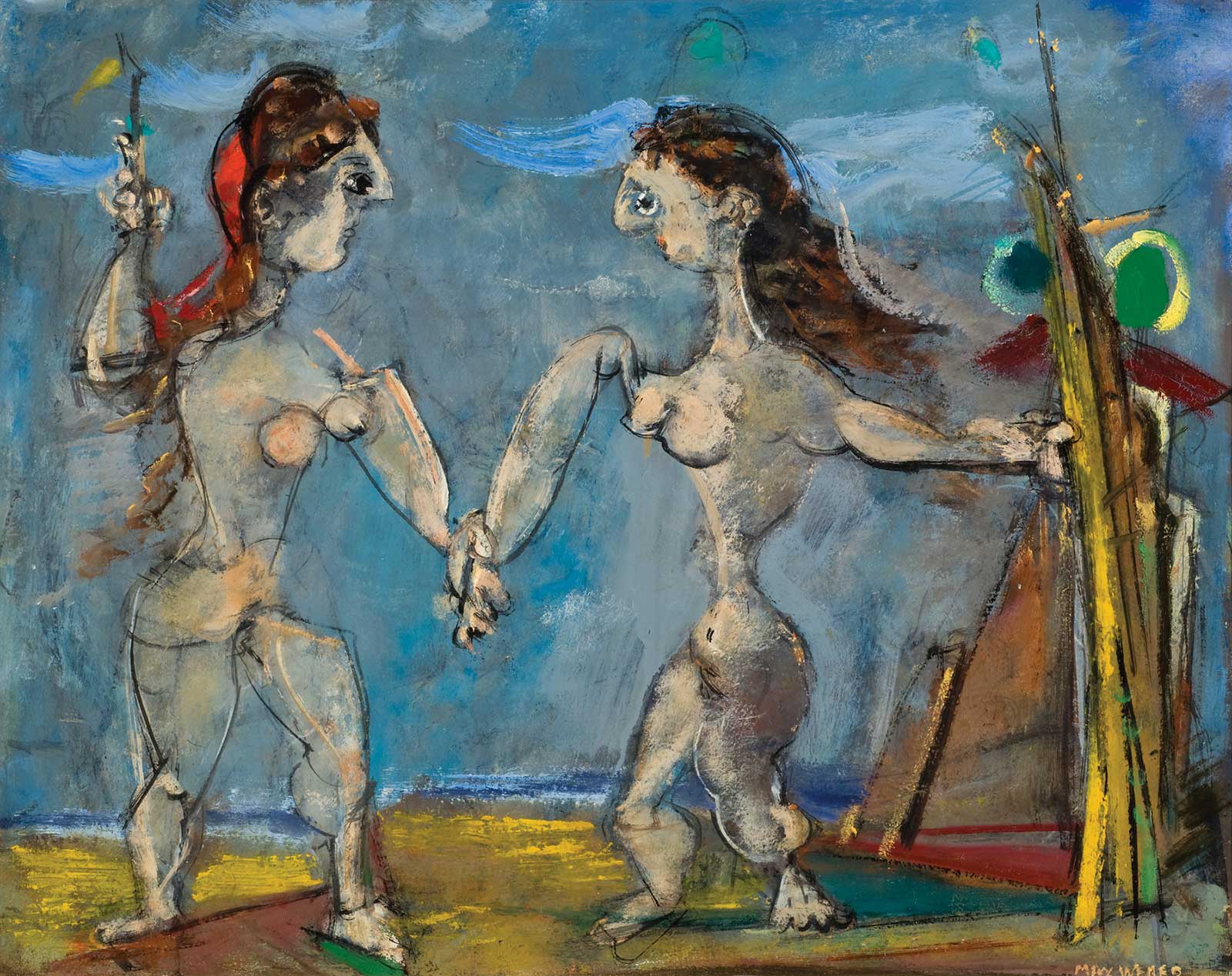 Max Weber (1864-1902), The Dancers, 1948. Oil on canvas, 20¼ x 24¼ in. Gift of Dorothy F. and Maynard J. Weber, Reynolda House Museum of American Art.Dove’s Dancing, 1934, is also in the exhibition. Asher writes, “O’Keeffe first saw Dove’s abstractions at 291 while still a student...Dove’s paintings were the only ones that O’Keeffe allowed on the walls of her homes, saying, ‘Dove had an earthy, simple quality that led directly to abstraction. I loved his things... I always wished I’d bought the ones I wanted, but Stieglitz always told me to wait.’” The admiration was mutual. Dove wrote that O’Keeffe was “doing without effort what all we moderns have been trying to do.” —
Powered by Froala Editor