In the 1930s, much of the art being created was inspired by “seen” aspects of the world, the parts that could be witnessed through the eyes. But the members of the Transcendental Painting Group would argue there was also the “unseen,” which was harder and more complicated to quantify but still worth the effort to explore.
And explore they did. 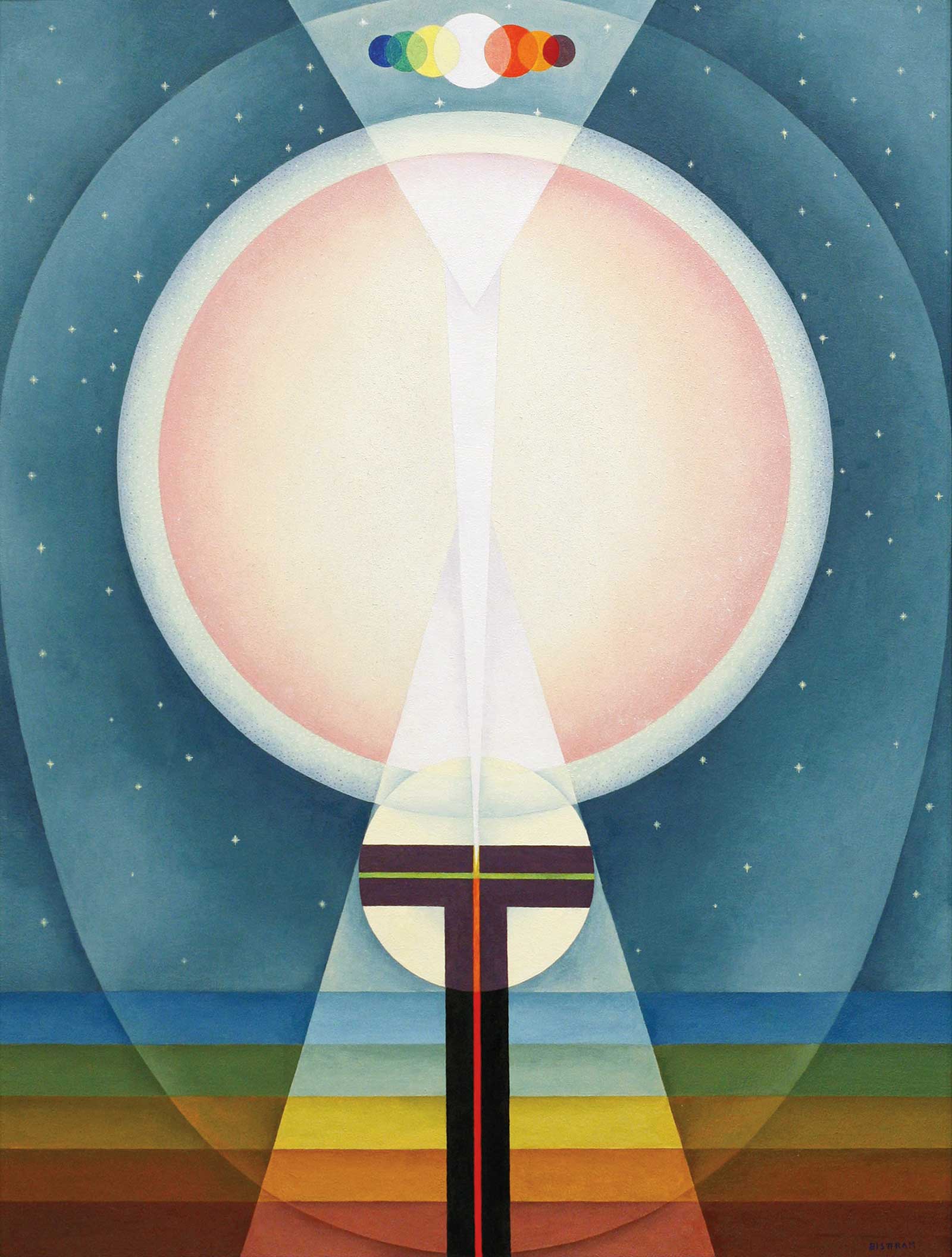 Emil Bisttram (1895-1976), Oversoul, ca. 1941. Oil on Masonite, 35½ x 26½ in. Private collection. © Emil Bisttram.
Now open at the Philbrook Museum of Art in Tulsa, Oklahoma, is a stunning new exhibition that examines the Transcendental Painting Group and what it is the group was trying to achieve. Another World: The Transcendental Painting Group: 1938-1945 will not only feature more than 80 works, but it will also feature works from all 11 members, a rare treat for museum visitors. The exhibition is organized by independent curator Michael Duncan and the Crocker Art Museum.
Formed in 1938, the TPG was primarily based in New Mexico, mostly because the members had ventured west looking for something different. Amid burgeoning scenes of artists in Taos, Santa Fe and Albuquerque, the painters found a welcome environment for modernism and abstraction. Members were Raymond Jonson, Emil Bisttram, Agnes Pelton, Lawren Harris, Florence Miller Pierce, Horace Pierce, Robert Gribbroek, William Lumpkins, Stuart Walker and Ed Garman, as well as Dane Rudhyar, who wasn’t a member but closely associated with the group. 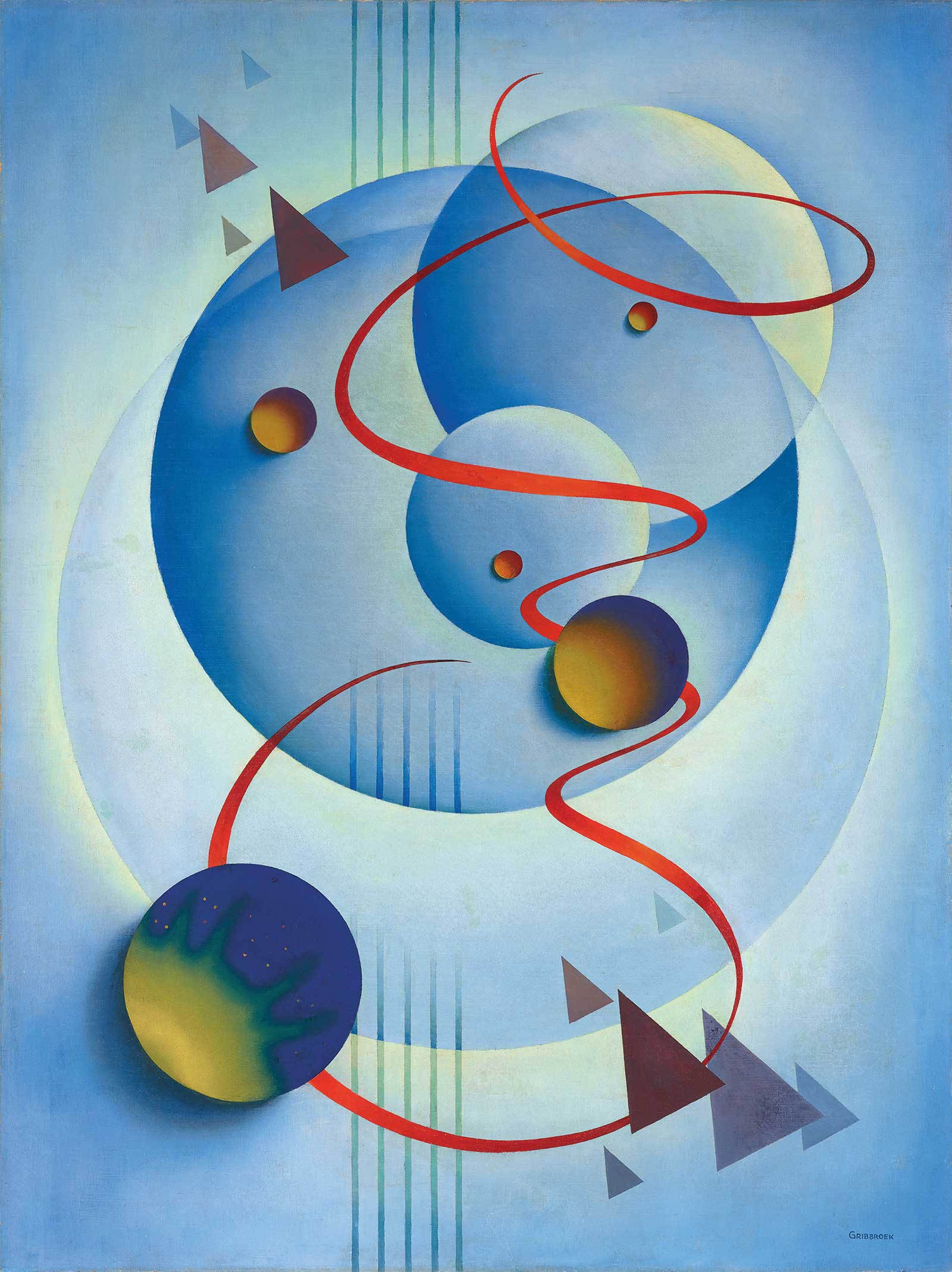 Robert Gribbroek (1906-1971), Composition #57 / Pattern 29, 1938. Oil on canvas, 36 x 27 in. Fine Arts Museums of San Francisco, The Harriet and Maurice Gregg Collection of American Abstract Art, 2019.42. © Robert Gribbroek.
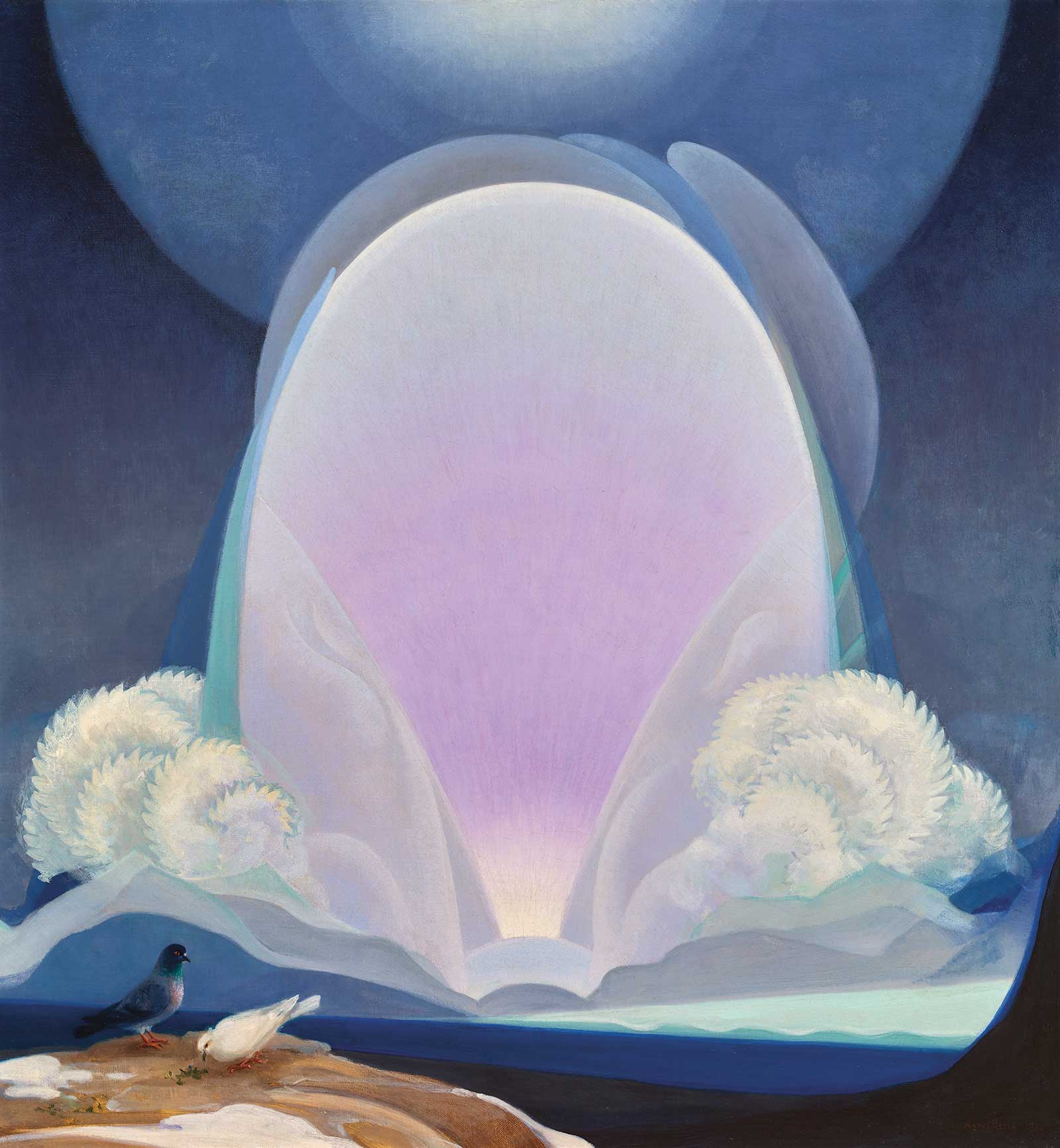 Agnes Pelton (1881-1961), Winter, 1933. Oil on canvas, 30 x 28 in. Crocker Art Museum Purchase; Paul LeBaron Thiebaud, George and Bea Gibson Fund, Denise and Donald C. Timmons, Melza and Ted Barr, Sandra Jones, Linda M. Lawrence, Nancy Lawrence and Gordon Klein, Nancy S. and Dennis N. Marks, William L. Snider and Brian Cameron, Stephenson Foundation, Alan Templeton, A.J. and Susana Mollinet Watson, and other donors, 2013.54. © Agnes Pelton.
“One of the big things they were doing, was they saw a definite connection between spirituality and abstraction. For them, you could represent what’s in front of you—that’s the seen and the known. But through abstraction you can represent what’s unseen or perhaps what’s hoped for—the bigger possibilities of life, the universal truths,” says Philbrook curator Susan Green. “Each of these artists were working in an abstract manner, but also interested in bigger ideas and concepts. For instance, Emil Bisttram was trying to take his ideas and transcend artwork in his own unique way by representing symbols and colors to represent these universal truths. Horace Towner Pierce was thinking about mathematics and proportions and logarithms, and how they are connected to humanity. And then Agnes Pelton, she was known in art circles for exploring spirituality.” 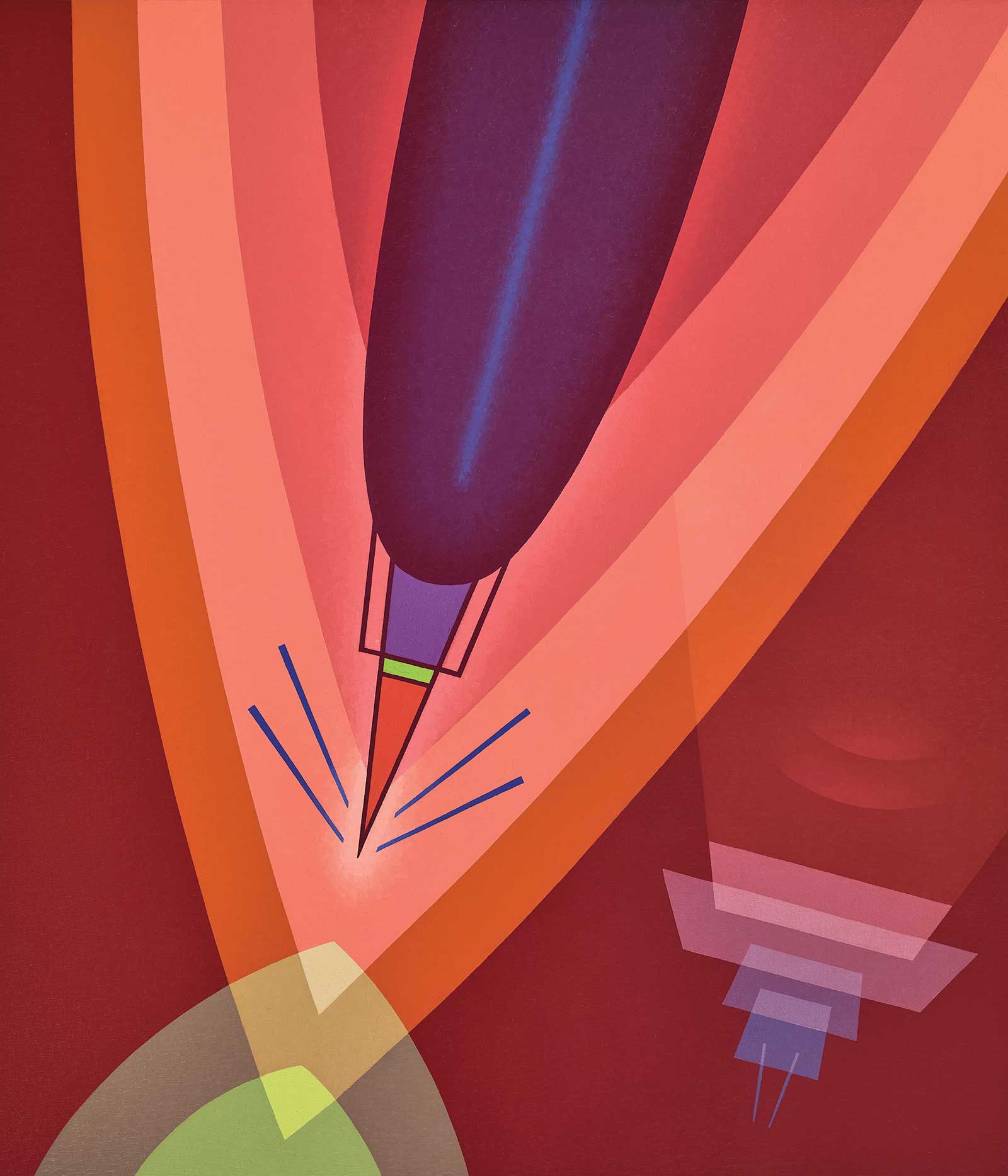 Raymond Jonson (1891-1982), Oil No. 2, 1942. Oil on canvas, 42 x 36 in. Crocker Art Museum Purchase, George and Bea Gibson Fund with contributions from Barbara and William Hyland and Loren G. Lipson, M.D., 2015.25. © Raymond Jonson.
The resulting work is astounding in its form, color and composition, as well as its genre-bending playfulness. “Convinced that an art capable of being intuitively understood would have equal validity to representational painting in an era of uncertainty, political divide, and fear, [the TPG] attempted to promote abstraction that pursued enlightenment and spiritual illumination,” the Crocker Art Museum notes. “Their manifesto stated their purpose: ‘To carry painting beyond the appearance of the physical world, through new concepts of space, color, light and design, to imaginative realms that are idealistic and spiritual.’”
Another World opened at the Albuquerque Museum in June, before heading to its current location at the Philbrook. It then goes to the Baker Museum in Naples, Florida; the Crocker Art Museum in Sacramento, California; and finally to the Los Angeles County Museum of Art in Los Angeles. —
Powered by Froala Editor