I will never forget the day in 2002 when I sat in the auction room at Sotheby’s New York, watching gobsmacked as Norman Rockwell’s Rosie the Riveter sold for $4,959,500, at the time a new auction record for the artist. Rosie, from 1943, represents the American women who worked in factories during World War II; it’s arguably the symbol for feminism and women’s economic power. It is also one of Rockwell’s most important paintings. Just seven years after the Sotheby’s sale, Alice Walton’s Crystal Bridges Museum of American Art in Bentonville, Arkansas, acquired the work privately for a reported $25 million; the work is among the most popular in the museum, as much a draw as Asher B. Durand’s Kindred Spirits. The painting increased in value by more than five times in just seven years. Aside from contemporary art, what other category of art even comes close to such appreciation in value? A rendering of the Lucas Museum of Narrative Art, which was founded by filmmaker and philanthropist George Lucas and his wife, Mellody Hobson. The institution is scheduled to open in 2023. Image courtesy Lucas Museum of Narrative Art.
In years past, the world’s top auction houses were more likely to place illustration art in their lower price point and midseason sales. But in recent years such works have been appropriately—and finally—elevated; houses now offer a growing number of significant works in this category alongside other landmark and important American art sales. Take Rockwell’s masterpiece Saying Grace, from 1951, which depicts a woman and boy bowing their heads in prayer at a table in a bustling restaurant as other patrons pause for a moment to look on. This masterwork sold in 2013 for an unbelievable $46 million. The entire auction realized a total of $58 million, with seven works by Rockwell earning 60 percent of the entire revenue for the sale. That same week at another auction house on the other side of town, an important Edward Hopper painting from 1934, East Wind Over Weehawken, sold for only $40 million. Rockwell was the star of the season, once again.
Of late, it’s a question asked over and over: Why is illustration art so popular and in demand now?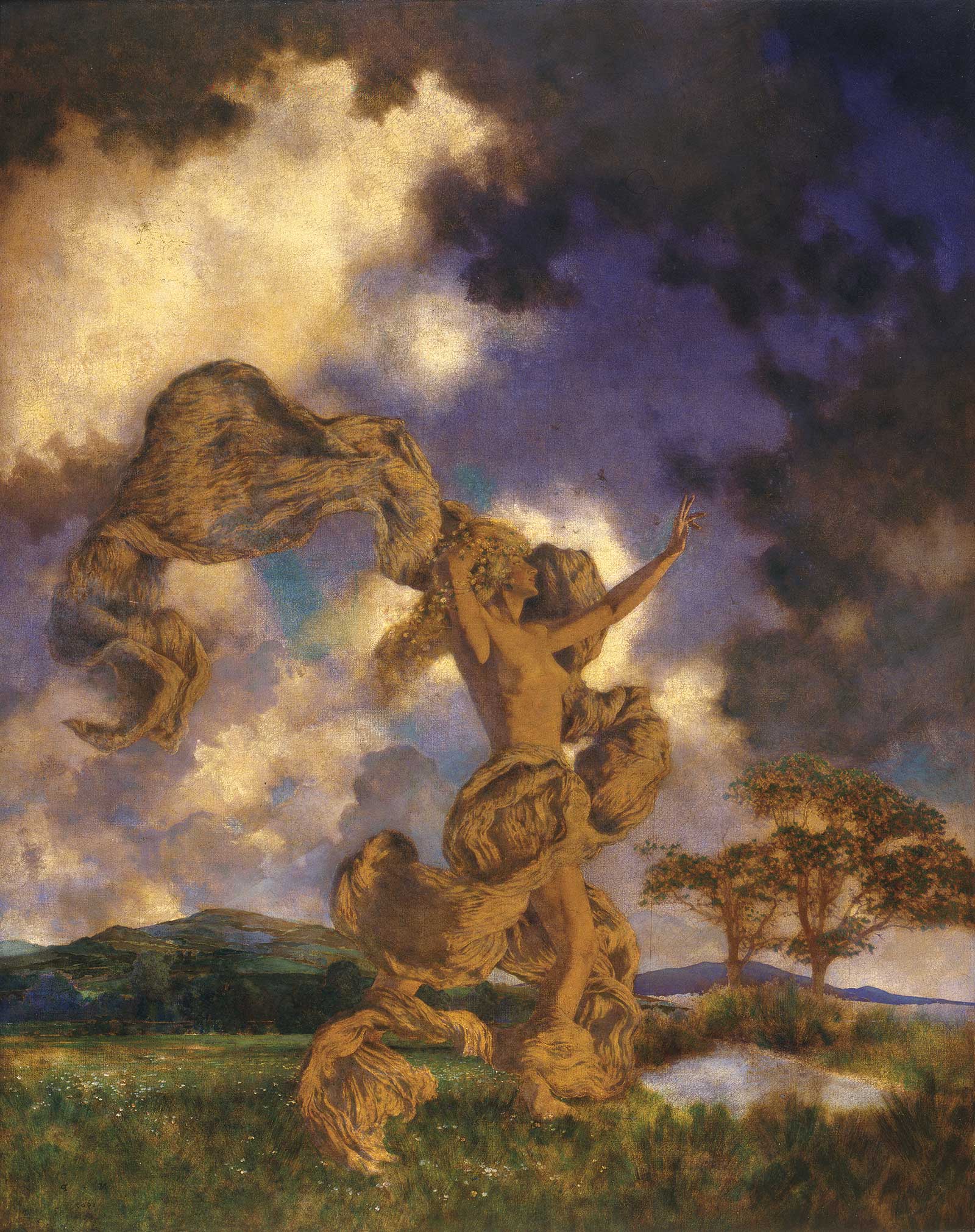 Maxfield Parrish (1870-1966), The Storm, 1907. Oil on canvas, 40 x 32 in. Addison Gallery of American Art, Phillips Academy, Andover, Massachusetts, gift of Mrs. Henry M. Sage, 1958.40. Photo credit: Addison Gallery of American Art, Phillips Academy, Andover, MA / Art Resource, NY. © 2021 Maxfield Parrish Family, LLC / Licensed by VAGA at Artists Rights Society (ARS), NY.
The reasons are myriad but likely simple enough, among them: The masterworks cited above encapsulate a certain flavor of American nostalgia. With all the world has endured, there’s a hunger for the simple, the innocent, the idyllic if not the outright ideal. The reason these lots fetched record prices is exactly the same reason illustration art, and Golden Age illustration in particular, is arguably the hottest area of the American art market these days: They provide comfort and entertainment.
In 2010 George Lucas and Steven Spielberg, two of the greatest collectors of Rockwell in the world, lent their collections to the Smithsonian American Art Museum in Washington, D.C. When Lucas was asked what exactly appeals to him in a Rockwell painting on CBS Sunday Morning, July 4, 2010, he said, “Rockwell was able to sum up the story and make you want to read the story, and at the same time actually understand who the people were, what their motives were, everything in one little frame.” On the same show, Spielberg said, Rockwell “had a tremendous respect for the virtues of mankind, and there was a real sense of community, of family, and especially of nation.” Despite our differences, we can all understand and appreciate Lucas and Spielberg’s sentiments. The yearning to feel part of a community and a unified nation as one escapes into an illustrated narrative is what drives the marketplace for illustration art.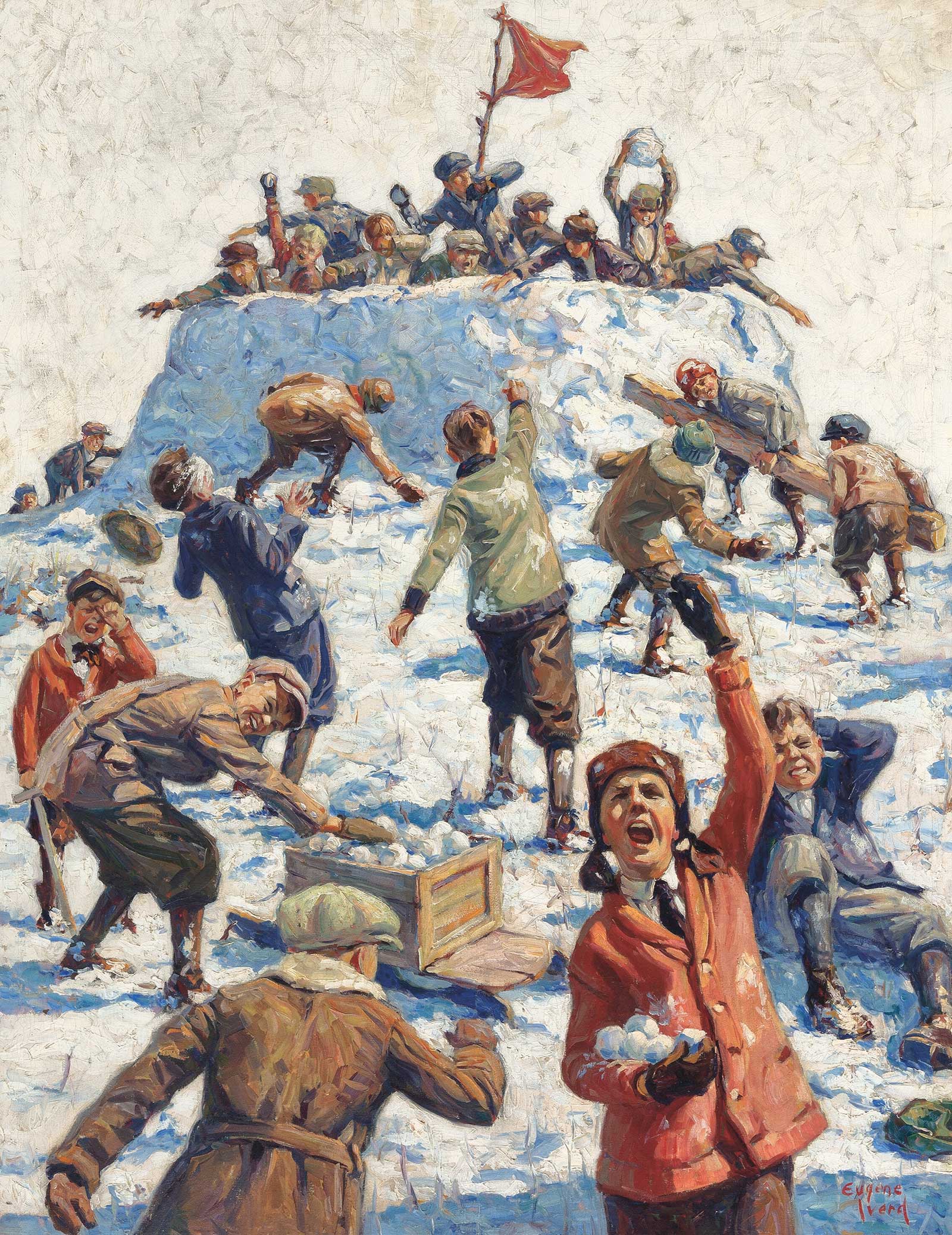 Eugene Iverd (1893-1936), The Siege, The Saturday Evening Post cover, January 15, 1927. Oil on canvas, 42 x 33 in. Artist World Auction Record. Courtesy Heritage Auctions, ha.com. Estimate: $4/6,000 SOLD: $162,500
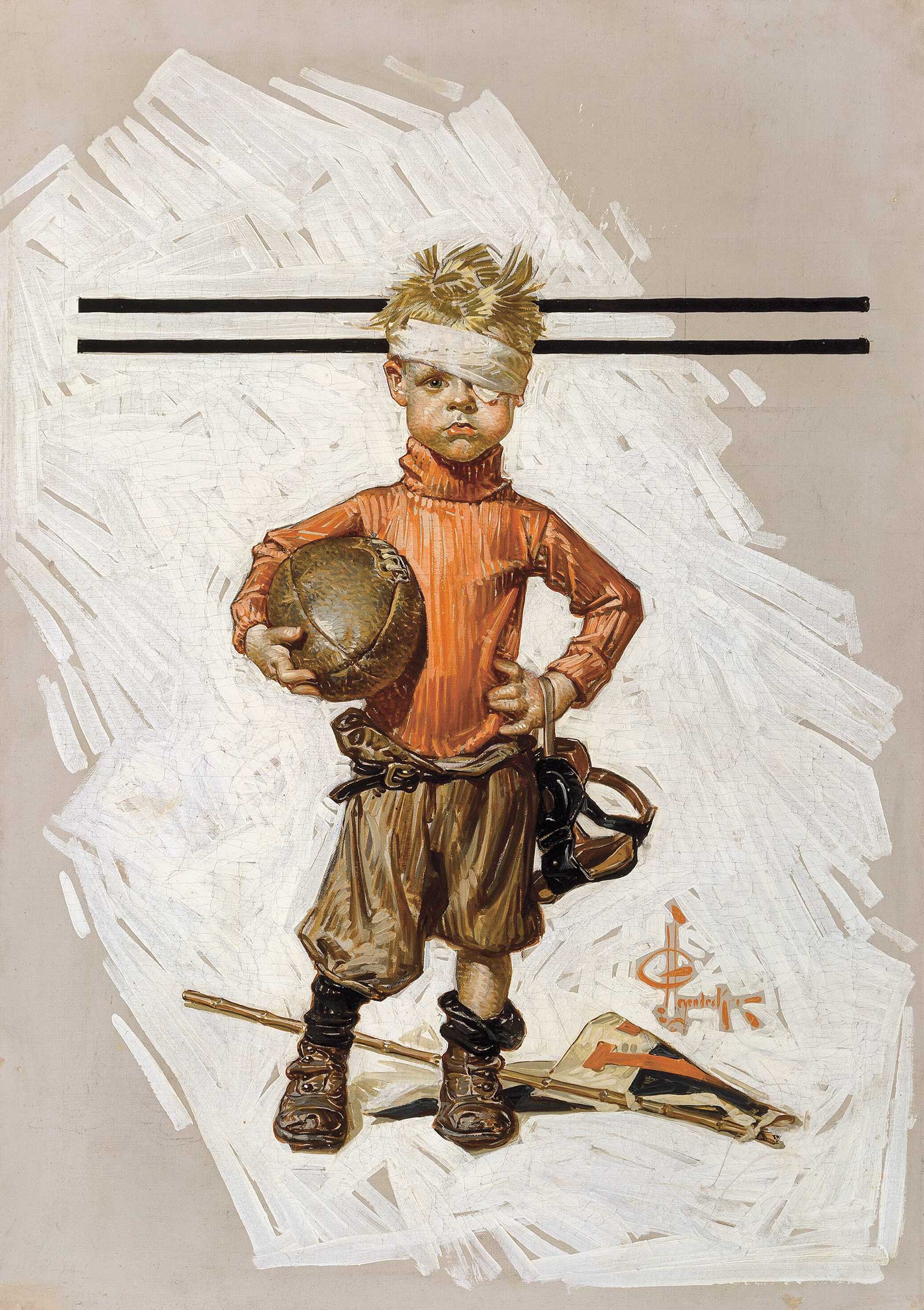 Joseph Christian Leyendecker (1874-1951), Beat-up Boy, Football Hero, The Saturday Evening Post cover, November 21, 1914. Oil on canvas, 30 x 21 in. Artist World Auction Record. Courtesy Heritage Auctions, ha.com Estimate: $150/250,000 SOLD: $4,121,250
The audience for Golden Age illustration grows by the season, and the appetite for blue-chip works by Rockwell, N.C. Wyeth and Maxfield Parrish is voracious. There is simply more demand than supply. As a result, lesser-known illustrators are finally receiving the attention they deserve, and they, too, are selling in the six- and even seven-figure range. Heritage Auctions recently established a new benchmark for a painting by Joseph Christian Leyendecker, Rockwell’s predecessor at The Saturday Evening Post.
Beat Up Boy, Football Hero, a Saturday Evening Post cover from 1914, sold for an extraordinary $4,121,250 in May, against a presale estimate of $150,000 to $250,000. The painting outpriced the previous auction record for Leyendecker established just six months earlier—by more than $3.5 million. Fourteen clients competed feverishly for more than 15 minutes to acquire this tour de force. In that same auction, another Post cover by a relatively unknown illustrator named Eugene Iverd blew past its $4,000 to $6,000 presale estimate, as 20 clients drove the final selling price to a record $162,500. I predict this trend will continue, and that we will see prices continue to explode for illustrators that have long been considered secondary and tertiary in relation to Rockwell.
Aside from the auction arena, institutional focus and scholarship have been geared more toward illustration art as well. The 1999 to 2002 traveling exhibition Norman Rockwell: Pictures for the American People, which made stops at the Corcoran Gallery of Art in Washington, D.C., the High Museum of Art in Atlanta and the Guggenheim in New York, among other institutions, appeared to signal a willingness on the part of the fine art crowd to take illustration art seriously. Exhibitions of illustration art are popping up in galleries, not only in America, but in Germany and Japan as well. The Lucas Museum of Narrative Art is being built in California, generating tremendous buzz even before the doors open. I for one can’t wait to buy my ticket and based on illustration’s wide-reaching popularity with young and old alike, I foresee the opening line will be quite long. Good things come to those who wait. —
Aviva Lehmann joined Heritage Auctions in January 2013 after 14 years in the auction industry. With over 20 years of in-depth knowledge and experience in American art, she holds a broad interest in all aspects of the field. Lehmann previously served as vice president, specialist in the American Art department at Christie’s, where she was instrumental in establishing dozens of auction records in virtually every category of American art. During her career at Heritage, Lehmann has been instrumental in bringing some of the finest single-owner collections to market, including the Judson Ball collection of Western and Wildlife Art, the Ember collection of Modernism and Design, and the Barry and Maria King collection of early American Modernism. She also has been instrumental in establishing dozens of new auction records in field. Lehmann lectures on American art at museums and institutions throughout the country and has successfully completed the coursework and examination in the Uniform Standards of Professional Appraisal Practice. She also serves as an adjunct professor of Appraisals and Valuation in the Art Administration Master’s Program at New York University.
Powered by Froala Editor