
Italian glassmaking began during the Roman Empire. By the eighth century, Venice had begun to emerge as a glassmaking center. Eventually, glassmaking became the city’s primary industry. In 1291, a law was passed to move all glassmaking to the island of Murano ostensibly to prevent fires from the furnaces spreading to the center of the city but, more practically, to prevent glassmaking secrets from leaking out. Political changes caused a diminution of Murano’s prominence but between 1860 and 1915 it witnessed a revival.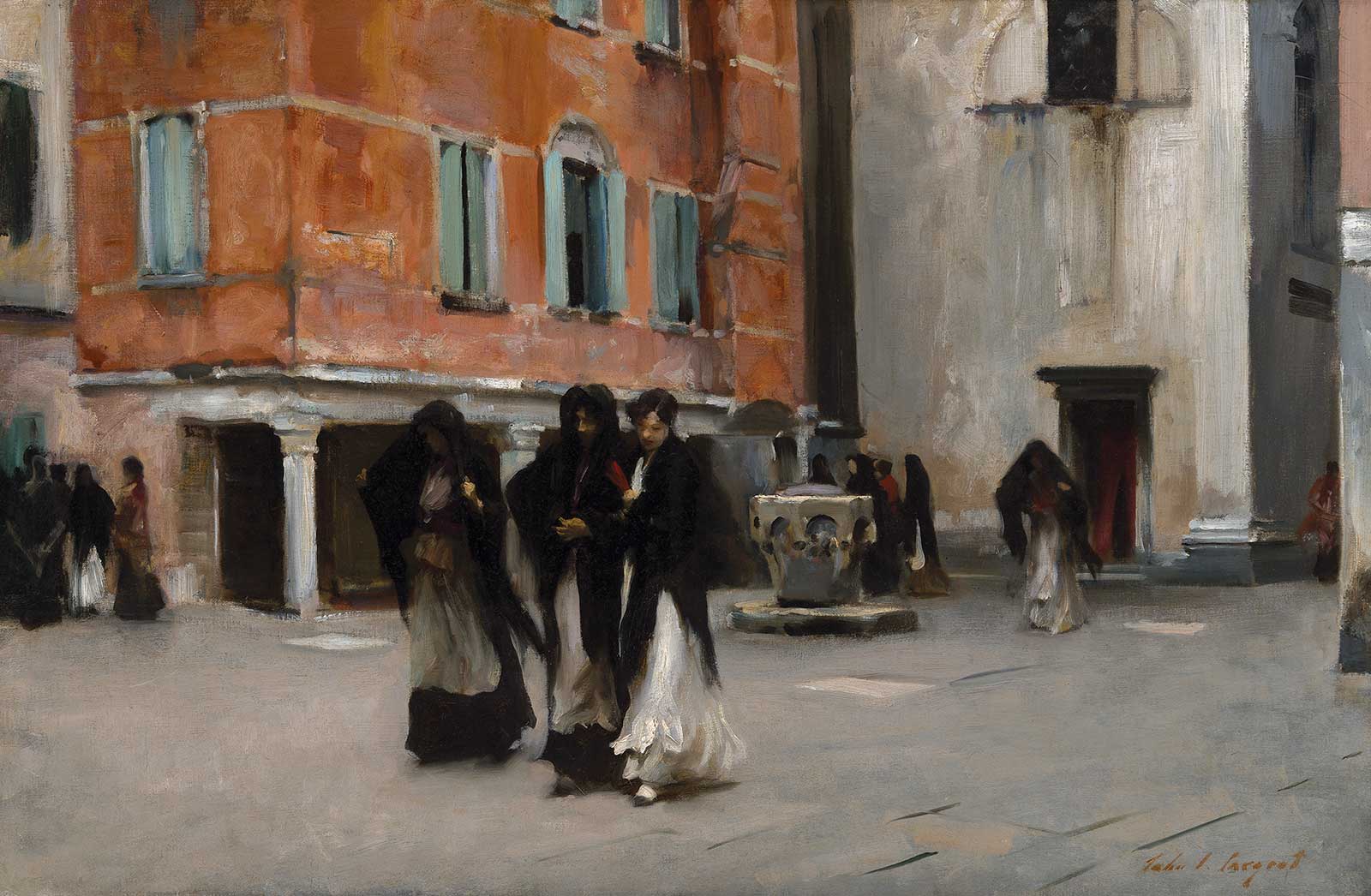 John Singer Sargent (1856-1925), Leaving Church, Campo San Canciano, Venice, ca. 1882. Oil on canvas, 22 x 33½ in. The Collection of Marie and Hugh Halff.
The exhibition Sargent, Whistler, and Venetian Glass: American Artists and the Magic of Murano continues at the Smithsonian American Art Museum in Washington, D.C., through May 8. The museums notes, “This glass revival coincided with a surge in Venice’s popularity as a destination for tourists, leading to frequent depictions of Italian glassmakers and glass objects by artists from abroad. American painters and their patrons visited the glass furnaces, and many collected ornate goblets and vases decorated with flowers, dragons, and sea creatures. Venetian glass vessels, and also glass mosaics, quickly became more than souvenirs—these were esteemed as museum-quality works of fine art.”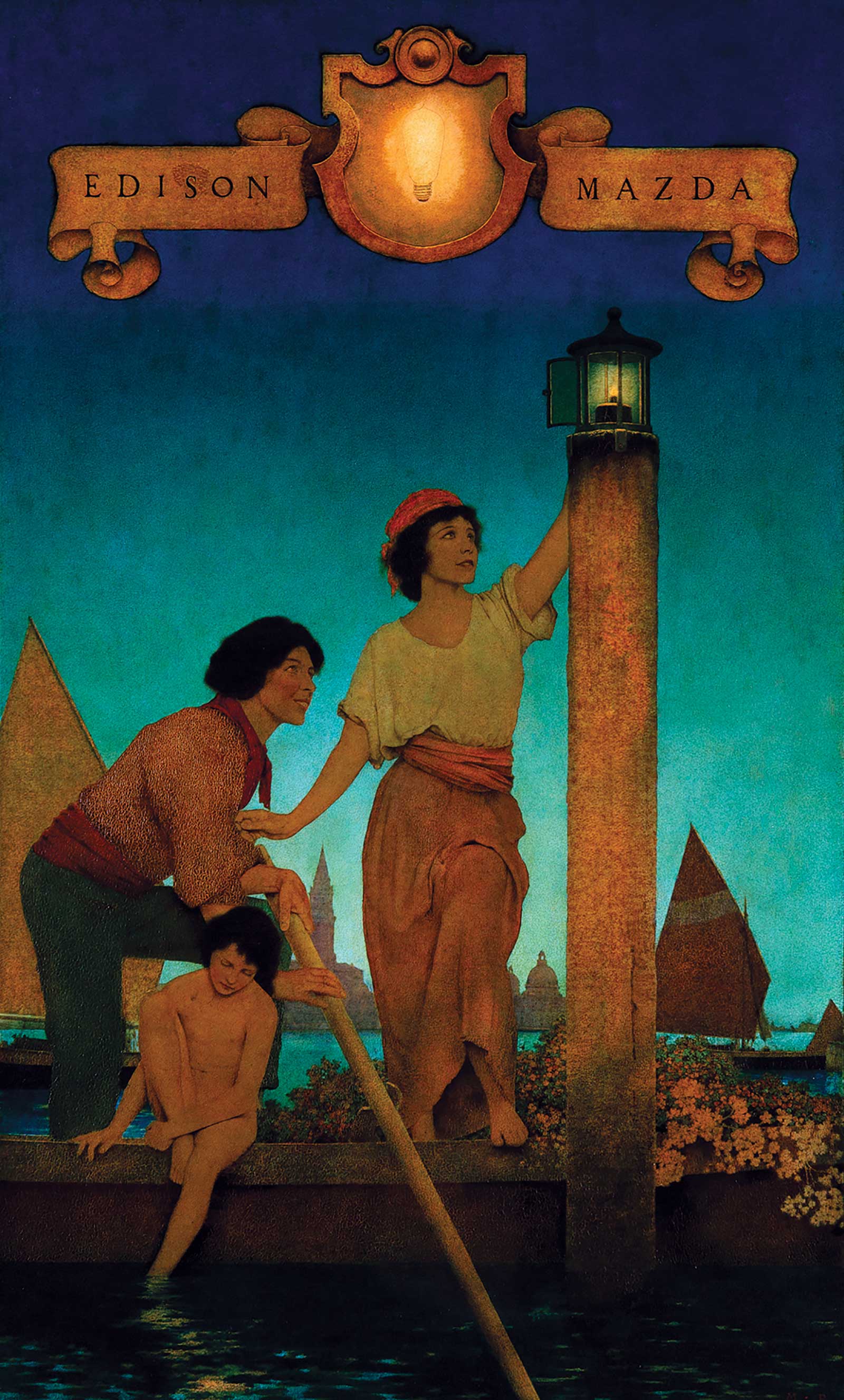 Maxfield Parrish (1870-1966), Venetian Lamplighters, 1922. Oil on panel, 28¾ x 18¾ in. National Museum of American Illustration, Newport, RI and American Illustrators Gallery, New York, NY. © 2021 Maxfield Parrish Family, LLC / Licensed by VAGA at Artists Rights Society (ARS), NY.
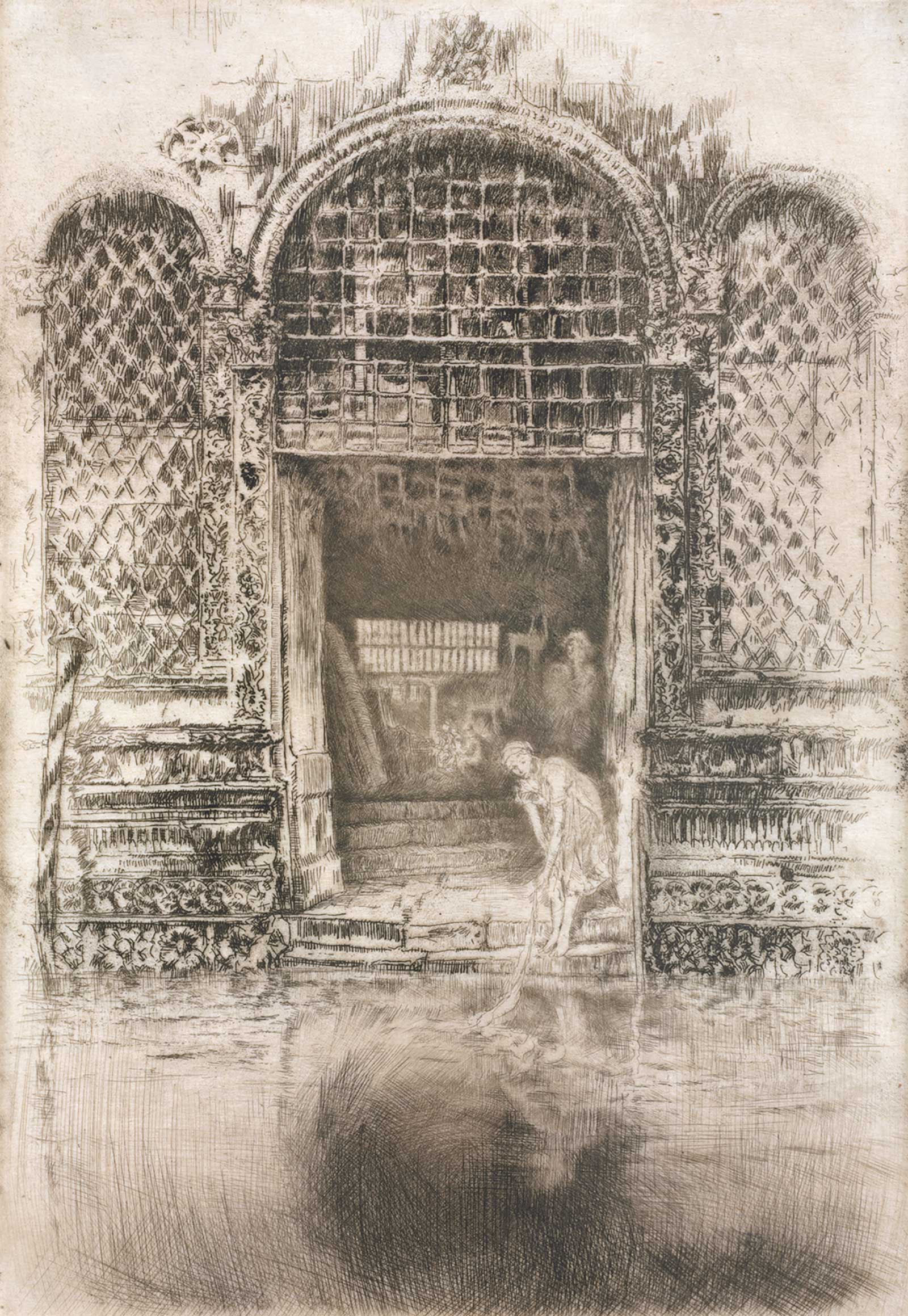 James Abbott McNeill Whistler (1834-1903), The Doorway (First Venice Set), 1879-80. Etching, drypoint and roulette on paper, 119/16 x 8 in. Baltimore Museum of Art, The Conrad Collection, 1932.17.13.
The museum continues, “Moreover, the inventions of Murano’s master glassmakers established Venice as a center for artistic experimentation. Sojourns in Venice were turning points for John Singer Sargent, James Abbott McNeill Whistler and scores of artists who followed in their footsteps, often referencing the glass industry in their works.”
John Singer Sargent (1856-1925) wrote, “I don’t dig beneath the surface for things that don’t appear before my own eyes.” Although he painted extraordinary watercolors of the iconic scenes of Venice, he also produced oils of ordinary people working at their crafts and going about their daily lives. The scene of women Leaving Church, San Canciano, Venice, circa 1882, looks essentially the same today. The women are models whom Sargent often hired on his visits to the city.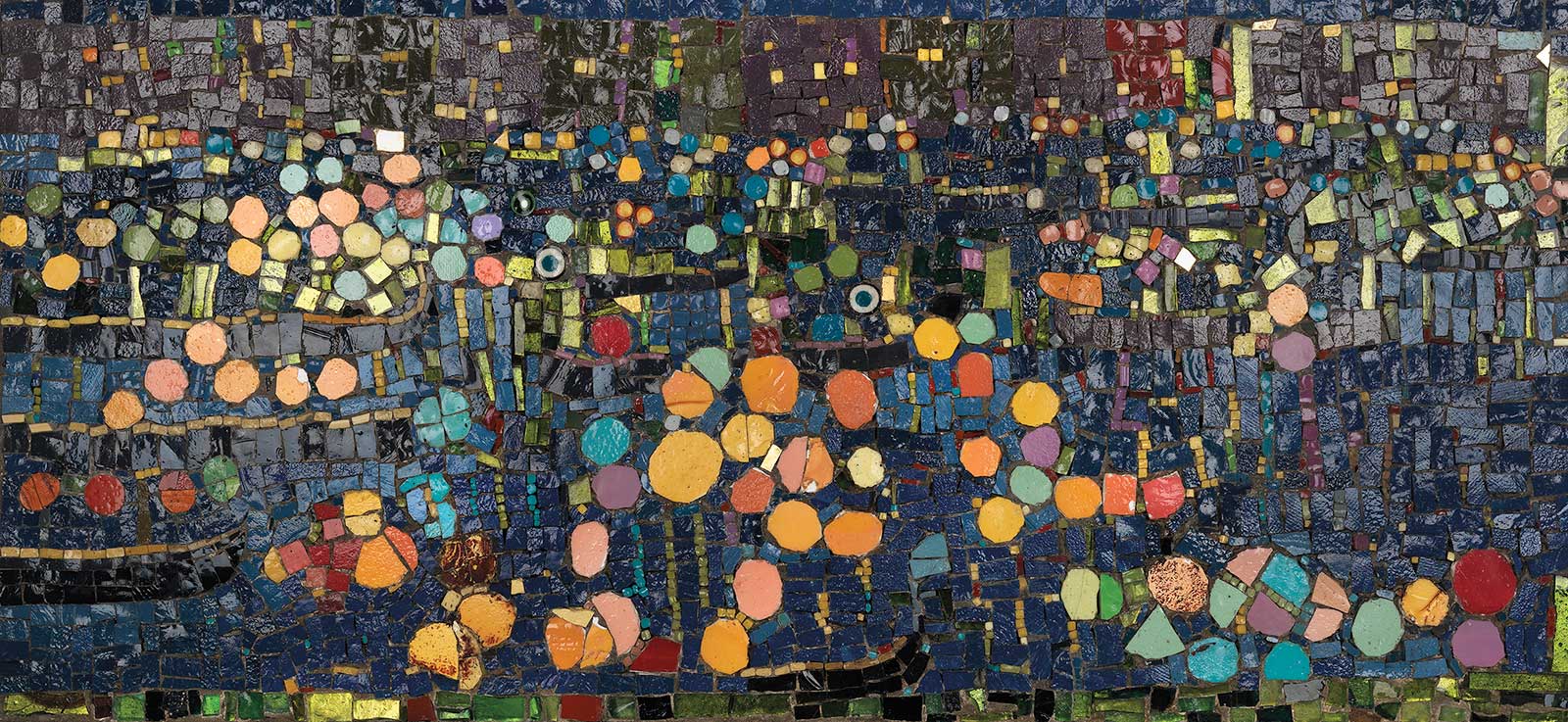 Maurice Brazil Prendergast (1858-1924), Fiesta Grand Canal, Venice, ca. 1899. Glass and ceramic mosaic tiles in plaster, 11 x 23 in. Williams College Museum of Art, Bequest of Mrs. Charles Prendergast, 95.4.79.
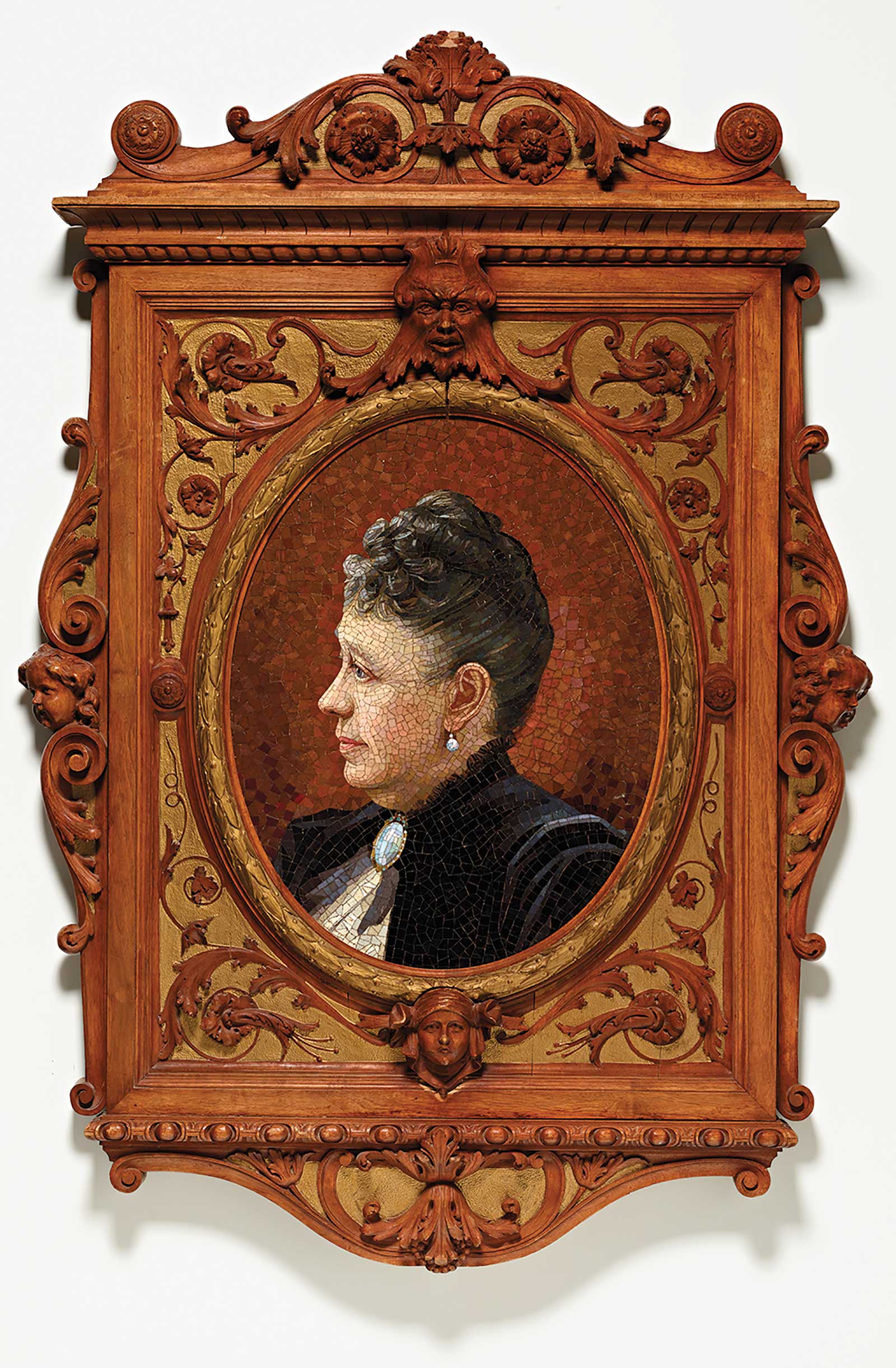 Dott. Antonio Salviati & Co., manufacturer or Erede Dr. A. Salviati & Co., manufacturer, Portrait of Jane Lathrop Stanford, ca. 1902. Glass mosaic tiles, 21½ x 165/8 in., Iris & B. Gerald Cantor Center for Visual Arts at Stanford University, Gift of Erede Dr. A. Salviati & Co., JLS.11462.
James Abbott McNeill Whistler (1834-1903) was commissioned by the Fine Art Society, London, to produce a series of etchings of Venice. He arrived there in 1879 and left over a year later. The Doorway (First Venice Set), 1879-80, depicts his fascination with the light of Venice reflecting off the canals and into the dark interiors of the city’s palazzi.
The museum explains that the “more than 150 objects, this exhibition presents a choice selection of glass vessels in conversation with paintings, watercolors and prints by the many talented American artists who found inspiration in Venice. This juxtaposition reveals the impact of Italian glass on American art, literature, design theory and science education, as well as ideas at the time about gender, labor and class relations.”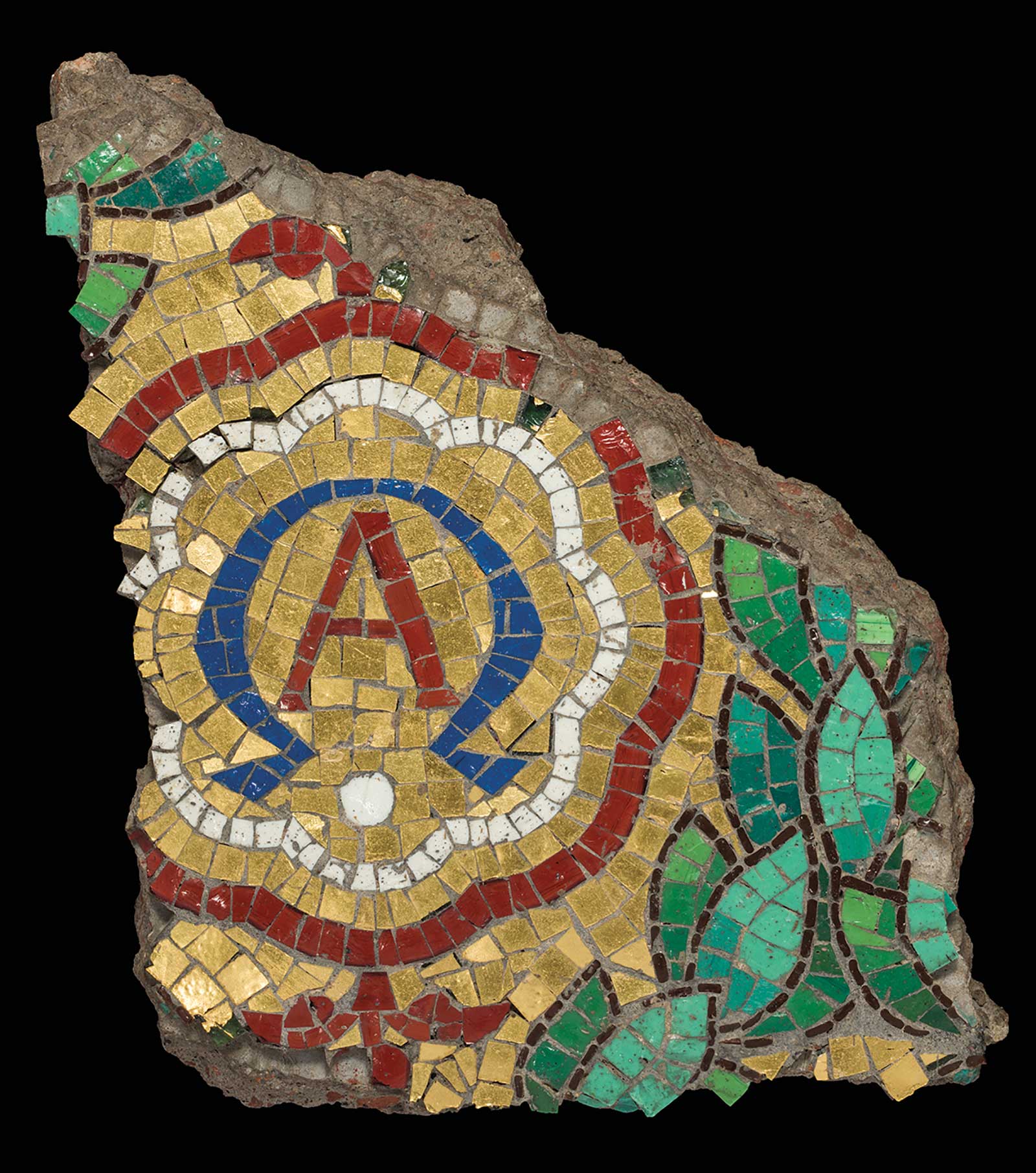 Erede Dr. A. Salviati & Co., manufacturer, Fragment from Stanford Memorial Church Mosaic Cycle, ca. 1903-5. Glass mosaic tiles and cement on sandstone with gold foil, 117/16 x 9½ x 215/16 in. The Corning Museum of Glass, Gift of Sheldon Barr and Thomas Gardner, 2017.3.13.
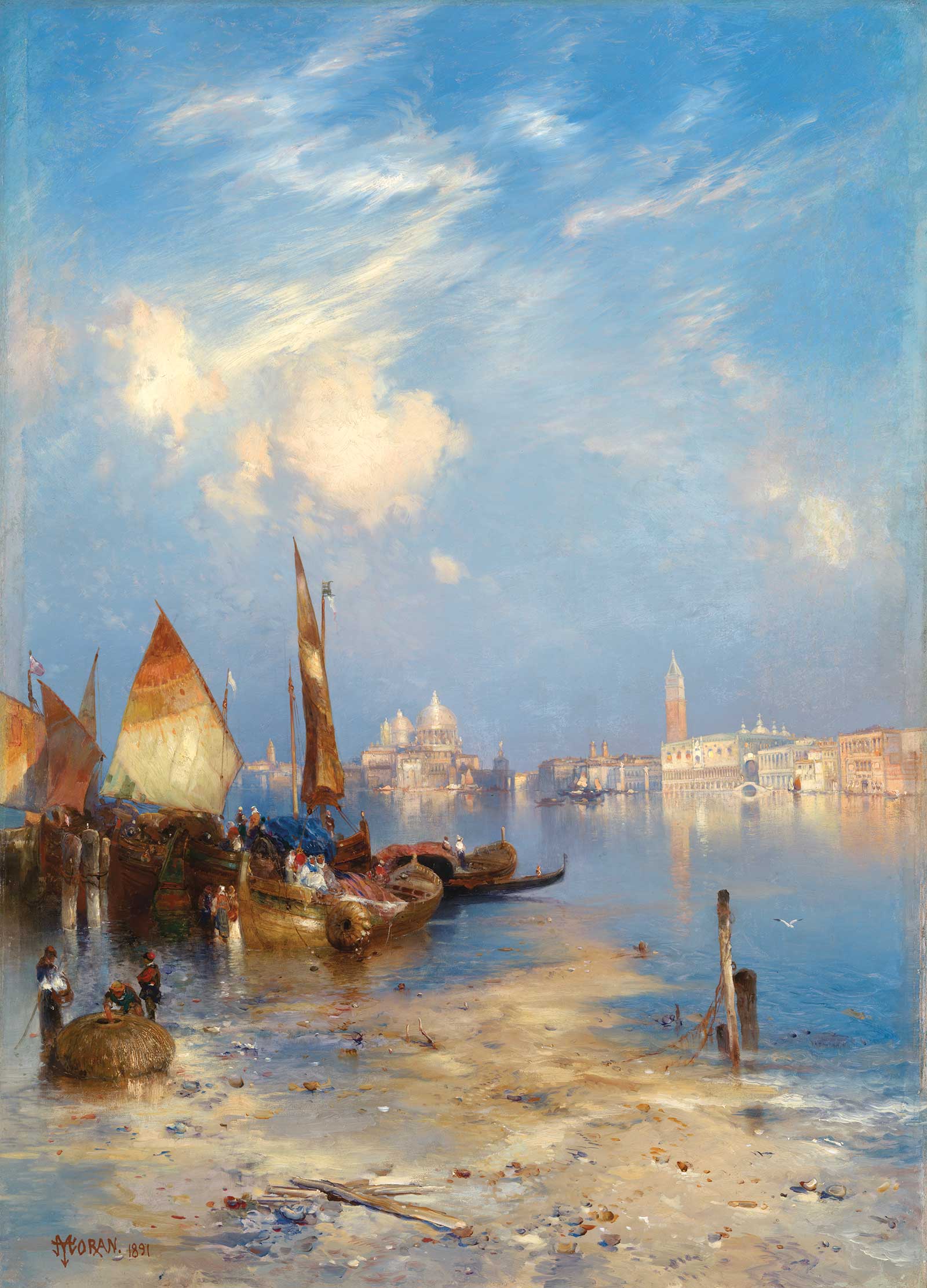 Thomas Moran (1837-1926), A View of Venice, 1891. Oil on canvas, 351/8 x 25¼ in. Smithsonian American Art Museum, Transfer from the U.S. Department of Interior, National Park Service, 1968.120.1.Jane Elizabeth Lathrop Stanford (1828-1905) is depicted in a Venetian glass mosaic from around 1902. She and her husband had founded Stanford University in 1885 to honor their son who had died at the age of 15. Leland Stanford died in 1893 and his wife commissioned the Stanford Memorial Chapel in his honor. She commissioned the Salviati Studios in Venice to produce murals for the church—the firm that would later produce her mosaic portrait. Much of the church was destroyed in a 1906 earthquake. A fragment of the original mosaics is in the exhibition.
Maurice Brazil Prendergast (1858-1924) was an American impressionist watercolorist whose works have often been compared to tapestries and glass mosaics. Around 1899 he created a scene of the Fiesta Grand Canal, Venice of glass and ceramic mosaic tiles in plaster.
Once the show closes at the Smithsonian in 2022, the exhibition will travel to the Amon Carter Museum of American Art in Fort Worth, Texas, where it will hang June 25 through September 11. —
Powered by Froala Editor