On my first day at Bartfield’s, a lifetime ago, I walked into the gallery and saw, on the wall just behind my desk, Thomas Cole’s Autumn Landscape (View of Mt. Chocorua). An easy sell, you would think (I did). Not so, as it turned out. Even the greatest paintings sometimes have to wait to find the right eyes to find them. As it happened—fortuitously for me, if not for the gallery—I had the privilege of looking at that painting every day, many times a day, for well over a year. I studied it stroke for stroke, up close and from a distance. Sometimes I didn’t look at it; sometimes I closed my eyes and imagined it and then opened them to see how the image in my mind compared with the painting. Imagine my delight when I visited Thomas Cole’s home and studio Cedar Grove in Catskill, New York, and saw Autumn Landscape hanging in a room on the second floor. There was the dreamy Cole himself, stretched out, leaning against a rock as if listening to—feeling, really—the vibration of the waterfall. The dead tree bisects the painting from lower left to upper right, and the mountain in the distance broods anciently. Early fall, not yet peak colors, brief and bittersweet and glorious. Looking at it, living with it, without even knowing it, made me want nothing more than to live there forever, or, failing that, do my best to make sure that the great beauties and truths Autumn Landscape conveyed would never vanish from the earth.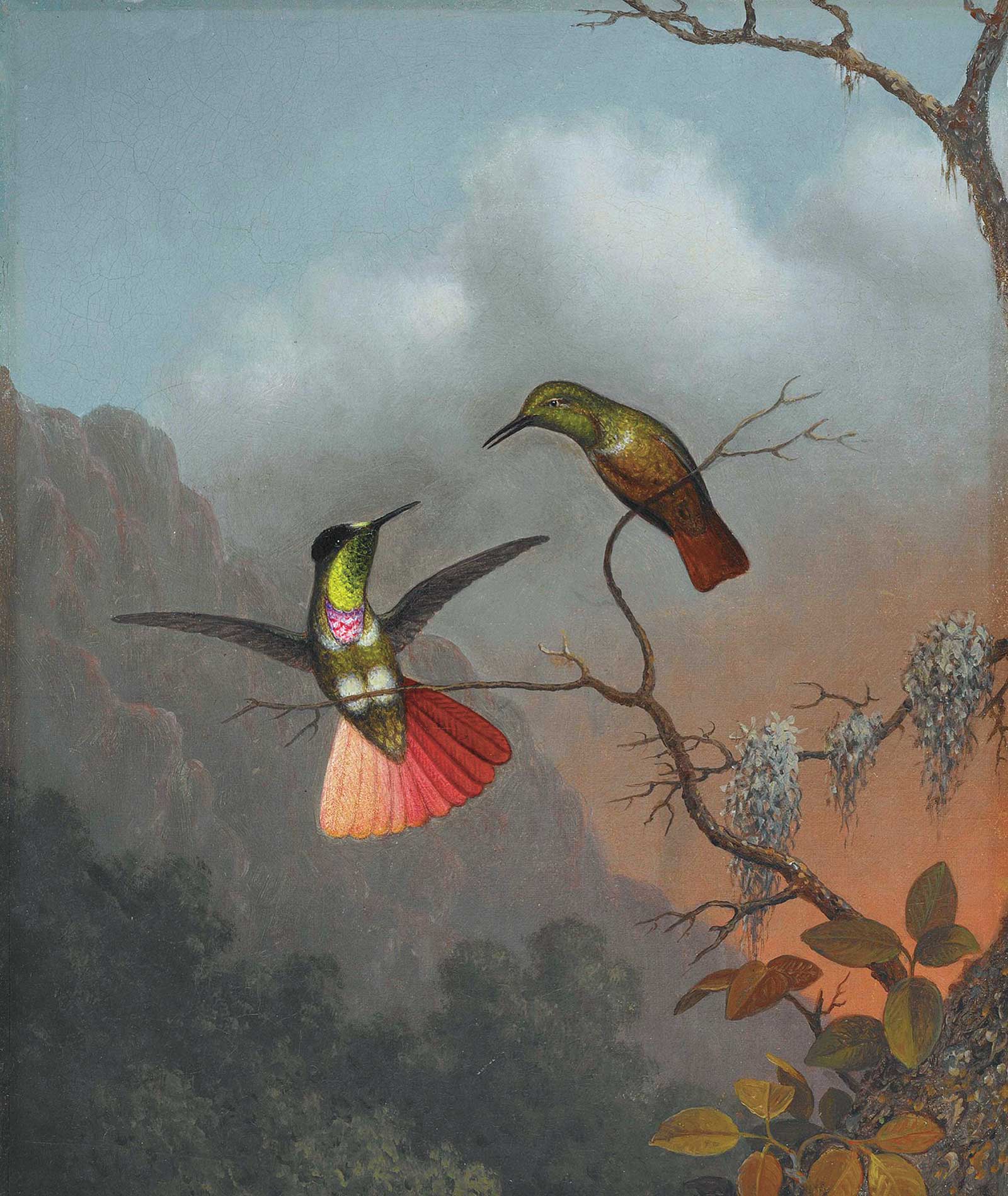 Martin Johnson Heade (1819-1904), Hooded Visorbearer, from the 16-painting series The Gems of Brazil, ca. 1863-1864. Oil on canvas, 12¼ x 10 in. Crystal Bridges Museum of American Art, Bentonville, Arkansas, 2006.93. Photo by Dwight Primiano.
I was there to see Cross Pollination: Heade, Cole, Church, and Our Contemporary Moment, a new exhibition Cole’s Cedar Grove shares with Frederic E. Church’s Olana. Full disclosure: Autumn Landscape is not an official artwork in an exhibition that builds a literal bridge between these two towers of American art, but for me, it also built a bridge between my present and my past, allowing me to spend time with an old friend I hadn’t seen for 20 years.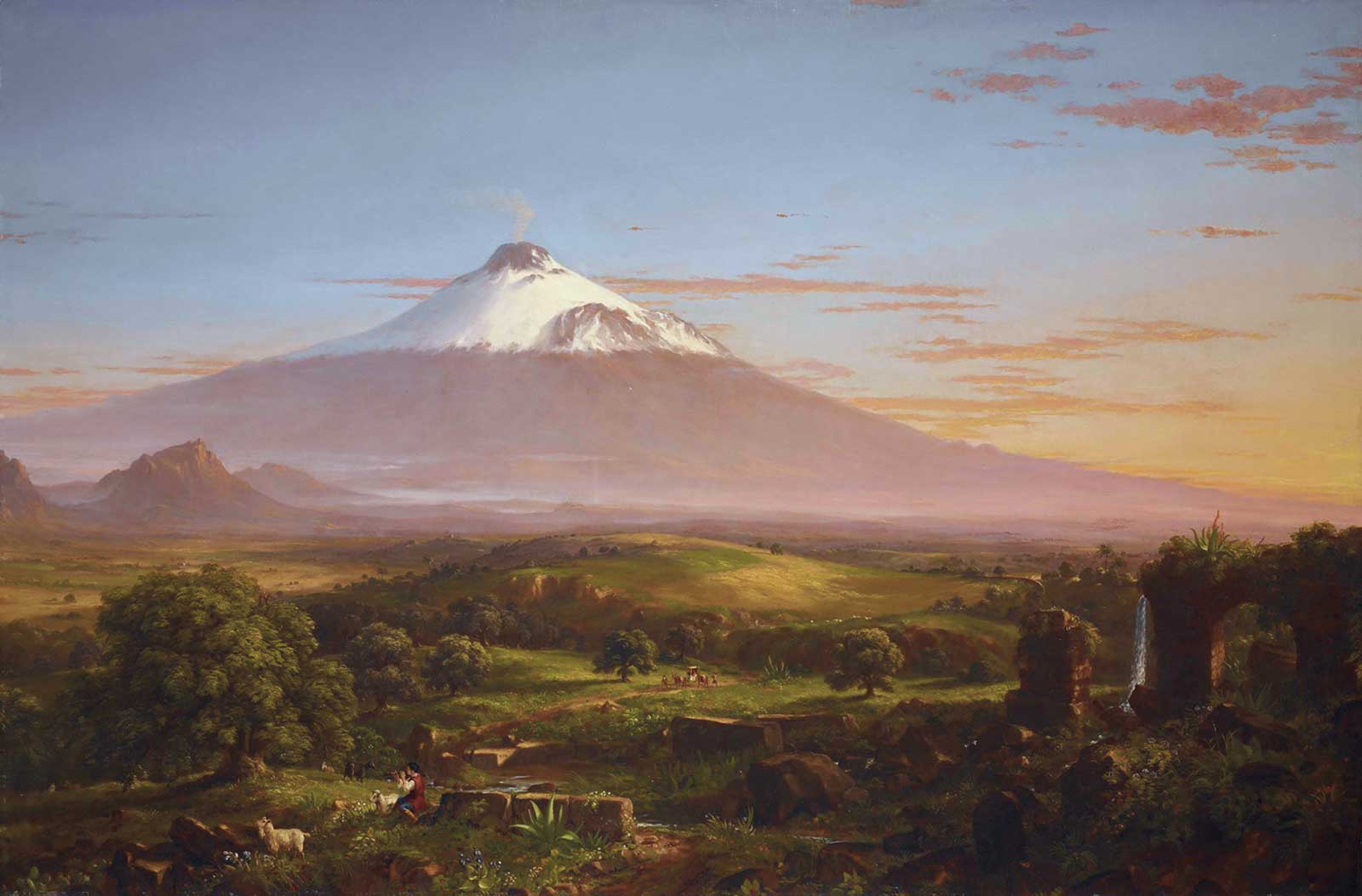 Thomas Cole (1801-1848), View of Mt. Etna, 1842. Oil on canvas, 32 x 48 in. Crystal Bridges Museum of American Art, Bentonville, Arkansas, 2007.11. Photo by Dwight Primiano.
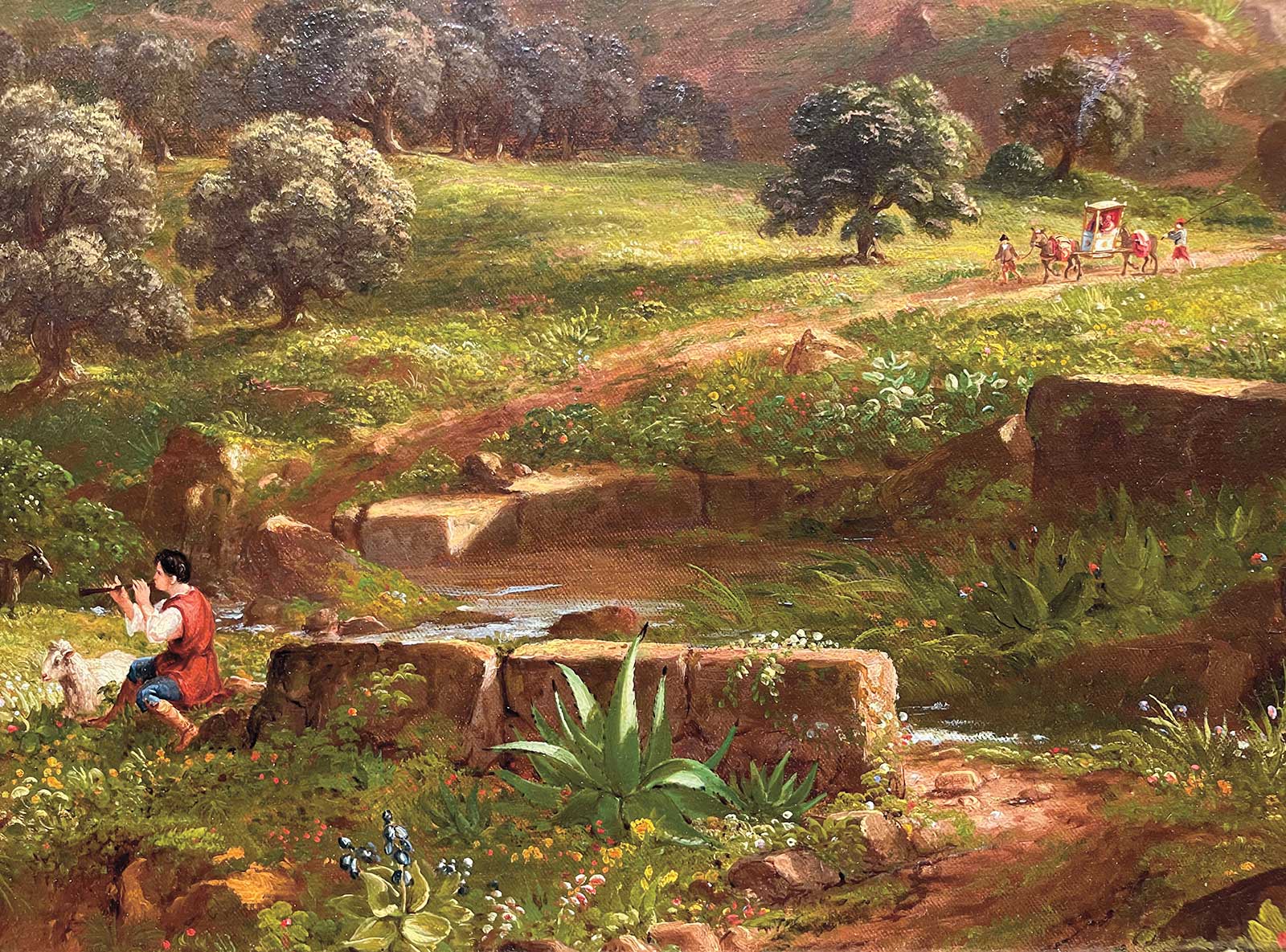 A detail of Thomas Cole’s View of Mt. Etna. Photo by James D. Balestrieri.
Until recently, Cole’s home and studio, Cedar Grove, and Church’s magnificent home, Olana, have yearned wistfully at one another across the Hudson River. Church was Cole’s friend and only student, and the Hudson was the inspiration and setting for their art, and for what became the first American “school” of art—the Hudson River School, naturally. Sure, you could always drive from Olana to Cedar Grove, or vice versa. Now, via the Hudson River Skywalk, visitors can walk from one to another, taking in views of the river as the artists would have experienced them, on foot.
Sixteen of Martin Johnson Heade’s hummingbird paintings from The Gems of Brazil series (on loan from the Crystal Bridges Museum of American Art, which co-organized the exhibition and will be the closing venue, on view from November 20 to March 21), as well as the botanical watercolors of Cole’s daughter Emily and Church’s daughter Isabel and a wide range of contemporary artworks that speak to the the beauty and fragility of ecosystems round out the dazzling, eclectic array. The exhibition makes a potent contribution to the relatively new notion that artists like Cole, Church and Heade were proto-environmentalists whose art brought them close to the natural world they loved and, as a consequence, made them frontline witnesses to its devastation. Artists today bring even greater urgency to the subject of the climate crisis. The bridge between the art of the past and the art of the present throws these issues into even sharper relief.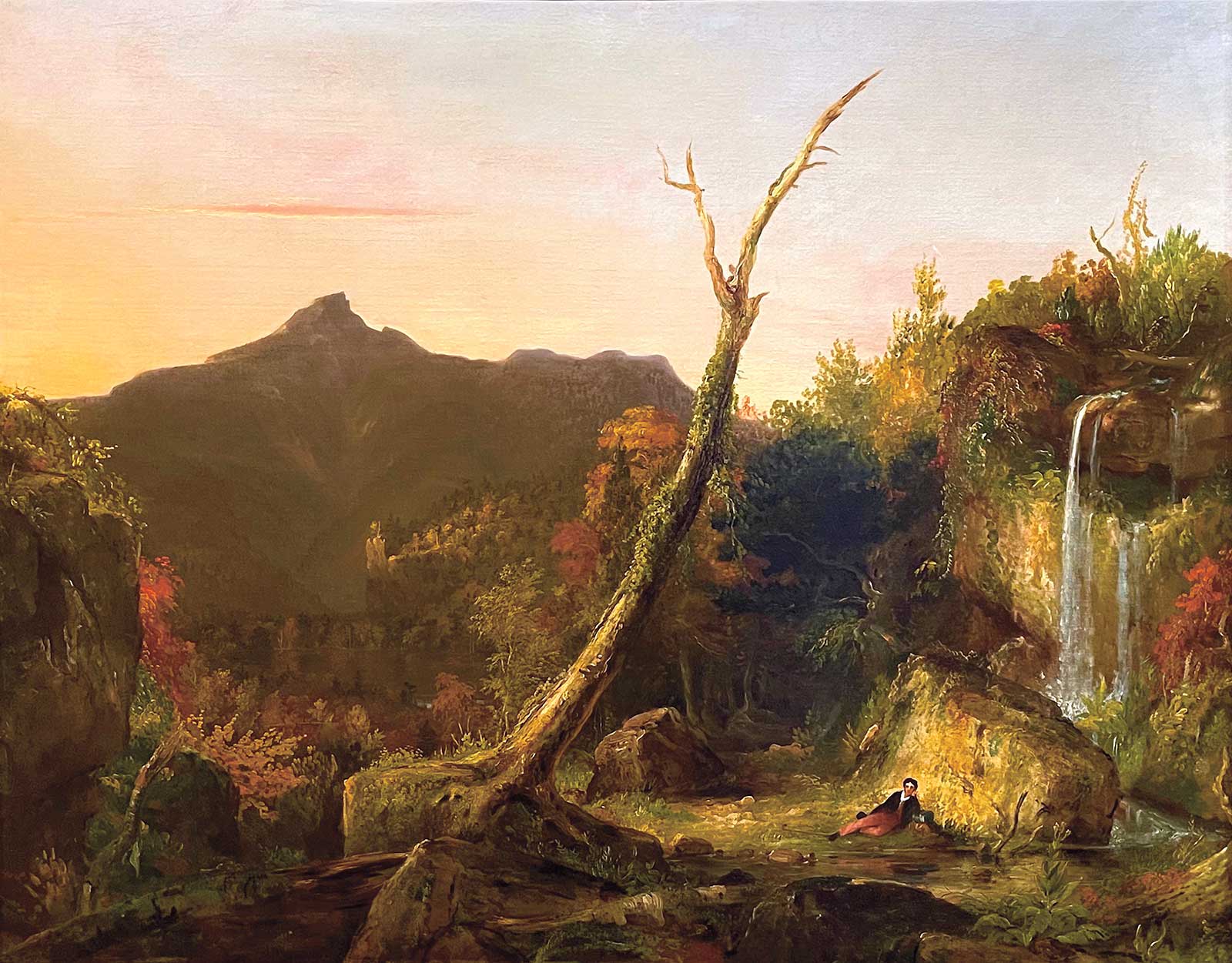 Thomas Cole (1801-1848), Autumn Landscape (View of Mt. Chocorua), ca. 1828. Oil on canvas. Photo by James D. Balestrieri.
Patrick Jacobs’ intricate miniature landscape Pink Forest with Stump threw another span from present to past. In the October 2011 issue of American Art Collector, I first wrote about Jacobs’ focused work: “Through a 2-inch porthole, Patrick Jacobs’ Dandelion Cluster offers a bud’s-eye view looking down an estuary to a distant body of water. Adding a third dimension to the classic American Trompe l’Oeil and landscape traditions locates the work in the sphere of the natural history museum. In full flower, gone to the seeds my kids blow and wish on, running in the damp grass, and past that, to the hard ovum at the center of the flower, this common weed, bane, pest, attains a specialness, is suddenly beautiful as it goes on the same winding way we go, downstream to our common merger with the infinite.” Pink Forest with Stump is larger and far more otherworldly, a work of fantasy arguing, perhaps, that the imagination is as expansive, fragile and endangered as the environment.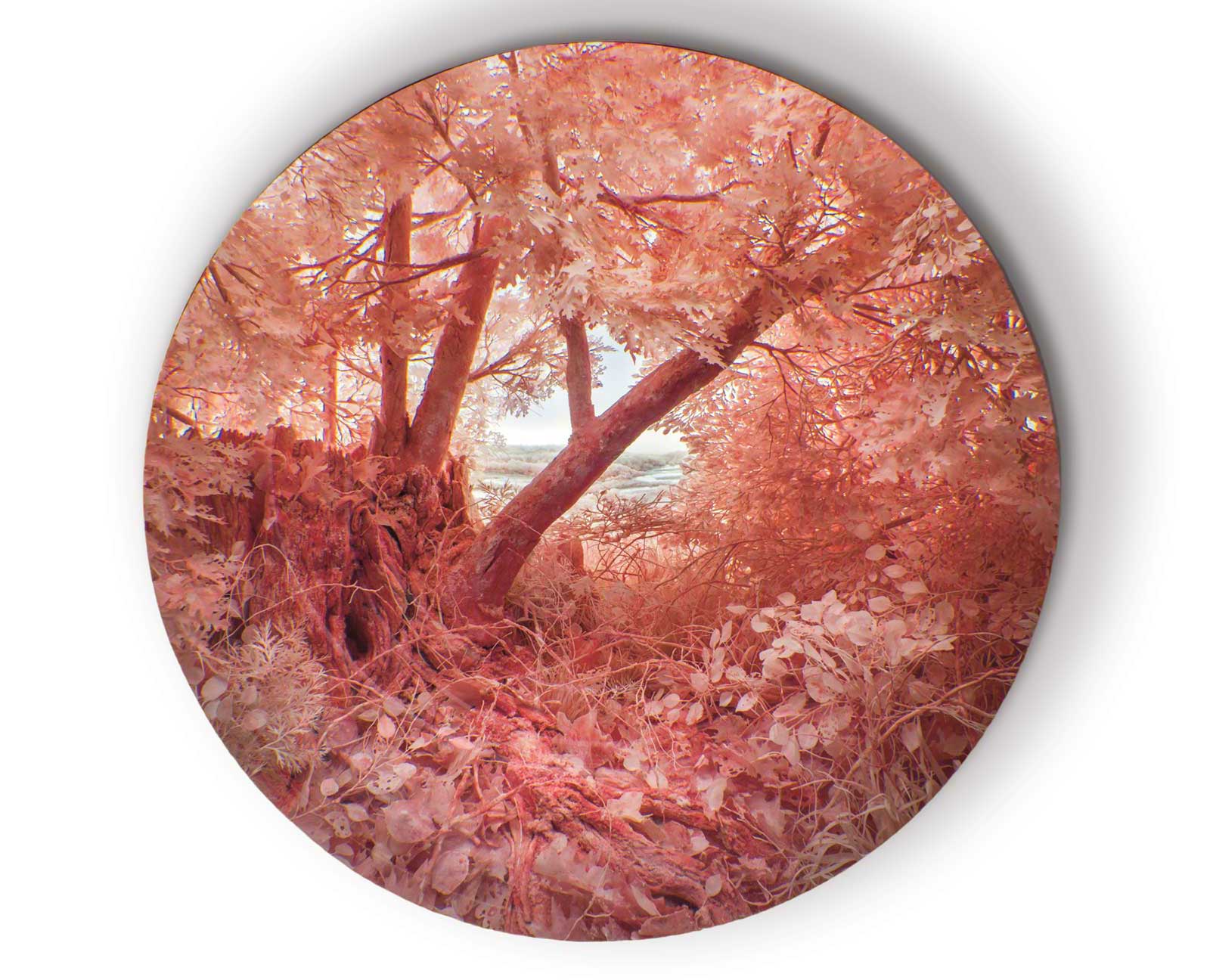 Patrick Jacobs, Pink Forest with Stump, 2016. Styrene, acrylic, cast neoprene, paper, hair, polyurethane foam, ash, talc, starch, acrylite, vinyl film, copper, wood, steel, lighting, and BK7 glass, 205/8 x 285/8 x 20½ in. (box), 73/8 in. (diorama window). Crystal Bridges Museum of American Art, Bentonville, Arkansas, 2016.22. Photo by Edward C. Robison III.
Of the contemporary pieces that were not familiar to me, Sayler/Morris’ video installation, Eclipse, features the white silhouette of a bare tree and roots. Over the course of the video, a flock of extinct passenger pigeons fills the branches—bringing it to leafy life—before flying up and off in groups, like spirits, leaving the tree barren once more. It’s a poetic, tragic work, and its placement behind the panes of a glass door in Cedar Grove situates the work in the time of the great flocks and separates it from our time, when not only the passenger pigeons but so many other species, have fallen in what has come to be called the sixth extinction.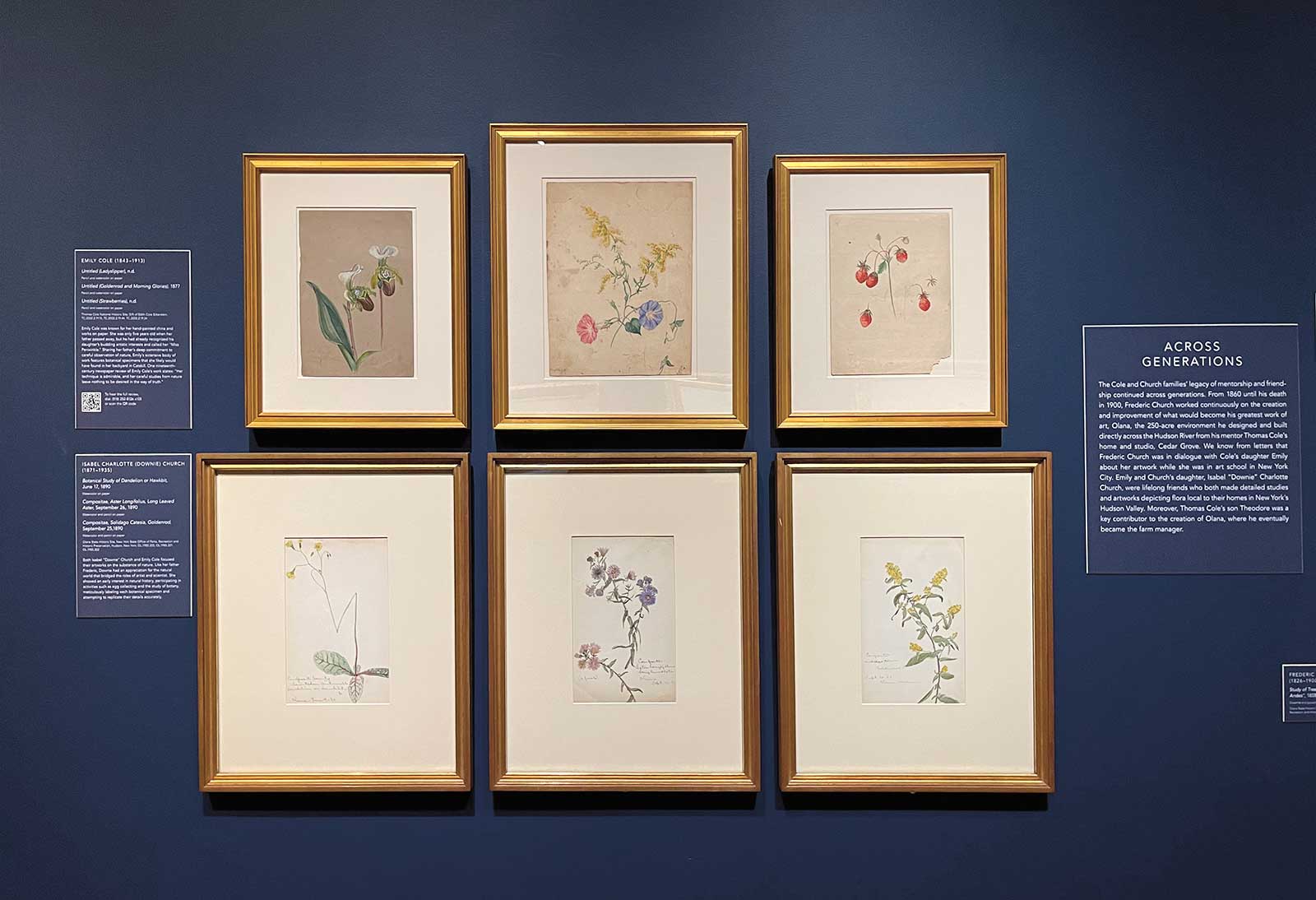 Various florals and botanicals by Emily Cole (1843-1913) and Isabel Charlotte (Downie) Church (1871-1935) on view in Cross Pollination. Photo by James D. Balestrieri.
When you circle back to Heade’s hummingbirds or the florals and botanicals painted by Cole and Church’s daughters, you almost forget that those birds and insects, those flowers and plants, were already dwindling in numbers. Today we see them almost as if through a telescope from the wrong end, sharply outlined but small, as if receding from us. Cole himself was even aware of the effects of eco-tourism on the landscape, as the detail from his painting View of Mt. Etna shows. The tourist in a rustic carriage who has come to gaze at the volcano—and Cole’s work often features such gazers—seems to ask: When those who appreciate nature come in numbers, can those who appreciate nature and seek to exploit it be far behind?
The catalog describes Martin Johnson Heade’s awakening: “By the early 1880s, Heade similarly became concerned about the unrestrained use of natural resources, in his case overhunting and the destruction of species. He took the pen name Didymus and began to contribute regularly to a sportsmen’s magazine, Forest and Stream, calling attention to environmental degradation…Heade had settled in Florida and, still enthusiastic for hummingbirds, had set up in his backyard feeders to watch them. But, he lamented, ‘between the frosts, taxidermists and milliners, I fear they’ll be almost exterminated in a few years.’”
The mashup of old and new art, old and new artists, is intended to create a kind of friction that makes fire—or, in the case of the climate crisis—puts fires out. But in touring the exhibition, I was reminded of old historical idea that states that people have to be ready for change, for progress. I don’t know if that has to do with the collective psyche, perhaps even a genetic mutation that opens our species to the possibility of change, or if it is merely a question of numbers, some critical mass that must be reached before we can accept that our ideas must change, and that we must adapt to changes that have already occurred in society and in the natural world. Maybe it’s both.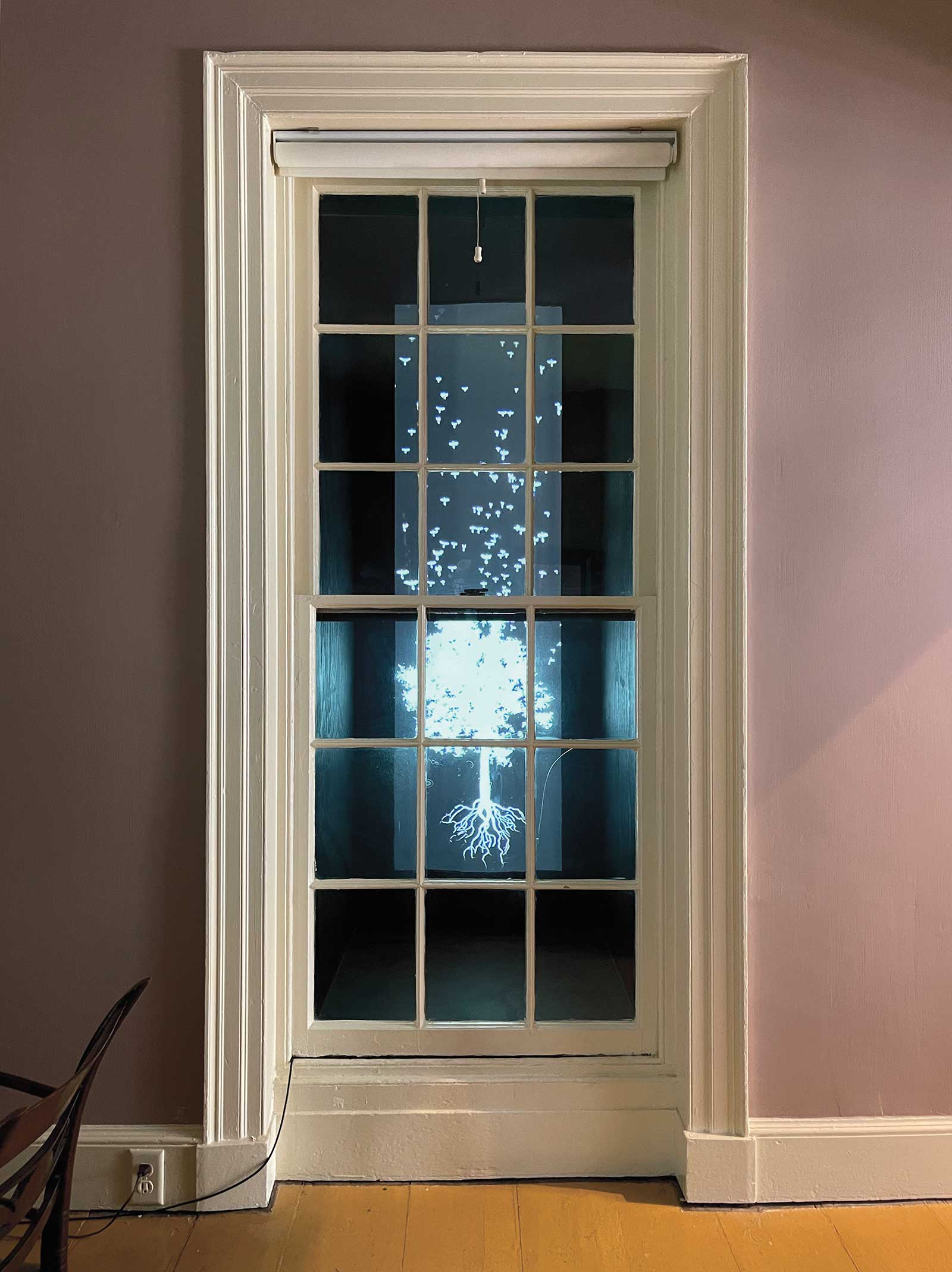 Still image of Saylor/Morris, Eclipse, 2014. Video installation, 7-minute 14-second loop. New site-specific installation created on the occasion of Cross Pollination at the exhibition at Olana and the Thomas Cole Historic Site. Photo by James D. Balestrieri.
What I know is that Thomas Cole, proto-environmentalist, wasn’t able to save a single one of his beloved chestnut trees with his art, his lectures, or his life. Indeed, the American chestnut fell to extinction by 1900. That its resurrection depends on scientists, students, and genetics, much of which is being conducted a few hours from Cedar Grove, in the labs of the State University of New York-Environmental Science and Forestry in Syracuse, is a hopeful and yet sad irony of sorts. I have read in recent days that the woolly mammoth may be the next extinct creature to retake the stage. If the chestnut and the mammoth make a comeback, what about the passenger pigeon? If the flocks were restored to their billions, would that be a good thing? Who would decide? Which begs another question: will the earnest contemporaries whose works are represented in Cross Pollination have any better luck? Will their art spur others to action or, at least, give our DNA a snip here and there to improve our empathy gene? Or will we see their art, one day, in that same tragically beautiful and elegiac light that sometimes bathes Thomas Cole’s? That is, if any of us are here to see it at all. Put it this way, if an artwork hangs where a forest once grew, and no one is there to appreciate it, does that artwork really exist at all?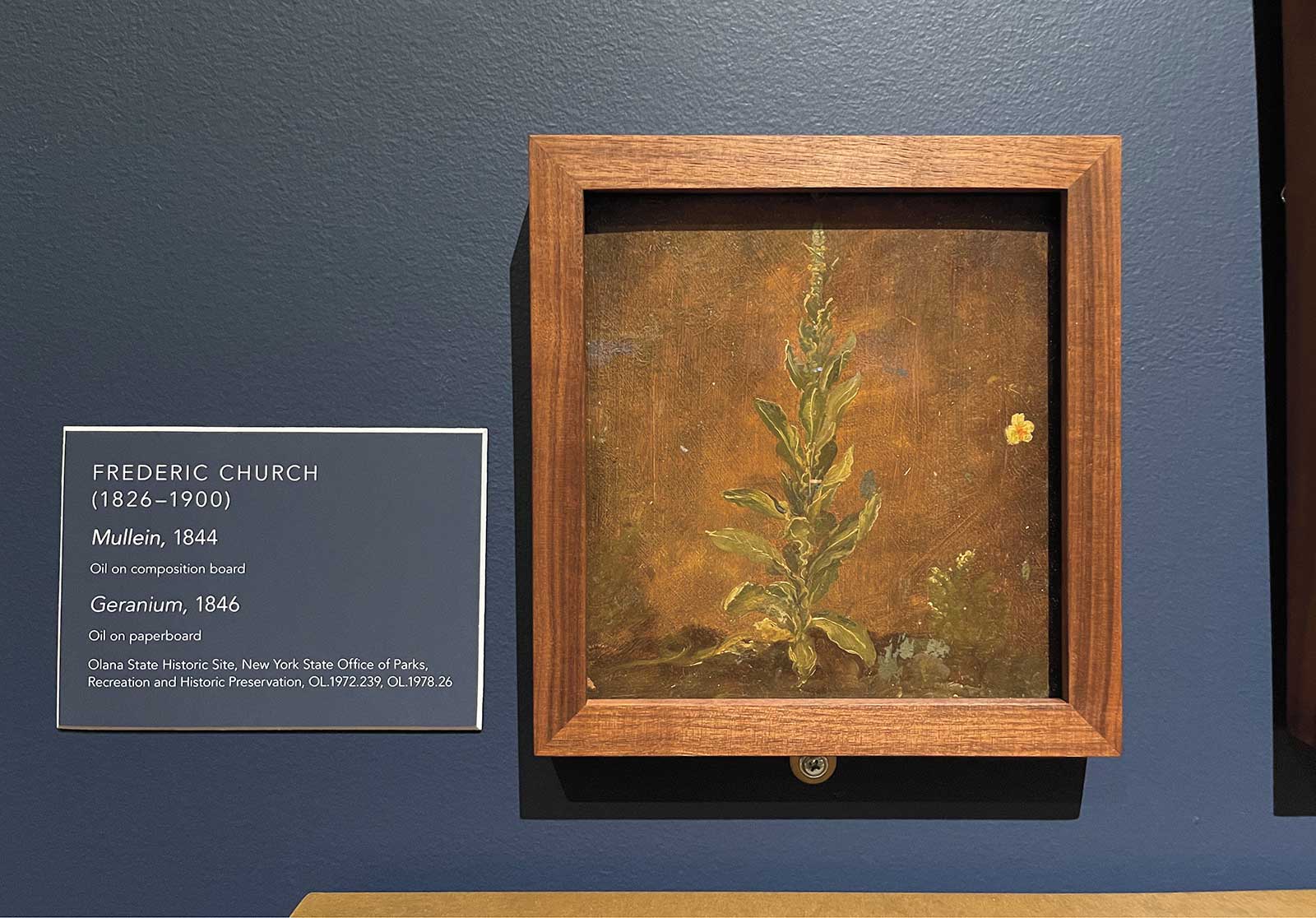 Frederic E. Church (1826-1900), Mullein, 1844. Oil on board. Photo by James D. Balestrieri.
Autumn—I prefer the word fall—is the finest season and October is the best month. Thomas Cole, in part, makes me think so and hope it stays that way. Art builds bridges and hopes we cross them.
James D. Balestrieri is the proprietor of Balestrieri Fine Arts, specializing in arts consulting, sales, research and writing. He is currently the writer-in-residence for the Clark Hulings Foundation, as well as estate and collections consultant for The Couse Foundation and communications manager for Western Spirit: Scottsdale’s Museum of the West. He was director of J.N. Bartfield Galleries for 20 years, worked with the Scottsdale Art Auction for 15 years and has written over 150 essays for various art publications.—
Cross Pollination: Heade, Cole, Church, and Our Contemporary Moment
November 20-March 21, 2022
Crystal Bridges Museum of American Art
600 Museum Way, Bentonville, AR
t: (479) 418-5700
www.crystalbridges.org
Powered by Froala Editor