
Antipodes. Ends of the Earth. Ultima Thule. Glaciers, icebergs, shelves of ice, shards of ice. Crystals. Ice in all its mind-bending, element-bending shapes. Magnetic North. Magnetic South. North Pole. South Pole. The poles. Magnetic. And, like all magnets, repelling and attracting—attracting human wonder, resisting human presence. At the North Pole, an ocean of ice. At the South Pole, a continent of ice. For now.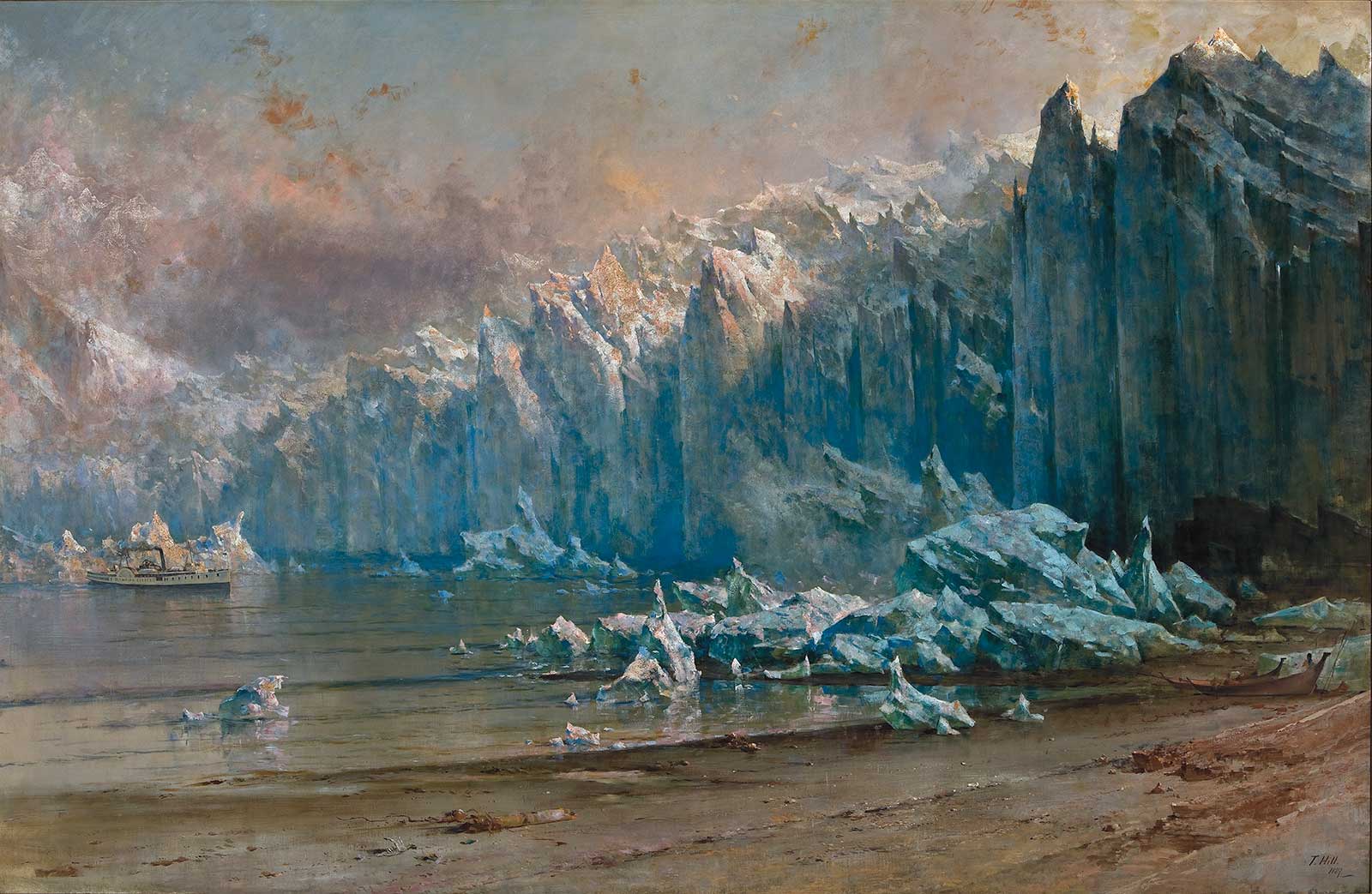 Thomas Hill (1829-1908), Muir Glacier, 1889. Oil on canvas, 68½ x 1023⁄8 x 4 in. Anchorage Museum Collection; 1976.050.1.
The artists I chose to glance at for this essay are only a few of those who actually went to the poles. Artist-adventurers, they took in the new science of the day, science that said the Earth was ever-changing, ever-shifting, that even mountains and glaciers rose and fell, and decided to see for themselves. They sketched and painted in the cold, on location, then returned to their studios to expand and enlarge their works for other eyes to take in. To us, these paintings touch on the fantastic, on scales of size and time, deep time, that are all but impossible for humans to embrace.
In our Anthropocene era, their paintings go beyond the beautiful and sublime, offering truths and insights into human impact on polar ecosystems and catastrophic changes in the Earth’s climate.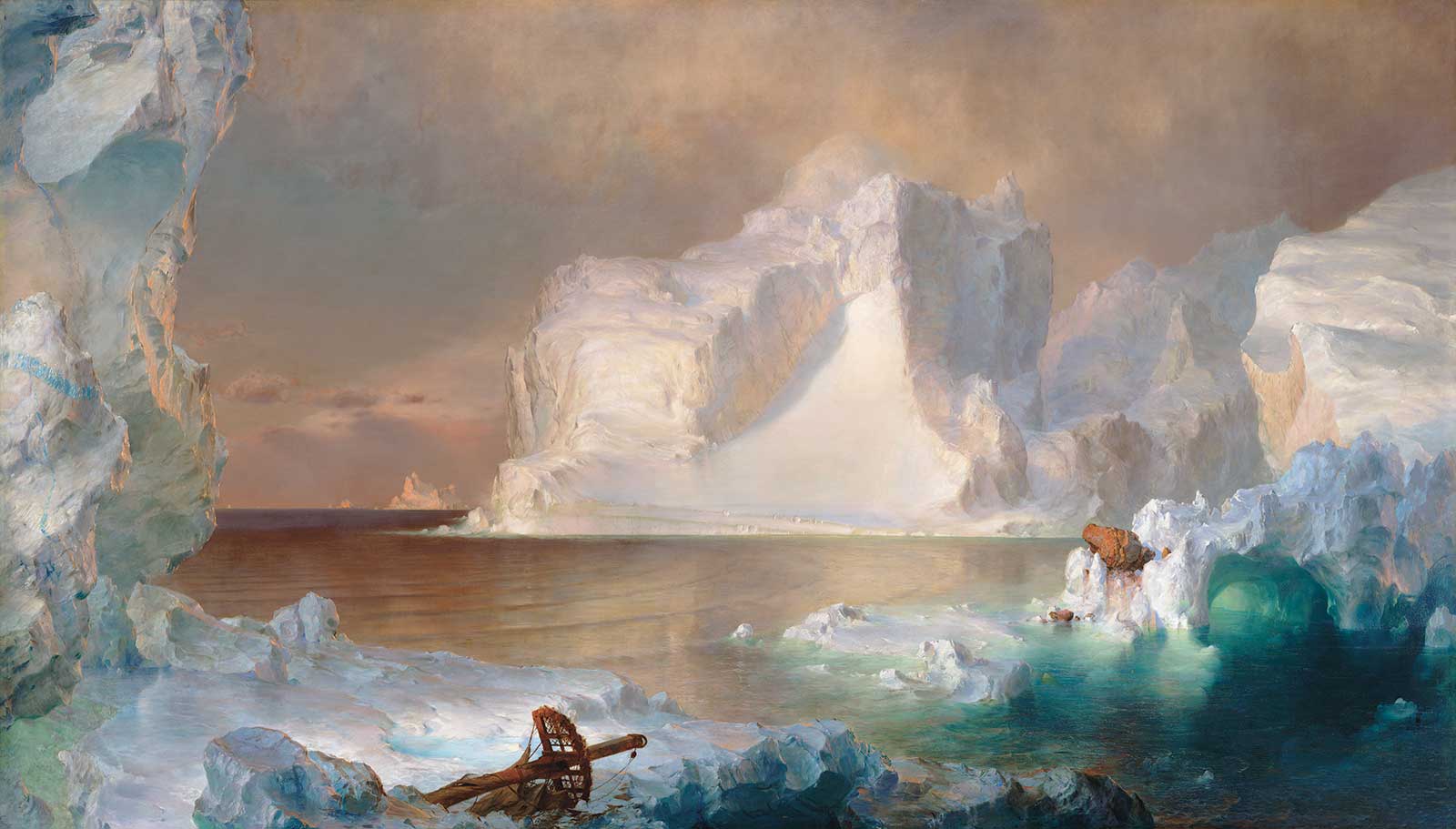 Frederic Edwin Church (1826-1900), The Icebergs, 1861. Oil on canvas, Dallas Museum of Art, gift of Norma and Lamar Hunt, 1979.28. Image courtesy of Dallas Museum of Art.
Whaling, fishing and exploring the polar sea of the north was William Bradford’s (1823-1892) principal subject. His paintings, executed in a Hudson River School tone—one derived from German Romantic painter Caspar David Friedrich—seem to suggest the puniness of human endeavor in the face of the vast hostility of the environment. Drifting icebergs dwarf the largest ships. Yet as fishermen from a large fleet haul in nets in Whaler and Fishing Vessels near the Coast of Labrador, circa 1880, and a skinny polar bear flees for its life in An Arctic Summer: Boring Through the Pack in Melville Bay, 1871, Bradford records the impact of human presence and commerce, even at an end of the Earth.
Frederic E. Church (1826-1900) is not best known for painting the Arctic, but because he, like so many, was influenced by the writings of naturalist-explorer Alexander Von Humboldt. In 1859, Church chartered a boat to take him on an iceberg-sketching voyage in the North Atlantic between Labrador and Greenland. The result was the magnificent 64-by-112-inch painting The Icebergs, first exhibited in 1861. Originally titled Icebergs: The North, the advent of Civil War made it seem as though the work must have some allegorical meaning. This proved elusive—and was probably not Church’s intent—so he dropped The North from the title and added, perhaps for purely pictorial reasons, or some question of scale, the wrecked ship’s mast in the foreground. A work of grand beauty, perhaps the most intriguing area of the canvas is the green ice grotto at the lower right with a portal that appears manmade but is, in fact, the product of the action of waves and wind.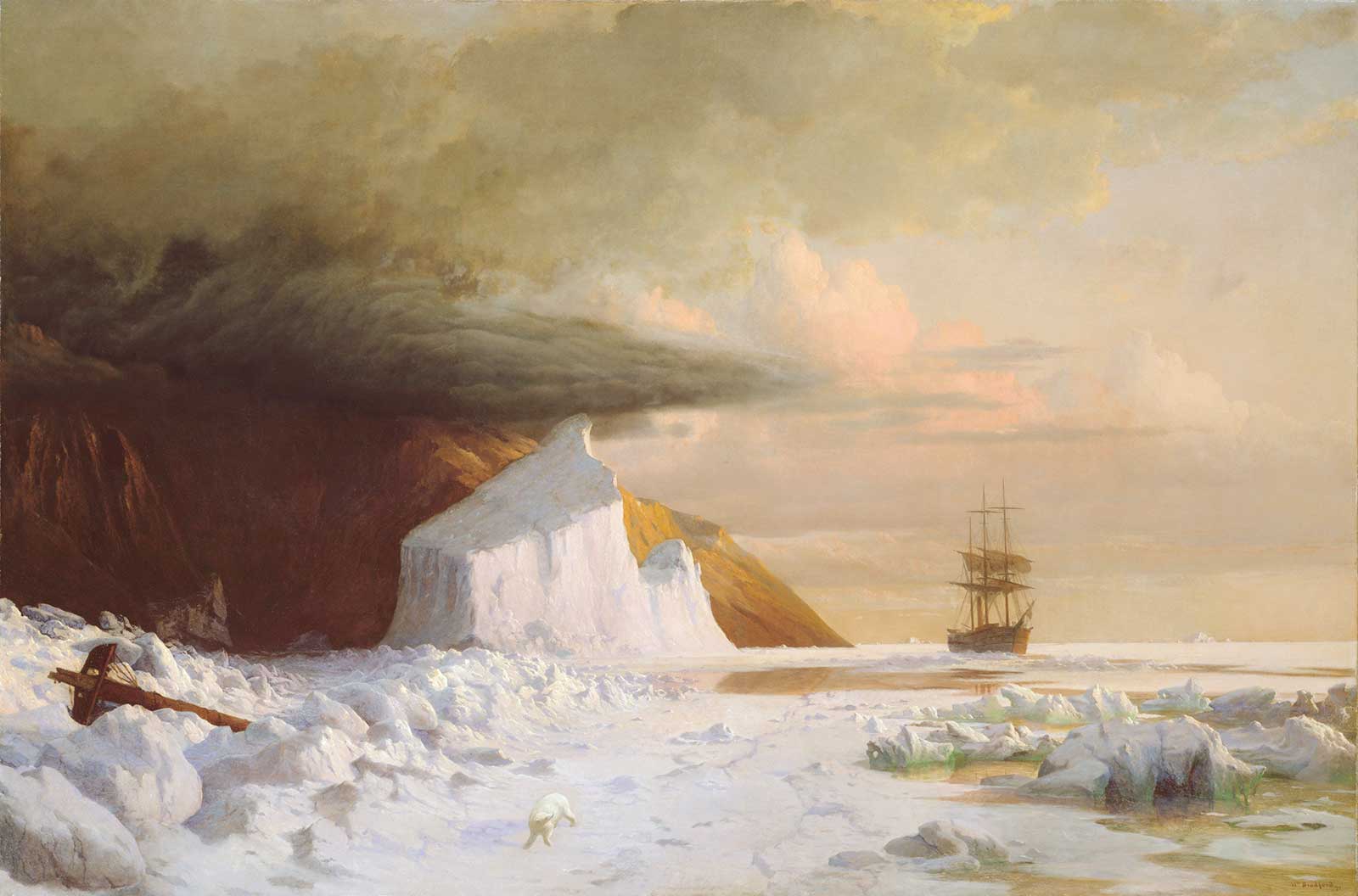 William Bradford (1823–1892), An Arctic Summer: Boring Through the Pack in Melville Bay, 1871. Oil, 51¾ x 78 in. Metropolitan Museum of Art. Gift of Erving and Joyce Wolf, in memory of Diane R. Wolf, 1982. 1982.443.1.
Muir Glacier is the subject of a painting by California painter Thomas Hill (1829-1908). Muir—an early American ecologist and one of the fathers of the national parks—had first visited Alaska in 1879. By 1889, when Hill—one of Muir’s close friends—painted Muir Glacier, steamers like the ones at center left were making regular tours of the towering castle of ice. Since Muir’s day, the glacier has retreated some 60 miles. Tourists who come to see calving icebergs are now taken elsewhere. The value of Hill’s painting to posterity may lie elsewhere as well.
When New York City artist and muralist David Abbey Paige (1901-1978) received a commission to create a Coney Island cyclorama depicting Admiral Byrd’s first Antarctic expedition, he contacted members of Byrd’s team to ask their opinion of his accuracy. Paige accepted their criticisms but kept at it until they were satisfied, and when Byrd announced he was heading back to the South Pole in 1934, Paige applied to be the expedition artist. Byrd refused at first, but Paige persisted and Byrd eventually relented. Halo; Wing of the Fokker Airplane Crashed on March 12, 1934 depicts a double sun halo caused by ice crystals in high cirrus or cirrostratus clouds reflecting the sun’s light. Against this symmetrical wonder of nature, the Fokker, icebound and with its wing tilted crazily in the air, takes us back to the blasted ship’s masts in
19th-century polar renderings.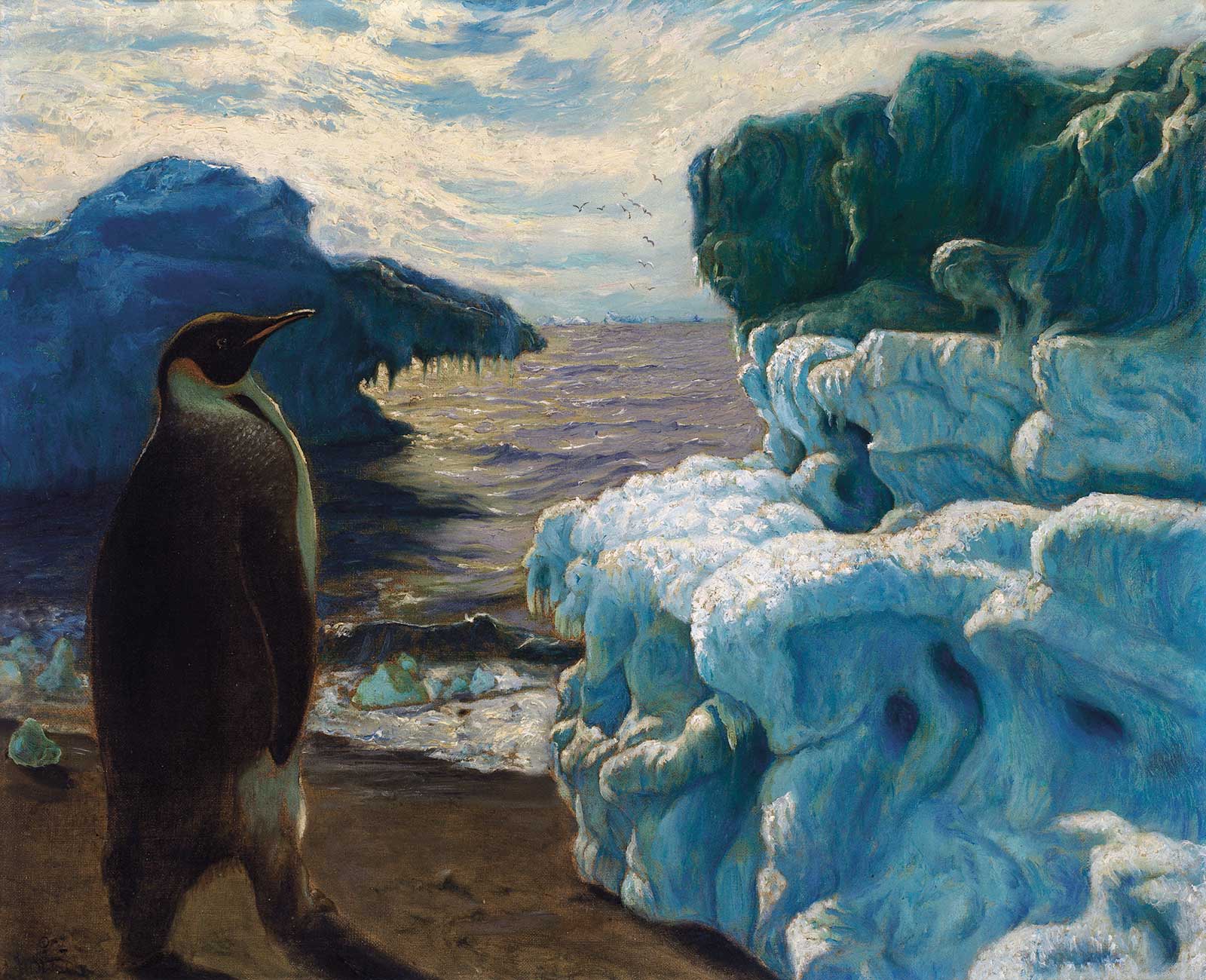 Frank Wilbert Stokes (1858-1955), Emperor Penguin, Admiralty Inlet Snow Hill, Antarctic... Oil on canvas, Smithsonian American Art Museum, Arthur Curtis James and Robert Curtis Ogden Memorial Collection, 1950.8.14
Rockwell Kent (1882-1971) completed a circumpolar circuit of sorts, traveling to and painting in Alaska, Greenland and Tierra del Fuego, Argentina, the southernmost point of land before you reach Antarctica. His journeys dovetailed with his interests in Norse Mythology, transcendentalist, nature-centered philosophy and the lure of “Ultima Thule.” Kent’s paintings reduce humanity to an essence—endurance and survival—and to a necessary superhumanity, that is, a humanity transcending pettiness and greed that must live with and subject to nature’s laws—if it is to live at all. Looking at the masses of rock and ice in Kent’s paintings, a world before and after the excesses of human civilization is made visible and tangible in the imagination and the ice itself is spare, simplified, reduced to essential, indelible form.
Those of us who love art often say, “Art is life.” Most of the Earth’s fresh water is held in ice. I am not the first to say this but, “No water, no life” quite quickly becomes “Ice is life,” which is true despite the uninhabitability—for the present—of the poles. Just ask NASA what they look for first in the solar system and beyond when they are hunting for signs of extraterrestrial life. Ice.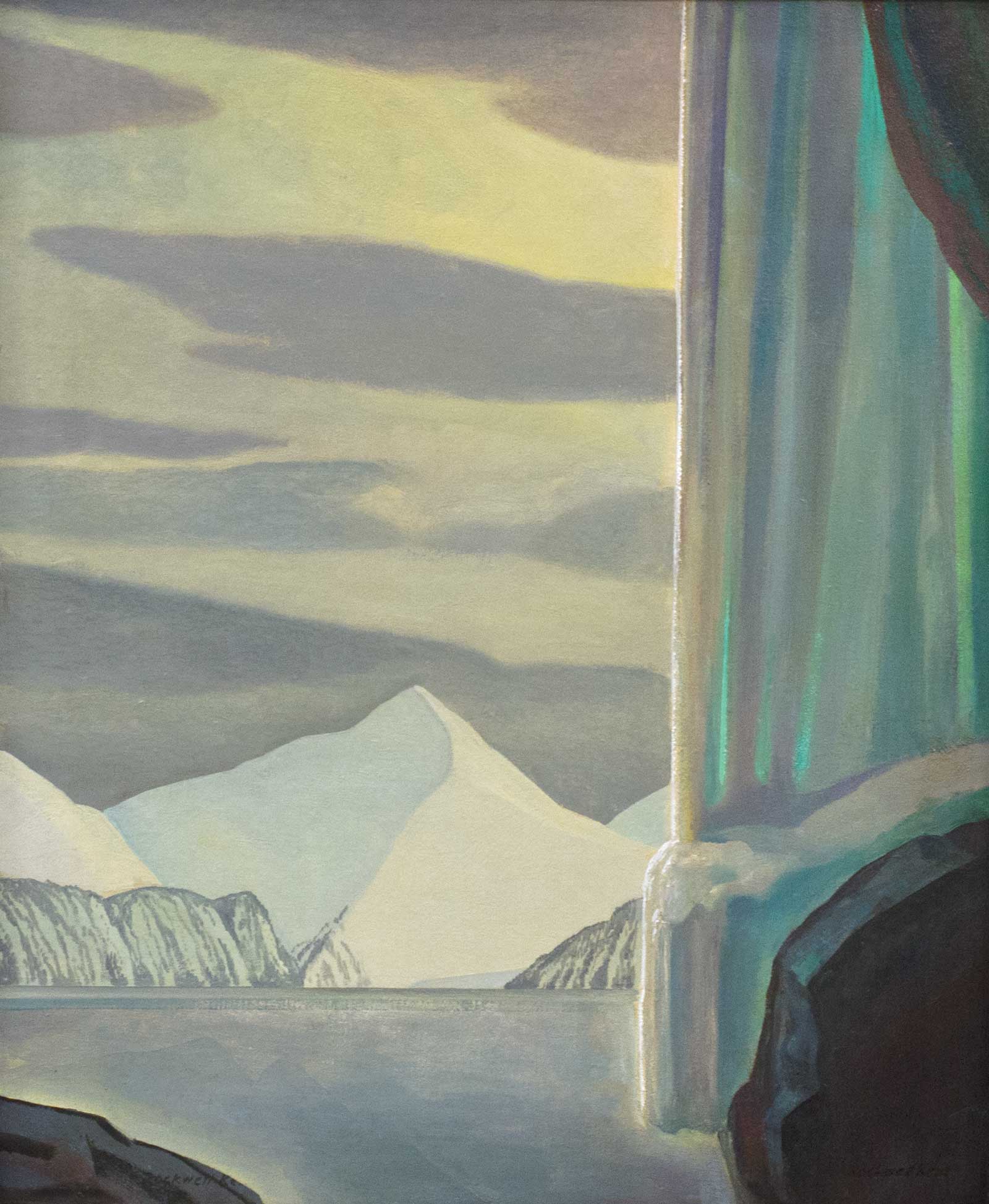 Rockwell Kent (1882-1971), Frozen Falls, Alaska, 1919. Oil on canvas. Rights courtesy of Plattsburgh State Art Museum, State University of New York, USA. Rockwell Kent Collection. Bequest of Sally Kent Gorton. All Rights reserved.
The impulse to write this essay stemmed from my interest in art and climate, as well as from my own private “Terra Incognita,” a glacier of more, shall we say, artistic proportions. Here’s the story: I was given part of the legacy of Jerome Milkman, a New Yorker who—from the 1930s to the 1960s—collected autographs of hundreds, perhaps thousands, of artists and kept them in homemade scrapbook folders. He wrote the artists letters and hoped they would write back. And they did. In droves. The autographs are accompanied by letters, invoices, exhibition announcements and reviews, news clippings, and obituaries. Perhaps 1,000 of the folders are in libraries. A collection of 200 came to auction in 2020. Others have been sold over the years in groups of fives and tens. My two boxes contain perhaps 150. The overall collection, when I think about it, is very much akin to a glacier ablating—calving, reforming, melting and freezing, retreating, disappearing.
I wonder how many have been destroyed, how many are crumbling to damp dust, how many have been separated—the autographs sold, the clippings tossed.
Somewhere on these pages you will see an image of one of these folders, taken apart by me to offer a visual idea of the time it must have taken Milkman to put them together. What motivated him? What pleasure did he derive from the letters he wrote and the letters he received in return? What satisfaction did he find in the hours he spent cutting and pasting clippings, poking holes through the pages, skewering them with two brass brads, cataloging the folders, and then, at his leisure, leafing through them? What did he think would happen to them after his passing?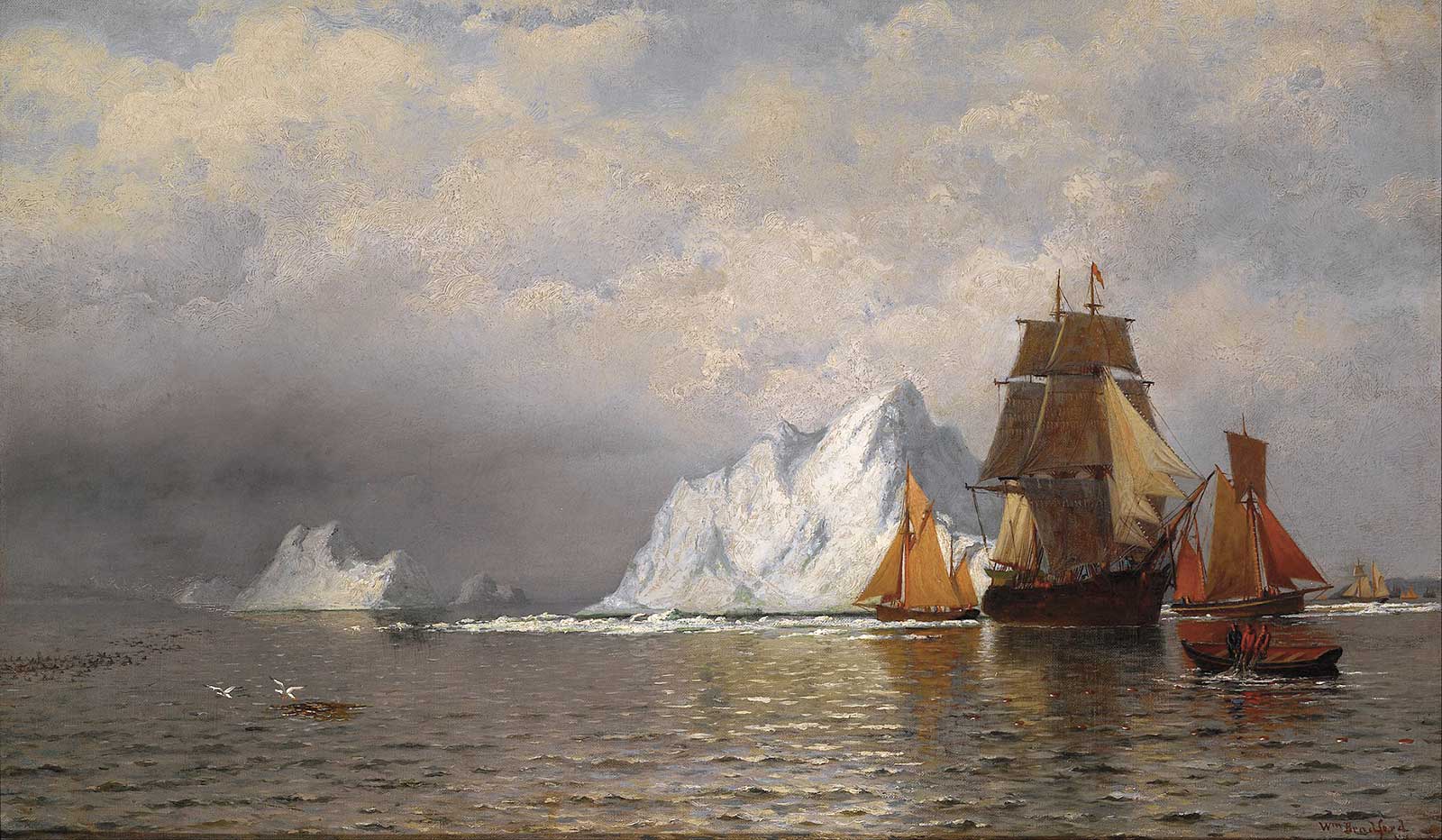 William Bradford (1823–1892), Whaler and Fishing Vessels near the Coast of Labrador, ca. 1880. Oil, 18 x 30 in. Indianapolis Museum of Art at Newfields. Gift of Delavan Smith.
Homo sapiens. A race of exploiters and shapers. Also a race of wanderers, comparers, recorders, appreciators and collectors. Some of us—a few—collect glaciers and icebergs in the paintings we make of them; at least one of us collected the autographs of artists.
The artist in the folder pictured on these pages is Frank Wilbert Stokes (1858-1955), an American painter few today have heard of, though the clippings in this scrapbook tell a tale of a widely celebrated artist-adventurer. Stokes accompanied Admiral Peary to the Arctic in 1892 and 1893, and the Nordenskjöld Expedition to the Antarctic in 1901-02. In 1926, when he was 68, he found himself by Roald Amundsen’s side, exploring the North Pole by dirigible.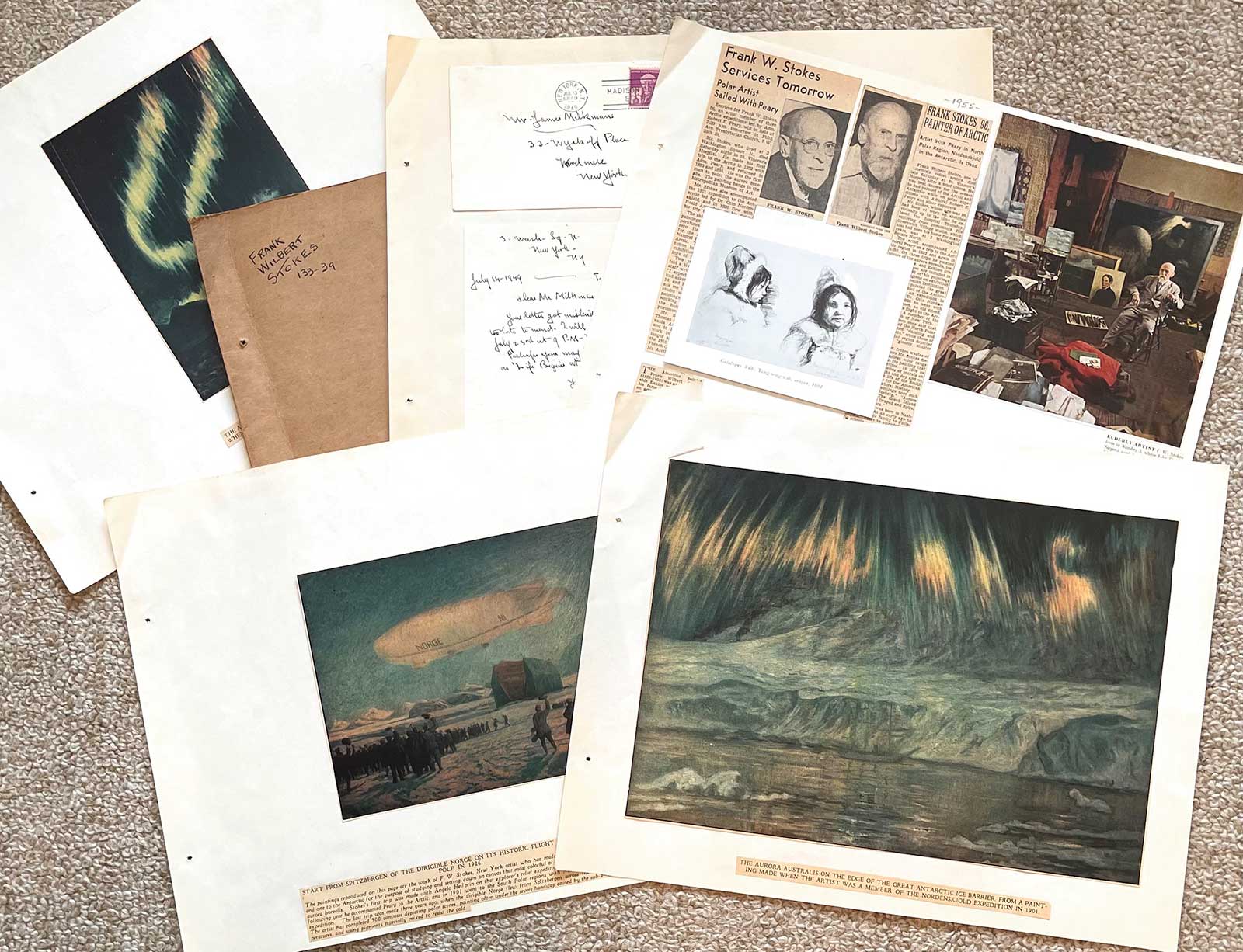 Frank Wilbert Stokes. Autograph and clipping scrapbook compiled by Jerome Milkman. Author’s collection.
In Stokes’ obituaries in the scrapbook, Amundsen reflects on Stokes’s Arctic paintings, saying they contained “dazzling and beautiful effects” while his Antarctic scenes depicted the “gloomy, sinister, and tragic.” Amundsen’s words remind me that science needs art—it needs language and images to add metaphor and soul to description. Amundsen saw the Poles with his own eyes; he also saw them through Stokes’ art. Look. The ice and sky are alive in The Eighth of March—Island Ice, Greenland, 1894 and in Emperor Penguin, Admiralty Inlet, Snow Hill, Antarctic. They swirl and heave, forbidding yet beautiful. The men and dogs are puny traces against a limitless horizon; the penguin lords over lethal terrain.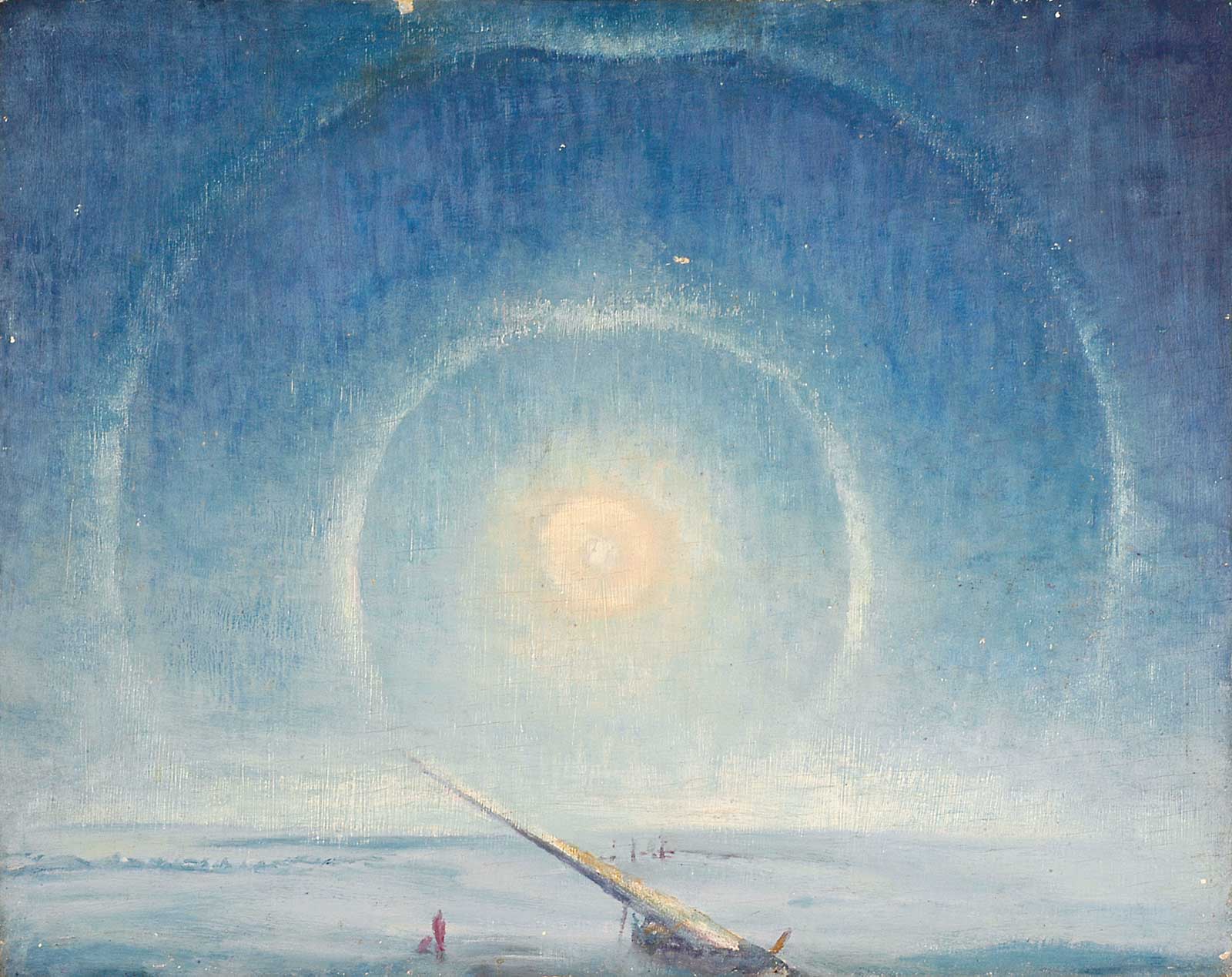 David Abbey Paige (1901-1979), Halo; wing of the Fokker airplane crashed on March 12, 1934. Oil on board, 40.3 x 50.3 in. Admiral Richard E. Byrd Papers, SPEC.PA.56.0001, Byrd Polar and Climate Research Center Archival Program, Ohio State University.
Is the scrapbook an artform of its own? Is collecting an artform? I want to explore these folders, hear more from the artists waiting in their pages, artists who are no longer canonical names or, perhaps, never were. Not that this matters. The more I look at art—especially the kind of scientific yet visionary art that Stokes made, tirelessly, until his death at the age of 96—the more I know that fame has nothing at all to do with art. Whether it’s glaciers or painting or scrapbooking, we’ll go to the ends of the Earth—to the antipodes—for our passions. Will we venture as far to save the Earth? —
James D. Balestrieri is the proprietor of Balestrieri Fine Arts, specializing in arts consulting, sales, research and writing. He is currently the writer-in-residence for the Clark Hulings Foundation, as well as estate and collections consultant for The Couse Foundation and communications manager for Western Spirit: Scottsdale’s Museum of the West. He was director of J.N. Bartfield Galleries for 20 years, worked with the Scottsdale Art Auction for 15 years and has written over 150 essays for various art publications.
Powered by Froala Editor