Given that 2021 has seen the first female vice president take office, it constitutes a real if unofficial “year of the woman.” This year also marks the 50th anniversary of the publication of Linda Nochlin’s seminal essay, “Why Have There Been No Great Women Artists?” Hence, it is the ideal time to consider women in American art. This article contextualizes highlights of Initiatives in Art and Culture’s upcoming 26th annual Conference on American Art, this November in New York City, within the framework proposed by Diana Greenwald in her important work Painting by Numbers: Data-Driven Histories of Nineteenth-Century Art. To consider art by women involves challenging prevailing cognitive approaches to art history to bring into the discussion those whose work merits (re)consideration.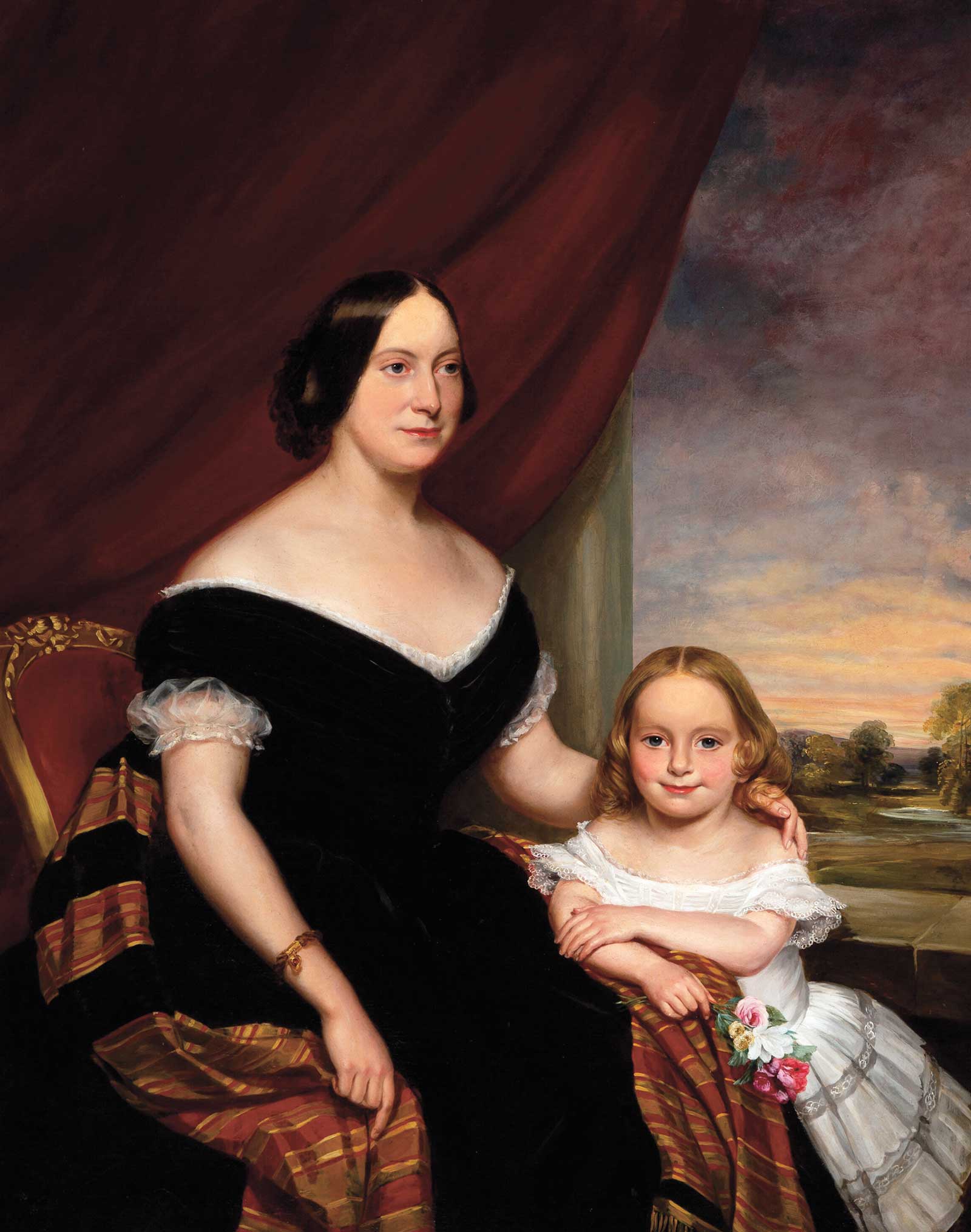 Sarah Miriam Peale (1800-1885), Mother and Child, ca. 1848. Oil on canvas, 49 x 39 in. The Bennett Collection of Women Realists.
In her book, Greenwald details structural factors faced by American women striving to become artists and employs theories from labor economics to underscore potential commonalities faced by women across class and racial lines. Women were active in genres and media that allowed them to create the most work in the least amount of time, across short working sessions.
The artist Cecilia Beaux (1855-1942), who was the first full-time female professor of painting at Pennsylvania Academy of the Fine Arts, expressed the hope that the hour was near “when the term ‘Women in Art’ will be as strange sounding a topic as Men in Art….” While this hope has been met, it is also true that, as Greenwald notes, “those same genres and media that are quicker to work [as noted above, those in which women worked] are also the ones that have traditionally been neglected in museum collections.” Greenwald’s analysis can spur discovery of the work of American women artists, representing a boon to those interested in reassessing American culture and identifying areas of opportunity for both individual and institutional collectors.
But to find women’s work, we must go beyond the standard catalog search because, as Greenwald notes, “a genre in which women are disproportionately active is one that is also disproportionately under collected relative to its 19th-century display and production.” Here, and in the IAC conference, we seek to do just that, looking beyond the confines of the canon, a body of work dominated by large-scale landscapes largely produced by men.
American women artists were drawn to miniature painting during the Colonial period. Indeed, Mary Roberts (1769-1833) was America’s first miniaturist. In the upcoming conference, scholar and dealer Elle Shushan will explore the life and work of Mary Way who, on the Eastern Shore of Connecticut, taught drawing, needlework and made unique cut and dressed profile portraits. In 1810, she traveled from the Eastern Shore of Connecticut to New York City to study miniature painting with John Wesley Jarvis and Anson Dickinson, two of America’s foremost practitioners. One of the earliest female artists in the city, she extensively documented her experiences in lengthy letters home, and constitutes the finest record extant of miniature painting in Federal New York. Her works, and works by her sister and niece, will be shown for the first time at an exhibition to be mounted at the Lyman Allyn Art Museum in New London, Connecticut.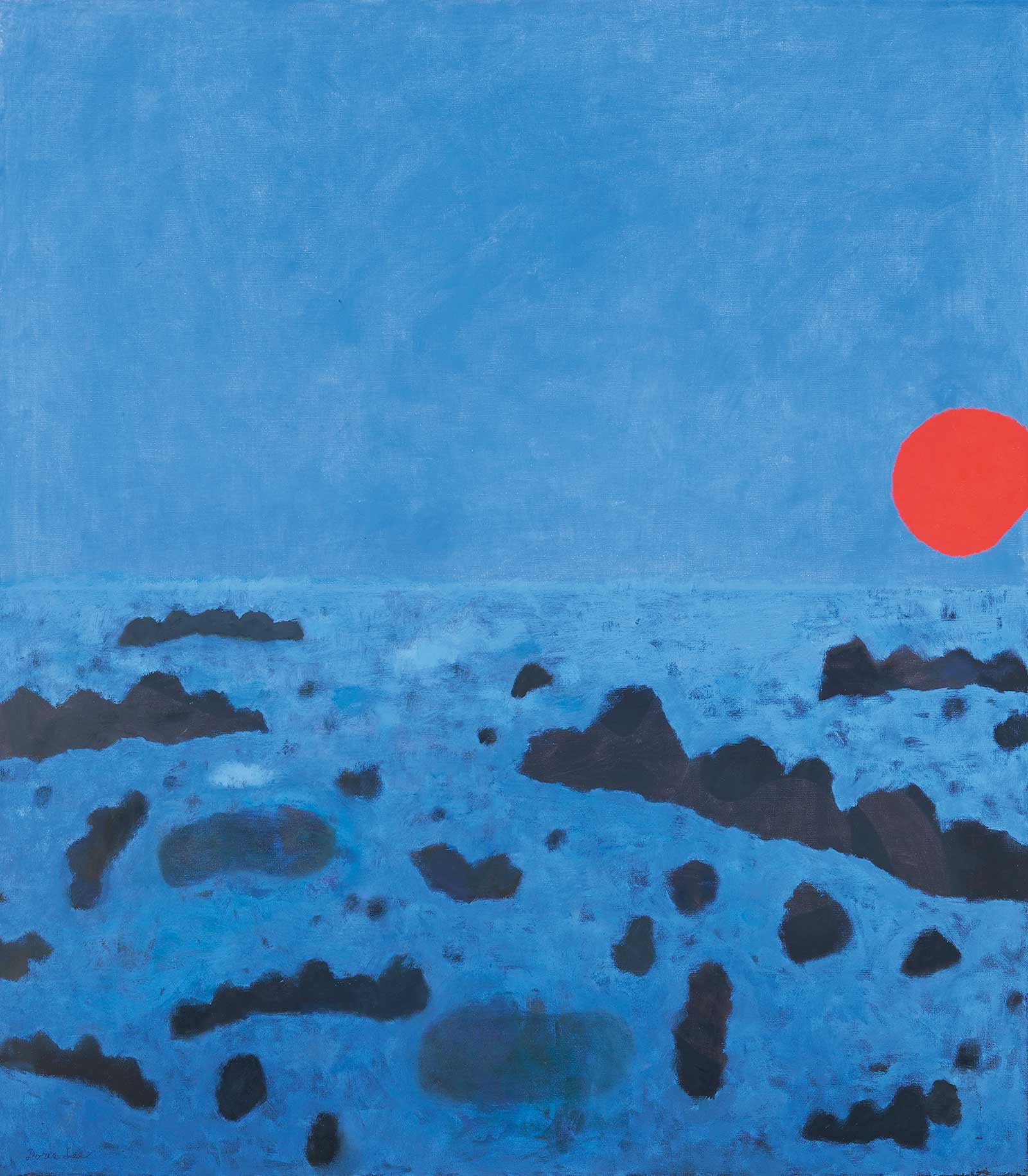 Doris Lee (1905-1983), Sunset in the Florida Keyes, ca. 1960s. Oil on canvas, 48 x 42 in. The Dicke Collection. Courtesy The Westmoreland Museum of American Art.
Works on paper were a major form of expression for American women artists. Shannon Vittoria, of the Metropolitan Museum of Art, will discuss American painter-etcher Mary Nimmo Moran (1842-1899), who began her career in 1863, studying drawing and painting with her husband, artist Thomas Moran (1837-1926). Nimmo Moran was most celebrated for her etchings, in particular a series of expressive tonal landscapes executed between 1879 and 1899, the year of her death. The first woman elected to both the New York Etching Club and London’s Society of Painter-Etchers, with her monochromatic harmonious tones, Nimmo Moran illustrated the importance of etching and women’s contributions to the development of the late 19th-century tonalist aesthetic.
Author of a seminal work, Forever Seeing New Beauties: The Forgotten Impressionist Mary Rogers Williams (1857–1907), Eve Kahn will explore this artist’s contributions to the American tonalist and impressionist movements. Williams worked in pastel, watercolor, and pen and ink (as well as oil), again suggesting a focus on works in categories often deemed as lesser in the classical hierarchy of media. A baker’s daughter from Hartford, Connecticut, she biked and hiked from the Arctic Circle to Naples, exhibited from Paris to Indianapolis, and taught at Smith College for nearly two decades. Her work was featured in posthumous shows at the Philadelphia Water Color Club (at PAFA), New York Water Color Club and the Wadsworth Atheneum Museum of Art.
Greenwald notes that in her frequent trips to Paris, Williams employed a strategy common to women artists in America: leaving the country to join communities of foreign artists or expatriate American artists, thereby circumventing sociocultural constraints at home. In her 2015 book A Sisterhood of Sculptors: American Artists in Nineteenth-Century Rome, Melissa Dabakis makes a similar observation, describing a community of talented women including Harriet Hosmer, Edmonia Lewis, Anne Whitney and Vinnie Ream, who between 1850 and 1876, achieved success as working sculptors in Rome.
Focusing further on sculptors, who pursued study and creative freedom abroad, Clarisse Fava-Piz considers Harriet Whitney Frishmuth (1880-1980) and Gertrude Vanderbilt Whitney (1875-1942). Frishmuth studied sculpture in Paris under Rodin in the early 1900s, a period when sculptors were particularly inspired by new forms of choreography. Frishmuth’s most highly movemented work, The Vine, 1923, was awarded the Julia A. Shaw Memorial Prize by the NAD. Whitney, a daughter of New York City’s uppermost class, discovered the art world of Montmartre and Montparnasse while visiting Europe in the early 1900s. She studied at the Art Students League of New York and then in Paris. Her first public commission Aspiration, a life-size male nude, was shown at the Pan-American Exposition in Buffalo, New York, in 1901 and her first solo show took place in New York City in 1916. During the 1920s, her increasingly realistic and often monumental sculpture was critically acclaimed in Europe and the United States. Whitney’s last pieces of public arts were the Spirit of Flight, created for the New York World’s Fair of 1939, and the Peter Stuyvesant monument in New York City.
It is useful to consider the schools and academies that shaped American women artists. PAFA is an important example. Anna Marley explores the artistic networks of women artists exhibiting, studying and teaching at this institution from its founding in 1805 to the end of the Second World War. PAFA has actively promoted women artists since its first annual exhibition in 1811, and has led in collecting art by women, including works by the first African American women to study there, Laura Wheeler Waring (1887-1948) and May Howard Jackson (1877-1931).
Another school important in the history of women American artists was Atelier 17, which taught traditional and experimental printmaking. Founded in Paris in 1927, it would move to New York City before the outbreak of the Second World War, before returning to Paris in 1950. Cristina Weyl, author of The Women of Atelier 17: Modernist Printmaking in Midcentury New York, 2019, discusses how Atelier 17 fostered an environment in which nearly 100 women artists would realize extraordinary work in different modernist styles and create a sisterhood decades before the women’s art movement of the 1970s.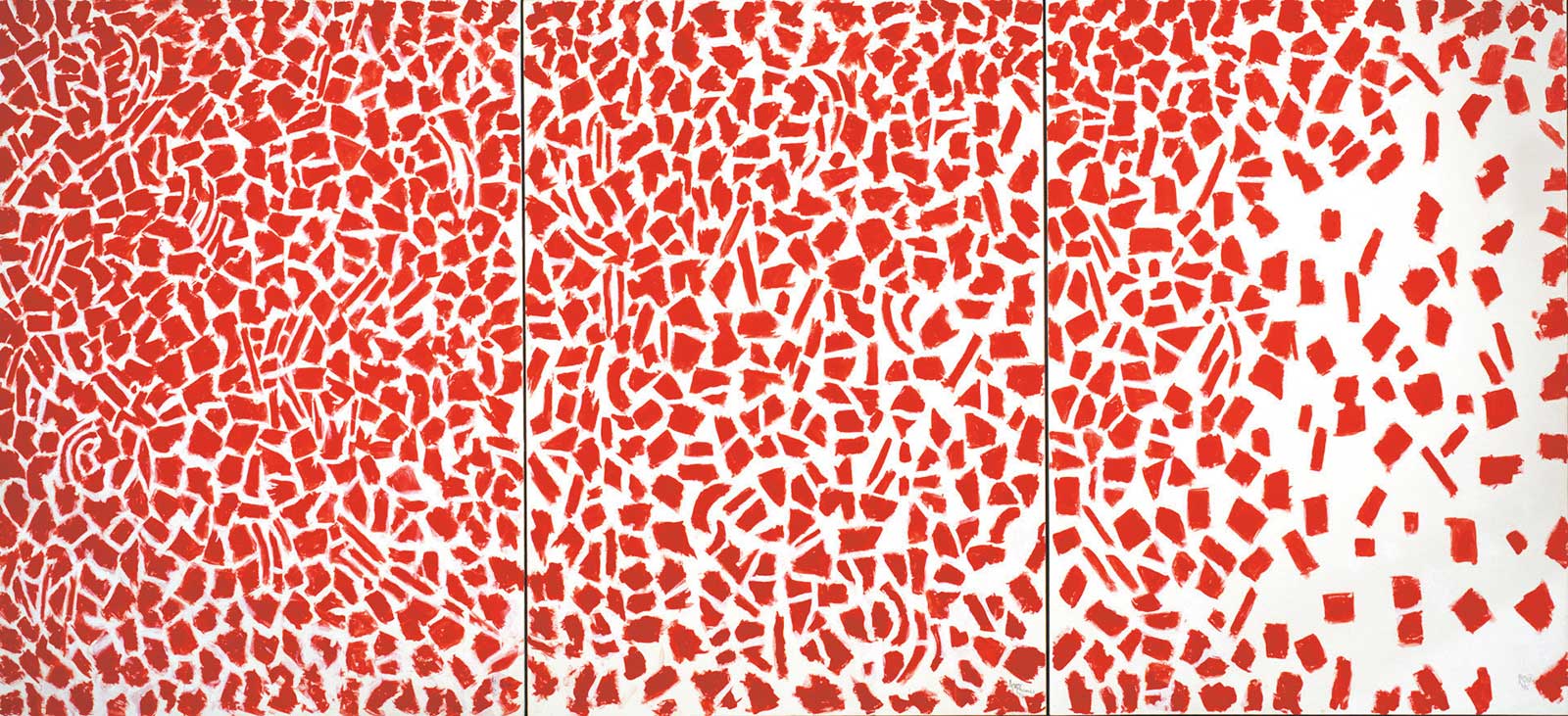 Alma Thomas (1891-1978), Red Azaleas Singing and Dancing Rock and Roll Music, 1976. Acrylic on three canvases. Smithsonian American Art Museum, Washington, D.C.
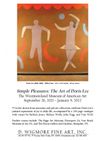
Doris Lee, a leading figure in the Woodstock Artists’ Colony in the decades after the Second World War, deftly absorbed and incorporated the innovations of abstract expressionism into her paintings, merging the reductionism of abstraction with the appeal of the everyday. The new exhibition Simple Pleasures: The Art of Doris Lee was co-curated by Melissa Wolfe of the St. Louis Museum of Art and Barbara Jones of the Westmoreland Museum of American Art. This exhibition constitutes the first critical assessment of the artist’s works, which includes drawings, prints, commissioned commercial designs in fabric and pottery, and images for advertisements.
In Alma W. Thomas: Everything is Beautiful, Columbus Museum of Art curator Jonathan Frederick Walz explores the life and work of an artist whose pursuit of beauty extended to every facet of her life, from her exuberant abstractions to the conscientious construction of her own persona. The first Black woman to receive a solo show at the Whitney Museum of American Art (1972), Thomas (1891-1978) is known for her large abstract paintings filled with irregular patterns of bright colors; her innovative palette and loose application of paint grew out of her long study of color theory. The first graduate of Howard University’s Fine Arts program, Thomas was a member of the Washington Color School.
Artist Faith Ringgold, born in 1930 in Harlem, New York, joins the conference in conversation from ACA Galleries. Having grown up in the creative and intellectual ferment of the Harlem Renaissance, Ringgold is widely recognized for her painted story quilts combining personal narratives, history and politics that, in her words, “tell my story, or, more to the point, my side of the story” as an African American woman. Embracing media often associated with feminine pursuits and her cultural heritage, in the 1970s Ringgold created her first unstretched works bordered with pieced fabric, inspired by Tibetan tanka paintings. This led in the 1980s to Ringgold’s first story quilts, where she was able to weave image and text in a tradition of quilting passed down through the female line of her family beginning with her great-great-grandmother, who was born into slavery.
Museum of Fine Arts, Boston curator Nonie Gadsden discusses overlooked and underrepresented women artists who challenge the dominant history of the 20th-century, discussing her exhibition Women Take the Floor, the reinstallation—or “takeover”—of Level 3 of the Art of the Americas Wing at the MFA. With their use of female metaphors and their work in varied media, these artists expand the concept of what constitutes American art.
Joan Mitchell, Grace Hartigan, Helen Frankenthaler and Elaine de Kooning, among others, challenged the notion that abstract expressionism was a movement of men and central to mid-20th-century action painting. Textile artists such as Sonya Clark, Gina Adams, Carla Fernandez and Erin Robertson use a medium associated with womanhood to confront notions of identity, gender and politics. The exhibition also considers women’s growing pursuit of photography from 1965 to 1985, both by (now) well-known American photographers such as Diane Arbus, Judy Dater, Annie Leibovitz, Sally Mann and Cindy Sherman, and underrecognized photographers working in Argentina, Mexico, Chile and Canada, including Adriana Lestido, Yolanda Andrade, Paz Errázuriz and Lynne Cohen. These latter artists expand our notion of what constitutes “America.”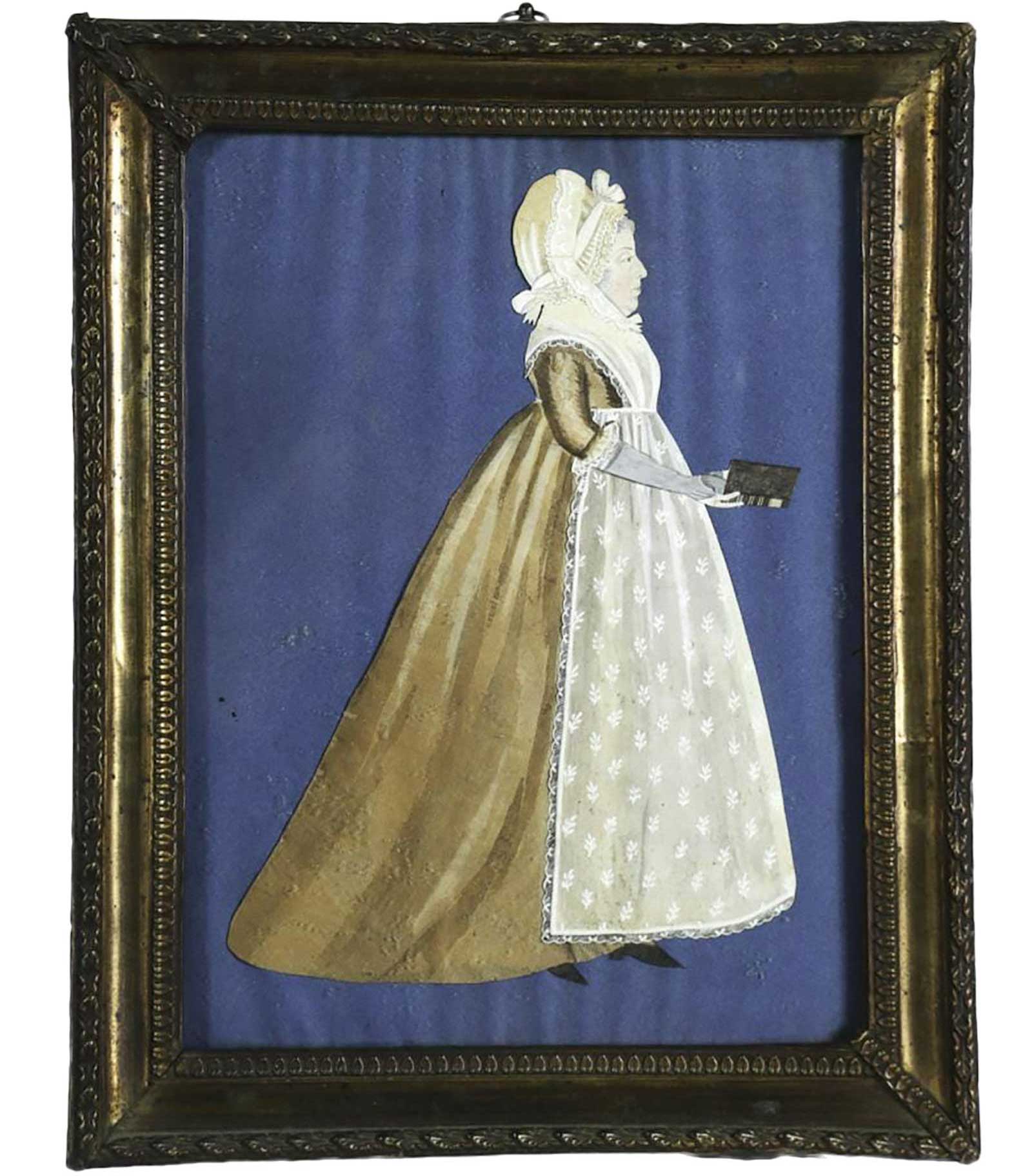 Mary Elizabeth Way (1769-1833), Dress Profile Portrait of a Lady, ca. 1795. Folded, painted paper, pencil. Private colletion.
Dispersed across collections devoted to science, history and anthropology, Native American art has been severed from the artists and communities who created it. Rejecting an entrenched view of artists of individual genius creating masterpieces, a perspective that led to Native American women’s art disappearing from consideration, Denver Art Museum curator of Native American Arts Dakota Hoska views the objects as living, relational beings: sacred creations, connected to living people and communities. She bases her discussion on a recategorization of Native American art and attributes the work, for the first time, to the right gender, thus revealing a previously unexplored universe of work by women.
Collectors can redress the balance, drawing attention to women artists’ past and present. In 2009, Steven Alan Bennett and Dr. Elaine Melotti Schmidt established The Bennett Collection of Women Realists, which includes only figurative realist paintings of women by women artists such as Julie Bell, Margaret Bowland, Aleah Chapin, Aneka Ingold, Andrea Kowch, Alyssa Monks, Katie O’Hagan. In addition, the Collection includes works by historic women painters, including Sarah Miriam Peale, Gertrude Abercrombie, Artemisia Gentileschi, Elaine de Kooning, Elisabetta Sirani and many others. The Bennett Prize, established in 2018, awards $50,000 to a woman artist to create her own solo exhibition of figurative realist paintings, which then travels the country. The Prize provides women artists with the opportunity to undertake an ambitious project while expanding opportunities for the public to learn more about talented women painters and figurative realist painting. —
Lisa Koenigsberg, president and founder of Initiatives in Art and Culture, is an internationally recognized thought-leader in visual culture. Her work is characterized by commitment to authenticity, artisanry, materials, sustainability and responsible practice. Over 20 years ago, she established IAC’s multidisciplinary conference series on visual culture, notably those that focus on American Art and on the Arts and Crafts Movement. She has held positions at NYU where she also served on the faculty, at several major museums, and at the New York City Landmarks Preservation Commission. Her writings have appeared in books, journals and magazines. She has organized symposia and special sessions, and given talks at universities, museums and professional organizations throughout the U.S. and abroad. A member of the Advisory Board of Ethical Metalsmiths and board member of the Morris-Jumel Mansion (of which she is president) and Glessner House, she holds graduate degrees from The Johns Hopkins University and from Yale University from which she received her PhD.
Powered by Froala Editor