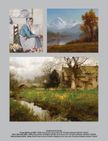
Women have shown work at the Pennsylvania Academy of the Fine Arts since the institution’s first annual exhibition in 1811. “The director of the institution was very clear that the ‘product of female genius’ should be included,” says Anna O. Marley, the Kenneth R. Woodcock Curator of Historical American Art and Director of the Center of the Study of the American Artist at PAFA.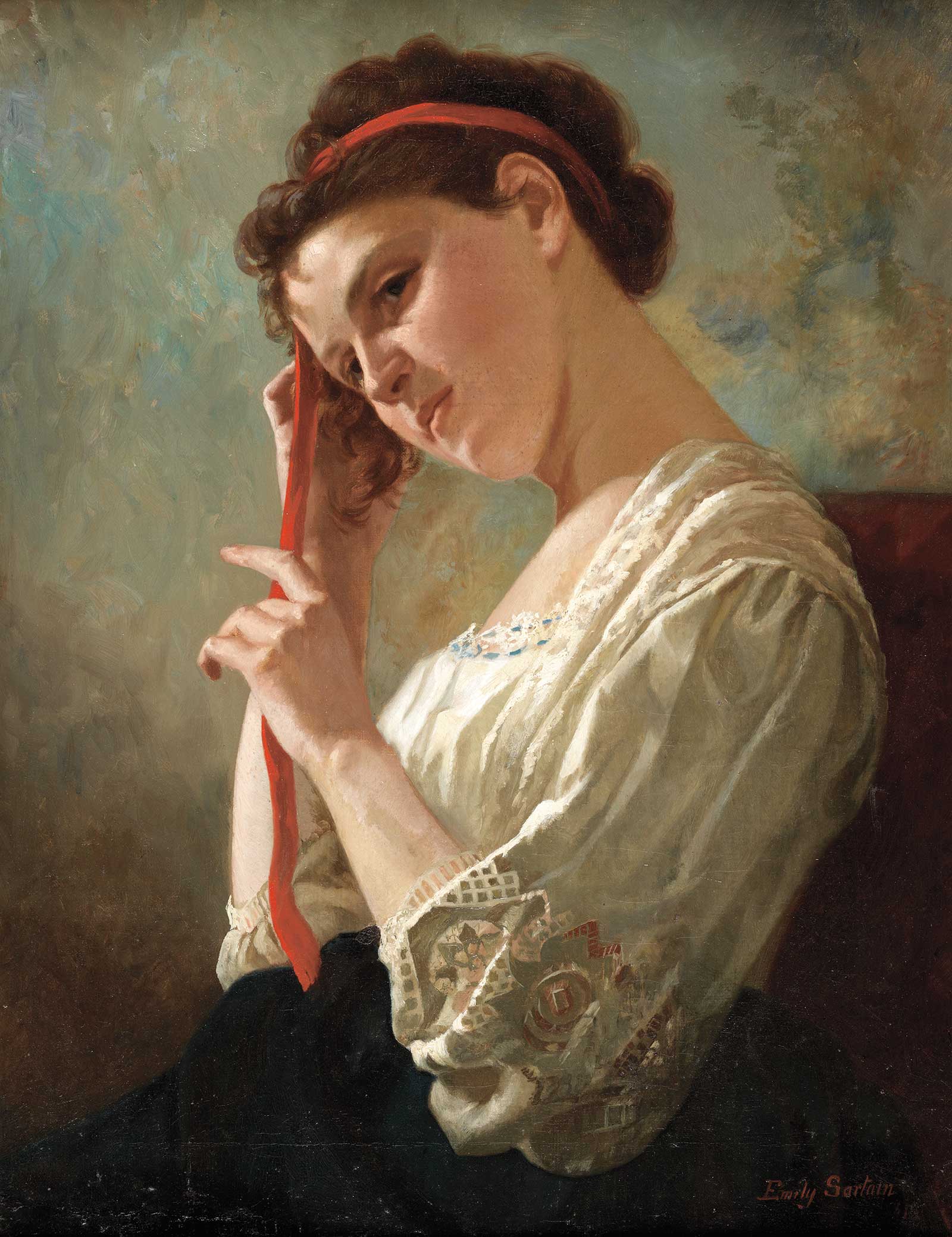 Emily Sartain (1841-1927), Study, 1878. Oil on canvas, 34 x 27 x 3 in. Museum Purchase, 2017.1. Courtesy Pennsylvania Academy of the Fine Arts, Philadelphia.
The rich history of women’s art at PAFA, starting with its founding at the beginning of the 19th century and extending through the end of World War II, is chronicled in Women in Motion: 150 Years of Women’s Networks at the Pennsylvania Academy of the Fine Arts, opening July 8, 2021, and remaining on view through July 24, 2022.
The earliest women artists to show at the institution—the “Founding Mothers,” Marley calls them—often had some sort of family connection. They were the daughters of the prominent artists of the era, like Thomas Sully and James Peale. “They were privileged,” Marley says. “They had the opportunity to study with their cousins or fathers, and they had an entry into exhibitions at PAFA. Women didn’t really begin to study at PAFA until the 1840s.”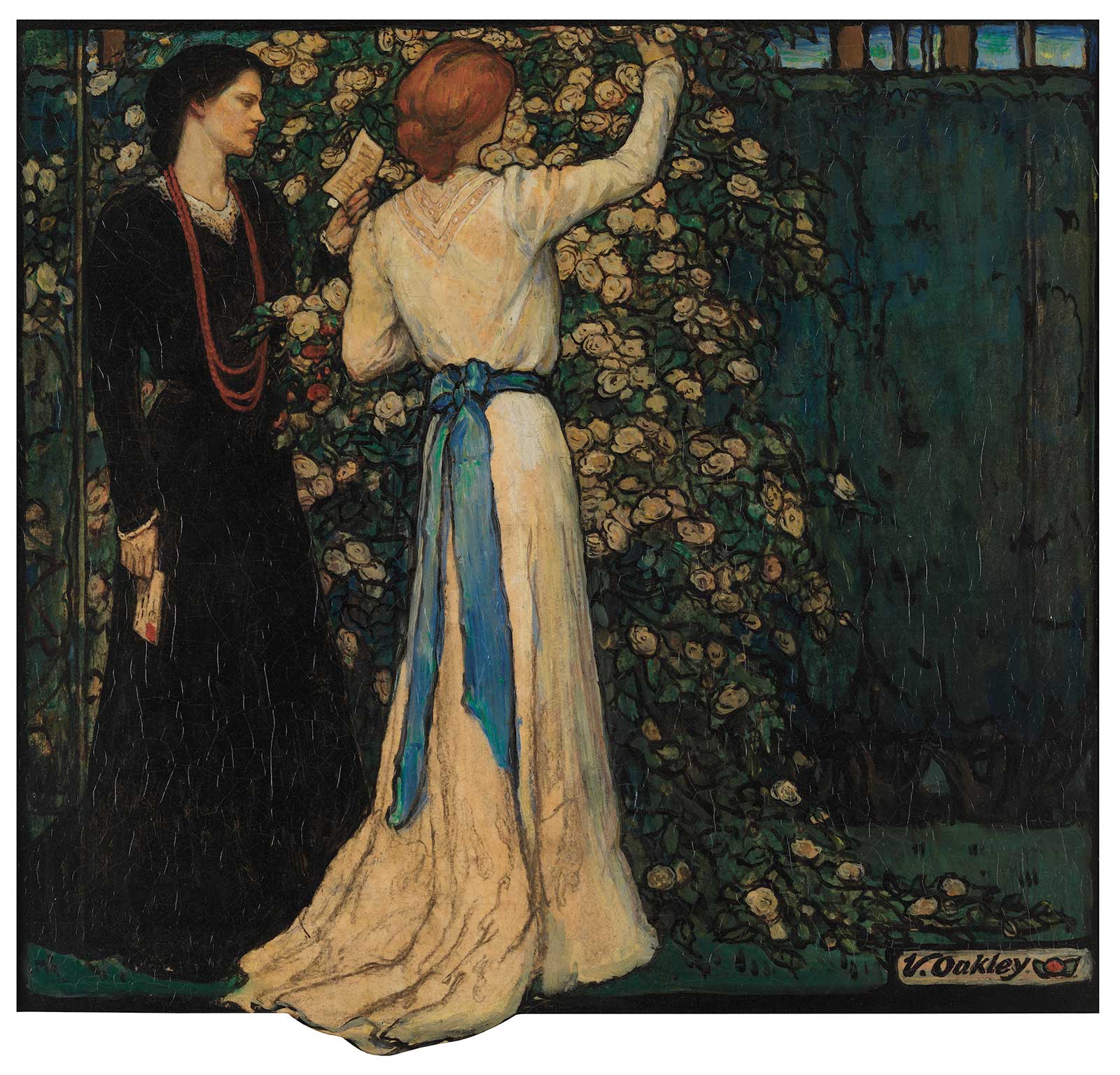 Violet Oakley (1874-1961), June, ca.1902. Oil, charcoal, and graphite on composition board, 163⁄16 x 171⁄16 in. Henry D. Gilpin Fund, 1903.4. Courtesy Pennsylvania Academy of the Fine Arts, Philadelphia.
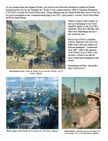
The exhibition’s title includes the word “network,” and the way women artists connected with one another is critical to the show. “While in the beginning of the 19th century, family networks defined women’s access to art, by the 1870s and 1880s, it became more about professional networking. Women are creating professional networks with each other,” says Marley.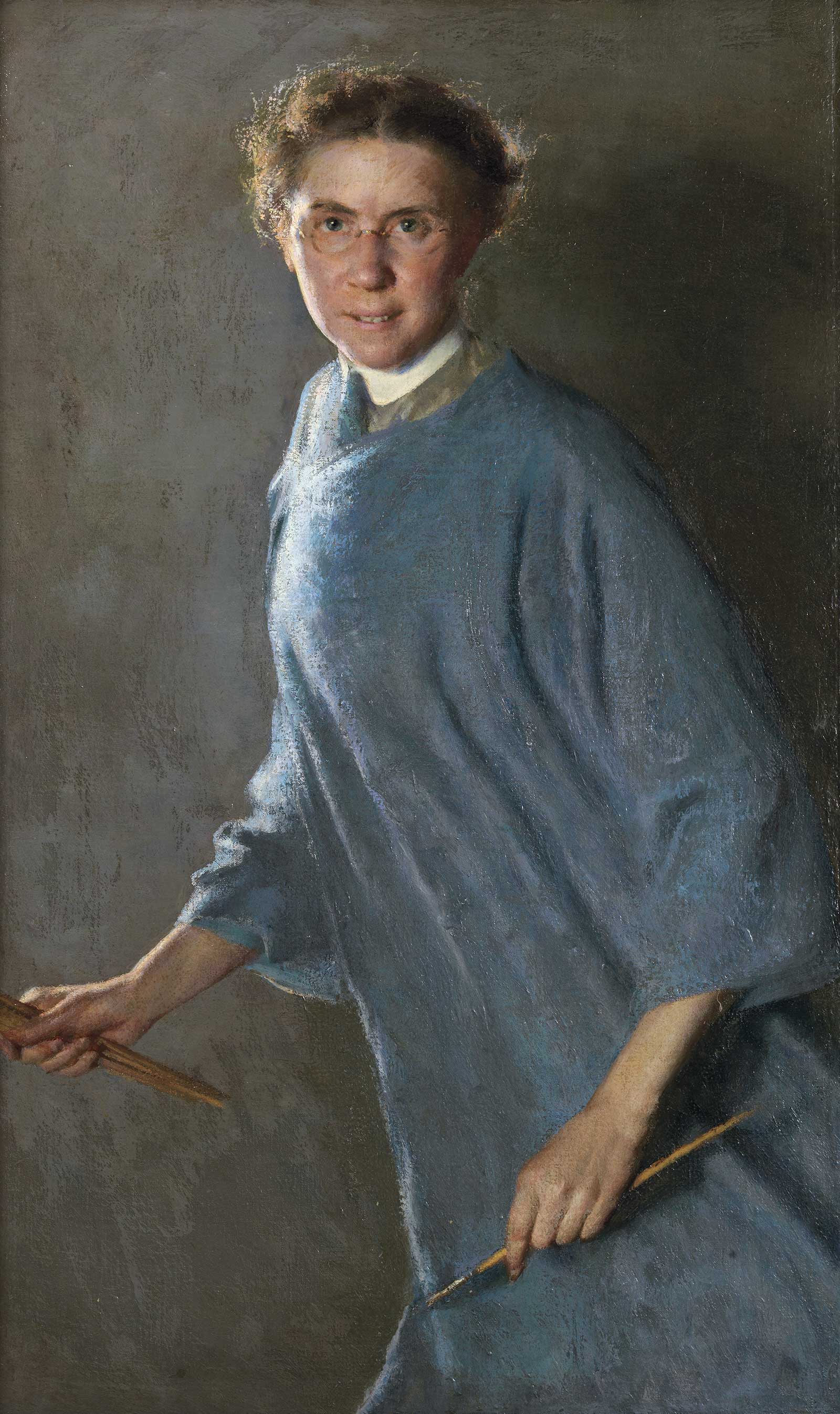 Margaret Foster Richardson (1881-ca. 1945), A Motion Picture, 1912. Oil on canvas, 40¾ x 231⁄8 in. Henry D. Gilpin Fund, 1913.13. Courtesy Pennsylvania Academy of the Fine Arts, Philadelphia.
Mary Cassatt and Emily Sartain, who both studied at PAFA in the 1860s, mark a transition from family networks to professional networks. Both came from influential Philadelphia families, but both were determined to build careers in art. Sartain eventually became the director for the Philadelphia School of Design for Women, where she championed women’s art education. Sartain will be represented in the exhibition with her 1878 Study, and Cassatt’s oil on canvas Baby on Mother’s Arm will also be on display.
A central figure in PAFA’s history of women in the arts is Cecilia Beaux, the first woman to teach at the school full time. Her painting New England Woman was the first work by a woman purchased by the institution, and it serves as the opening piece of the exhibition. Marley says, “I thought it was fascinating that though we’ve been exhibiting work by women since 1811, it wasn’t until the 1890s that we purchased a work by a woman artist for the collection. It’s fitting that its by Cecilia Beaux, our first full-time female faculty member.”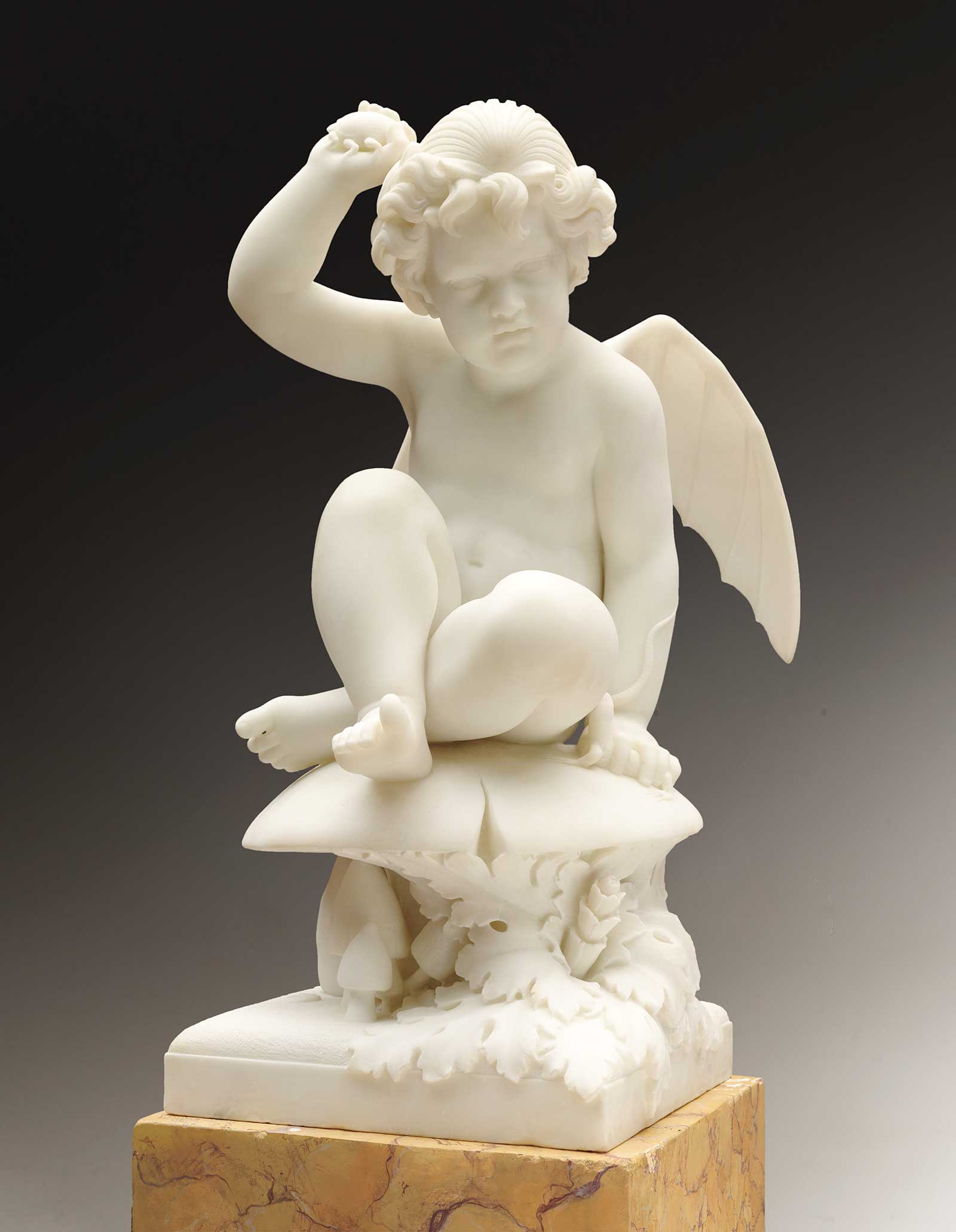 Harriet Hosmer (1830-1908), Puck on a Toadstool, ca.1856. Marble, 671⁄16 x 18 x 18 in. Museum Purchase, 2016.1. Courtesy Pennsylvania Academy of the Fine Arts, Philadelphia.
By the 1890s, Beaux was a bona fide superstar in the art world, well known in both the United States and France, and that’s when PAFA’s director recruited her to teach at the school. In that position, she had an indelible influence on a generation of women artist. “She teaches Elizabeth Sparhawk-Jones, and they remain close, and also Violet Oakley, who then becomes the second full-time female professor at PAFA,” Marley explains. “Cecilia Beaux sets that precedent for her.”
Oakley first made her mark as one of the Red Rose Girls, a trio that also included Jessie Willcox Smith and Elizabeth Shippen Green, and is part of a tradition of queer artists that is threaded throughout the exhibition. The three women lived together in a studio and had a “wife” who took care of them while they worked on advancing their art careers. After the Red Rose Girls disbanded, Oakley went on to live with life partner Edith Emerson, who helped found another Philadelphia art institution, the Woodmere Art Museum.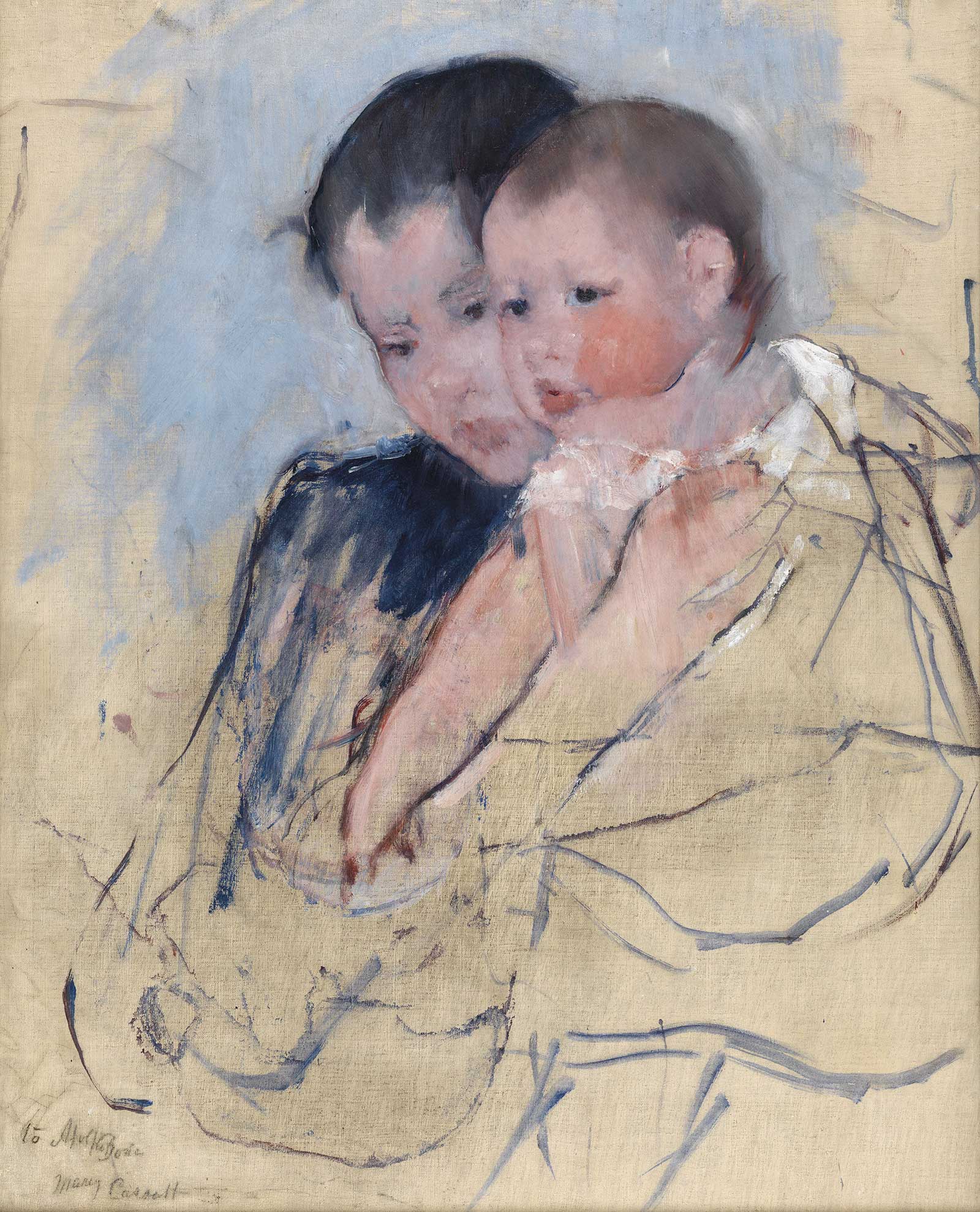 Mary Cassatt (1844-1926), Baby on Mother’s Arm, ca.1891. Oil on canvas, 25 x 19¾ in. Bequest of Peter Borie, 2003.15. Courtesy Pennsylvania Academy of the Fine Arts, Philadelphia.
Women in Motion will feature Oakley’s June, which was painted as an illustration for a periodical during her time with the Red Rose Girls. It features two women, safely enclosed in a garden. “They look very much like a sort of idealized Gibson Girl that would have been very popular at the time, but it’s also a nod to the fact that these women were living together and supporting each other,” Marley says. “It creates a space for women’s relationships and women’s artistic practice.”
Harriet Hosmer is another queer artist to be featured in the exhibition with her sculpture Puck on a Toadstool, which Marley sees as something of a self-portrait. It portrays an impish toddler grasping at a beetle with one hand and a lizard with the other. “Hosmer was known for living in a same-sex community of progressive women in Rome, and she was often described as a sort of transgressive, fairylike figure. She was quite petite, and she had a whole group of Italian men as studio assistants who towered over her in height. But she commanded them in terms of her artistry,” Marley says. 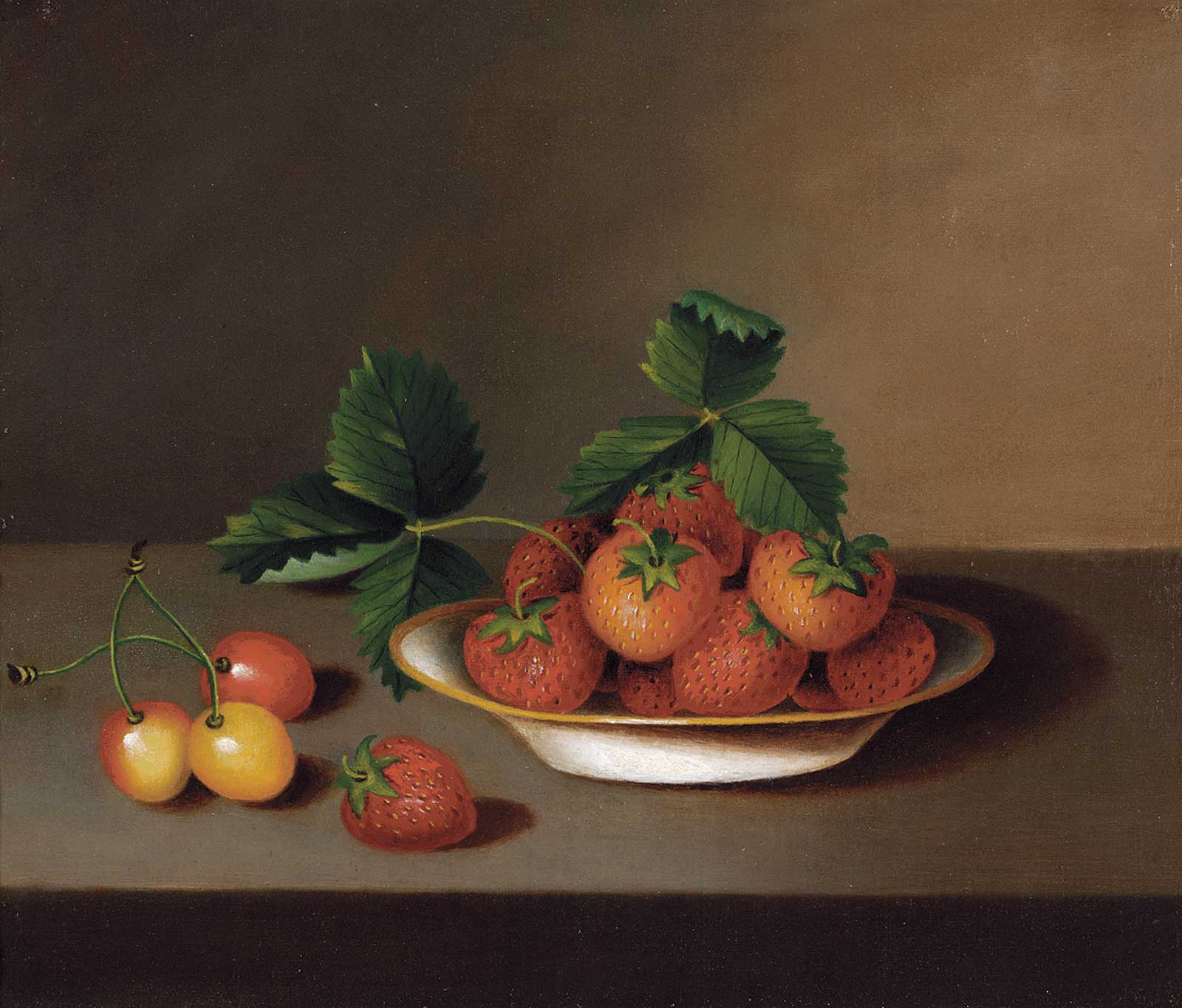 Margaretta Angelica Peale (1795-1882), Strawberries and Cherries, ca. 1813-30. Oil on canvas, 101⁄16 x 121⁄8 in. Source unknown, 1924.11. Courtesy Pennsylvania Academy of the Fine Arts, Philadelphia.
“There’s a real connection between these queer women that we can trace from the career of Rosalie Sully, who was one of Thomas Sully’s daughters, to Harriett Hosmer, to Violet Oakley, and on into the 20th century,” Marley explains. “That was an element of the exhibition that really developed out of the art and thinking about the strategies these women had for supporting each other’s careers.”
Like Beaux, William Merritt Chase served as a pivotal connection point for female artists in Philadelphia, as he taught over 500 women artists during his time at PAFA. Among those who studied with him are May Howard Jackson and Laura Wheeler Waring, who later became associated with the Harlem Renaissance.
Jackson was the first African American woman to receive a scholarship from PAFA, and her landscape Morris Heights, N. Y. City will be featured in the exhibition. Waring followed in her footsteps, and after studying at PAFA, she went on to run the art department at Cheyney University, a historically Black university located just outside of Philadelphia. Her painting The Study of a Student is most likely of one of her students at Cheyney while she was a faculty member there. Maryley says, “I think there’s a really wonderful warmth and intimacy in those portrayals, which are different from the kinds of society portraits that we might associate with Cecilia Beaux or William Merritt Chase.”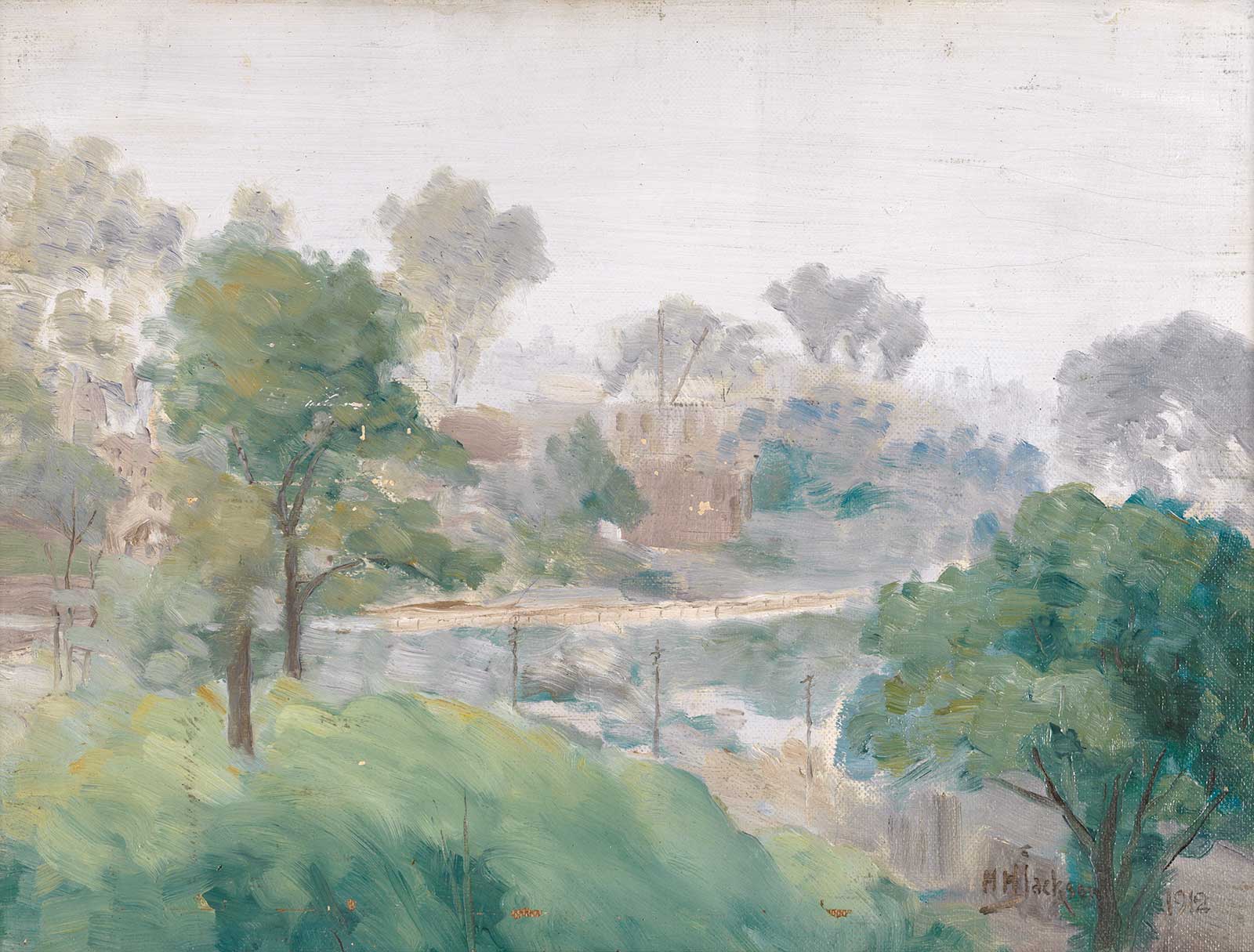 May Howard Jackson (1877-1931), Morris Heights, N.Y. City, 1912. Oil on linen canvas, mounted to wood panel, 12¼ x 16 in. Museum Purchase, 2018.14. Courtesy Pennsylvania Academy of the Fine Arts, Philadelphia.
Another one of Chase’s notable students was the one and only Georgia O’Keeffe. While she studied at the Art Students League, not PAFA, she did show at the institution during her lifetime. “We tend to talk about Georgia O’Keeffe like Athena, springing fully formed from the head of Zeus, but if you look at her paintings from her time in the Art Students League, you can see how much she got from Chase,” Marley says.
O’Keeffe described Chase’s instruction as “fresh, energetic and fierce,” and he encouraged students to explore their own style. Marley says, “O’Keeffe learned how to do these exuberant impressionist still lifes from him, and then she takes it in a totally different direction.” Coxcomb, one of her continuingly popular flower portraits, will be shown in the exhibition.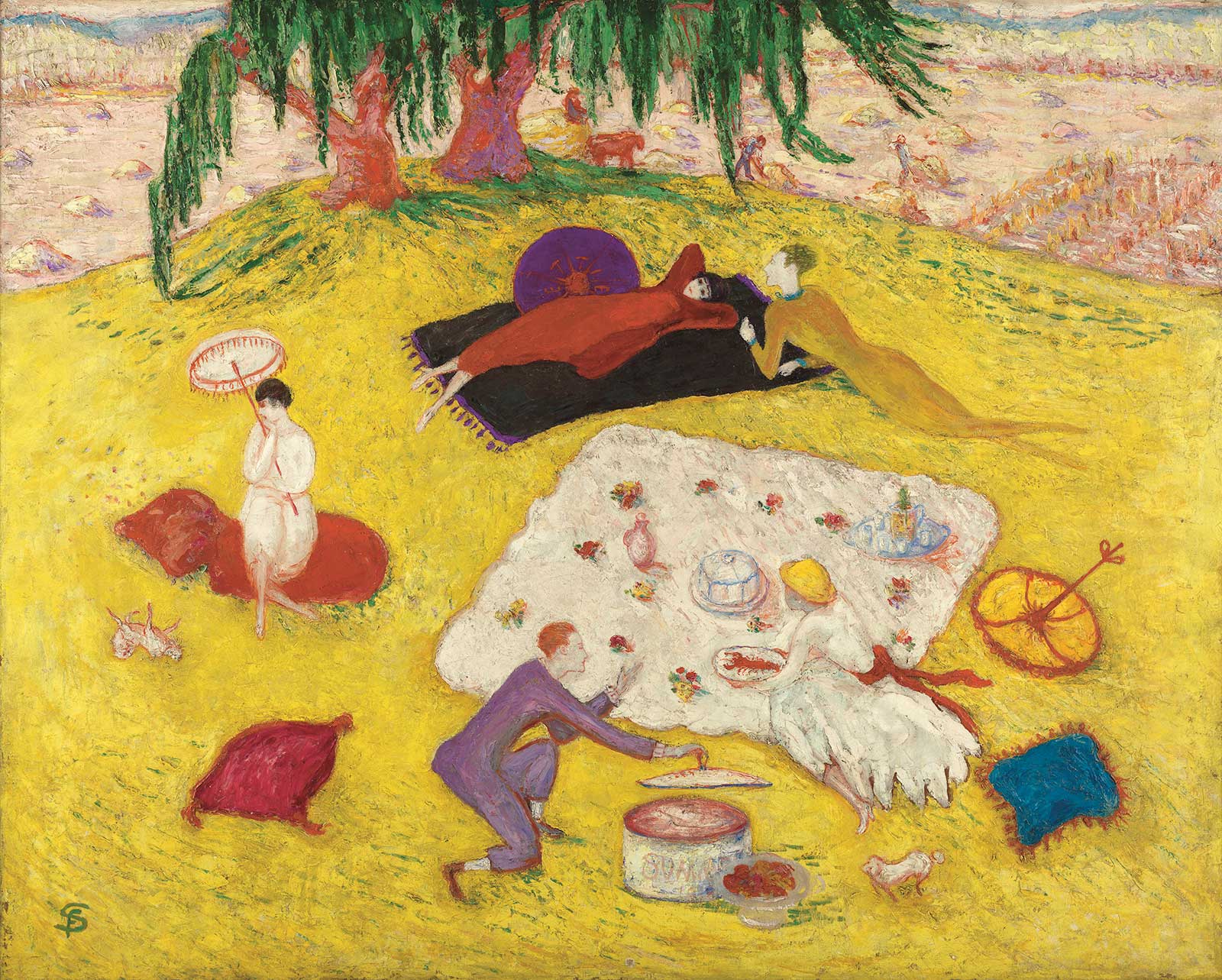 Florine Stettheimer (1871-1944), Picnic at Bedford Hills, 1918. Oil on canvas, 405⁄16 x 50¼ in. Gift of Ettie Stettheimer, 1950.21. Courtesy Pennsylvania Academy of the Fine Arts, Philadelphia.
With close to 100 works on display, spanning over 150 years of Philadelphia art history, Marley says that Women in Motion should feature something for everyone. “There’s paintings, sculptures and works on paper, and there’s modernists, impressionism, Ashcan school and neoclassical,” she says. “It will be on view through July of next year, because we know it might take people a while to make it out here after the pandemic, and we really want people to be able to see it.” —
Erin E. Rand is a former editor of American Art Collector, Western Art Collector, Native American Art and American Fine Art Magazine. She received her MA in Publishing and Writing from Emerson College, where she was a founding editor of MinervaMag.com, and she has a BA in History and International Affairs from Trinity University. She currently resides in Kansas City, Missouri.
Women in Motion: 150 Years of Women’s artistic Networks at the Pennsylvania Academy of the Fine Arts
July 8, 2021-July 24, 2022
Pennsylvania Academy of the Fine Arts
118-128 N. Broad Street, Philadelphia, PA 19102
(215) 972-7600, www.pafa.org
Powered by Froala Editor