Clark Hulings saw himself as a working artist. Given his training and early experience as an illustrator for hire this is perhaps not so unusual. When you meet artists who came of age at the same time, they often refer to paintings as “jobs,” automatically going back to the argot from the age of paintings as magazine and paperback covers, and as advertisements—jobs whose job was to sell something other than themselves.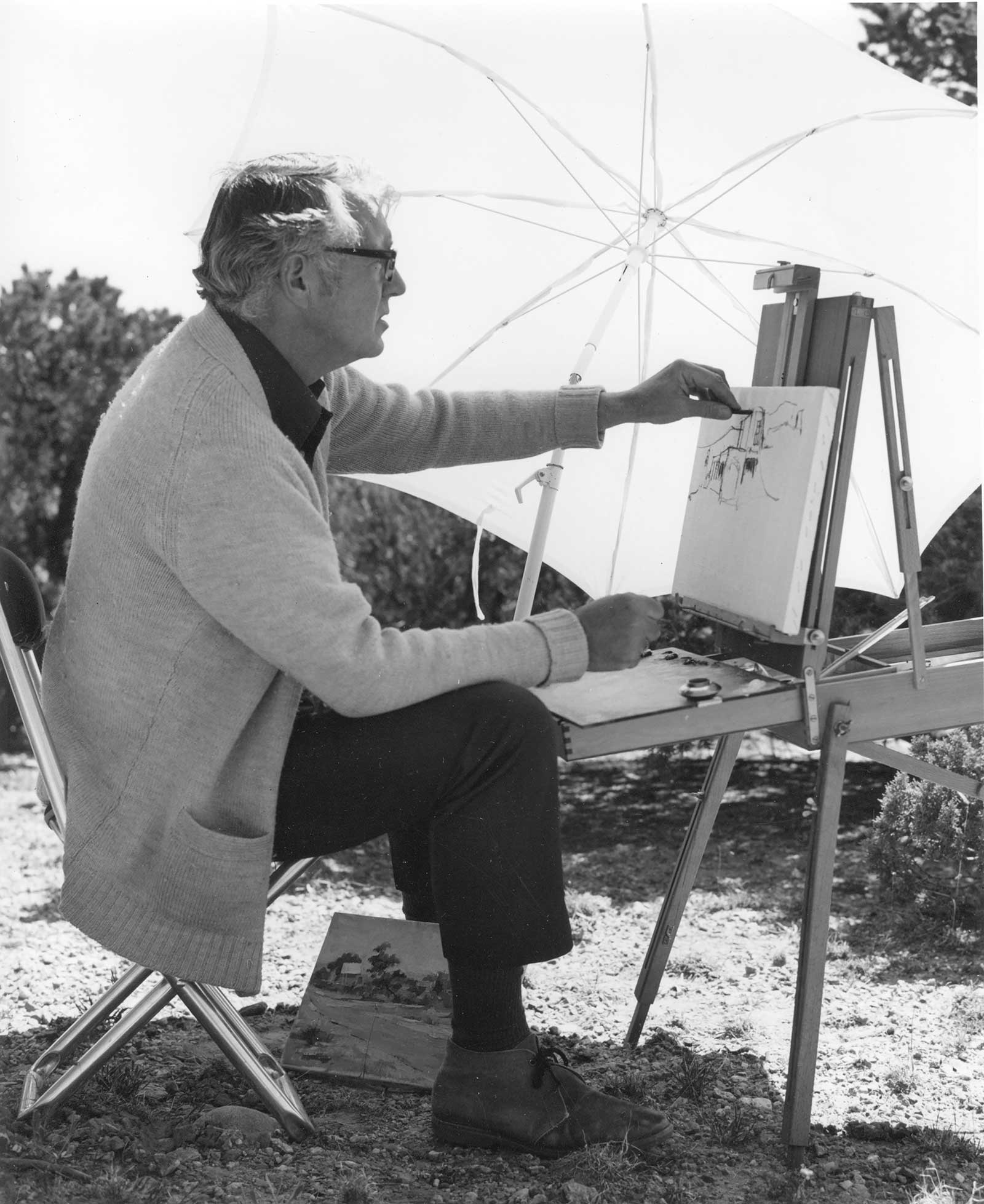 Clark Hulings creating his art on location.
Like his peers, Hulings valued work, but his observations on work and working people on his travels led him to make the lives and labor of working people his principal subject. When we speak of the word “oeuvre,” a word we have borrowed from the French language, we mean an artwork or an artist’s body of work. In Hulings’ case, work became his work. Work was his oeuvre. The canvas became not only the site of his labor, but a mirror for the ancient, rural labor that he saw giving way inexorably to modernity.
You would expect a strong slant toward nostalgia in Hulings’ paintings, but it is not an emotion he or his works indulge. Nor is romanticism. The people and animals—especially the burros—in Hulings’ paintings go about and through their days with minimal emotion, poised on the knife edge between suffering and dignity. That they are often bathed in bright, beautiful light only makes the shadows they cast all the longer and darker. They are their own sundials.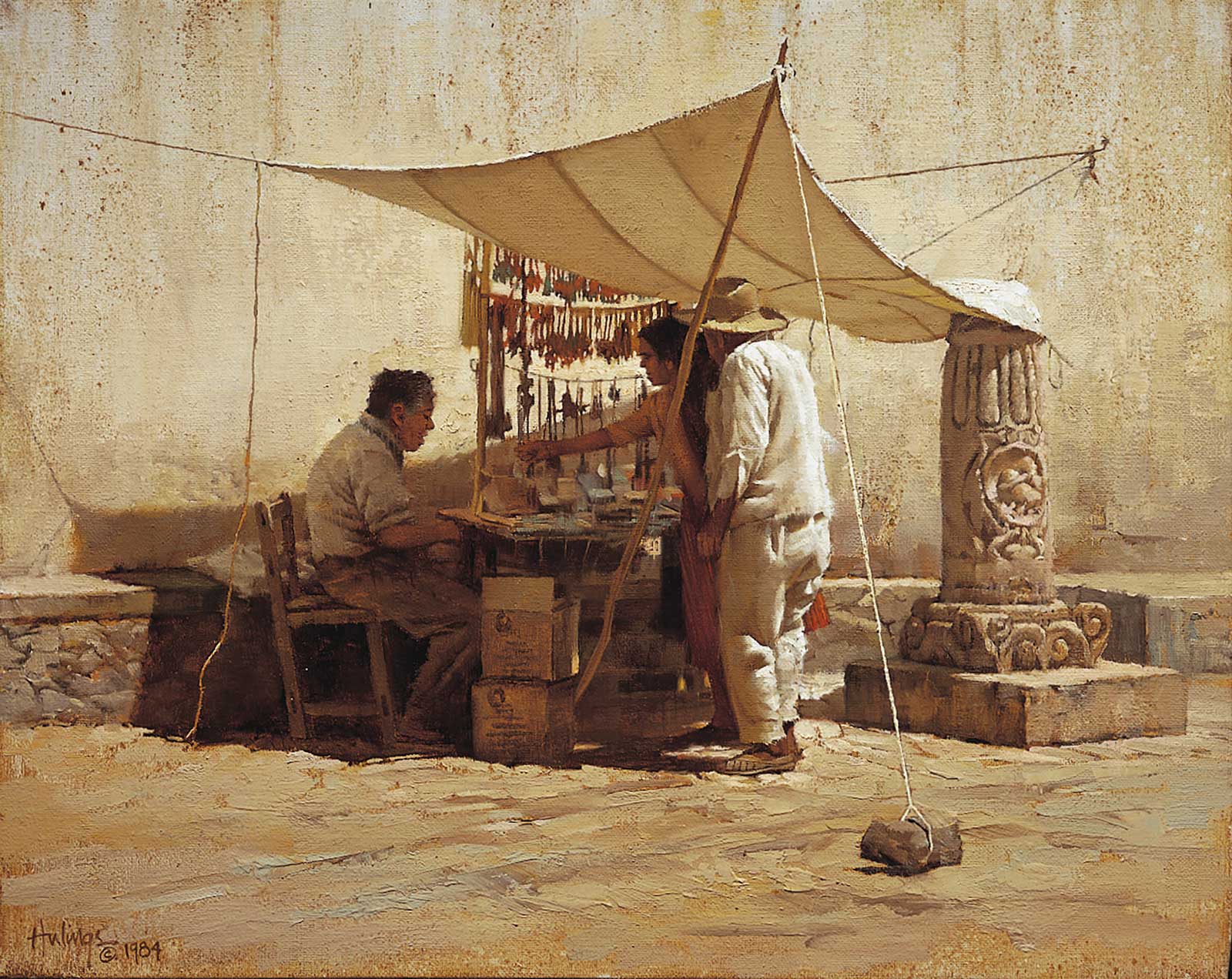 Clark Hulings (1922-2011), Mexican Rosary Man, 1984. Oil on canvas, 16 x 20 in.
Hulings’ compositions present; they do not judge or inspire judgement. Despite their manifold and manifest beauties, they—meaning the paintings themselves as well as their subjects—are utterly indifferent to the eyes of those who look at them. Even when Hulings’ villages, markets and mission bustle with activity, they depict cultures so old that they blur the edges between culture and nature. His paintings are mosaics—and also stained glass—but imagine mosaics cracked by time, with vines and weeds growing up through them, nature entwining culture, portrait entangled with landscape, held suspended in a hybrid form that has become something that is neither tile nor vine, something new, beyond both, that partakes of both.
What does the real work of a painting? What is the ultimate tile in the mosaic, the armature of the artist’s art? What’s the nature under the culture?
The canvas. The woven canvas. The canvas woven of harvested natural fibers: cotton, linen, hemp.
You see quite a bit of canvas in Clark Hulings’ paintings. Not the canvas beneath the painting, but canvases—tarpaulins—as objects depicted in his paintings, especially in his marketplace scenes.
Hulings wrote, “I must confess to an undying gratitude for tarpaulins. To the vendors who use them, they are protection from the glare and heat of the sun. To me, they are excellent ploys to be used in composing pictures.”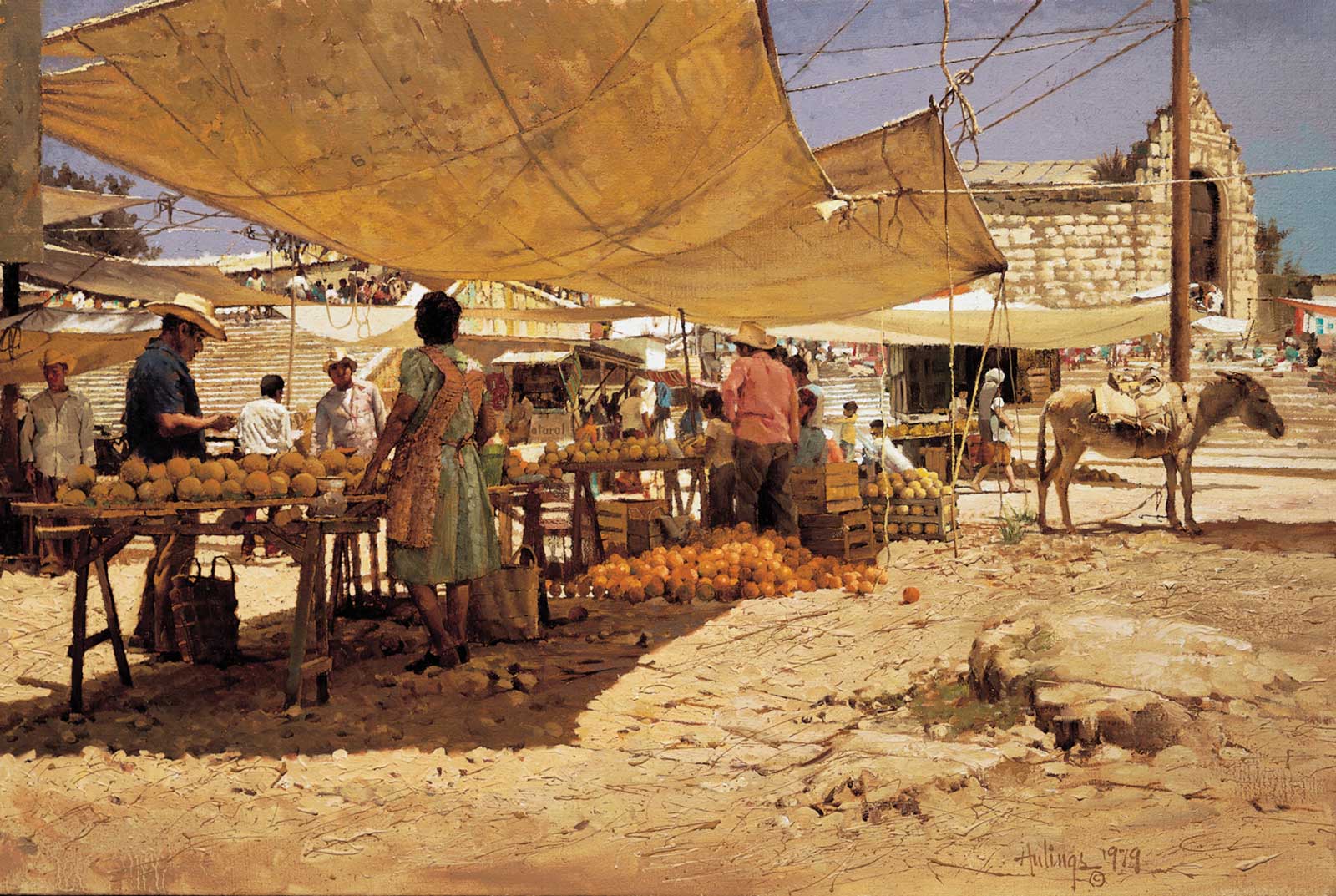 Clark Hulings (1922-2011), The Melon Stand, 1979. Oil on canvas, 20 x 30 in.
The tarpaulin works, just as a sail or an artist’s canvas works. All three are stretched, tied off, anchored. The tarp and the sail bow to gravity and billow in the wind. The tarp—or awning—protects, shields and contains. The sail moves the boat from A to B. Both have a job to do.
In a painting, conversely, the canvas is stretched until it cannot bow, until it cries out like a felon on the rack. It is taut, containing the painting, limiting it through its own limits. The colors applied to its surfaces reflect and refract light. But the sail and tarp are always themselves. Unless the canvas is the point of the artwork—take Lucio Fontana’s slashed canvases, for instance—the artist’s canvas serves the artist by disappearing beneath the painting.
Hulings specifies “…a tarpaulin can also act simply as a necessary empty space in a very busy picture… It can also provide linear perspective to guide your eye back into the distance.”
Tarps, as Hulings understands them, displace and enliven negative space, guide the eye, and add color and light through their translucency. Tarps are paintings within the paintings, utilitarian objects, objects that Hulings repurposes when he deploys them on his own canvases in a kind of meta-aesthetic upcycling.
Tarps, and their “canvasness,” also connect Hulings’ art to the work done by the farmers. Farmers harvest fruits, vegetables and flowers, from rural soil, and arrange them under canvases in city and village squares; Hulings harvests images from this soil and these squares and arranges them on his canvases. His paintings are then arranged once again, displayed for the delectation of viewers’ and buyers’ eyes.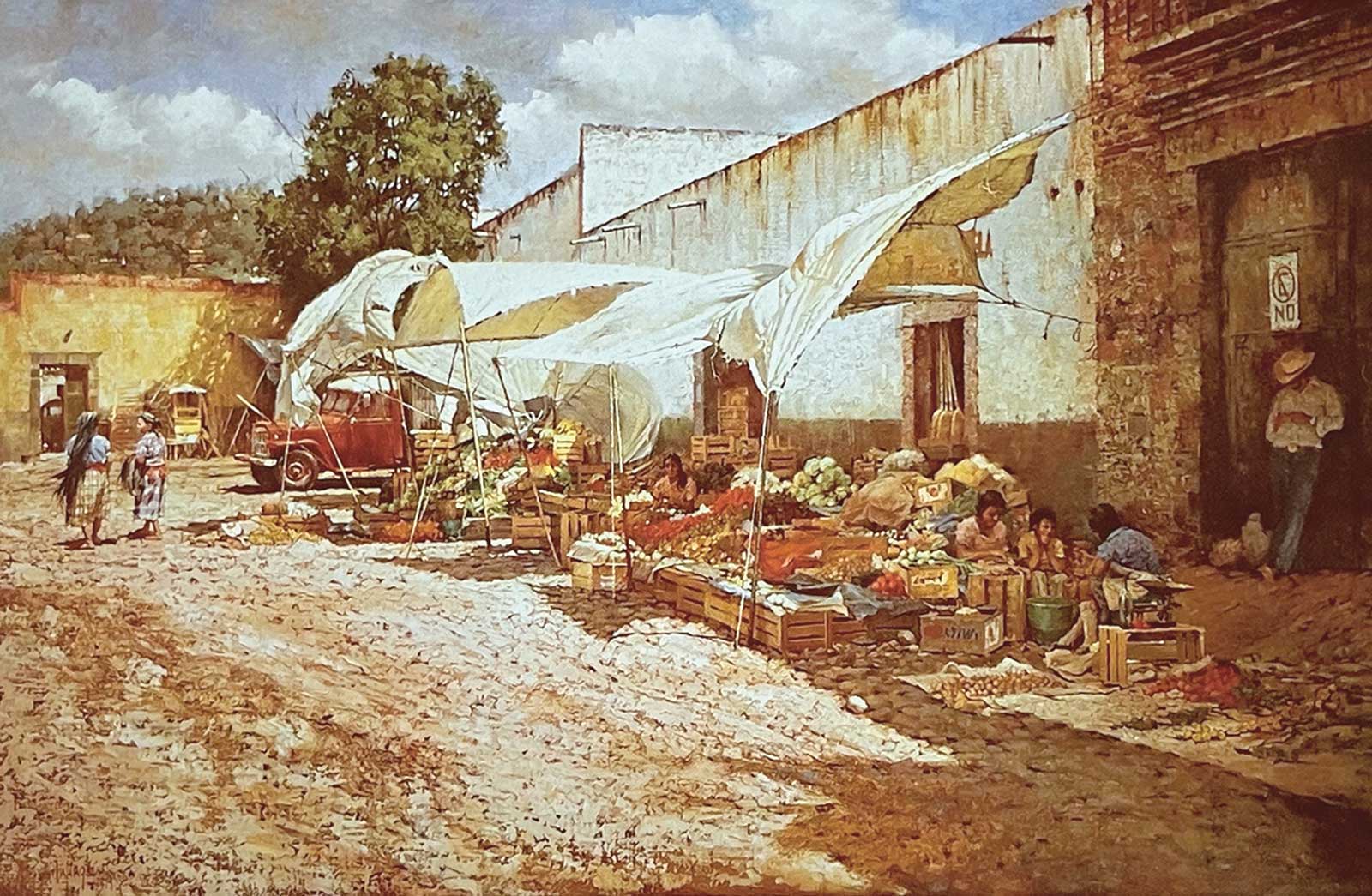 Clark Hulings (1922-2011), Windy Market Day, 1979. Oil on canvas, 32 x 46 in.
The artist is always like the flower and fruit seller, setting up in the shadow of patronage, whether patronage means the church, the state, or the corporation. The artist’s studio, the gallery, and, later, the auction room, are stalls in a market, with the paintings as hand-cut flowers and hand-picked fruits—the ripest, the best, the most enticing. I think Hulings saw himself in these small farmer-vendors, offering the fruits and flowers from the garden of his eye and imagination to passersby.
I think Clark Hulings saw himself as a laborer in the field of art.
What Hulings achieves then, is something unusual and perhaps unique among painters who have made the labor of the soil and village life their subject: he has, in effect, inserted his work into the wheel of seasons of growth and decay, into expressions of youth and old age, as they cycle through seasons and generations, differently yet congruently, in country cultures around the world. He succeeds because he paints these people and places unsentimentally, without the conventions of conservative nostalgias for lost Edens and simpler, golden ages.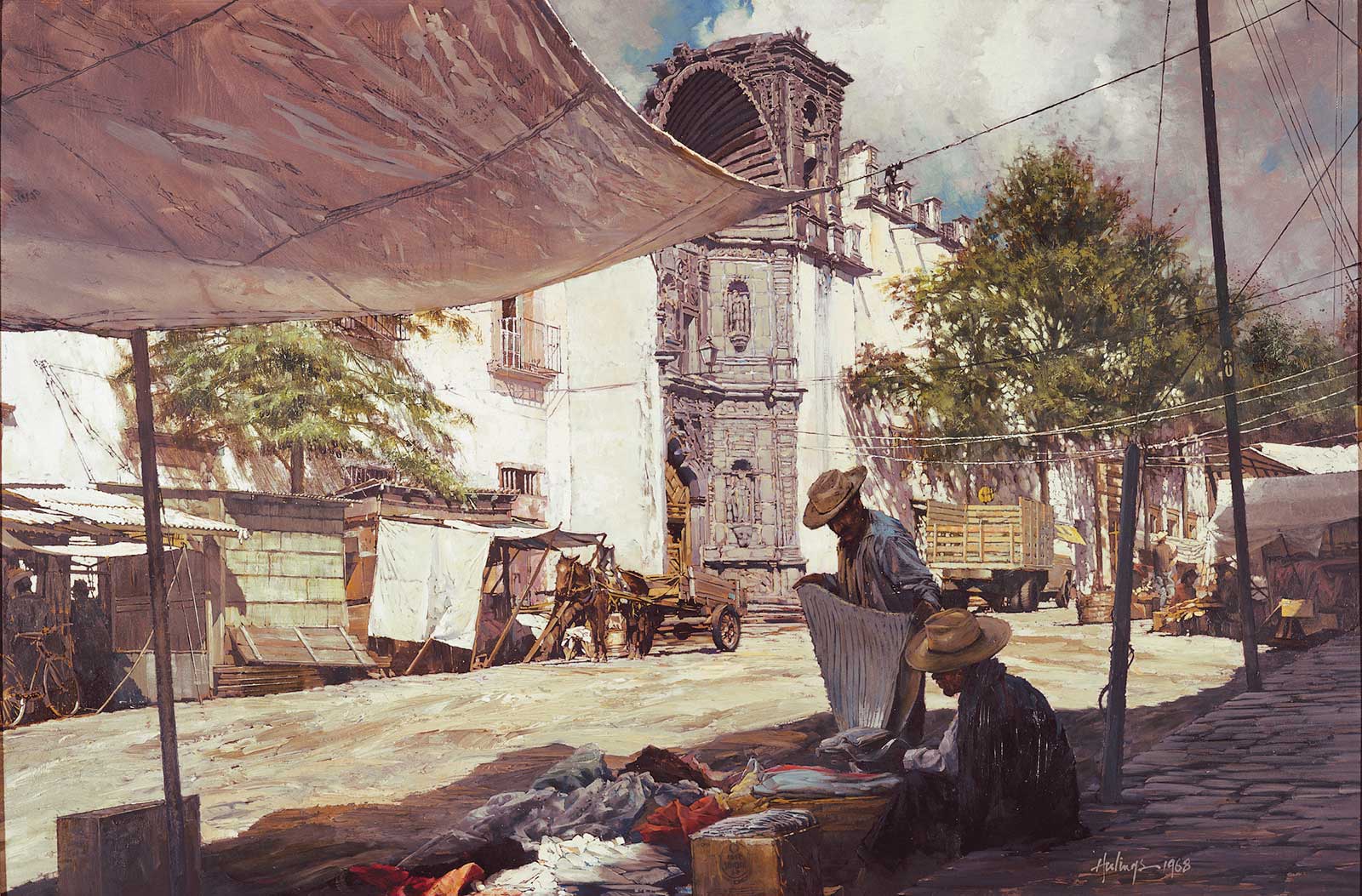 Clark Hulings (1922-2011), Cloth Vendors, 1968. Oil on canvas, 24 x 36 in.
It’s hard to imagine a busy, bright painting like The Melon Stand as a blank canvas, a blank slate or tile, yet, though dozens of figures people the painting, you would be hard pressed to pinpoint any emotion, or to say, “Hulings means this or that.” Apart from the woman walking at right, absolute stillness—the stillness of late morning or early afternoon—permeates the painting, yet the paint moves and moves, stroke upon stroke, finding the straw in the plaza—the same straw that made the bricks in the mission—finding the wrinkles in shirts and aprons, finding the seams in the tarps that provide shade even as they let light in and onto the melons and the stand. On the steps, peeking above and around the strung canvas, Hulings’ use of the tarp to “provide linear perspective” creates the illusion in the viewer of looking around and through, craning to discern the large groups of people lounging in and out of the sun.
But the ropes, those taut ropes webbing the top and right of the painting, dividing foreground from background—you want to say something about them, find some meaning in them, especially in the narrow triangle of ropes that just happens to contain the walking woman. Her own shadow makes the third side of the triangle; a slack rope bisects her. Is this the web of life in the village, held together by ropes straining against the 20th century or is the web a metaphor for village life as a trap? Nothing gives this away. The ropes and tarps are temporary expedients—they’ll be gone in a few hours, or by the next day—and the triangle that traps the walking woman is an accident, a moment of arrangement Hulings may have noticed and photographed, or a detail he added later. The ropes are to the market in the painting as they are to the painting itself; they are akin to the tacks that hold the canvas to the stretcher, indifferent perhaps, but where would the painting be without them? Hulings himself sums this up nicely in his observation on another work, Windy Market Day, “The main actor in this scene was surely the wind.” In fact, you might say that in this painting the wind directs the tarps to play the part of, to act as sails on a static, though temporary and provisional, market stage.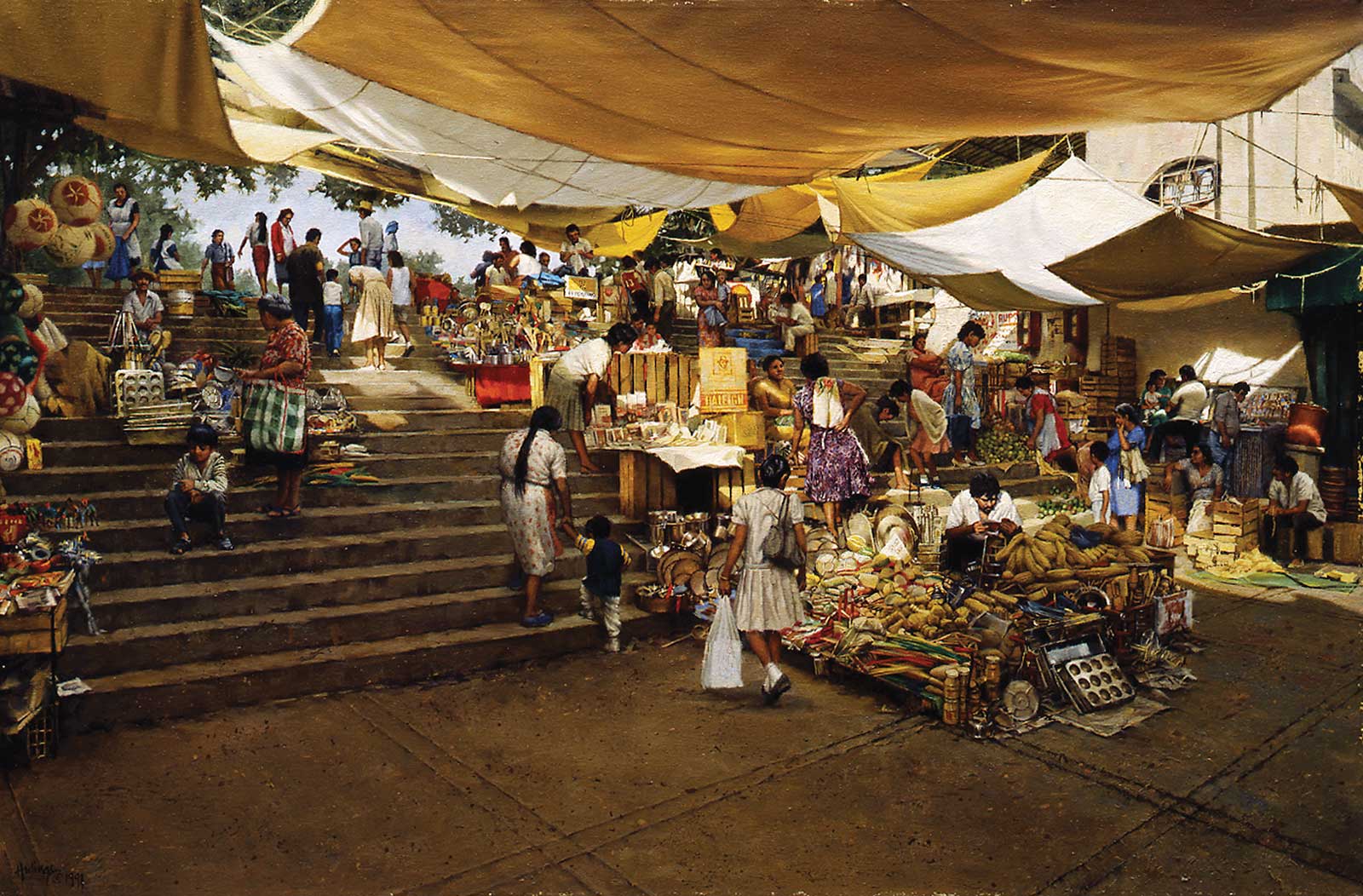 Clark Hulings (1922-2011), Cuernavaca Steps - Hardware Market, 1991. Oil on canvas, 29 x 44 in.
Market stalls in the shadow of cathedrals, mosques, and in the civic solidity of neighborhood squares are cyclical moments of exchange. In the modern city, where spiritual life survives under the footings of great monuments, not to God or Nature, but to commerce, the greenmarkets and farmers’ markets spring up in the shadows of the edifices of capital, in civic spaces like Rockefeller Center that connote the generosity and civic-mindedness of the corporation. See what we have set aside for you! You
can be cynical about this largess—
I imagine Hulings was, at times—but it is a fact. Corporate sponsorship of the arts displaced church and state in large measure. In an art humanities course at Columbia University, Dr. Michael Marrinan tasked my class to find and write about a building in New York City. I wandered until I found the then-new Citicorp building at the corner of 53rd and Lexington. St. Peter’s Evangelical Lutheran Church occupied a small corner of the skyscraper. For some reason, I looked down, rather than up, and found myself looking through glass onto the church itself, onto the sanctuary and the rows of pews. It is a beautiful, modern place of worship, all blond wood and shaped something like a canoe, a Dantean bark of spirituality bobbing on the tempests of existence. But where the market once grew beside the landmark solidity of the church, here the church huddled beside and under the sleek, towering monument to business, all steeple and no bell other than the one on Wall Street that rings at 9:00 and 4:00, Monday through Friday. In the basement of the church, the excellent York Theatre presides, but the pecking order is apparent: commerce atop faith atop art.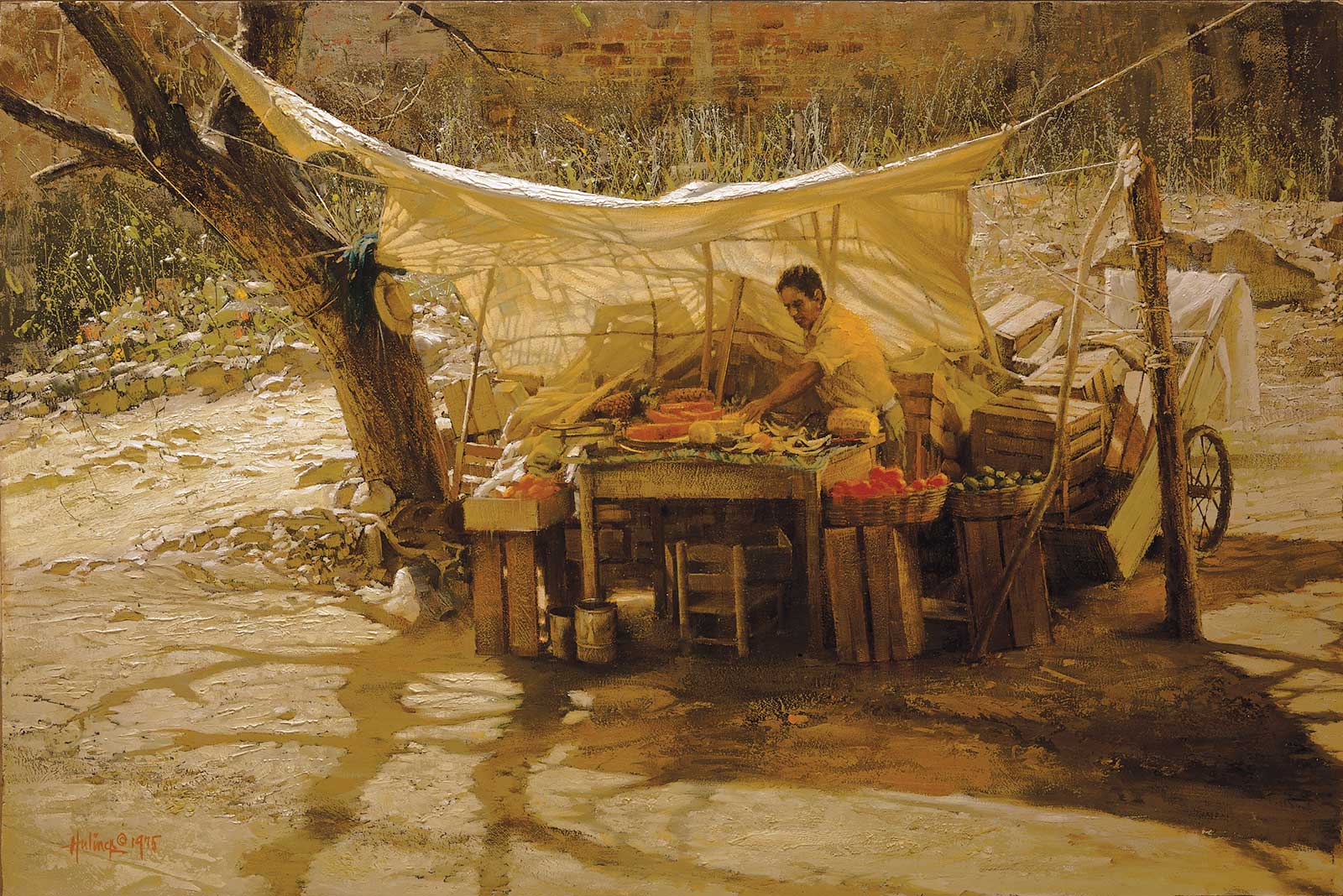 Clark Hulings (1922-2011), Chapala Fruit Vendor, 1975. Oil on canvas, 18 x 27 in.
One of Hulings’ most fascinating tarpaulin scenes is a 16-by-20 vignette, The Mexican Rosary Man. Right after the artist’s confession of gratitude for tarpaulins, he describes this painting in matter-of-fact terms: “The old Indian is selling religious articles to people visiting the church. The stone pillar is a remnant of the Mixtec temple that once served his ancestors. He uses it as an anchor for his tarpaulin.” What an extraordinary statement! Here is a man, whose distant ancestors would have worshipped at the Mixtec temple that once stood here, selling rosaries, medallions, and other articles of a faith, Catholicism, that some of his distant forebears were no doubt compelled to convert to. He sells them beside the church that sits on the ruin of the temple, tying the tarp that shields him from the sun to the ruined pillar of a faith no longer followed, a faith and way of life already forgotten, even as this scene itself, painted in the sepia tones of a faded photograph, seems to be vanishing into yet another antiquity.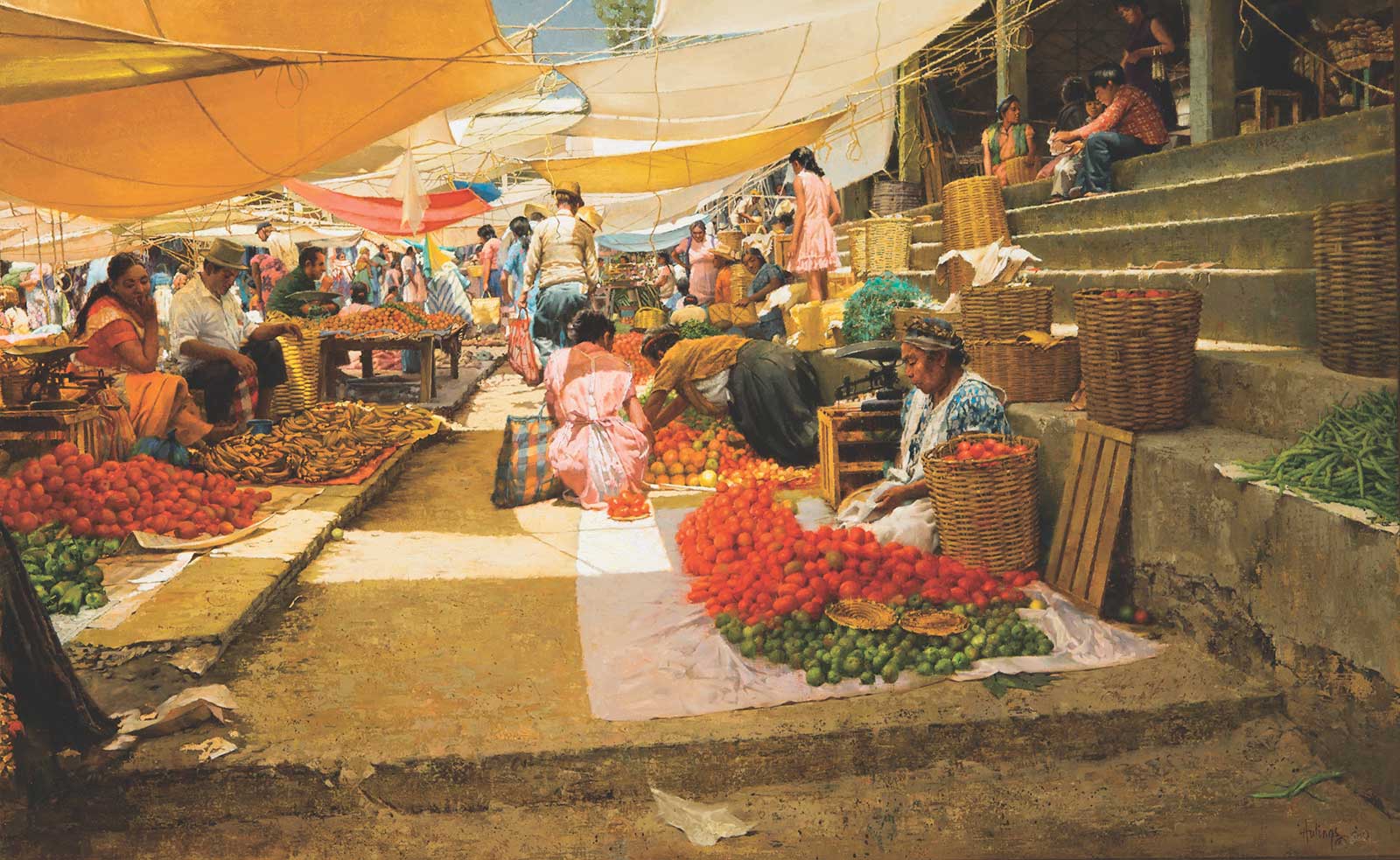 Clark Hulings (1922-2011), Kaleidoscope, 1980. Oil on canvas, 29 x 46 in.
The stretched ropes, the broken pillar, and the precarious pole hold the tarp up, but all of it—and the entire painting—is counterweighted by the rock at lower right and the rope tied to it. This rock. Is it a fragment of the crumbled temple whose stones may have been repurposed to build the church, a church, perhaps, now itself beginning to crumble? For the moment, in the moment, the rosary man is deep in bargaining—commerce. For the moment, the order seems to be faith atop commerce atop art—the folk artistry of the rosaries and what remains of the elegant Mixtec carving. None of this matters to the rosary man. He is as indifferent to history as the pillar and its unworshipped but not quite vanished gods, as indifferent as the rock is to time on any human scale. Nothing matters but today, this moment, the sale. Life sails on, as does the market, as does art.
James D. Balestrieri is the proprietor of Balestrieri Fine Arts, specializing in arts consulting, sales, research and writing. He is currently the writer-in-residence for the Clark Hulings Foundation, as well as estate and collections consultant for The Couse Foundation and communications manager for Western Spirit: Scottsdale’s Museum of the West. He was director of J.N. Bartfield Galleries for 20 years, worked with the Scottsdale Art Auction for 15 years and has written over 150 essays for various art publications.—
Powered by Froala Editor