“Among mountains… large unbroken spaces of pure violet and purple are introduced in their distances: and even near, by films of cloud passing over the darkness of ravines or forests, blues are produced of the most subtle tenderness; these azures and purples passing into rose-colour of otherwise wholly unattainable delicacy among the upper summits, the blue of the sky being at the same time purer and deeper than in the plains. …In some sense, a person who has never seen the rose-colour of the rays of dawn crossing a blue mountain twelve or fifteen miles away, can hardly be said to know what tenderness in colour means at all… this grave tenderness of the far-away hill-purples he cannot conceive.” —John Ruskin, The Mountain Glory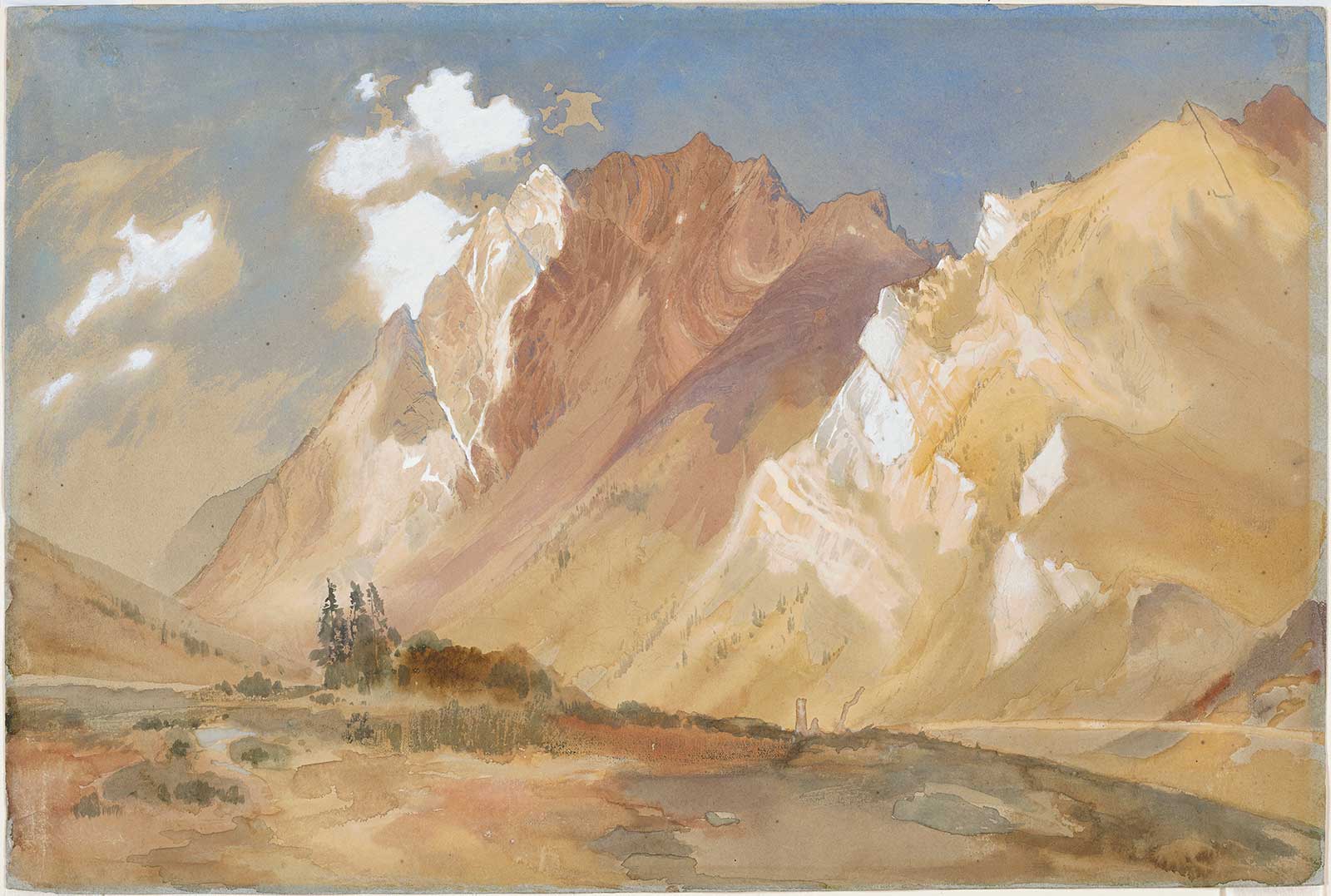 Thomas Moran (1837-1926), Mount Superior, as viewed from Alta, Little Cottonwood, Utah, 1879. Watercolor and graphite on paper. Amon Carter Museum of American Art, Fort Worth, TX, 2020.1.Imagine John Ruskin, the grand old man of arts, holding Mount Superior, as viewed from Alta, Little Cottonwood Canyon, Utah in his hand. Imagine him taking the watercolor in, noting the whites of the clouds, of the snow in the mountain fissures, and in the banded rock that looks, from a distance, like the crests of stilled waves. Imagine him going through the Rolodex of quotes like the one cited that recur like wishes in his writings, speeches and in his own art. In his mind he must have said, “Someone listened. They heard me.”
It’s possible that Ruskin purchased Mount Superior from Moran or that someone purchased it for him in the early 1880s, when Moran returned to his native Britain to exhibit his work, but the story is better when I envision it as a gift, Moran’s token of gratitude for Ruskin’s inspiration. What’s amazing is that Mount Superior left Ruskin’s hands, descended through his family, passed into private hands and, now, nearly a century and a half later, it finds its way into the collection of the Amon Carter Museum of American Art, where it will be on view as part of an exhibition of Moran material from August 28 through December 12, 2021—I trust that it will be on view permanently once the exhibition is over.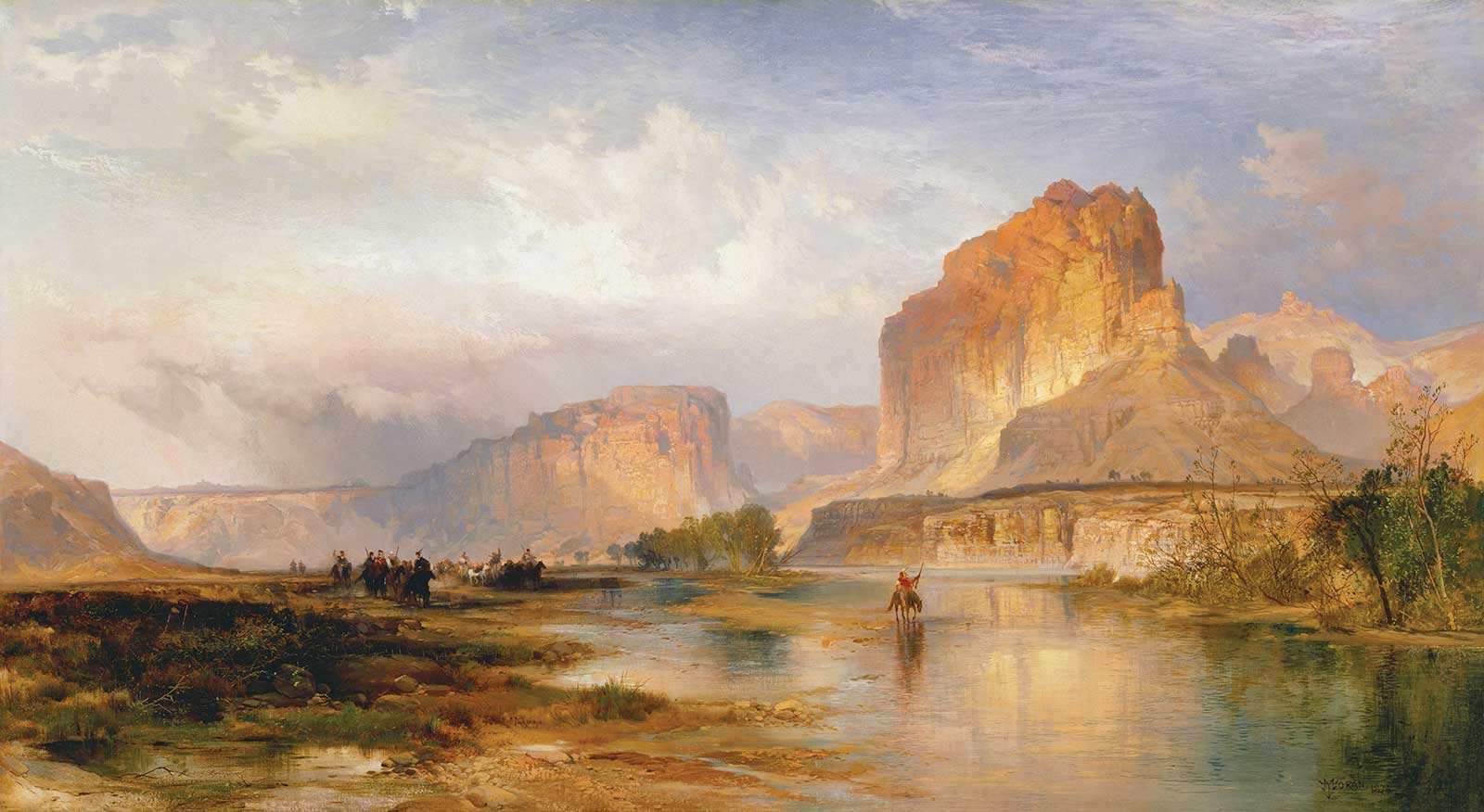 Thomas Moran (1837–1926), Cliffs of Green River, 1874. Oil on canvas. Amon Carter Museum of American Art, Fort Worth, TX, 1975.28.
It’s hard to sum up a giant like Ruskin (1819-1900). His work and interests embrace the glories of the natural world, the effects of industrialization and capitalism, and the responsibility of art and beauty to respond to these. Science, art, economy and culture are all intertwined in Ruskin. In effect, he creates art history and cultural criticism in the English-speaking world. Ruskin championed the works of J.M.W. Turner, who ushers modernity into landscape painting and becomes one of the principal artistic models for Moran. Toward the end of his life, Ruskin becomes one of the founders of the Pre-Raphaelite movement, which advocated a reaction against machine-made, urban modernity and a return to handcrafted, village life. From Tennyson to Tolkien, Ruskin’s observations and philosophy shimmer through.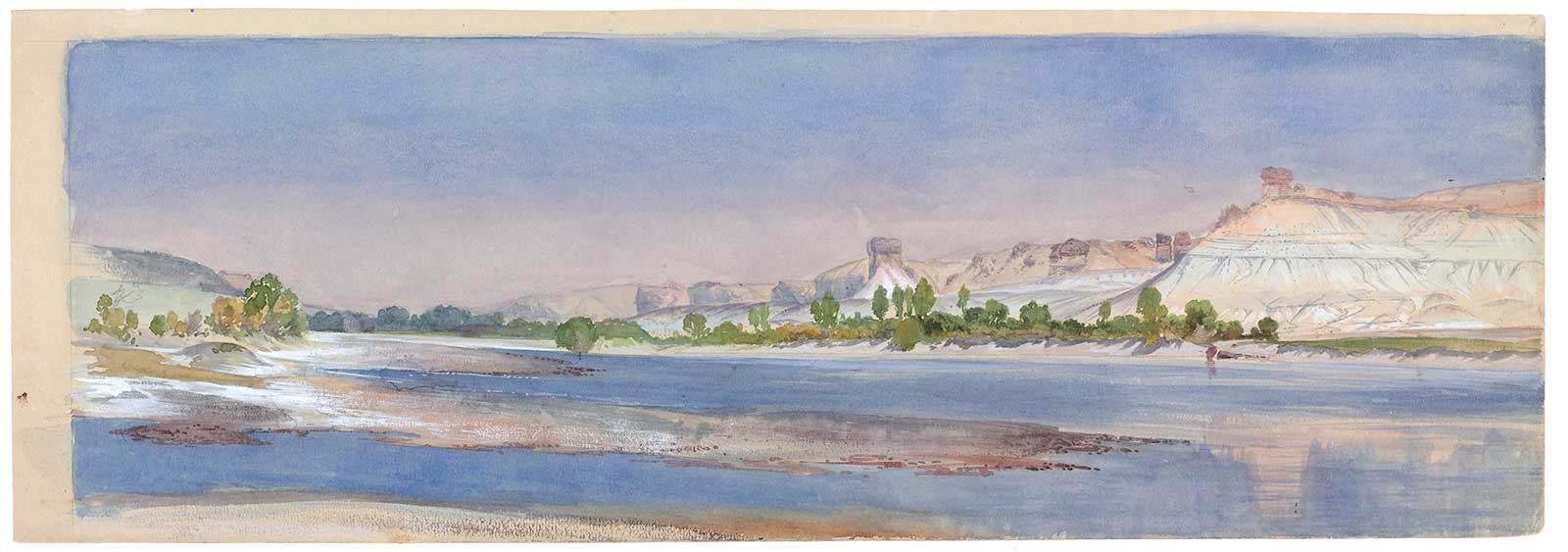 Peter Moran (1841–1914), Cliffs Along the Green River, 1879. Transparent and opaque watercolor and graphite on tan paper. Amon Carter Museum of American Art, Fort Worth, TX, 1965.82.
Wisely, and with a sense of the irony of the situation, the exhibition at the Amon Carter locates Mount Superior in its times and in Moran’s artistic practice. Surrounded by photographs, etchings and drawings, not only by Moran, but also by his wife, Mary, and brother, Peter, the exhibition reminds us that it was the transcontinental railroad that brought Moran to places like Mount Superior, and that the evidence of rapid modernization was often just outside the frame of the image, that is, if it had not been omitted altogether. Moran, like Ruskin, lived and traded in alternate histories, in wish fulfillments running alongside harsher realities. Moran’s celebrated Green River paintings, like the magnificent 1874 oil, Cliffs of Green River, in which a Native scout leads a large band of mounted men across the river, are products of the artist’s imagination. Moran almost certainly never saw Native Americans in Green River. By the time Moran got there, he had to crop out the bustling, ramshackle railroad town of Green River. Moran’s West isn’t the West of the “vanishing race” myth; it’s more properly a vanished West, or, perhaps, a West that never was outside of his artistic vision.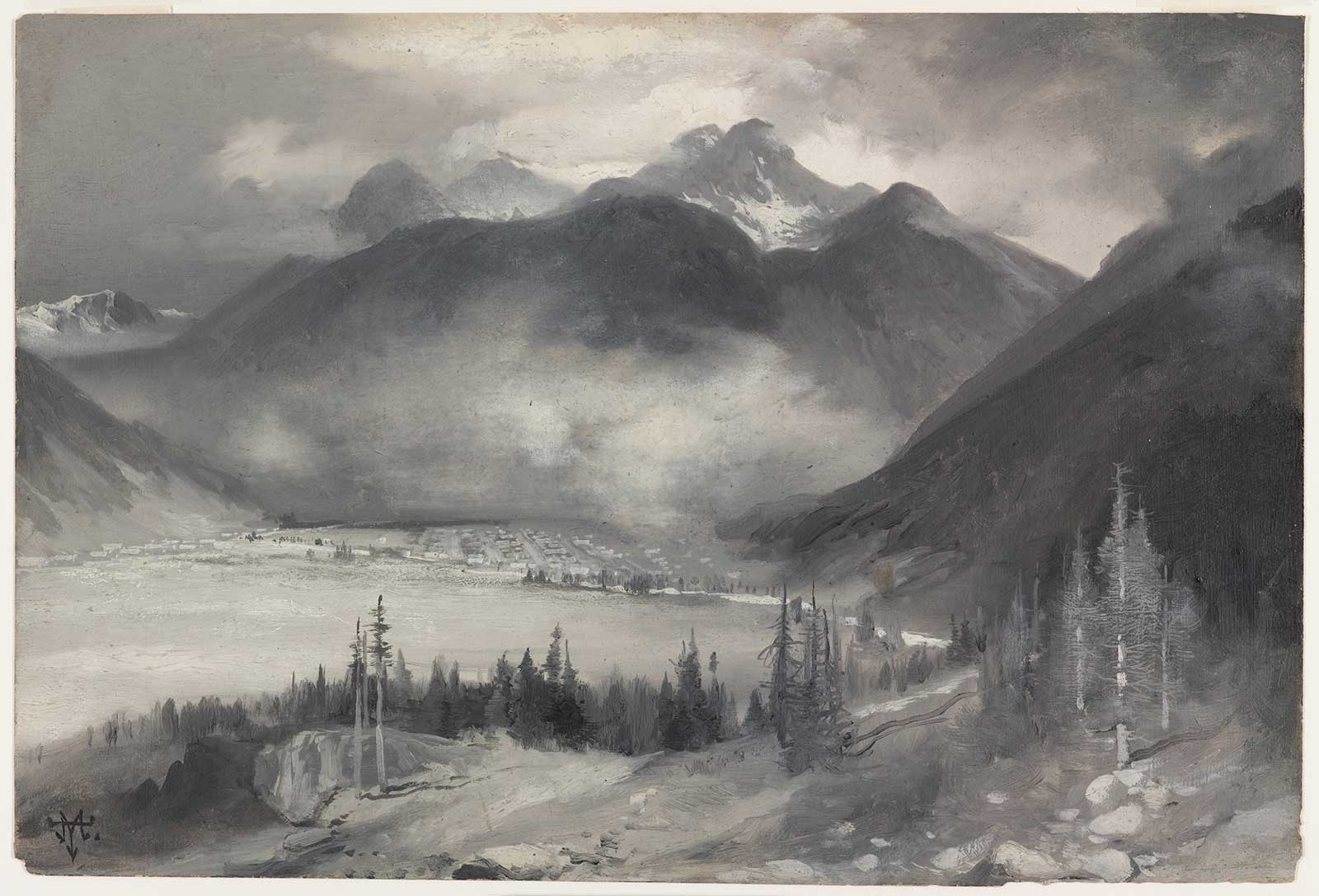 Thomas Moran (1837–1926), Silverton, Colorado, Bakers Park and Sultan Mountain. Opaque watercolor on paper. Amon Carter Museum of American Art, Fort Worth, TX, 1975.45.
But mythology is as central to history as the dates of battles. What we believe—and want to believe—guides us as often as truth, often with even greater force than truth, and often with detrimental effect. Manifest Destiny manifests destiny, but for whom, and at what cost? The ghosts that Moran adds as elements in some of his works, especially the major oils, articulate not the West that once was, but the West we might wish once was. That wish also shapes our view of the American West.
Sometimes, modernity finds its way into Moran’s work, as in the splendid Silverton, Colorado, Bakers Park and Sultan Mountain, a black-and-white watercolor wash heightened with opaque white that looks as if it must have been painted in plein air. Here, Moran returns to his roots in the Hudson River School, dwarfing the boom town in the grandeur of peaks and weather. Nature, Moran seems to say, may briefly shine her light on Silverton, but nature, in her own time—which can be a moment or an eon—will one day reclaim this place. Moran’s painting looks down on Silverton, as if from on high, with nature’s patient impassivity.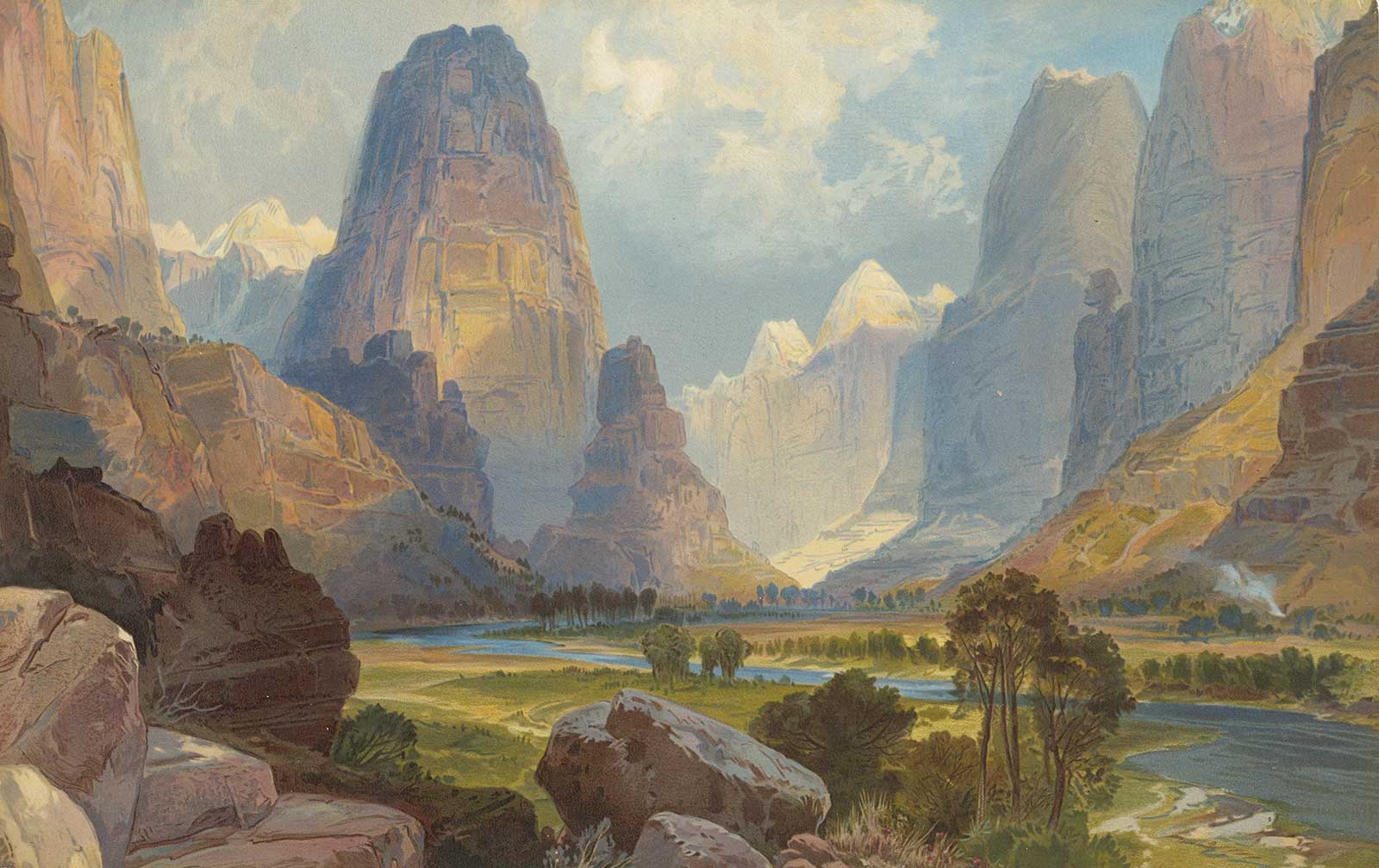 Thomas Moran (1837–1926), Valley of Babbling Waters, Southern Utah, 1876. Chromolithograph. Amon Carter Museum of American Art, Fort Worth, TX, 1971.59.3.
Otherworldliness in Moran’s imagery is amplified in the chromolithographs that the Prang Company prints from the artist’s renderings. In Valley of Babbling Waters, Southern Utah, and Hot Springs of Gardiner’s River, Yellowstone National Park, for instance, the lithographer’s sharpened lines and heightened colors send these scenes into the territory of fantasy and science fiction. That they helped stir the American public to create national parks is no accident. The three adventurers in Hot Springs of Gardiner’s River, Yellowstone National Park look like characters out of Jules Verne.
We’re beyond Ruskin now. Ruskin wanted us—and artists—to look at mountains, explore them, investigate them, understand how they were formed and then draw and paint them. For Ruskin, mountains are, and that suffices. For Moran, mountains must also mean.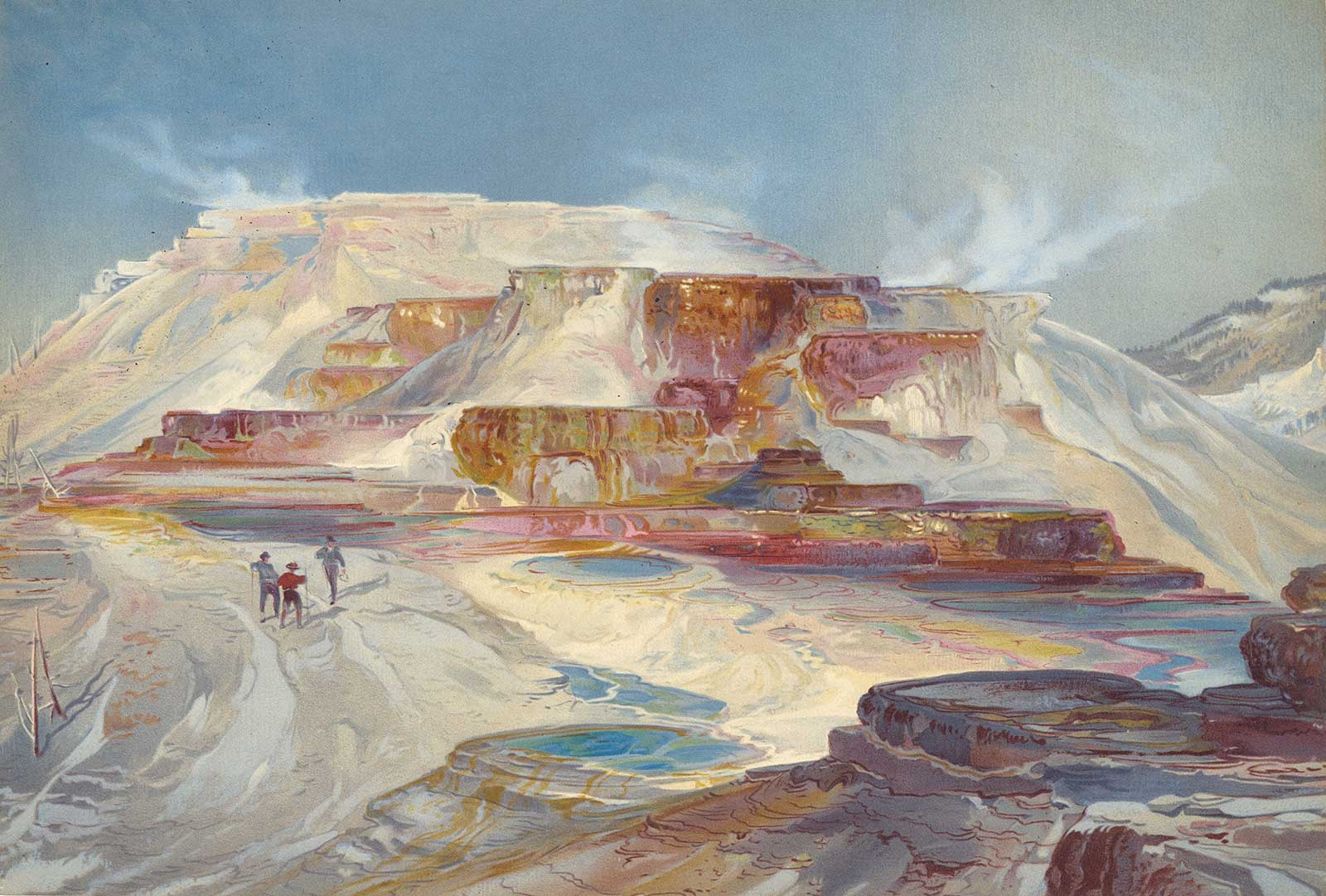 Thomas Moran (1837–1926), Hot Springs of Gardiner’s River, Yellowstone National Park, 1875. Chromolithograph. Amon Carter Museum of American Art, Fort Worth, TX, 1971.59.14.
The railroad and the development that accompanied it bear Moran to Utah in 1879, when he paints Mount Superior. I did a quick 3-D Google Earth search, just to see where Mount Superior is and get some idea of how it looks now. Where Moran’s set up to paint the Mount Superior watercolor, is approximately where a hotel stands today. One wonders whether the beautiful view of the mountain, as he took it in and decided to paint it, might not have been right outside his inn door on that day.
What would Ruskin have loved about Mount Superior, as viewed from Alta, Little Cottonwood Canyon, Utah, a painting of a place he never saw and would never see?
First, he would have been drawn to the horseshoe of folded red rock (iron-rich pre-Cambrian strata according to my reading) near the top center of the watercolor. Ruskin imagined, and was among the first to intuit, as Robert Macfarlane writes in Mountains of the Mind, that “mountain ranges, like hydraulic waves, were prone to motion. They had been cast up by colossal forces, and were still being moved by them.” He would have loved the purple shadow on the rounded peak beside the folded strata and would have imagined it moving across the shapes of the rock. He would have loved the framing of the red and purple with the white of clouds, snow, and banded rock, and might have smiled as he wondered whether Moran had caught a happy accident of moment or composed the scene after regarding it over hours or days. He would have loved the pines and the dark umber smudge of rock, almost calligraphic and Asian in execution, swift, unlabored and perfect, and the echoes of trees up the slopes, grace notes to the mountains. Ruskin would have loved the sensation of wind in the clouds and the overall impression that Moran put just enough in and left just enough out, something he stressed in his writing.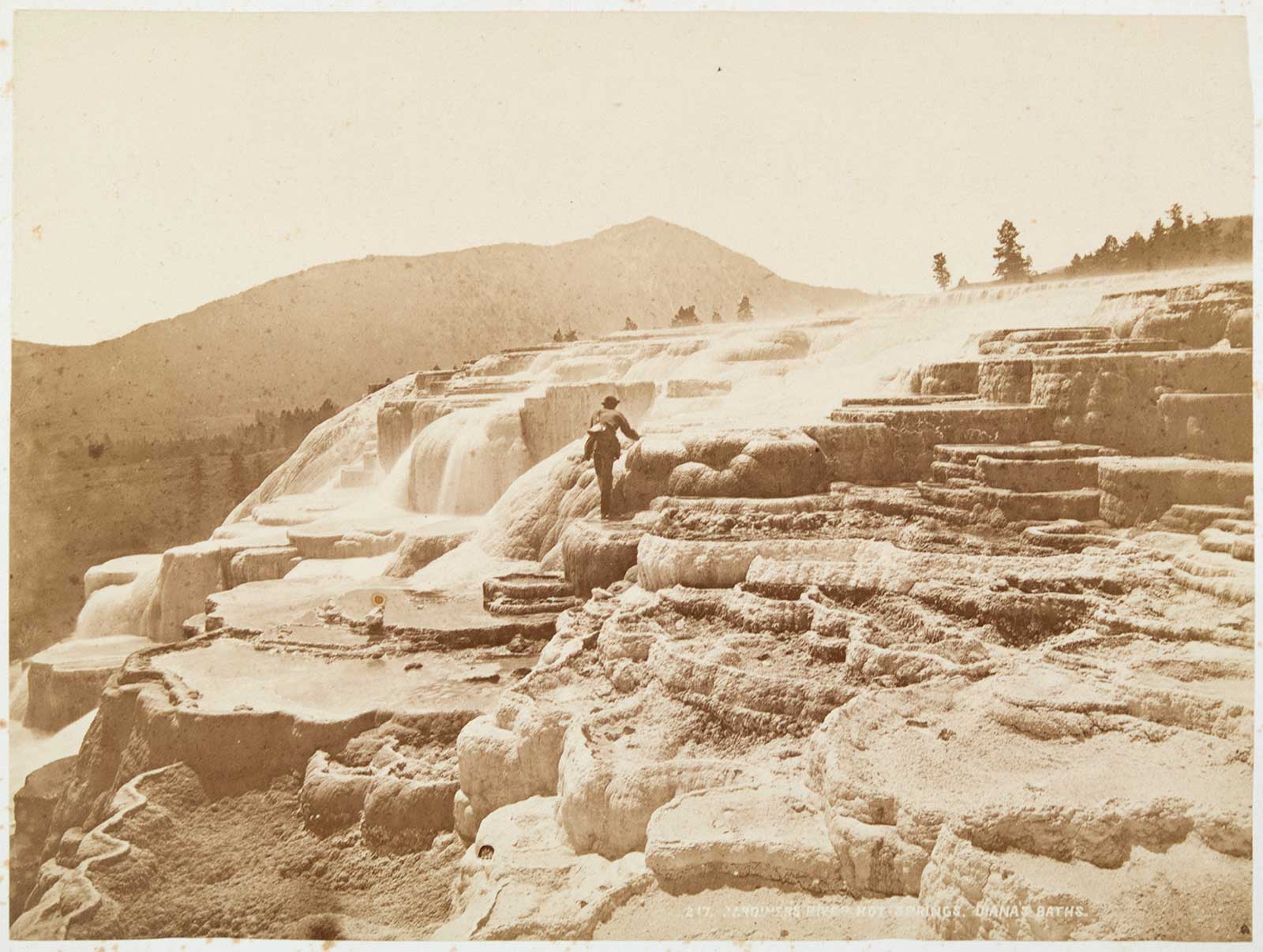 William Henry Jackson (1843–1942), Gardiner’s River Hot Springs. Diana’s Baths, 1871. Albumen silver print. Amon Carter Museum of American Art, Fort Worth, TX. Gift of James Maroney, Inc., New York, NY, P1980.17.
What to leave in; what to leave out. When to start painting, when to keep painting, when to stop. With Ruskin in his ear, Moran must have asked himself these questions a thousand times a day. For Ruskin, they are also questions to be asked of society, questions about progress, about modernity. For us now, they are also questions about technology, about communication. Artists can try to crop them out and sometimes even succeed. But they have a way of cropping up. What does it say; what does it mean, when you have to mount a visual campaign—a marketing campaign, really—to make sure that some part of the wilderness of the West is set aside? How wild can it be once it is circumscribed? And when the national parks are traffic jams of cars and hikers, all thirsting for some experience of the natural world, what does that say and mean? Thomas Moran’s brooding mountains, moving and changing on scales of time beyond our imagining, seem keenly and intimately interested in our answers to these questions. —
Thomas Moran: Mount Superior
August 28-December 12
Amon Carter Museum of American Art
3501 Camp Bowie Boulevard, Fort Worth, TX 76107
t: (817) 738-1933, www.cartermuseum.org
Powered by Froala Editor