In the 1930s, Ralston Crawford was a young precisionist in the vein of Charles Demuth and Charles Sheeler, whose works glorified the advancement of industry, engineering and technology. But upon the outbreak of World War II, Crawford enlisted in the U.S. Army, which nudged him ever so slightly off that course. By the end of the war, and in the years immediately following, Crawford would draw from his war-time experiences to break those fine precisionist lines and examine the chaos that the war had caused. 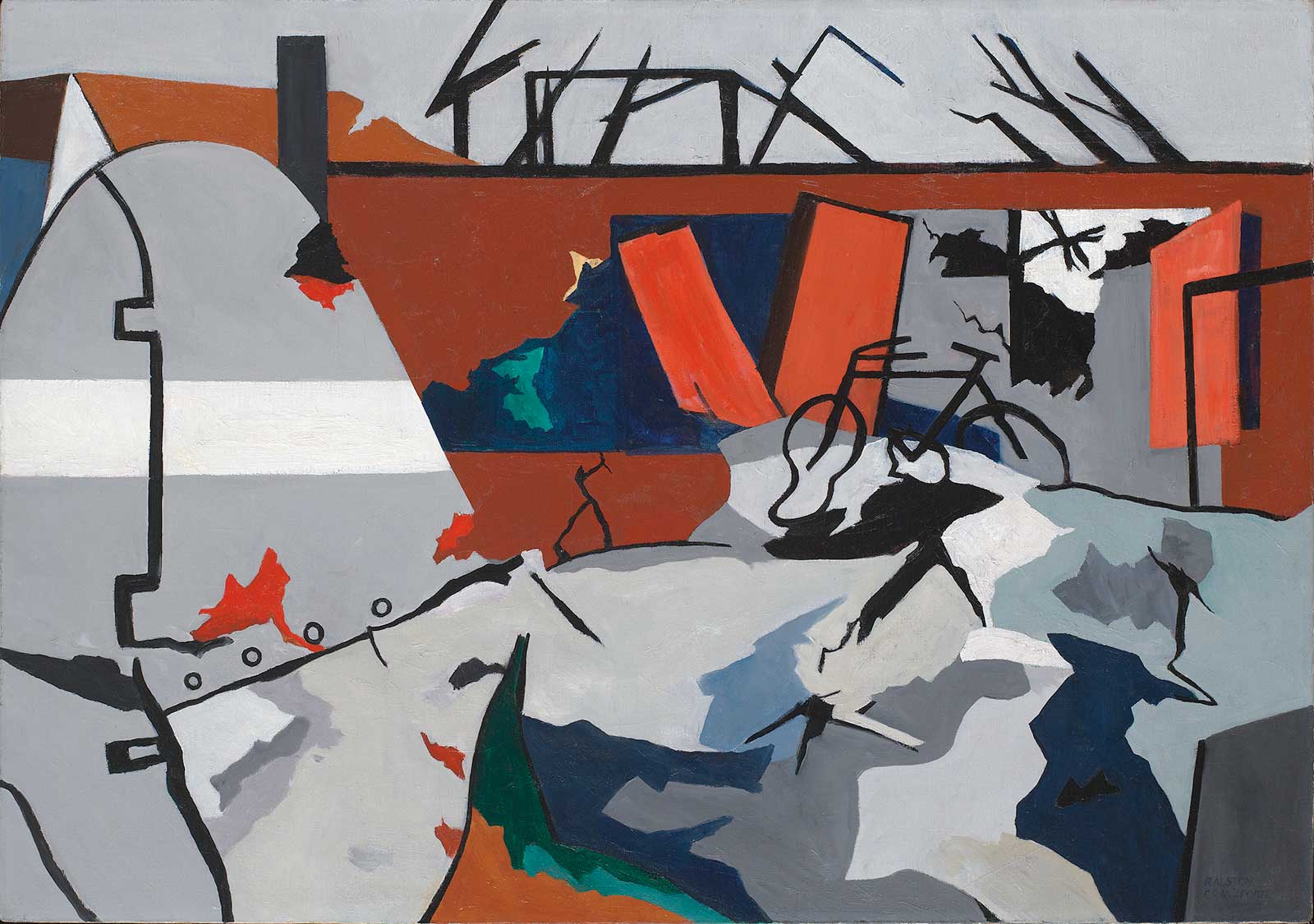 Ralston Crawford (1906-1978), Bomber, 1944. Oil on canvas, 28 x 40 in. Vilcek Collection, VF2016.03.02.
This fascinating period of one of America’s lesser-known greats is the basis for Ralston Crawford: Air + Space + War, a new exhibition opening June 20 at the Brandywine River Museum of Art in Chadds Ford, Pennsylvania. The exhibition, which will feature nearly 80 works by the artist, is being organized by the Vilcek Foundation and includes contributions from John Crawford, one of the artist’s sons.
“Ralston Crawford was probably best known for his early 1930s precisionist scenes of bridges and barns. They are exceptional pieces, and they are what most people would say are quintessential Ralston Crawford works. They celebrated industry and showed the progress occurring within the country,” says Emily Schuchardt Navratil, curator for the Vilcek Foundation. “Lesser known were his war works, which should make this exhibition interesting for many who may not be familiar with the artist or this period of his life.”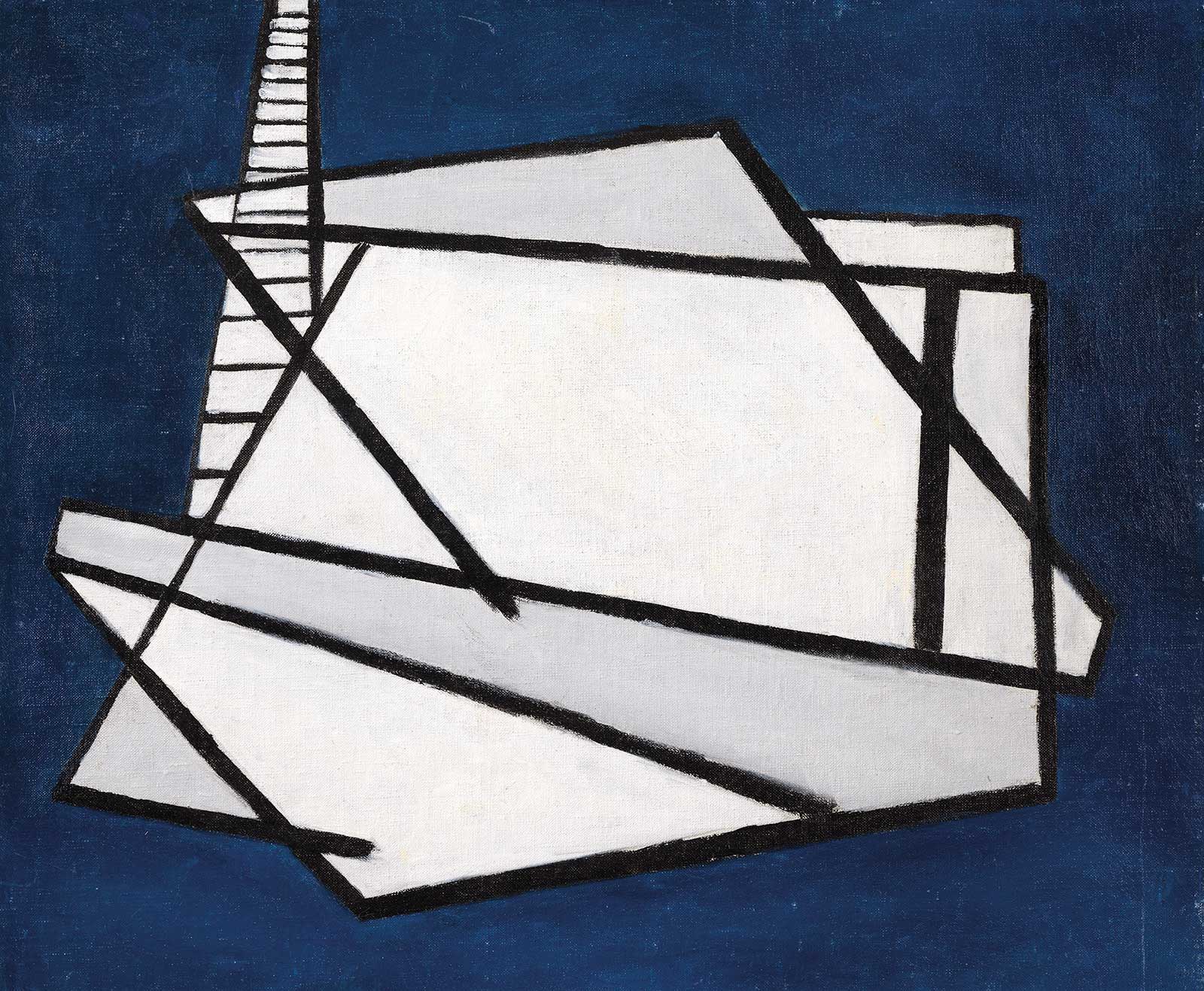 Ralston Crawford (1906-1978), Untitled (Blue and White), 1938. Oil on canvas, 201/8 x 241/8 in. Collection of John Crawford.
Crawford’s military service begins in 1942 after being drafted into the Army. He would flunk an eye test, but he would still end up working on the development of large-scale camouflage as part of the 603rd Engineer Camouflage Battalion. The battalion, sometimes called the Ghost Army, was part of a military deception on a grand scale. Later Crawford worked in the weather division in the Army Air Forces, where he would help develop a visual language known as weather infographics. Though he would never leave Washington, D.C., Crawford was exposed to an overwhelming amount of visual imagery as photographs poured into the War Department. “Crawford was deeply affected by these images, which more often than not depicted death and destruction,” writes Rick Kinsel in the exhibition catalog. “Perhaps as a way of processing some of what he was exposed to, he mined them for his own work: elements and sometimes entire scenes from photographs appear transformed by his hand in his paintings.”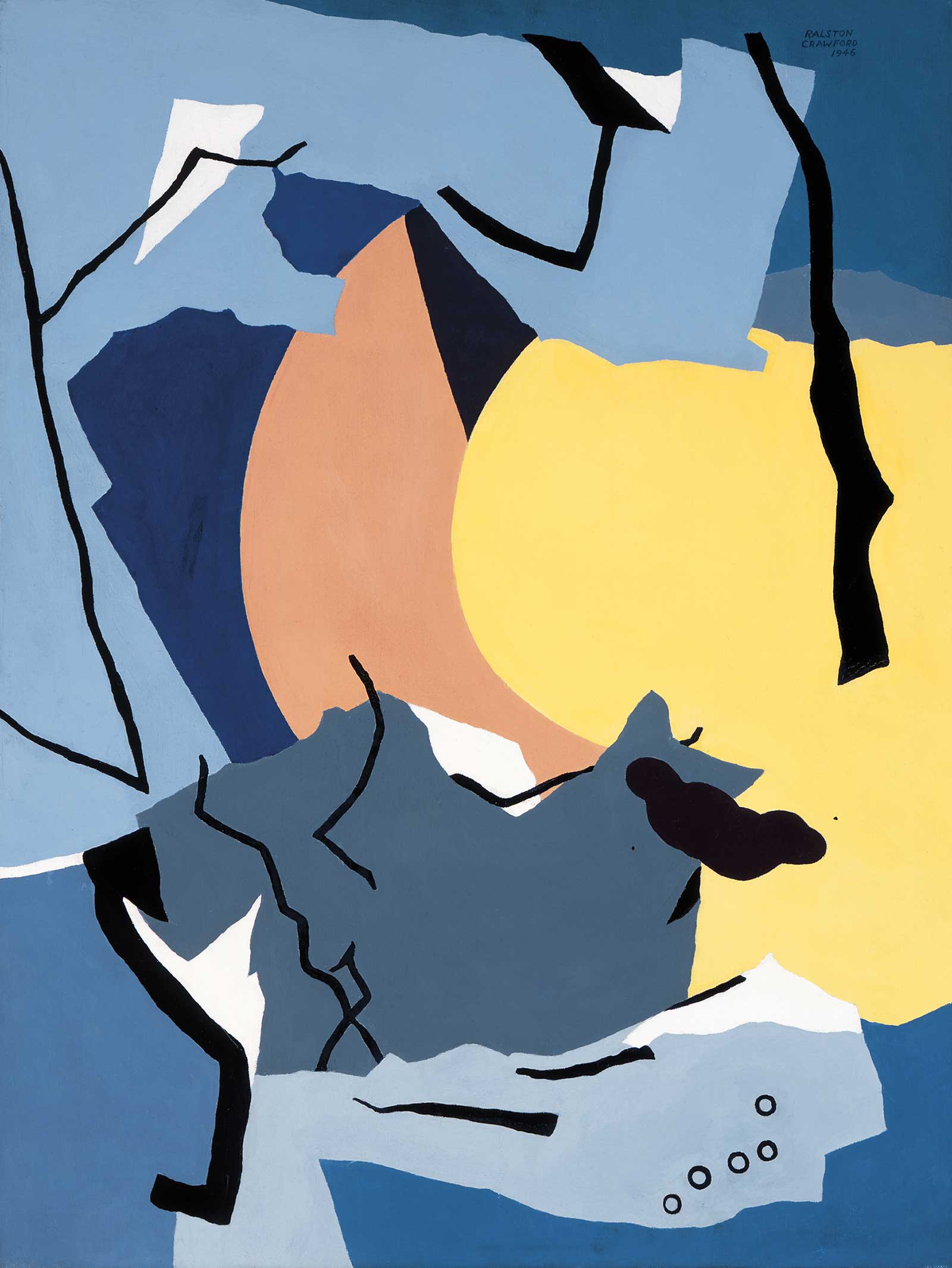 Ralston Crawford (1906-1978), Test Able, 1946. Oil on canvas, 235/8 x 175/8 in. Georgia Museum of Art, University of Georgia, Athens, Eva Underhill Holbrook Memorial Collection of American Art, Gift of Alfred H. Holbrook, GMOA 1946.140.
By the end of the war, Crawford’s clean precisionism had caved to full-blown abstraction, a chaotic mixture of bent metal and crumbled brick that showed the war’s terrible consequences. In one of the early pieces from this period, Bomber from 1944, the artist painted the wreckage of a P-47 Thunderbolt that had crashed into a home. The scene is a mangle of debris and destruction, and also death—the pilot died in the crash. Both Bomber and a 1943 issue of Impact magazine, which featured the photograph that inspired the artist, will be in the exhibition. “It’s fascinating to see the painting and photograph together, and to see what Crawford kept and what he didn’t, and what he emphasized and what he deemphasized or eliminated,” says Navratil, noting the painting has two red shutters that make a distinct V shape that are not in the photograph. “He agonized over this image and labored over every element in it, so it’s nice to return the favor and look really closely.”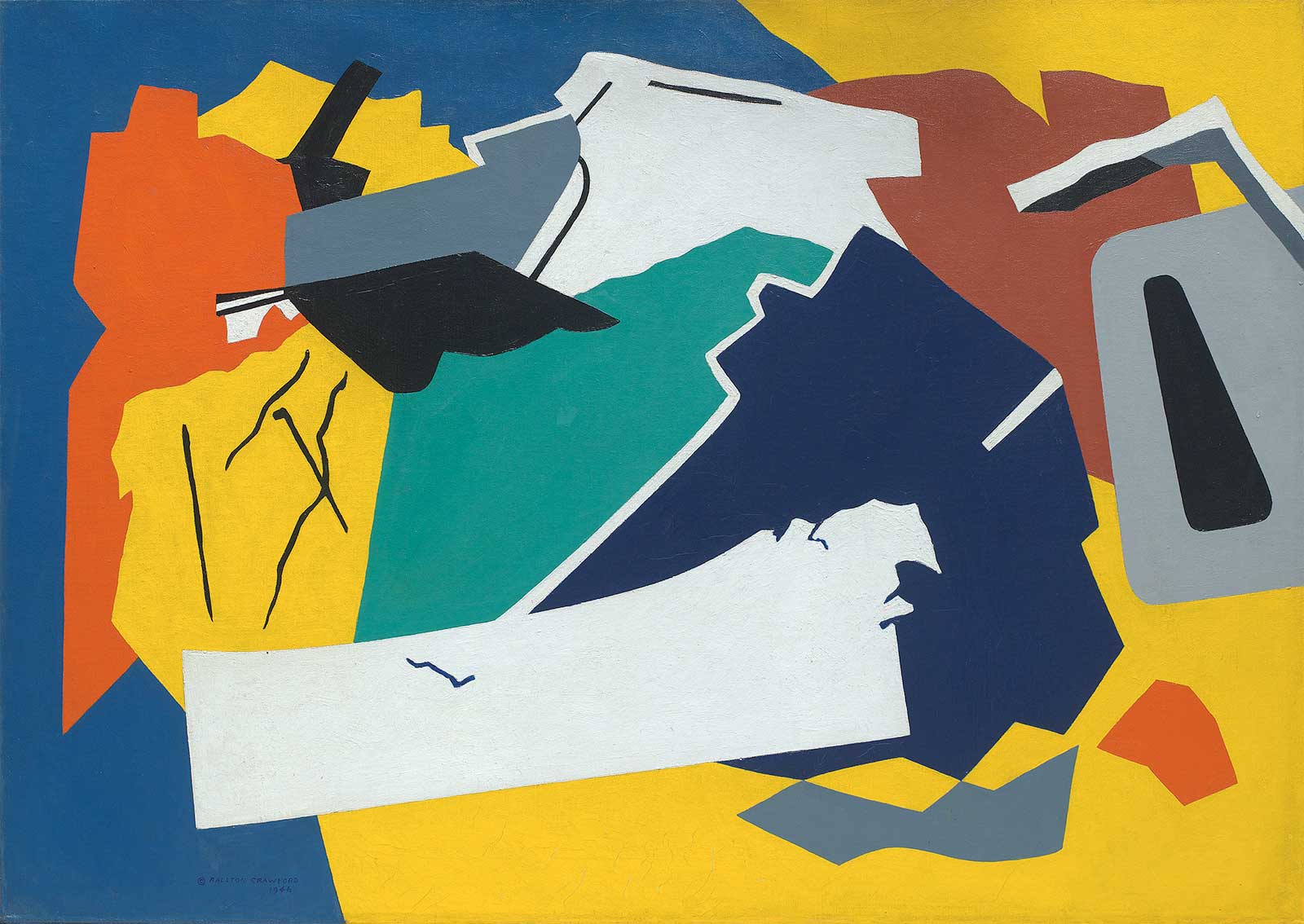 Ralston Crawford (1906-1978), Bikini, Tour of Inspection, 1946. Oil on canvas, 24 x 34 in. Vilcek Collection, VF2015.01.01.
The exhibition will also include pieces from a commission at the Curtiss-Wright aircraft plant in Buffalo, New York. The artist also witnessed Test Able, a nuclear detonation over Bikini Atoll in 1946. Its devastation appears in the 1946 work Test Able.
The works—featuring nuclear bombs, crashed planes and war-time destruction—contain heavy subject matter, but they are revealing about how Crawford was experiencing the war and its immediate effects. “In comparing Bomber to Test Able, we see the incredible shift in Crawford’s style that occurred in the intervening two years. Both are images of destruction, but in Test Able, Crawford has moved beyond the recognizable; it is not about the individual objects destroyed, but the act and power of destruction,” Navratil writes in the catalog. “The forms have increased in scale and are brought right to the picture plane. We have a sense of atmosphere, rather than actual space. The blinding yellow and salmon light of the blast are set off against the brilliant blue of the ocean. Twisted gray shapes suggesting shredded metal, punctuated by circular rivets, appear in both paintings and connect them, but in Test Able they are the only element of the painting that hints at what existed before the blast. We feel the immense force of destruction, and it is so complete that we are left with almost nothing we can name.” —
Powered by Froala Editor