John F. Kennedy addressed the America’s Cup crews in 1962.
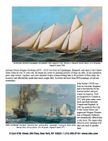
“I really don’t know why it is that all of us are so committed to the sea, except I think it’s because in addition to the fact that the sea changes, and the light changes, and ships change, it’s because we all came from the sea. And it is an interesting biological fact that all of us have in our veins the exact same percentage of salt in our blood that exists in the ocean, and, therefore, we have salt in our blood, in our sweat, in our tears. We are tied to the ocean. And when we go back to the sea—whether it is to sail or to watch it—we are going back from whence we came.”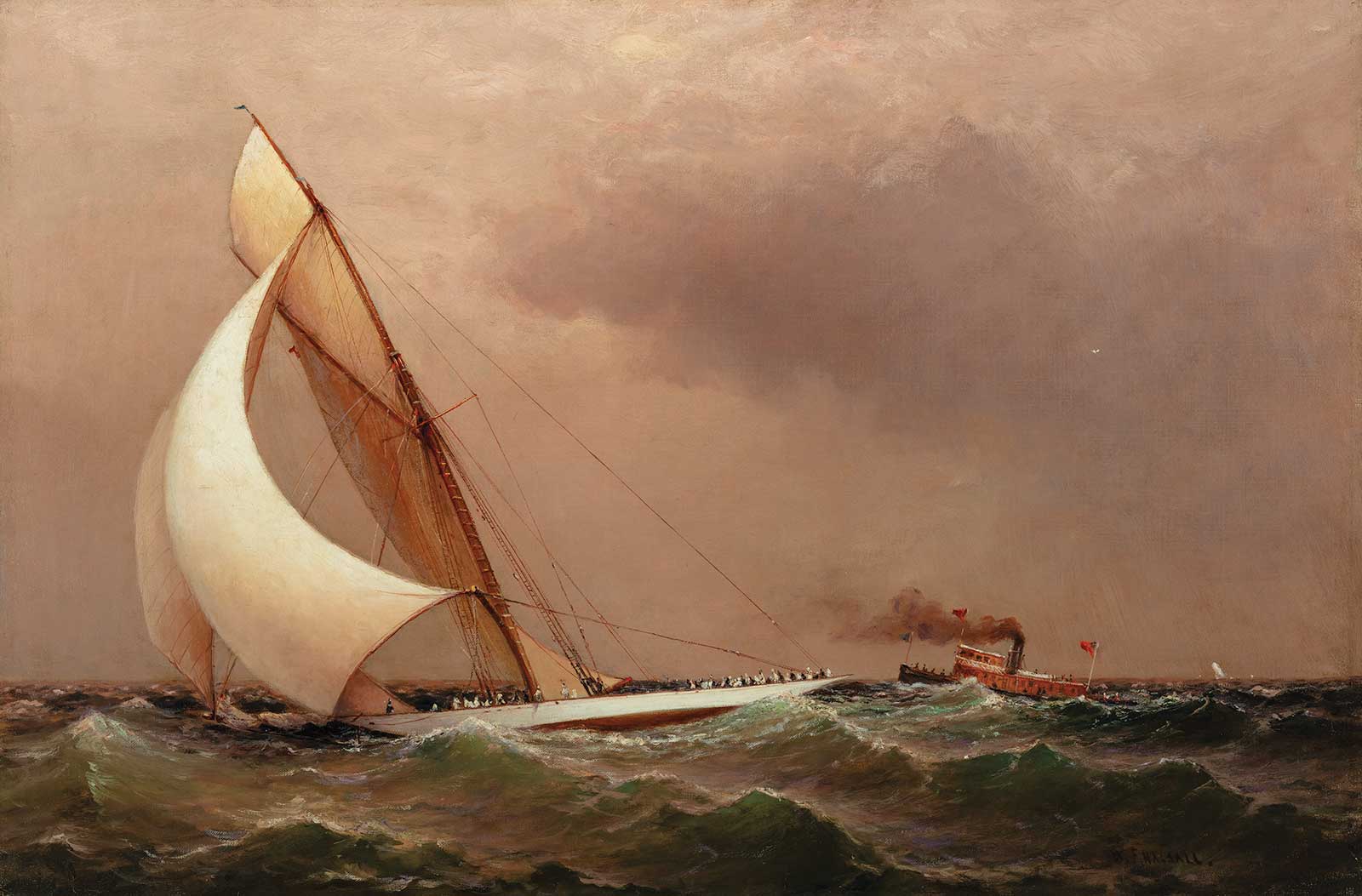 William Formby Halsall (1841-1919), Vigilant in last days Race against Valkyrie, 1893. Oil on canvas, 19 x 29¼in. Peabody Essex Museum. Gift of Frederic A. Turner, 1961. M10946. © 2020 Peabody Essex Museum. Photography by Kathy Tarantola.
Kennedy, himself, was an avid, prize-winning sailor, and commanded PT boats during World War II. His great-grandfather emigrated by sea from Ireland in 1849.
Stuart W. Pratt, chair of the board of trustees of the Peabody Essex Museum in Salem, Massachusetts, and Rod Bigelow, executive director and chief diversity and inclusion officer of the Crystal Bridges Museum of American Art in Bentonville, Arkansas, echo Kennedy in their foreword to the exhibition catalog of In American Waters: The Sea in American Painting, which will be at the Peabody Essex Museum May 29 through October 3 and at Crystal Bridges from November 6 through January 31, 2022.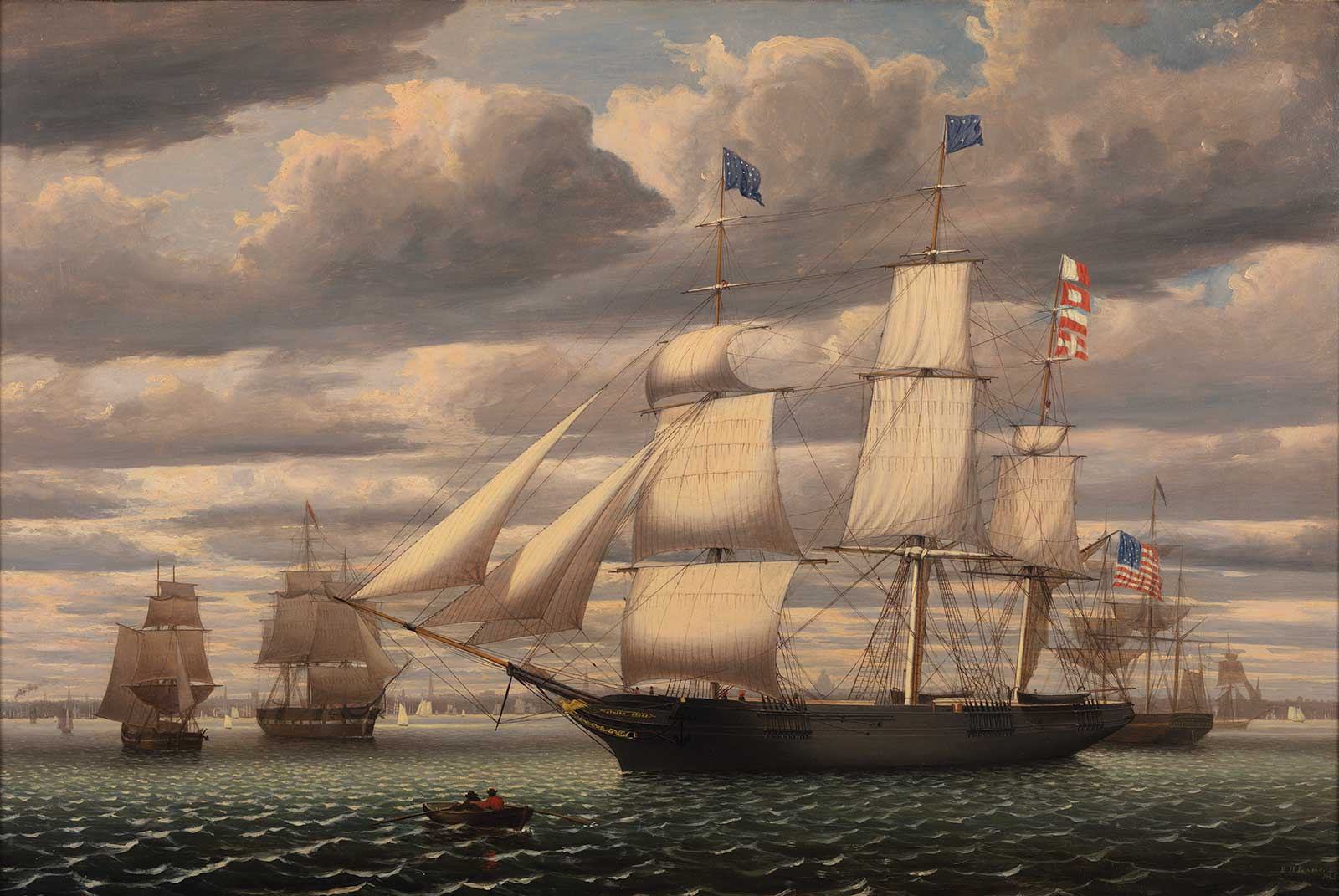 Fitz Henry Lane (1804-1865), Southern Cross in Boston Harbor, 1851. Oil on canvas,251/4 x 38 in. Gift of Stephen Wheatland, 1987. M18639. © 2020 Peabody Essex Museum. Photography by Kathy Tarantola.
“The sea shapes America and its painters, who have long turned to it as a source of inspiration and employed it—and the vessels sailing upon it—as a symbol of the country’s identity and aspirations. As the great American novelist Herman Melville, with wonderment, so keenly observed, whether people live on the coasts or far inland, they appear magnetically drawn to the water and the symbolic and emotional impact of the marine,” reads the catalog. “It is especially fitting, therefore, that the Peabody Essex Museum and Crystal Bridges Museum of American Art have partnered to co-organize In American Waters: The Sea in American Painting. This exhibition and publication offer new perspectives on the ways in which marine painting is an integral and wide-ranging form of expression of American art, culture and environment.”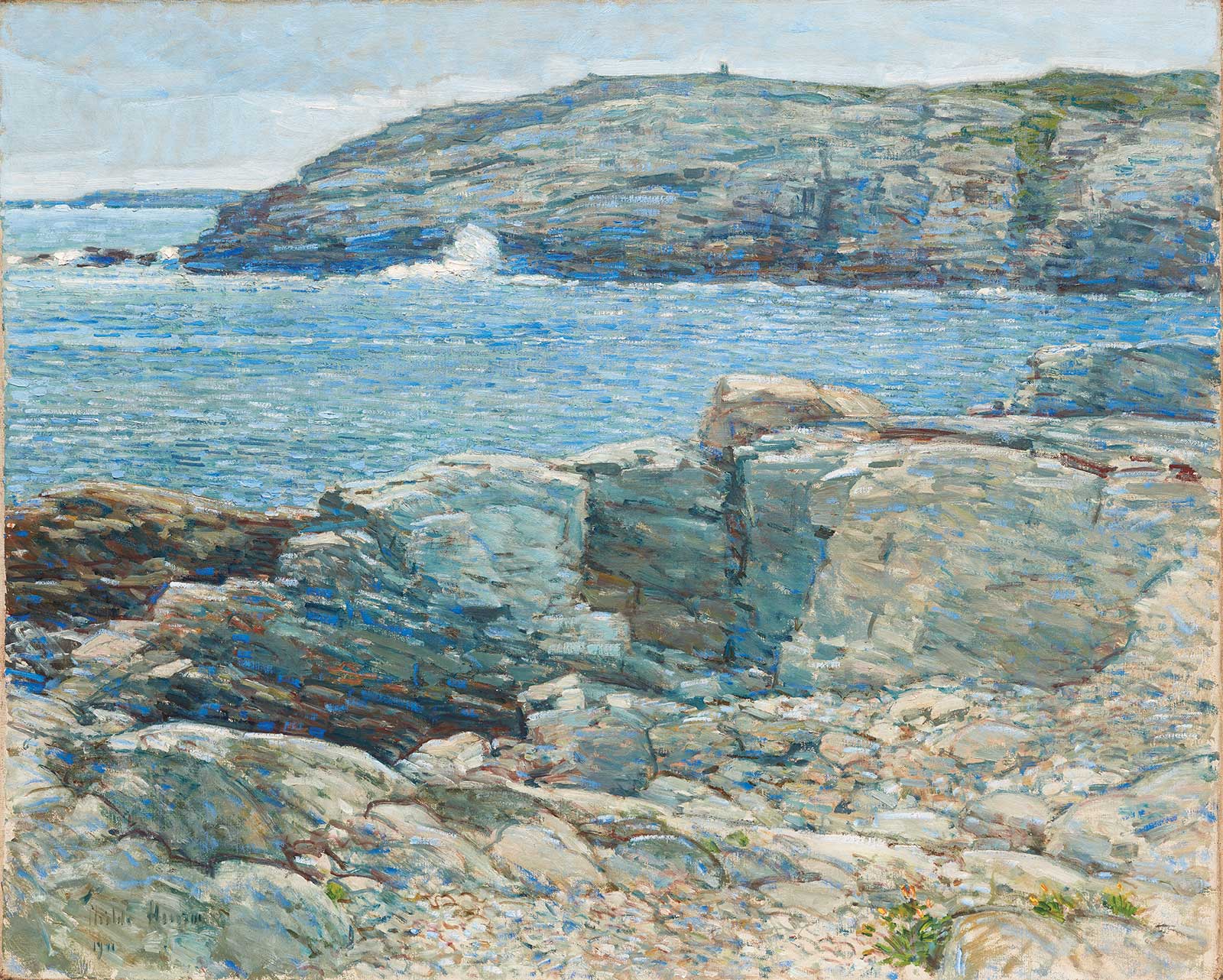 Childe Hassam (1859–1935), East Headland, Appledore, Isles of Shoals, 1911. Oil on canvas, 30 x 36 in. Gift of Peter S. Lynch in memory of Carolyn A. Lynch, 2018. 2018.72.1. Courtesy of Peabody Essex Museum, Salem, Massachusetts. Photography by Kathy Tarantola.
The curators explain the breadth of the exhibition. Dan Finamore, PEM’s associate director of exhibitions and the Russell W. Knight Curator of Maritime Art and History, explains, “As this exhibition vigorously asserts, marine painting is so much more than ship portraits. Through more than 90 works, we can trace changing attitudes about the symbolic and emotional resonance of the sea in America and see how contemporary perspectives are informed by marine traditions. No matter where we live, the sea shapes all of our lives and continues to inspire some of the most exciting artists working today.”
Austen Barron Bailly, chief curator at Crystal Bridges Museum of American Art, writes, “To look anew at American marine painting, we studied and analyzed its colonial and Eurocentric origins and found that the genre is far more dynamic and broad than previously assumed. When we think of marine painting we may think of high-seas realism and faithful portraits of ships but, as this exhibition attests, in practice we see broad-ranging expressions of American ambition, opportunity and invention.”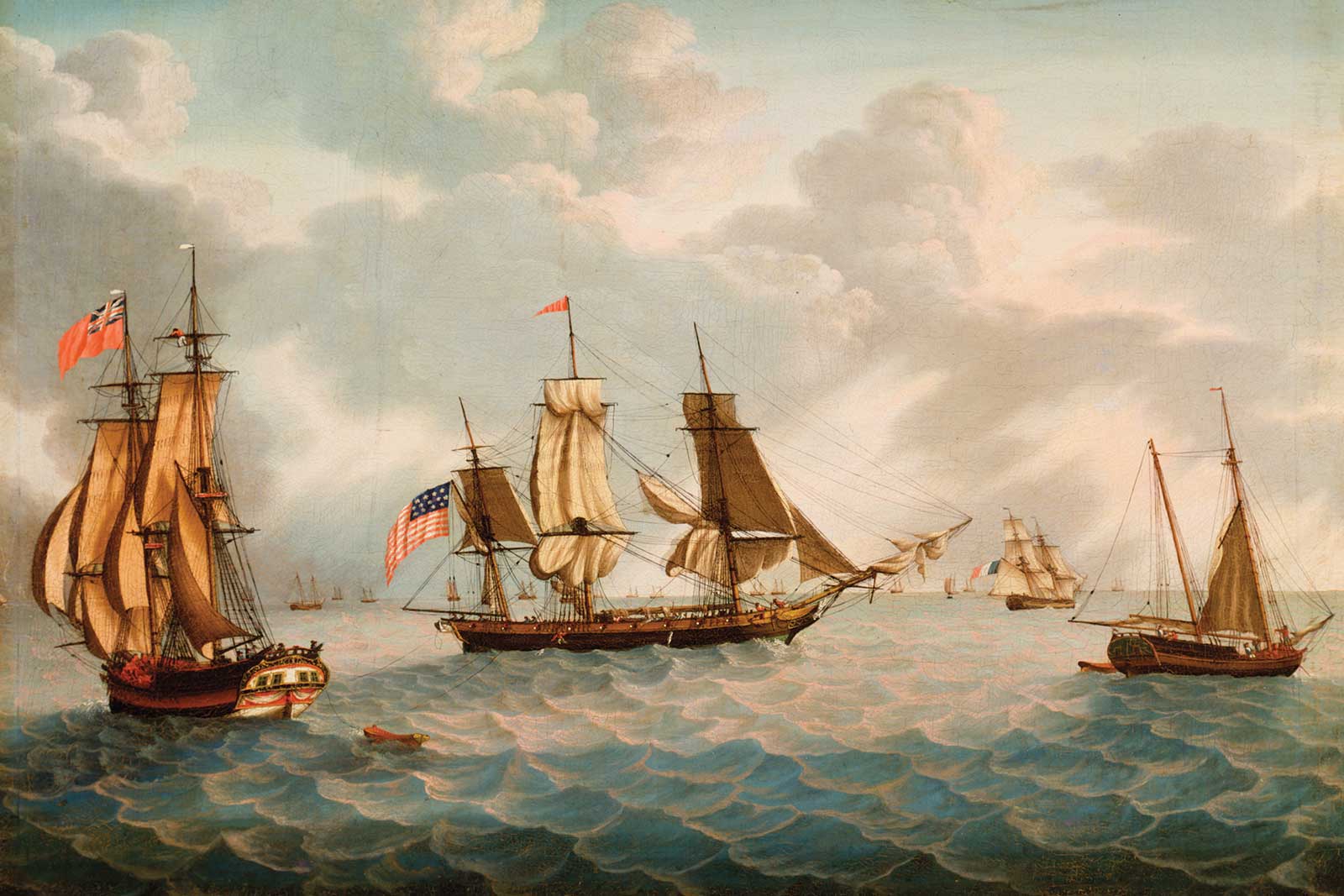 Michele Felice Cornè (1752-1845), Ship America on the Grand Banks, about 1800. Oil on canvas, 393/4 x 56 in. Gift of Mrs. Francis B. Crowninshield, 1953. M8257.
The exhibition explores not only what artists saw and what we see in their work, but also, “how” we see. In her catalog essay “The Horizon as a Region of Interest” Bailly writes, “From a vision neuroscience point of view, the horizon is a physical edge that will be detected by neurons in the visual system because the horizon line stands out from or contrasts with the surrounding elements. The horizon also functions conceptually and metaphorically as an edge…The ‘Maritime Aesthetics’ study [from Peabody Essex Museum in collaboration with Harvard University] and the pattern of fixations in the dataset do not comment on the connection between the visual horizon line and its meaning. But the study signals that the horizon as an edge may operate in multiple ways simultaneously. In the context of American art, this multiplicity is expressed relative to artists’ affinity for the horizon and relative to the onshore-to-offshore positions from which they paint. [Historian John R. Gillis] observes that, in contradistinction to a human affinity for linear horizons and infinite space, ‘nature abhors sharp edges,’ and his research focuses on the importance of the ever-changing shoreline as its own region of interest: ‘In reality, shores are what ecologists call an ecotone, boundary places where two ecosystems meet and interface, more like a seam than an edge, a connection rather than a separation…Conceptualizing [the shore] as an edge has obscured the reality of its betweenness, its ecotonal nature.’”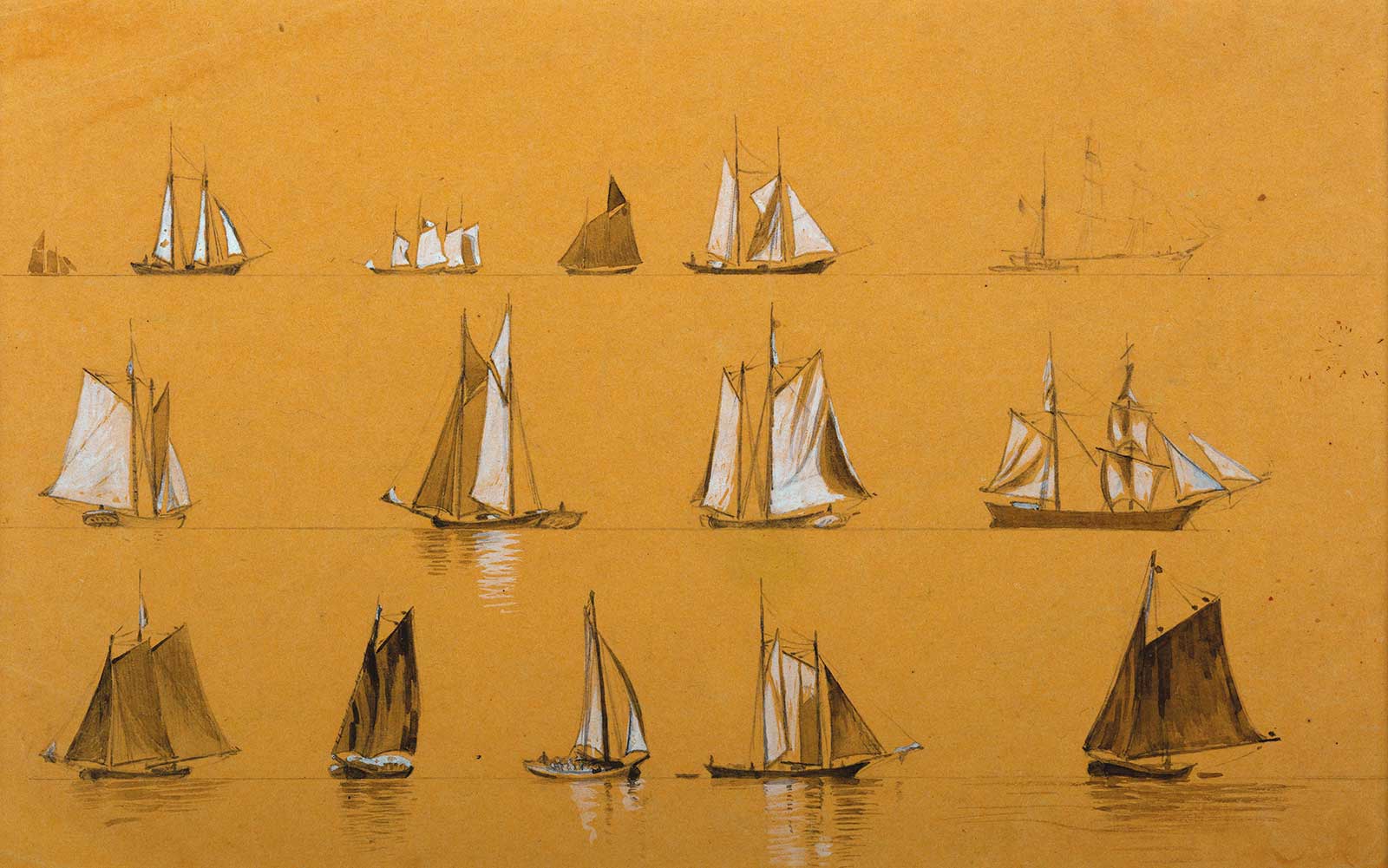 Francis Augustus Silva (1835-1886), Various Vessels, 1867–84. Watercolor and ink on paper, 63/8 × 101/4 in. (16.2 × 26 cm). Peabody Essex Museum, gift of Miss M. Antoinette Silva, 1956 M8871.F2.2. © 2020 Peabody Essex Museum. Photography by Kathy Tarantola.
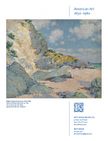
American impressionist Childe Hassam (1859-1935) visited Appledore Island for nearly 30 years. Appledore is the largest of the Isles of Shoals off the coast of Maine. He produced nearly 300 artworks there, from the rocky shore to his friend Celia Thaxter’s extraordinary cutting garden. He often returned to favorite sites, refining his response to the landscape as well as his skills. His East Headland, Appledore, Isles of Shoals, 1911, is in the exhibition, its strong horizontals defining the seams between sea and rocks, distant hills and sky.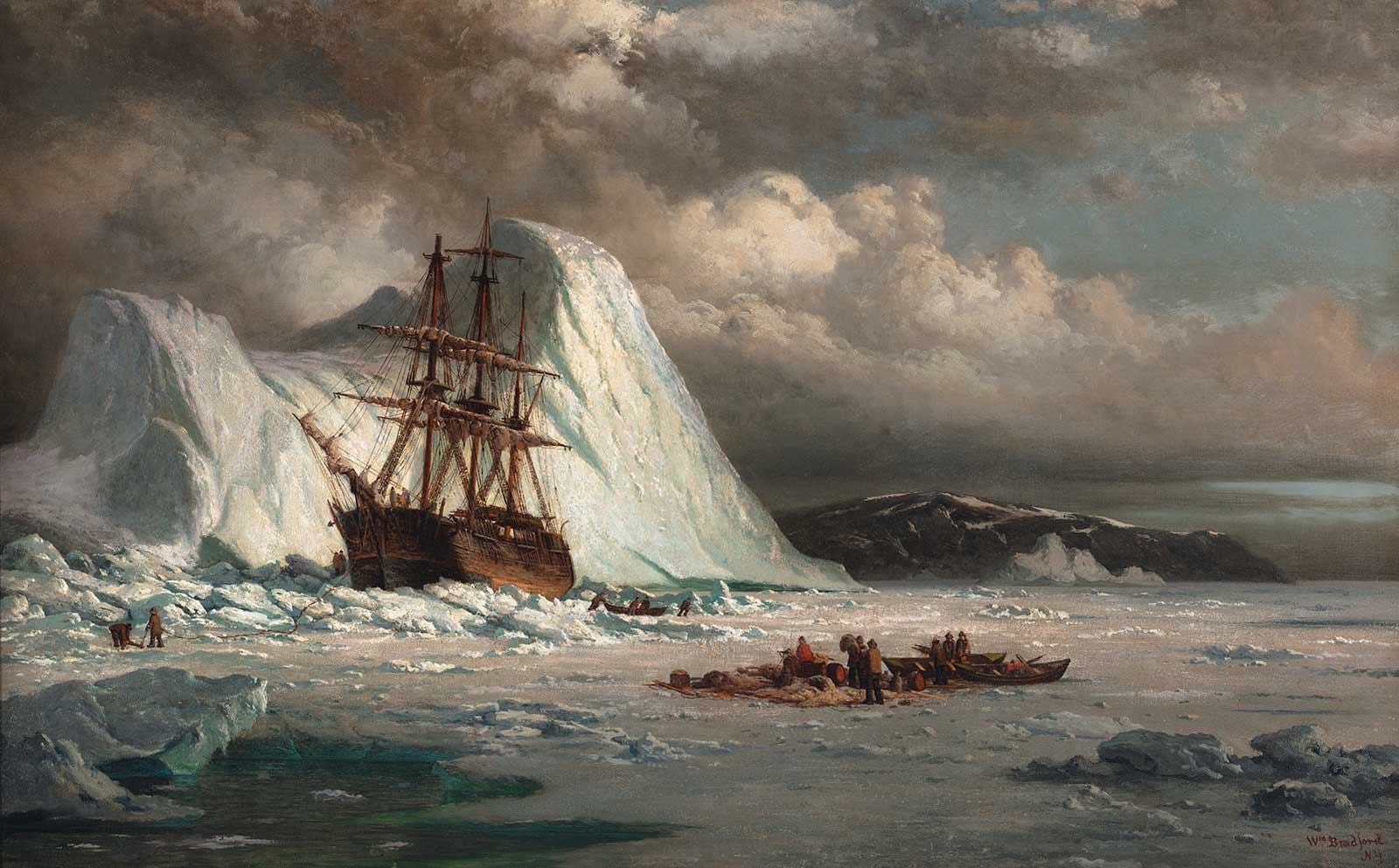 William Bradford (1823-1892), Icebound Ship, about 1880. Oil on canvas, 30 x 481⁄8 in. Museum purchase with funds from anonymous donor, 1996. M27190. © 2020 Peabody Essex Museum. Photography by Kathy Tarantola.
A classic painting of ships at sea is Ship America on the Grand Banks, circa 1800, by Michele Felice Cornè (1752-1845) who, the curators note, was “the first artist in the United States to declare a specialty in marine subjects.” The painting speaks to American nationalism. The “America” was originally a British merchantman capture during the American Revolution. The ship proudly flies the American flag among other fishing vessels flying the flags of Great Britain and France “all within a competitive commercial setting, evoke affective bonds of pride in the new nation and its emerging international profile.”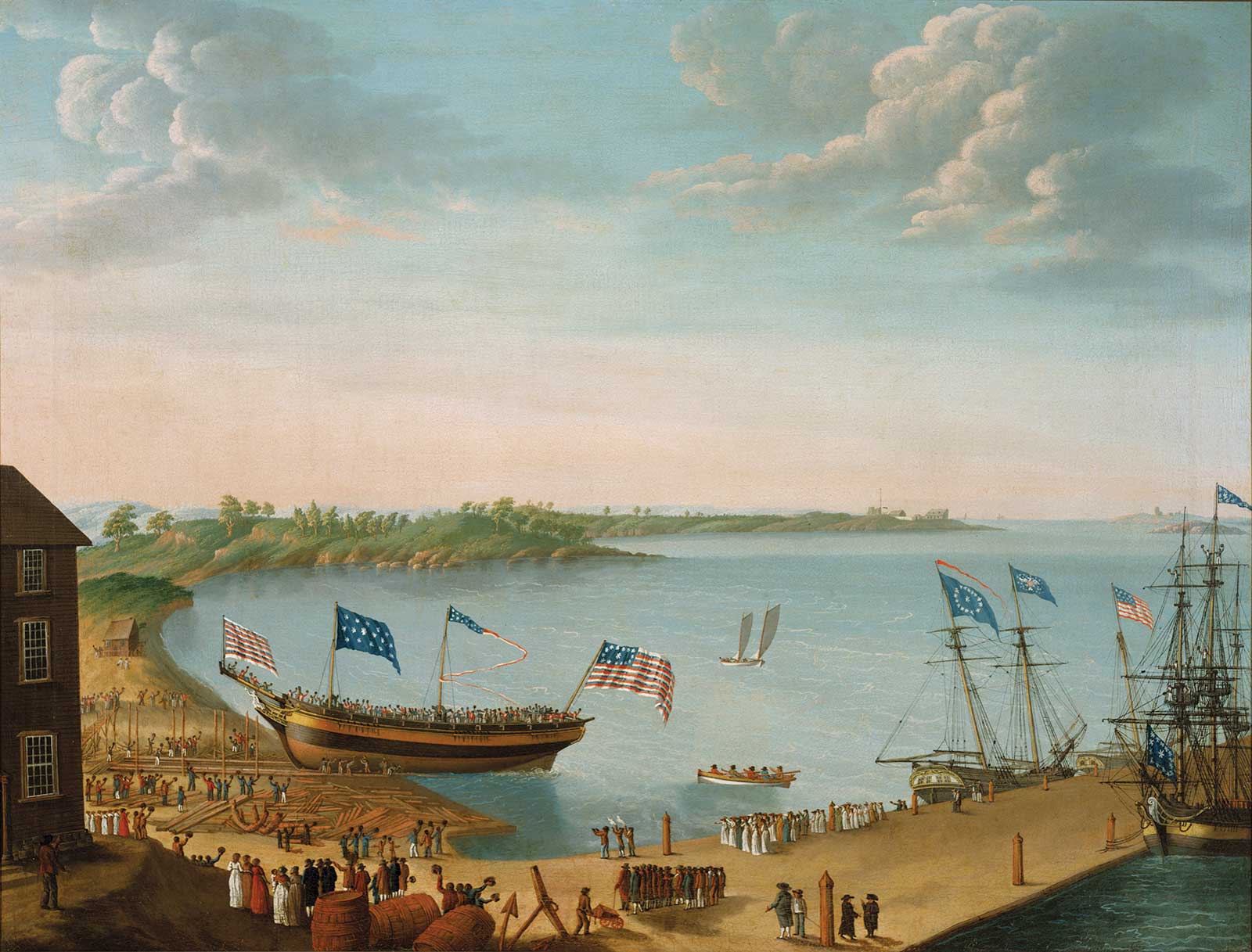 George Ropes Jr. (1788–1819), Launching of the Ship Fame, 1802. Oil on canvas, 353/4 x 46 in. Peabody Essex Museum, gift of Captain Nathaniel Silsbee, 1862. 108332. © Peabody Essex Museum, Salem, MA. Photography by Jeffrey R. Dykes.
The continuing desire for an American identify is described by the luminist painter Francis Augustus Silva (1835–1886). “Why do not some of our young American painters give us American subjects, instead of replicas of what French men have painted even so much better? The earnest men, working here among us, casting their lot with us, are the men who will help make the close of the 19th century famous in the history of American art.” —
In American Waters: The Sea in American Painting
May 29-October 3
Peabody Essex Museum
161 Essex Street, Salem, MA 01970
t: (978) 745-9500, www.pem.org
November 6-January 31, 2022
Crystal Bridges Museum of American Art
600 Museum Way, Bentonville, AR 72712
(479) 418-5700, www.crystalbridges.org
Powered by Froala Editor