
Imagine there are no images on these pages, no high-res renderings to catch your eye as you go by, hoping you’ll stop and dip into the essay. Imagine that’s the way it is. No images. Just these words. Or, perhaps, imagine the artworks on these pages as piles of smoldering ash and cinder. Or imagine them vanished, looted, replaced by other, less eclectic works, works that all pay tribute to some single figure of absolute authority. Or imagine that they were never there at all, the artworks in the United States Capitol, that there isn’t such a place, not anymore. Or that there never was.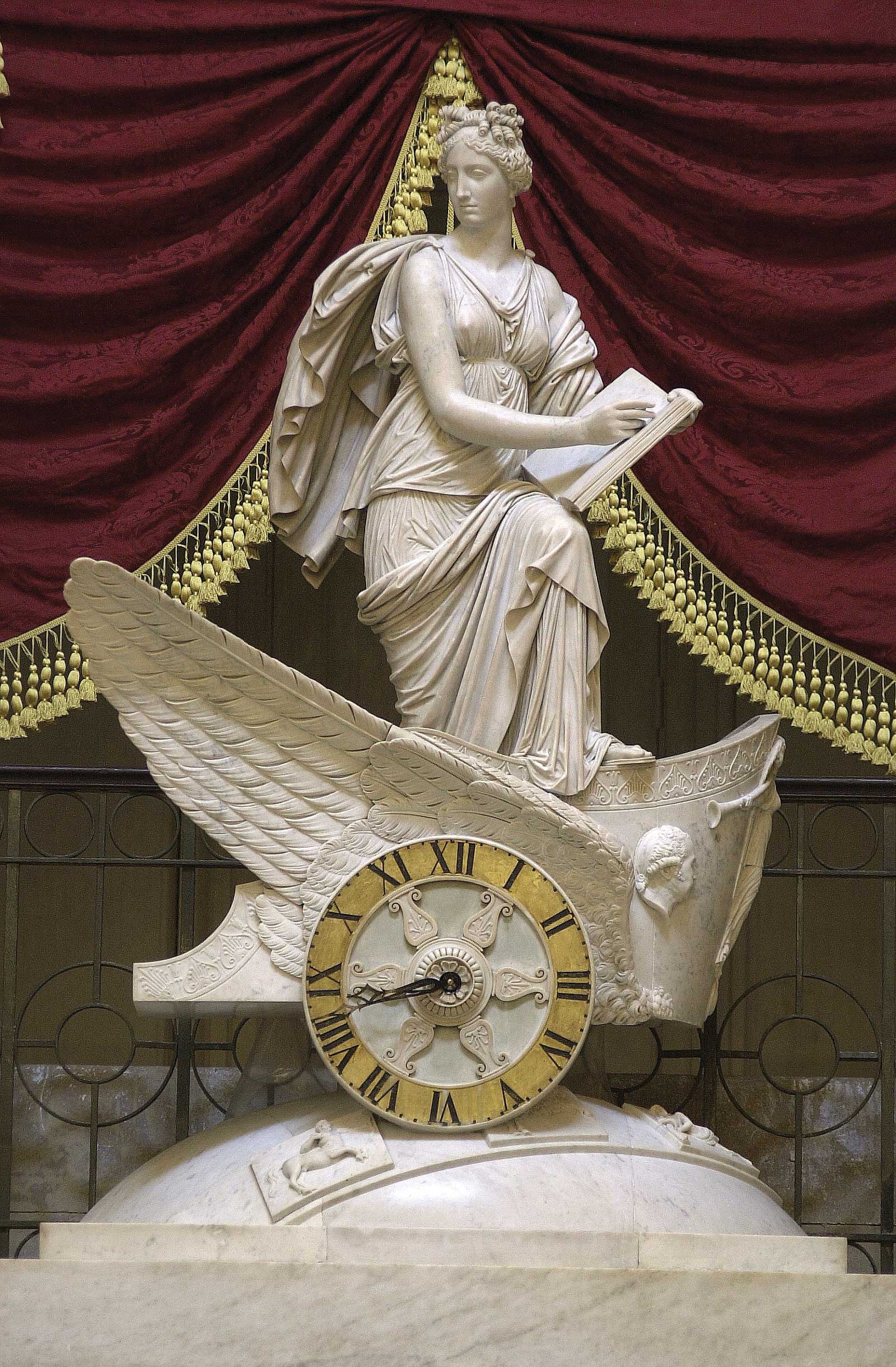 Carlo Franzoni (1789-1819), Car of History, 1819.
Apocryphally, though quoted incessantly, when Benjamin Franklin left the Constitutional Convention in 1787, a Mrs. Powell of Philadelphia asked him, “Well, Doctor, what have we got, a republic or a monarchy?”—to which Franklin is said to have replied, “A republic—if you can keep it.”
Whether Franklin said this or not, he and the other founders of the United States were all too aware of the fragility of democracy. The art of a republic—indeed, the art of any sort of government—is as fragile as its institutions. The same power that influences, shapes and shifts power not only shifts but often replaces one sort of art with another. This is especially true of civic art, and the art of the United States Capitol is a kind of living, breathing time capsule of these changes and shifts. The most recent artists, artworks and art forms could scarcely be imagined by those who designed, built and decorated the first Capitol.
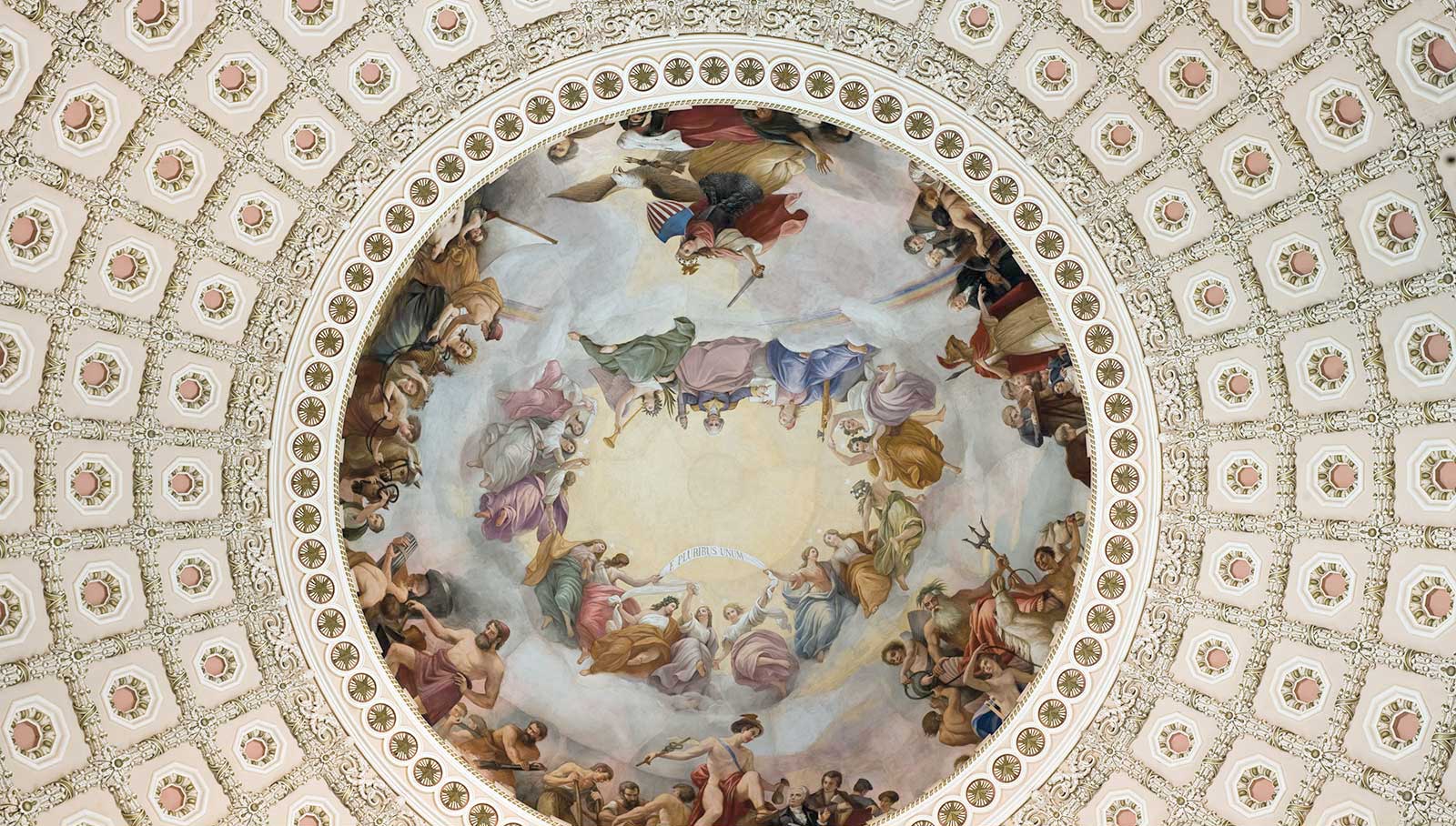 Constantino Brumidi (1805-1880), Apotheosis of Washington, 1865.
The purposes of art and the gap between what art meant then and what it means now evolve. Monuments whose reason for being was to keep alive the myth of the “lost cause” after the defeat of the Confederacy in the Civil War have come to be seen as works whose ideological purpose was to serve Jim Crow domination of one race over another. If art is to have meaning, the tension between intention and reception has to exist. That’s how it should and must be.
Perhaps, it would be worthwhile to look at just a few of the myriad, diverse wonders of art in the U.S. Capitol, our Capitol, artworks we might take for granted.
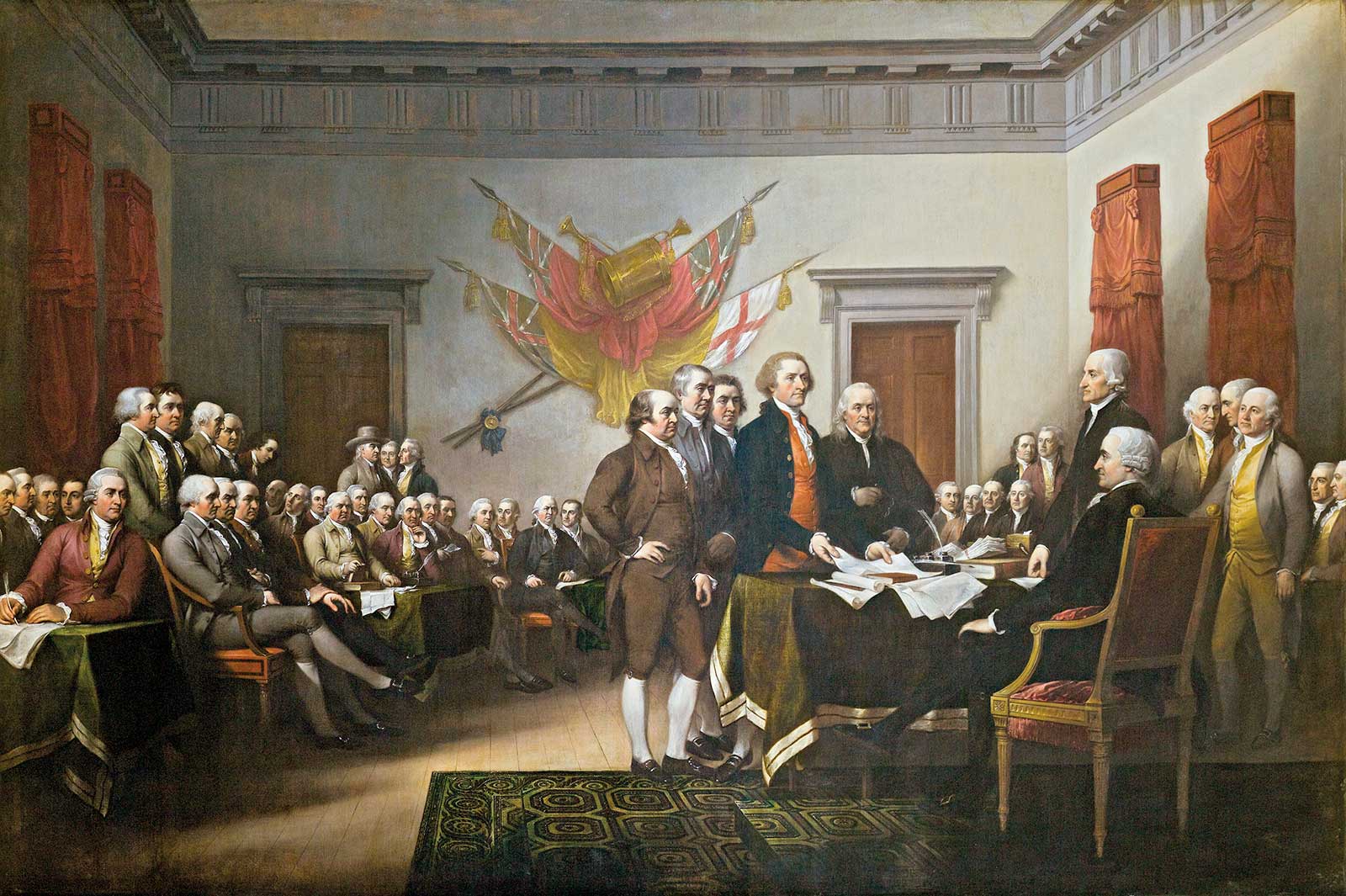 John Trumbull (1756-1843), Declaration of Independence, 1826.
The first United States Capitol was partially burned in 1814 by the British during the War of 1812. A year later, reconstruction began. Artists from abroad were sought out and hired to bring their talents to bear on the new edifice. Italian sculptor Carlo Franzoni’s 1819 marble, Car of History, is a classically inspired carving of Clio, the Greek Muse of History, standing on the winged chariot of time, recording deeds in the book of history. Installed in what was the room where the House of Representatives met—now Statuary Hall—Clio enacts what Lin-Manuel Miranda’s musical Hamilton, sings—by way of warning—to the title character, “History has its eyes on you.”
If you have ever watched the television series John Adams, you will have seen the aged Adams try to destroy one of the most famous of all American paintings, John Trumbull’s 1826 canvas The Declaration of Independence, which purports to depict the signing of our founding document. Adams’ anger, entirely justified, comes from the fact that this stately gathering is entirely wrong. Adams recalls that in the summer of 1776, the signers were fighting and fleeing the British, and that they ran in, furtively, in ones and twos, to sign the document, fearful of being apprehended and put to death for treason. Trumbull’s rendition of mythological inevitability masks the knife edge on which our nation’s founding truly rests.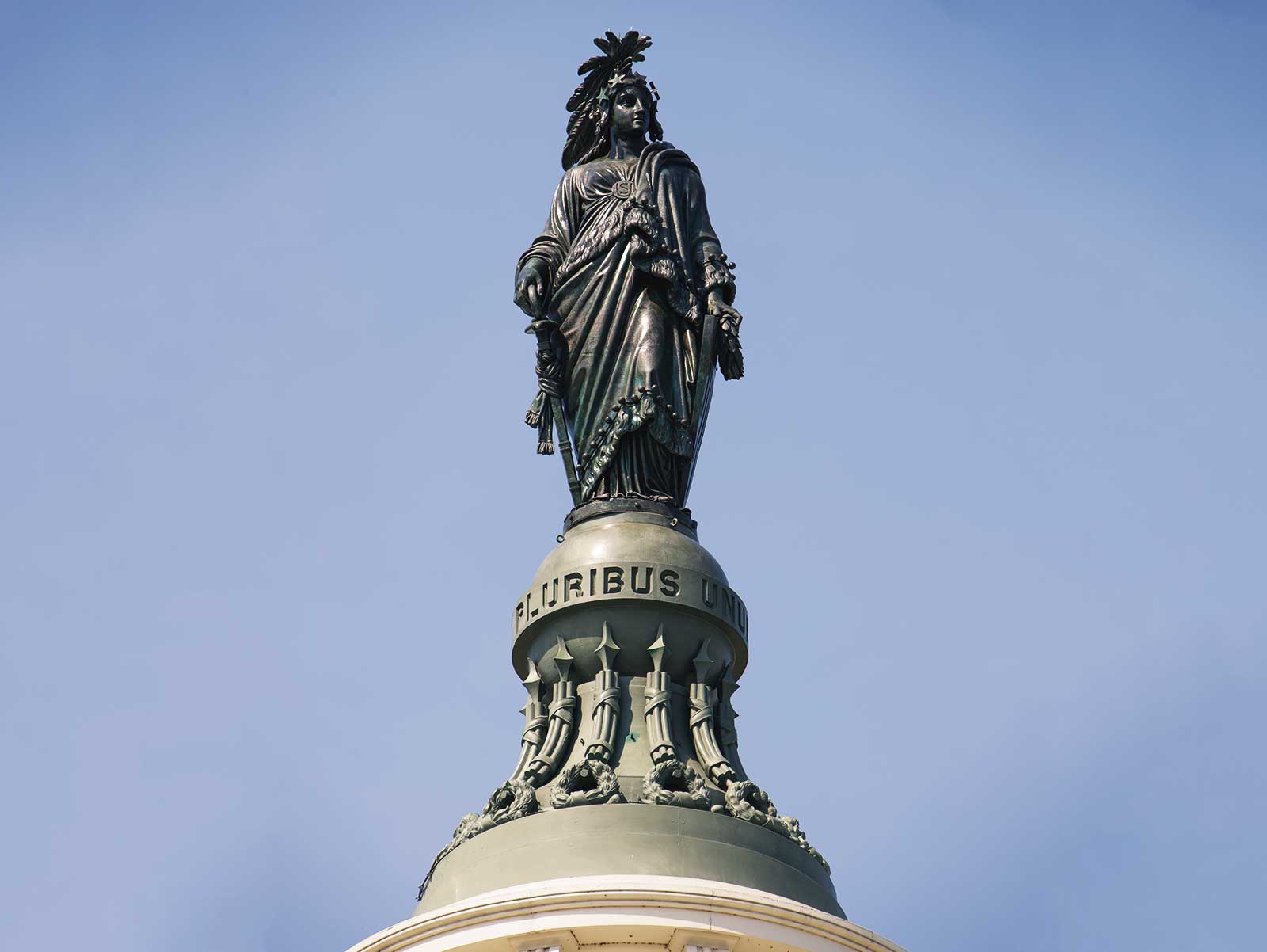 Thomas Crawford (1814-1857), Statue of Freedom, 1863.
Thomas Crawford’s Statue of Freedom adorns the zenith of the iron dome of the Capitol. Finished in 1863 under President Lincoln’s explicit order during the height of the Civil War, the bronze is rarely seen up close. That it exists at all is, in large measure, due to the talents of an enslaved African, Philip Reid, who labored in the Clark Mills foundry, which had been contracted to cast the bronze. It was Reid who figured out how to separate the pieces of the plaster model for transport to the foundry and oversaw the casting. By the time the statue was installed, Reid was free and would go on to open his own foundry after the war.
The Capitol Rotunda is a philosophical space, round in the way the Round Table in Camelot is round, a space where all are equal, where every expression is treated equally, where no one has the right to deny another’s freedom of thought or words, where no king and no royal decree reigns. When you look up, what you see is the magnificent Apotheosis of Washington, Constantino Brumidi’s painting, finished in 1865. Though Washington would no doubt have appreciated the classical allusions and presentation, he would have chafed at the deification. Having refused a crown, he certainly would have said no to godhood.
Vinnie Ream Hoxie’s 1871 marble, Abraham Lincoln, is the first artwork by a woman ever commissioned by the United States government. Her Lincoln, looking down into the Rotunda, is a more contemplative take on the great man. Holding the Emancipation Proclamation, his head bowed in weariness and in humble service, Ream’s Lincoln is all-too human.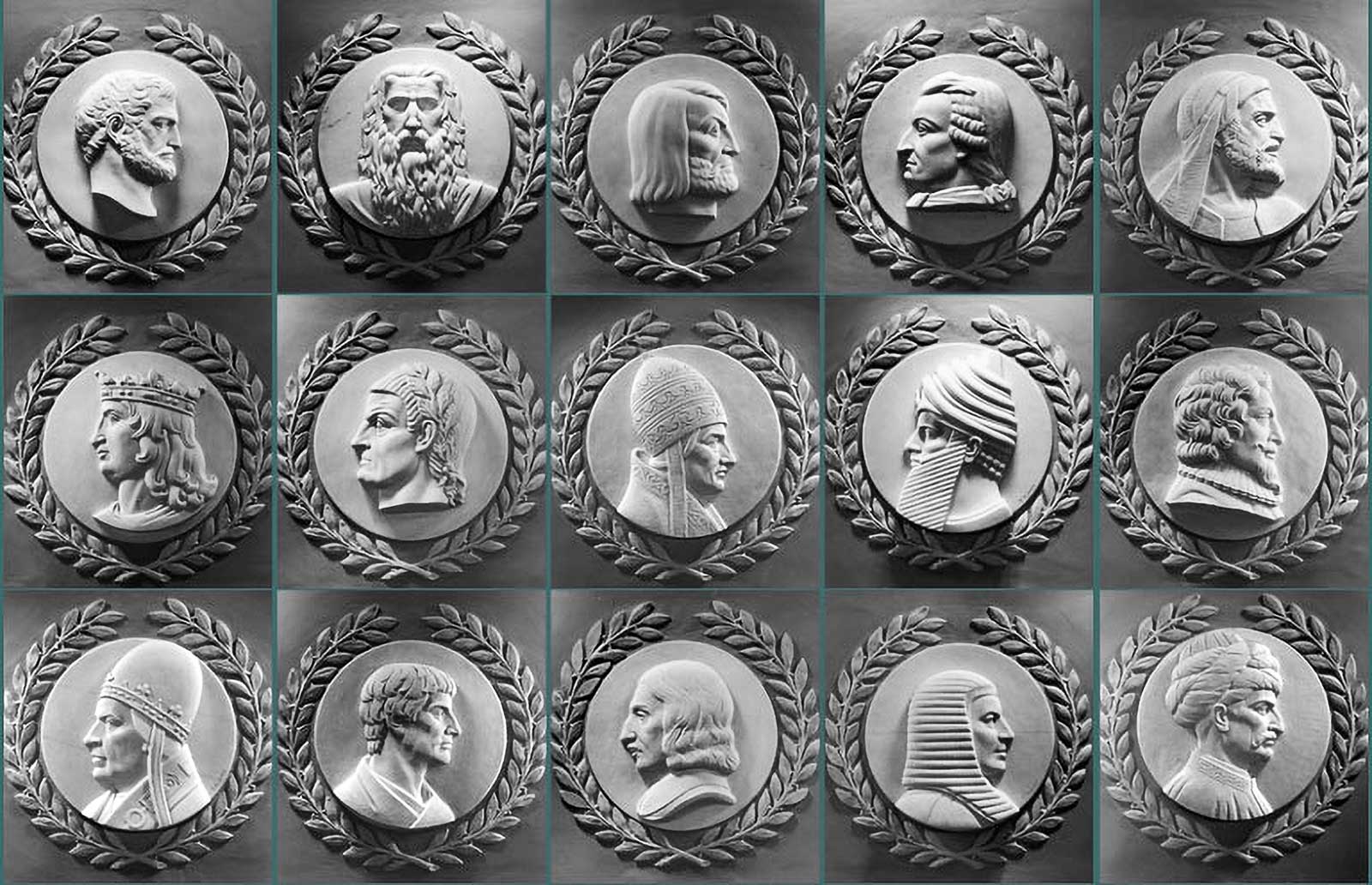 There are 23 marble relief portraits over the gallery doors of the House Chamber in the U.S. Capitol depict historical figures who are noted for establishing the principles that underlie American law. Seven different sculptors created the reliefs and each measure 28 inches in diameter.
In 1950, the Capitol commissioned a series of marble relief portrait medallions of lawgivers to be installed above the doors that lead into the House chambers. All of them, from Hammurabi and Solon to Maimonides and Suleiman, from Justinian to Jefferson, Blackstone, and even Napoleon contributed in some way to the idea of the United States of America. The medallions themselves were fashioned by a range of artists, men and women. We are part of a continuum, these portraits say, one that encourages us not to settle, but to strive.
Installed in 1969, Marisol Escobar’s Father Damien, one of Hawaii’s contributions to the Capitol, moves away from heroism to the notion of sacrifice, showing, without embellishment, the ravaged priest who succumbed to the disease leprosy, to whose sufferers he devoted his life and ministry.
I hope the nation finds room in the Capitol for a monument to the Iroquois Confederacy’s contributions to our system of government and laws. Their success at knitting together disparate peoples helped inspire our own experiment in federalist government. Older paintings of Native Americans run to depictions of Pocahontas saving John Smith’s life and statues to famous leaders memorialized by white artists. Jemez Pueblo sculptor Cliff Fragua’s 2005 work, Po’Pay, is the first artwork by an Indigenous artist to be placed in Statuary Hall and the second to represent New Mexico. Fragua carved Po’Pay, one of the leaders of the Pueblo Revolt against Spanish colonization in 1680, out of marble. The objects Po’Pay holds, his clothing and his manner, suggest a deeply religious man, not a warrior by choice, but a visionary leader who was determined to preserve the Pueblo way of life.
This is, of necessity, a quick tour, but I am suggesting that the range of works at the Capitol is a good place to start an education in American art and history, and that the Capitol is a living, breathing, ever-changing and evolving, perfect and imperfect house of democracy. There are the good and great works, as well as the not so good. There are accurate works, historically wrong works, works that are heroic, quotidian, realistic, mythological, abstract. American art is an art of Indigenous peoples, of immigrants who came here of their own free will, and of immigrants who were brought here against their will. It’s an art that’s liberal and conservative, an art that celebrates cultures, an art that meshes cultures, and an art that strikes out on its own.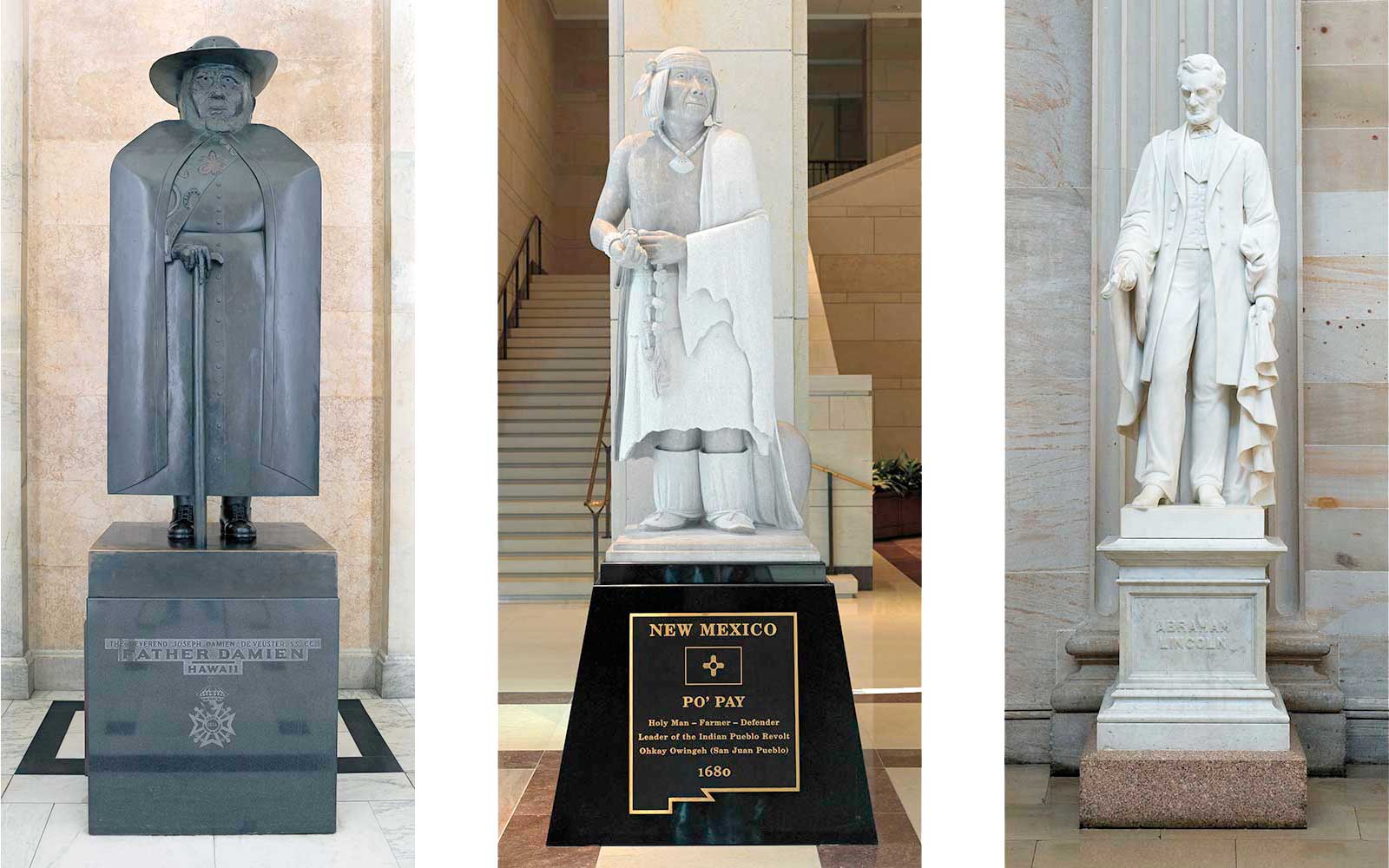 Left: Marisol Escobar (1930-2016), Father Damien, 1969; Middle: Cliff Fragua, Po’Pay, 2005; Right: Vinnie Ream, Abraham Lincoln, 1871. Photos courtesy Architect of the Capitol.
We celebrate, quite rightly, our first responders. But artists are first responders, too. Often, what they respond to in culture are inflection points and upheavals that are not yet visible to the culture. Artists are canaries in coal mines that haven’t even broke ground, and often shouldn’t. Just as the walls in Washington this summer, during the Black Lives Matter protests, became canvases for expressions of every sort, I wonder how the new security fences around the Capitol—brutalist fortress architecture—temporary, I hope—will become cathartic screens on which American artists project their hopes and anxieties.
History has its eyes on us.
The U.S. Capitol is our house, where “our” means “belonging to everyone,” to all of us, not just some Americans, not even just Americans. It is ours in the way that America is ours, and the Earth is ours, where “ours” means, “belonging to everything on it.” In a way, we are all artworks of the Capitol, forged and sculpted and painted by what transpires there. And all of this is ours, “a gift,” to paraphrase Benjamin Franklin, “if we can accept it.”
James D. Balestrieri is the proprietor of Balestrieri Fine Arts, specializing in arts consulting, sales, research, and writing. He is currently the writer-in-residence for the Clark Hulings Foundation, as well as estate and collections consultant for The Couse Foundation and communications manager for Western Spirit: Scottsdale’s Museum of the West. He was director of
J.N. Bartfield Galleries for 20 years, worked with the Scottsdale Art Auction for 15 years and has written over 150 essays for various art publications.—
Powered by Froala Editor