The Figge Art Museum in Davenport, Iowa, owns eight paintings by Ralph Albert Blakelock (1847-1919). Acclaimed in his lifetime, confined to a mental institution for much of his later life and nearly forgotten today, he and his work are featured in the exhibition Blakelock: By the Light of the Moon, through April 25.
Vanessa Sage, assistant curator at the museum, explains, “As the global pandemic has compelled many of us to connect with nature in new ways, this exhibition offers a glimpse into one artist’s connection to the land. From mental illness to rapid fame to intrigue, the dramatic circumstances of Blakelock’s life often eclipse discussions about his art. This exhibition focuses on this complex artist and his work, and gives a fascinating look at a life of creative experimentation and artistic resilience.”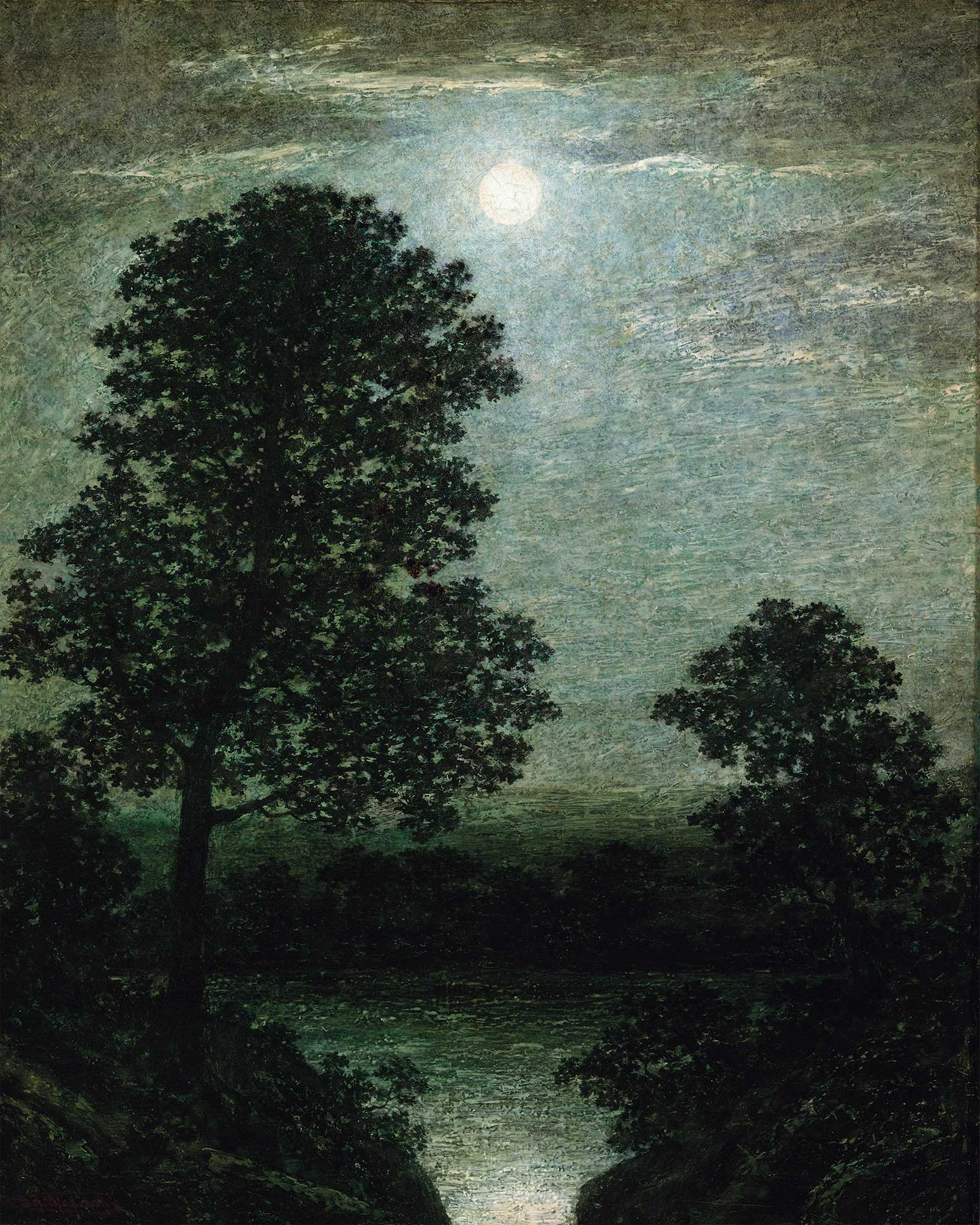 Ralph Albert Blakelock (1847-1919), Moonlight, late 19th century. Oil on wood panel. Figge Art Museum, City of Davenport Art Collection, gift of Maurice Hemsing, 1945.837.
Blakelock’s contemporary Elliott Daingerfield (1859-1932) wrote, “Moonlight and that strange, wonderful moment when night is about to assume full sway, when the light in the Western sky lingers lovingly, glowingly, for a space, and the trees trace themselves in giant patterns of lace against the light…This was Blakelock’s moment, and it took such hold upon him that his vision translated it into all his work.”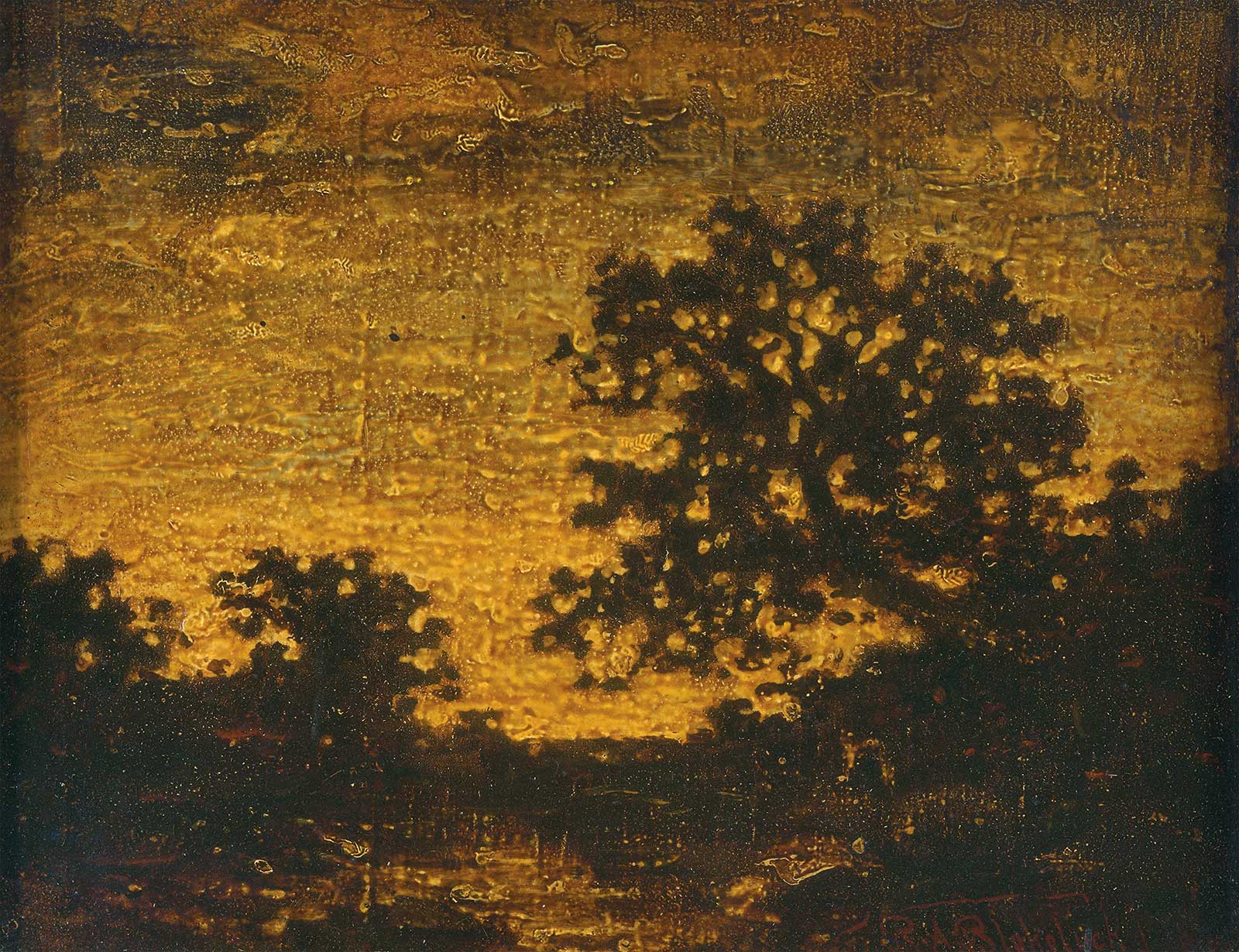 Ralph Albert Blakelock (1847-1919), Sunset, late 19th century. Oil on wood panel. Figge Art Museum, City of Davenport Art Collection, gift of Maurice Hemsing, 1945.836.
Blakelock was self-taught but was keenly aware of the movements in art in his time (the Hudson River School, the Barbizon School and romanticism). Norman Geske, in his biography of Blakelock, wrote that he “proceeded with an imagination that was singularly free of any allegiance to established procedures.”
Encouraged by his homeopathic doctor father to follow in his footsteps, he tried, but quit. He set out for the West in 1869 not as a member of an expedition like Albert Bierstadt and Thomas Moran, but on his own. Although the landscape of the West was a source of inspiration, his time spent among Native American tribes, learning about their connection to the land, had a lasting influence. Based on his sketches made on his trips West, as well as on his memories and his imagination, he painted nocturnes of his experiences when he returned to New York.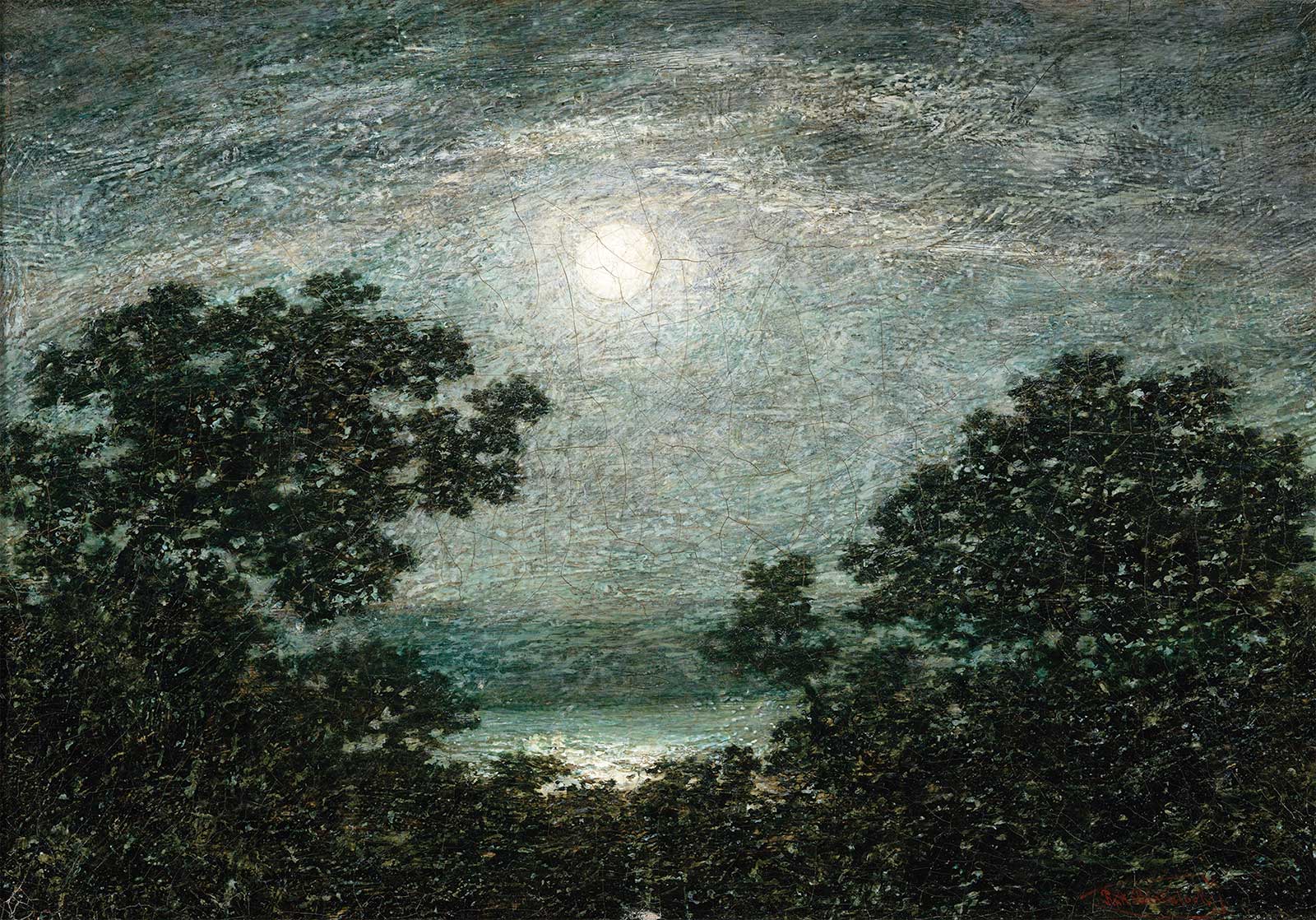 Ralph Albert Blakelock (1847-1919), Moonlight, late 19th century. Oil on canvas. Figge Art Museum, City of Davenport Art Collection, gift of Clara L. Brandt. 1931.4.
He experimented with different techniques, often building up layers of paint and later scraping it down or scratching into the surface of the paint. His experiments with bitumen kept the paint from drying and, eventually, the images slid off their support. His attention to the surface of his paintings and the qualities of paint presage the advent of abstract expressionism.
His paintings are poetic symphonies of light, most often moonlight seen through frames of dark leaves and rendered with a limited palette. One of his moonlight paintings sold at a New York auction 1916 for $20,000. The auctioneer proclaimed, “It is the finest work ever done by an American artist.” 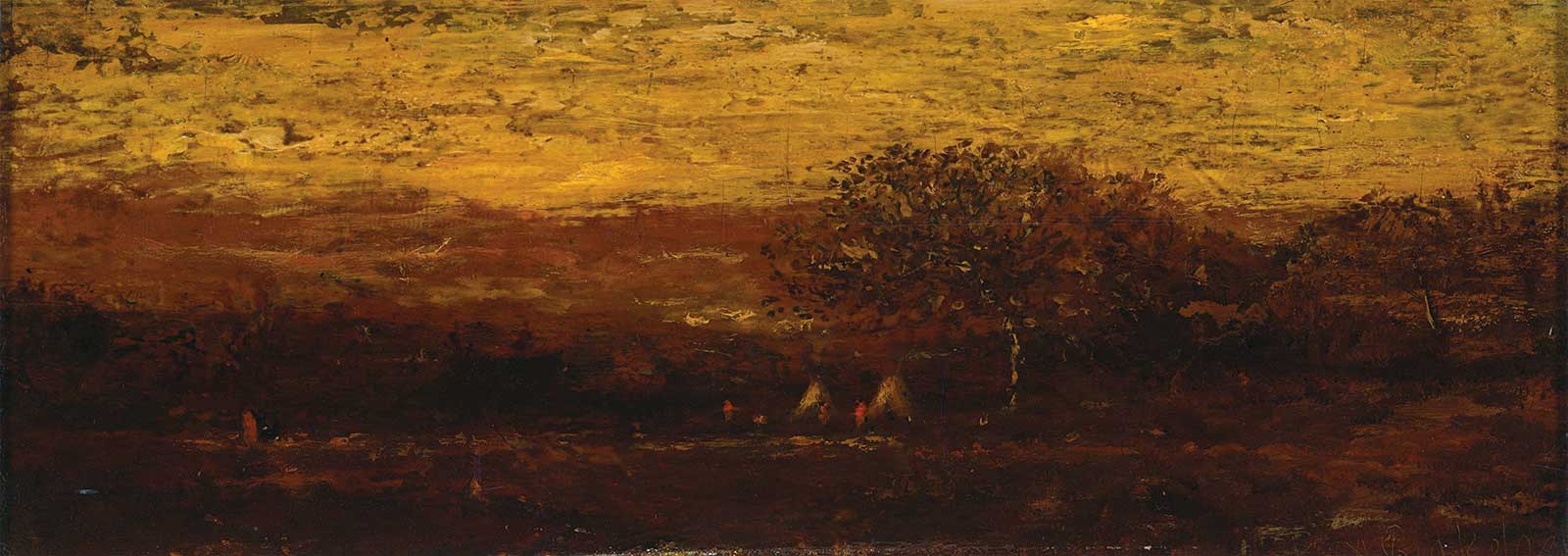 Ralph Albert Blakelock (1847-1919), Encampment, late 19th century. Oil on wood panel. Figge Art Museum, City of Davenport Art Collection, gift of Maurice Hemsing, 1945.834.
Blakelock, at the time, was confined to a hospital with paranoid schizophrenia. He had sold the painting to a collector 15 years earlier for half his original asking price—yet another incident in his lifelong battle with financial insecurity. Not only did he not benefit from the sale, but the market began to be saturated with forgeries of his work.
He was a member of the Swedenborgian church in East Orange, New Jersey, a Christian church founded on the teachings of the Swedish scientist, theologian and mystic, Emanuel Swedenborg (1688-1772). The New England transcendentalists and people from John Chapman (“Johnny Appleseed”) to Helen Keller were influenced by his thought. He, like his compatriot, George Inness, believed in the spiritual nature beneath and animating physical reality. —
Powered by Froala Editor